
“The world has been fed many lies about me..”
Richard Ramírez
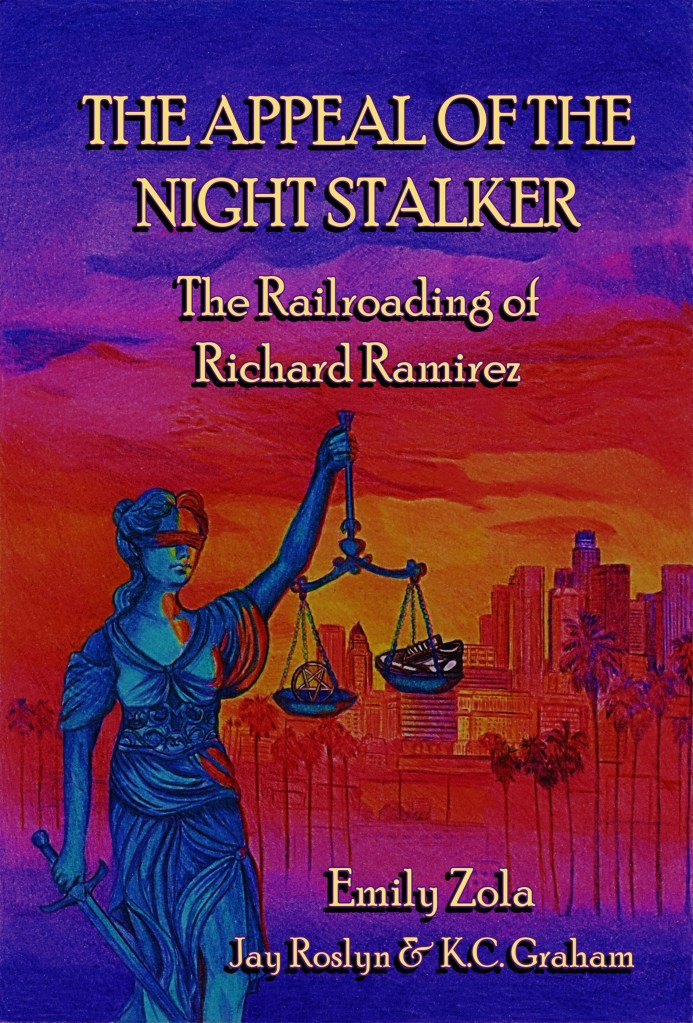
Now available, the book: The Appeal of the Night Stalker: The Railroading of Richard Ramirez.
Welcome to our blog.
This analysis examines the life and trial of Richard Ramirez, also known as The Night Stalker. Our research draws upon a wide range of materials, including evidentiary documentation, eyewitness accounts, crime reports, federal court petitions, expert testimony, medical records, psychiatric evaluations, and other relevant sources as deemed appropriate.
For the first time, this case has been thoroughly deconstructed and re-examined. With authorised access to the Los Angeles case files, our team incorporated these findings to present a comprehensive overview of the case.
The Writ of Habeas Corpus
The literal meaning of habeas corpus is “you should have the body”—that is, the judge or court should (and must) have any person who is being detained brought forward so that the legality of that person’s detention can be assessed. In United States law, habeas corpus ad subjiciendum (the full name of what habeas corpus typically refers to) is also called “the Great Writ,” and it is not about a person’s guilt or innocence, but about whether custody of that person is lawful under the U.S. Constitution. Common grounds for relief under habeas corpus—”relief” in this case being a release from custody—include a conviction based on illegally obtained or falsified evidence; a denial of effective assistance of counsel; or a conviction by a jury that was improperly selected and impanelled.
All of those things can be seen within this writ.
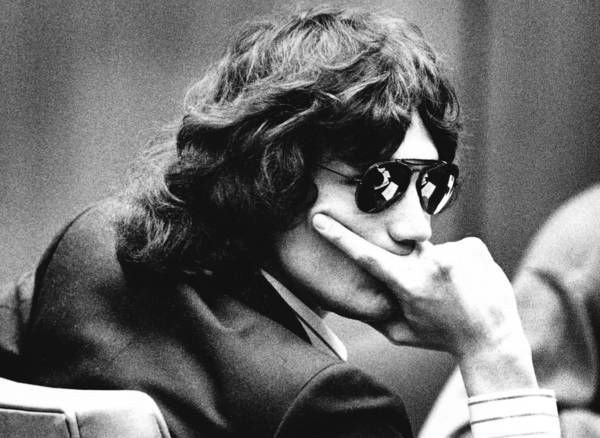
The Writ of Habeas Corpus is not a given right, unlike review on direct appeal, it is not automatic.
What happened was a violation of constitutional rights, under the 5th, 6th, 8th and 14th Amendments.
Demonised, sexualised and monetised.
After all, we are all expendable for a cause.
- ATROCIOUS ATTORNEYS (4)
- “THIS TRIAL IS A JOKE!” (8)
- CONSTITUTIONAL VIOLATIONS (9)
- DEATH ROW (3)
- DEFENCE DISASTER (7)
- INFORMANTS (6)
- IT'S RELEVANT (17)
- LOOSE ENDS (15)
- ORANGE COUNTY (3)
- POOR EVIDENCE (16)
- RICHARD'S BACKGROUND (7)
- SNARK (12)
- THE BOOK (4)
- THE LOS ANGELES CRIMES (22)
- THE PSYCH REPORTS (14)
- THE SAN FRANCISCO CRIMES (5)
- Uncategorized (5)
-
You, the Jury
Questioning
The word “occult” comes from the Latin “occultus”. Ironically, the trial of an infamous occultist and Satanist is the epitome of the meaning of the word itself: clandestine, secret; hidden.
We’ve written many words; a story needed to be told, and we created this place to enable us to do just that.
Here, in this space, we intended to present the defence omitted at Richard Ramirez’s trial in violation of his constitutional rights. Our investigations have taken us down roads we’d rather not travel along, but as we did so, we realised that there was so much hidden we could search for a lifetime and still not see the end of it. Once we’d started, there was no turning back; we followed wherever it led.This was never about proving innocence; that was never the intent or purpose. We wanted to begin a dialogue, allowing this information to be freely discussed and for us to verbalise the rarely asked questions. We asked, and we’re still asking.
We can’t tell you, the reader, what to think; you must come to your own conclusions, as we did.
And so
We’ve said what we came here to say; with 114 articles and supporting documents, we’ve said as much as we can at this point.
This blog will stand as a record of that, and although we will still be here, we intend to only update if we find new information, if we suddenly remember something we haven’t previously covered, or to “tidy up” existing articles and examine any new claims (or expose outrageous lies) that come to light. The site will be maintained, and we’ll be around to answer any comments or questions.
What Next?
We will focus on the book being worked on; we’ve also been invited to participate in a podcast. When we have dates for those, we’ll update you.
The defence rests? Somehow, I sincerely doubt that; ultimately, we’re all “expendable for a cause”.
~ J, V and K ~
-
Justice, Steve De Prima Style
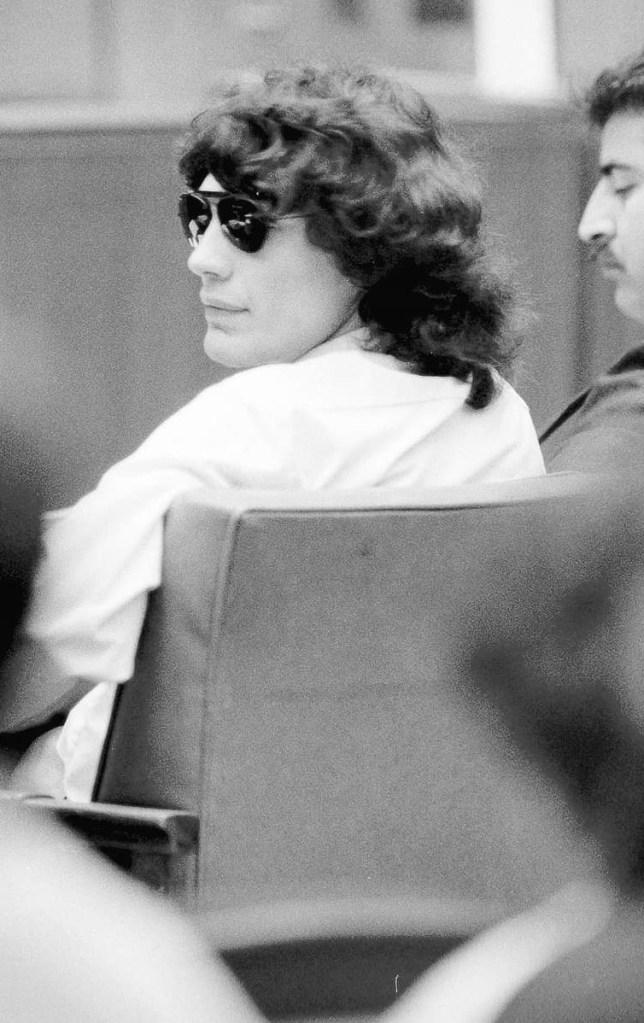
At the preliminary hearing, Richard was beaten up by court bailiffs. It is unclear what happened, but as an elderly female witness was brought into the courtroom behind him, three bailiffs jumped on Richard and dragged him, still in his chair into the holding cell.
Richard was completely defenceless, as he was forced (unconstitutionally) to wear ankle shackles and as such, not a threat to anyone. He had no history of violence towards any court staff or prison guards. Nonetheless, one bailiff had him in a chokehold, while another – let’s name and shame him – Steve De Prima, evidently a violent thug, punched Richard several times in the face. Clearly enjoying beating up a defenceless man, they refused to allow Richard’s defence team into the holding cell. Eventually, Arturo Hernandez was permitted to peer in through a peephole and cried out, “You don’t have to hit him anymore. He’s not moving anymore.” He then turned to the courtroom and said “There’s four guys on top of him.”
“Three bailiffs repeatendly struck the lanky defendant with their fists as they jumped on him and quickly pulled him out a doorway and back to his holding cell. Ramirez, who as usual was manacled in leg chains, did not cry out during the brief struggle. After a half-hour recess, Ramirez’s preliminary hearing continued with the defendant grinning broadly as he was led back into the courtroom. A red scratch mark was evident on his neck where one of the bailiffs had applied a chokehold.”
Who is the criminal here? People clearly are not safe around Steve De Prima and company. One of the useless Hernandez defence attorneys asserted that De Prima had been “antagonistic and hostile” towards the defendant for the previous 8 weeks of the hearing. De Prima’s excuse was that the defendant had turned around as the witness (Esperanza Contreras Gonzales) entered, so he took it upon himself to assault Richard, grabbing him by the hair, and forcing him to face the front of the courtroom. The defence stated that Richard had only turned to confer with his lawyers.
Steve De Prima and his uncontrolled anger issues were removed for the duration of the case, but he was not punished. It is unknown whether the other aggressive bailiffs were allowed to remain.
Richard’s history of multiple serious head injuries and epilepsy was covered up and would not have been known to bailiffs, but he was the last person anybody should have been punching in the head – not that any defendant should be punched, whatever they are accused of. What kind of clown court was this, where three men (and apparently a fourth) were allowed to attack a defenceless and chained man before he was even on proper trial, let alone convicted? They had no right to mete out their own personal ‘justice’ in such a way. There was also some strange, unprofessional goings-on between both the defence and the prosecution here.
After the day’s session, Hernandez said that Ramirez had suffered scratches, but no extensive injuries. Ramirez laughed when he came back in the courtroom, Hernandez said, because he was embarrased. Hernandez accused Halpin of trying to provoke him into fighting. As Hernandez shouted at the bailiffs to stop hitting his client, the defense lawyer said, “Halpin was saying, ‘why don’t you wait until they come out and beat them up?”
It is important to note that this was also during the discussion regarding Jesse Perez and the false murder weapon. What a convenient distraction from the fact that Perez admitted he received the Jennings pistol before the Dois were supposedly murdered with it. The entire Ramirez case never fails to disgust.
-VenningB-
4th November 2022
-
Richard Ramirez: The Dentist Conundrum and the Failed Alibi
This post was originally going to be called ‘the tooth, the whole tooth and nothing but the tooth’, but tooth is in place of truth and what is the truth? The Ramirez case is complicated and convuluted; all we can do is dismantle it and try to rebuild it in a way that makes sense.
Richard Ramirez was found to have attended the dentist at least five times in 1985. These visits were proven with comparisons to post-arrest dental x-rays. This meant that an alibi given by his father – that Richard had been in El Paso at the time of the crimes – was ‘false’ and it was dismissed in court. Julián Ramirez Sr was impeached. The alibi was intended to clear him of both the Bell and Lang incident and the Kyle attack. Bell and Lang were bludgeoned and left for dead between 29th May – 1st June and Kyle was raped and burgled on 30th May.
Julián Ramirez Sr said his son arrived between 22nd – 24th May (dates vary) and departed by bus on 31st. The dental records showed that Richard had received treatment on 23rd and 30th May, directly either side of his time in El Paso.
Here’s a table; they always make things easier…
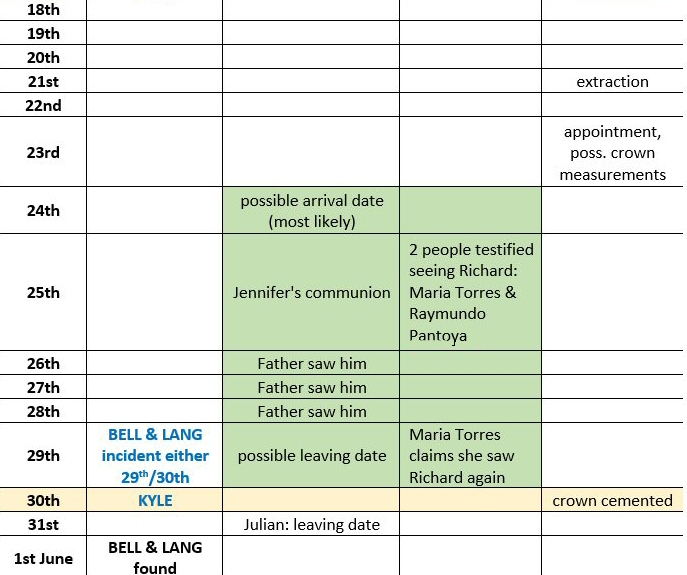
It is likely Richard was in El Paso for his niece Jennifer’s First Communion on 25th May 1985 and photographic evidence was provided.
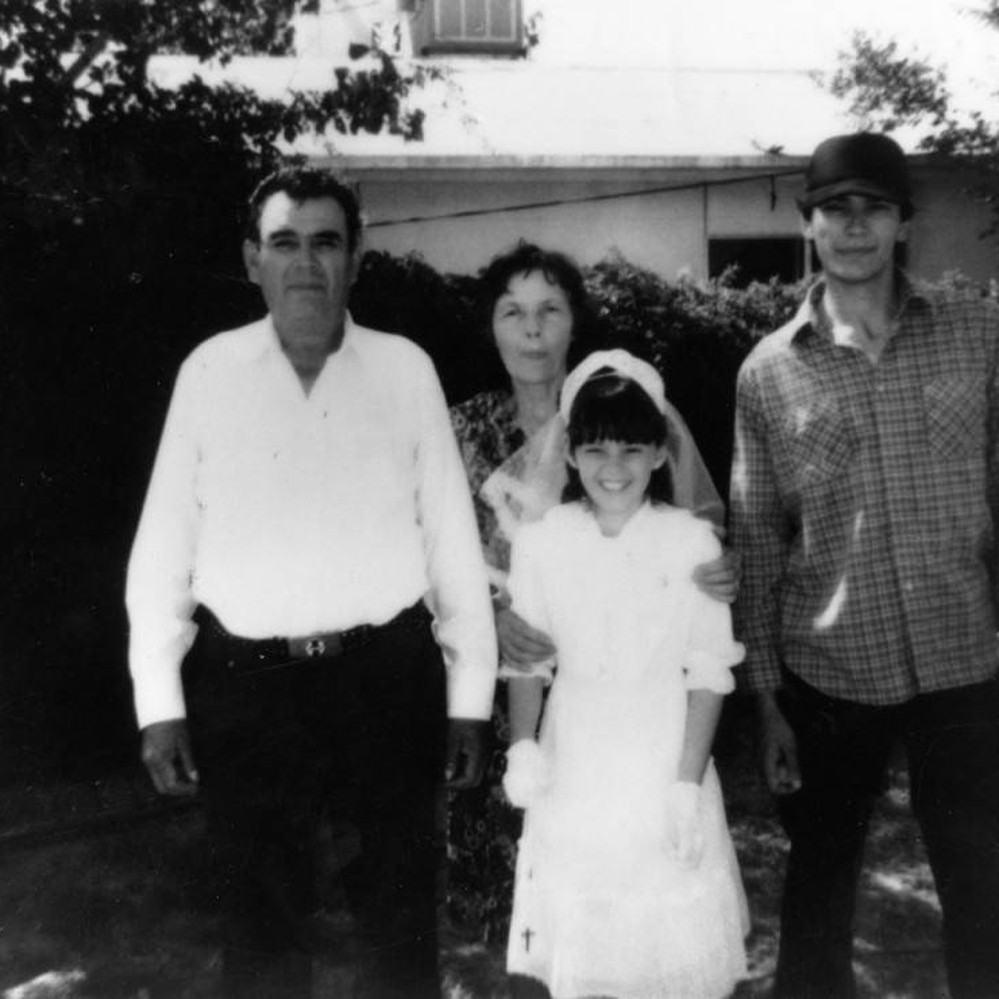
Other witnesses:
A friend of Richard’s father, Raymundo Pantoya, brought a tool round to fix the sink and saw Richard at the house on the day of the Communion – Saturday 25th May. Maria Torres, a sister-in-law of Ignacio Ramirez (Richard’s brother), saw this photo being taken on Saturday 25th May and testified that she had seen Richard again, at Ignacio’s house on Wednesday 29th May.
As far as these dates are concerned, they allow for Richard to return to Los Angeles in time for his crown on 30th, and – if you believe it – the attacks on Bell and Lang and then Kyle. We don’t know exactly when Bell and Lang were attacked, because they were not discovered for days. The date is generally thought to be the night of 29th May/early hours of 30th, because of dated evidence at the scene.
However, the picture became murkier when Richard’s father testified. Julián Ramirez Sr said Richard left on Friday, by bus, making this 31st of May. It is possible Julián was lying to save his son, but it is equally possible he mixed the dates up because four years had elapsed. In general, he seems confused about dates and reasons for visits and even dates police visited – it must be emphasised here that Julián also suffered from mental health problems and was under immense pressure in this situation.
Julián Sr had also not helped the situation when he had spoken to a local newspaper, lying that he had not seen his son for two or three years, possibly to wash his hands of responsibility for what his son had supposedly done. It is unhelpful but understandable; he must have been in a distressed state, hearing that his son was a serial killer. Naturally, the prosecution brought this evidence forward and the defence made no effort to extract Richard’s father out of the hole he had dug himself into.
This was the point where the defence should have said, ‘Yes, Richard was in El Paso, but he left two days earlier than his father claims and arrived a day later than his father claims. Julián Ramirez made a simple mistake, because too much time has passed for him to accurately remember and he was in a state of distress.’ Instead, they tried to simultaneously argue for both the alibi and dental x-rays, which damaged the credibility of their argument and showed them up to be the bumbling incompetents they were. If the defendant’s alibi has fallen to pieces, you don’t try glue it together with pieces of the prosecution’s argument, especially when it is incontrovertible and you’ve acknowledged that! You should explain how an innocent mistake was made, then move swiftly onto other important evidence, otherwise the jury will wonder what else you’ve got wrong. Do you think they moved on to more important evidence? No, of course they didn’t.
They should have still argued that Richard was seen in El Paso on 29th May; because that would still realistically allow him to be able to attend the dentist’s the next day, but not the murders that took place during the early hours of 30th. They should have argued that the timing of the murders was implausible given that Richard had travelled approximately 800 miles between El Paso and LA taking between 12-17 hours making it unlikely that the first thing he would do upon returning is commit two very different crimes. Not only that, but the crime locations themselves were 20 miles apart, with Kyle in Burbank, and Bell and Lang in Monrovia. Bear in mind that the suspect stayed at both crime scenes for a long time. If that was Ramirez, it was remarkable that he managed to also wake up and attend his dental appointment in downtown L.A.
Is it plausible that he had the energy? People will no doubt argue “Of course! He injected cocaine.” If I was on the jury, this wouldn’t be good enough. The prosecutor argued that Ramirez must have travelled by plane, but nobody was asked. Maria Torres said Richard was picked up by his sister, but his sister was never asked to testify whether he was taken to the bus station or the airport. There was no effort to check whether he had purchased a plane ticket either as himself or under an alias. So again, Philip Halpin was able to make claims without the worry of the defence ever challenging them.
The distance between the dentist’s surgery and the crime scenes should have been pointed out too, because every angle must be argued. We don’t know the time of Richard’s dental appointment, but if he was the perpetrator, he was travelling across a wide geographical area. It is almost 12 miles between Kyle’s house on North Avon Street, Burbank to the dentist at 732 North Broadway in Chinatown. Then, it is 21 miles between Bell/Lang in the hills above North Alta Vista Avenue and Chinatown. While the journeys themselves don’t take long, it is very random and it is all too easy to say “His MO was having no MO” – Gil Carrillo’s oft repeated line. Somebody should make a Carrillo bingo card.
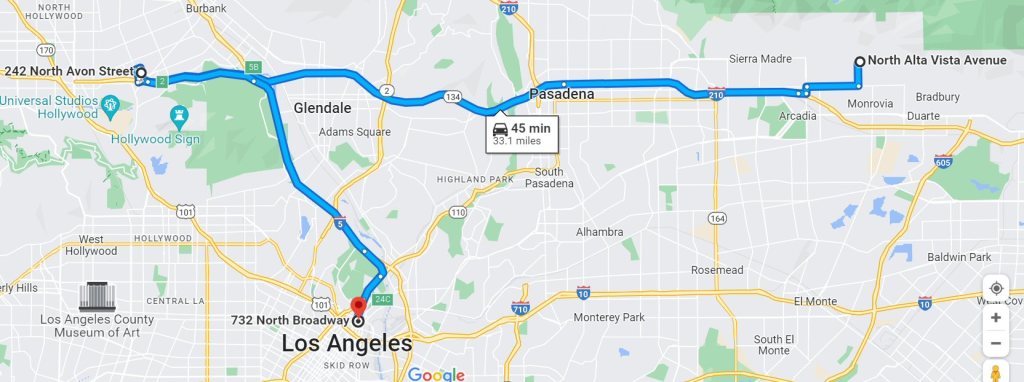
Picture him: ‘Richard’ was driving all over the place – he probably needed to steal a car first. Then he was brutally attacking old ladies up quiet winding lanes in the foothills of the mountains, then driving through residential areas to get to the freeway, past Griffith Park and the Hollywood Sign, then through the canyons to rape and burgle another, arriving with nothing but a stain on his shoulder (as per Kyle’s composite sketch) with not a speck of blood on him, before returning 12 miles downtown for his dental crown; if this was him, he never stopped to rest. Amazingly, as mentioned in our posts on Kyle and Bell and Lang, both crimes seem to have occurred simultaneously. The clock at Bell and Lang’s stopped at 5:29am when the cable was severed – during the Kyle attack.
Oh no, they didn’t, did they?
The alibi had failed for the Bell and Lang incident, so embarrassingly, the defence attempted to reintroduce it for the Kyle case, and horrifyingly, it was the only evidence they brought forward; the rest was left with only the most basic refuting arguments. The full defence failures of the Carol Kyle case are covered here.
So, how did the dentist enter the picture?
Evidence points to Richard having been stopped by police for a traffic violation sometime in June 1985. He was pulled over and when the officer went to retrieve his notebook, he drew a pentagram on the car(!) and legged it.
The Netflix documentary will tell you that he was on the run from a child molestation incident that had just come over the officer’s radio, but it is a bit of a reach to assume a man jumping a red light is a nonce and he was never charged with those crimes anyway. He most likely ran away because the car was stolen; that Richard Ramirez was a thief is unquestionable. Not only that, he had been briefly imprisoned for car theft in late 1984 so a second arrest didn’t really appeal to him. The spurious link between the murders and the child molestations is covered in this mega post.
Anyway, weeks later, police incompetence led to them leaving said vehicle out in a sunny impound lot, which melted away any fingerprint evidence. However, there was a dental appointment card inside, written out for Richard Mena, whose date of birth was close to Richard’s and whose address was a fake residence near Richard’s brother’s real one (1259 South Brannick Avenue). Associates of Richard would later testify that Mena was one of Richard’s criminal aliases.

The next appointment was for 3rd July… the dentist told the police Ramirez would be back soon because he needed further urgent treatment. They still didn’t catch him. This particular aspect of the case will be dealt with in detail in our book.
-VenningB-
26/10/2022
-
“Disrespecting the Victims”
“This blog is so disrespectful to the victims and their families” is a common and intellectually deficient ‘rebuttal’ to any claims that Ramirez might not have been responsible for the Night Stalker crimes.
Tell us how saying, “You might have got the wrong guy here” is disrespectful to victims? We base our work off the appeals written by Ramirez’s lawyers as well as media reports and our own theories. Is having a defence team disrespectful to victims? If your answer is yes, you do not believe in justice. You ought to live in a dictatorship.
Do you know what is disrespectful? Detectives lazily pinning unrelated rapes and murders on one mentally impaired, poor, Mexican petty criminal, who was utterly unable to participate in his own defence just to ‘clear the books’.
It is disrespectful for police to tell the public (via a complicit media) that every victim saw the same assailant when it was untrue. It misled innocent people and caused unnecessary hysteria. It undermined what victims had said in police reports (and somehow, the victims went along with it, as vulnerable people are easier to manipulate and confuse).
The real murderers might still be out there. The families and survivors might not have received justice, robbing them of closure.
We are sometimes asked, “Well, if Richard didn’t do it, who did?!” We wish we knew. You should ask the Los Angeles and San Francisco police and District Attorneys who utterly failed to prosecute or pursue other potential suspects. The legal petitions do however name some people who should have been investigated. All we can present are the reasons he probably had nothing to do with the crimes. Criminal investigations are not our job.
Another bad argument aimed at us is the accusation we treat the habeas corpus as gospel. Well, it is just as easy for us to accuse them of worshipping the prosecution and the flawed official narrative. “Authority can do no wrong.” The writ is simply the defence Richard Ramirez should have had all those years ago and was not given. Both sides should be heard because that is how trials work. Again, if you disagree with the need for criminal defence, just hope you aren’t wrongly accused of a crime and too poor for a fancy lawyer.
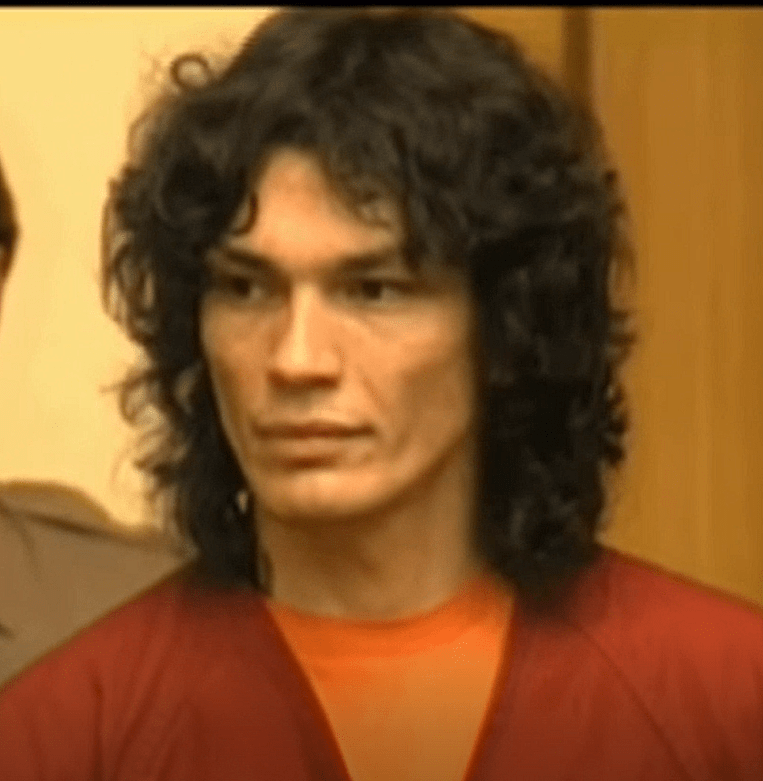
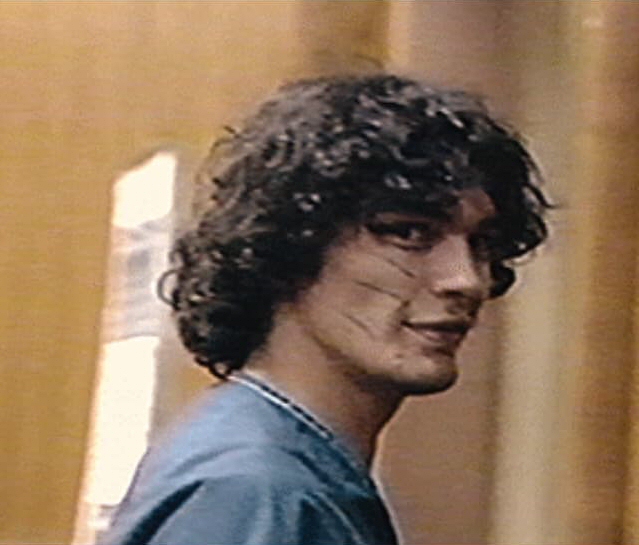
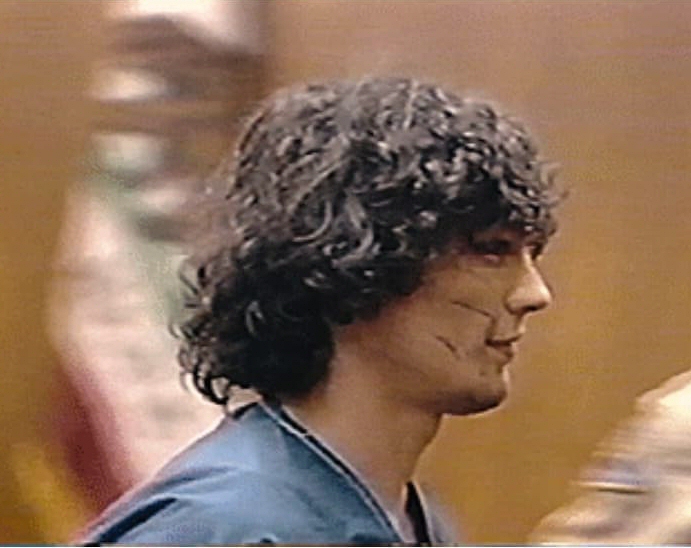
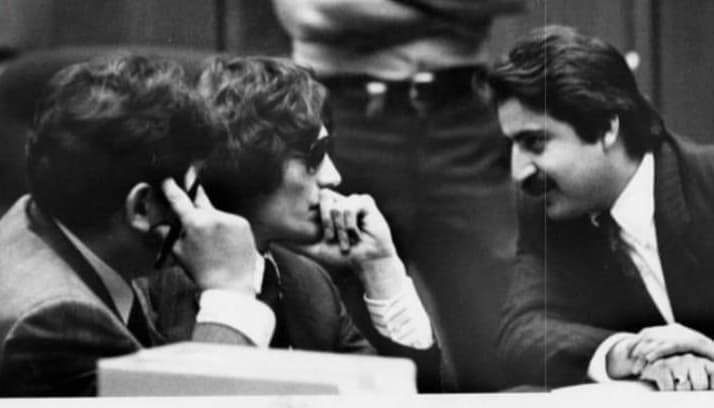
Ramirez at a 1991 hearing -VenningB-
-
There’s a Guy Works Down the Chip Shop Swears He’s Elvis..
” I think it’s bothersome when public officials make statements that appear to presume the guilt of a person who has only been arrested and charged with a crime and hasn’t even entered a plea yet.”
Alan Adashek, public defender.
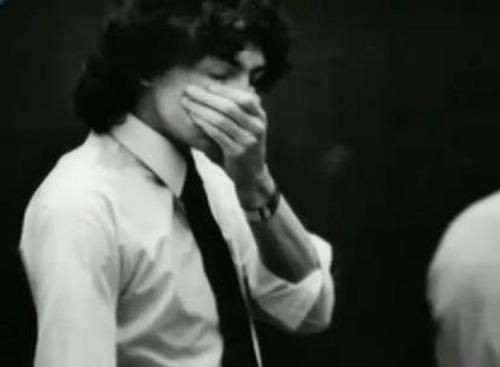
Sometimes, when I am researching for another article, I come across items which leave me open-mouthed. This is one of those times. Here we go with another instalment from the circus surrounding the arrest, trial and conviction of Richard Ramirez.
.
We don’t need a trial..
Umm, yes, yes you do, that is the law.
Although, according to Los Angeles Mayor, Tom Bradley, no trial was necessary as he, along with everyone else, had already decided that Richard Ramirez was guilty.
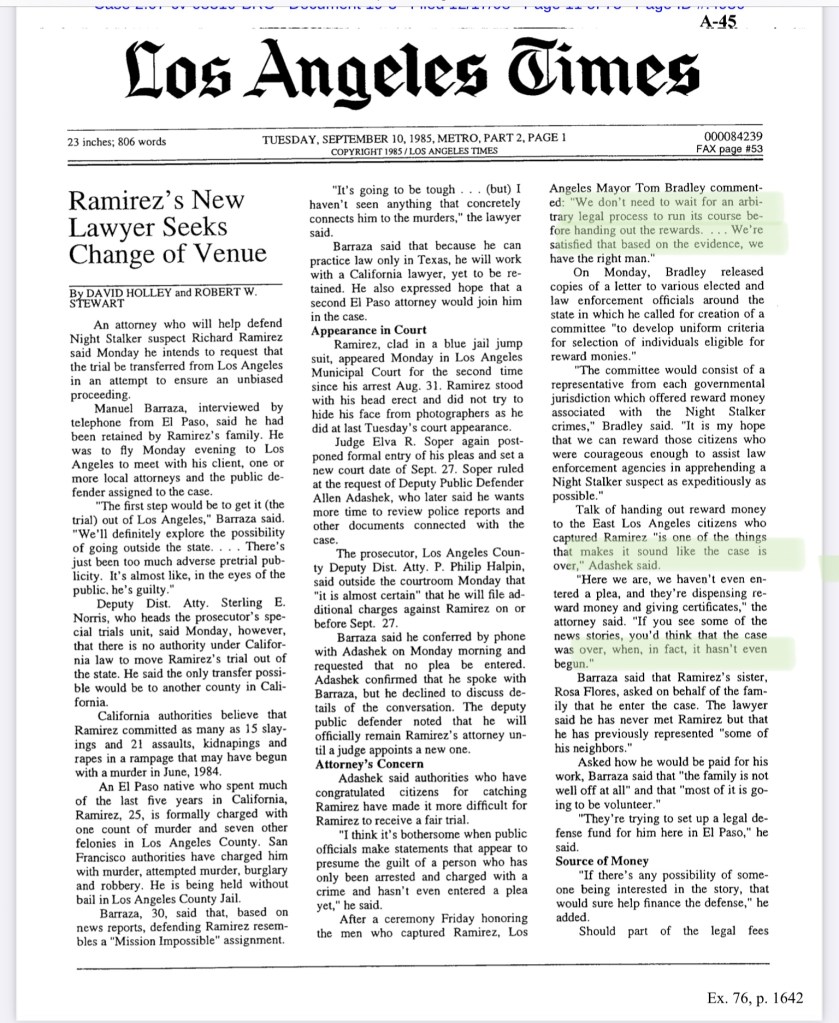
With media coverage such as this, he was never going to get a fair hearing. “We don’t need to wait for an arbitrary legal process to run its course before handing out rewards. We’re satisfied that based on the evidence; we have the right man.”
Mayor Tom BradleyThis article shows that a fair trial in LA was not a possibility, and you can see why. “Good” public servant, Mayor Bradley, holding ceremonies, giving out awards, certificates and promising lots of lovely cash to those who were involved in the famous apprehension of the Night Stalker. There was even an off-road motorcycle given out, like sweets, with the promise that it wouldn’t have to be returned in the unlikely case that they didn’t get a conviction.
Who cares if he’d entered a plea, or got a trial date?
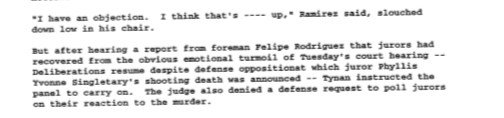
“I have an objection. I think that’s f*cked up!”
So do we, Richard, so do we..
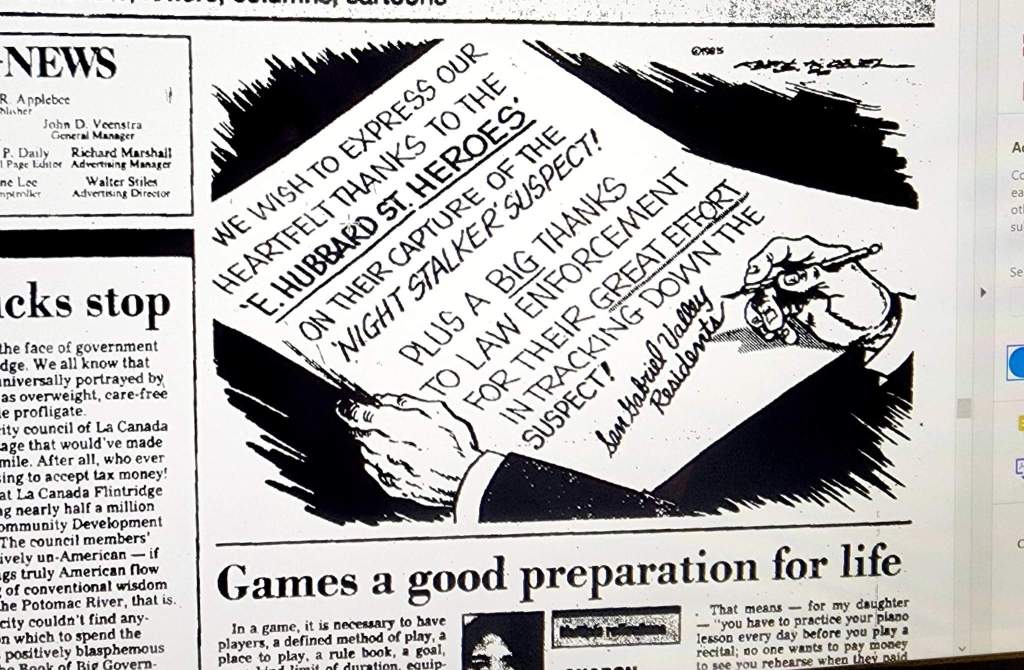
Well, we wish to express how ridiculous this is. We’re in the Money!
And out of the woodwork they came, hoping to cash in on the situation, as the media caravan trundled on.
And who got the biggest slice of that particular cake? Jesse Perez, a criminal, and associate of Felipe Solano and Ramirez, granted immunity by law enforcement, for leading them to the Jennings semi-automatic. And there hangs a tale worth telling! I would urge you to read THIS POST for detailed information about the chain of custody of the weapon in question. All roads do not lead to Rome, or Richard Ramirez!
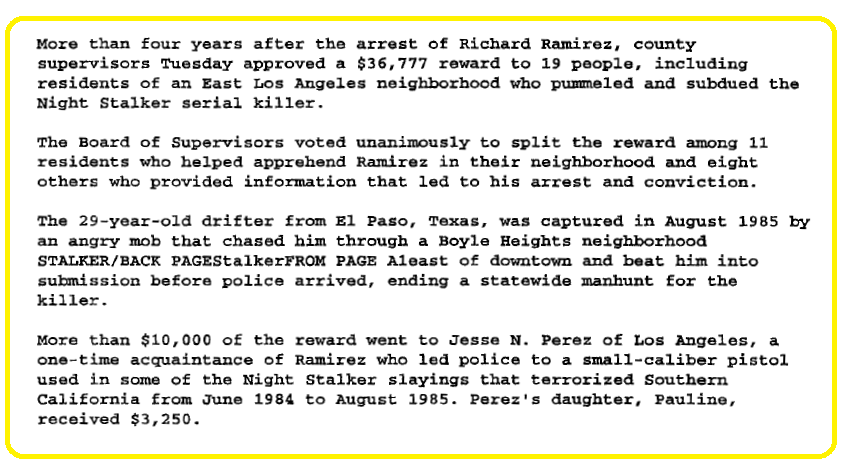
Document 19-10, from the Writ of Habeas Corpus “One guy called in and said, ‘I saw the Night Stalker on the freeway. Where do I get my money?’”

Saturation
Examining the nature of the publicity is perhaps the trial court’s
most important duty in assessing the prejudice of pretrial publicity. It is during this analysis that a trial court can assess to what degree the media was inflammatory or whether there has been prejudicial material publicised in the media that was not admissible at trial.Indeed, counsel were able to collect 903 articles written about the case from the beginning of the Night Stalker murders through September 1st, 1989. This included 211 articles from the L.A. Times, 197 articles from the Los Angeles Herald Examiner, 120 articles from the Los Angeles Daily News, 113 articles from the La Opinion, 108 articles from the Los Angeles Daily Breeze, and 154 articles from other smaller local newspapers. This number does not include additional articles submitted to the trial court from newspapers with less circulation.
Further, among just three major Los Angeles newspapers, 167 articles were written about Richard during his trial. A total of 97 photos of him also accompanied these prejudicial articles.
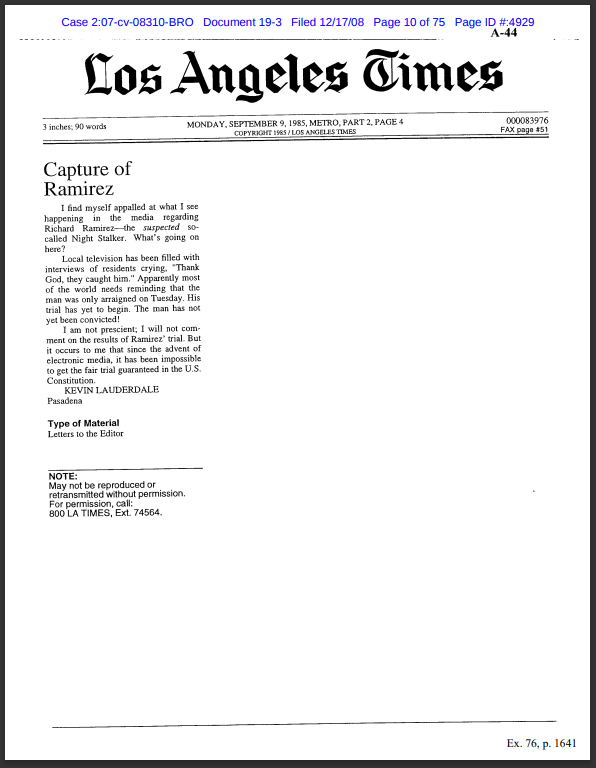
Someone saw what was going on…a fair trial was not going to happen. The Voice of Reason
Not That We’re Making a Big Thing About This, But News Is News…
- (1) “A trail of death and destruction”
- (2) “atrocities”
- (3) “terrible trauma”
- (4) “Spread terror,” “terrorized,” “terrified California
- residents,” “night of terror,” “really terrible.”
- (5) “Bloody rampage” and “savage assault.”
- (6) “seven-month crime spree.”
- (7) “string of slayings, rapes and attacks”
- (8) “string of sadistic nighttime murders”
- (9) “More horrendous than (the Hillside Strangler)”
- (10) “gruesome”
- (11) “grisly details,” “grisly attacks, “grisly series of attacks”
“The entire tenor of the coverage reflects the view that Mr. Ramirez
Dr Edward Bronson, social scientist. From the Federal Writ of Habeas Corpus
was guilty and deserving of death, even if the stories often included
de regueur terms such as ‘alleged’ or ‘charged.’ One reading
through these articles is left with an abiding belief that the writers
are convinced of Ramirez’s guilt.”All this, and this is even without mentioning or reproducing the hundreds of times “Satan”, “Satanic”, “Devil-worshipping AC/DC fan”, “Rituals” and a myriad of similar terms were printed, talked about on TV, and circulated to the horrified, enthralled and equally fascinated population. From THIS population, the jury would be chosen. From THIS, credible eyewitness testimonies were expected to be untainted. (More on media influence can be found HERE.)
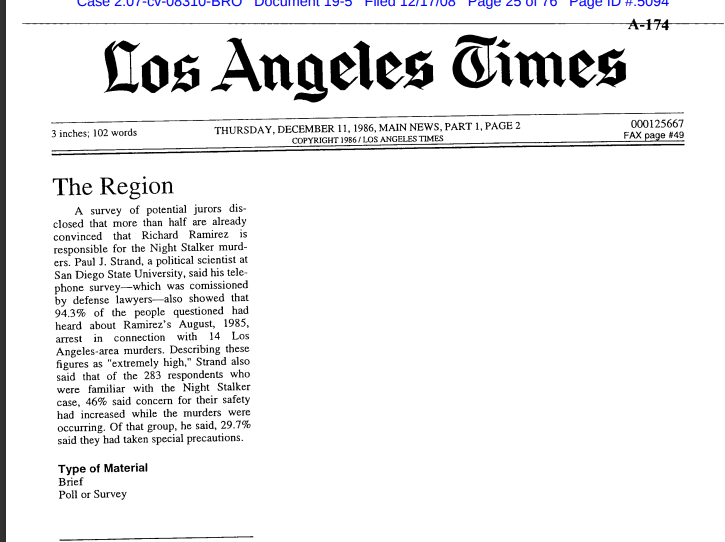
The date of this publication is 11th December 1986, and yet they already think he’s guilty. A defendant is innocent until proven guilty, at least, that’s how it should be, however in Richard’s case, it was flipped. The onus was on the defence counsel to prove he was innocent, the world already having judged him guilty, even before he set foot inside the courtroom.

For despite all of this media frenzy, public ceremonies and offers of cash for information, the motion to move venues, from Los Angeles to a less polluted location, was denied. Denied; and the jury, which was not sequestered, was exposed to it all.
How can this help an inflamed jury consider the evidence (or lack thereof) put before them and rationally weigh it up? The seriousness of this can not be stressed enough. However impartial they may consider themselves to be, the truth is, they were not. They were allowed to take all of these sensationalised news articles in on a daily basis. It was allowed to seep in, day by day, hour by hour.

I would say nearer a three-and-a-half to four-year delay, his capture being August 1985 and the trial beginning in January 1989.
Jury Sequestration
The isolation of a jury to avoid accidental or deliberate tainting of a jury by exposing them to outside influence or information that is not admissible in court. They are not allowed to read the newspapers, watch TV, or have internet access, and may have only limited contact with others, and even with each other. Sequestration is most commonly used in high-profile trials, in which media coverage and public conversations, may be so ubiquitous that it is difficult for the jury to avoid. Trials do not come with a higher profile than this one. In comparison, at the trial of OJ Simpson, in 1995, the jury spent 265 days in sequestration.
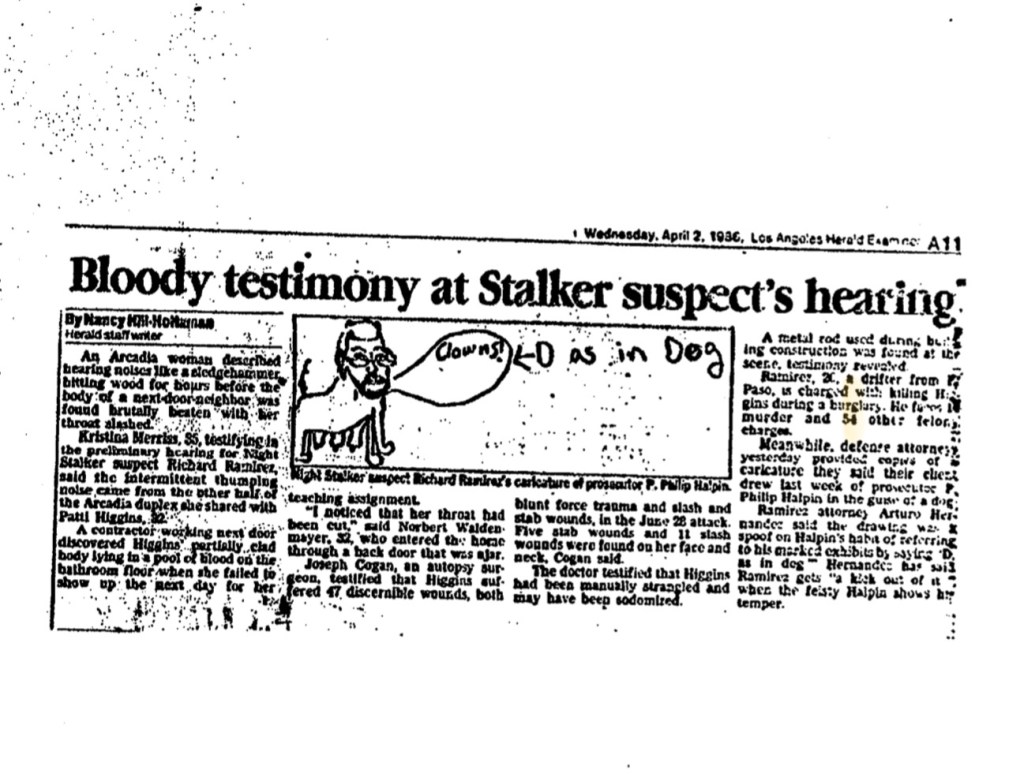
A cartoon of the prosecutor, Phil Halpin, was drawn by Richard during a court session and leaked to the press by his defence lawyers. A female juror said that seeing it made her angry and that she could not remain unbiased. “Media reports of evidence or activities not admissible at trial are especially prejudicial to a prospective jury. Not only will prospective jurors be told that certain acts or facts are linked to a defendant, they will also be inclined to think the defendant is deliberately hiding those facts when they never come out during the trial. A jury may therefore weigh uncharged and even untrue crimes when assessing the guilt
From the Federal Writ of Habeas Corpus
or punishment for a defendant. For these reasons, the federal courts regard publicity of inadmissible material as a factor weighing in favour of presuming prejudice. The publicity in Petitioner’s case contained multiple stories and accounts of facts that Petitioner’s jury was never entitled to hear in the courtroom”
But Who Cares?
I mean as long as the mayor gets to give out awards because he doesn’t think an actual trial is needed, as long as people can call up and claim the money because they may (or may not) have seen Ramirez on the freeway, or outside Bob’s Big Boy restaurant, or indeed, down the chip shop, swearing he’s Elvis. What does it matter? He was already found guilty before he even set foot in any courthouse. He never stood a chance.
And they call it justice.
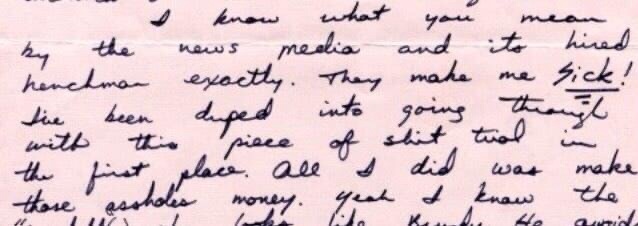
Richard, in a letter to an unknown person. He knew, right from the start, a fair trial was impossible.
“They tragically failed in their most important duty, to report the truth in an unbiased and truthful manner”.
Richard Ramirez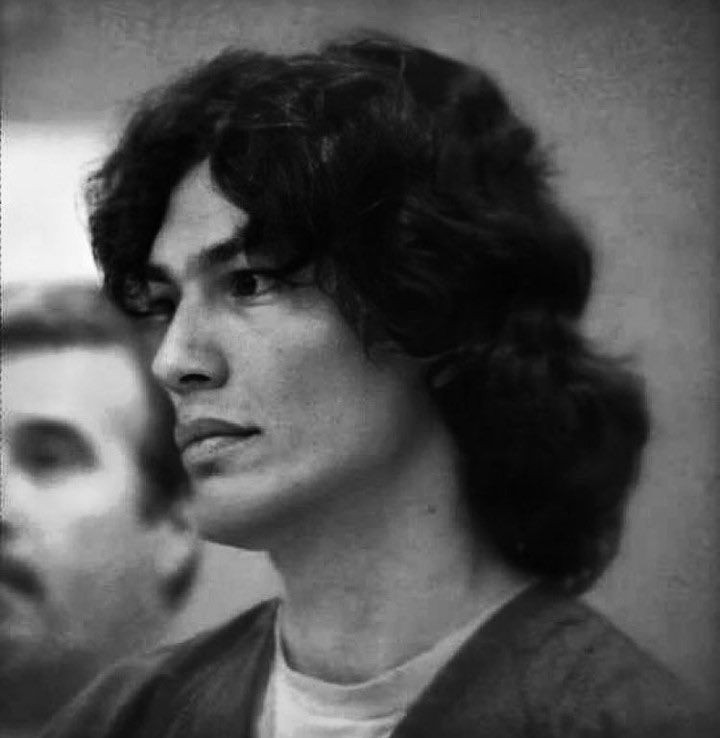
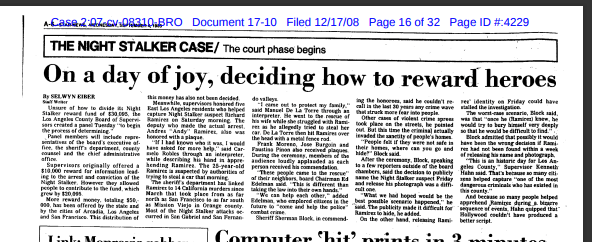
How joyful “If we are to keep our democracy, there must be one commandment: Thou shalt not ration justice“.
SophoclesThe railroading of Richard Ramirez.
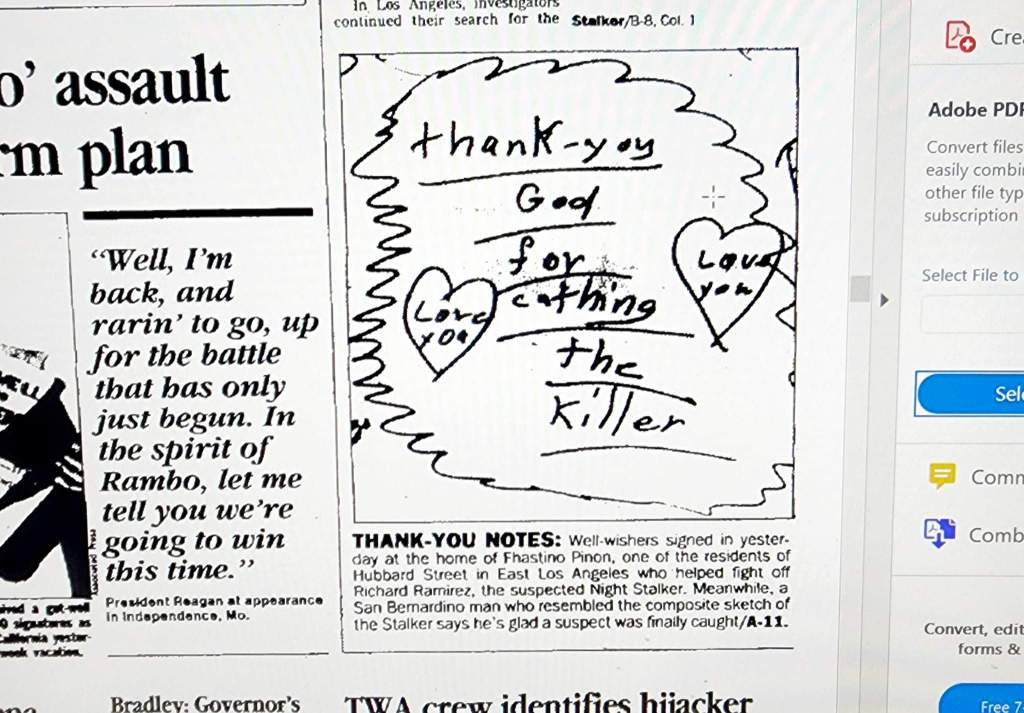
Seriously… ~ Jay ~
-
Night Stalker: The Murder of Mary Louise Cannon
Richard Ramirez, known as the “Night Stalker,” was convicted of multiple murders, including that of Mary Cannon on July 2, 1985, in Arcadia, Los Angeles County. However, key forensic evidence in Cannon’s case was overlooked or misrepresented – issues later raised in Ramirez’s 2008 federal habeas corpus petition. A habeas corpus petition is a legal mechanism that allows a prisoner to challenge the lawfulness of their imprisonment, especially after state appeals have been exhausted.
Mary Cannon was a two-time cancer survivor. She had been in a minor car accident the day before she was murdered. That evening, she had visited her neighbours, who had a spare key to her house. Despite staying up watching TV approximately 35 feet away from Cannon’s house, the neighbour did not hear anything strange. However, at 8:30 the next morning he noticed that the screen from her window was lying on the porch and her newspaper remained on the grass, soggy from her garden sprinkler.
Concerned, the neighbours phoned Cannon, then entered with their spare key. They were alarmed to find the lights on and the hallway in disarray, and they phoned the police. Officer Edward Winter arrived at 9:26am and found Mary Cannon dead on her bed, face down in a pool of blood. Later, Sergeant Frank Salerno of the Los Angeles County Sheriff’s Department arrived.
The autopsy revealed that Mary Cannon was killed by multiple stab wounds to the neck; one was fatal. She had also been strangled by either hands or the crook of an arm. Additionally, she suffered blunt force trauma to the face and head. The murder weapons appeared to be a ten-inch knife, her walking cane, and a glass lamp stand.
Physical Evidence:
- A paper tissue with a bloody shoeprint.
- Three more shoe prints in the carpet.
- Shattered glass from a broken lamp near her shoulder and in her hair.
- A bloody mitten.
- A snapped walking cane on the bed.
- A bloody ten-inch knife on the bed – this had come from her kitchen.
- Ransacked room, including a filing cabinet and raided jewellery box.
- Bedroom window screen missing from a smashed window.
- Human hairs – blonde/light brown.
- A rape kit was collected.
Irregularities with the Blood Evidence
Giselle LaVigne, a criminalist from the Los Angeles County Sheriff’s Department (LASD) discovered wet blood on some shattered glass in Cannon’s hair. This came from a glass lamp stand that was used as a bludgeoning instrument.
This blood was tested to determine PGM markers. Before DNA testing, forensic scientists used PGM testing to identify people based on enzymes in blood, semen, or saliva. PGM (phosphoglucomutase) subtypes vary slightly from person to person because of genetic differences. They are like unique markers in your DNA, and they can be used to tell people apart.
In a crime investigation, if blood is found at a crime scene, forensic scientists can test it to see which PGM subtypes are present. Here’s how it works:
- Scientists take a sample of the blood (or other fluid, like semen) from the crime scene.
- They use a technique called electrophoresis, where the sample is placed in a gel and an electric current is applied. Different PGM subtypes move at different speeds in the gel, creating distinct patterns (like bands) that can be seen under special conditions.
- The PGM subtype pattern in the crime scene blood is compared to the PGM subtypes in a suspect’s blood. If they match, the suspect could be the source of the blood. If they don’t match, the suspect can be ruled out.
LaVigne’s initial findings were that the blood on the shattered glass did not match Mary Cannon’s PGM subtype. But it also did not match Richard Ramirez’s subtype.
A second blood sample came from a mitten. The blood’s PGM markers were consistent with both Mary Cannon’s blood and Ramirez’s. However, LaVigne subjected it to additional electrophoretic tests which conclusively proved that the mitten blood did not come from Ramirez. It is possible that the differing blood results from the shattered glass and the mitten could mean there were two perpetrators. (Ramirez’s federal habeas corpus, pp. 138-139).
The Problems at Trial
LaVigne’s original analysis strongly suggested a third party at the crime scene. However, on the witness stand, she reversed her findings and doubted her own accuracy, claiming that the blood sample was degraded. She testified that neither Cannon nor Ramirez could be excluded from the blood samples.
But how did the sample become degraded? Was there a flaw in the way it was collected and subsequently stored? Electrophoretic testing can work on both wet and dry blood – indeed 90% of crime scene blood samples received by forensic scientists are dried or old. (Source).
Because LaVigne discredited herself, and Ramirez’s attorneys failed to bring their own forensic scientist to examine the samples, jurors were left confused over the blood samples. One juror, Martha Salcido, wrote a declaration for Ramirez’s appeals:
“I recall some confusion over something like blood stains.”
– Declaration of Martha Salcido, Document 20.8.
Ramirez’s appeal petition also states that some evidence was released to the defence but for some reason, it was not returned to the crime lab. This presumably relates to the blood samples. It is unclear whether this is the fault of the prosecution or the defence team. Ramirez’s attorneys lacked the money required for their own expert witnesses. They were relying on money from book and movie deals that never came. They asked for the court to fund them but the request was denied because they were not sufficiently qualified under California law. They had never defended a capital case and were out of their depth.
Hair Evidence
Los Angeles Sheriff’s Department criminalist, Melvin Kong, found some hairs in Mary Cannon’s home. He determined that they had not come from Ramirez because they were the wrong colour. Hair that did not match Ramirez was also found at the Bell and Lang, Nelson, Kneiding and Abowath crime scenes. In the newspaper cutting below, it is revealed that Melvin Kong testified that the hairs were blonde. Ramirez’s 2008 appeal says some hairs were medium brown. (Habeas Corpus pg. 138).
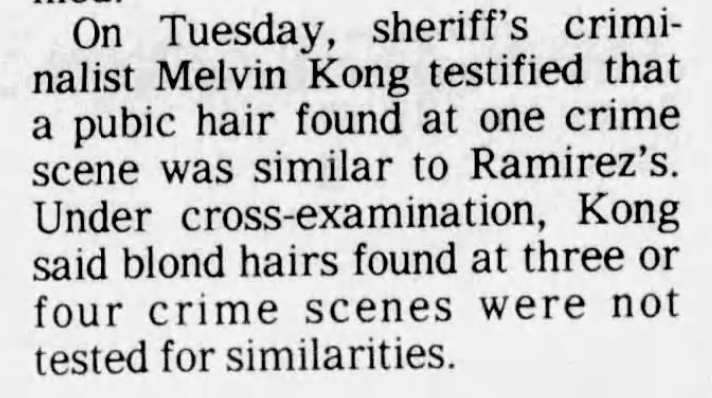
Newspaper cutting covering the preliminary hearing in 1986 Hair testing was primitive in the 1980s and was subjective depending on the serologist’s opinion (it is now tested using mtDNA). Ramirez’s attorneys should have argued that it was not Ramirez hair but they failed to do so.
Shoeprint Evidence & Potential Perjury
One of the most compelling pieces of the prosecution’s evidence in the Night Stalker case was the Avia shoeprints found at multiple crime scenes. These were Zazzara, Doi, Bell and Lang, Cannon, Bennett, Nelson and Khovananth.
Shoe prints were found in several rooms of Mary Cannon’s house. Carpet pieces were extracted and sent to the Sheriff’s Department criminalist, Gerald Burke. Initially, Burke could not tell what type of shoe had left the prints. However, he changed his story on the witness stand.
Below is an image of is Burke’s report from Habeas Corpus supporting document 7.20. It says:
“[Shoeprint 1] was photographed … and enlarged to life scale … there is no definite pattern present to identify … as being made by a specific brand of shoe.
[Shoeprints 2 & 3] were not photographed due to lack of detail on carpet imprints.
[Shoeprint 4] … the pattern of the red stain shows certain characteristics that are present in … Avia Aerobic shoes. There is not, however, enough pattern detail to conclusively state that … was made by this type of shoe.”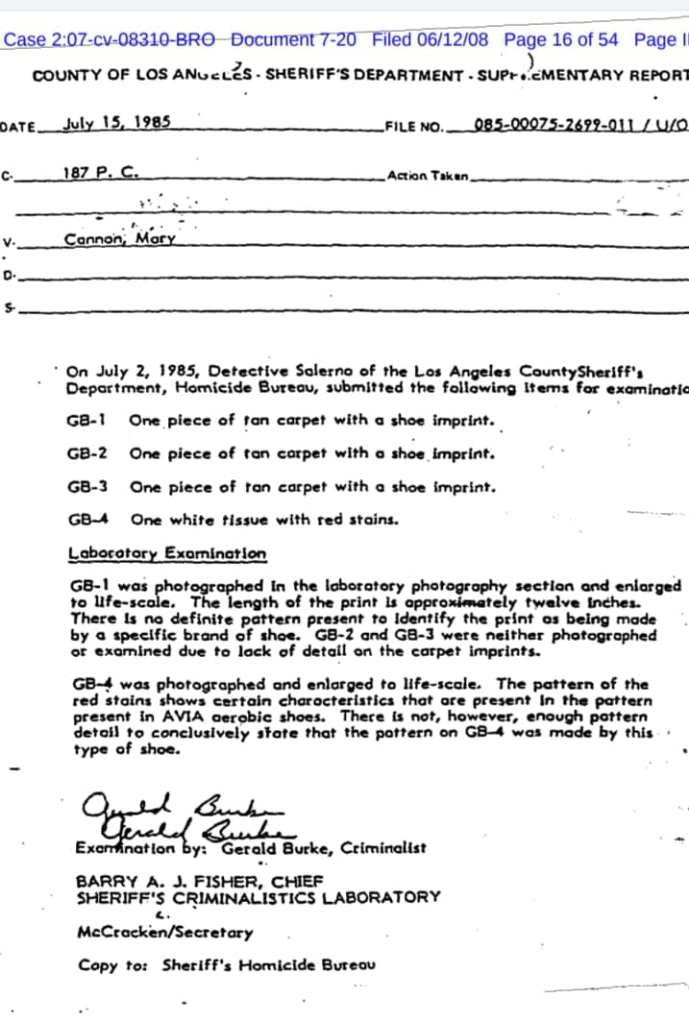
On the witness stand, however, Burke testified that he had found Avia Aerobics model prints on Mary Cannon’s carpet.
Ramirez’s attorneys did not retain a shoe forensics expert, so the prosecution’s shoe evidence – as well as Burke’s changing testimony – were left unchallenged.
In 2004, Ramirez’s appellate lawyers hired forensic expert Lisa DiMeo to reexamine the Avia shoe evidence. The following is from one of her declarations regarding the Cannon case.
“In the Cannon incident, Mr Burke testified that a partial shoe impression in the carpet was made by a right Avia Aerobic shoe. Burke admitted that by the time he got the sample, he was unable to observe any specific pattern. In a written report prepared by Mr Burke dated July 15, 1985 … he stated “There is no definite pattern present to identify the print as being made by a specific brand of shoe.” However, by the time of the trial, he had made an identification of one of the carpet impressions as a right Avia Aerobic.”
– Declaration of Lisa DiMeo, Document 7.20.
Not only did Burke lie about his findings, but DiMeo found his trial exhibit to be falsified with a printed overlay which tricked the jury into believing there was an obvious Avia shoe print.
“I personally examined the Cannon carpet sample and the court display Mr Burke used during his testimony. No impression was observed on the carpet sample; however, due to the length of time that has passed, I would not have expected an impression to remain in the carpet.
The display depicted a photograph of the impression at the scene. A transparent overlay of a right Avia Aerobic model shoe was hinge-taped over the impression. I lifted the transparency to observe the photographic enlargement beneath.
Other than an approximate length and right shoe orientation, no shoe pattern could be identified. It is only by use of the transparency taped over the photograph that there is any association between the scene impression and Avia Aerobic print.
To an untrained eye, there is an assumed correlation due to the design of the display. However, to the trained eye, this is incorrect and misleading.”– Declaration of Lisa DiMeo.

The transparency over the carpet sample, from The New Detectives A partial bloody print of an alleged Avia was made on a small piece of tissue. It was impossible to tell which model it was because the heel is not present – the heel pattern of an Avia determines whether they come from Basketball, Aerobics or Coach/Referee models.
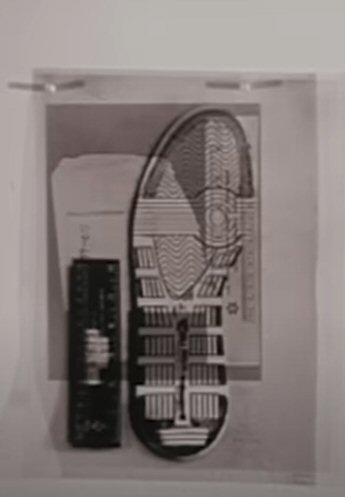
An Avia transparency over the tissue print According to DiMeo, this means at least 13 types of Avia sneaker could be responsible for the partial print. It is a misconception that the Avia sole design was invented in 1985. The design had been in circulation since 1981. The prosecution’s argument that the sole was new and unique at the time of the Night Stalker murders has been conflated with the fact that the Aerobics model – the one thought to be observed at the crime scenes – was released in early 1985.
The shoeprints at the Cannon crime scene remain inconclusive and most importantly, the Avia shoes were never recovered and cannot be scientifically connected to Richard Ramirez.
Circumstantial Evidence: Stolen Property
The prosecution had more cards to play and presented evidence that Richard Ramirez had sold items stolen from Mary Cannon’s house to a fence called Felipe Solano. A friend of Cannon’s identified her jewellery at a property line-up on September 5, 1985.
On the surface, this looks compelling but is more complicated than it seems. In court, Felipe Solano’s testimony unravelled, when it was revealed he was protecting multiple criminals – one of these could have committed some of the Night Stalker crimes. There are so many questions that need answering in regard to Felipe Solano and this network of burglars.
According to Philip Carlo’s biography, a burglar associate of Ramirez, Sandra Hotchkiss, claimed that Solano was beaten up by police before being questioned about his connection to Ramirez. She tried to tell the District Attorney and claimed this beating was recorded on tape but the tape was never presented as evidence and the police denied everything.
Ultimately, the chain of custody of the stolen items was never established, none were recovered from Richard Ramirez and his fingerprints were not found on any of them. At the end of the article, there will be a link to articles explaining the network of burglars in the Night Stalker case.
Halpin Logic – Prosecution Conjecture
The defence attorneys were not the only ones at fault: some of Prosecutor Philip Halpin’s arguments were conjecture, for example urging the jury to find Ramirez guilty of the Cannon murder because the stab wounds matched those on Maxine Zazzara. Stabbings and beatings are the most common methods of murder and unless the weapon was unique, wounds look identical, making comparison meaningless. The Zazzara and Cannon crimes have nothing in common aside from alleged Avia shoeprints. At least the defence made an argument against this.
Halpin also urged conviction based on the Cannon scene’s proximity to the Bennett and Bell/Lang scenes. Was Richard Ramirez innocent of this crime? We can never truly know. However, serological test results suggest the possibility of reasonable doubt.
-VenningB-
11th Oct 2022
Further reading:



 Expendable For A Cause.
You must be logged in to post a comment.