
“The world has been fed many lies about me..”
Richard Ramírez
Now available, the book: The Appeal of the Night Stalker: The Railroading of Richard Ramirez.
Welcome to our blog.
This analysis examines the life and trial of Richard Ramirez, also known as The Night Stalker. Our research draws upon a wide range of materials, including evidentiary documentation, eyewitness accounts, crime reports, federal court petitions, expert testimony, medical records, psychiatric evaluations, and other relevant sources as deemed appropriate.
For the first time, this case has been thoroughly deconstructed and re-examined. With authorised access to the Los Angeles case files, our team incorporated these findings to present a comprehensive overview of the case.
The Writ of Habeas Corpus
The literal meaning of habeas corpus is “you should have the body”—that is, the judge or court should (and must) have any person who is being detained brought forward so that the legality of that person’s detention can be assessed. In United States law, habeas corpus ad subjiciendum (the full name of what habeas corpus typically refers to) is also called “the Great Writ,” and it is not about a person’s guilt or innocence, but about whether custody of that person is lawful under the U.S. Constitution. Common grounds for relief under habeas corpus—”relief” in this case being a release from custody—include a conviction based on illegally obtained or falsified evidence; a denial of effective assistance of counsel; or a conviction by a jury that was improperly selected and impanelled.
All of those things can be seen within this writ.
The Writ of Habeas Corpus is not a given right, unlike review on direct appeal, it is not automatic.
What happened was a violation of constitutional rights, under the 5th, 6th, 8th and 14th Amendments.
Demonised, sexualised and monetised.
After all, we are all expendable for a cause.
- ATROCIOUS ATTORNEYS (4)
- “THIS TRIAL IS A JOKE!” (8)
- CONSTITUTIONAL VIOLATIONS (9)
- DEATH ROW (3)
- DEFENCE DISASTER (7)
- INFORMANTS (6)
- IT'S RELEVANT (17)
- LOOSE ENDS (15)
- ORANGE COUNTY (3)
- POOR EVIDENCE (16)
- RICHARD'S BACKGROUND (7)
- SNARK (12)
- THE BOOK (4)
- THE LOS ANGELES CRIMES (22)
- THE PSYCH REPORTS (14)
- THE SAN FRANCISCO CRIMES (5)
- Uncategorized (5)
-
You, the Jury
Questioning
The word “occult” comes from the Latin “occultus”. Ironically, the trial of an infamous occultist and Satanist is the epitome of the meaning of the word itself: clandestine, secret; hidden.
We’ve written many words; a story needed to be told, and we created this place to enable us to do just that.
Here, in this space, we intended to present the defence omitted at Richard Ramirez’s trial in violation of his constitutional rights. Our investigations have taken us down roads we’d rather not travel along, but as we did so, we realised that there was so much hidden we could search for a lifetime and still not see the end of it. Once we’d started, there was no turning back; we followed wherever it led.This was never about proving innocence; that was never the intent or purpose. We wanted to begin a dialogue, allowing this information to be freely discussed and for us to verbalise the rarely asked questions. We asked, and we’re still asking.
We can’t tell you, the reader, what to think; you must come to your own conclusions, as we did.
And so
We’ve said what we came here to say; with 114 articles and supporting documents, we’ve said as much as we can at this point.
This blog will stand as a record of that, and although we will still be here, we intend to only update if we find new information, if we suddenly remember something we haven’t previously covered, or to “tidy up” existing articles and examine any new claims (or expose outrageous lies) that come to light. The site will be maintained, and we’ll be around to answer any comments or questions.
What Next?
We will focus on the book being worked on; we’ve also been invited to participate in a podcast. When we have dates for those, we’ll update you.
The defence rests? Somehow, I sincerely doubt that; ultimately, we’re all “expendable for a cause”.
~ J, V and K ~
-
The Crimes Didn’t Stop
(Updated 14/05/2024 with new information.)
People often ask why the murders ceased after Richard Ramirez was imprisoned. The truth is, they didn’t. Statistics show there were many murders across the valley regions and throughout the rest of L.A. County. In some cases, the killers were apprehended so there isn’t the same publicity as a slew of open cases, but that does not mean the murders were not happening. They simply weren’t hyped up as the work of a serial killer.
According to the L.A. Almanac, there were actually fewer homicides during 1985, the year ‘Richard Ramirez terrorized Los Angeles’. In 1986, there were 1,408 homicides in L.A. County compared to 1,326 in 1985. There were 1,412 murders in 1987. 1984 crimes are not included in the L.A. Almanac statistics. The L.A. County (and Orange County) residents were reassured that they were safe again, and the heroic police had restored their oceanside, palm tree-lined, glamour-filled city to the peaceful utopia it once was. Never mind the fact they were in the midst of a crack epidemic, the south and east of the city overrun by gang warfare.
While there did seem to be a lull in homicides after Ramirez was captured, killing resumed in 1986. Below are the 1986 crime statistics. The cities in black boxes are where Night Stalker attacks took place (or cities close to areas where attacks occurred).
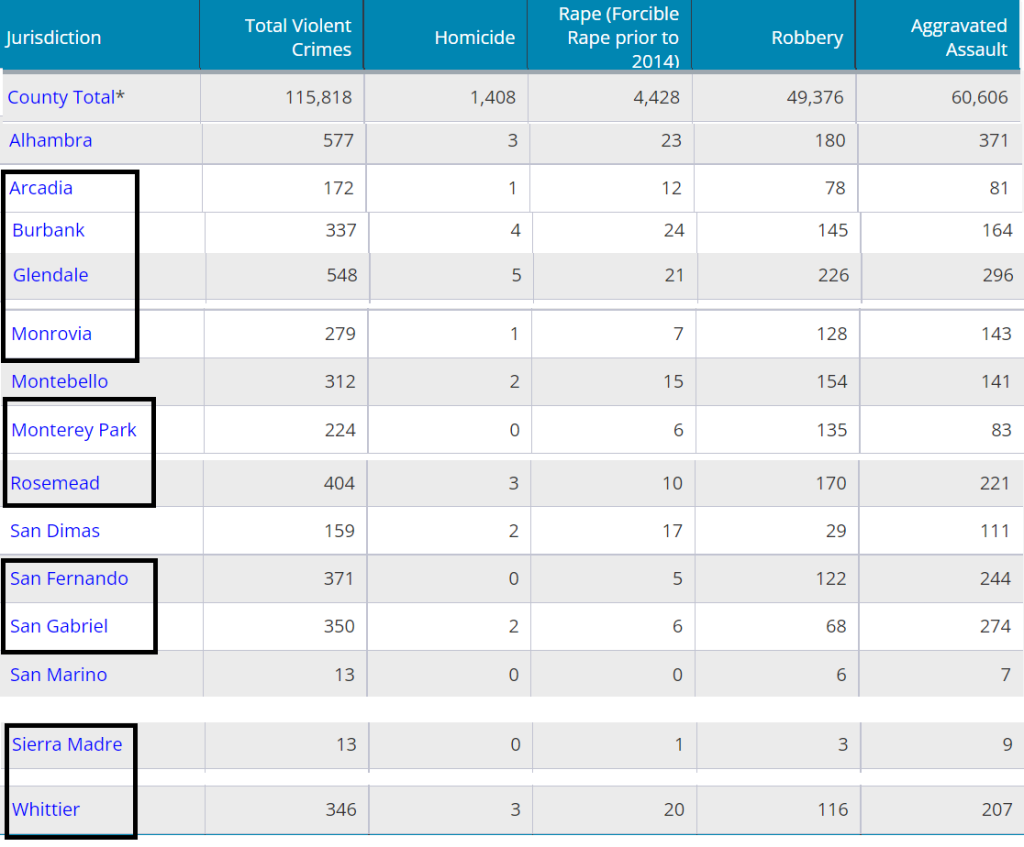
Some murders are not publicised at all, so it may be that they were happening but police and the media kept quiet about them. For example, the above table shows that there were three homicides in Rosemead during 1986, but a quick search of newspaper achives yields zero results. Even some of the Night Stalker victims were not reported at the time they happened (Tsai-Lian Yu and William Doi were not reported on until August 1985). The 1985 statistics show that there were six murders in Monterey Park, but only the Doi, Yu and Nelson murders ever received publicity, because they were linked to the ‘serial killer.’ Other similar attacks were occurring concurrently but discounted because of a lack of evidence or perhaps the location was out of the area the Night Stalker was believed to operate.
Nevertheless, there were multiple killers plaguing the city in 1985, after Richard’s conviction and well beyond, into the 90s. One only has to look at the Homicide Report to see how dangerous Los Angeles still is.
It would be time consuming and pointless to highlight every 1986 murder. The small selection mentioned in this post have been chosen because they bear resemblance to the Night Stalker crimes in methods – yes, plural because the Night Stalker had multiple M.O.s. This means intruder attacks that were carried out by knives, guns or blunt objects during the night. It will also include Orange County as it borders L.A. County and the Night Stalker also struck there. In fact, it is much easier to find articles on O.C. murders and rapes.
Murders and Attempted Murders
Originally feared to be the work of the Night Stalker, Cynthia Monnier was found naked and dead close to her Orange County home. A neighbour heard screams from a woman banging on the door. By the time she reached the door, Monnier was dead in the flowerbeds, having been stabbed. Monnier had been robbed two weeks earlier.
Jose Franco Gonzales raped and killed an elderly woman in September 1985. Beatrice Franco Terrones in Placentia, Orange County, as well as another murder in his home county of Mexico.
Just one week after Ramirez was arrested, Emily Humphreys, 81, was stabbed to death by an intruder who ransacked her house in Pasadena. That same day, also in Pasadena, a 79-year-old was robbed at knifepoint, On 13th September, in Monrovia, 41-year-old woman, Gerry Coleman, was stabbed to death by an intruder. Police admitted that Richard Ramirez was not the only murderer doing this type of crime – yet the LASD pretended his crimes were new and unique and, as such, could only have been committed by one man despite their differences.
In Villa Park, Orange County, on 16th October 1985 – just 2.6 miles from Cynthia Monnier’s house, a man broke into a garage and shot the female resident, Helen Schwartz. Had this happened just six weeks earlier, Ramirez would have been blamed. The suspect, was thought to be Latino, 5’10”, wore a black shirt… and an AC/DC hat – just like the shooter seen by Maria Hernandez in Rosemead seven months earlier.
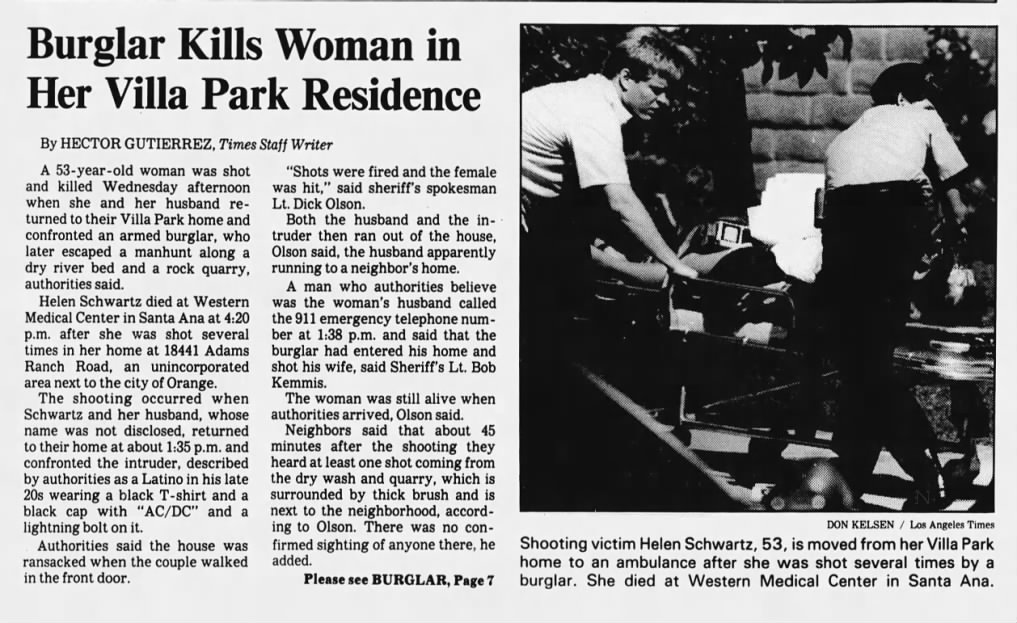
Yes – an AC/DC hat just the Night Stalker supposedly wore, except no victims actually reported their attacker wore a hat. It was instantly downplayed for its similarity to the Night Stalker.
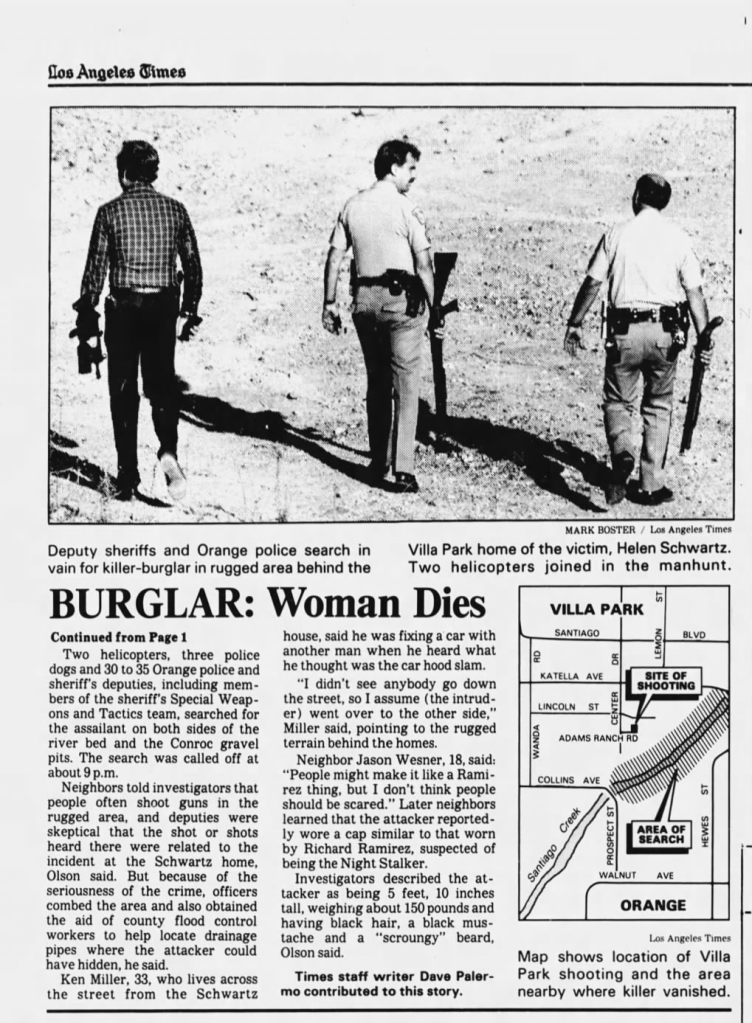
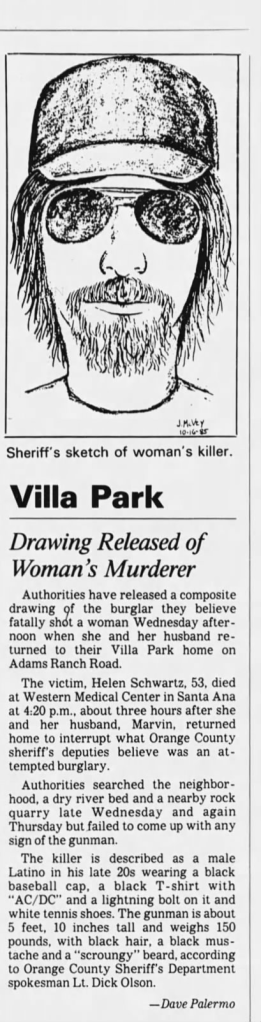
This suspect had a beard. Maria Hernandez said her shooter also had a beard (you can just about see it in the image below, screen-grabbed from the Netflix documentary). The composite sketch (also on the documentary), displayed a moustache.

In April 1986, Eddie Wayne Stone raped and beat an 81-year-old woman to death.
In May 1986, Janelle Cruz, aged 18, was murdered with a pipe wrench in Irvine, Orange County. The attack is similar to the attempted murder of Whitney Bennett less than a year earlier. In 2018, Joseph James DeAngelo would be found guilty of this crime. He is known as the Golden State Killer or the Original Night Stalker. None of the Golden State Killer’s crimes were reported as connected in the newspapers.
Marvin and Myrtle Spitz, aged 70 and 68 respectively, were beaten and stabbed to death in their home near Canoga Park. Their son Robert was arrested but murder charges were dismissed more than once. The prosecution admitted their evidence was circumstantial. Robert Spitz suffered from severe mental health problems.
In Torrence, Los Angeles County, Mark Steven Erler stabbed, raped and beat several women over the head in the spring of 1986. Luckily all women survived.
In October 1986, 85-year-old Edwin Marriott and his wife Mary, aged 72, were found dead in their ransacked home. This occurred in Whittier (where the Zazzaras lived). The killer, Larry Lucas, was a man under the influence of a cocktail of drugs. He was sentenced to death but it was later overturned. He had left a bloody trail to his own home. Interestingly, whoever killed the Zazzaras left a pool of blood at their neighbour’s house.
A California politician, March Fong Eu, was almost hacked to death by an intruder in November 1986.
Intruder Rapists
These 1985 rapes occurred in the same locations, yet only a select few were blamed on Richard Ramirez. Richard was convicted of raping Carol Kyle in Burbank and Somkid Khovananth in Sun Valley, both in the San Fernando Valley, yet in the spring and summer of 1985, a rapist was doing the exact same thing in the same area, only stopped when a victim bit the tip of his finger off – just six days after the Khovananth attack. He was also reported for prowling in Glendale, near where the Kneidings were murdered.
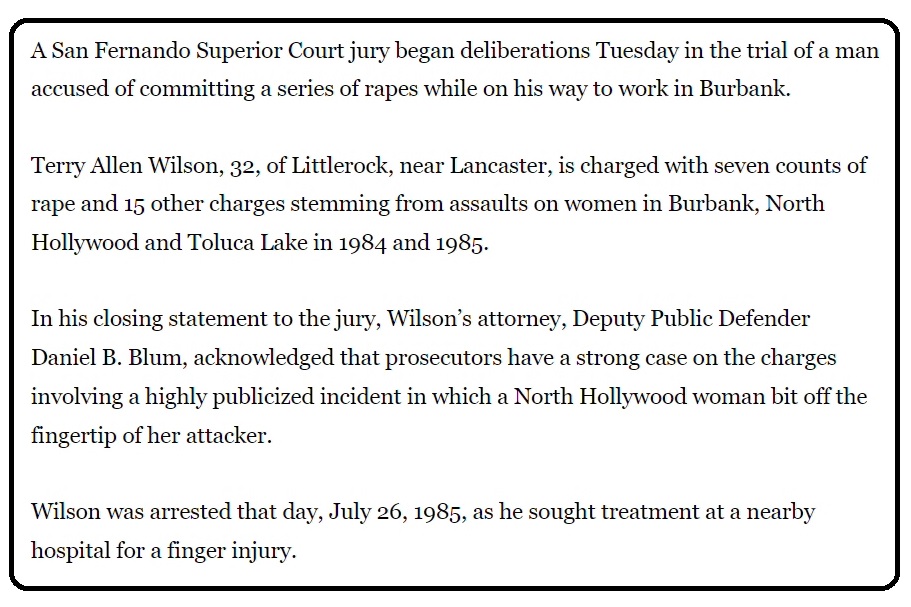
The following attacks happened in Claremont (LA County) Fullerton, Anaheim and Santa Ana (Orange County) – Richard had been accused of attacking people as far away as Mission Viejo in Orange County, so these are relevant. This series of 22 rape-burglaries began in December 1985 and are similar to the attacks on Sophie Dickman and Carol Kyle.
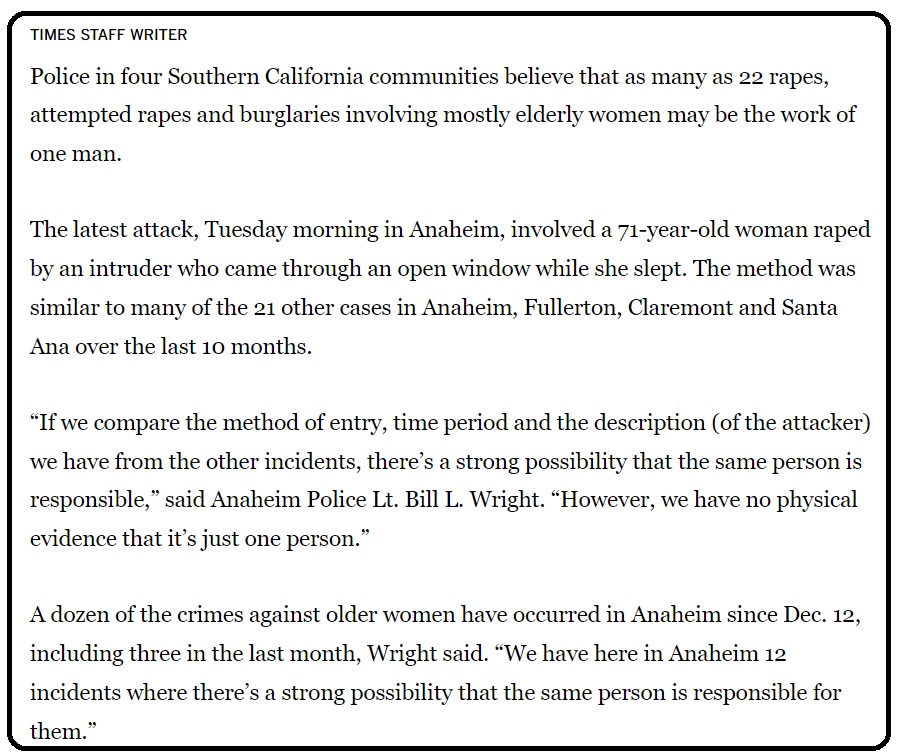
They were not just older women. Some were in their 30s. These attacks spanned from July 1985 until April 1986. Here is another article listing the victims and their ages.
Between May and September 1986, an intruder was raping or sexually assaulting at least five women in the San Fernando Valley. He cut electrical power to apartments and entered through unlocked windows. There were similar attacks in North Hollywood and Studio City.
The media is surely responsible for this lie that the city and county were now safe now that Richard Ramirez had been caught. Under a false sense of security, women opened their windows and were attacked.
-VenningB-
December 2022
-
Tsai-Lian Yu: Murder, Medallions & Morphing Suspects
The Yu incident does not match any of the other Night Stalker attacks. Before the killer’s moniker had been coined, he was also the ‘Valley Intruder’, the ‘Valley Invader’, or the ‘Walk-in-Killer. Only, in this incident, nobody walked in, invaded or intruded anywhere. This shooting happened in the middle of a road; there was no burglary, no rape, no slashing, no bludgeoning, no satanism and no Avia shoes. However, detectives had linked it to the other murders, just because it occurred on the same night as another – Dayle Okazaki, almost 4 miles southeast. Yu’s murder was formally linked to the Night Stalker around August 1985.
This description of the murder comes from two men people who were in the street at the time: Joseph Dueñas, Jorge Gallegos (sometimes Jorge Calderon, so we will call him Gallegos Calderon here for clarity) and his girlfriend who never testified. There were others, but they were never asked to testify in court. Further details will be given in our book.
Joseph Dueñas
Joseph Dueñas’ initial police report is not available but from the Federal Habeas Corpus, we know that between 11:15 and 11:30pm, he heard a woman scream up to seven times. He went to his balcony where he witnessed a blue car and a yellow car in the middle of the road. He saw a man and a woman tussling; the woman was holding onto the man’s arm or jacket. He said, “get away from me,” then returned to the car and drove away. The woman, Tsai-Lian Yu, fell to the ground and crawled in the direction of Dueñas’ apartment. He called the police and, with some other neighbours and the second witness, Jorge Gallegos Calderon, he went to help Yu.
Dueñas said the killer was either “oriental” with “slanted eyes” but that he could have been “Mexican.” He was about 5’7″ or 5’8″ and wore jeans, a T-shirt and a jacket, colours not specified. He was slim with shaggy long hair but other than this, Dueñas said he was unable to positively identify the suspect.
Dueñas Recants
At the preliminary hearing in March 1986, Joseph Dueñas identified Richard Ramirez at Tsai-Lian Yu’s killer. However, four days later, he recanted under cross-examination by Ramirez’s defence attorneys. He was asked to look at Ramirez again, stared intensely and eventually said, “No.” At trial in 1989, Dueñas maintained that he could not identify the killer.
Jorge Gallegos Calderon
Below is Jorge Gallegos Calderon’s initial police statement taken by Detective Corrigan of Monterey Park Police Department at 2:30am on 18th March 1985. The interview was conducted in Spanish, for Jorge could not speak good English.

From Document 20.3, pg. 4. Gallegos Calderon said that he was parked in his truck facing south. He was talking to his girlfriend Edith Alcaaz, who was the cousin of Joseph Dueñas. Gallegos Calderon saw a dark blue car drive past, travelling south down North Alhambra Avenue and onto East Emerson Avenue. He did not see which way it turned. The headlights were off.
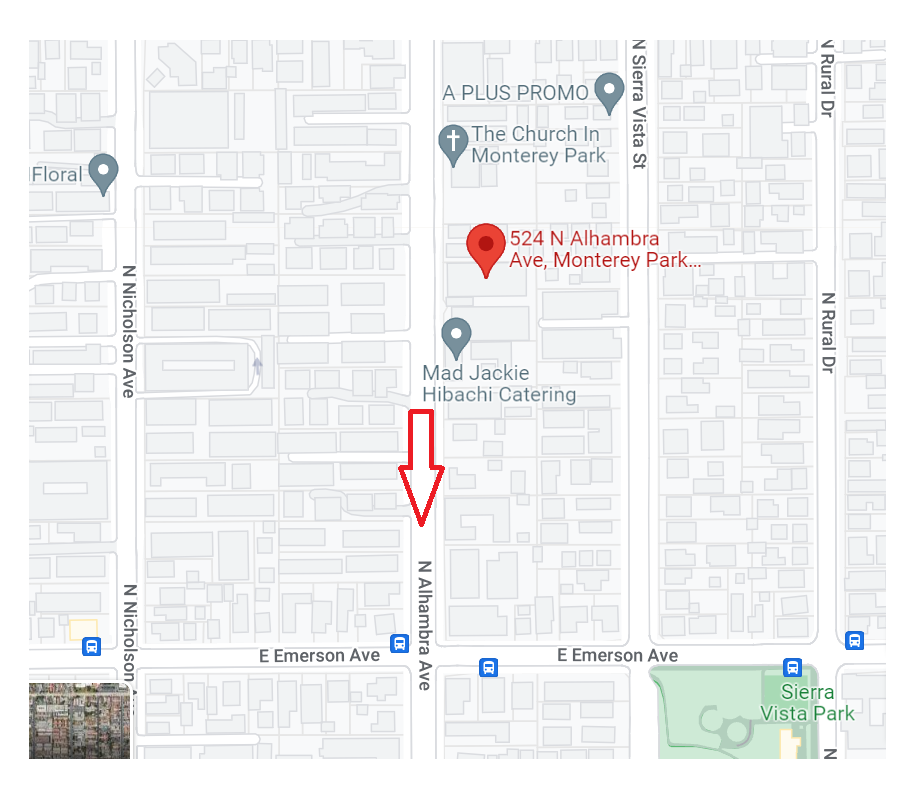
Gallegos Caldelron only observed the driver from behind and noted his dark hair. He said he could not be sure if the suspect was “Oriental” or Latino. He exited the van and ran towards Yu who was squatted with her right leg extended forwards. She was dragging herself backwards before falling onto her side. She was saying, “help me.”
Gallegos Calderon: Changing the Story
At the preliminary hearing in 1986, Jorge Gallegos Calderon embellished his original story and claimed to have seen the tussle between Tsai-Lian Yu and her murderer. Even the prosecutor, Philip Halpin, was surprised by this: the witness was only supposed to testify what he saw, not who he saw. Strangely, Gallegos Calderon forgot to tell Detective Corrigan that he saw the tussle on the night of the murder.
“Gallegos saw the man from the blue car lean into the window of the yellow car and try to pull the woman from her car. Gallegos thought they were having a lovers’ quarrel. He did not hear any shots.”
– Petition, pg. 50
Gallegos Calderon now said he observed the gunman in profile and saw his whole body and even his clothing. The killer was allegedly wearing light blue pants and a light blue shirt. And he also had curly hair. Gallegos Calderon was asked if the killer was in the courtroom. He confirmed that he was and identified Richard Ramirez. When questioned about the suspect’s height, Gallegos Calderon said “about my height: 5’8”. Richard Ramirez was 6’1″ (from ‘Ramirez Identified as Woman’s Assailant,’ News-Pilot, 18th March 1985).
Gallegos Calderon at Trial
On the night of the murder, he was also interviewed by Officer Dan Romero and also neglected to report that he saw the fight between victim and killer. This was blamed on Romero for conducting the interview in English when Gallegos Calderon, a recent immigrant, struggled with the language. Yet Detective Corrigan had interviewed him in Spanish and the fight was still not mentioned. A third police officer, Anthony Romero, had gone over the statement with Gallegos Calderon who told him he had no more information to add. The witness was blatantly lying on the stand.
Gallegos Calderon had not been called to the 5th September 1985 line-up, so had not identified Ramirez until the March 1986 preliminary hearing. The failure to call him was also blamed on Detective Dan Romero – who was a defence witness. Romero testified that this was because Gallegos Calderon told him he would be unable to positively identify the killer.
At trial, Gallegos Calderon was again asked to identify Ramirez in the courtroom – ridiculous because it is always obvious who the defendant is, especially as Ramirez was visibly chained. He said that Ramirez looked different to the last time he saw him (his hair was longer and he wore dark glasses in court). This should not have been a problem. Gallegos Calderon had decided in 1986 that the killer had shaggy or curly hair. Ramirez’s hair length at trial was immaterial. He should have had a clear description of him on the night of Yu’s murder – he originally only said the man had dark hair.
Ramirez had useless defence lawyers who should have questioned Jorge Gallegos Calderon over the fact his story now matched that of Joseph Dueñas. They should have accused them of comparing statements and copying each other. Perhaps Gallegos Calderon was desperate to participate in a high profile court case so lied about seeing it all – and Ramirez – yet slipped up over the short height of the suspect. Ramirez was asked both to stand to demonstrate his height and to remove his sunglasses, but he refused. Prosecutor Halpin argued in bad faith that this implied Ramirez’s guilt which violated due process.
“You might conclude from that that he didn’t want to give Mr Gallegos any more opportunity to identify him than was necessary. I think that is a reasonable conclusion.“
– Philip Halpin from the Petition, pg. 423.
This is ludicrous: everybody knew that Ramirez was tall and what his eyes were like. The eyes were irrelevant: in the dark, viewing from a mirror at some distance, Gallegos Calderon would not have been able to see the suspect’s eyes.
While the two men corroborate the suspect being short and possibly Asian, they differ in their observation of the killer’s clothing and hair. Moreover, we now know that Jorge Gallegos Calderon added more to the story at the preliminary hearing. The original information he gave should not have been enough to convict Richard Ramirez. Add to this the fact the other witness, Joseph Dueñas, recanted his identification, the Tsai-Lian Yu murder should not have made it to trial. The defence should have demanded this be thrown out and Gallegos Calderon should have been impeached. Richard Ramirez was known for wearing dark clothes, so, if he was indeed wearing light blue, then it was not the man seen at the Okazaki killing. It certainly was not the “man in black” that Detective Carrillo claimed was terrorizing L.A. County.
The following is curious. Richard had short hair in 1985. Joseph Dueñas said the suspect had light, long and shaggy hair. Then Gallegos Calderon later claimed his hair was wavy. By the time of the 1986 hearing, Richard did have long shaggy hair, even longer by the 1989 trial. So, why was Gallegos Calderon bothered that his hair was “a little different”? Surely Ramirez’s longer hair is a closer match to the original suspect than his 1985 hair? This is strong evidence that the witnesses were influenced by the bushy-haired man sitting at the defence bench rather than the short-haired man who had been shown in the papers – which both men admitted to seeing.

Ramirez in September 1985 
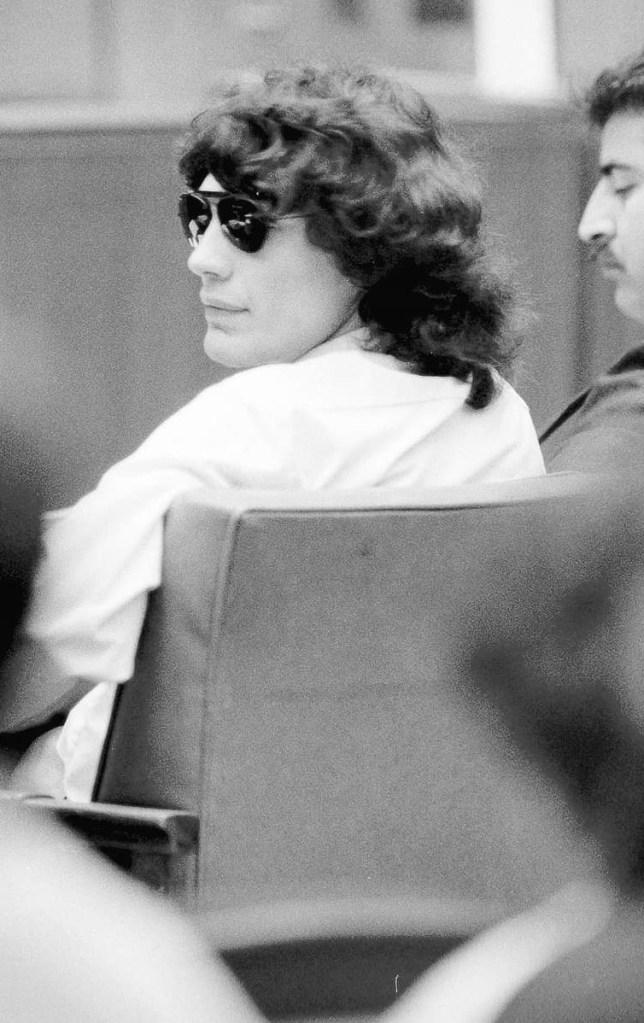
Ramirez in spring 1986
The Car Conundrum
Jorge Gallegos Calderon thought he saw the suspect driving a 1978/1979 Plymouth Arrow with a squared-off back end, like a hatchback (like the orange car below). He did not identify this car independently – rather, he picked it out of a selection of police photographs. He believed the licence plate read 521 MCD or NCD. Joseph Dueñas saw a Ford Escort.
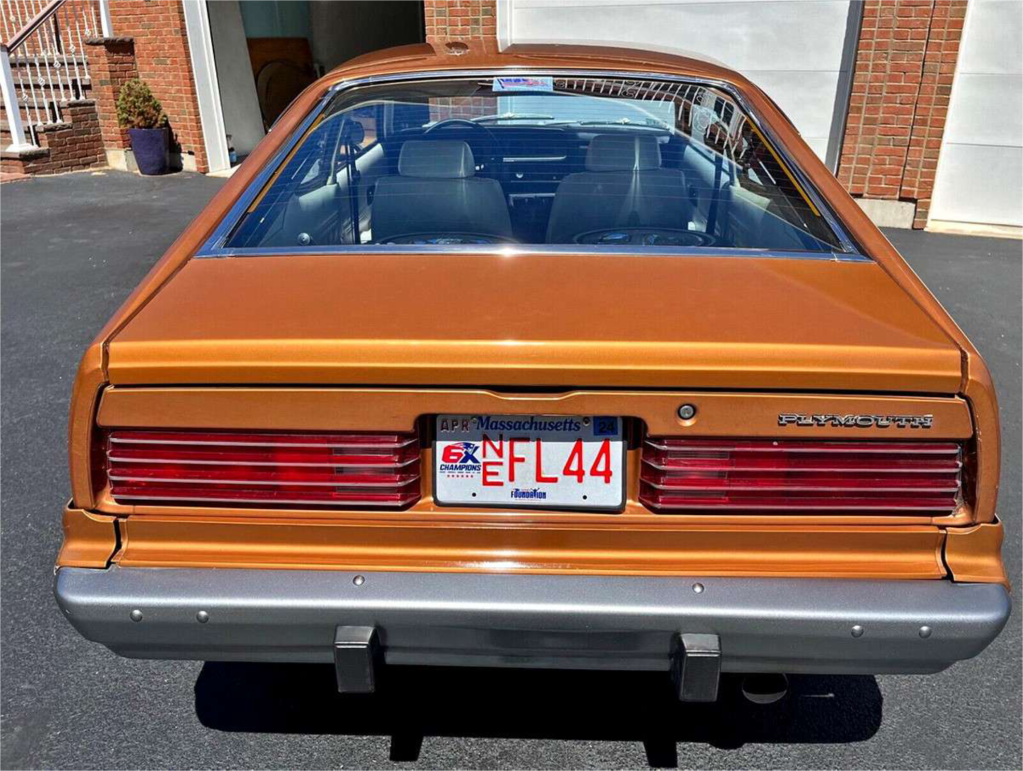
Plymouth Arrow from rear 
Plymouth Arrow 
Ford Escort The prosecution attempted to tie a car stolen from Downtown Los Angeles and abandoned near Monterey Park Hospital to the murder because the first three digits of the licence plate were 521. That car, a 1974 Toyota Corolla station wagon, belonged to Teresa Cerna and the plate read 521 MNI. As you can see, it looks nothing like the cars above.

It seems that because Richard Ramirez apparently liked to steal Corollas, the dumped car has been used to tie him to what otherwise seems like a random hit job. In case you were wondering, no fingerprints belonging to him were found in the Corolla which actually belonged to an unrelated car in Pomona, Los Angeles County.
The Missing Medallion
In the Night Stalker trial, several key pieces of evidence went missing, such as blood samples, a pistol and, in this case, a Christian medallion found by Tsai-Lian Yu’s body. It was deemed important, because as a devil worshipper, Ramirez would not have owned such an item, and the defence mentioned it in their opening statement. The prosecutor mocked Ramirez’s attorneys for presenting yet another “dead end” in his closing statement. This made them look ridiculous to the jury.
Other prosecutorial misconduct was showing the jury inflammatory and horrifying images of Tsai-Lian Yu. These did not aid them in working out whether or not Richard committed this crime. When the defence objected, the judge sided with the prosecutor.
Ballistics and Trajectory
When first examined by Sergeant Robert Christansen, it was determined that the .22 calibre revolver bullets used on Maria Hernandez and Dayle Okazaki were too distorted to be matched to the bullets fired at Yu. However, at trial, the prosecution’s firearms expert, Edward Robinson, said that the Yu bullets not only matched those at Okazaki, but also the completely unrelated Kneiding double murder which occurred four months later. However, the two examiners disagreed on the brands of weapon that were involved in these cases. Moreover, Christansen originally said the Kneiding bullets matched other crimes in July and August. Without the weapons themselves, and such bullet mutilation (50% and 70% in Yu’s case, 75% in Okazaki’s, and 60% and 75% in the Kneiding case) accurate comparison was impossible and it is clear this was contrived by the prosecutor and the Los Angeles County Sheriff’s Department.
Pathologist Dr Selser was unable to determine whether or not Yu was in her car when the shots were fired. However, Dr Spitz said it was more likely that she was inside the car due to the angle of the bullet entrance wound and the angle was not likely to have come from someone who was as tall as Ramirez. It fits more with the killer being short.
“Hypothetically, the path of a bullet would be significantly more downward if a 5’3″ tall victim were shot by a person who was 6’1″.”
– Petition, pg. 131.
Second Degree Murder
The Yu case was the only count that was commuted to second-degree murder on the grounds that the witnesses testified that it was some kind of lover’s quarrel in which Tsai-Lian Yu was tussling with Richard. It was assumed to be a mutual fight, even in spite of witness Jorge Gallegos Calderon only adding this story after the initial police interviews. The defence attorneys went along with the commution of the sentence – it was better than another death penalty. Also, it was argued that the gun was not aimed at Tsai-Lian Yu in a way that suggested intent to kill. Although nobody actually saw her being shot, pathologists established that she was not shot directly into her vital organs.
“The wounds, the direction of each bullet, and the number of shots fired demonstrated at most a chaotic encounter, not a determined effort to inflict lethal harm.”
– Petition, pg. 628
Gil Carrillo, in one of his many podcast pontifications, makes the claim Richard Ramirez argued with the victim but, like the prosecution, failed to present any evidence that he was connected with, let alone in some kind of relationship with Tsai-Lian Yu. Yu’s killer could just as easily have been a mad stalker – not the Night Stalker. This conviction was a complete miscarriage of justice on multiple levels.
Further reading: a 2019 documentary on Fox Nation revealed that a “Chinese spy” was acting agitated in Tsai-Lian Yu’s apartment. I wrote about it here.
-VenningB-
Originally written 28/11/2022
Updated 05/06/2024 -
Night Stalker: The Jennings Pistol
Updated with new information on 10th September 2025.
None of the Night Stalker’s guns were recovered except one, a Jennings pistol. In the Netflix documentary Night Stalker: The Hunt for a Serial Killer, key claims about the gun and an informant, Jesse Perez were made, particularly by Sergeant Frank Salerno. Firstly, what Salerno says does not hold up against public records. Secondly, there are serious questions over Jesse Perez’s court testimony.
Frank Salerno’s Unverifiable Recollection
Sergeant Salerno made a claim in the documentary that seems to be at variance with documented evidence regarding a police informant named Jesse Perez and a .22 Jennings pistol he received from Ramirez. Perez was a man in his 60s who had previously been imprisoned for manslaughter following a bar fight in the 1940s and also for burglary. He drove Ramirez around and was connected to the ‘fence’ Felipe Solano.
Sergeant Frank Salerno claims Perez said Ramirez had offered him the pistol and bragged about using it to kill an East Asian couple in Monterey Park. The documentary then displays a photo of William and Lillie Doi. It was important, Salerno says, because the type of gun was not known to the public, therefore, Jesse Perez had to be telling the truth.
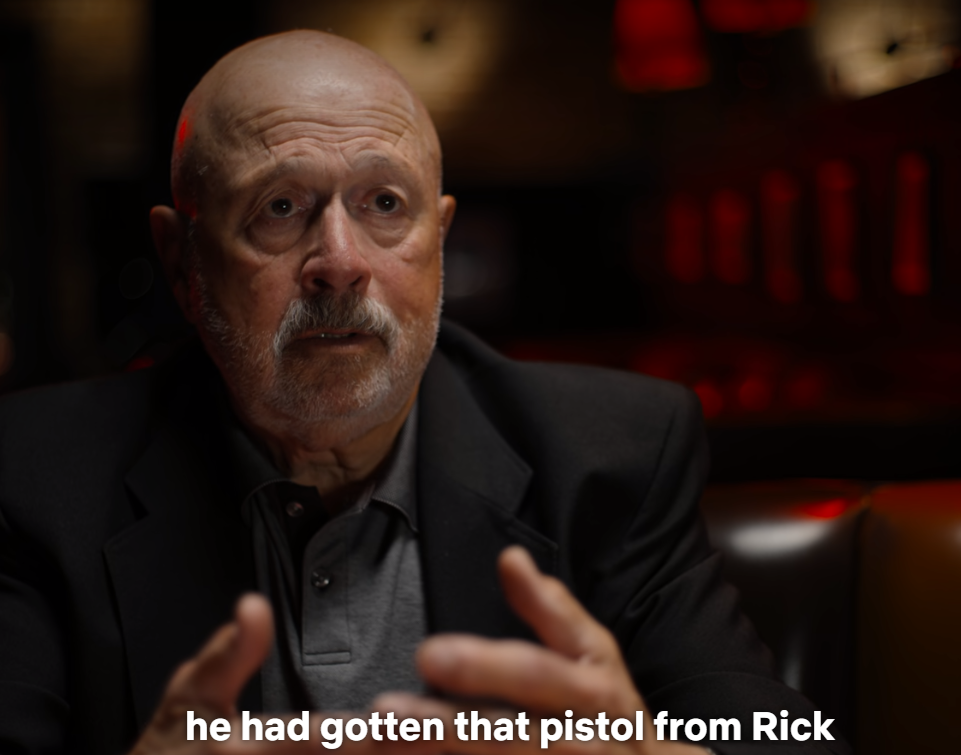
Still: courtesy of Netflix The problem with Salerno’s recollection is that there is no evidence that Jesse Perez ever said such a thing at trial and it is not mentioned or challenged in the Habeas Corpus petition. Nor was it reported by members of the press watching from the public gallery.
Jesse Perez’s original allegation was that Ramirez boasted of robbing “Orientals” because they did not retaliate. Even Philip Carlo’s book does not mention anything about Perez claiming Richard Ramirez confessed to murder (Carlo, pp. 330-331). Perez merely says Ramirez was a burglar, who once sold him a gun. Frank Salerno’s claim is currently unsupported by public records – although this could change if more documents are discovered.
Yellow Houses:
Perez testified that Ramirez confessed to choosing yellow houses for his attacks. The idea that the Night Stalker specifically targeted yellow or beige painted homes came from an interview with FBI profiler in the newspapers who was attempting to find a pattern. This was because the Night Stalker had no MO and left detectives and criminal profilers baffled. The myth is well known enough that it is commonly referred to by inhabitants of Los Angeles even today. Some people even painted their homes fearing the killer. Jesse Perez could easily have read these articles and then added it to his testimony to enhance his credibility. After all, he was angling for a slice of the informant’s reward (more on that later). There was no real evidence that the killer deliberately targeted houses based on their colour.
Unrealistic Confession:
Such a confession is unlikely from a logical standpoint. Richard Ramirez was mentally ill, but would he really flippantly confess to an acquaintance that he murdered two people with the very gun he was selling him? Why would Perez even take a weapon that had been used in a murder? A normal person would not touch this weapon for fear of being implicated. He would immediately go to the police, but instead, Perez sold it to a friend in Tijuana, then called the police after money was offered by the City of Los Angeles.
Not only this but the Doi attack was not a double murder, so Ramirez’s alleged confession was not even accurate. Both victims were alive when the killer left. Lillie was beaten and restrained with thumb cuffs. William was shot vertically upwards through the chin, but was still alive and mobile after the botched shooting – he even phoned the police twice and moved about the house. He died later that morning in the hospital, from cardiac arrest.
Jesse Perez evidently failed to check facts before making his claim. If Perez really had revealed inside information about the murder weapon, he should have become a suspect but he was instead given immunity from prosecution as a reward for information on Ramirez.
The Gun’s Chain of Custody
At trial, under cross-examination, the defence pushed Perez into admitting that he originally told police that he received the gun months before William Doi was killed, which he said he forgot, because he was ‘senile.’ (Carlo, pg. 330).
“On cross-examination, Perez did not recall that he had previously testified at the preliminary hearing about asking Petitioner to sell him a handgun six to nine months before Petitioner’s arrest.“
Federal Writ of Habeas Corpus, pg. 108.Perez received the gun in March 1985 at the latest and December 1984 at the earliest. The Doi attack was 14th May. A motion by the defence revealed that Jesse Perez might have had the gun even longer. So Ramirez’s “confession” about murdering an Asian couple in Monterey Park with the gun cannot be true.
Perez’s friend Esperanza Contreras Gonzales, to whom the gun was given, was granted immunity from prosecution. During the preliminary hearing, Perez admitted to lying to the deputy sheriff about how she obtained the gun, but his words are not revealed. She did not know Ramirez.
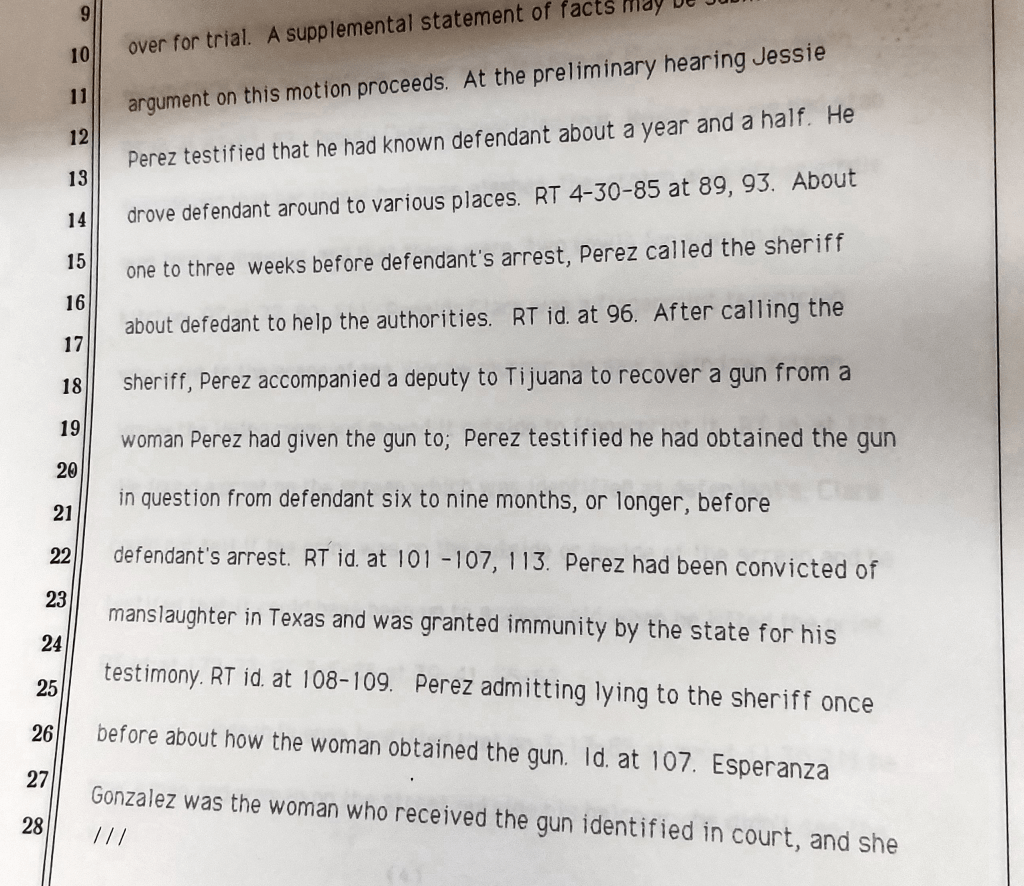
From a 1986 defence motion. “Esperanza Contreras testified that she had been living in Tijuana, Mexico for fifteen years and that she knew Jesse Perez. She first saw the handgun three years prior to trial. Perez brought it to her because she needed a gun for protection … She had the gun for about a month and then gave it to a police officer. She was granted immunity from prosecution at the preliminary hearing.”
Federal Writ of Habeas Corpus, pg. 109The entire testimony of Jesse Perez should have been thrown out. It should not have made it past the preliminary hearing. But the prosecution’s firearms expert, Edward Robinson, concluded that the expended bullets at the crime scene came from the Jennings pistol and Perez’s words seemed enough to solidify the connection despite the date discrepancy.
However, there could be a reason for the irregularity being missed: during Esperanza Contreras Gonzales and Jesse Perez’s cross-examinations, Ramirez was attacked by bailiffs for allegedly looking round at the public gallery and witnesses. This possibly distracted the media and even the judge from scrutinising Perez’s testimony and the prosecution’s evidence. Instead, the media focused on Ramirez’s behaviour, and the argument that ensued between Ramirez’s attorneys and prosecutor Halpin. See this article about the incident.
The Wrong Gun
More false information is presented in the Netflix documentary: but it can be explained by an error at trial. A dramatic noise plays and up pops the exhibit – a .22 Jennings pistol – only, it isn’t…
A Jennings pistol (now called a Jimenez pistol) is semi-automatic. The photo below, shown in this part of the documentary, is a double-action revolver, more specifically, if you look at the logo and the serial number on the barrel, a Colt Police Positive.
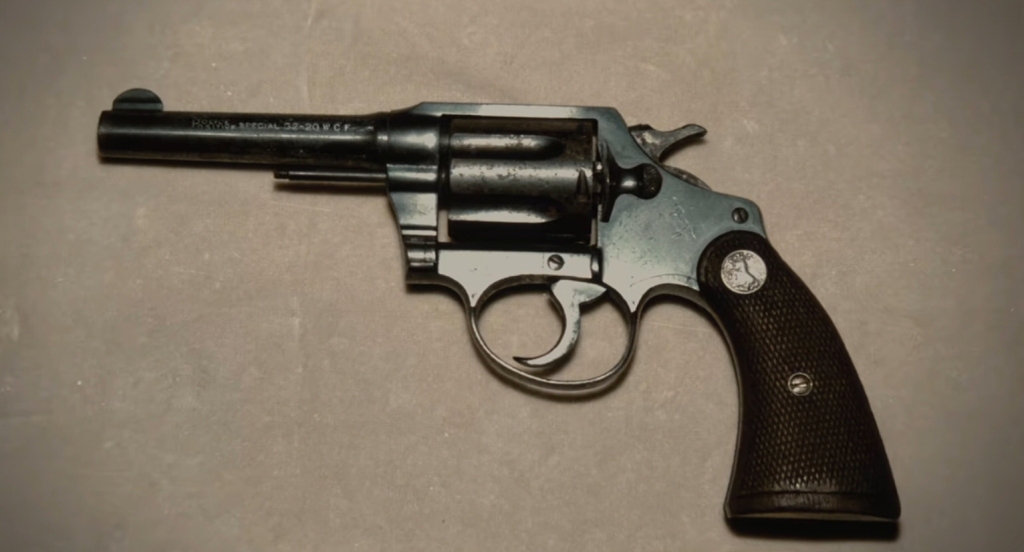
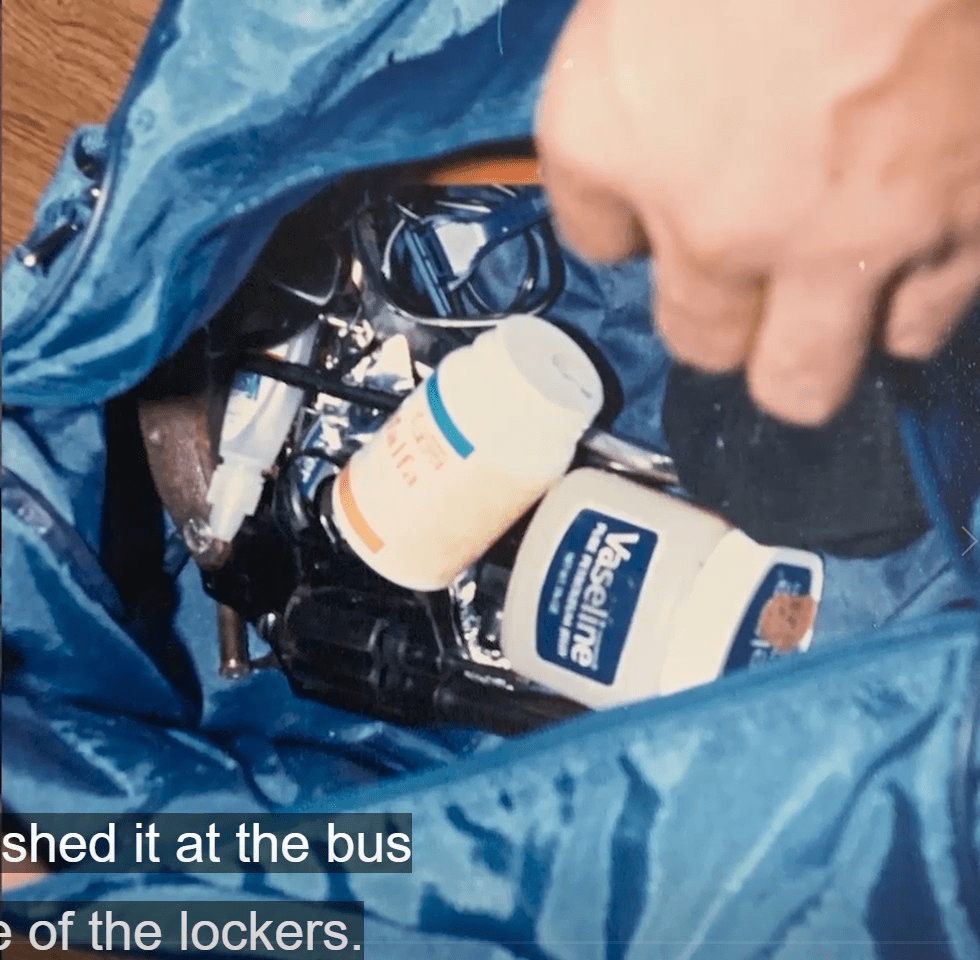
This gun was actually the .32 found in Ramirez’s bag contained within his locker. The Netflix documentary contains a lot of small errors like this. The .32 was never connected to a crime. Ramirez was in the ‘business’ of stealing and selling guns and this does not implicate him in any murders. None of the cases involved a .32.
Below is a .22 Jennings/Jimenez pistol. They are tiny.
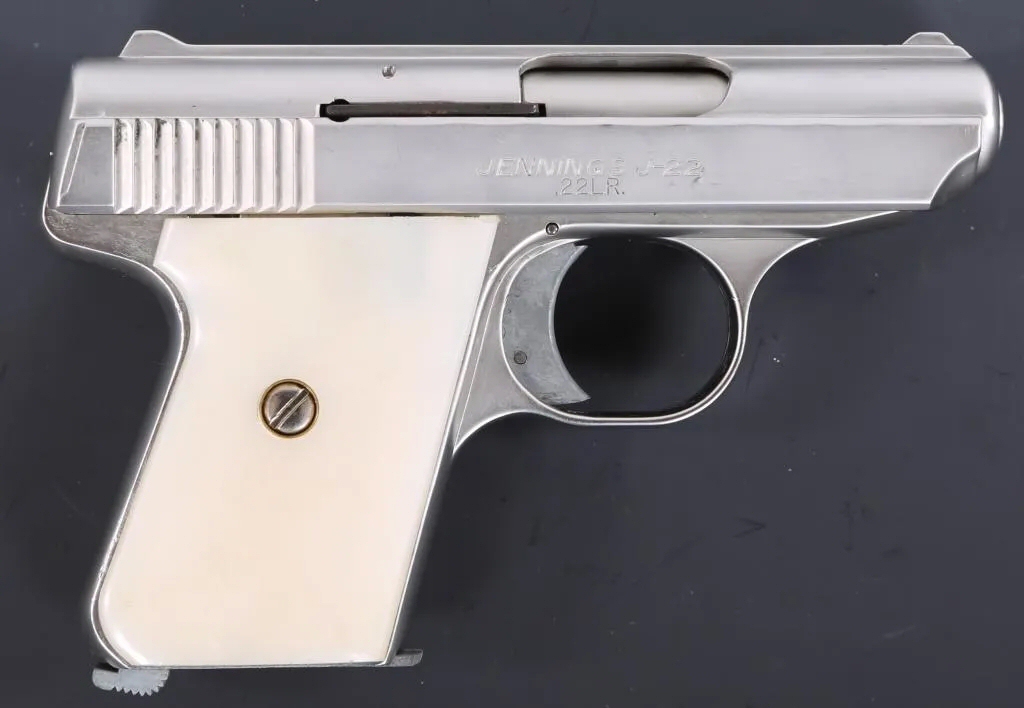
An actual Jennings As you can see, these are totally different weapons. The Colt revolver has a cylinder, whereas the Jennings uses a magazine clip in the handle. The real weapon was shown on the Fox Nation documentary (2019) and as you can see, it is not a revolver.
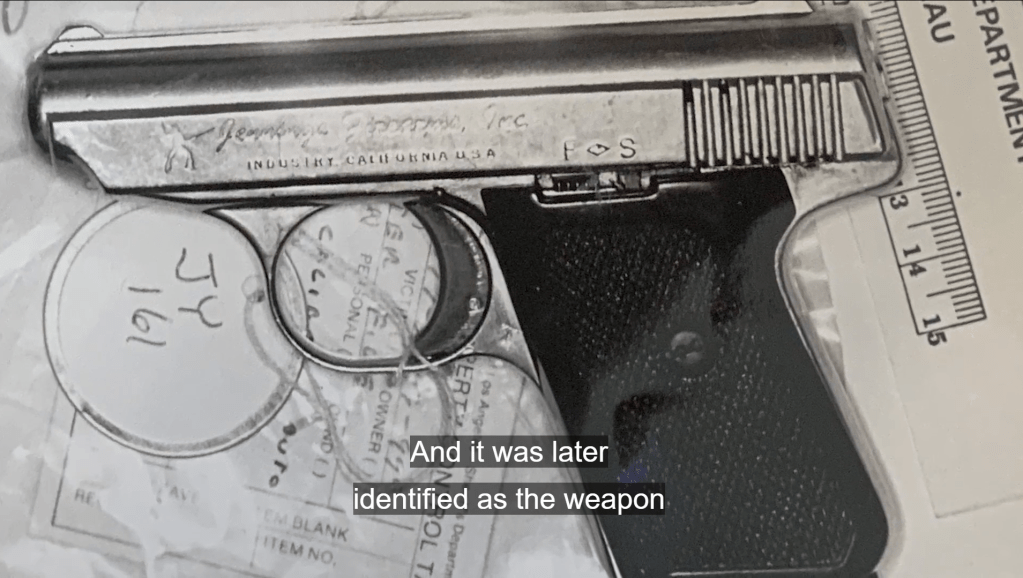
Strangely, the above weapon disappeared during the trial, and the prosecutor, Philip Halpin, felt that this was not a problem – the jury and witnesses looked at dummy weapons anyway. But this loss is concerning given was supposedly the only weapon recovered from the Night Stalker attacks and it was mislaid?
Ramirez’s ‘friend’ Earl Gregg testified at the trial. Gregg claimed that Ramirez tried to sell him some guns in April 1985:
“Petitioner asked Gregg if he wanted to buy a gun. Petitioner showed him two guns: a .25-caliber automatic and a small-caliber, black revolver that resembled the Jennings handgun.”
Federal Writ of Habeas Corpus, pg. 112How could a black revolver resemble the Jennings? The Jennings company have never produced revolvers. Neither gun Gregg saw was a .22 long rifle semi-automatic. The .25 automatic was probably even smaller than the Jennings.
Incidentally, both Jesse Perez and Earl Gregg – and their families – received rewards from the cites of Los Angeles and San Francisco. Perez was given the most, although he testified that he expected to receive $500,000. No wonder he was willing to embellish stories.
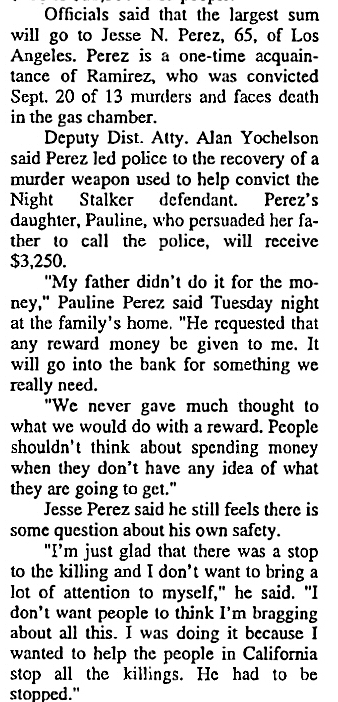
From the Los Angeles Times after the conviction. The Stereo Connection
It was also alleged by Frank Salerno, on the documentary, that police recovered Mabel Bell and Florence Lang’s stereo/cassette player from Tijuana too, but the petition and press reporters all say this was found with Felipe Solano.
The claims surrounding Jesse Perez, the alleged confession, and the supposed murder weapon demonstrate how shaky evidence can be amplified into accepted fact when repeated without scrutiny. Salerno’s statements in Night Stalker: The Hunt for a Serial Killer are not supported by trial transcripts, court petitions, or contemporary press accounts. The gun’s chain of custody was dubious, the confession story was riddled with inconsistencies, and even the firearm shown in the documentary appears to be misrepresented. As viewers, we should approach future documentaries with a more critical eye.
-VenningB-
21st November 2022
-
Serial Delusions
Richard Ramirez, January 1989. “A series of crimes involves distinctive features, offences or signature mark to indicate that particular individual likely committed all of the crimes. Distinctive features of a modus operandi include cause of death, type of weapon used, or victim. By definition, a series of crimes requires similarity among the criminal acts; crimes linked together because of unusual or unique characteristics not present in other crimes. In the absence of a distinctive pattern, crimes are not necessarily connected together; they may be random acts allegedly committed by one or more suspects”
(Declaration of Steve Strong, criminalist and expert witness in gang-related crime, homicide investigation, and narcotics investigation. From the Writ of Habeas Corpus
The police authorities were so desperate to declare they had a serial killer on their hands, they began to link the incidents together, unconcerned that there was a distinct lack of pattern, or any M.O, they announced the lack of pattern was the M.O. Of course, how obvious. Nice one, Gil Carrillo!
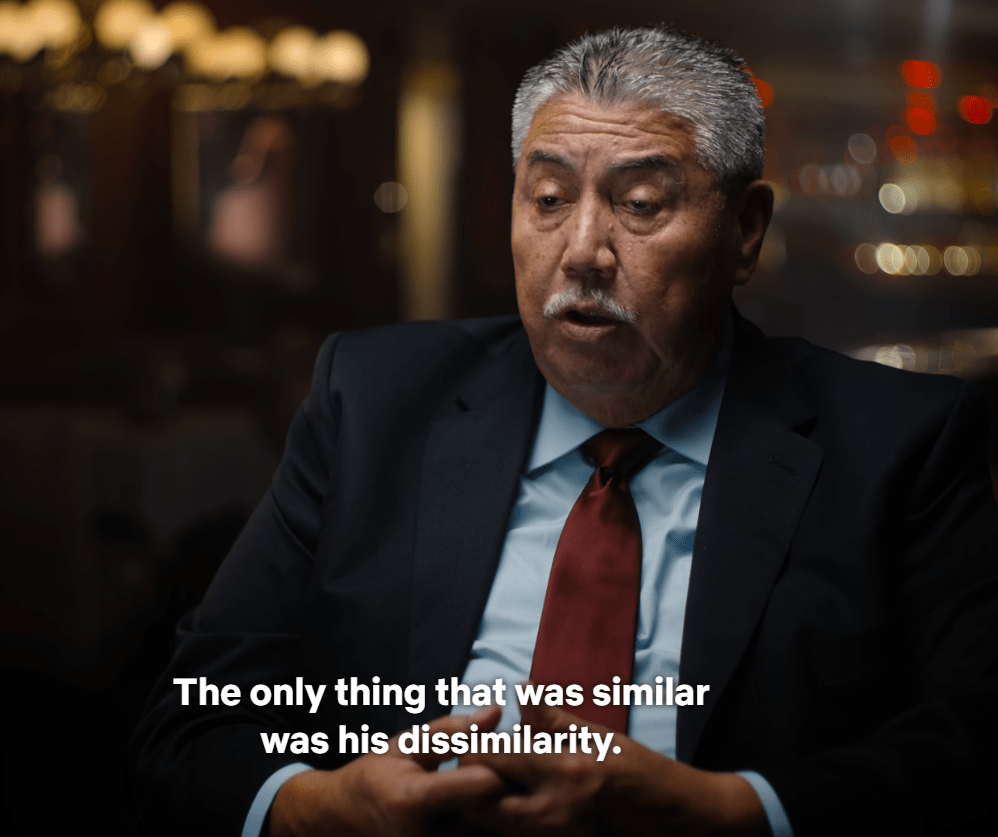
Image: Netflix. A nonsensical quote, for how can anything be similar if dissimilar? 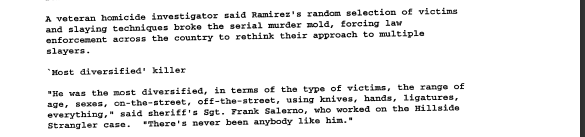
Frank Salerno, from the Writ of Habeas Corpus, document 19-10 In closing argument, the prosecution emphasised to the jury that physical evidence, specifically shoe print impression and ballistics, linked Richard Ramirez to the series of crimes. The prosecution argued, improperly, that the crimes constituted a pattern of offences. There was significant evidence to show that the incidents were not all linked to one another. Criminalist and expert witness, Steve Strong, described the prosecution’s evidence as demonstrating a lack of pattern with respect to many of the incidents.
In the Vincow incident, for example, a print was found on a window screen but not inside the residence. Time of death was estimated to be in the afternoon, unlike the night- time intrusions in many of the cases ( Zazzara, Doi, Bell and Lang, Cannon, Bennett, Nelson, Kneiding, and the uncharged incident), it is not possible to determine how many persons were involved in each incident. It is not so obvious that he was the only suspect due, in part, to the lack of evidence at the scenes. Another massive fail from his deficient defence, who didn’t even bother to investigate the dodgy characters surrounding Richard, the fence, Felipe Solano, with his entourage of thieves, liars, police informers and those who betrayed him for the money. (More about these particular individuals in an up-coming post.)
The reason it was hard to apprehend a suspect in the so-called Night Stalker crimes was because there was no discernible pattern. The locations of the scenes had no particular pattern, except for four incidents in Monterey Park, and the geographical range was wide. (See map pinpointing the incident locations)
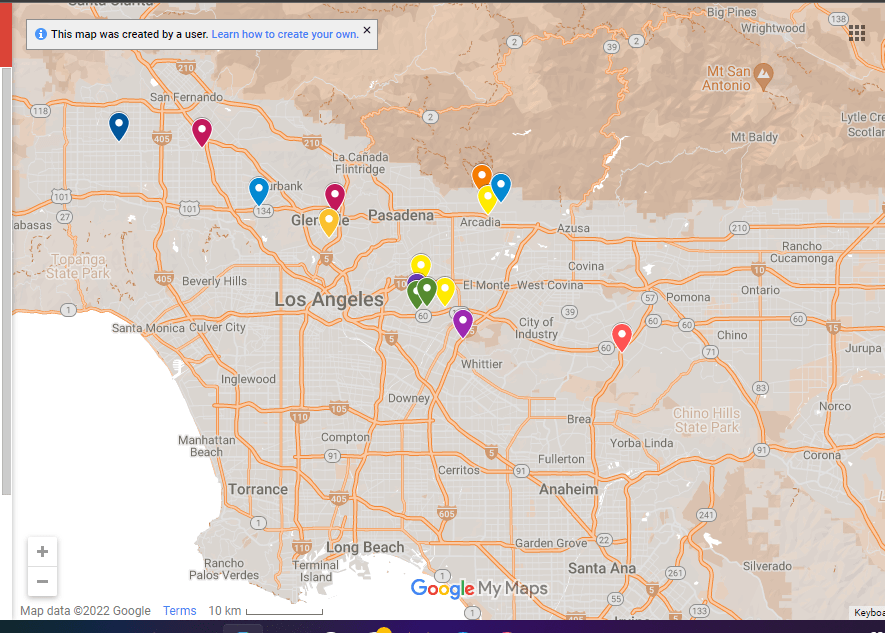
Location of incidents
Let’s examine just one part of this geographical range and a brief look at two incidents within.
The map below shows the locations and distance between two crimes committed on the same night, Kneiding and Khovananth. The details of these crimes will be discussed in a future post, but for now, I will concentrate on the logistics because I find this one particularly interesting, as they occurred during the early hours of the same day, and yet were not “linked” together by evidence from ballistics or the obligatory Avia print. The M.O is also completely different, one being a double murder, the other, murder/rape/burglary.
What Happened?
Maxon and Lela Kneiding were both murdered during a terrible and bloody attack at their Glendale home during the early of 20th July 1985. No time of death has been released, but we are told that the Kneidings daughter discovered their bodies at 8am on the morning of 20th July, and the only other indication given is that the bodies were said to be in “full rigor” by 8pm.
At an unclarified time after 12.30am on the same morning Somkid Khovananth was woken up in the Sun Valley home by a man holding a gun. Her husband was shot, and Ms Khovananth suffered a sexual attack, a beating and a robbery. We are not told the time the attack happened, only that at 6am she heard an alarm clock sound and by 7am the police were in attendance.
Multiple weapons were used in the Kneiding murders, .22 calibre gun, machete, knives. In the Khovananth incident, again a .22 calibre but, we are told, not the same one as in the Kneiding incident.
So why Richard Ramirez?
We are led to believe that the attacker, for unknown reasons, drove to Glendale in the very early hours of the 20th, committed a heinous, brutal, double murder, using an array of weaponry. Then, deciding that more murder was on the agenda, drove 14 miles to Sun Valley (within minutes, according to the prosecution) to perpetrate another attack on the Khovananth household.
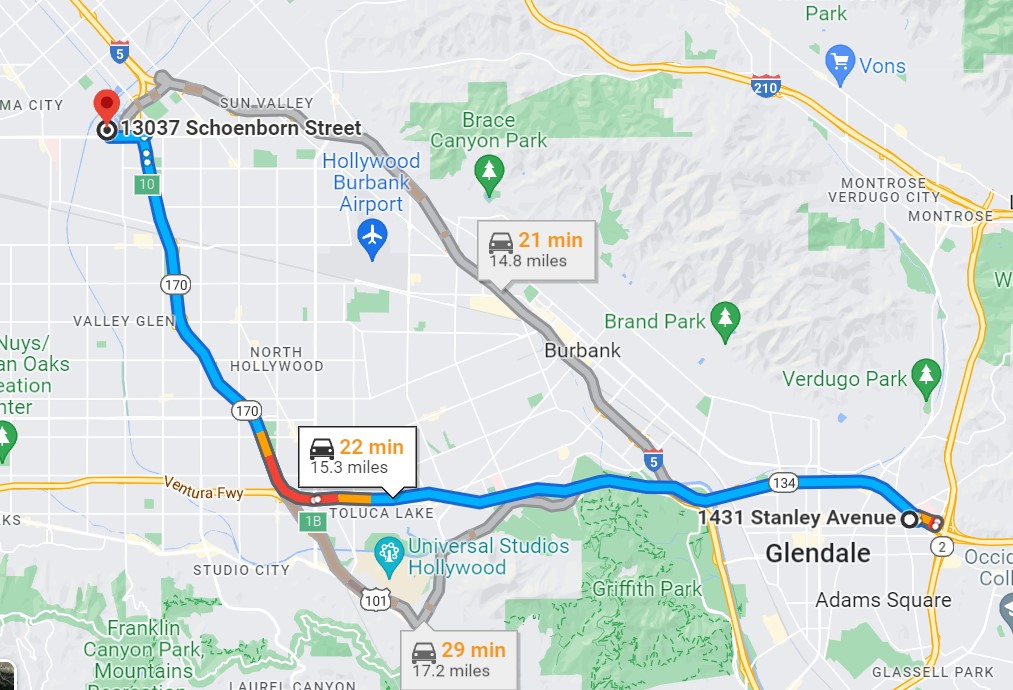
Distance between incidents, showing two possible routes. Given that the Kneiding attack was horrific in its brutality, whoever conducted this crime could not fail to be blood-drenched, it is impossible to think otherwise. However, Ms Khovananth does not mention her attacker being blood stained, she says nothing of the sort. There is also no transfer of blood from one crime scene to the other, no smearing of blood anywhere at all. Not one drop. The attacker also used a different gun.
Are we to believe that Richard Ramirez, seeing as he was convicted, we might as well use his name, coming from the Kneiding murder, stopped somewhere along the way to change his clothes, have a shower and thoroughly clean out his undoubtedly bloody car? To then appear at the Khovananth residence devoid of any blood stains? This is the man, after all, who was known as “despeinada”, “uncombed or dishevelled” by some of his dodgy associates, the man sleeping in cars who doesn’t care about hygiene. Yet he’s suddenly capable of forensically scrubbing himself down as if he’s about to enter an operating theatre.
Did he also, perhaps, ditch all his weapons somewhere along the way and decide to use another .22? Twitter readers and Netflix watchers will undoubtedly scream, “He went to the Cecil Hotel!” Did he really? There is no evidence that that happened, and to do so would mean he doubled back on himself a good 8 miles, making it even more ridiculous. Are we supposed to really believe that Richard, who, according to the prosecution, seems to have been more tooled up than a GTA character with a weapons stash to match, somehow managed to get rid of them all? Bearing in mind that no weapons were ever recovered from him that could be linked to any of the incidents.
Perhaps, he threw them all off the Golden Gate Bridge, alongside his “phantom Avias”, maybe they just vanished into the ether, along with any credibility belonging to either his deficient attorneys or indeed, this case.
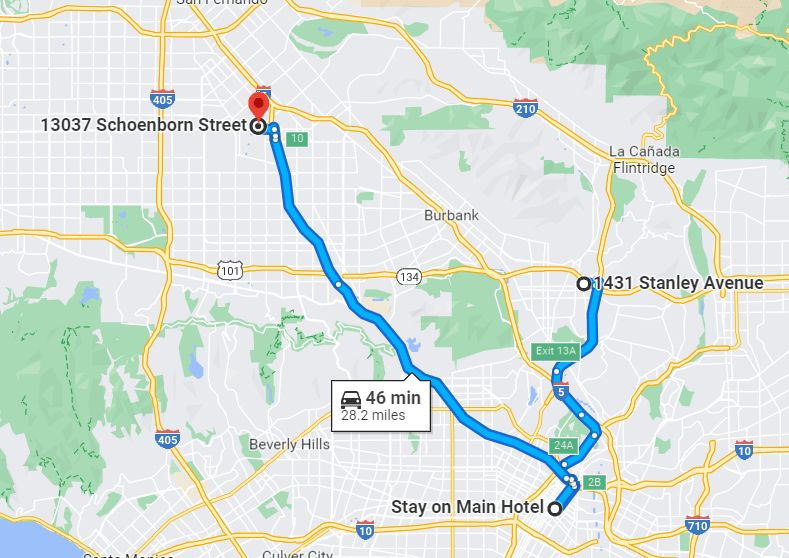
Route, if he’d stopped off at the “Cecil” for a clean-up.
So why was he blamed for these crimes? Because the prosecution determined that the gun used in the Kneiding incident was used in the Okazaki and Yu incidents. The shoeprint found at the Khovananth, linked to the other supposed Avia prints found elsewhere and her eyewitness testimony, which she changed. That is indeed a far reach because, as has been shown, the evidence put forward by the prosecution was found to be false and unreliable, as discussed in THIS POST.
It seems to be a clear case of deciding the outcome and then trying to make the evidence fit around that. Yet again, none of this was questioned. What of the unidentified hair found in both scenes? Was that ever assessed to see if it matched? Nothing is ever mentioned about it. It wasn’t Richard’s; let’s all just move on and forget about it.
The only pattern I see beginning to emerge is one of mystery semen, blood, hair and sets of unidentified fingerprints, none of which seemed to belong to Ramirez.
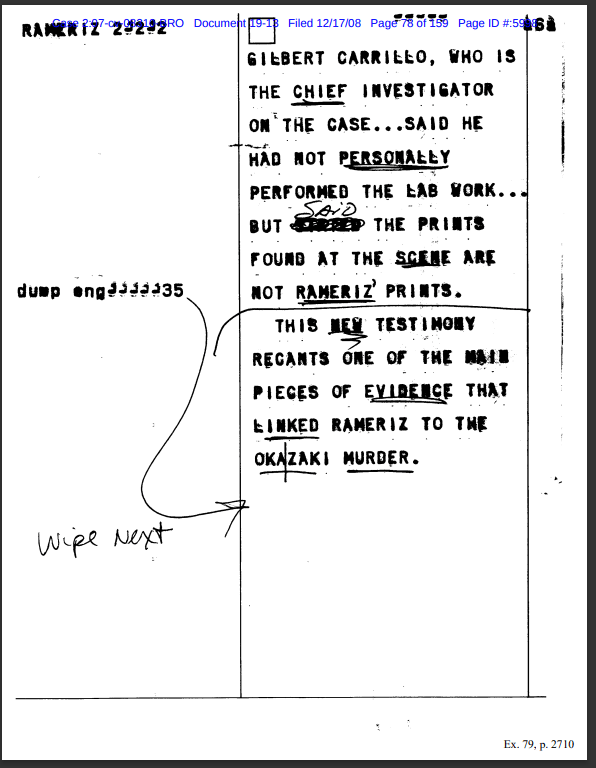
That time Gil Carrillo admitted the fingerprints at the Hernandez/Okazaki incident did not belong to Ramirez. Taken from transcripts from TV networks and listed in document 19-13 from the Writ of Habeas Corpus. Look at the above image again.
“This new testimony recants one of the main pieces of evidence that linked Ramirez to the Okazaki murder”.
That information was dumped from the network that day, so no one watching the TV got to hear it.
The killings had no distinctive pattern; different weapons were used in many incidents, and none were ever found in Richard’s possession. The state’s theory that Richard must have put gloves on upon entry does not make sense because the crimes lacked organisation, according to the victim’s testimony. The anomaly here is the “uncharged incident”, where for some inexplicable reason, the prosecution alleged that he removed his gloves after convincing the jury that the reason for lack of fingerprints was, well, he wore gloves, of course!
As an aside, the “uncharged incident” has another differing profile, featuring what must be the most well-appointed squad car in history. No need to call in for fingerprint and footprint technicians, not when Officer Wright had the whole lot in the boot of his car or up his sleeves. He was, so he claimed, able to dust for prints, take photographic evidence and even had the special, extra-large lifting tape required for shoeprint impressions. He did all that without calling in the people specifically trained to do this work. Amazing! No charges were made, and as the resident passed away sometime later, no one was around to dispute any of this.
Ballistic Simplistic or Unrealistic
Ballistics evidence was involved in only eight of the incidents. The firearms comparison evidence did not determine who fired the weapons, and as the ballistics evidence was found to be unreliable, no link can be conclusively established.
Incompetence strikes once again, for in 1986, firearms expert, Paul Dougherty, was hired by Richard’s woeful defence counsel, to examine ballistics evidence gathered by the prosecution, of course, in their usual style, they failed to communicate with him and ignored his request to provide evidence itself, you know, so he could do his job. His work was terminated before it even began. Let me repeat this:
Counsel for the defence did NOT provide an expert witness with the evidence they had hired him to investigate.
This resulted in defence conceding ballistics charges without a whimper of protest.

Statement of Paul Dougherty, doc 7-20, from the Writ of Habeas Corpus Paul Dougherty, for the purpose of Habeas Corpus, was again asked to examine the ballistics evidence and his preliminary findings are interesting.

Statement of Paul Dougherty, doc 7-20, from the Writ of Habeas Corpus In his statement, he explains that the law enforcement work was inaccurate and inadequate. In reviewing the work performed in this case, he found that:
“There are internal conflicts in the written reports with regard to the testing conducted, such as condition of the bullets.”
Ex. 35 Declaration of Paul DoughertyIn Dougherty’s opinion, all the ballistics evidence should be retested. The State, in its zeal to get a conviction, presented evidence that was unreliable.
“It is impossible to say with certainty whether the findings . . . are accurate”.
Ex. 35 Declaration of Paul DoughertyHis examination discovered there was evidence of bullet distortion and lack of unique rifling characteristics, moreover, the three officers who first examined the ballistics evidence, could not agree on their findings. Because of this only one was called upon to testify in court because his report fitted the prosecution case and the prosecution relied on ballistics evidence to try to link the crimes.
It is worth knowing that there is NO scientific foundation in the claim that a specific bullet can be matched to a particular gun; the same goes for shell casings.
“In Okazaki and Yu to Kneiding, Zazzara to Khovananth, and Petersen to Abowath. Prosecution witness Edward Robinson testified that ballistics evidence conclusively linked the incidents above (172 RT 20034-52.) He also testified that a recovered Jennings .22-caliber semi-automatic pistol was positively compared to the Doi case (172 RT 20061.) Robinson was the last of three law enforcement firearms examiners to evaluate the general rifling characteristics of the ballistics evidence. Yet the two other examiners, who did not reach entirely the same conclusions, were not called to testify at trial, because they did not have the answer wanted by the prosecution. For example, in the report prepared by Robert Christansen on March 28, 1985, he concluded that due to distortions of the .22-caliber bullet in the Okazaki case, no positive comparison can be made to the Yu case. In the Kneiding case, firearms examiner Hawkins found there was 60% mutilation of an expended bullet but identified the bullet as having been fired from the same firearm as the bullets fired in the Yu case. This finding raises questions about the reliability of the testing.”
Writ of Habeas Corpus, page 634Jennings .22 semi-automatic, a small silver-coloured gun. More information on the chain of custody of the Jennings, the one they lost can be found HERE A point of interest is that the Netflix documentary, the sensationalised and often factually incorrect, “Night Stalker: The Hunt for a Serial Killer“, when discussing the Jennings, inexplicably show a completely different weapon. The gun they show is a revolver, a black double-action Colt Police Positive, all photographed up to look like evidence.
Colt double-action revolver. Not a Jennings semi-automatic. 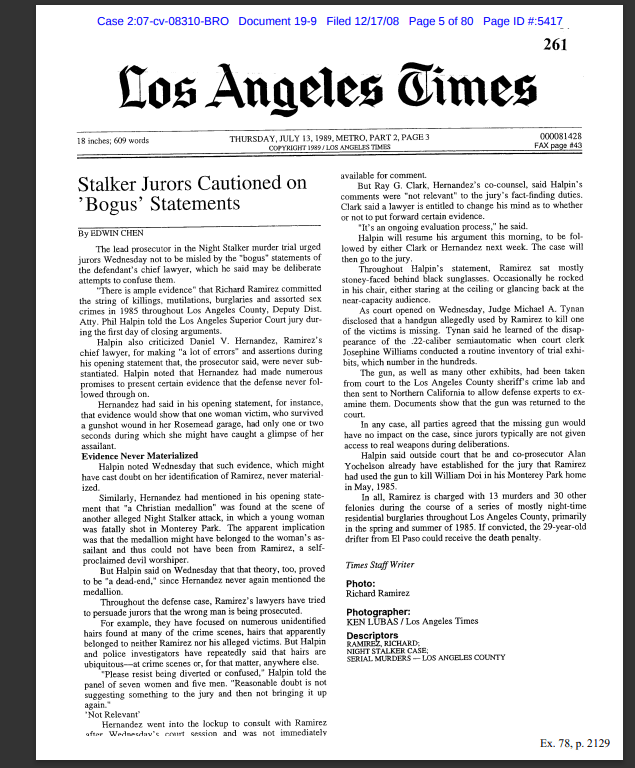
They seemed to have lost the .22 semi-automatic. How careless of them, but apparently, it didn’t matter. How did they manage to lose it?
Not the Avias again!
Shoeprint impressions were discovered in only eight incidents, and as shown in this post, false evidence regarding shoeprint impressions was knowingly presented to the jury. A full breakdown of shoeprint evidence is given in the previously mentioned post within this blog, please read it as to include it again here would be repetition.
“I mean that is – you know, you are not allowed to make up evidence, and that is one of the rules”
(Prosecution statement in trial transcripts, taken from the Federal Writ of Habeas Corpus)Shamefully, that is exactly what they did, as shown HERE and also HERE.
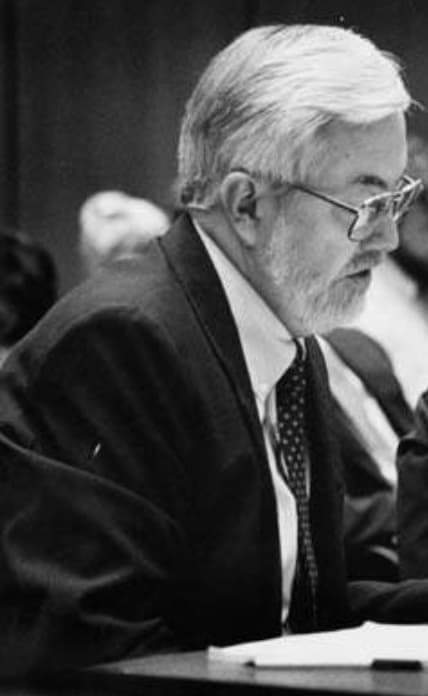
Prosecutor Phil Halpin, photo from LA Public Library. At NO point was the shoe size of Richard Ramirez even mentioned, or determined, during his trial. No proof that Richard even owned a pair of Avia shoes ever materialised either, just some ridiculous fiction about him chucking his “phantom sneakers” off the Golden Gate Bridge. Which no one saw him do.
Summary re: Lack of Distinctive Pattern.
Below is a chart showing how the prosecution tried to link the crimes into a pattern, which there never was. Law enforcement made a big deal out of repeatedly saying that the pattern was there was no pattern, see? That way they could make a link out anything, it didn’t matter whether it was real or imagined.
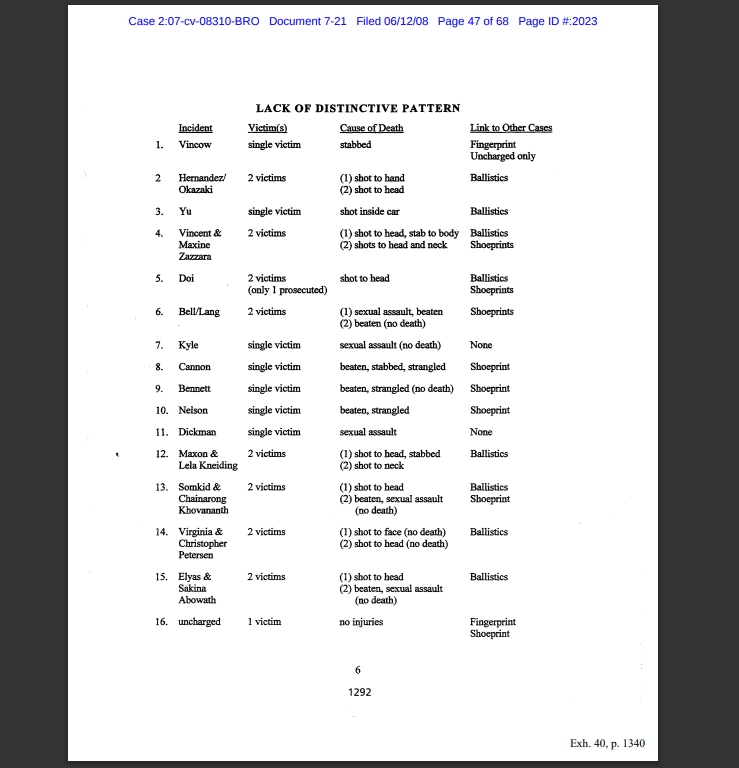
from the Writ of Habeas Corpus, ex 40, declaration of Steve Strong With that in mind, let’s look at each incident where we can see there really wasn’t anything viable to link these crimes together or even to show that one person committed them, or that the one person was Richard Ramirez.
Distorted, dusty bullets, do not show who pulled the trigger!
- Vincow
- No fingerprints belonging to Richard found inside apartment
- No property stolen or recovered
- Wounds not unique
- Could have been committed by more than one person
- Location: Los Angeles City
- Hernandez/Okazaki
- No fingerprints found inside or on doors of residence
- Unidentified fingerprints found, not Richard’s
- No property taken
- Wounds not unique
- No weapon found or recovered from Richard
- Location: Rosemead
- Yu
- No fingerprints found in recovered stolen car
- Wounds not unique
- No property taken
- No weapon found or recovered from Richard
- No apparent motive
- Location: Monterey Park
- Zazzara
- No fingerprints found belonging to Richard
- Unidentified prints were found not to belong to Richard
- Exact model or size of Avia shoeprint not determined
- No weapon found or recovered from Richard
- No property recovered
- Could have been more than one person
- Location: Whittier
- Doi
- No fingerprints found belonging to Richard
- Exact model or size of Avia shoeprint not determined
- Wounds not unique
- No inventory of property stolen from earlier burglary was done
- Trail of stolen property not investigated or questioned
- Could have been more than one person
- Location: Monterey Park
- Bell/Lang
- No fingerprints found belonging to Richard
- Exact model or size of Avia shoeprint not determined
- Scene disorganised, multiple shoe impressions
- Hair found at scene did not belong to Richard
- Wounds not unique
- No weapon traced to Richard
- Trail of stolen property not questioned
- Could have been more than one person
- Location: Monrovia
- Kyle
- No fingerprints found belonging to Richard
- Kyle gave inconsistent statements regarding identification
- Trail of property not questioned
- Location: Burbank
- Cannon
- No fingerprints found belonging to Richard
- Model and size of Avia shoeprint not determined
- Wounds not unique
- Hair found at the scene not Richard’s
- Blood found on the mitten and lamp, not Richard’s
- Trail of stolen property not questioned
- Could have been more than one person
- Location: Arcadia
(I will interject here to say that prosecution failed to preserve important blood evidence or to try and determine just who bled on that lamp. and tried to stem the flow with the mitten! Someone cut themselves during that horrific attack, that someone was shown not to be Richard. Unless he was capable of bleeding someone else’s blood)
- Bennett
- No fingerprints found belonging to Richard
- Scene disorganised
- Hair found at scene inconclusive
- Blood found not Richard’s or Bennett’s. Someone cut themselves again, that someone was not Richard. Both Richard and Bennett were blood group O, the unidentified blood was from group A.
- No property recovered
- Could have been more than one person
- Two types of shoe print on her comforter. One, the obligatory Avia print, size and model undetermined. The other had a herringbone pattern, brand and size not known.
- Location: Sierra Madre
- Nelson
- No fingerprints found belonging to Richard
- Exact model and size of Avia shoeprint not determined
- Hair found at the scene did not belong to Richard
- Trail of stolen property not questioned
- Could have been more than one person
- Location: Monterey Park
- Dickman
- No fingerprints belonging to Richard
- Trail of stolen property not questioned
- Location: Monterey Park
- Kneiding
- No fingerprints found belonging to Richard
- No weapons found or recovered from him
- Hair found at the scene did not belong to Richard
- Trail of stolen property not questioned
- Could have been more than one person
- Location: Glendale
- Khovananth
- No fingerprints found belonging to Richard
- No gloves found or recovered from Richard that matched impressions.
- No weapon found or recovered.
- Trail of stolen property not questioned
- Hair found at scene not Richard’s
- Location: Sun Valley
- Petersen
- No fingerprints found belonging to Richard
- No weapon found or recovered from him
- No property taken
- Location: Northridge
- Abowath
- No fingerprints belonging to Richard
- No weapon found or recovered from him
- Trail of stolen property not questioned
- Semen from vaginal swab not Richard’s, and not her husband’s
- Semen on bedsheets inconclusive
- Location: Diamond Bar
- Uncharged Incident
- Model and size of Avia shoe impression not determined
- Could have been more than one person
- Location: Monrovia
Now We’re Reaching
“In nine incidents (Zazzara, Doi, Bell/Lang, Cannon, Bennett, Nelson, Khovananth, Abowath, and the uncharged case), trial counsel failed to challenge or refute the testimony of the prosecution’s unqualified, inexperienced shoe print witness. In eight incidents, ballistics evidence went unchallenged. The testimony of the prosecution’s firearms expert attempted to link the Okazaki homicide to those of Yu and Kneiding; attempted to link the Zazzara homicide to the Khovananth incident; attempted to link a Jennings semi-automatic pistol that fires .22-caliber long-rifle ammunition to the Doi case; and attempted to link the Petersen and Abowath incidents. Defence counsel failed to competently challenge this evidence”
from the Writ of Habeas CorpusOf course, they failed to challenge the evidence and inexplicably made it worse, if that were possible.
“I didn’t have any evidence to prove that it was a different gun, therefore you didn’t hear any. I certainly would have brought it in if I had, you could rest assured of that.”
Writ of Habeas Corpus, page 418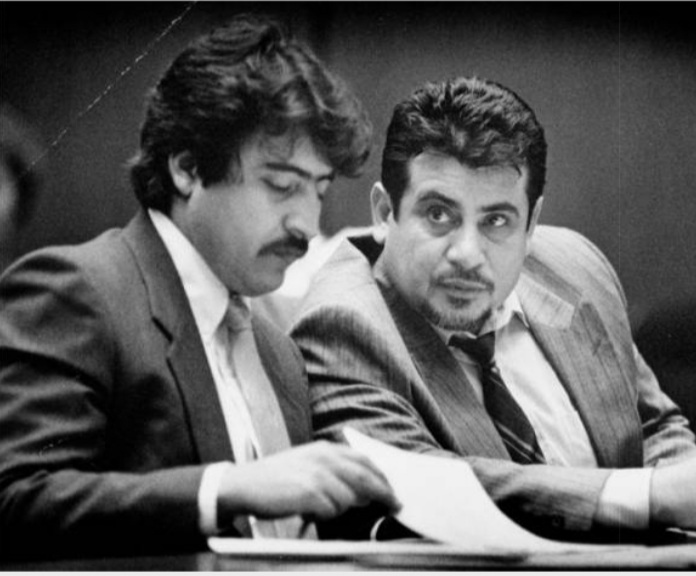
Daniel Hernandez, right, with Richard Salinas, 1988, from The Herald Examiner Collection. Perhaps, if you’d given the firearms expert the evidence he requested, you’d have had the evidence you needed for the rebuttal. Just a thought. What a fool.
There was significant evidence to show that the offences were not all linked to one another, enough to create reasonable doubt and yet Richard Ramirez was convicted on dodgy physical and ballistics evidence, the unreliable testimony of a “fence” (who was impeached for perjury) and inconsistent eyewitnesses, who could not decide if Richard was tall, short, Asian, white, Hispanic, who may have been blond with bad teeth, or perhaps straight white ones.
Conclusion of Steve Strong, or a lesson in serial blunders..
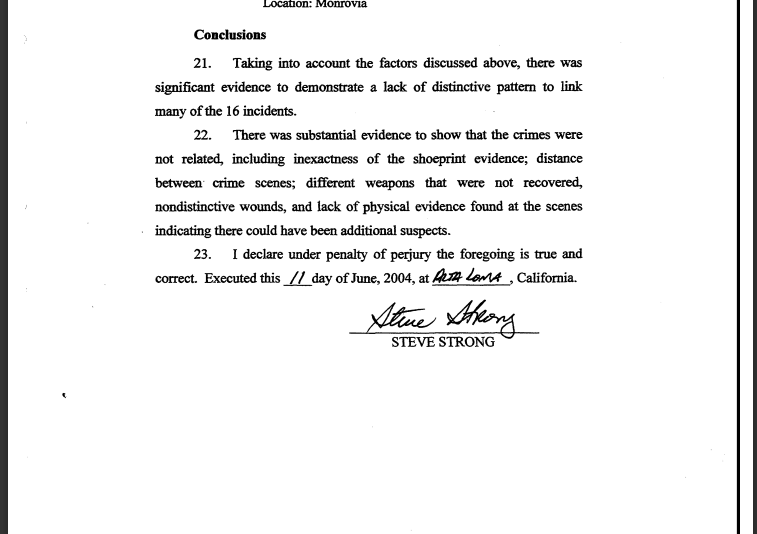
Declaration of Steve Strong, doc 7-20, from the Writ of Habeas Corpus One more step along in the railroading of Richard Ramirez, a series of catastrophic blunders, where his defence counsel conceded ballistic and shoeprint evidence, whilst simultaneously arguing that there was no pattern.
This case never fails to disappoint in its sheer disregard for the truth and the violation of rights. The prosecution improperly relied on inaccurate and unreliable evidence, urging on the jury the significance of such “evidence”, knowing it was incorrect, and using emotive language as it tried to forge links that just weren’t there.
“‘The prosecutor compared less sensational murders, such as the Yu incident to more sensational murders which involved mutilation: “So you didn’t have the mutilation [in Okazaki] that you had in a number of these other cases, but certainly very cold-blooded, deliberate act and inexcusable. . .. March 17 also, the murder of Ms. Yu out on the street . . .. Another terrible act again with no time to mutilate. ‘”
From the Writ of Habeas Corpus, transcript of the prosecution.There was no link but using the phrase “no time to mutilate” in addressing the jury had the purpose of imprinting a connection between random and unrelated crimes.
A competent defence team should have challenged on all counts, but they did not, having neither experience nor proper preparation. Which culminated in Richard being forever branded a serial murderer and receiving the death penalty multiple times.
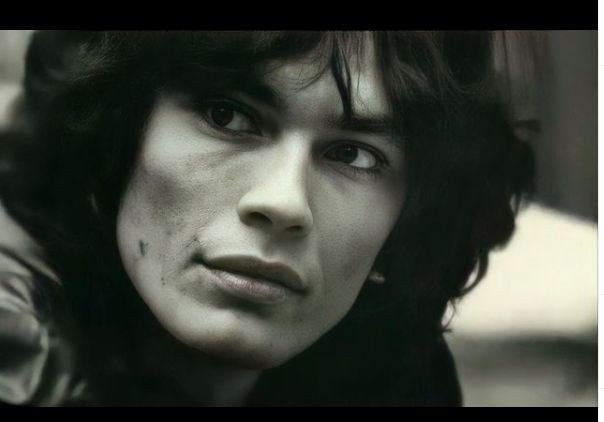
“Those who plead their cause in the absence of an opponent can invent to their heart’s content, can pontificate without taking into account the opposite point of view, and keep the best arguments for themselves. For aggressors are always quick to attack those who have no means of defence.”
Christine de PizanIt is painfully obvious there was no defence for Richard Ramirez.
~ Jay ~
-
The Light-Haired Man Who Attacked the Abowaths
This article will argue that the evidence in the Abowath case was deeply flawed in three areas: forensic science (bodily fluids), physical (shoeprints/firearms) and eyewitness identification. These raise serious doubts about Ramirez’s guilt for this crime.
Diamond Bar, Los Angeles County
8th August 1985
Some time after 2:30am, Sakina Abowath was woken by a loud “pop” of a gun, and was hit very hard on the head and forced onto her stomach. She was handcuffed and beaten about the head. Her assailant stood on the bed and kicked her in the head with what felt like boots. He bound her feet together and stuffed her mouth with clothing. He forced her to swear upon Satan that she would not scream – otherwise he would kill her two sons, aged three, and ten weeks. At some point, Mrs Abowath ended up on the floor, where she was blindfolded.
Later, the killer removed her gag and blindfold and demanded money and valuables. Mrs Abowath guided him to the wardrobe where jewellery was hidden in a briefcase. Mrs Abowath looked at the killer while they were in the bathroom, so he hit her and ordered her not to.
The killer went in and out of the bedroom multiple times as he ransacked the house. On the final time he returned to the master bedroom, he dragged Mrs Abowath into the guest bedroom, beat her and orally raped her. He vaginally raped her then covered her with a bedspread. The killer offered her some respite when he allowed her to comfort her crying baby, but soon dragged her back to the guest bedroom and raped her a second time, as well as unsuccessfully attempting to anally rape her.
When the three-year-old son began to scream, Mrs Abowath told him to climb into bed with her. The killer bound him and stuffed pillows on top of him, restricting his breathing and asked Mrs Abowath for some tape to put over the boy’s mouth. The intruder left the room but returned laughing that he had “hit” her husband Elyas Abowath, before handcuffing Mrs Abowath to the doorknob. He barricaded her inside the room with the bed and cushions from the living room and left by car.
Evidence at the scene:
- A melon, a spoon, and a pack of Salem menthol cigarettes on the table. Melon seeds littered the hallway and front garden (transferred by clumsy police officers).
- A .25 calibre copper cased bullet with red primer in Elyas Abowath’s skull.
- Two pubic or transitional hairs (between chest hair and pubic hair) on the Abowath bed.
- A rape kit swab was taken from Sakina Abowath containing semen.
- Semen stains on the bed.
- Kinney brand Stadia shoeprints on the kitchen floor.
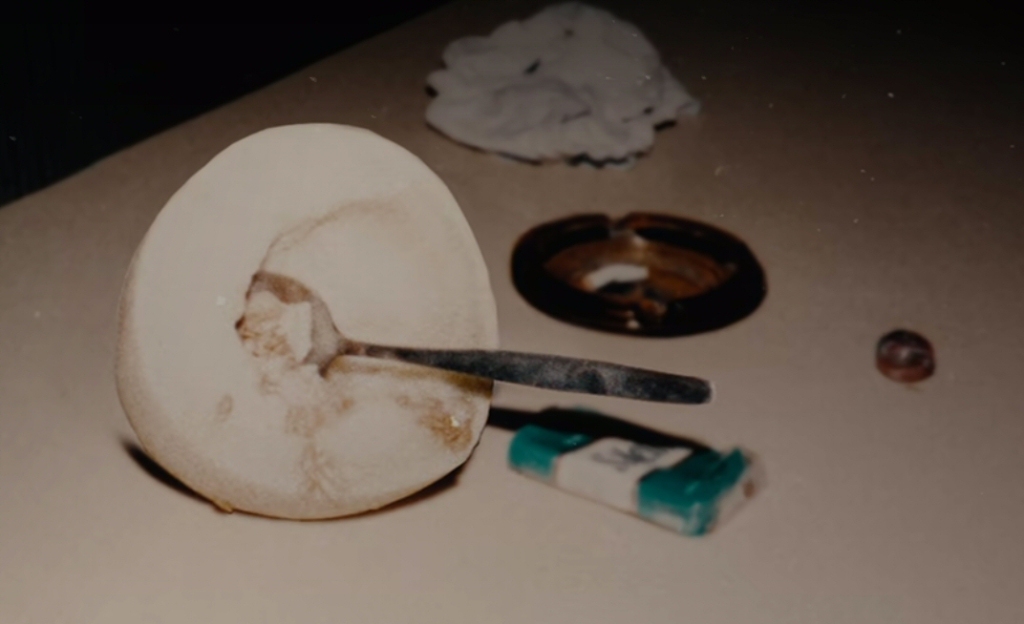
The melon allegedly enjoyed by the felon The Rape Kit Evidence Suggests Ramirez Was Not the Perpetrator
Detectives claim that the Night Stalker often ate at crime scenes, for example a banana and drinks can at the Bell and Lang crime and alleged milk consumption at the Pan case in San Francisco. A melon and cigarettes were found at the Abowath crime scene, with melon seeds down the hallway. No saliva tests from the melon, its seeds or the spoon were presented by the prosecution. There is no proof that Ramirez ate the melon or smoked menthols. He was not a smoker of ordinary cigarettes – he preferred marijuana. Sakina Abowath did not mention the killer smoking during the attack.
This was the pre-DNA era, so a vaginal swab was taken from Mrs Abowath to determine the PGM (phosphoglucomutase) subtype of the semen. This involves identifying specific variants (isoenzymes) of the PGM enzyme in bodily fluids. Philip Carlo’s book revealed that LASD criminalist, Steve Renteria, discovered that a specific “genetic marker” was present in the semen: a “two-plus band.” This refers to a specific PGM subtype (likely PGM 2+). Ramirez’s subtype did not include the 2+ band, he is conclusively ruled out as the source of the semen. (Carlo, pg. 373).
There were further semen stains on the bed. This time, Renteria used ABO blood typing tests. One stain matched Elyas Abowath’s blood group. The other was Type O, the same as Ramirez. The presence of Type O semen does not make Ramirez the perpetrator – O is the most common blood group. The most important semen sample was on the aforementioned vaginal swab. Why were there multiple sources of semen in the Abowaths’ bed?
“Transitional hairs” were found at the crime scene. This means hairs that are between pubic and chest hair. Ramirez had no chest hair and forensic testing – admittedly rudimentary at the time – ruled him out as the source. (Habeas Corpus pg. 138).
Because Ramirez’s lawyers failed to emphasise this evidence, their arguments made no impact on the jury. They did not retain their own forensic scientists to examine the evidence.
Ballistics Results Were Inconclusive and Possibly Misleading
As mentioned above, Elyas Abowath was killed by a .25 ACP firearm using bullets that contained red or pink coloured primer on the casings. However, because the weapon was never recovered, no appropriate testing could be done. Therefore the ballistics results cannot be conclusive.
The prosecution claimed this connected the Abowath crime to the Petersen Incident in Northridge, 57 miles away because the bullets at that scene also contained the pink/red primer. There was some circumstantial evidence: Ramirez had three similar-looking bullets within a collection in his bag. No other evidence tied the two crimes.
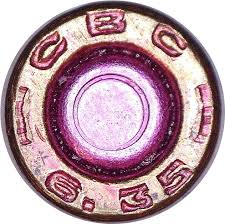
In the opinion of Deputy Sheriff Edward Robinson, the prosecution’s firearms expert, the red primer bullets were no longer manufactured – implying they were uncommon. But it is doubtful that Richard Ramirez should be the only person in Los Angeles who had these old bullets (the prosecution argued that his Avia sneakers were also unique). Ultimately, Edward Robinson failed to demonstrate how the bullet casings proved Ramirez pulled the trigger.
Paul Dougherty, the Habeas Corpus firearms expert, felt that all ballistics needed retesting and that they seemed too distorted to make accurate judgements. Dougherty was supposed to testify for the defence at trial but they failed to contact him and the prosecution’s firearms evidence was left unchallenged.
Shoeprint Evidence Was Weak and Contradictory
The Night Stalker was infamous for wearing size 11.5 Avia Aerobics sneakers. No Avias were found at the Abowath crime scene. Instead, Gerald Burke, a criminalist from the LASD crime laboratory, believed the prints came from size 12 Stadia aerobics sneakers from the Kinney brand. The sole pattern was a “dot matrix.” Stadia sneakers fit with what Ramirez was wearing when he was apprehended.
The Stadia impression was only partial and Burke could not determine whether it was from a left or right shoe and was size 12. However, when cross-examined, he was less certain. Forensic scientist, Lisa DiMeo, writing for Ramirez’s appeals, heavilty criticised Burke’s flawed measuring technique (Habeas Corpus documents 7.19 and 7.20).
At trial, Ramirez’s defence failed to bring a shoe forensics expert witness due to a combination of incompetence and lack of funds (they were not suffiently qualified to be paid by the court). Again, the prosecution’s evidence was not challenged.
Below is a photo from Beware the Night Stalker (Fox Nation – 2019). This purports to show the Stadia shoeprint but it’s merely the image of the sole printed on acetate and superimposed over a photo of the Abowaths’ linoleum. There is no way to judge for ourselves how much of the impression was visible or if it was there at all.

However, sneakers do not fit with the testimony of the victim. According to Ramirez’s biographer Philip Carlo, Mrs Abowath testified that her attacker had been stomping about in footwear that sounded heavy, like boots as opposed to sneakers. The killer removed his boots to rape her and took some time to lace them up (Carlo, pg. 371). Abowath also stated that it felt like she was kicked with a hard sole (Habeas Corpus pg.136).
Unreliable Eyewitness Testimony
Sakina Abowath drastically changed the description of the killer after her initial statement. Below is her description in a crime report taken immediately after the incident. It reports white skin (MW), tall, with light brown/dark blonde curls (Habeas Corpus document 20.3).

“Light brown or blonde curly hair.” Colouring and Ethnicity:
Mrs Abowath spoke to police four times. She reaffirmed to LASD Sergeant John Yarbrough (of the Night Stalker Task Force) that the intruder was “Tall, thin, with a recessed chest and light brown to medium blonde hair with curls.”
She now added that, although he appeared Caucasian, he had “Latin features” and “yellowish skin.” (Habeas Corpus, pg. 136). Latin features are not expanded upon and she said that he did not have an accent. Richard Ramirez had a slight Mexican lilt as one might expect of someone who grew up next to the Mexican border.
So, what changed to make Abowath think the suspect was no longer white, and was now possibly Latino? This raises the possibility that Mrs Abowath was asked leading questions by Sergeant Yarbrough because the Task Force already had a suspect in mind.
Later, when asked to help police create a composite sketch (which has never been made public), Sakina Abowath settled on the hair being “light brown” instead of possibly blonde. (Habeas Corpus, pg. 95). It seems as if every time Abowath was re-interviewed by detectives, her description moved closer to the suspect the Task Force was hunting for.
Teeth:
Initially, Abowath told Yarbrough the killer had “wide front teeth” and “Sakina could not recall any gaps in his teeth.” (Habeas Corpus, pg. 136). Note the language – did Sergeant Yarbrough ask her specific questions about gaps in the suspect’s teeth?
At this time, the Night Stalker Task Force had received intelligence that the suspect might have bad teeth. On July 20, the previous victim, Somkid Khovananth, reported her attacker to be a dark-haired, tanned Mexican with gapped, rotten teeth. The Khovananth police sketch was being wideley circulated at the time of the Abowath murder.
Smell and Appearance:
Abowath described the attacker as having a “receding” or “recessed chest” but again, this does not fit Ramirez’s appearance. Even though he was underweight, his upper torso was broad.
It is a misconception that all Night Stalker victims mentioned his pungent smell. Only Sakina Abowath reported body odour like “stale sweat.” It is not in any other police statements. (Habeas Corpus pg. 136).
This forensic evidence, had it been properly presented and contextualized, may have raised serious doubt in the minds of the jury.
The Court Identifications
It is unclear whether Sakina Abowath identified Ramirez at the September 5, 1985 line-up. The Petition and the Los Angeles Times suggested she had. However, she must have been present in the police station because she identified stolen property on the same day in the next room.
Abowath was first asked to identify the suspect in court at the 1986 preliminary hearing. Asking a victim to identify a suspect in court creates a bias. The following is from Dr Kathy Pezdek who wrote for Ramirez’s appeals:
“An in-court identification is not a fair and unbiased identification procedure because the eyewitnesses are not given a set of similar looking individuals from which to select the perpetrator. There is also the suggestion in court that the defendant must be guilty because he is there.“
– Declaration of Dr Kathy Pezdek, Habeas Corpus Document 16.7
Preliminary Hearing, 1986:
Sakina Abowath was curiously confused when asked to point her husband’s killer out in the courtroom, according to a Los Angeles Times reporter.
“The woman, who testified for about an hour, seemed not to notice defendant Richard Ramirez seated at a courtroom table until the prosecutor asked if she saw in the courtroom the man who attacked her.
“I beg your pardon?” the woman said, appearing confused.
“Do you see the man here today that was in your home that morning?” asked Deputy District Attorney, Philip Halpin.The woman gazed around, sucked in her breath and almost shouted, “Oh, yeah – him!” as she pointed towards Ramirez.”
– Los Angeles Times, 16th April 1986
A problem in the Night Stalker case was mass hysteria in California before Ramirez’s arrest. This meant that Ramirez appeared repeatedly on the television news and on the front pages of multiple newspapers. However, Sakina Abowath denied seeing Ramirez in any media, citing her Islamic faith – she avoided television during a grieving period.
The Trial, 1989:
Sakina Abowath became abusive and hysterical when she identified Ramirez in 1989. She screamed, “You son of a bitch! Why did you kill him?! You bastard!” and “Stand up! What’s wrong with you?” This was even more dramatic than the preliminary hearing where she had collapsed and had to be carried to the witness chair.
There were discrepancies in her testimony. Originally, she said she was woken by the popping sound of the gunshot that killed her husband. Elyas was clearly unresponsive or dead during her rape – he failed to come to her aid or make a noise. Yet, on the witness stand, she claimed Ramirez gratuitously killed her husband after she had given him everything.

Los Angeles Times, March 29, 1985. Unfortunately, Sakina Abowath’s dramatic witness testimony stuck in this alternate juror’s mind instead of the fact her description did not match.
The most persuasive evidence of Richard Ramirez’s guilt was (1) the woman who broke down and cried during her testimony and said, “why did you have to kill my husband?”
– Alternate juror, Janice McDowell, Habeas Corpus document 20.8.
Blonde Suspect Cross-Examination:
The matter of the light-haired killer returned. Sakina Abowath was asked why she told the police sketch artist that the suspect had “light brown” or “dishwater blonde” hair. Abowath blamed the bathroom light for making Ramirez’s black hair appear blonde – she insisted it was him.
The Habeas Corpus criticises Ramirez’s attorneys for not attacking Abowath’s credibility as a witness and suggest that she should have been “impeached.” That is to say they should have asked the judge to strike her testimony from the record so the jury could disregard it. (Habeas Corpus pg. 472).
The blonde suspect issue did not go unnoticed – some alternate jurors mentioned it in their appeals declarations.
“For example, I remember that at least one of the victims described their attacker as having dirty blonde hair and Mr Ramirez’s hair was clearly dark. That distinction was really significant and his lawyers didn’t do anything to adequately address just how significant this descrepancy was.”
– Alternate juror, Bonita Smith, Document 20.8.
And:
Specifically, I recall that three witnesses testified that they were assaulted by a tall, skinny Caucasian man. Mr Ramirez is not Caucasian and, in my opinion, would not be confused with someone who is Caucasian. Mr Ramirez’s lawyers didn’t seem to notice or didn’t understand the significance of that testimony … the other jurors said they’d heard the same thing … yet, I have no recollection of Mr Ramirez’s lawyers emphasising this discrepancy in an effective manner…”
– Alternate juror, James Muldrow, Document 20.8.
These alternative jurors did not seem to have raised an objection, but perhaps they were not in a position to because they were mere reserves.
The Stolen Property Evidence
As mentioned, on September 5, 1985, Sakina Abowath attended the property line-up. She identified jewellery, including two gold chains, earrings, an engagement ring, a necklace pendant, a television, and a VCR as items stolen by the murderer. These items were found in properties owned by a fence called Felipe Solano and his family. Solano was an acquaintance of Ramirez and given immunity from prosecution for telling police that Ramirez sold him the items. If true, this circumstantially tied Ramirez to several attacks.
However, it is not as clear-cut as it first seems. At trial, it transpired that Solano also received stolen property from other people and he was found to be a liar. The defence attorneys again failed to adequately impeach Solano. They also filed a motion against prosecutor Halpin to accuse him of subornation to perjury (calling witnesses he knew to be liars) but Judge Tynan ruled against their motion and to cross-examine Solano as normal.
Solano’s testimony crumbled as it transpired that he was protecting at least three other burglars. Two of those made police statements naming yet more burglars. None of this was thoroughly investigated and none of the informants and burglars testified at trial. The defence attorneys asked the prosecutor for addresses of these witnesses but the request was denied. Links to articles about the informants can be found at the end of this article.
Potential Suspects
Ramirez’s attorneys were supposed to raise the topic of third-party suspects who were known to both the police and the District Attorney. The Habeas Corpus petition goes as far as to suggest a suspect: the mysterious Julio – who was blonde, Mexican and six feet tall. (Habeas Corpus pg. 639).
Lastly, the defence were supposed to present a witness who saw something strange on the night of the attack: a security guard witnessed a Datsun pickup truck speeding away from the direction of Pinehill Lane (Carlo, pg 353). This witness was never called due to defence incompetence, and led to mocking from prosecutor Philip Halpin.
“Mr Hernandez told you that they were going to prove to you that there was a private security guard in the area of the Abowath murder… No nothing, no evidence of that at all.”
– Halpin, quoted on page 479 of the Federal Habeas Corpus.
Swear Upon Satan?
Sakina Abowath testified that her husband’s killer ordered her to swear upon Satan. This is circumstantial evidence that appeared to link Ramirez – who called himself a Satanist – to the scene.
Later, at the Carns/Erickson attack in Mission Viejo similar satanic demands were allegedly made – and this gunman also wore heavy combat boots. If this was the same man who invaded the Abowath home, which is highly likely, then could this be the blonde man. In the Mission Viejo incident, victim Inez Erickson was unable to see the suspect properly, and identified Richard Ramirez by his walk.
In conclusion, the prosecution’s case against Richard Ramirez for the Abowath crime rested on a framework of suggestive eyewitness testimony, inconclusive ballistics, questionable shoeprint analysis, and circumstantial possession of stolen property. Crucially, the only biological evidence capable of identifying the rapist: semen from the vaginal swab excluded Ramirez as the source. The defense failed to properly present this fact to the jury, nor did they effectively challenge contradictory testimony or the credibility of prosecution witnesses.Instead of certainty, the Abowath case reveals a troubling pattern of investigative tunnel vision. Changes in Sakina Abowath’s suspect description appear to track the evolution of police focus rather than objective memory. The failure to follow leads pointing to alternate suspects, the discrediting of potentially exculpatory forensic results, and the reliance on emotionally charged courtroom identification all undermine the integrity of this conviction.
-VenningB-
(9th Nov 2022, edited for clarity on 27th May 2025)
Sources:
Federal Habeas Corpus Petition, 2008.
Carlo, Philip. The Night Stalker: The Life and Crimes of Richard Ramirez, 2016 edition.
Further reading:
Another Night Stalker crime involving a suspect in boots.
The engineering of the Night Stalker’s appearance.

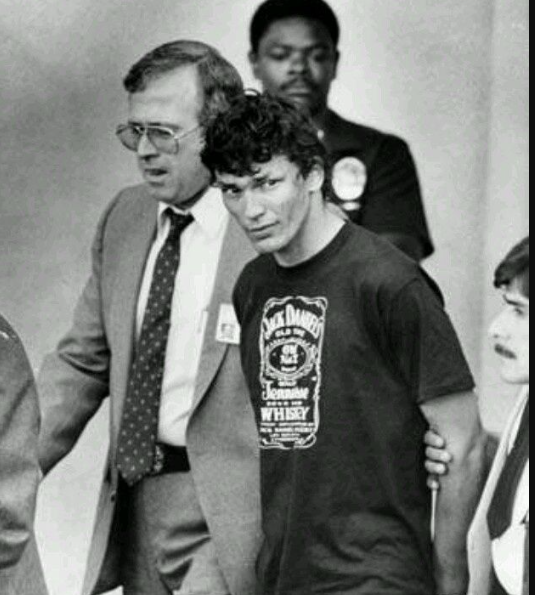

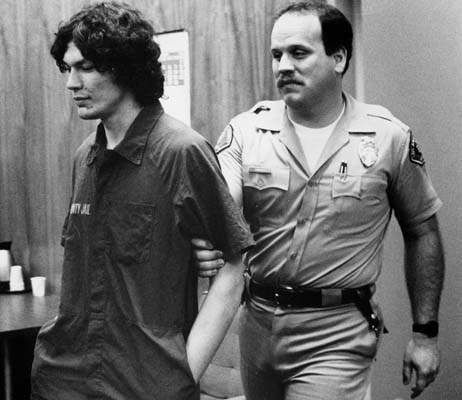
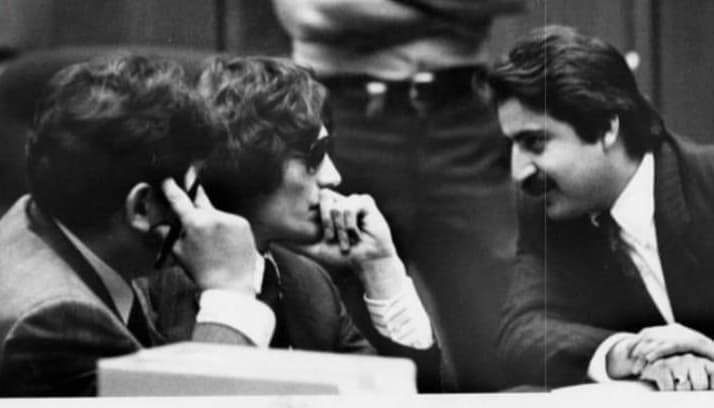
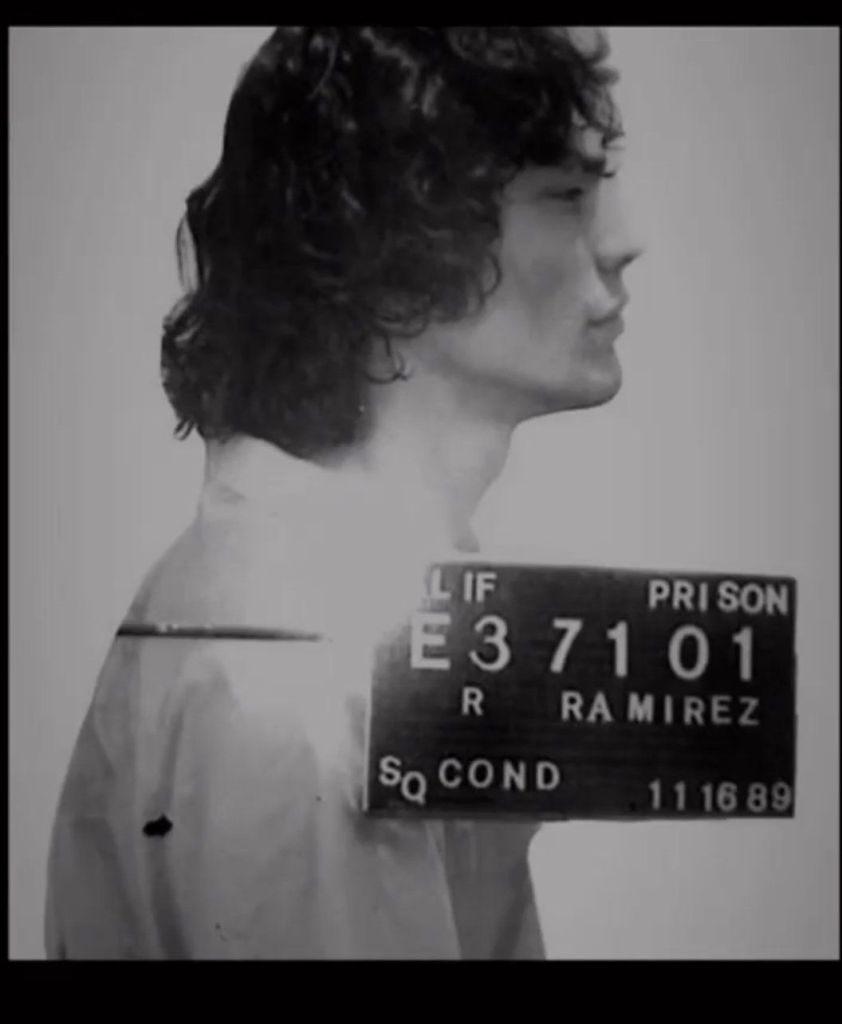
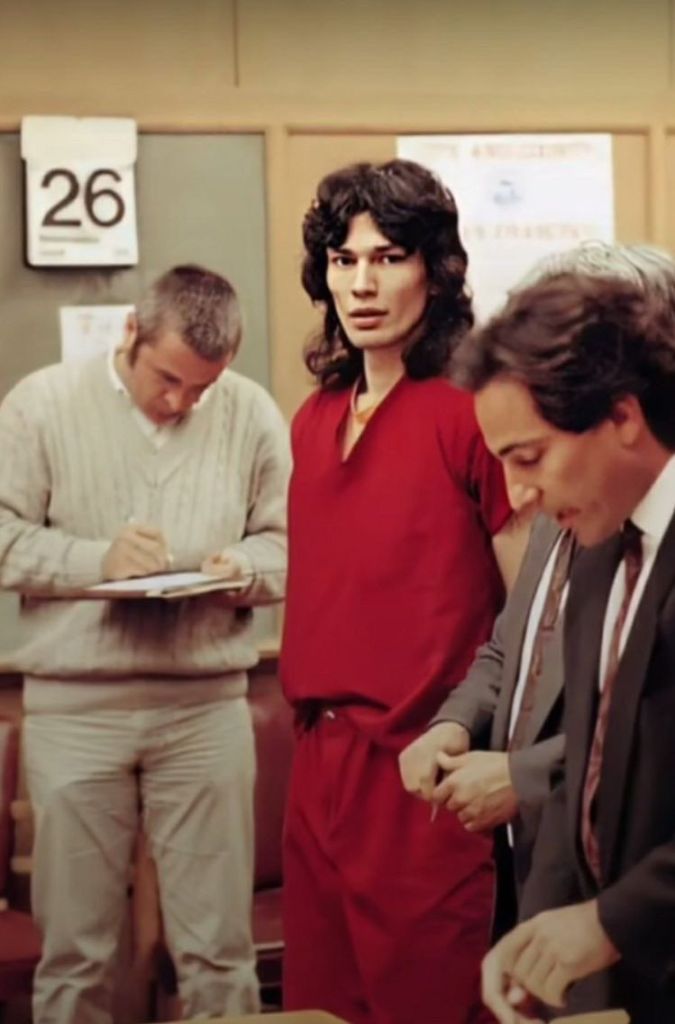
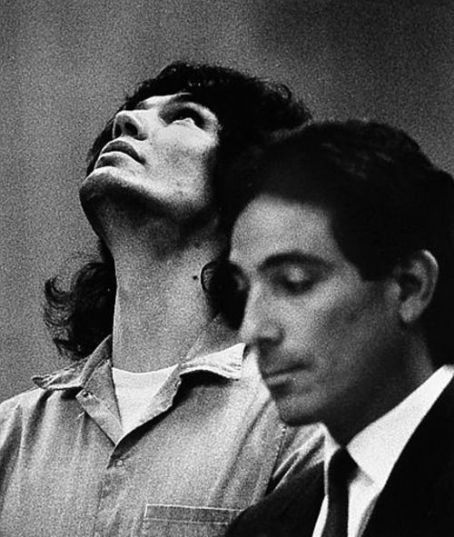
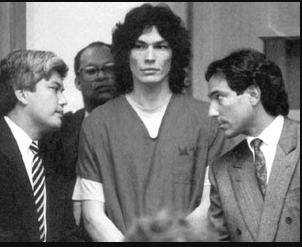
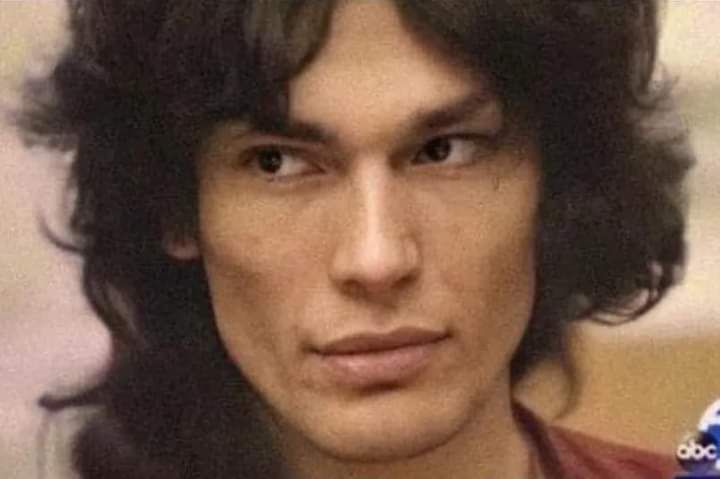
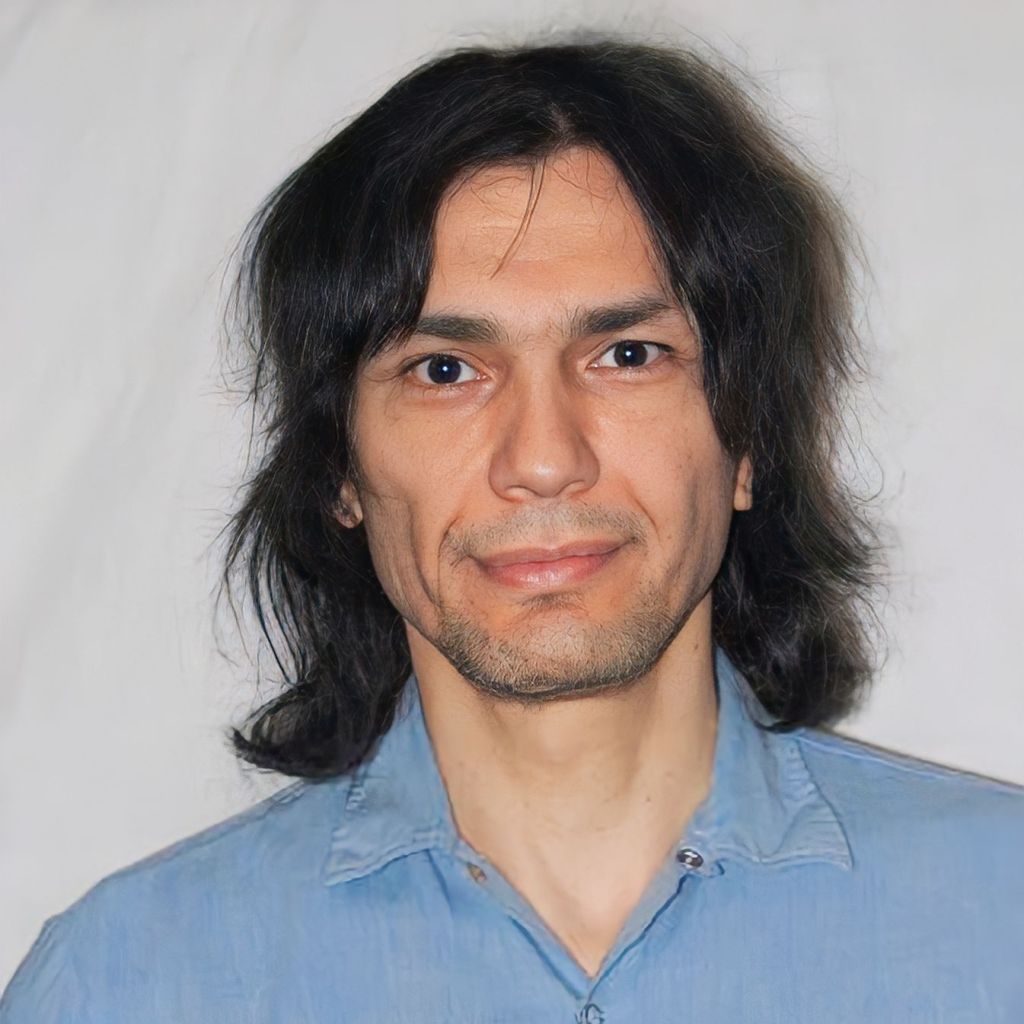
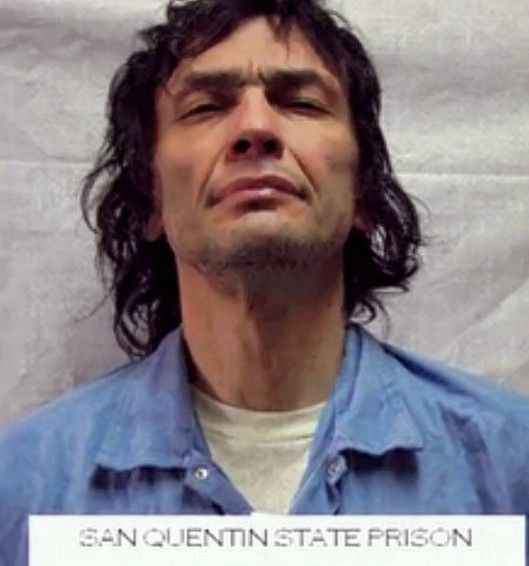
 Expendable For A Cause.
You must be logged in to post a comment.