
“The world has been fed many lies about me..”
Richard Ramírez
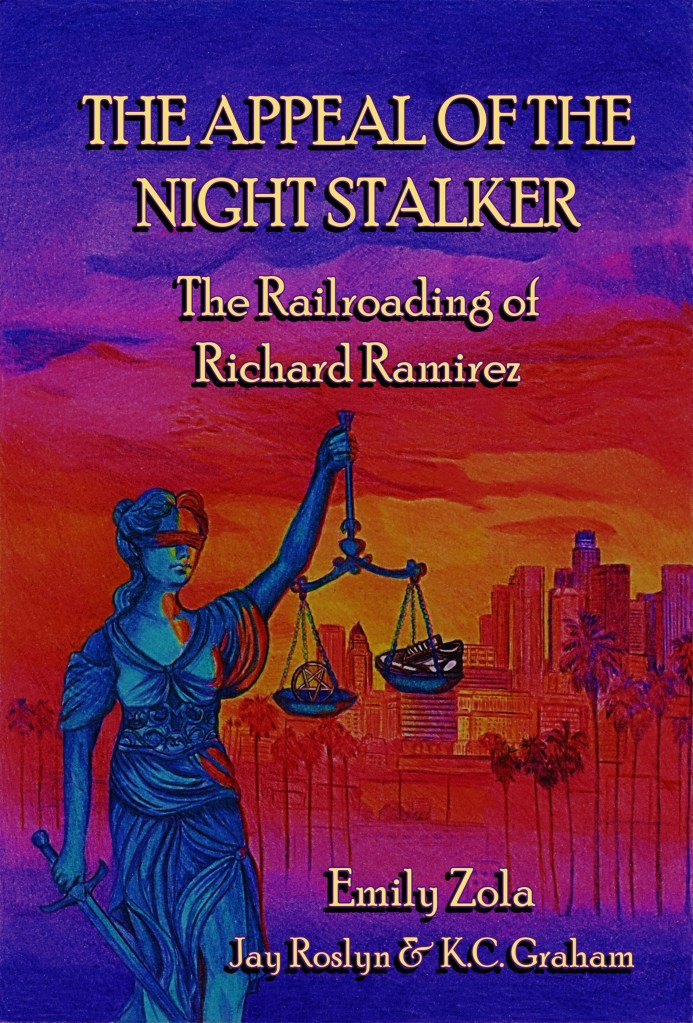
Now available, the book: The Appeal of the Night Stalker: The Railroading of Richard Ramirez.
Welcome to our blog.
This analysis examines the life and trial of Richard Ramirez, also known as The Night Stalker. Our research draws upon a wide range of materials, including evidentiary documentation, eyewitness accounts, crime reports, federal court petitions, expert testimony, medical records, psychiatric evaluations, and other relevant sources as deemed appropriate.
For the first time, this case has been thoroughly deconstructed and re-examined. With authorised access to the Los Angeles case files, our team incorporated these findings to present a comprehensive overview of the case.
The Writ of Habeas Corpus
The literal meaning of habeas corpus is “you should have the body”—that is, the judge or court should (and must) have any person who is being detained brought forward so that the legality of that person’s detention can be assessed. In United States law, habeas corpus ad subjiciendum (the full name of what habeas corpus typically refers to) is also called “the Great Writ,” and it is not about a person’s guilt or innocence, but about whether custody of that person is lawful under the U.S. Constitution. Common grounds for relief under habeas corpus—”relief” in this case being a release from custody—include a conviction based on illegally obtained or falsified evidence; a denial of effective assistance of counsel; or a conviction by a jury that was improperly selected and impanelled.
All of those things can be seen within this writ.
The Writ of Habeas Corpus is not a given right, unlike review on direct appeal, it is not automatic.
What happened was a violation of constitutional rights, under the 5th, 6th, 8th and 14th Amendments.
Demonised, sexualised and monetised.
After all, we are all expendable for a cause.
- ATROCIOUS ATTORNEYS (4)
- “THIS TRIAL IS A JOKE!” (8)
- CONSTITUTIONAL VIOLATIONS (9)
- DEATH ROW (3)
- DEFENCE DISASTER (7)
- INFORMANTS (6)
- IT'S RELEVANT (17)
- LOOSE ENDS (15)
- ORANGE COUNTY (3)
- POOR EVIDENCE (16)
- RICHARD'S BACKGROUND (7)
- SNARK (12)
- THE BOOK (4)
- THE LOS ANGELES CRIMES (22)
- THE PSYCH REPORTS (14)
- THE SAN FRANCISCO CRIMES (5)
- Uncategorized (5)
-
You, the Jury
Questioning
The word “occult” comes from the Latin “occultus”. Ironically, the trial of an infamous occultist and Satanist is the epitome of the meaning of the word itself: clandestine, secret; hidden.
We’ve written many words; a story needed to be told, and we created this place to enable us to do just that.
Here, in this space, we intended to present the defence omitted at Richard Ramirez’s trial in violation of his constitutional rights. Our investigations have taken us down roads we’d rather not travel along, but as we did so, we realised that there was so much hidden we could search for a lifetime and still not see the end of it. Once we’d started, there was no turning back; we followed wherever it led.This was never about proving innocence; that was never the intent or purpose. We wanted to begin a dialogue, allowing this information to be freely discussed and for us to verbalise the rarely asked questions. We asked, and we’re still asking.
We can’t tell you, the reader, what to think; you must come to your own conclusions, as we did.
And so
We’ve said what we came here to say; with 114 articles and supporting documents, we’ve said as much as we can at this point.
This blog will stand as a record of that, and although we will still be here, we intend to only update if we find new information, if we suddenly remember something we haven’t previously covered, or to “tidy up” existing articles and examine any new claims (or expose outrageous lies) that come to light. The site will be maintained, and we’ll be around to answer any comments or questions.
What Next?
We will focus on the book being worked on; we’ve also been invited to participate in a podcast. When we have dates for those, we’ll update you.
The defence rests? Somehow, I sincerely doubt that; ultimately, we’re all “expendable for a cause”.
~ J, V and K ~
-
Satan Loves Some Metal.
“We’re on a Highway to Hell!”
*Please note: there is use of swear words and sexual references in parts of this post.*
Summer 1985, picture the scene: a young addict, a stolen car, cruising through Los Angeles in the darkest hours of the night.
Cocaine surging through his veins, adrenaline pumping, he slams a cassette tape into the car stereo and disappears into the night, in search of women to rape, people to kill. Music pounding, he feels invincible, he knows Satan is on his side, protecting him. Because, fuck yeah, AC/DC!

Lyrics from Highway to Hell by AC/DC, They say never let the truth get in the way of a good story, however, I am going to, because the famous rock anthem was inspired by a stretch of road in Australia called the Canning Highway, not the Prince of Darkness. Sorry.
That’s the often-told tale, part of the myth surrounding this case, that Richard Ramirez, self-confessed Satanist, committed his heinous and diabolical crimes due to the influence of heavy rock.
“Satanic Panic!” – a very brief over view
In the 1980’s USA, the phenomenon, that came to be known as the “Satanic Panic” came to a head, the frenzy, fuelled (as ever) by the media, led citizens to believe that Satan was lurking around every corner. He was coming for your children, poisoning their minds through heavy metal/rock music, Dungeons and Dragons; and they were also being ritually abused or slain by a vast network of Satanists, hiding in plain sight throughout the country.
This “moral panic” had been teetering on the edge since the late 60s and into the 70s, with the founding of the Church of Satan in 1966, the release of film The Exorcist, the Manson case and the plethora of Serial Killers throughout the 70s, and their supposed links to the occult, in particular The Zodiac Killer and David Berkowitz, aka The Son of Sam. It spilled over in the 80s with the release of the (now debunked) book Michelle Remembers and the highly publicised McMartin Preschool case in Los Angeles.
Satanic Panic persisted late into the decade, with TV personalities like Geraldo and Oprah dedicating hours of time to the subject. Geraldo claimed there were over one million Satanists hiding in neighbourhoods, and this fear did not begin to disperse until after the McMartin case had also been debunked and parents turned their fears in another direction.
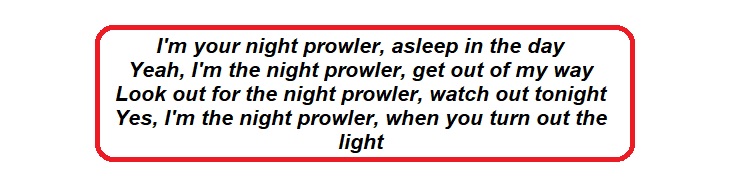
Lyrics from Night Prowler by AC/DC
“The Filthy Fifteen”
Ahh, yes, Satan’s favourite, some good old rock music.
Bands such as Judas Priest, Black Sabbath, Led Zeppelin, Twisted Sister, and of course, AC/DC, were in the firing line, coming in for hatred and blame, accused of hiding “Satanic messages” within their lyrics, with the suggestion that if you played your vinyl records backwards, demonic sounds were heard. That’s just stupid, yes, you got warped sounds — because it pushed the needle backwards. It just ruined the record, so you went out and replaced it! Genius marketing.
(I know this, because I tried it with my sister’s Led Zeppelin IV album, not because I believed in subliminal messages, but I wanted to hear if it was true, none the less. I wrecked both the album and the turntable stylus, both of which I had to replace. I still have the replacement album, sadly not the turntable)
Music, in particular, rock or metal, was thought to be influencing the young, to encourage them in the participation of drinking, sex, drugs and devil worship.
This eventually led to the birth of the Parents Music Resource Center, in 1985, and the “Filthy Fifteen”, a list of what was deemed the most disgusting songs and the requirement of parental advisory stickers on albums. Most were about sex and drugs, but a couple on the list were because of the “Occult”. AC/DC made the list, but not for Highway to Hell, Hell’s Bells or Night Prowler.
What a load of basket cases.
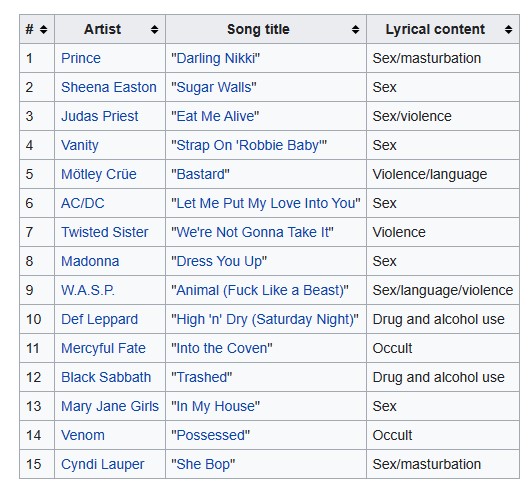
The Filthy Fifteen. Sheena Easton, is that you?
Ride like the Devil..
Just when you think things couldn’t couldn’t possibly get any crazier, along comes a couple of evangelists to prove us wrong.
‘Southern Ohio evangelist Jim Brown claims that he and cohort Greg Hudson have discovered that the theme song to the old ”Mr. Ed” television show contains a satanic message when played backward’.
Chicago Tribune, May 1986Here’s the article in full for you.
Oh, and a video from YouTube.
Es tu, Mr Ed?
Stranger Danger!
With the Reagan administration came a new panic, this time in the shape of stranger danger. The theme of social chaos and disorder permeated the air, and with family values and law and order at the heart of the Reagan campaign, the combination of the two “panics” came at the perfect time.
In 1982 CBS News informed a horrified nation that 50,000 children were abducted by strangers every year, although these figures had been wildly inflated, it served to create further uproar. A stranger was coming for your child!
THIS article, which went to print the day after the arrest of Richard Ramirez, again debunks the exaggerated numbers. Whether this article had much impact on either the city or wider county of Los Angeles is hard to say, after all, they had been terrorised for weeks and months over the so-called Night Stalker killing spree.

The caption dated September 1,1985, a quote by the woman in the photograph, identified as Debbie, reads:
“I don’t know why the Night Stalker started to bother me. Nothing like this has ever happened before, but it did. So, when my husband went on call the other night, I started cleaning and oiling my gun. I’m taking shooting practice this week.” Photographer Anne Knudsen from the Herald Examiner Collection.Los Angeles was a hot-bed of crime before, during and after the Night Stalker crimes, the only difference was public perception and media attention.
Richard
Into this maelstrom, out of nowhere, they dropped Richard Ramirez. Here at last, was the perfect example of everything they had been warning about for years. The drug addicted, rock music-loving, Devil worshipping, thief, rapist and murderer: the stranger in your perfect world, the “drifter”, as he was called in many news articles.
The media went wild and so began the circus, the show trial and the railroading of Ramirez.
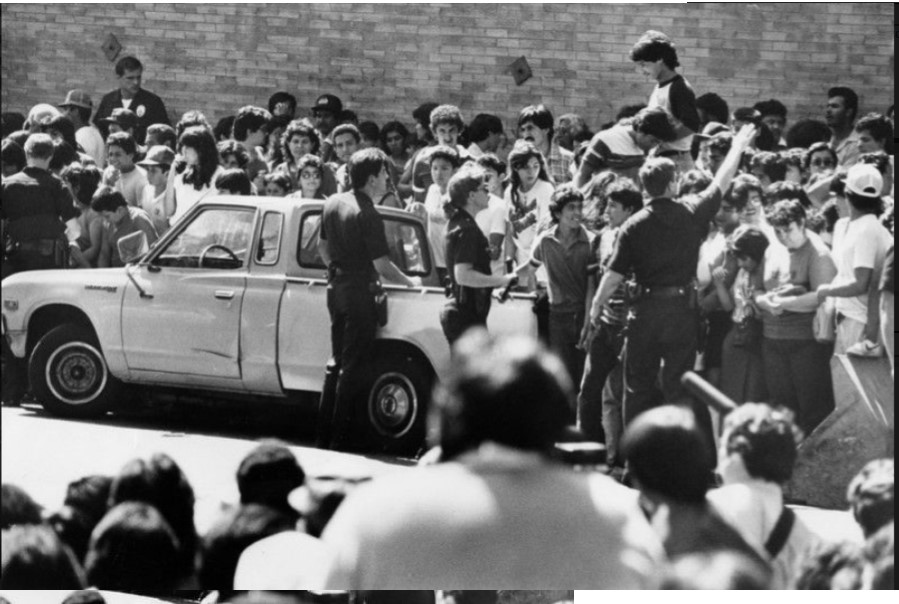
Photographer Mike Sergieff, from Herald Examiner Collection. Photograph caption dated September 1, 1985 reads:
“Police hold back crowd that gathered at the LAPD’s Hollenbeck station.”
Photograph snipe dated August 31, 1985 reads:
“Nite [sic] Stalker vigil at LAPD’s Hollenbeck. Crowd on St. Louis St. being pushed back by LAPD officers to across the street and onto First St. for crowd control by the police station where the night stalker suspect was moved from.” Additional photograph caption reads, “After the capture, crowds surged around Hollenbeck station in East Los Angeles to catch a glimpse of the Night Stalker.”
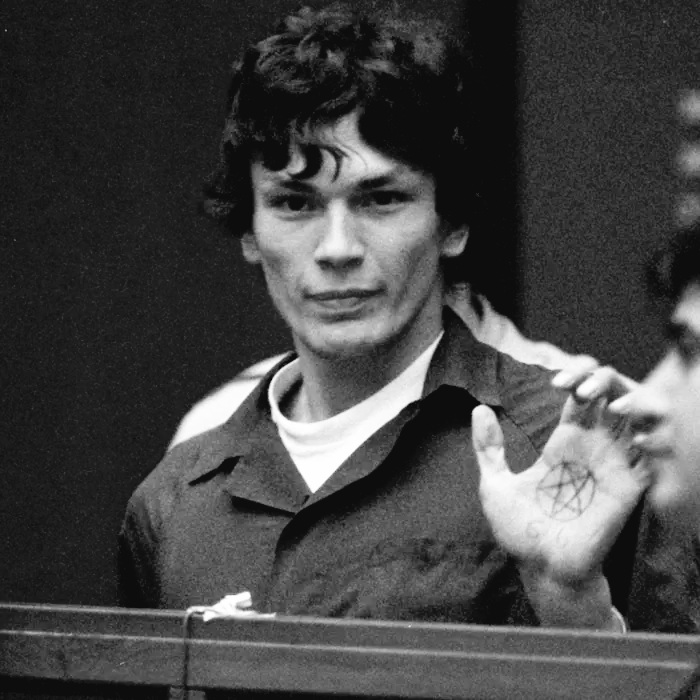
“Hail Satan” Richard’s chances of a fair trial were slim to zero, right from the beginning, as we have shown many times.
A review of the L.A. Times showed extremely prejudicial and inflammatory language used to describe and characterise Ramirez and the “Night Stalker” crimes:
- “Satanic Overtones”
- “Devil Worshipper” (Ex. 76, L.A. Times Articles Reviewed by Dr. Bronson)
- “Diabolical”
- “Satan Worship”
- “Satanic rituals”
- “At House hearing regarding alleged pornography in rock music, panel was told by an expert about AC/DC ‘one of their fans, I’m sure you know, is the accused Night Stalker,’ referring to serial murder suspect, Richard Ramirez’” (this is a reference to the Filthy Fifteen)
You get the picture, and there were hundreds of these articles.
Every fourth article, or one-quarter of the actual amount of L.A. Times
articles ,was devoted to the Night Stalker, and this information was drip-fed to a non-sequestered jury.“People knew my lifestyle, and the connection was made by them – and eventually the police – that because of my beliefs, I was the perfect candidate for being the Night Stalker”
Richard Ramirez, from a 1993 interview with Hustler.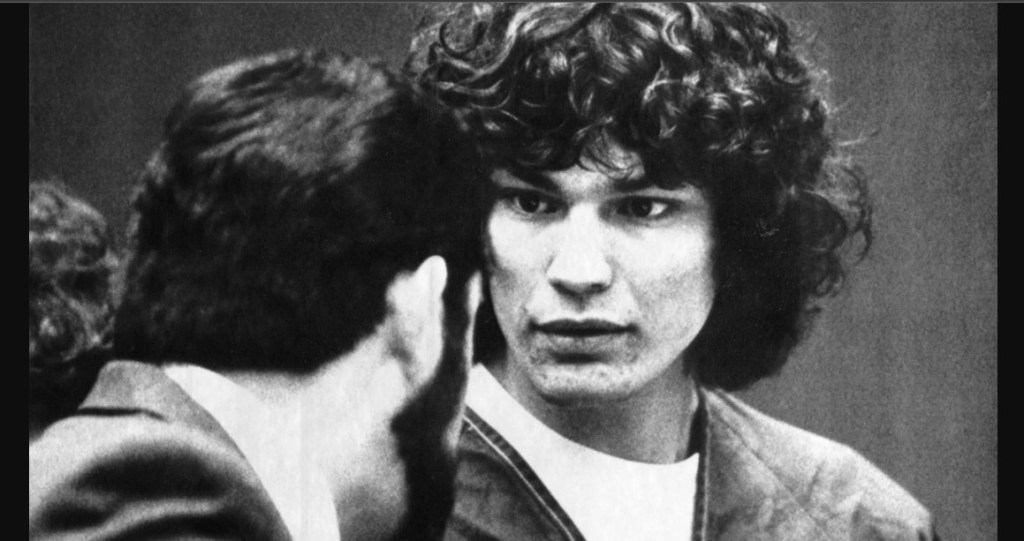
For Richard, his love of rock music, coupled with an interest in the occult, and his criminal activities, of both stealing and dealing, created the perfect storm, one in which he remains embroiled forever.
“I’m an angry motherfucker and I just hope all those that are deserving get what they got coming. I’ll leave it at that.”
Richard Ramirez~ Jay ~
-
The Gallery of Horrors
Some people have watched the Netflix documentary and were left with the question: how did all those varied composite drawings lead to Richard Ramirez? He looked nothing like most of them, yet Ramirez had many distinguishing features, like scars and unusual eyebrows.
Here is a quick rundown of some the composites involved in the Ramirez case. There were others but they were not released to the public, or have been lost in the mists of time.
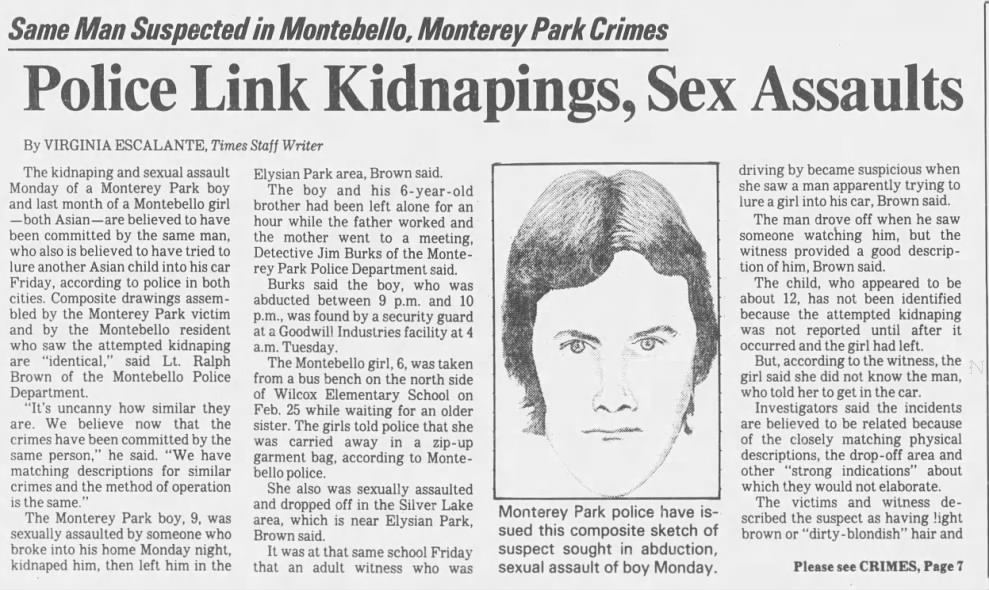
Feb-March 1985: The San Gabriel Child Abductor. Three children and one adult said he was “dirty blonde” or light brown, 5’9” and of medium build. Below is a composite sketch of the suspect, from a 14th March 1985 Los Angeles Times article, again describing his hair as “dirty blondish” to light brown.
A 29th March Los Angeles Times article gives the same description but a different drawing, this time a sketch rather than a composite. It was created by police sketch artist Fernando Ponce.
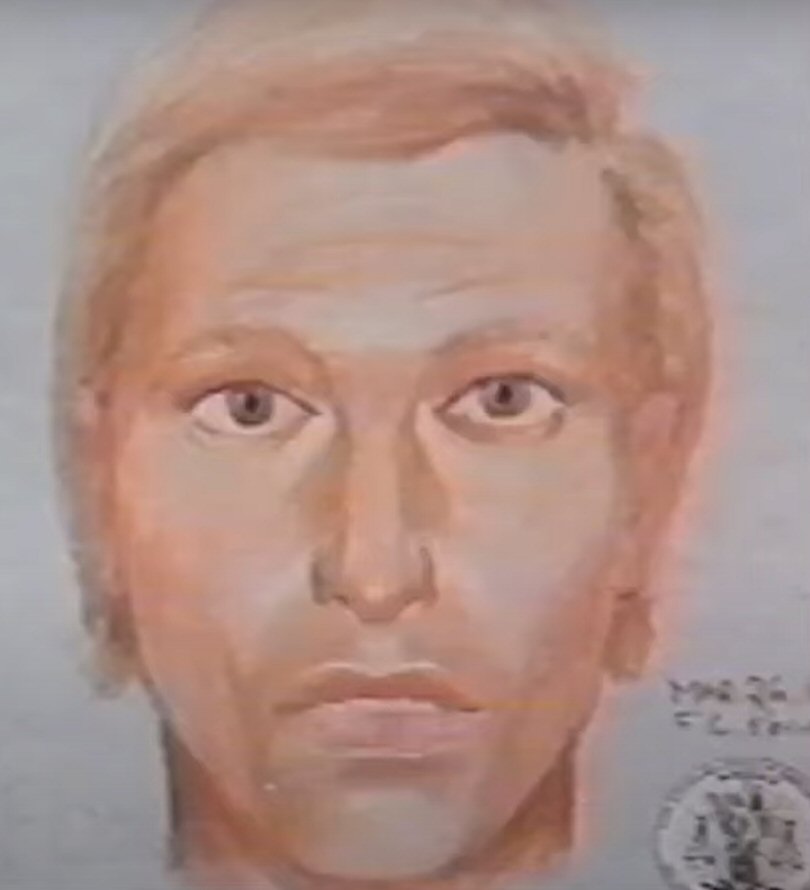

Ramirez as he looked in December 1984 compared to the blondish-brown child kidnapper of February/March 1985. March 1985: After Dayle Okazaki’s murder, victim Maria Hernandez helped create a drawing of a moustachioed hitman.

Detective Carrillo found an AC/DC hat inside their garage, so Moustachioed Hitman gained a hat in April – the logo was not included for some reason, which is unhelpful.
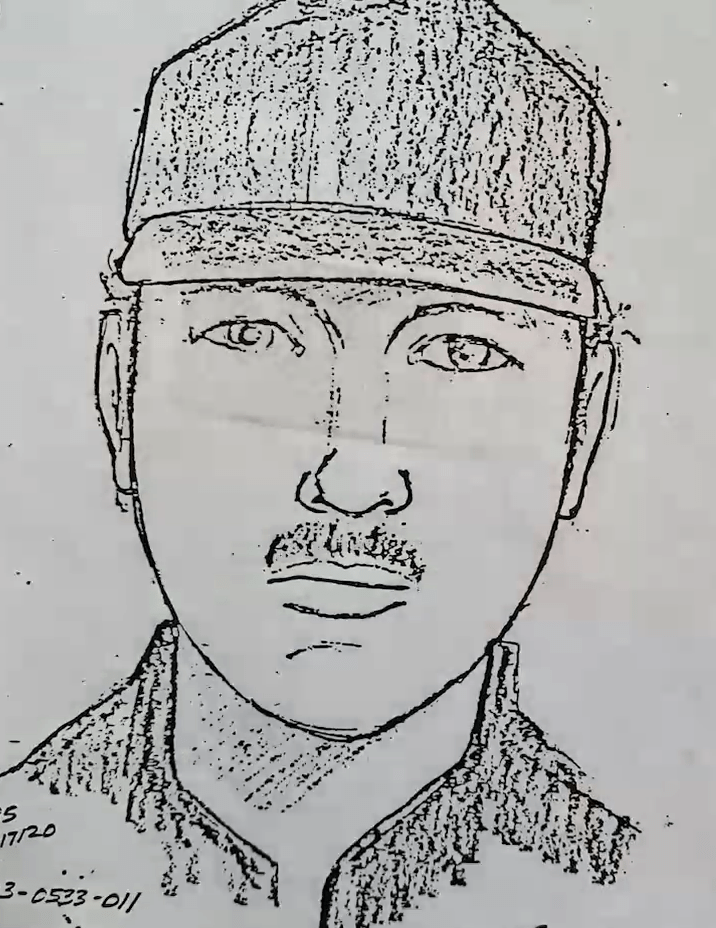
The Doi sketch – previously thought to be from a child abduction. Lillie Doi told neighbours that she did not think Ramirez was her husband’s murderer.
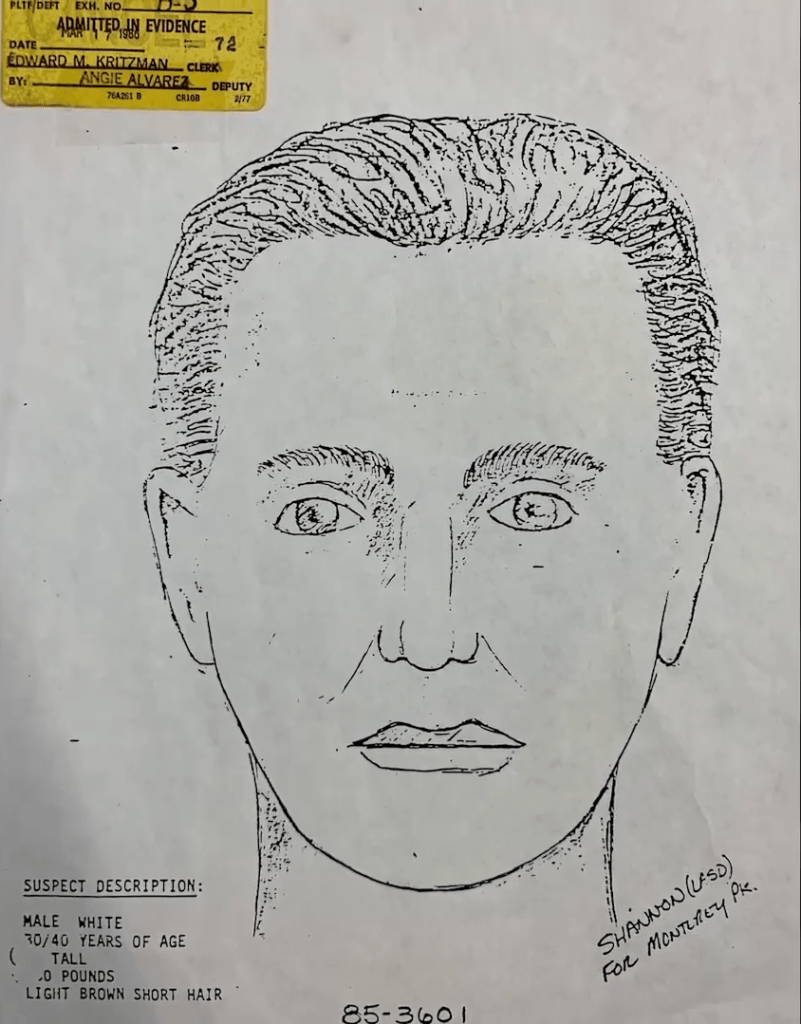
Released on 25th June 1985: Carol Kyle was raped by a Latino with a side parting and fringe, whose hair curled slightly at the ends. (She was attacked on 30th May so there was a delay between the attack and her meeting with police artist Fernando Ponce) Again he has none of Richard’s distinctive features: arched eyebrows, messy hair, full lips – and, at the time – broken teeth. More on his teeth later…

On 7th July Sophie Dickman was raped. The sketch below ended up looking the same as the composite in two unrelated crimes and the nose is similar to those. Some newspapers state that this was the suspect in the Joyce Nelson crime, based on the paper girl describing a curly haired man lurking in the street days earlier, although this is never made clear.
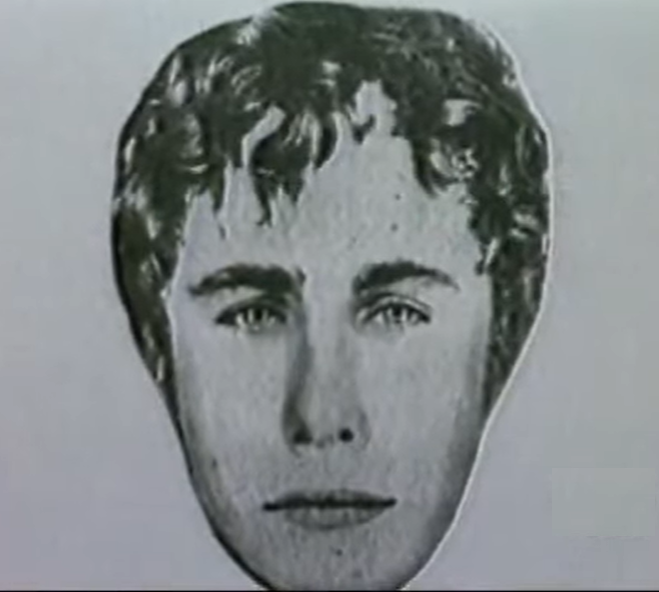
Composites are made almost like a flat, two-dimensional Mr Potato Head where you are given a base head shape and select see-through slides of features and overlay them onto that face. It has Richard Ramirez’s hairstyle, but curly hair is not uncommon.
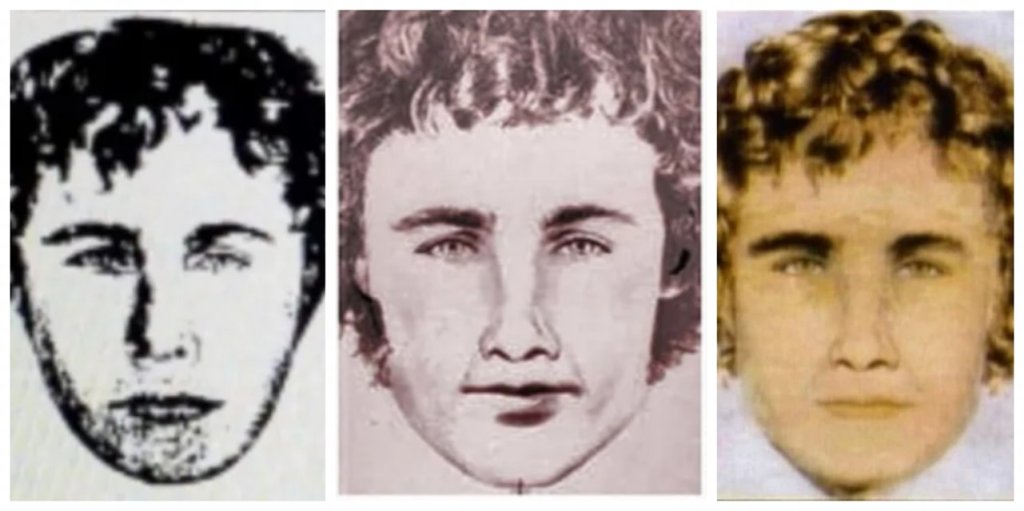
Because of this method, many composite sketches look the same across the United States. This is silly – composite sketches are not always drawn by artists, so this same face, aside from a few differences has been used in the 1978 suspected Golden State Killer attack (below, centre) and also for the ‘Brayman Road Attacker’ in Connecticut from 1988. Frankly, it should be thrown in the bin.
When Evil Triplets Attack Now we come to the most famous composite, again by Fernando Ponce, for the Khovananth Incident which occurred on 20th July 1985.
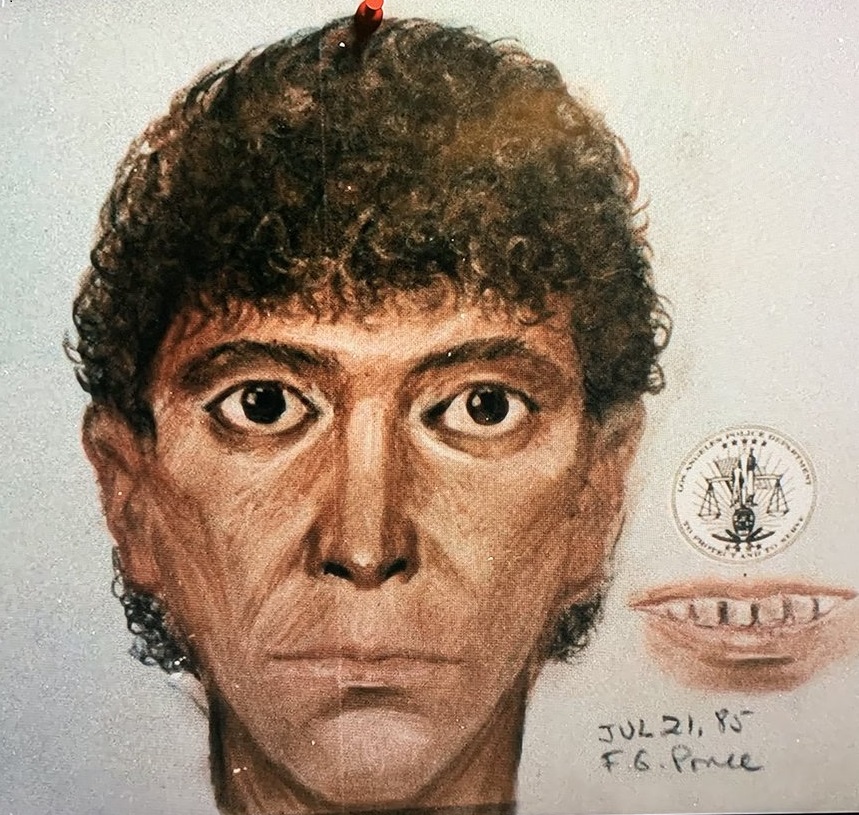
The reason the police decided that this composite was the man they were looking for, was because they had previously pulled over a man named Richard Mena for a traffic violation in a car found to be stolen. That man was Richard Ramirez using an alias. Richard drew a pentagram on the car, which was suspicious – a pentagram had been drawn on a recent murder victim.
Richard left his dental appointment card behind and they discovered he had decayed teeth – the damage and decay to his upper front teeth created a gap. For the record, Somkid Khovananth was the only victim who described someone with ‘stained, gapped teeth’ – no one else. The police (mostly Carrillo) and the media lied. He does not really resemble Richard. All his features are wrong; the distinct attributes are absent. Furthermore, Khovananth described him as having a brown face, before changing it.
Not that the nose is very similar to the third child abductor drawing. Detective Carrillo insists that every victim description was identical. However, it is important to note that the abductor was fair-haired and averaged sized, not tall, skinny and dark like Mrs Khovananth’s description. It is common mistake for artists to draw the same face over and over, which might explain the similarities.

Apparently, Sakina Abowath helped to create a composite, but it has not been made available but in any case, she had originally seen a very tall, dirty blonde to light brown-haired man. It seems likely that Abowath had been led by the police and was shown the Khovananth composite. After being asked whether his teeth were stained, she changed her description from “wide front teeth” to “crooked and stained”. Reminder: Ramirez’s semen was not on her vaginal swab.
A child named James Romero spotted a ‘prowler’ in his yard. The prowler wore a baseball cap. Because an attempted murder occurred 1.5 miles away, the police somehow decided – without evidence – that the prowler was the killer. So, the Khovananth composite gained a hat.
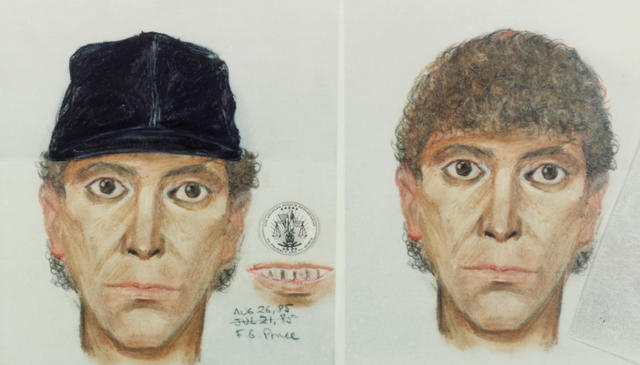
By now, the police had Ramirez in their sights, and thanks to the police focus on the ‘stained, gapped teeth’ man, were beginning to receive tip-offs from his associates. All the previous descriptions were swept away. However, on 30th August, Carol Kyle made a second composite. Kyle insisted her rapist had ‘clean, straight teeth, with excessive gums’. We know Ramirez did not have his front teeth fixed until early 1986.
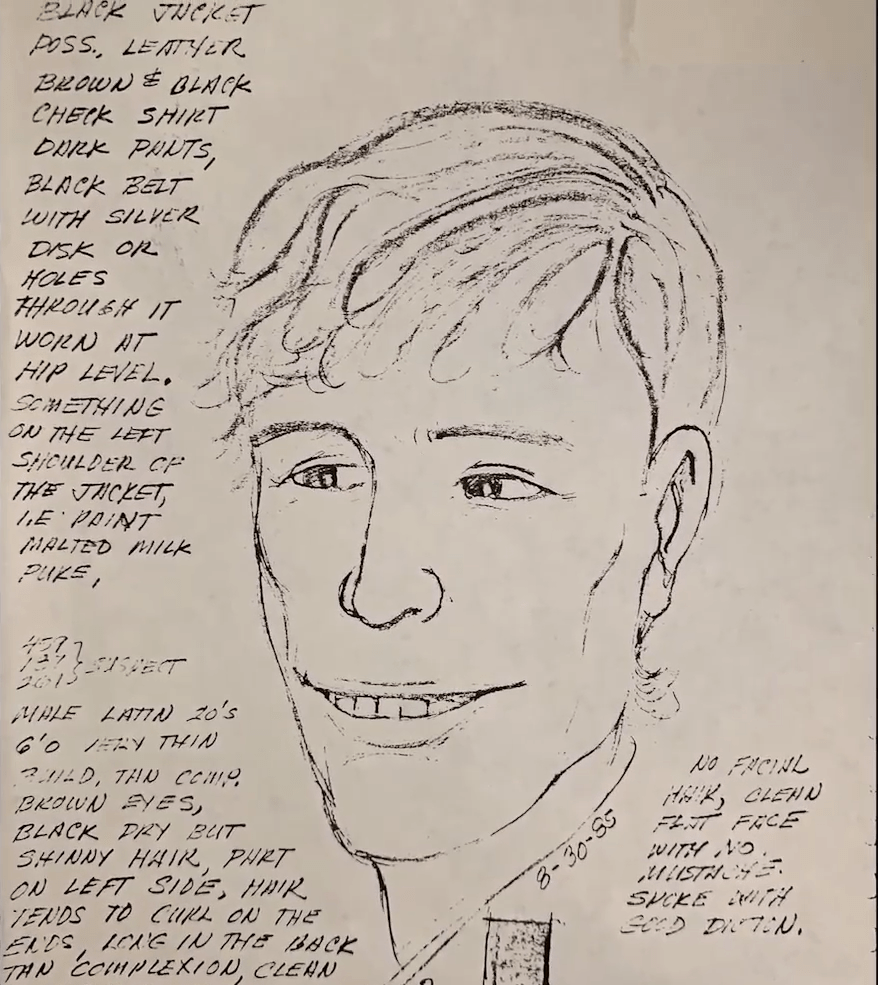
The artist, Deputy Sheriff Mahlon Coleman, denied knowing what Richard Ramirez looked like despite the fact informers had given the police his name, and his face was released on the news that very night.
The Netflix documentary shows this weird August 1985 morph of multiple composites. You can see where the hat from the Khovananth/Romero composite has been laid over the blondish paedophile sketch – the forehead is dark and the teeth drawing is just visible.
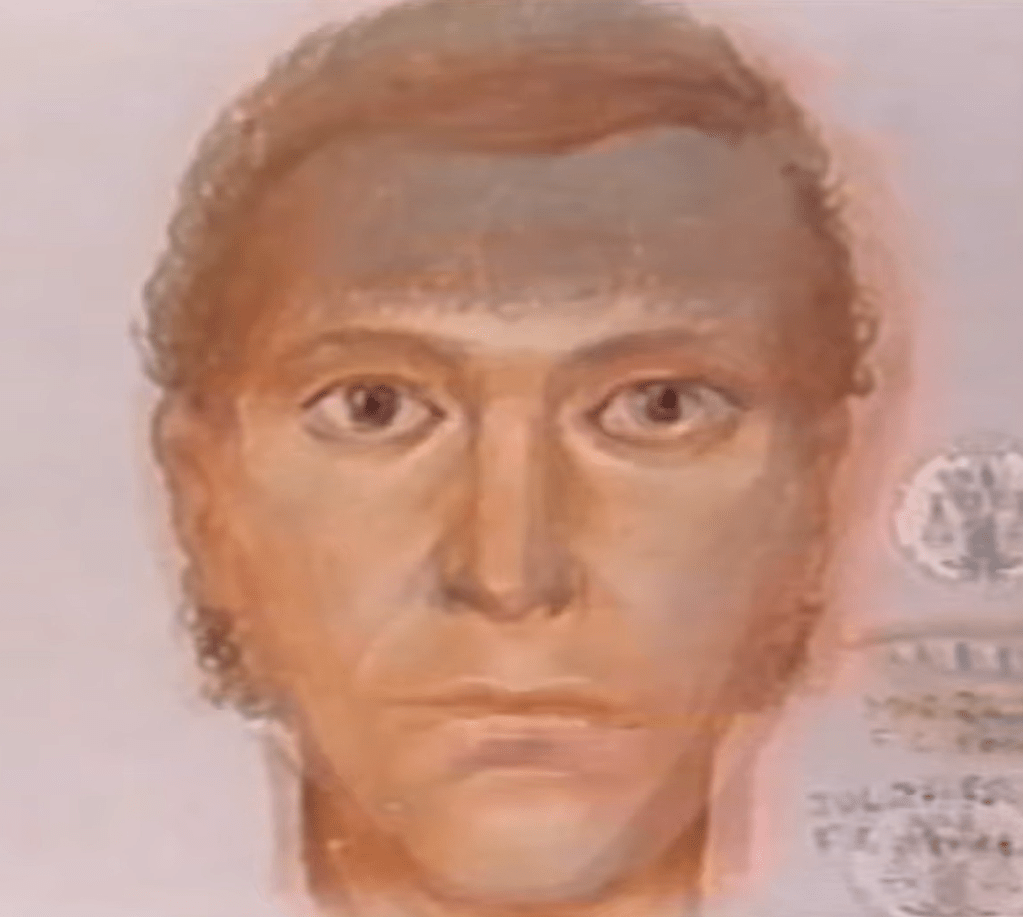
Just as a footnote. This is probably fake.

Here’s why. Compare it to the real one and look at the dates.
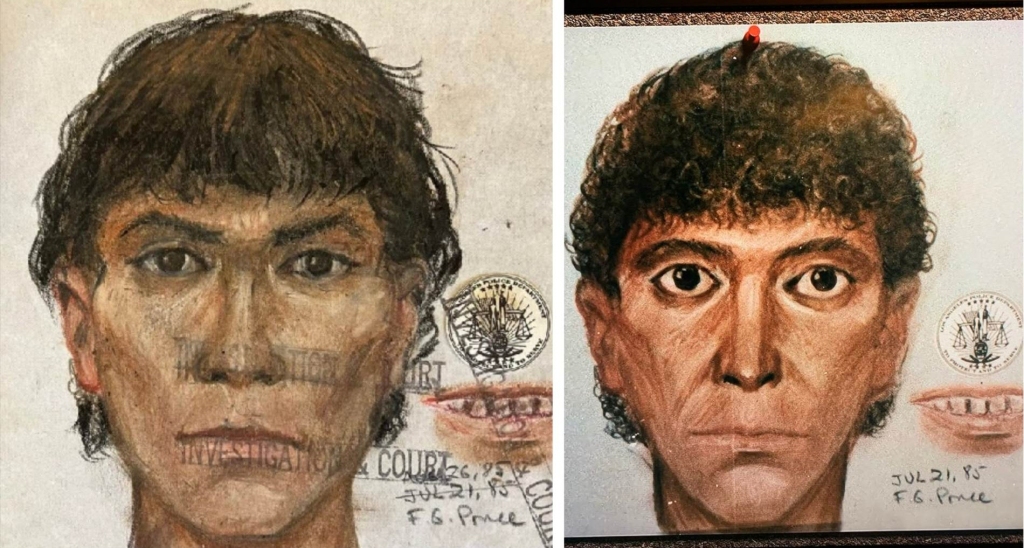
July 21st was the original creation date of the image on the right. It was crossed out and replaced with August 26th and given a hat as per James Romero’s description (see the dual image above).
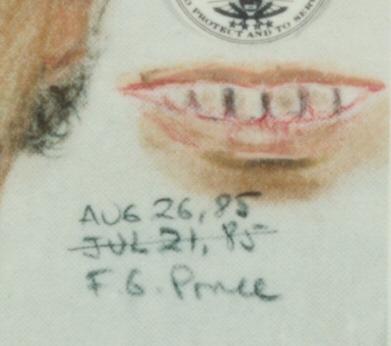
It would be nice if people would refrain from fabricating evidence and muddying the waters of a case already shrouded in mystery and outright deception.
-VenningB-
09/01/2023
-
Presumed Guilty
We’ve been sold a lie all these years. It’s been one vamped-up story after another to keep the ever-growing saga of Richard Ramirez alive. But the lies don’t add up. So many of the stories that have been spun don’t even make sense. Richard has been wrongly vilified for 37 years. The truth has been silenced and suppressed, with no one revealing the uncensored evidence of this convoluted story, until now.
Could any defendant possibly have had a more biased judge and jury than Richard Ramirez? Before you think I’m being too harsh or don’t know what I’m talking about, please continue to read as we delve deeper into this topic.
What is the Role of a Jury?
In criminal law, under the United States Constitution, a defendant has a right to a jury trial. The role of the jury is to hear and see the evidence, to follow the law, to deliberate after all the evidence has been presented, and to decide whether or not the accused is guilty of one or more of the charges.The key is impartiality and a presumption of innocence.
Where Do the Jurors Come From?
A jury is supposed to be made up of the accused “peers.” Generally, jurors are selected from those who have registered to vote. The court sends out notices to a certain number of voters in the local community requiring that they appear at the courthouse for possible selection as a juror. This creates a “jury pool”. In Richard’s case, the jurors were drawn from an area that was within 20 miles of the courthouse in downtown Los Angeles where his trial was held.
The jury is chosen from the jury pool through a process called a “voir dire.” The voir dire involves asking each person various questions to determine if they can be impartial when deliberating and deciding on the guilt or innocence of the accused. A jury is supposed to be made up of individuals who have not formulated an opinion about the defendant’s innocence or guilt. A jury trial consists of 12 jurors and several alternate jurors. The alternates attend the trial the same as the main jurors but have no input in deliberations or trial outcomes.
Change of Venue
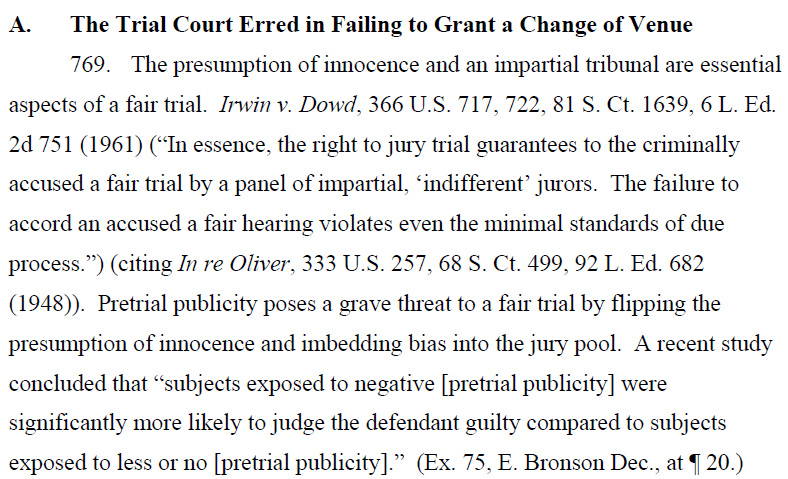
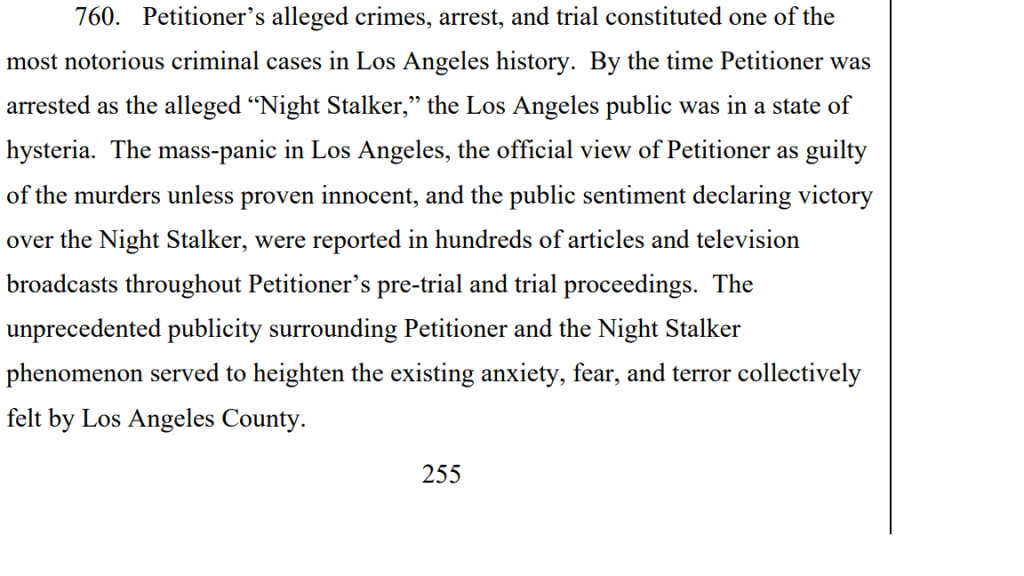
Richard’s case received an extraordinary amount of publicity. Even before Richard was arrested, the newspapers and television networks were filled with information about the Night Stalker. Los Angeles county was in a frenzied state. Gun sales were up. People were putting bars on their windows and buying guard dogs. A state of fear permeated the entire county. When Richard was arrested, many people expressed relief. Even the mayor of LA County made a statement on the day of his arrest, telling the public that they could rest easy because a dangerous criminal had been removed from the streets. He even said there was no need for a trial. Mere days after the arrest, Sheriff Block said that Richard’s arrest had removed the most significant threat the county had ever experienced. So much for innocent until proven guilty. More like innocent until accused.
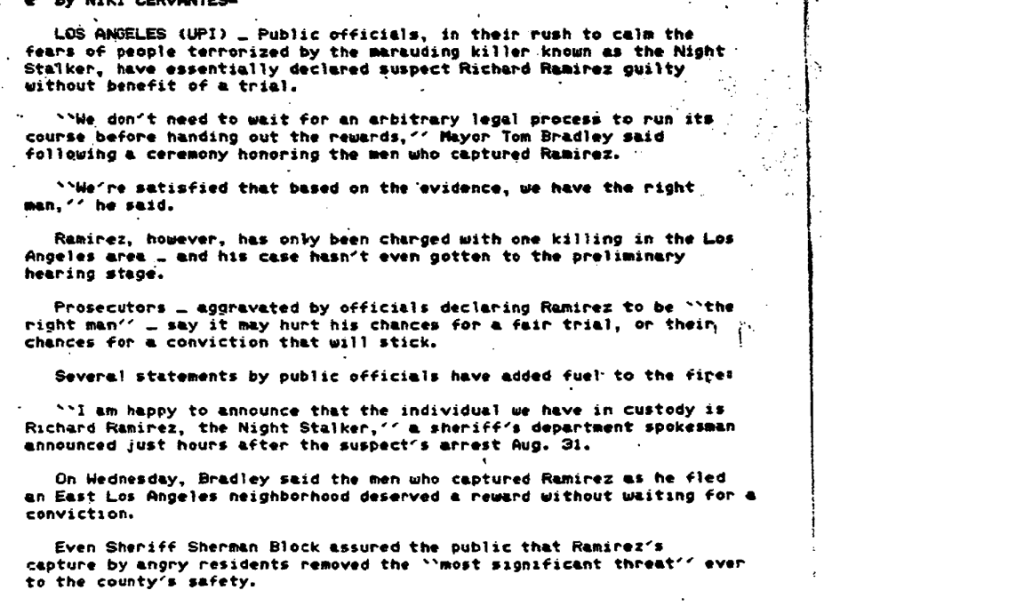
Another example of the toxic publicity surrounding Richard’s arrest, this letter, appeared in the Los Angeles Times shortly after Richard was arrested.
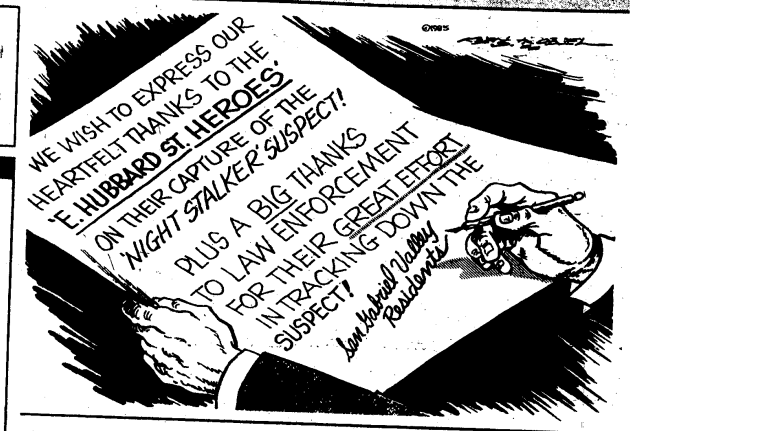
The thugs, for that, is what they were, that chased Richard down and beat him over the head the day of his arrest, were celebrated as heroes. If they had done what they did to Richard to another individual, they would’ve been charged with assault. Instead, they were given rewards and parties. This was the culture Richard’s jury was selected from.
The inept Hernandezes did make a motion to move the trial out of Los Angeles County, but they failed to properly authenticate supporting documents per trial protocol, and the motion was denied.
The Jury of Richard’s Peers
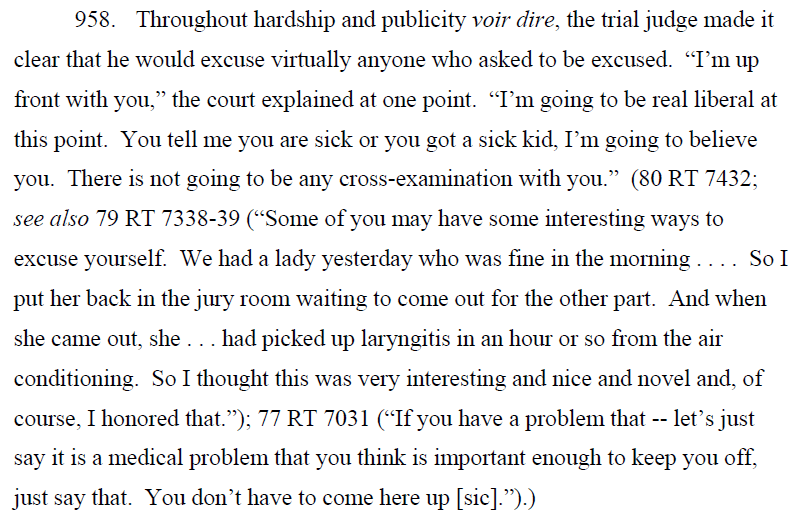
Several potential jurors were excused because they simply told Judge Tynan they could not serve because of an alleged “hardship.” However, this was after he led potential jurors in such a way that basically told them they could be excused for any reason, and he wouldn’t question them any further or require proof of hardship.
During voir dire, both the prosecuting and defense attorneys have what is called a “strike” available to use. Using a strike excludes the potential juror from serving. An attorney can use a strike for basically any reason to get a potential juror removed, but an attorney is not supposed to be allowed to remove a potential juror because of race. There are a limited number of strikes an attorney can use, and once they have used them all, they can no longer have a potential juror dismissed. During voir dire, the prosecution used strikes to remove several black and Hispanic jurors and to remove jurors that did not support the death penalty.

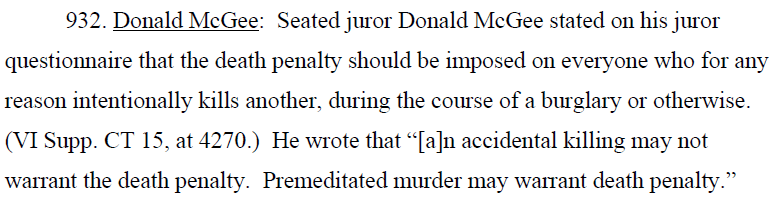
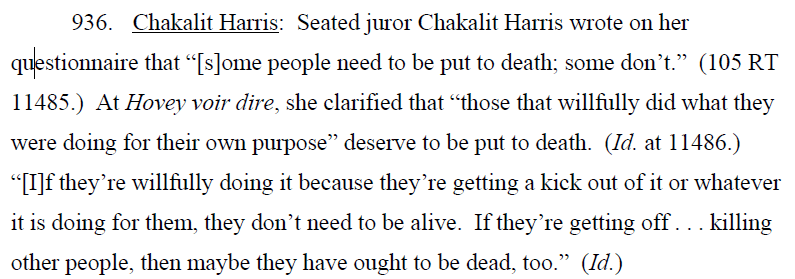
The Hernandezes had to use several strikes to remove potential jurors that believed the death penalty was an appropriate punishment for any murder conviction, regardless of mitigating factors. Despite this, several jurors remained that had strong beliefs in favor of the death penalty, such as Donald McGee and Chakalit Harris.
January 1989, 12 jurors and 13 alternate jurors were impaneled. And so began the trial of the Night Stalker. The following individuals would determine Richard’s fate: Lillian Aragon, Alfred Carillo, Lillian Casselli, Cynthia Haden, Chakalit Harris, Mary Helen Herrera (replaced Phyllis Singletary), Arthur Johnson, Donald McGee, Felipe Rodriguez, Martha Salcido, Verbe Sutton (replaced Robert Lee), and Shirley Zelaya. The jury would not be sequestered, meaning they would continue to be exposed to the onslaught of media coverage of Richard’s case and trial. And none of that publicity would favor Richard.
The burden of proof in a criminal trial is not on the accused. It is not their responsibility to prove they are innocent. It is the duty of the prosecuting attorney to prove the defendant committed the crimes they are accused of beyond a reasonable doubt. They have to prove that it is 100% likely the defendant committed the crime. It’s not to be a case of “I think they are 99% guilty.” Yet, in Richard’s trial, the burden of proof was placed on the defense. The jury expected Richard’s attorneys to prove he was innocent.
The jury that determined Richard’s fate ended up being a tainted jury of ” volunteers.” Basically, those that wanted to serve on Richard’s jury, for whatever reason, were the ones that ended up on the jury.
Removal of a Juror
The guilt phase deliberations began on July 26, 1989. On August 11, the jury foreman sent a note to Judge Tynan stating that Juror Robert Lee had fallen asleep briefly on 2 occasions during deliberations. The foreman stated he had not seen this juror sleeping before, and neither had any other jurors mentioned it. The foreman would further state that one of the alleged sleeping episodes was during their lunch break. On the basis of the information provided by the jury foreman, Juror Lee was removed from the jury without Tynan even so much as speaking to him about the alleged incidents or exploring alternative options.
Under the Fifth Amendment of the United States Constitution, a defendant has a right to have his case decided by the original jury that was sworn in. Very few reasons allow for the removal of a juror once they are sworn in, especially during a capital trial case. This is a right rooted in the “double jeopardy” clause of the Fifth Amendment. And “cat napping” on two occasions, one during a lunch break, certainly isn’t a legitimate reason. Far worse things have occurred in trials that did not result in the removal of a juror. Judge Tynan neglected to conduct a hearing to establish good cause to remove Robert Lee. Instead, he took the jury foreman’s statement at face value without so much as discussing it with Juror Lee. Judge Tynan not only interfered with the jury composition by removing Juror Lee, but he also allowed the jurors to exercise control over the composition of the jury, which was tantamount to jury tampering. Perhaps Juror Lee, 16 days into deliberations, did not agree with the findings of the other jurors. Could Robert Lee have been the one “hold out” that had the potential to cause a “hung jury?”
Murder of a Juror
On August 14, 1989, juror Phyllis Singletary failed to appear for jury duty. The following day, Judge Tynan informed the jurors that Singletary had been found in her apartment, beaten, and shot to death. Most of them had already learned of this via news broadcasts. On August 16, an alternate juror, Mary Helen Herrera, was selected to replace Singletary. She was so distraught and overcome with emotion that she could not even walk to the jury box and take her place as juror number 8, the seat Singletary had filled. All of the jurors were, rightly so, very upset and distraught over the murder of someone they had spent the past 7 months with and had come to know. Despite this, a mere 2 days after the murder, Tynan ordered the jury to resume deliberations. Richard’s attorneys did object to this and asked that the jury be polled on their ability to remain impartial. A request that Tynan denied. His solution was to ask the jury foreman, Felipe Rodriguez, if the jury could continue and resume deliberations. The following is the conversation Judge Tynan had with Rodriguez:
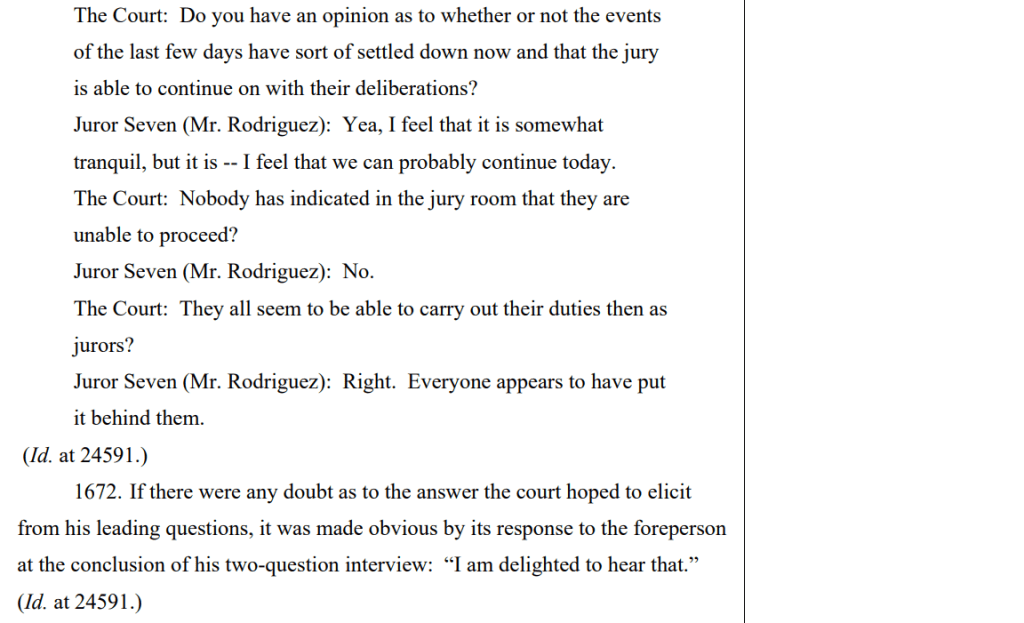
Two days after they found out a fellow juror had been murdered, the jury foreman told Tynan, “everyone appears to have put it behind them.” I find it difficult to believe that something as disturbing as the murder of a juror would be “put behind them” in 2 days. Here we also have the jury foreman testifying to the state of mind of the other jurors. How does one adequately testify to the emotional state of 11 other individuals?
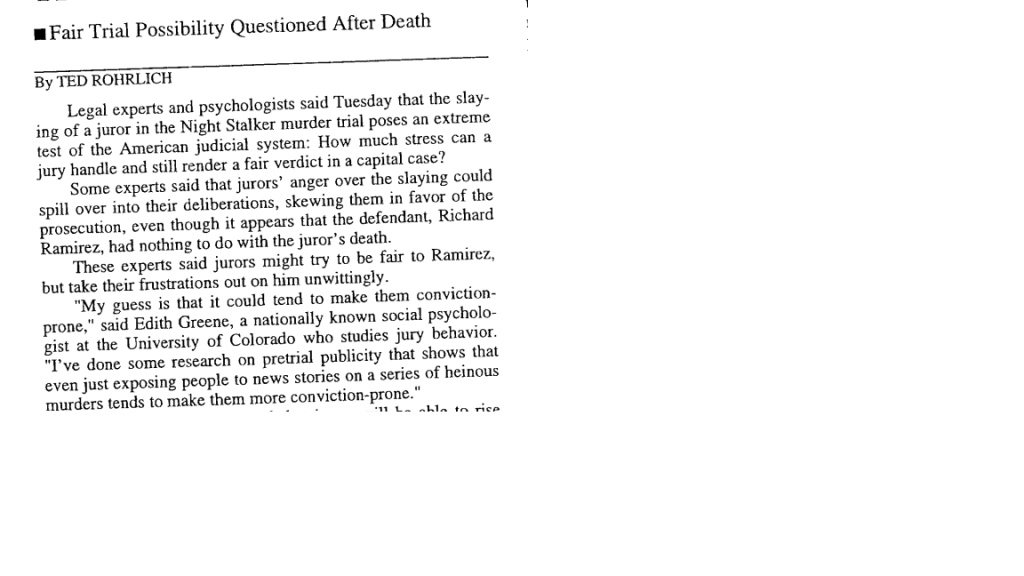
A juror was murdered during guilt phase deliberations in a similar manner as the victims were in a capital murder trial. How could the jurors possibly remain impartial when one of their own had been brutally murdered? Shouldn’t this have caused a mistrial? If grounds ever existed for a mistrial, surely this was it. The Hernandezes actually did make a motion to disqualify the jurors and moved for a mistrial. Of course, Judge Tynan, being the biased schmuck that he was, denied the motion. He wanted nothing to stop deliberations or the trial from moving forward. He did not seemingly care about fairness or justice. Otherwise, he would have done his duty as the trial judge and made sure the trial was conducted in a fair and impartial manner.
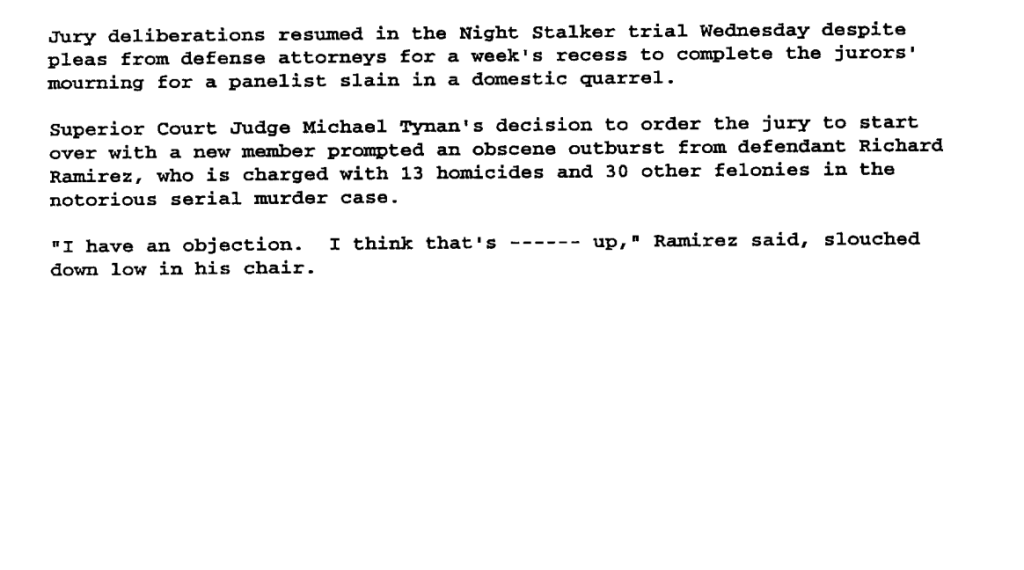
I must say, I agree with Richard’s objection to resume deliberations 2 days after the murder of Juror Singletary.
Convicted on Faulty Evidence
The evidence the jury used to determine Richard’s fate:
- Avia shoe prints at eight of the crime scenes-how do you convict someone based on a shoe the defendant was never even seen wearing? Richard was never seen wearing Avias, there’s no proof he ever owned a pair, and no Avias were ever found in his possession (and no, he didn’t throw them off the Golden Gate Bridge). Not only that, no one at any time during Richard’s trial ever measured his foot to see what size shoe he actually wore. So how do you convict someone based on a shoeprint when you don’t even know the defendant’s shoe size?
- Eye witness identification-every single person that identified Richard as their attacker changed their testimony from what they said in their initial police report. Not a single person gave a consistent statement regarding their attacker’s appearance. Not Maria, not Sakina, not Somkid, not Ginny, not Sophie, and not Carol.
- The “pattern”-there was no pattern, nothing that stands out as one person committing all of the “Night Stalker” crimes. Some victims were shot but not with the same type of weapon; some were stabbed, some were beaten, some were old, some young, some Caucasian, and some Asian. I’m no FBI profiler, but I can tell you that’s not how serial killers operate-they don’t change their modus operandi from one crime to the next.
Because the defence was so bad, the jury had no exculpatory evidence to consider. The defence even failed to present mitigating circumstances to find reasons for Ramirez’s alleged criminal behaviour. From juror Arthur Johnson in the L.A. Times.
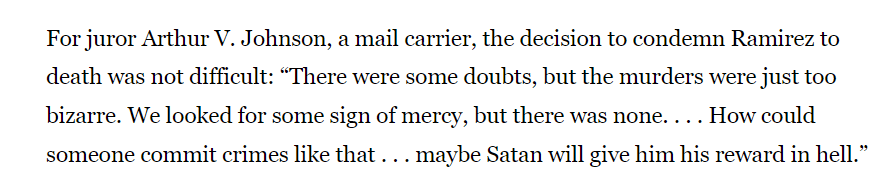
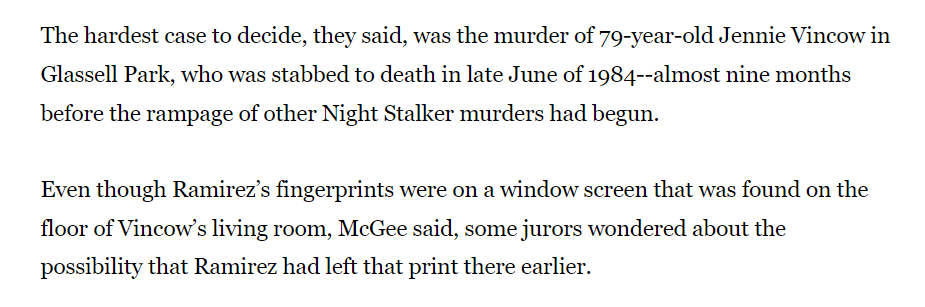
Ironically, the jurors had doubts about the one case where evidence was harder to explain away without a defence expert: the fingerprints at Vincow.
Convicted in the court of public opinion
Cynthia Haden was one of the jurors that convicted Richard and sentenced him to death. After his conviction, she appeared on the Geraldo Rivera show twice and said she believed he didn’t get a fair trial. She later became a private investigator because she said she wanted to help Richard with his appeal. So how does a juror vote for conviction and death but believe the trial wasn’t fair? Doesn’t the fact that you think the trial wasn’t fair mean you have a duty to vote against conviction? Isn’t a fair, impartial trial a part of due process? The answer is yes, it is.
Even alternate jurors, such as James Muldrow, Bonita Smith, and Fernando Sendejas, questioned some of the testimonies they heard in court. Unfortunately, as alternate jurors, there was nothing they could say or do to influence the legal proceedings.
Regardless of what you believe about Richard’s innocence or guilt, he was convicted by the media and law enforcement before he set foot in a courtroom. His trial was neither fair nor just. If you still think it was, then all I can say is perhaps your sense of justice is as warped as the judge and jury that sentenced him to death.
KayCee
-
More Carrillo Logic
Another two nuggets of stupidity from the ‘His M.O. was No M.O.’ files.
‘Climaxing!’ Carrillo had learned through his detective studies that some killers are sexually aroused by seeing fear in their victims’ eyes. He frequently cites his source, a criminology professor, Robert Morneau. Morneau wrote a book called Sex, Motivation and the Criminal Offender (1980) and Carrillo evidently applied Morneau’s teachings to the Night Stalker case. On podcasts, he cogitates for far too long at the idea of Richard Ramirez reaching orgasm: ‘He was orgasming!’ ‘Climaxing!’ ‘Foreplay!’. Alongside the bullets and the ridiculous links set out in this post, he also speculated that the murders of Okazaki and Yu were committed by the same man because ‘Richard Ramirez’ wanted to see fear in their eyes. “That was sex to him,” he declares.
Carrillo does not actually know what happened. He claims the killer banged on a car to attract Maria Hernandez’s attention (though she said it was an undefinable noise) specifically to see her scared expression. He claims Richard went up into Okazaki’s kitchen and waited for her to peep over the breakfast bar before shooting her (again, speculation). He then claimed that when the killer walked past Hernandez outside, he decided not to shoot her a second time because she no longer had fear in her eyes.
Wait – what? Why would Hernandez not have fear in her eyes? She had just been shot in the hand and was bleeding. She had heard her friend being shot and had no idea whether she would find her dead or alive. And here was the shooter, pointing the gun at her face for the second time… and she did not show fear?
Carrillo claims that Richard turned Tsai-Lian Yu around to see the fear in her eyes before he shot her. There was no proof this man – described as short and Asian – was Richard, yet Carrillo somehow knows what the Night Stalker was feeling when he shot this woman.
The next murder was a couple: Maxine and Vincent Zazzara. Maxine’s eyes were removed, so presumably, the killer did not enjoy seeing the fear in her eyes that much.
Then there were the four rape victims:
Carol Kyle testified that the rapist threatened to cut her eyes out if she looked at him. He covered her head with a pillow. (She did manage to see his nice straight teeth though).
Sophie Dickman said he put a towel and a pillow over her head, (but was able to see he was short to average height).
Somkid Khovananth said he put a coat over her head (luckily, she was able to identify a man with dark curly hair and a ‘brown face’).
Sakina Abowath was blindfolded (but not before she glimpsed a blondish man) and he hit her for looking at him.
Hold on a minute… did the modus operandi just change? How did the man who became excited from seeing Okazaki, Hernandez and Yu’s terror suddenly change into the man who gouges women’s eyes out, threatens others with the same, or covers victims’ faces and demands that they do not look at him?
He conveniently argues that those rapes were different because the Night Stalker only kills those who fight back, extinguising his fear-fetish. They complied so were spared. This doesn’t make sense either. Violent rape and burglary at gunpoint are terrifying – surely, he would be in his element? But no, he did not want to see their faces, not even to help him get an erection after he was unable to at the Dickman Incident. Hardly a sexual fetish then. And, if he really cared about being seen, he would have shot them; he had a gun; after all, he had killed the husbands of two of the rape victims.
The Night Stalker ‘celebrity’ detectives like to state that Richard’s M.O. was no M.O., but that is clearly an excuse for their lazy policing; they cannot have it both ways. You either have a man who gets off on seeing women terrified or a man who hates being looked at. He cannot be both. It’s merely a device to excuse the lack of consistency: make the Night Stalker someone completely unusual. Furthermore, he cannot have nine different looks, five different heights, three different body types, four different hair colours, and three different sets of teeth.
Bob Morneau: Turd Theory
In Philip Carlo’s book, there is a passage where Morneau is mentioned regarding … for want of a better phrase, a kink for shit. According to Morneau, if a criminal is dropping a log on your property, that’s his/her sexual deviance. Well, Carrillo has picked up the turd theory with both hands, clapped, and then smeared it all over the Ramirez case: he claims Richard Ramirez “confessed” (at around the 42 mins mark) to curling one out at one of the crime scenes. I wonder what other theories from Morneau found their way into the Night Stalker cases.

-VenningB-
5th Jan 2023
Did you know we have a book out? Well, you can buy it on all Amazon marketplaces.
-
The Murder of Joyce Nelson
By Venning
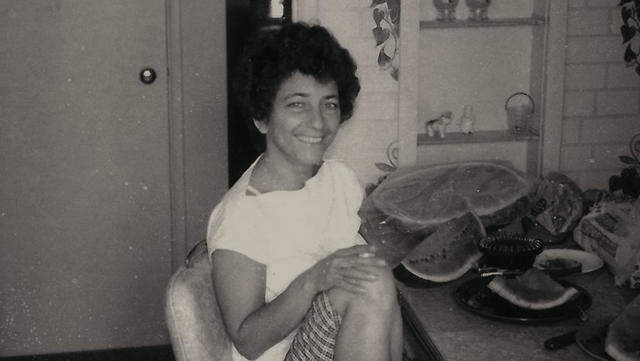
If you have seen the Netflix documentary, it is difficult to think about Joyce Nelson without recalling her family’s devastation when they discuss her personality, the way she dressed and her fears. The family display a justified hatred and disgust towards her killer. They believe wholeheartedly that Richard Ramirez was convicted with conclusive evidence.
However, examining the details of Nelson case, it is plain to see that no scientific evidence tied Richard Ramirez to this crime. One might feel a sinking feeling: if Ramirez was not the killer, Joyce Nelson never had justice and the killer might still be free and probably went on to kill others in another location. For anyone in this situation, it would be difficult to process and even more difficult to believe. Yet, police make errors, falsify evidence, or even lie, and as a result, miscarriages of justice happen all the time.
With California’s lengthy appeals system, many appeals are never read, the truth is never exposed, and the public continue in their ignorance that justice has been served and the killer is caught ‘bang to rights.’ This appears to be the case with Richard Ramirez, who, due to brain damage, was completely unable to defend himself against the charges. There was no concrete evidence that Richard Ramirez was the Night Stalker and that there were probably multiple killers.
The Attack
On 7th July, 1985, Joyce Nelson’s neighbour, Robert Blanco, noticed her back gate was open at 6am. Blanco entered her yard, heard her TV on and called out. There was no response. He checked on her again at 9am, with the same result. At this point, Blanco noticed the window screen from the front window lying in her flowerbed. The window itself was open. Her front door was also open. The back door screen had also been cut. Blanco alerted another neighbour who called the police.
Joyce Nelson had been beaten over the head, (which was not the immediate cause of death) and then manually strangled. She had fought her attacker and sustained a broken nail and severe bruising and cuts to the face.
Physical Evidence at the Scene:
- Partial shoe prints in the planter under the window and on the porch.
- A shoe print on Joyce Nelson’s face and robe.
- Palm prints on the bedroom door and windowsill.
- Glove marks on a file box in the other bedroom.
- Human hairs.
Is It Possible That Ramirez Did Not Murder Joyce Nelson?
Hair:
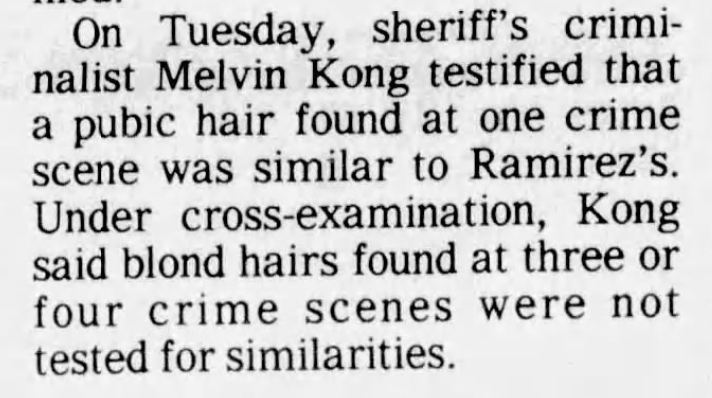
Hairs at the scene were medium brown, which did not match Ramirez’s near-black hair. While the tests used for hair in the 80s are discredited now – modern forensics uses mtDNA – a marked colour difference is visible to the naked eye. Interestingly, at the preliminary hearing, a serologist, Melvin Kong, testified that hairs of a similar colour were found at other crime scenes, namely Bell and Lang and Cannon – however, the press reported that he said the hairs were blonde. He did not compare the hair across crime scenes. Is it because he was falsely told that all victims saw a man with dark curly hair?
“On Tuesday, Sheriff’s criminalist, Melvin Kong testified that a pubic hair found at one crime scene was similar to Ramirez’s. Under cross-examination, Kong said that blond hairs found at three or four crime scenes were not tested for similarities.
– Monrovia News Post, May 7, 1986.
Gloves:
Gloved handprints were found at multiple Night Stalker crime scenes except Vincow. These cannot be used as evidence, because material does not leave identifiable prints. It is unclear whether the palm prints at the Nelson scene were gloved – if they were, the prosecution did not use them as evidence, so it is safe to assume they did not come from Ramirez.
Without any serological evidence to tie Ramirez to the Nelson murder, the prosecution fell back on the Avia shoeprints.
The Most Conspicuous Avia Location
By this time, the Los Angeles County Sheriff’s Homicide Bureau – driven by Carrillo – was in the grip of Avia fever, having found them two days earlier at the Bennett scene, where Sergeant Frank Salerno had finally come on board Carrillo’s serial killer train. A detective even brought a pair of the Basketball models to the Nelson home to compare the prints and Carrillo also bought a pair of the Aerobics model. Here, in addition to the porch, the infamous shoe prints appeared on the victim’s face. However, according to Philip Carlo’s book, Salerno admitted in court that the Avia pattern was not really visible on her face.
The shoe evidence was taken to LASD criminalist Gerald Burke’s laboratory, where Salerno also brought a pair of Avias. Burke, who was not sufficiently qualified to examine shoe prints at that time, confirmed that these were indeed the ‘murder shoes.’
Below are some images of the shoe impressions at the Nelson scene.
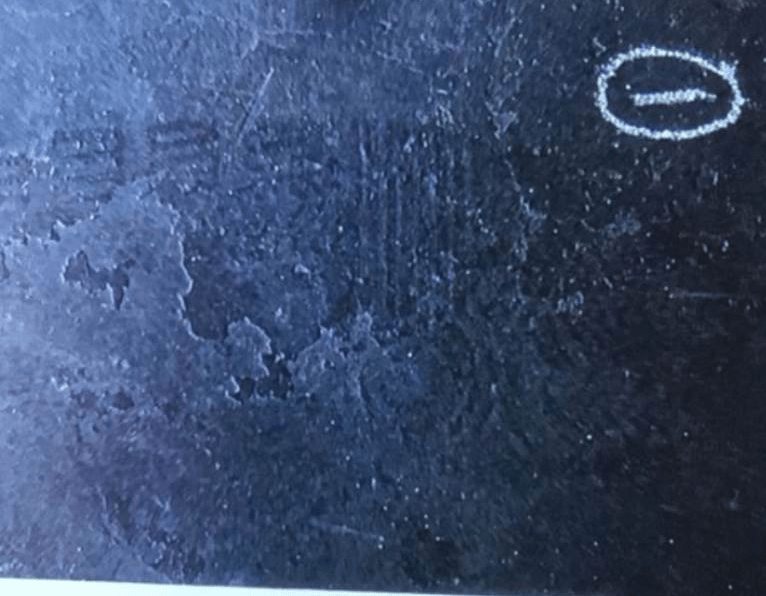
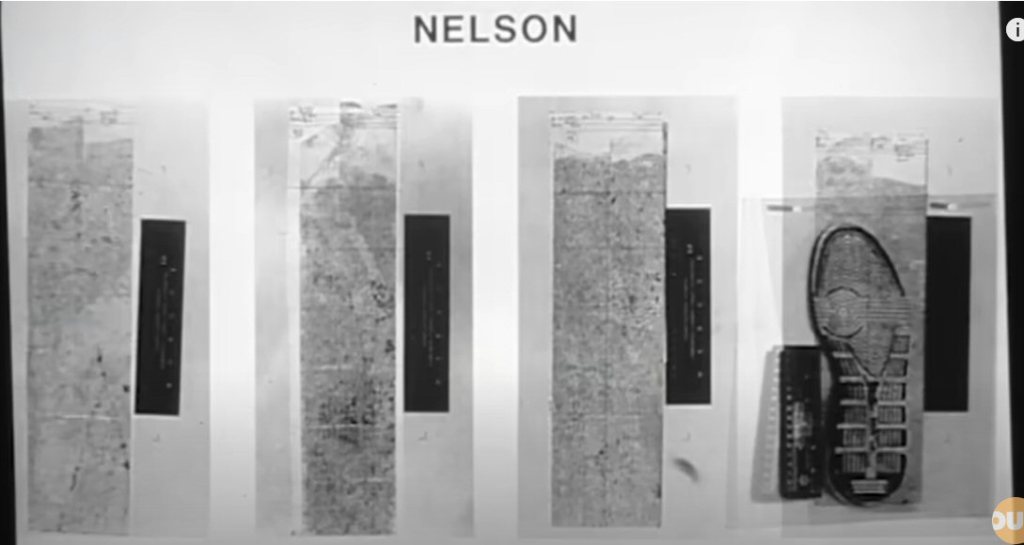
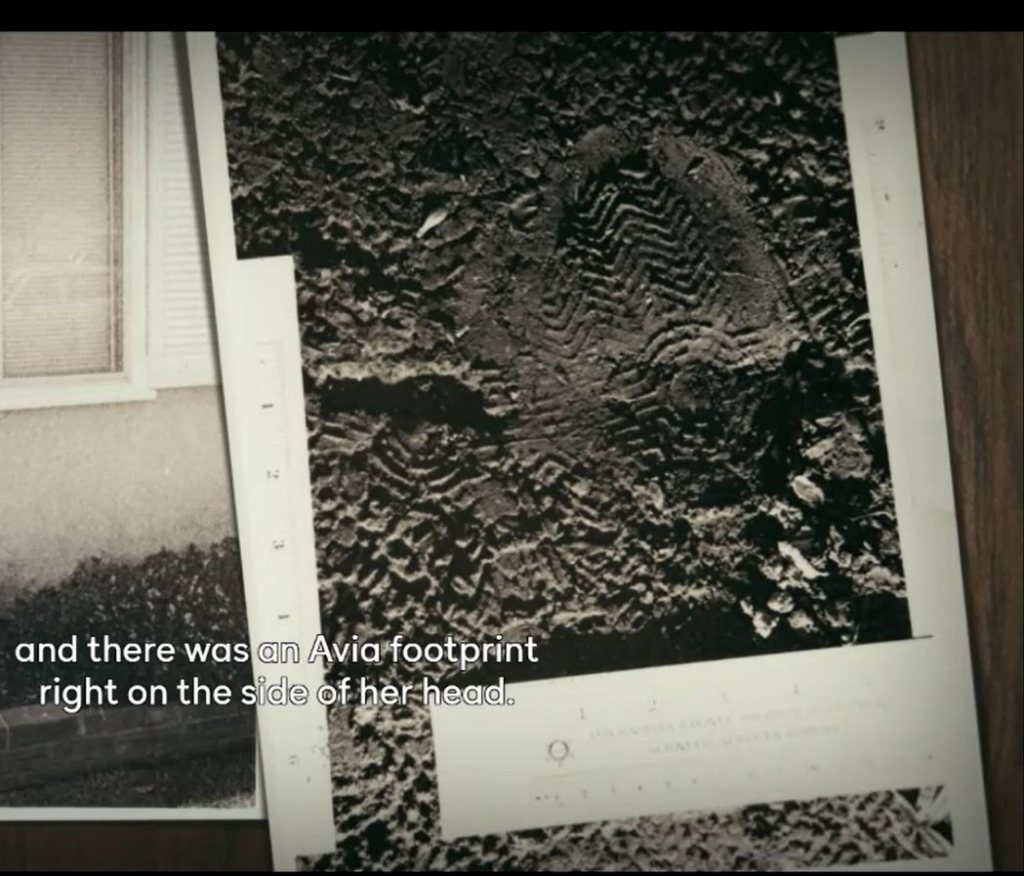
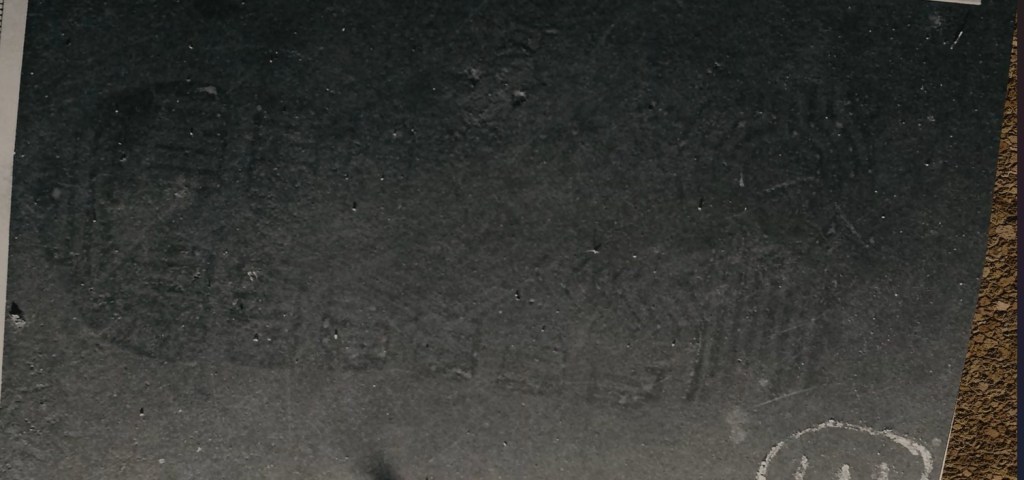
The shoe evidence was not defended in court. Ramirez’s attorneys lacked the funds to pay for their own expert witness. The court would not fund them because they were not sufficently qualified under California law. In 2004, Ramirez’s appeals team contacted forensic specialist Lisa DiMeo who examined four partial shoe prints. Here is her assessment below from Habeas Corpus supporting document 7.19:
“Nelson:
Two partial overlapping shoeprints exhibiting herringbone elements and a flex joint were found in dry soil outside the scene. They were consistent with any model and style of Avia athletic shoes [inconclusive].
Of four shoeprints on the concrete floor, the following fingingers were made:
a) Left Avia. Cannot exclude any Aerobics, Basketball or All Court Sport model which exhibited similar class characteristics as the questioned print. Hell area was not captured [inconclusive].
b) Right Avia. Heel area was not captured.
c) Right Avia. Cannot exclude Aerobics, Basketball of All Court Sport Model. Heel – three graduating length parallel bars … consistent with modesl 252, 255, 255W, 552R, 560, 565W and 565.
d) Left Avia. Heel not captured [inconclusive].With Avia evidence, the heel print must be present to determine which model made the impression. DiMeo’s opinion of shoeprint C means that it could be a different model to the shoe print at the Zazzara scene. Here is a video that might help to understand the shoe forensics in the Night Stalker cases.
As for physical evidence, shoeprints was all the prosecution had – and they could not prove Ramirez ever owned Avias – they were not found in his possession.
Circumstantial Evidence: Felipe Solano and the Stolen Property
Items stolen from Joyce Nelson’s home ended up in the possession of the notorious L.A. ‘fence’, Felipe Solano. Solano was given immunity from prosecution in return for his testimony that Ramirez sold him the stolen items.
There is more to this story than meets the eye. In court, Felipe Solano’s testimony unravelled, when it was revealed he was protecting multiple criminals – one of these could have committed some of the Night Stalker crimes, but the police and prosecution did not investigate this, while having the temerity to mock the defence for not bringing the other suspects to the trial. There are so many questions that need answering in regard to Felipe Solano and this network of burglars.
According to Philip Carlo’s biography, a burglar associate of Ramirez, Sandra Hotchkiss, claimed that Solano was beaten up by police before being questioned about his connection to Ramirez. She tried to tell the District Attorney and claimed this beating was recorded on tape but the tape was never presented as evidence and the police denied the beating.
Ultimately, the chain of custody of the stolen items was never established, none was recovered from Richard Ramirez and his fingerprints were not found on any of them.
Connections to Other Attacks
While it seems unlikely that Ramirez committed all the Night Stalker crimes (several occurred simultaneously, making it impossible), the Nelson, Cannon and Bennett crimes are very similar in nature, and may well have been committed by the same perpetrator. However, it cannot have been Ramirez. As discussed in the Cannon and Bennett posts, the blood at both scenes was inconsistent with both the victims and Ramirez. If the same killer attacked Joyce Nelson, then it too was not Ramirez. It would be someone with Type A blood and possibly medium brown hair.
The Cannon and Bennett attacks were geographically close, but Nelson was much further away and despite its similarity (bludgeoning, slashing, stranglulation, and Avia shoes), The prosecution instead relied on its proximity to the Dickman scene that occurred on the same night, just a mile away, even though the Dickman attack was a rape – by a man she initially claimed was 5’8”.
Detective Carrillo claims that Richard had not achieved his sexual gratification from Nelson’s murder so went to deal with his ‘unfinished business’ at Dickman’s. This is pure conjecture – there is no evidence that ties the two crimes. Moreover, Sophie Dickman was threatened with a gun. If Joyce Nelson’s killer had a gun, why did he not use it? If Nelson was murdered first, then why did Dickman not report that her killer was covered in blood and bruises, from where Nelson fought back? To say Richard Ramirez was a circumstantial killer and did not have a modus operandi is lazy and too convenient.
Witness Launie Dempster
Launie Dempster, was a newspaper deliverer who was also a witness for the Doi Incident, elsewhere in Monterey Park. Dempster claimed to have seen a “Mexican” in a car outside the residence an hour before William Doi was murdered. Then she claimed to have seen the same man again on approximately 28th May (Ramirez was in El Paso on this date) on San Patricio Drive, Monterey Park. Later, Dempster claimed to see him again on about the 5th July, close to Joyce Nelson’s home at 3am.
It seems to have been overlooked by the defence, that if Dempster did see Ramirez at 3am in Monterey Park, she unwittingly gave Ramirez an alibi for the Bennett attack, fourteen miles away. However, she originally described this Mexican as ‘dark-skinned’ which does not describe Ramirez.
Dempster’s description was also odd. She claimed ‘Richard Ramirez’ was wearing a short-sleeved shirt but also a jacket. Unless she witnessed him in the act of putting the jacket on, she would not be able to see the length of his sleeves. And there is nothing significant about her seeing a man by his car. People get in and out of their cars at all times of the day or night.
Not only that, each time Launie Dempster had seen him, it was around 3am – 4am, in the dark and he was wearing dark clothes and sitting in a dark car. How can one accurately identify someone in these conditions?
Even less likely when one considers that Dempster had not bothered to inform the police she had seen a man near Joyce Nelson’s home until she had seen Richard Ramirez on the news. This strange delay in informing the police was also the case with some of the other victims (Carol Kyle, Sophie Dickman, Somkid Khovananth and Virginia Petersen).
Ramirez’s defence counsel failed to adequately cross-examine Launie Dempster and her motivations for reporting her sighting so late, and never questioned her on what characteristics the suspect had that led her to believe he was Richard Ramirez, given that he was originally dark-skinned. Dempster only started claiming the Mexican was ‘lanky’ after Ramirez was referred to as lanky in the newspapers – that Dempster delivered.
If Ramirez had been tried for the Nelson Incident alone – or even alongside Cannon and Bennett, he would have been acquitted, although he would have needed better attorneys than Daniel and Arturo Hernandez and Ray Clark.
5th January 2023



 Expendable For A Cause.
You must be logged in to post a comment.