
“The world has been fed many lies about me..”
Richard Ramírez
Now available, the book: The Appeal of the Night Stalker: The Railroading of Richard Ramirez.
Welcome to our blog.
This analysis examines the life and trial of Richard Ramirez, also known as The Night Stalker. Our research draws upon a wide range of materials, including evidentiary documentation, eyewitness accounts, crime reports, federal court petitions, expert testimony, medical records, psychiatric evaluations, and other relevant sources as deemed appropriate.
For the first time, this case has been thoroughly deconstructed and re-examined. With authorised access to the Los Angeles case files, our team incorporated these findings to present a comprehensive overview of the case.
The Writ of Habeas Corpus
The literal meaning of habeas corpus is “you should have the body”—that is, the judge or court should (and must) have any person who is being detained brought forward so that the legality of that person’s detention can be assessed. In United States law, habeas corpus ad subjiciendum (the full name of what habeas corpus typically refers to) is also called “the Great Writ,” and it is not about a person’s guilt or innocence, but about whether custody of that person is lawful under the U.S. Constitution. Common grounds for relief under habeas corpus—”relief” in this case being a release from custody—include a conviction based on illegally obtained or falsified evidence; a denial of effective assistance of counsel; or a conviction by a jury that was improperly selected and impanelled.
All of those things can be seen within this writ.
The Writ of Habeas Corpus is not a given right, unlike review on direct appeal, it is not automatic.
What happened was a violation of constitutional rights, under the 5th, 6th, 8th and 14th Amendments.
Demonised, sexualised and monetised.
After all, we are all expendable for a cause.
- ATROCIOUS ATTORNEYS (4)
- “THIS TRIAL IS A JOKE!” (8)
- CONSTITUTIONAL VIOLATIONS (9)
- DEATH ROW (3)
- DEFENCE DISASTER (7)
- INFORMANTS (6)
- IT'S RELEVANT (17)
- LOOSE ENDS (15)
- ORANGE COUNTY (3)
- POOR EVIDENCE (16)
- RICHARD'S BACKGROUND (7)
- SNARK (12)
- THE BOOK (4)
- THE LOS ANGELES CRIMES (22)
- THE PSYCH REPORTS (14)
- THE SAN FRANCISCO CRIMES (5)
- Uncategorized (5)
-
You, the Jury
Questioning
The word “occult” comes from the Latin “occultus”. Ironically, the trial of an infamous occultist and Satanist is the epitome of the meaning of the word itself: clandestine, secret; hidden.
We’ve written many words; a story needed to be told, and we created this place to enable us to do just that.
Here, in this space, we intended to present the defence omitted at Richard Ramirez’s trial in violation of his constitutional rights. Our investigations have taken us down roads we’d rather not travel along, but as we did so, we realised that there was so much hidden we could search for a lifetime and still not see the end of it. Once we’d started, there was no turning back; we followed wherever it led.This was never about proving innocence; that was never the intent or purpose. We wanted to begin a dialogue, allowing this information to be freely discussed and for us to verbalise the rarely asked questions. We asked, and we’re still asking.
We can’t tell you, the reader, what to think; you must come to your own conclusions, as we did.
And so
We’ve said what we came here to say; with 114 articles and supporting documents, we’ve said as much as we can at this point.
This blog will stand as a record of that, and although we will still be here, we intend to only update if we find new information, if we suddenly remember something we haven’t previously covered, or to “tidy up” existing articles and examine any new claims (or expose outrageous lies) that come to light. The site will be maintained, and we’ll be around to answer any comments or questions.
What Next?
We will focus on the book being worked on; we’ve also been invited to participate in a podcast. When we have dates for those, we’ll update you.
The defence rests? Somehow, I sincerely doubt that; ultimately, we’re all “expendable for a cause”.
~ J, V and K ~
-
Night Stalker: Why the Khovananth Incident Was a Pivotal Moment
By Venning
On 20th July 1985, Chainarong Khovananth was murdered by a gunshot at close range. His wife, Somkid, was raped and robbed. The Khovananth case became the most important Night Stalker case of all because it incorporated various aspects of previous attacks, seemingly tying them all together (the use of a small calibre pistol, male occupant shot at close range, alleged child assault and robbery). Moreover, the perpetrator’s appearance matched the vague description police agencies had been pursuing – a tall, thin Latino male with dark curly hair and dental problems, including a gap between his top front teeth. The teeth aspect was not yet revealed to the public.
Back in June, Richard Ramirez was pulled over by traffic police for running a stop sign, and before he escaped, had drawn a pentagram on the car. The most recent ‘Valley Intruder/Night Stalker’ incident at that time was Bell/Lang, at which pentagrams were found, and Ramirez inadvertently became a person of interest. The car turned out to be stolen and was impounded. Inside the vehicle, a dental appointment card was discovered, made out for Ramirez’s alias, ‘Richard Mena’, which led police to his dentist, who confirmed his physical attributes. This appearance was noted. Attempts to apprehend ‘Mena’ at his next appointment failed due to police incompetence.
What Did the Night Stalker Look Like?
Judging by police statements that come with the Habeas Corpus (in Document 20-3), up to this point, victims and witnesses had given a variety of descriptions of their attacker. Maria Hernandez had seen a 5’10”-6’1” light-skinned man with facial hair. Witnesses to Tsai-Lian Yu’s murder believed the suspect was between 5’6”-5’8” and East Asian. Lillian Doi claimed her husband’s killer was white with mid-brown hair and was between 5’10”-6’0”. Launie Dempster had seen a dark-skinned Mexican lurking in cars. Carol Kyle saw a shiny-haired 5’10”-6’0” Latino with a side-swept wavy fringe and nice teeth, Sophie Dickman had seen a 5’8” white man with brown curls. The child abduction victims saw a blonde man of medium build. Therefore, it is factually incorrect that everybody described ‘Richard Mena’.
If we were not in possession of these police statements – and the court testimonies via the Habeas Corpus – these descriptions would have been buried forever. But back in the summer of 1985, this was the pivotal moment in the Night Stalker case. At this juncture, all the other witness descriptions were thrown down the memory hole. The man who raped Somkid Khovananth – immortalised in a police sketch – had a vague resemblance to ‘Richard Mena,’ and thereby became the benchmark by which all suspects would be compared. Two later victims would describe their own different Night Stalkers, but their unreleased composite sketches would never supersede the ‘Khovananth Composite.’
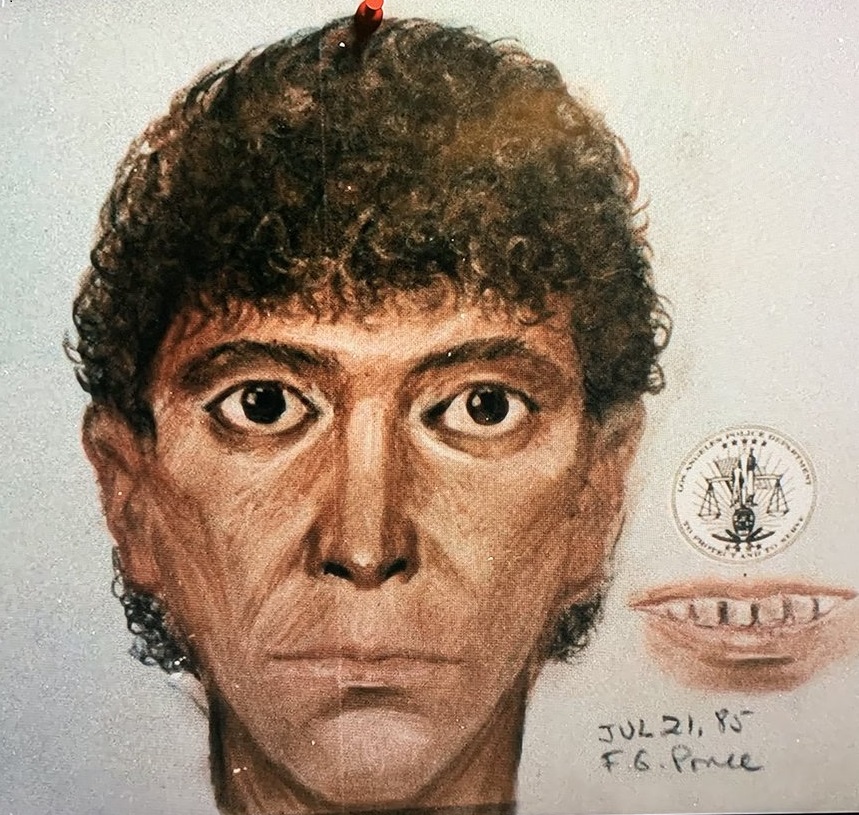
The infamous police sketch by Fernando Ponce WANTED
On 28th August 1985, the LAPD Chief of Police, Daryl Gates, released the ‘wanted poster’ below, stating that the Khovananth attacker was responsible for all the attacks. This included later attacks in which a blondish man was described.

At the time of the Khovananth Incident, no other attacks like it had taken place. It was similar to the Doi Incident insofar as the husband had been shot in bed, but different in that Lillian Doi was not dragged around the house and repeatedly raped (newspaper sources state that she was, but ultimately, the rape charge was dropped, no semen evidence was admitted at trial, and the Petition only mentions her facial beatings and restraints). The only reason the Khovananth case was added to the Night Stalker tally was because Avia shoeprints (that police had discovered at other crime scenes) were discovered on the front porch and back step of the house.
It seems like confirmation bias: the detectives had decided that Richard ‘Mena’ was the prime suspect, and it only took one survivor, Somkid Khovananth, to describe a man with curls and bad teeth, for them to decide he was definitely the Night Stalker. This was also reinforced by the pentagram on the car; the suspicion moved beyond mere bias.
Now their task was to find out his real name. Thousands of people contacted the police to report friends, or suspicious neighbours just because they vaguely resembled the Khovananth composite. It was only a matter of time before friends of Ramirez contacted the police – especially after the mayors of Los Angeles and San Francisco offered financial rewards to would-be informants. Ramirez was a burglar and two sets of criminal associates in different parts of the state reported him to the police. As a result, three different law enforcement agencies, the LAPD, LASD and SFPD simultaneously closed in on him.
In conclusion, there is a strong possibility that the Night Stalker character was engineered to look like Richard ‘Mena’ Ramirez, which caused a snowball effect leading to his capture. Being expendable to the criminal community he mingled with – and unable to defend himself due to brain damage – Richard Ramirez became the perfect prime suspect.
Further reading:
I wrote a book on the whole case in chronological order!Ramirez’s 2008 appeal petition.
Information on Ramirez’s brain injuries.
A video explaining the Avia shoes.
Debunking the myth that the Night Stalker exclusively wore black.
Informants in the Ramirez case – collection.
Below: a video about the “Man in Black Myth”.First posted 29th July 2023. Updated on 27th May 2025.
-
Moonlighting for CSI – The Uncharged Incident
*images may need to be viewed on a desktop due to size*
“It should be noted at the outset that no suspect Avia shoes were obtained in this case and no scientific correlation between Avia shoeprints and petitioner Richard Ramirez exists.”
Supplementary declaration of Forensic Specialist Lisa DiMeo
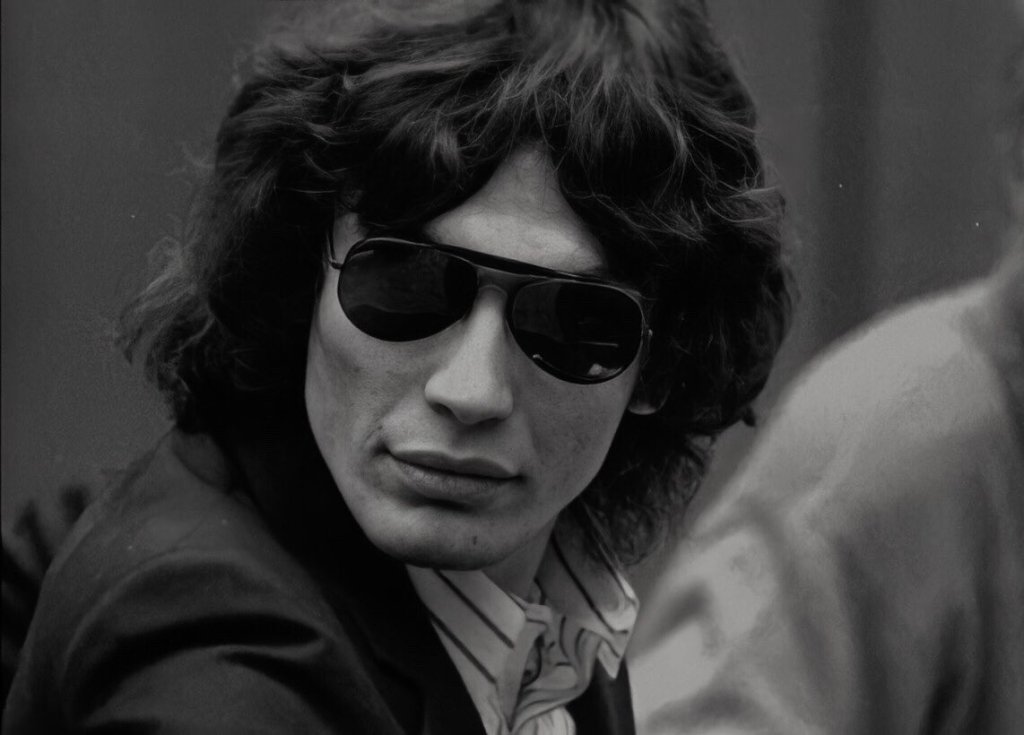
Richard Ramirez, January 1989
We had hoped never to have to talk about those Avia shoes again, but I fear I must go there one more time and discuss the mysterious Uncharged Incident—the break-in at the home of Clara Hadsall, 9th May 1985.
Out of all the incidents in the Night Stalker case, the robbery of Clara Hadsall gets the least attention, although it was a significant part of the process that led to convictions on all 43 counts.
If the Hadsall incident was so crucial to the prosecution’s case against Richard, why was it uncharged? No crime report is attached to any court documents, Hadsall gave no testimony or witness statement that has been made public, and law enforcement did not call her to the identification line-up. The episode itself does not appear to have been reported in the news when it occurred, possibly because she wasn’t attacked, and robberies and break-ins were prevalent, with 685 reported residential burglaries in Monrovia in 1985 alone. The earliest that the police linked Richard to this crime seems to have been in September 1985, after his arrest.
What Happened?
“In a second attack that had not previously been publicized, Ramirez was accused of robbing and burglarizing the Monrovia home of 85-year-old Clara Cecilia Hadsall on May 9. The woman, who was living alone, told authorities that a man appeared in her bedroom at 2:30 a.m., shined a flashlight in her eyes and robbed her of cash and jewelry.”
LA Times 4th September 1985Clara Hadsall wasn’t attacked or injured, and her stolen items are never mentioned in the property identification, which occurred on the same day as the live line-up on 5th September, the day after the news report. By 4th September, Richard had, as yet, only been linked to the Doi incident, a very different, horrific crime, which occurred on 14th May.
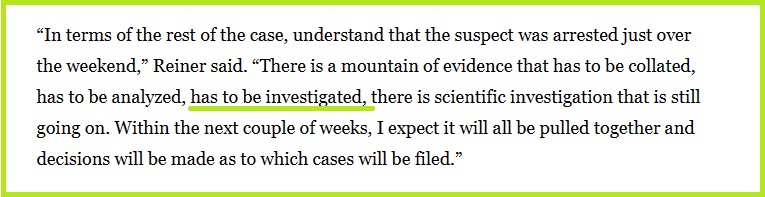
LA Times – 4th September 1985
Neither Lillian Doi, who survived her attack, nor Clara Hadsall, who wasn’t attacked, were called to testify. Prosecutor Halpin stated he thought about videotaping Ms Hadsall’s testimony, then decided not to, in case it “hastened her demise”. As Clara passed away on October 8th 1985, we can assume that by this stage, her health was failing, and although they tried, officials found no link to pin her demise onto Richard Ramirez. Ms Hadsall passed away from natural causes.
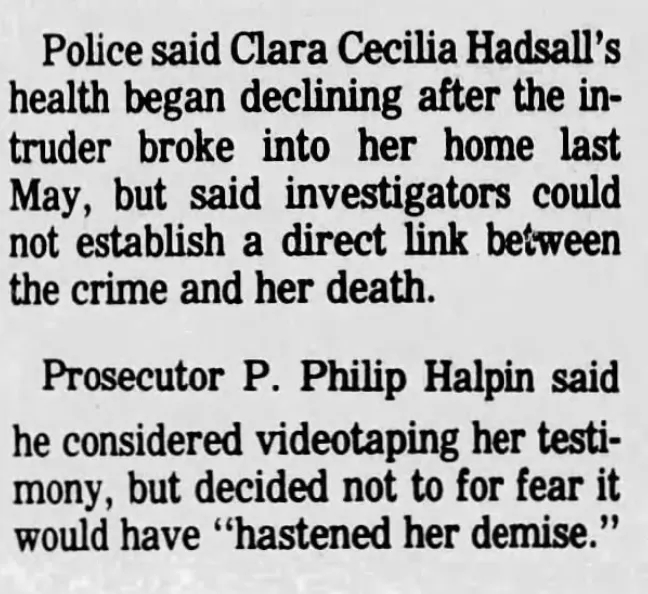
Auburn Journal – 25th October 1985. 
Lillian Doi’s description of her attacker, the man with light brown hair – Orange County Register. It is unclear just what physical evidence Halpin is referring to below, there was none to be found at the Doi incident that tied Ramirez to the scene. 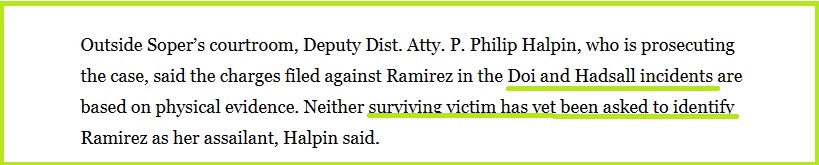
LA Times – 4th September 1985 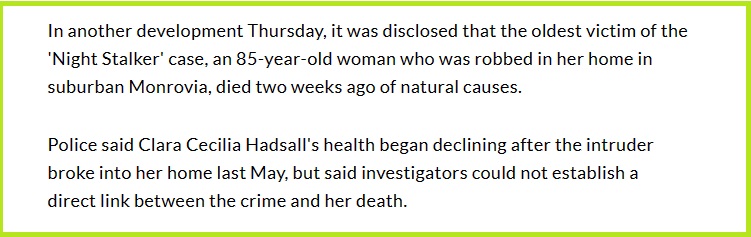
UPI Archive – 25th October 1985
A brief outline of the uncharged incident can be found on page 96 of the 2008 habeas corpus petition.
“On May 9th 1985 Monrovia Police Officer, Thomas Wright, responded to a call at 424 West Olive Street in Monrovia, LA County. Officer Wright found that louvers were removed from the kitchen window; a patio chair pushed against the wall. Officer Wright dusted for fingerprints and lifted several prints and a shoe print from the kitchen sink and a fingerprint from the kitchen awning. A shoe print on the patio that could not be lifted matched the tread pattern of the shoe print found on the sink”.
Page 96 – writ of habeas corpusThat is the extent of the information concerning this break-in and at first glance, it doesn’t look particularly unusual. That is until you ask why a regular officer called to a routine break-in had all the forensic equipment with him.
The Enterprising Officer with the Best Equipped Car
In a slightly unusual scenario, Officer Wright, on discovering the alleged break-in, observed shoe prints and palm prints on the sink; rather than call in the people specifically trained to do the crime scene investigation, he took it upon himself to take control of the situation. He gathered all the evidence alone, using a forensic kit he just so happened to have in the trunk of what seems to have been the most well-appointed cop car in history.
The usual course of action, one imagines, would be to see to the property resident, who though not injured, was 85 years old, and call in the personnel trained in crime scene investigation. Not in this case. Not in the “uncharged incident”, the one where no one was injured, where the Night Stalker, who the prosecution has told us, didn’t leave fingerprints because he always wore gloves, left those gloves at home for the evening, and most bizarrely, and most conveniently, planted his whole palm right next to his footprint. How very obliging of him.
In his book “The Night Stalker: The Life and Crimes of Richard Ramirez”, Philip Carlo had this to say. I don’t usually quote anything from Carlo, but this is interesting.
“Officer Wright found a palm print on the sink that had left a latent impression, which Officer Wright had lifted with a fingerprint kit he kept in the trunk of his police car. As well as lifting the palm and fingerprints he found around the sink, he had lifted the footprint right out of the sink using extra–long lifting tape and cards. Officer Wright stated he also found footprints in the dirt on the north side of the house and made plaster casts of those prints too.“
The Life and Crimes of Richard Ramirez the Night Stalker – Philip CarloPlaster casts? That is a specialist job requiring precision, training, and knowledge. Even Gerald Burke, the prosecution’s “expert witness“, did not have the necessary training for this work, as his inaccurate findings showed.
Are we really to accept that the diligent Officer Wright carried out this work and (allegedly) photographed it all, without the need to call in the forensics team? It’s worth pointing out that plaster casts are not mentioned in the 2008 petition, only that he lifted prints using powder and tape. Clara Hadsall was no longer around to give her version of events.
Uncharged
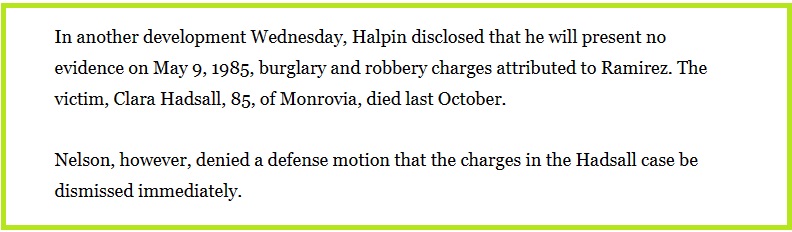
No evidence to be presented, but the motion to dismiss denied. LA Times – 20th March 1986 The prosecution had a challenging task; the lack of evidence at crime scenes meant difficulties placing him at the locations. In a peculiar turn of events, they decided not to charge him with the ONE and only incident where they allegedly had both shoe imprints and latent fingerprints, although it would still be introduced to the jury. The defence moved to have the case dismissed as inadmissible, but Judge Nelson was having none of that
The motion to dismiss was denied, as according to the prosecution, it showed the propensity of the accused to commit these sorts of crimes. No one was ever denying Richard Ramirez was a thief; however, as no attack took place, it vastly differs from the other so-called Night Stalker incidents. This incident only shows that if Richard did indeed break into Clara Hadsall’s house, he had the disposition to commit non-violent crime, as the testimonies of his criminal associates Sandra Hotchkiss and Eva Castillo established.
Following on in that vein, when the defence wanted to introduce the dropped charges concerning the murder of Patti Higgins, the trial court overruled and would not let them bring it forward, in a predictable display of double standards, as that particular incident would favour the defence. Nonetheless, Ramirez has been forever blamed for her murder, although all charges were quietly dropped; he was not convicted on that count.
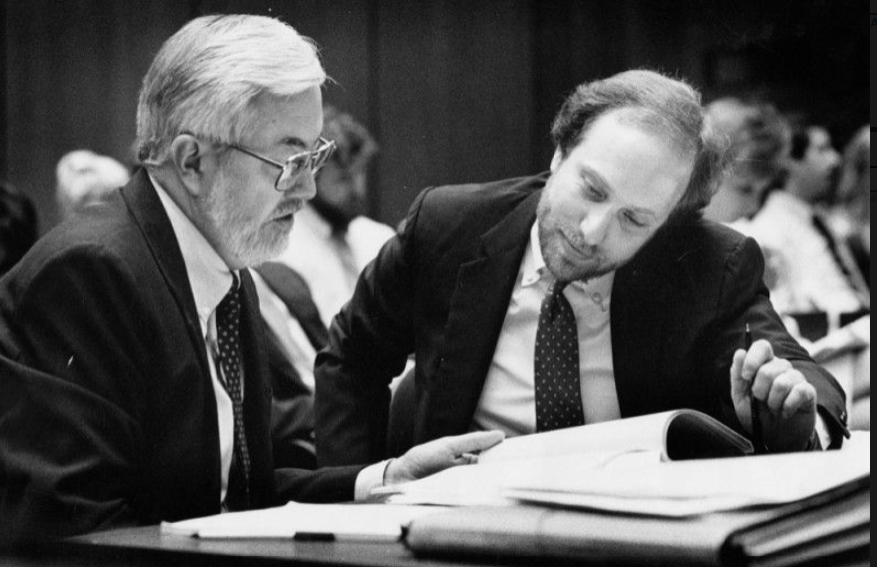
Prosecuting attorneys Philip Halpin and Alan Yochelson. The photograph ran in the newspaper on 3rd August 1988. Credit: Leo Jarzomb – Herald Examiner Collection The wily prosecutor, Philip Halpin felt they didn’t need to bring in charges; they had what they believed to be the trump card – yes, you’ve guessed it, those Avias.
Avia Time Again!
We have gone over this many times, but let me direct you to THIS POST for a complete breakdown of the Avia story to save repetition; now, for one last time, let’s go there.
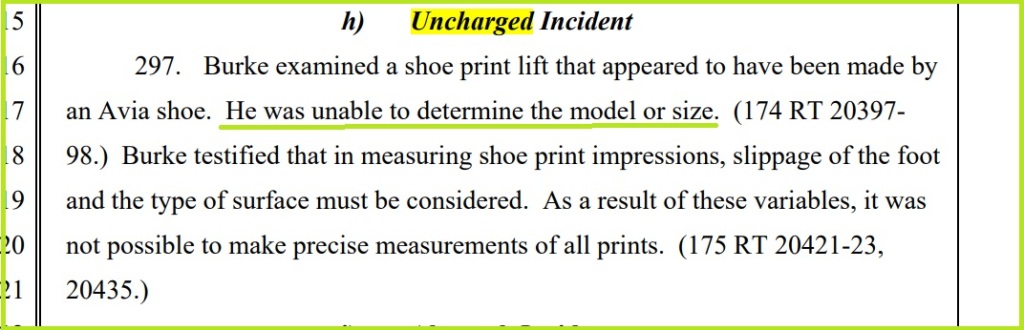
Writ of habeas corpus, page 104
The prosecution desperately needed to get those notorious Avias firmly attached to the feet of Richard Ramirez, alas in this, they failed as all the shoe prints and impressions were partial prints, improperly measured and evaluated, but that didn’t stop them from knowingly presenting false evidence designed to mislead the jury into thinking that only one pair of sneakers in the whole of California could have made those prints.
So far, they had been unable to prove that Ramirez had ever set eyes on a pair of Avias, let alone wear them. In the uncharged Hadsall incident, with its helpful placement of both hand and footprints, they played their ace.
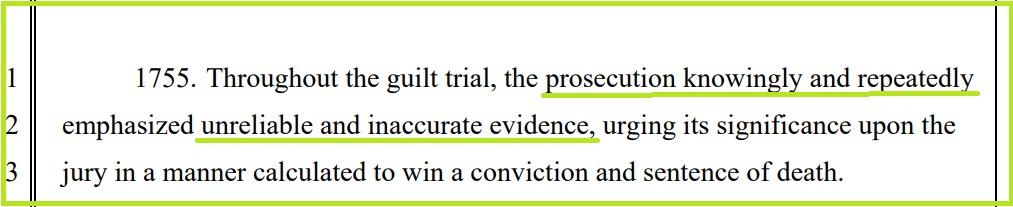
Writ of habeas corpus – page 661 Gerald Burke, the “non-expert” expert witness for the prosecution, determined that the shoe prints came from an Avia sneaker but could not say what size or model.
Deputy Sheriff Hannah Woods compared Richard’s rolled prints with the partial print found outside the window screen at the Vincow incident. She also compared the prints to those on his belongings, declaring a match. However, as we’ve previously discussed, partial fingerprints are inconclusive; it’s a grey area, with different law enforcement agencies employing various techniques and requirements regarding how many loops and ridges are considered admissible evidence in court; it is not an exact science and could have been quickly challenged by his defence team, but of course, it wasn’t. In fact all this proved was that Ramirez touched his own things.
Richard’s defence introduced no expert witnesses of their own. Such was their incompetence; they might as well have been working for the prosecution. Competent attorneys would have vigorously challenged the prosecution’s less-than-conclusive evidence of shoeprints and fingerprints. Because of their ineffectual attempts to present a challenge to the prosecution’s unreliable evidence, which resulted in conceding without a whimper, they failed to defend him, denying him once more the effective assistance of counsel he was entitled to receive.
“Trial counsel failed to investigate, develop, and present evidence to refute the prosecution’s evidence. The defense presented no evidence or expert testimony to challenge the prosecution’s physical and forensic evidence; defense counsel presented no evidence about third-party suspects”.
Writ of habeas corpus – page 427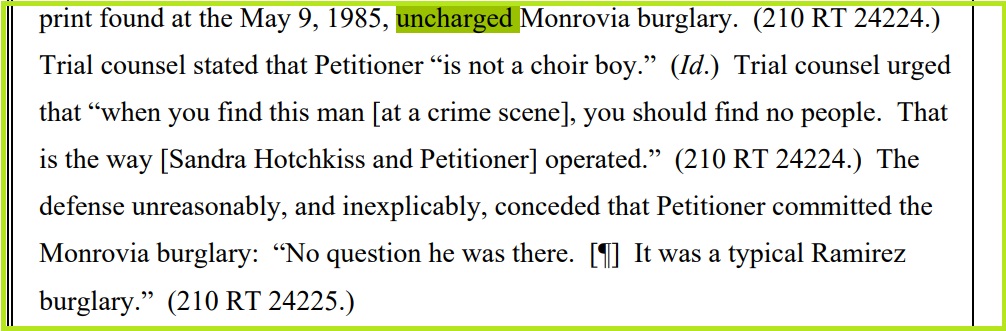
Utterly useless.
Lisa DiMeo, a forensic specialist in shoe print, tyre treads and blood spatter patterns, was retained by Richard’s habeas lawyers. Here are her conclusions:
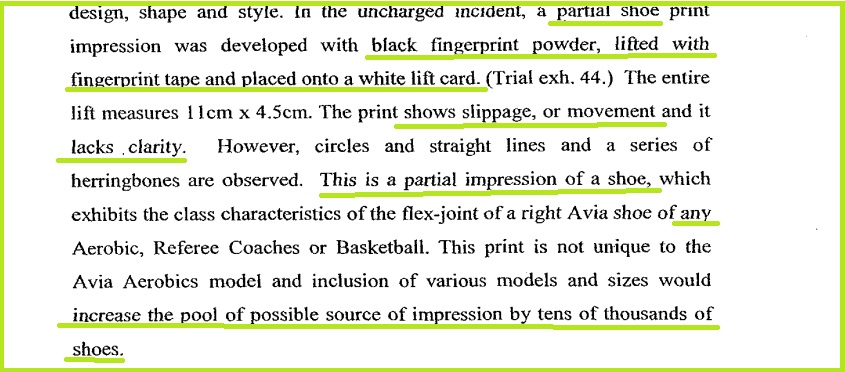
Supplementary declaration of Lisa DiMeo – doc 7-20 “Tens of thousands of shoes”. Regarding Gerald Burke’s testimony, she states:
“His findings and conclusions regarding size and models were inaccurate and based on improper information: he lacked the training and experience to properly compare impression evidence. Distortion in casting led to inaccurate findings; the lack of individual shoeprint characteristics, including wear patterns, rendered his findings scientifically unreliable. In this case, there were many possible models and sizes of shoes that could have been identified from the shoe print impressions”.
Writ of habeas corpus, statement of Lisa DiMeo, page 633
Lisa DiMeo, along with the fingerprint expert, Ron Smith (retained by the habeas lawyers) both requested that the fingerprint and shoeprint evidence be released into their custody for deeper analysis. The goverment refused their request. Why? If there was nothing to hide?


Ron doesn’t seem to have even got a look.
To Conclude
Far from being the forgotten incident in the Night Stalker case, the one with the most minor scrutiny and interest is one of the most important. With their scientifically unreliable evidence, the prosecution misled the jury to demonstrate ownership of the phantom Avias. At no time was the size of Richard’s feet established in court.
Does it prove that Ramirez wore Avias? If we are prepared to accept the unusual collection of evidence from an unremarked-upon crime scene, where no witness was available to question, give evidence or make an identification, and even then, even if we accept that faintly ridiculous scenario, does it also prove that Richard Ramirez was the Night Stalker?
No, it does not. Nor does it show that he entered Clara Hadsall’s property alone. It is impossible to rule out third-party suspects. At most it shows he was a thief, and no one denies that; that was never in doubt.
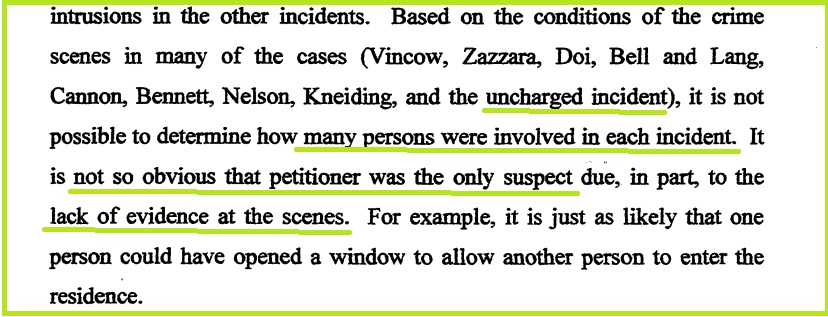
Declaration of expert witness Steve Strong doc7-21 Gerald Burke had declared in his testimony that the person who was committing the crimes wore an Avia Aerobic shoe, model 445b, the partial treads captured in the uncharged incident were too poorly preserved to tell either size or model. The heel section was not present, and that is the bit that differentiates between Avia sneakers, meaning that all classes of Avias cannot be discounted; aerobic, referee, coach and basketball. Tens of thousands of shoes. Not just one.
Law enforcement never discovered those elusive Avias, and if you believe he threw them off the Golden Gate Bridge, you may need to examine that thought again.
We’ve been led to think that because of the press conference given in San Francisco by Dianne Feinstein on 23rd August 1985, where she revealed the shoeprints, Richard, on hearing this, immediately ran off to the bridge to throw away his incriminating sneakers, after which he began wearing the Stadia brand instead.
That doesn’t hold weight and is more nonsense constantly being retold as gospel. The Stadia shoeprint appeared on 8th August, two weeks before.
Yet still, the myth grows, the stories are embellished, and no one seems to want to look at questions that are in abundance when discussing the case of Richard Ramirez.
~ Jay ~
-
Rorschach
*some images may need viewing on a desktop for greater clarity*
“You see what you want to see”
Geoff Johns – Doomsday Clock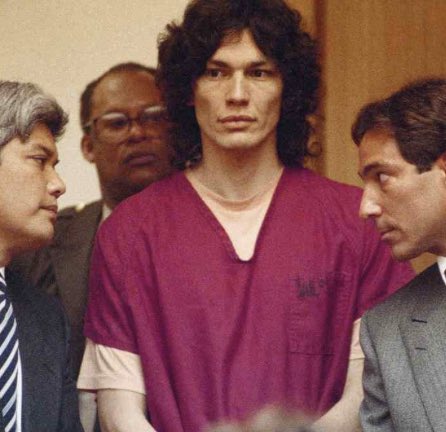
Richard Ramirez with San Francisco attorneys Randall Martin and Daro Inouye.
The Young Report – 1994
In 1994 Richard’s San Francisco defence lawyers, Michael Burt, Daro Inouye and Dorothy Bischoff, referred him for neuropsychological evaluation. The clinical psychologist retained to carry out the tests was Myla H Young, PhD, who saw Richard on three occasions on the 9th, 10th, and 28th December 1994, post his LA convictions. These meetings occurred both at San Francisco County Jail and at San Quentin. She was to describe Richard’s intellectual, neuropsychological, and psychological functioning.
One more in a cluster of doctors, psychiatrists and psychologists who saw, tested, and evaluated him between 1985 and 2008.
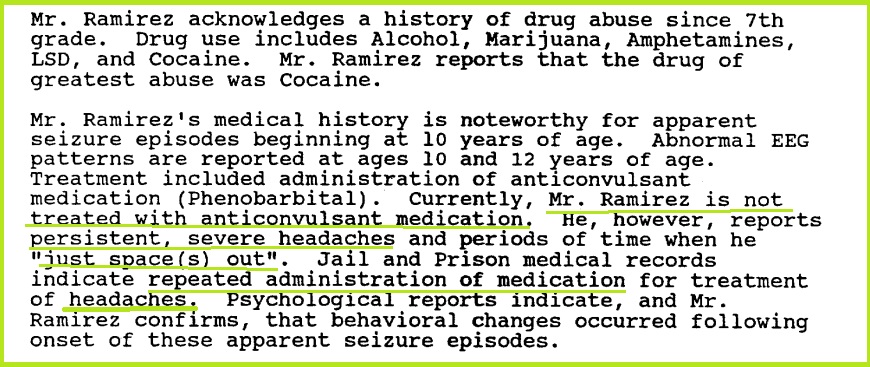
What is very noticeable is Richard’s absolute refusal to discuss his childhood and family, displaying a genuine and intense protectiveness, especially where his parents were concerned. Both Myla Young and Elise Taylor draw attention to this in their reports. Because he refused to discuss his early life, Young used his medical history accounts for information. In 1994 Richard was not receiving medication for convulsions, and Young stated that prison medical records showed he had repeated administration of medicine for chronic headaches.
Young was to administer a similar set of tests to those later completed by Dale Watson in 1999, so I will avoid repeating those, however Young was to conduct a test that Watson did not, the Rorschach Test.
Inkblots
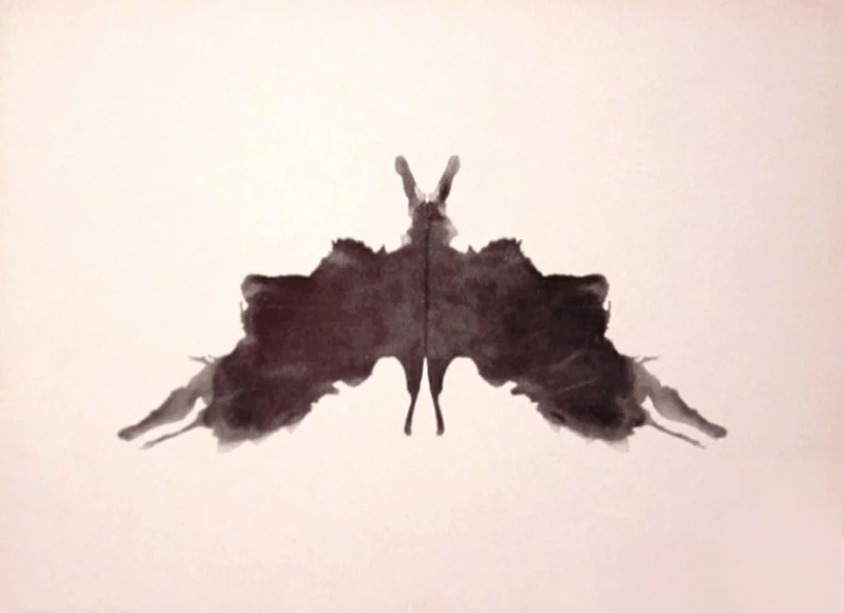
Rorschach card 5 – it’s a bat, isn’t it? The Rorschach Test evaluates emotional functioning and personality or particular mental disorders. It was designed by psychiatrist Herman Rorschach in the early 1900s.
The test is conducted by a practitioner who sits next to a subject and presents them with ten images of symmetrical inkblots, one at a time. The practitioner asks the subject to describe what they see in the blot, such as animals or people. This process may occur repeatedly to explore whether the subject perceives anything new the next time.
The subject’s responses are then recorded and interpreted according to standardised scoring systems. For example, scoring criteria may include how typical the response is, what part of the blot the subject focuses on, or if the person sees movement in the image. The interpretation was initially designed to diagnose schizophrenia but today may aim to elicit insights about the subject’s personality, emotions, cognition, motivations, relationships, or mental health. (Psychology Today)
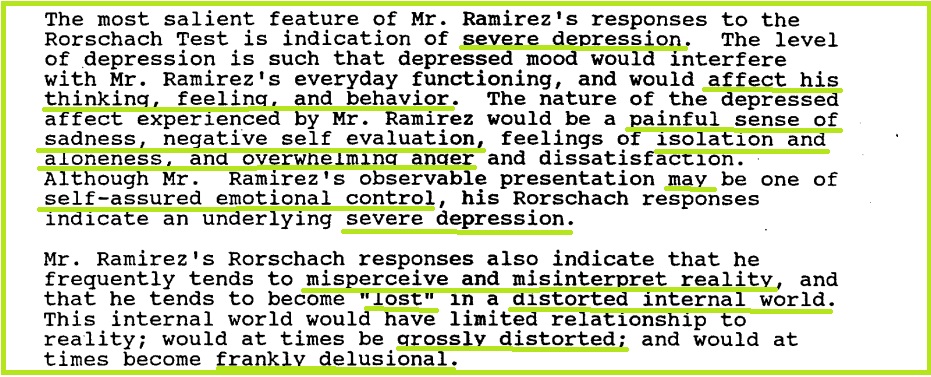
Report of Myla H Young. Doc 20-3.
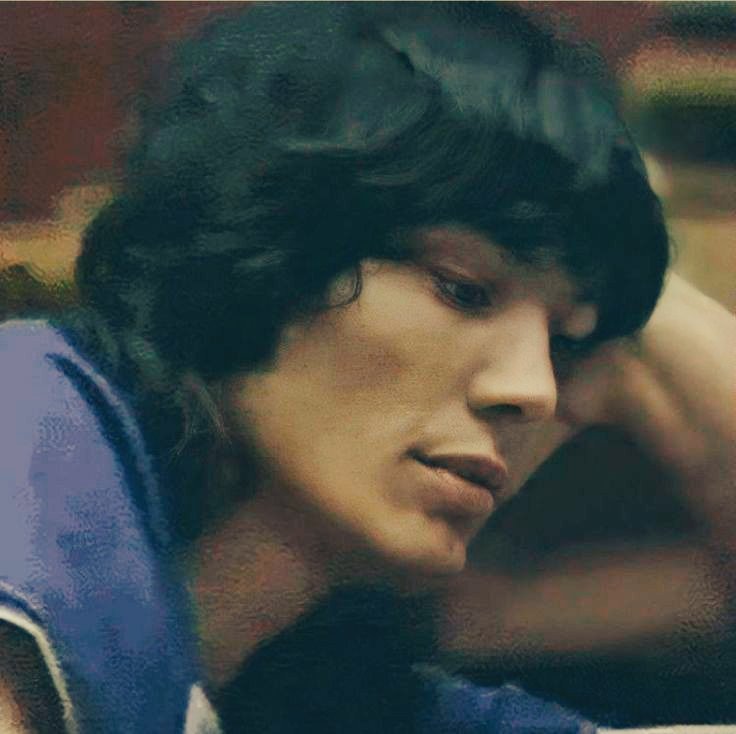
Young recorded that, in her opinion, the most noticeable aspect of her diagnosis was that Richard suffered from severe depression to the extent that he would struggle with a pervasive sense of sadness, overwhelming anger and “aloneness“. Notice she says “aloneness” rather than “loneliness”. There is a subtle difference.

Report of Myla H Young. Doc 20-3 One can easily understand why. His negative feelings of self-worth contradict the portrayal of the Night Stalker character, so full of confidence, and brashness, with the “couldn’t give a damn” attitude on display in the courtroom. That image, given to him by the media, law enforcement and the public, was just an act. In slipping on the skin of the Night Stalker, Richard hid from the world what was really going on inside him. His transformation is complete; only through these psychological tests (and some of the testimonies of his friends and family) can we get a small glimpse of the real person. He played his part well.
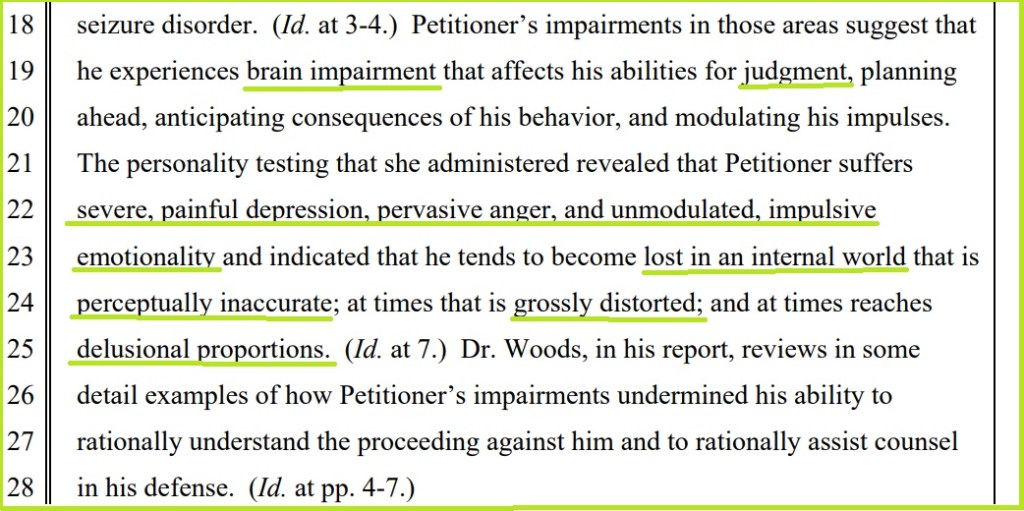
Writ of habeas corpus, page 173 Locked away in physical and mental isolation, his disordered thoughts could not perceive what was real and what was fantasy; he became lost in the inner world of his delusional thinking.
All his coping mechanisms were taken away, and receiving no medication to treat his psychosis, depression, temporal lobe epilepsy or other neuropsychological disorders, compulsions and behaviours began to manifest, the most salient of which was seemingly masturbation.
Hands on the Table
Myla Young observed Richard’s behaviour during her time with him. She noted that “several” occasions throughout her interviews, he attempted to “sexually expose and manipulate himself”. She goes on to say, “Although he required multiple, persistent reminders, he was able to respond to my demands that he place his hands on the table for the period of time needed to complete this assessment. Mr Ramirez’s attempted masturbatory behaviour did not occur during direct administration of test items, but did occur at times of transition between tasks”.
Young’s remarks concerning this inappropriate behaviour echo Elise Taylor’s, as this was also her experience throughout her time with Richard.
“Prior to beginning work on the case, I had been informed that Mr Ramirez had displayed this sort of behaviour with other female defence team members, and, accordingly, I discussed the structure and purpose of our relationship with him when we first met, including the absolute and non-negotiable absence of any physical contact of any kind. Although he seemed to comprehend what I was saying, he displayed an almost compulsive tendency towards an extremely adolescent (and, at times, pre-adolescent) obsession with sex, including repeated discussion of masturbation, his thoughts about genitalia, and his various sexual fantasies”
Report of Elise Taylor, psychotherapist. Doc 20-3Taylor went on to say that after many months of meetings, Richard finally realised that the nature of their relationship would not change because of his repeated discussions about sex, and initiated that subject less frequently. However, she mentions that if she tried to engage him in conversation about his early years and home life, he would once more focus on his sexualised thoughts about her.
“Even after many months of my unquestionably consistent negative response to, and dismissal of, this behaviour, it appeared as though he approached every incident with the real belief that I might respond positively. His repeated suggestions that we might have sex in the interview room were presented with a sincerity and intensity that indicated that he actually believed that this was a possibility, despite the constant presence of a guard three feet in front of a large glass window in the front of the room. Whereas one might expect that there would be some extinction of this behaviour after more than a year of repeated attempts and requests on his part, it was as though each time, he was proposing it for the first time, as though he had never mentioned it before”
Report of Elise Taylor. Doc 20-3
Report of Elise Taylor. Doc 20-3
It is not news that Ramirez had a habit of exposing himself; this compulsive behaviour seems to have escalated with prolonged incarceration, where he was not given the treatment he needed. Richard no longer had access to the recreational drugs he was self-medicating with outside in the free world, and as his anxiety, depression, headaches, neuropsychological conditions, and insomnia increased, so did his need to find a way to cope.
His female friends and associates who knew him before his arrest do not mention masturbation or exposing himself; their testimonies speak of his calmness, non-violent personality, and quietness. Jail and then prison amplified all his psychological problems, and nobody dealt with them. After all, who cares if a condemned man is physically and mentally ill?Neither Taylor nor Young ceased their work with him; he was not violent nor aggressive. He was able to comply with their wishes that he stop.
Women – lots of them.
Ramirez received many letters and photographs from women who all found him irresistible. They fed him their sexual fantasies and semi-naked pictures, and he responded; why wouldn’t he? Locked up in a cell for twenty-three hours daily, he didn’t have much else to do. This sudden and unexpected sexualisation of him must have had a profound effect. If we are to believe the Carlo book, the juror Cindy Haden, yes, the one who “fell in love with him”, followed him to San Francisco for the very reason of getting some “alone time”. She was, according to Carlo, so excited to be near him she nearly fainted.
Those women, who queued hours to see him and, in the process, caused security concerns, were instrumental in getting him removed back to San Quentin prison, much to his annoyance. All very heady stuff for someone with his particular set of problems.
Hypersexuality
Richard Ramirez was diagnosed with frontal lobe damage and temporal lobe epilepsy; he had not been treated for either since his early teens, the symptoms of which we have already covered in THIS POST, but here’s a recap:
- Anxiety
- Depression
- Memory impairments
- Vivid hallucinations
- Hyper-religiosity
- Blank stare or “staring into space.”
- Compulsions
- Headaches
- Insomnia
- Paranoia
- Fetishes
All of the above manifested at various stages of his life.
Report of Myla H Young. Doc 20-3
When a person’s frontal lobe is damaged, so is cognitive functioning, which can lead to numerous psychological and emotional problems, including hypersexuality. Our old friend Dietrich Blumer, who examined Richard pre-trial in 1986, wrote a book on the subject, THIS LINK provides an in-depth account of hypersexuality and brain disorder.
Richard’s compulsions, fetishes and preoccupation with sexual matters originate from a brain injury, his behaviour was driven by anxiety and a mental illness he was never given help with. The seizures, and personality changes, including the hyper-religiosity he also engaged in, were part of an ongoing set of neurological and psychological irregularities which every doctor who evaluated him attested to. A collection of mental impairments that have been swept aside because it is not convenient to mention them.
We are left with the mental image of a man so traumatised by the events in his life that his ability to discuss them is reduced to staring at a sequence of inkblots on cards presented to him, unable to confront, understand or rationalise the process that led him there.
“He would struggle with a pervasive sense of sadness, overwhelming anger and aloneness.“ I’d be angry, too, if I were you.
“My left hand is a Rorschach blotch all its own, a six-fingered, skin-blood-and-bone ink splatter. People see it and fly their worst fears and secret fetishes at full mast when they think they’re being discreet. They see it as strange, fascinating, ugly, beautiful, disgusting or erotic depending on what’s behind their eyes.”
Craig Clevenger, The Contortionist’s Handbook~ Jay ~
-
Foot Fetishes & Death Sentences

Richard’s mental and physical health has been overlooked for decades by law enforcement, the media, and the public. Apparently, a mentally ill Richard Ramirez does not excite people. It’s the “sadistic, evil” narrative of him that does it for most. It is time to provide an alternative to the lies, the slander, and the defamation. It is time to question and end the constant maligning of a man who suffered so much physically and emotionally by law enforcement individuals, who claim they know the truth, and by true crime enthusiasts who merely report the ramblings of those seeking financial gain from exploiting the story, yet claim to only deal with the facts.
As I delved into these reports, I caught a glimpse of who Richard really was. And the images that come through were not those of a murderer, a rapist, or a pedophile. When I analyzed the reports of the numerous professionals that evaluated him, examined him, and administered tests to him, I saw an image quite different from the one painted by law enforcement, the media, and true crime enthusiasts. I observed a man suffering from depression, anxiety, delusions, obsessive behaviors fueled by trauma, and temporal lobe epilepsy. I saw a man who had been physically and mentally wounded; A man who couldn’t help himself, who coped the only way he knew how – by abusing drugs. I discovered a man who cared about his family and friends.
The following evidence comes from a supporting document to Richard Ramirez’s 2008 federal Habeas Corpus petition: Document 20.3, Exhibit 99, the declaration of Elise Taylor, a licensed psychotherapist.
Taylor was retained by Michael Burt from the San Francisco Public Defender’s Office to assist with preparing Richard’s psychosocial history for use in the San Francisco trial. As has been discussed in my article “All the Broken Pieces,” this trial never happened. However, Taylor came to the same conclusion as every other professional that evaluated Richard: He was not able to rationally participate in his defense.
In her report from 1995, she stated:
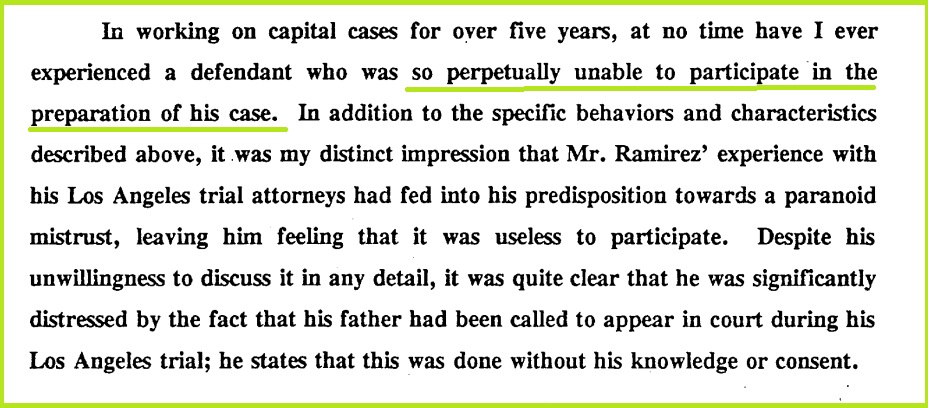
“…at no time have I ever experienced a defendant who was so perpetually unable to participate in the preparation of his case.”
She determined that Richard was obsessed and paranoid regarding security and confidentiality:
“For the first months I met with Mr. Ramirez, a significant portion of the time we spent together was taken up by his repeated questioning of the security measures in my office, the public defender’s office, what kind of locks were used, who had keys, security of telephone lines, who had access to my notes, etc.”
– Document 20-3, exhibit 99,
Richard tried to control communication between his psychiatrists and his attorneys as Taylor explains here:
“Mr. Ramirez also spoke about his pervasive lack of trust, and, during the first months that we worked together, he devised complex plans for trying to determine the lines of communication within the defense team. Despite the fact that I had made clear to him that I would not hold anything he said secret from his attorney, and that anything he told me in any context would be shared with the rest of his defense team, he seemed obsessed to distraction by trying to “catch” someone lying to him.”
– Document 20-3, Exhibit 99, Habeas Corpus
This paranoia extended to disclosing anything about his family or upbringing. Richard requested that any discussions with his family be recorded for his review. He also dictated who his family and friends could talk to and what they should and should not say. This was a pattern. He behaved the same way with psychiatrist Dr Evans, who I wrote about in a previous article.
What is a Foot Fetish? Did Richard Really Have One?
A foot fetish is when someone is strongly drawn to or aroused by feet. It’s one of the most common fetishes, though there’s limited research on how or why it develops. Some scientists believe it stems from a kind of “cross-wiring” in the brain areas responsible for foot and genital sensation. Studies of fetish groups consistently show that feet and foot accessories are the most fetishized non-genital body parts. Per Elise Taylor, Richard did indeed have a noticeable preoccupation with feet. (Taylor, exhibit 99, document 20-3)
While working with Richard, Taylor observed that he displayed obsessive-compulsive behaviors, including a significant fixation on feet. He would frequently comment on women’s shoes if they walked by the interview room. However, not a single Night Stalker victim ever mentioned their attacker showing any interest in their feet – no touching, no comments, no fixation. Nothing.
That might not seem important at first. But when someone with a true foot fetish engages in sexual violence, that fetish often appears as part of the behavior. The feet are typically integrated into the act. With Richard, if his fixation was that intense, it’s reasonable to expect it would have manifested during the assaults. The fact that none of the victims reported anything related to a foot fetish is significant – and it raises serious questions about whether he was the actual perpetrator in those cases.
Judicial Murder
Although Richard had received multiple death sentences, and Taylor addressed this with him numerous times, he was in denial that it would ever happen. He did not state this, but his behaviors indicated to her that he could not process the finality of his sentences. Elise Taylor found Richard to be dissociative regarding his death sentences. She stated Richard could discuss the fact that he had received multiple death sentences, but he did not acknowledge any concern regarding it, nor did he understand the impact it had on his family, especially his mother, whom he was particularly concerned for.
“This [the death sentences] was particularly significant from the perpsective of his mother, for whom he appeared to have the most sincere concern, yet whose fears surrounding his death sentence, he could not in any way understand or respond to.”
– Taylor, exhibit 99, document 20-3.
Although Richard would not discuss his social history with Taylor, he was willing to sell his life story for publication, and she confronted him about this. She stated that Richard’s experience with his L.A. trial and attorneys who provided ineffective assistance of counsel had led him to believe that legal efforts on his behalf were futile:
” … it was my distinct impression that Mr. Ramirez’s experience with his Los Angeles trial attorneys had fed into his predisposition towards a paranoid mistrust, leaving him feeling that it was useless to participate.”
– Taylor, exhibit 99, document 20-3.
Who could blame him for feeling that way?
Even though Richard understood the media bias in his case, Taylor determined that it was not taken into consideration when it came to selling his story and the damage it could have on his case.
Ramirez told her Taylor he would censor his story and present it in a way that was marketable. Yet, he would do it in a way that would not be destructive to his family.
“In my professional opinion, Richard’s judgement concerning who he could and should trust (based on all logical and rational information) was significantly impaired, and he seemed truly surprised and taken aback when various media personnel did not present him (and various bits and pieces of his story) in exactly the manner in which he had provided it to them. Again, despite Mr. Ramirez’s extensive history with the media, and his apparent ability to acknowledge the bias with which he felt his case had always been presented, in my professional opinion, that knowledge was not in any way incorporated into his thought processes.”
– Taylor, exhibit 99, document 20-3.
Richard only told the media what he wanted them to hear, and the media took that information and distorted, inflamed, and heightened the bits and pieces into a story that fit the narrative of the rapist and murderer they would refer to as the Night Stalker. The media made his story into something that would grab the reader’s attention, and that would allow them to profit from it regardless of whether or not there was a thread of truth to it. And why did he want to sell his story? So that he could provide financial support for his mother.
It’s been a decade since Richard’s death, yet his story continues to grow. The more his story grows, the more fictionalized it becomes. I have a challenge for the true crime podcasters, law enforcement, the media, and even Richard’s family members, who continue to profit from his misfortunes. How about reporting verifiable facts instead of repeating the same sensationalized narratives? How about legitimately responding to questions asked by those curious about the truths instead of ignoring any comments that question the authenticity of the well-rehearsed, fabricated story?

“We are all evil in some form or another, are we not?” Richard Ramirez
Sources:
2008 federal petition for Writ of Habeas Corpus, Richard Ramirez vs. Robert Ayers.
Document 20-3, supporting document to 2008 federal petition, report of Elise Taylor
Kaycee
-
The Fragmented Mind -The Watson Report
* Some images may require a desktop for greater clarity*
“I’ll describe some characteristics of a man I knew almost ten years ago. When I first met him he was sitting a table. He was thin and somewhat hunched over; he looked like a bird with a broken wing, afraid and isolated. He had a nervous smile and an awkward way of doing just about everything. Soon after, when he got to know me better, he began drawing pictures for me, usually of small animals. Rabbits were his favourite. He was quite a good artist”.
Jo-Ellan Dimitrius, jury consultant at Richard’s trial, from her book Reading People.
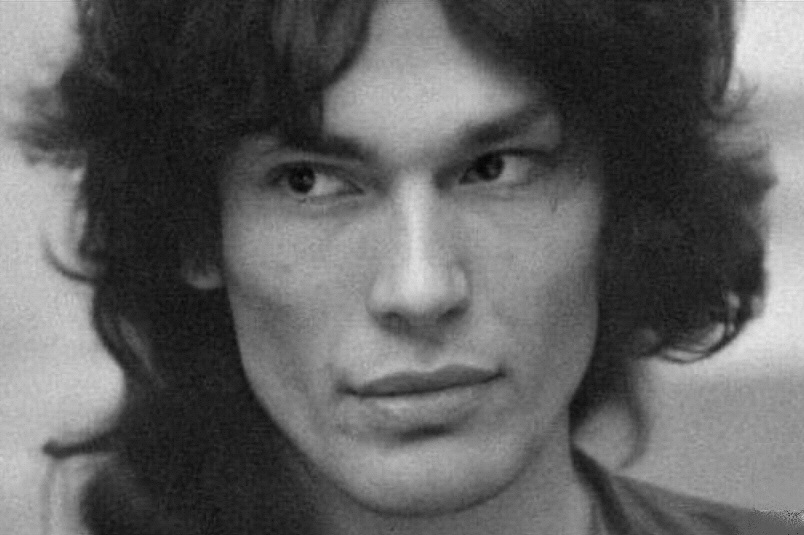
Richard Ramirez, post-conviction, during a hearing in San Francisco
What Watson Said
Dale Watson, PhD, a psychologist specialising in forensic psychology and neuropsychological assessment, was retained by post-conviction counsel acting on behalf of Richard Ramirez. The reason for Dr Watson’s evaluation of Richard should now be apparent; it was to determine whether Richard had been competent to stand trial and to waive his rights during his LA trial in 1989, as part of his appeals process.
His findings, echoing what previous doctors had found, should come as no surprise as we have covered it numerous times, so this section may seem repetitive. It is because the psychiatrists, neuropsychiatrists and forensic psychologists all came to the same conclusion; that Ramirez was suffering from many mental health problems and thought disorders. Considering Richard’s San Francisco trial had been stayed indefinitely in 1995, due to mental incompetence, one would think that was obvious. These conditions rendered him unable to understand proceedings and rationally assist his counsel.
Dale Watson interviewed Richard on three separate occasions, 29th September 1999, 26th October 1999 and 20th June 2000. This is ten years post-conviction, ten years! Richard was still displaying the same symptoms observed by William Vicary, Victor Henderson, and Dietrich Blumer had reported pre-trial, in 1985 and 1986.
Richard refused to see Watson twice, just as he did with Blumer. The first refusal came in 1999, and the second in 2003. One can imagine it was the only vestige of control Richard could exercise concerning his life, who he chose to see and refused. No reasons are given for these refusals; we could speculate that Richard may have been sick of the tests, and he also trusted no one. Whatever the reason was, Watson said in his report:
“Mr Ramirez’s level of disorganisation and subsequently his refusal to be seen for further evaluation precluded conducting a more thorough and comprehensive neuropsychological evaluation.”
Dale Watson from his report. Doc 7-21
What Watson Did.

Declaration of Dale Watson doc 7-21 “Petitioner was incapable of understanding what he was entitled to before, during, and after his trial. Petitioner did not understand how the court functioned or how his attorneys should be functioning. He could not understand that he had a right to a strong and vigorous defense in a trial where his life was at stake. Petitioner’s counsel failed to protect his interests throughout their representation of him, a four-year period”.
Writ of Habeas Corpus page 177
Along with the neuropsychological tests Dale Watson conducted, he reviewed Richard’s medical records, school reports, hospital reports, information from his time in TYC (Texas Youth Council), and his El Paso Guidance Centre reports. Additionally, he examined the declarations of other doctors who had interviewed and evaluated Richard. The testing and evaluation aimed to determine the level of cognitive brain functioning and formed a fundamental part of a reliable and comprehensive clinical evaluation. Each test is designed to provide insight into brain dysfunction’s presence, nature and extent.
A word about percentiles, the measurement used for gauging Richard’s performance. Not to be confused with percentages, which reflect how well an individual has performed in a test or exam; percentiles show the performance compared to other individuals who also completed the test. For example, if someone falls at the 25th percentile, it means they achieved a higher score than 25% of others who also took the same test or exam.
The Tests
The Wisconsin Card Sorting Test (WCST)
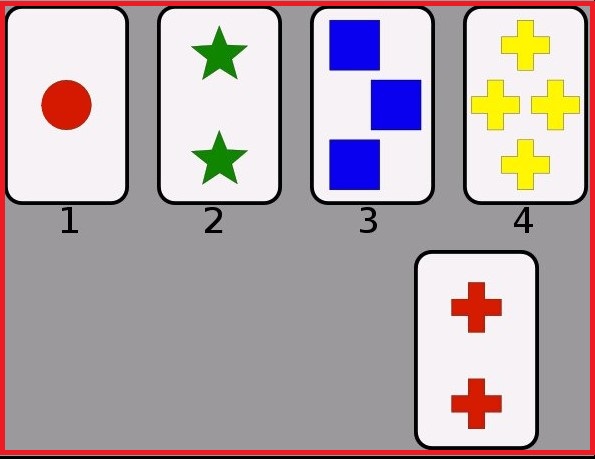
This test aimed to measure cognitive processes such as memory, abstract thinking, attention and cognitive ability. It can also measure perseverative behaviours and the insistence of an individual to repeat the same behaviour when it is inappropriate. The WCST is considered a measure of executive functioning because of its sensitivity to the frontal lobe area of the brain.
The subject is asked to place each upcoming card onto one of the four piles; there are no directions, and they may choose either colour, shape or number. Whichever category they choose is “correct” for several categories but then is met with an “incorrect” response, and they must switch sets to get a “correct” answer again. A failure to change sets is termed “perseveration”.
Richard fell in the 2nd percentile and was within the mild to moderately impaired range. Watson believed Richard was drawn to the saliency of the stimulus rather than solving the problem itself; in other words, the colours and shapes caught his eye, and that overrode the task itself. He had difficulty changing to the new rules and repeatedly made the same mistakes, even when shown that it was wrong.
“Mr Ramirez’s performance reflected a significant degree of perseveration. Perseveration has been defined as the ‘Persistence of the same response, even when it is shown to be inappropriate’. It is associated with both diffuse and frontal lobe disease. Perseveration may involve motor acts, speech, or ideas”.
Declaration of Dale Watson doc 7-21Richard could only complete one of the six expected card sorts.
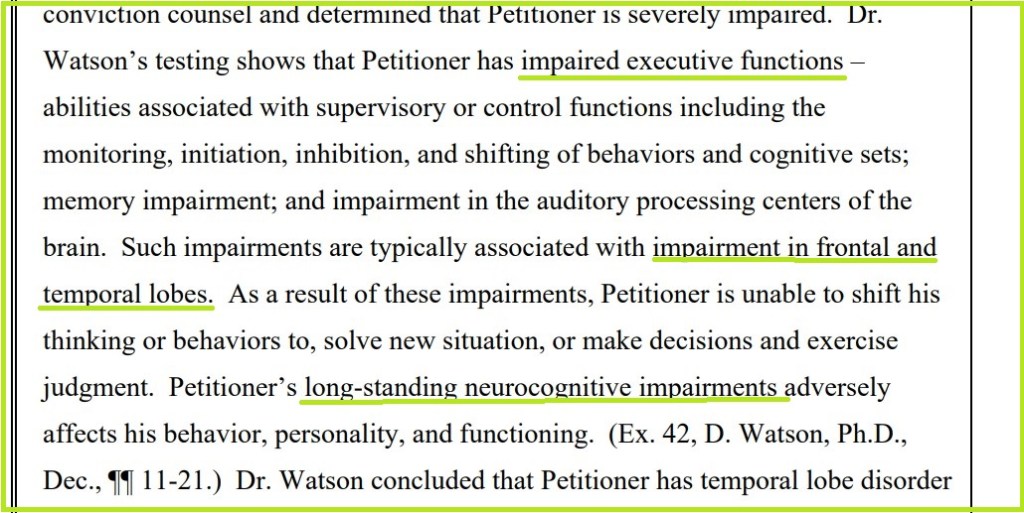
Writ of Habeas Corpus page 175
The Stroop Colour and Word Test

Image: psyToolkit It measures a person’s attention, executive functions, and inhibitory behavioural control. It is an excellent example of how the left side of the brain interprets language and can change perceptions of what is real and what is fantasy.
Watson found that in this test, Richard fell within the low-average range.


This test assesses complex attention and is presented in two forms.
- Form A: the participant is required to drawn lines joining the numbers in ascending order as quickly as possible and involves focus and attention.
- Form B: Also requiring attention, this form also measures the ability to switch cognitive sets between letters and numbers.
Richard fell in the average range.
Repeatable Battery for the Assessment of Neuropsychological Status (RBANS)
This test is a screening instrument for the assessment of an array of neuropsychological functions: it measures the following components:
- Memory
- Visuospatial perception – the ability to copy a design
- Attention
- Language
- Delayed memory
Watson reported that Richard’s “overall performance fell at the 8th percentile and within the mildly impaired range. He had particular deficits in recalling paragraph-length auditory material, where his performance was at only the 1st percentile. Likewise, he was markedly impaired in his ability to copy a complex geometric figure (well below the 1st percentile rank) and recall the figure several minutes later (less than the 1st percentile rank). The impairment of memory functions is most commonly associated with temporal lobe functions”.
Additional auditory testing suggested some possible impairment.
This task required him to repeat different words presented simultaneously to the right and left ears via stereo headphones. Richard fell at the 5th percentile in the right auditory channel and was below the cut-off for identifying both words; Watson’s findings implicated impaired temporal lobe functioning.
Richard had difficulty recalling and repeating an auditory paragraph played to him; his performance fell within the 1st percentile.The Test of Memory Malingering
Most importantly, this test measured if Richard was having them on, playing around and malingering. The visual recognition memory test is sensitive to lack of effort but not to brain dysfunction. Richard correctly completed 50 out of 50 during both trials and, in Watson’s opinion, was shown to have put in maximum effort and supported the interpretation of brain impairment from the other tests.
Summing Up
What does all this mean?
That Richard was perhaps “simple” or “stupid” somehow? No, he was neither of those things. His thinking was disordered, fragmented and disturbed; he had psychosis, paranoid delusions and severe depression; he was not an idiotDale Watson concluded in his findings that Richard had temporal lobe disorder and frontal lobe dysfunction; his preliminary testing suggested he also had neurocognitive deficits and difficulty with problem-solving and shifting mental sets. Watson also found Richard to have poor impulse control and impaired decision-making ability and judgement.
His report agrees with the conclusions of the other doctors who saw Richard over the years.
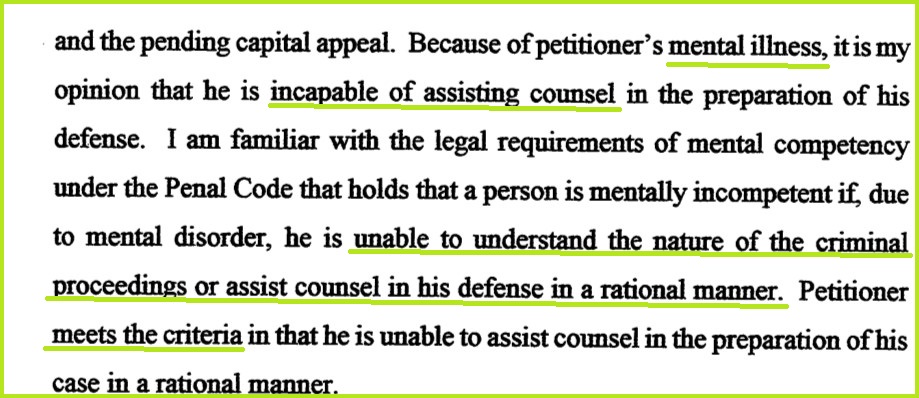
Declaration of Dale Watson doc 7-21
Watson had found Richard unable to rationally assist in is own defence and to understand the proceedings against him.
“Based on my review of records referenced above, including El Paso Guidance Center and Hotel Dieu Hospital, and the declaration of Dr Dietrich Blumer who evaluated petitioner in 1986, prior to petitioner’s trial, it appears that petitioner has been mentally impaired for a long period of time. Petitioner suffered brain dysfunction at an early age; he underwent brief treatment for temporal lobe epilepsy; and he suffered head trauma. In addition, he experienced trauma from exposure to violence; he used drugs to self-medicate after he stopped taking the prescribed medication; and he has a history of being unable to separate reality from fantasy. Exposure to neurotoxins, which petitioner likely experienced, can also result in neurocognitive deficits. These factors point to a long-term mental disorder with psychotic features”.
“There is strong evidence that petitioner suffers from a temporal lobe disorder and frontal lobe dysfunction with neurocognitive deficits. A competent mental health evaluation of petitioner at or near the time of trial would have disclosed much of the same evidence of mental illness as set forth in this declaration. Moreover, the evidence of his mental disorders was crucial information to explain to the jury”
Declaration of Dale Watson doc 7-21Richard’s conditions were all treatable, although not curable, and his condition deteriorated as time passed, his symptoms exacerbated by the lack of medical care throughout his life.
“Long-term confinement while awaiting trial on capital charges in the Los Angeles County Jail, where the inadequate staffing, programming, and other adverse conditions of confinement resulted in institutional failure to address and provide appropriate intervention and treatment”.
(Ex. 43, Declaration of Dr Jane Wells, J.D., PhD, dated 05/19/2004, ¶ 46.)
Richard had been ill since before his arrest in 1985 and after, a cover-up still not acknowledged. We can thank Richard’s San Francisco lawyers for finally thoroughly investigating and disclosing the information deliberately hidden at Richard’s trial in LA. His habeas lawyers, in the 2008 petition, shed further light on this, enabling us to understand what happened in that courtroom and beyond; and why Richard’s defence team, Daniel and Arturo Hernandez, along with Ray Clark, failed him utterly.

Declaration of Dale Watson doc 7-21
Back to LA and incompetent, negligent lawyers
Here we are again, from LA to San Quentin, to San Francisco and back again. Back to LA and the sad excuse for a defence team on whom much of this rests. Their failure to fight this case in every way is sickening, especially as they had so much material to work with. Weak evidence not being the only thing. They had a duty to expose everything and cross-examine the charges against Richard; they failed. An obligation to investigate and fully present his mental impairments; they failed. A responsibility to provide the jury with counter-evidence to consider; they failed. A duty to submit, at mitigation, his whole life history; they failed.
Let’s stop with the “smart criminal” rhetoric; it’s a load of rubbish; if a man with a high IQ committed these crimes, that man could not have been Ramirez.
He cannot be the man who flummoxed LASD and SFPD, dancing rings around them, evading capture, like a coked-up, latter-day Scarlet Pimpernel, and also be the man who took part in these tests. One of those scenarios is blatantly inaccurate; he can’t be a criminal mastermind while simultaneously being unable to sort out a pack of playing cards. Take your pick.
Writ of Habeas Corpus page 516
What does this tell us about justice? There is none, not for an indigent defendant on a capital charge, and who has the bad luck to have a pitiful defence team.
“2060. Petitioner’s convictions, sentences, and confinement were obtained as the result of serious errors constituting multiple violations of his fundamental constitutional rights at every phase of his trial, from the unfair and discriminatory decision to charge and prosecute him, prosecutorial misconduct, the presentation of inaccurate, incomplete and unreliable evidence in the guilt phase, and culminating in a sentencing phase, in which no evidence of his character, background, and mental illness was presented, and was fatally flawed by gross prosecutorial misconduct. Through it all, Petitioner’s trial counsel were so ineffective and incompetent that they consistently provided grossly ineffective representation and failed to protect his fundamental rights.”
Writ of Habeas Corpus page 734~ Jay ~
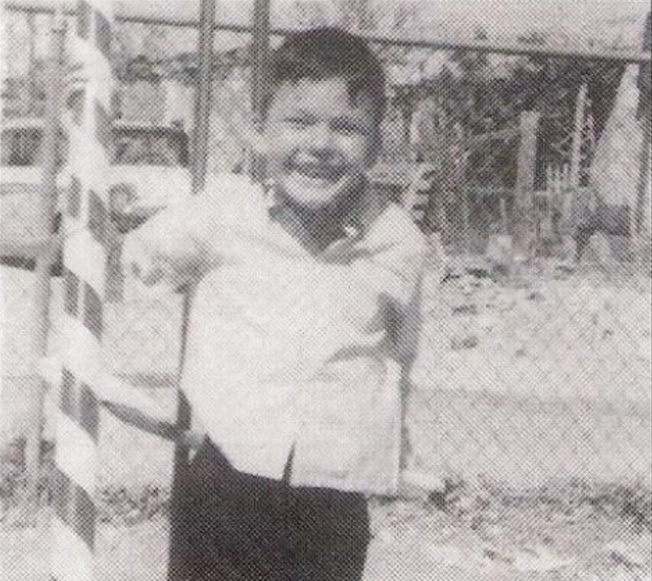





 Expendable For A Cause.
You must be logged in to post a comment.