
“The world has been fed many lies about me..”
Richard Ramírez
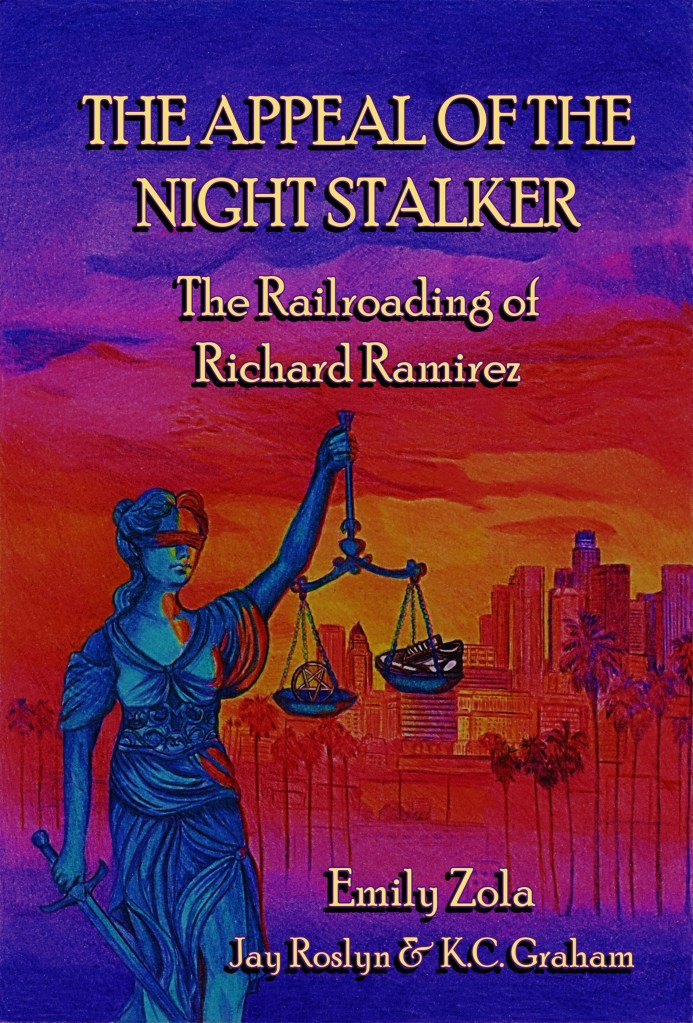
Now available, the book: The Appeal of the Night Stalker: The Railroading of Richard Ramirez.
Welcome to our blog.
This analysis examines the life and trial of Richard Ramirez, also known as The Night Stalker. Our research draws upon a wide range of materials, including evidentiary documentation, eyewitness accounts, crime reports, federal court petitions, expert testimony, medical records, psychiatric evaluations, and other relevant sources as deemed appropriate.
For the first time, this case has been thoroughly deconstructed and re-examined. With authorised access to the Los Angeles case files, our team incorporated these findings to present a comprehensive overview of the case.
The Writ of Habeas Corpus
The literal meaning of habeas corpus is “you should have the body”—that is, the judge or court should (and must) have any person who is being detained brought forward so that the legality of that person’s detention can be assessed. In United States law, habeas corpus ad subjiciendum (the full name of what habeas corpus typically refers to) is also called “the Great Writ,” and it is not about a person’s guilt or innocence, but about whether custody of that person is lawful under the U.S. Constitution. Common grounds for relief under habeas corpus—”relief” in this case being a release from custody—include a conviction based on illegally obtained or falsified evidence; a denial of effective assistance of counsel; or a conviction by a jury that was improperly selected and impanelled.
All of those things can be seen within this writ.
The Writ of Habeas Corpus is not a given right, unlike review on direct appeal, it is not automatic.
What happened was a violation of constitutional rights, under the 5th, 6th, 8th and 14th Amendments.
Demonised, sexualised and monetised.
After all, we are all expendable for a cause.
- ATROCIOUS ATTORNEYS (4)
- “THIS TRIAL IS A JOKE!” (8)
- CONSTITUTIONAL VIOLATIONS (9)
- DEATH ROW (3)
- DEFENCE DISASTER (7)
- INFORMANTS (6)
- IT'S RELEVANT (17)
- LOOSE ENDS (15)
- ORANGE COUNTY (3)
- POOR EVIDENCE (16)
- RICHARD'S BACKGROUND (7)
- SNARK (12)
- THE BOOK (4)
- THE LOS ANGELES CRIMES (22)
- THE PSYCH REPORTS (14)
- THE SAN FRANCISCO CRIMES (5)
- Uncategorized (5)
-
You, the Jury
Questioning
The word “occult” comes from the Latin “occultus”. Ironically, the trial of an infamous occultist and Satanist is the epitome of the meaning of the word itself: clandestine, secret; hidden.
We’ve written many words; a story needed to be told, and we created this place to enable us to do just that.
Here, in this space, we intended to present the defence omitted at Richard Ramirez’s trial in violation of his constitutional rights. Our investigations have taken us down roads we’d rather not travel along, but as we did so, we realised that there was so much hidden we could search for a lifetime and still not see the end of it. Once we’d started, there was no turning back; we followed wherever it led.This was never about proving innocence; that was never the intent or purpose. We wanted to begin a dialogue, allowing this information to be freely discussed and for us to verbalise the rarely asked questions. We asked, and we’re still asking.
We can’t tell you, the reader, what to think; you must come to your own conclusions, as we did.
And so
We’ve said what we came here to say; with 114 articles and supporting documents, we’ve said as much as we can at this point.
This blog will stand as a record of that, and although we will still be here, we intend to only update if we find new information, if we suddenly remember something we haven’t previously covered, or to “tidy up” existing articles and examine any new claims (or expose outrageous lies) that come to light. The site will be maintained, and we’ll be around to answer any comments or questions.
What Next?
We will focus on the book being worked on; we’ve also been invited to participate in a podcast. When we have dates for those, we’ll update you.
The defence rests? Somehow, I sincerely doubt that; ultimately, we’re all “expendable for a cause”.
~ J, V and K ~
-
Family Matters – Part One
*A desktop may be required to view some images clearly*
Marylin Cornell, a marriage and family therapist, was retained by post-conviction counsel for Richard Ramirez. Cornell was regularly retained as an expert witness in capital cases to help prepare the defence of the charges, presenting mitigating evidence on behalf of the client.
Her task was to prepare detailed reports regarding social and family background, enumerating the history, economic, cultural, institutional, and environmental factors and how they affected his emotional and psychological development from birth.For her assessment, Cornell interviewed Ramirez family members, including his mother, sister and his brother, Ignacio. She also reviewed all medical, school and social reports, court records and proceedings from Richard’s youth, the family declarations and doctor’s statements.
The family statements within this article are from 2004, and can be found in doc 7-30, apart from Robert Ramirez, whose statement is from 2008, and found in document 20-5. Marylin Cornell’s report is found in document 7-19; all are exhibits to the 2008 Writ of Habeas Corpus. Cornell’s report is sizable and will be broken down through subsequent posts.
Background

El Segundo Barrio, El Paso, Texas (Getty images) Mercedes Muñoz, Richard’s mother, was born in 1927. Her parents moved from Camargo, Mexico, to Montana to work on the railroad. However, the harsh Montana winters prompted the family to relocate to Colorado, where Mercedes was born. Guadalupe, the mother of Mercedes, missed her family back in Camargo, and in 1937 the family returned to Mexico.
Mercedes’ education was cut short; family circumstances required her to work to help with the finances, and she left school in the 5th grade. When she was fifteen, she met her future husband, Julian Tapia Ramirez.Julian Sr was born in 1927 in Camargo, Mexico, one of eight children; his education was also cut short, completing only first grade. After that, he went to work in the fields to help support his family.
In the 1940s, after a traditional courtship, the couple married and left behind their hometown of Camargo, near the Sierra Madre Mountains, moving to the border town of Ciudad Juarez, infamously known for its poverty, pollution, and lawlessness. In 1951, after they had their first child, Julian Jnr, who was born in 1950, the family migrated across the Rio Grande River to the barrio in El Paso, Texas. Life wasn’t easy, and they struggled to survive as four more children were born over the next nine years: Ignacio, born in 1951, and Robert, born in 1953. Rosa in 1955, and lastly, Richard in 1960.
Richard Ramirez was to spend the first years of his life in El Segundo Barrio; this was one of the main entry points from Mexico into the United States for many years. The family lived in a two-roomed dwelling bordered to the south by the Rio Grande River and Juarez, Mexico.
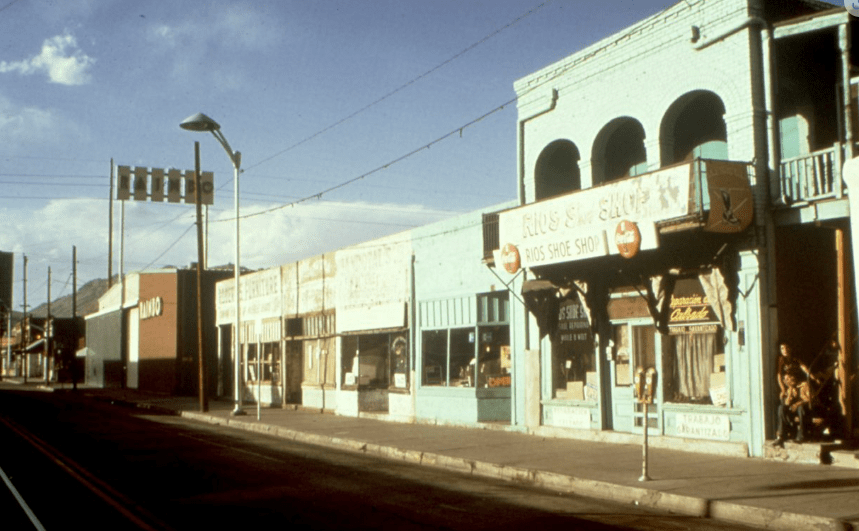
El Segundo Barrio 1972, credit Danny Lyon. 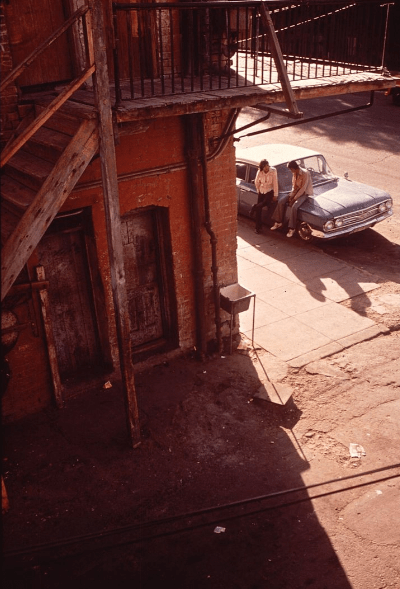
El Segundo Barrio 1972, credit Danny Lyon. 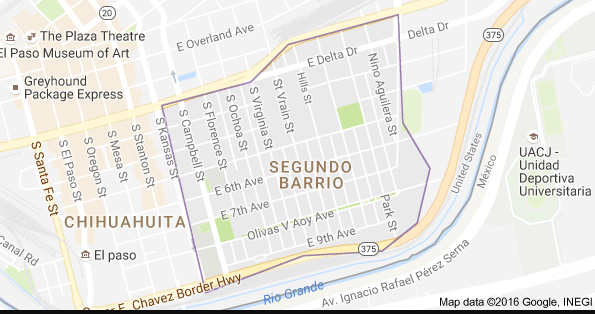
How Clean is Your Earth?
“My husband, Julian, Sr., worked for the Santa Fe Railroad for
Declaration of Mercedes Muñoz Ramirez, 2004. Document 7-30 from the Federal Writ of Habeas Corpus, 2008.
many years. He worked in and around the ASARCO smelting plant, bringing home on his clothes heavy dirt which could be almost suffocating.
All of us were exposed to it especially Richard because he was the youngest and would be waiting on his father. I believe that many of the health problems my husband suffered came because of his work. He died at an early age from cancer.“
Julian Snr struggled to find full-time employment when the family first came to the United States, working several jobs, including construction, the Tony Lama boot factory (where his wife, Mercedes, also found work) and the American Smelting and Refining Company) (ASARCO). Eventually, he found full-time employment with the Santa Fe railroad company, where he was to work for nearly forty years, laying tracks within the vicinity of the ASARCO smelting works, which had been home to the world’s tallest smokestack/chimney when it was built in the 1950s; for many years it was the largest smelter in the USA, processing copper and lead harvested from mines in Mexico.
Julian Snr worked for a time inside the grounds of ASARCO, where the Santa Fe railroad hauled the products from the plant to off-site locations. The pollution from ASARCO permeated the air for three miles in any direction, while the lead poisoned the soil and the bodies of those within the area of El Paso.
The company-owned community, Smeltertown, where many who worked at the plant itself lived, was dismantled in the 1970s after an environmental investigation and scandal, where the city of El Paso sued the smelting company for the devastatingly high levels of contamination from lead, cadmium, arsenic, and zinc, continuously belched out into the atmosphere over many years. For the residents of Smeltertown and El Paso, and the areas surrounding the ASARCO plant, it meant toxicity in the air they breathed, the soil they walked and played on, the food they ate and the rivers and waterways that flowed through the land.

ASARCO, 1972. Credit: Danny Lyon
Lead Poisoning in Children
Exposure to lead can have terrible consequences for the health of children, including:
- Damage to the brain and nervous system
- Convulsions
- Learning disabilities
- Behavioural disorders, criminality
- Neurological damage
- Reduced attention span
- Reduced attainment in education
- Hearing and speech problems
The inhalation of toxic dust and air in pregnant women can also cause foetal damage.
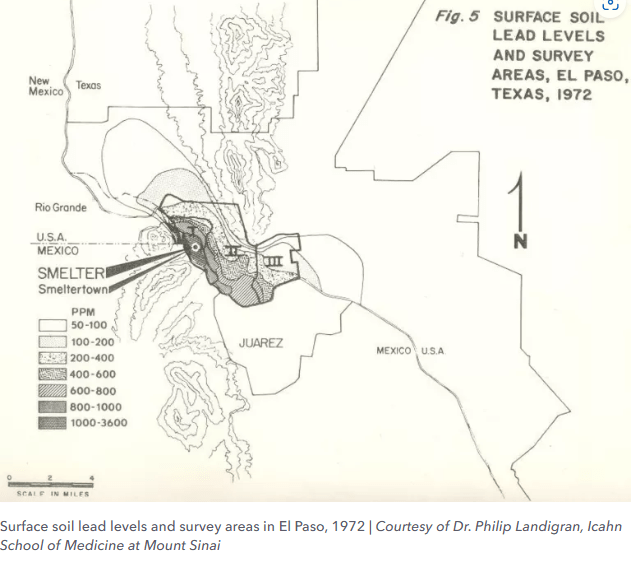
Julian Ramirez Snr died at 64 in August 1991 from cancer. It was not determined that his prolonged exposure to neurotoxins had any ill effect on his health. He had worked long years in hazardous conditions in an environment severely polluted by heavy metals and toxic substances. One cannot help but wonder if exposure to multiple carcinogens contributed to his illness.
But what of Richard, his mother, and his siblings? They, too, were vulnerable to the polluted atmosphere in and around El Paso, and all exhibited physical and cognitive problems throughout their lives.
Mercedes
For Richard’s mother, the conditions within the Tony Lama boot factory, where she was employed, were an additional cause for concern. Throughout her five pregnancies and beyond, she worked an average of five days a week, eight hours a day, on her feet in a poorly ventilated environment. Handling toxic substances daily, she was provided with no protective clothing, gloves or eyewear, as she polished and treated boots with paints and dyes, leaving her skin stained black.
The chemicals she breathed in made her feel sick and dizzy, something which significantly affected her during her last and most challenging pregnancy with Richard. Mercedes had to see a specialist throughout her term and was advised to take time off from work, as continuing in her job may cause harm to her unborn child. She was unable to do so because the family needed her income.
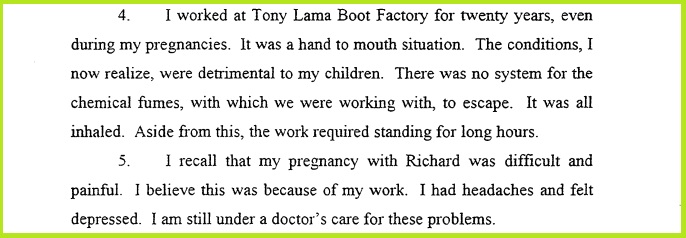
Declaration of Mercedes Muñoz Ramirez, document 7-30.
Julian Jnr.
“My family was very poor when I was growing up. Both of my parents worked full-time when I attended grade school. We first lived in an El Paso barrio very close to Juarez, Mexico and ASARC0 smelting plant.
By the age of 10, I began to have difficulties in school. I had trouble concentrating and was unable to keep up with my classes. I attended special education classes to help with my schooling, but I continued to have problems with my studies. In high school I suffered a serious injury to one of my arms. After that, I stopped attending and did not finish high school.”
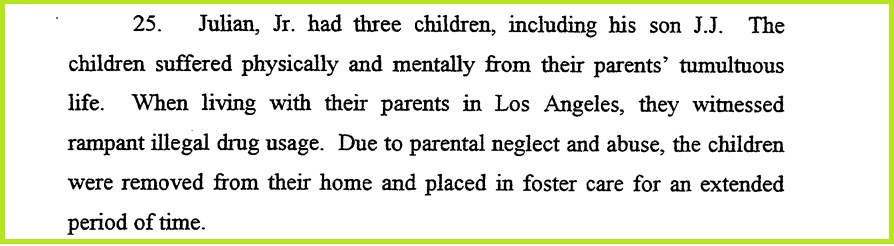
Declaration of Julian Jnr Ramirez, 2004. Document 7-30The first child of Julian Snr and Mercedes, Julian Jnr was born in 1950 in St Joseph’s Maternity Hospital in El Paso, where he spent the first month of his life receiving treatment for tumorous growths on his head. At the time of his birth, the family were still living in Juarez, Mexico.
Julian Jnr attended special educational classes for a series of learning difficulties, difficulties which continued throughout his school life. He became addicted to heroin, dropping out of school after an incident where he received a severe knife wound to his arm.Julian later married and moved to Los Angeles, where he and his wife continued a dependency on both alcohol and drugs, contributing to their children’s removal into care for an extended period, and Julian being in and out of jail on drug-related offences. Both genetics and environment may be considered a factor in his lifelong addictions and mental impairments.
Declaration of Marylin Cornell, document 7-19.
Ignacio
“I believe that my medical problems are related to the area that
Declaration of Ignacio Ramirez, 2004. Document 7-30.
I lived in, including the soil because of lead poisoning by ASARCO; air pollution from Chevron oil refineries that were nearby; and water pollution of the Rio Grande. All of these things have affected my health”Ignacio was born less than a year after Julian Jnr, and birth-related problems led to grave physical disabilities that severely impacted his life. His childhood was marred by painful bone deformities, and he underwent many painful operations in his early years, eventually leading to the amputation of a leg.
Medical treatment was expensive, and the Ramirez family received some financial assistance from the Lions Club programme.Like his brother before him, Ignacio also needed educational support, although it seems he did not get it.
His parents devoted most of their limited time, resources and energy to their second son out of necessity, as he needed their support and care. Even that was problematic, for at age eleven, with his father away and his mother unable to take time off work, Ignacio had to travel by bus to the hospital on his own for an operationHe was to suffer into his adult years, both physically and mentally.

Declaration of Ignacio Ramirez, 2004. Document 7-30
Robert
“I have been diagnosed with bi-polar disorder, schizophrenia, high blood pressure and arthritis. I have had four surgeries on my left knee and two on my right knee. I have had back surgery and broken both of my arms. I am currently on disability; I am unable to lift more than fifty pounds”.
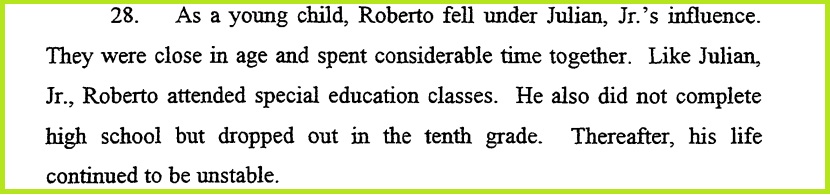
Declaration of Robert Ramirez, 2008. Document 20-5The third child, Robert, was born in 1953 to parents already struggling to manage their older children with their cognitive and medical needs. According to Mercedes, it was a “hand to mouth situation”.
Sadly, Robert also had mental difficulties that required special needs classes and assistance in school. Robert dropped out of school in the tenth grade, and his life became more unstable after that as he fell under the influence of his brother Julian Jnr, who was probably not an ideal role model; they were often left to their own devices as their parents attempted to cope with the needs of Ignacio, coupled with the demands of work.
Like Julian Jnr (and later, Richard), Robert became a substance abuser, addicted to drugs. With his psychiatric problems, which limited his ability to find and retain work, he also would spend time in prison for theft and gun offences
Declaration of Marylin Cornell, document 7-19.
Rosario
“When we were growing up, I tried to take care of Richard. I watched over him and tried to protect him from teasing from my older brothers, Julian, Jr., and Roberto. When I left home and got married, Richard came to my home and spent time with me and my then husband. I was aware that Richard had problems in school, and he was running around”.
Declaration of Rosario Ramirez, 2004. Document 7-13Richard’s only sister, Rosa, was born in 1955, the fourth child of Mercedes and Julian Snr. Unlike her brothers, she did not require special educational assistance, although she struggled with drugs and depression, suffering from chronic headaches as all her siblings suffered.
She was particularly close to her youngest brother, Richard, caring for him when his mother could not.
But as we’ve shown in earlier posts, the young Richard was to have his own deeper problems, problems that would one day engulf them all.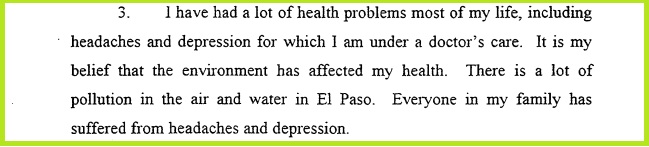
Declaration of Rasario Ramirez, 2004. Document 7-30.
And Richard? What of him?
We have covered the mental and cognitive deficiencies of Richard Ramirez in THIS SECTION; out of any of the siblings, for obvious reasons, Richard has had the most investigation into his considerable neurological problems. I do not need to repeat them here; all the reports have been covered in the above-referenced section.
Richard’s early years and head injuries can be found in THIS POST.
This article is not a “blame game”; however, the environment that the Ramirez family grew up in did have physical and mental consequences for all of them.
Cornell asserts lack of emotional support and nurture had a profound effect, as the brothers, lacking guidance and psychiatric and parental intervention, found themselves on dangerous trajectories.Their father, both strict and with a traditional view of disciplining his wayward sons, often worked away, leaving Mercedes to cope with everything, trying to work whilst simultaneously taking care of Ignacio and his multiple needs. Neither parent seemed to comprehend that traditional forms of discipline would not help to bring the other three boys into line. This doesn’t mean they didn’t love their sons; they just couldn’t cope, while straddling two different cultures brought added pressure.
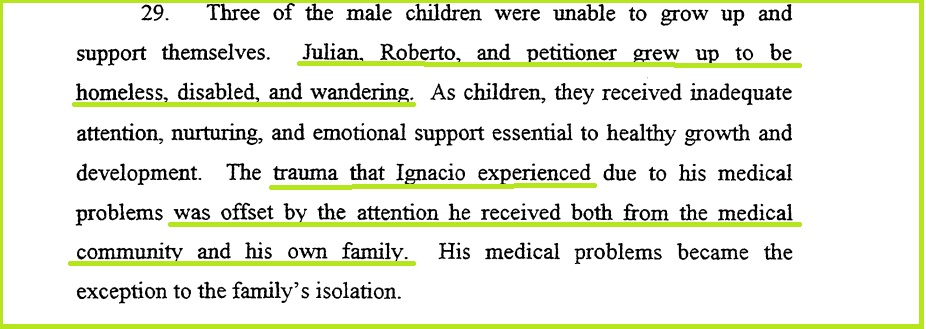
Julian Jnr, Robert, and Richard were unable or unwilling to support themselves. At various times, they became homeless, drifting, and in trouble, varying in degrees of seriousness, with Richard ending his life in more trouble than anyone could imagine.
Declaration of Marylin Cornell, 2004. Document 7-19. 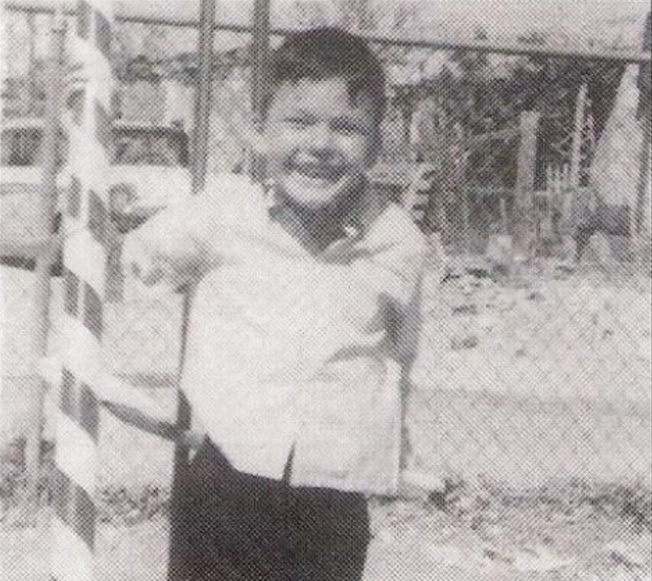
Richard as a child – reproduced from the Ramirez family collection. The family environment, coupled with the actual environment they inhabited, contained the seeds for disaster.
Additional sources: Lead Poisoning in El Paso (theirminesourstories.org), Juarez: The Laboratory of Our Future by Charles Bowden | LibraryThing, Before Flint, Before East Chicago, There Was Smeltertown (nrdc.org)
~ Jay ~
-
A Burglary in Marina

On August 15th, 1985, a burglary occurred in an affluent neighborhood in the Marina District area of San Francisco on Baker Street, at the townhome of dentist Jack Saroyan. While his niece Rosemary Ovian and her friend were sleeping, burglar(s) gained entry to the home, and the house was robbed.
At 11:40 p.m., the Saroyan’s arrived home and found it had been ransacked. The intruder made off with cash, jewelry, a bracelet, a fur stole, cameras, a VCR, and a portable stereo. Inspector Larry Dubour dusted for prints and seemingly found a partial fingerprint on an outside window, but only glove prints were found inside the home. There were no witnesses to the Marina District burglary, and no suspects were identified at the time.

Frank Falzon describes the Marina crime scene in his book, San Francisco Homicide Inspector 5-Henry-7,
“The effort by the burglar to gain entry into the three-story residence showed his tenacity. Sometime after 10:00 p.m., the man first went to the backyard of a house two doors away. He crept down a long driveway on the side of the house and into the backyard. The house was under renovation, and there were old kitchen cabinets and heavy scaffolding strewn about the yard.
He lugged a cabinet and a seven-foot plank over the fence, through the yard adjacent to the Saroyan house, over another fence, and into the Saroyans’ yard. Using the cabinet front and the plank, he fashioned a crude ladder and scaled up to a partially open second-story window. Using a tire iron for leverage – a Toyota tire iron, in fact – he pried open the window and clambered into the kitchen.”Gaining entry to the Baker Street home was quite an elaborate undertaking. Could this have been a two-or three-person job?

* From Los Angeles Times, Sept.1, 1985
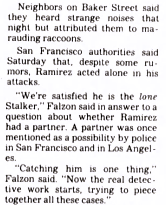
* From Los Angeles Times, Sept.1, 1985
Note Falzon’s statement, “We’re satisfied he is the lone stalker.” Ramirez had not set foot in a courtroom; not a single witness had testified, but the police had already decided he was the Night Stalker, and no one else.
So, how is the Marina burglary connected to the Pan crime? SFPD used the Marina burglary to link the so-called Night Stalker to the Pan crime by making several assumptions and a considerable leap in conclusions. On August 18, 1985, three days after the Marina burglary, Larry Dubour of the San Francisco Police Department (SFPD) was called to the home of Peter and Barbara Pan; both had been brutally attacked, leaving Peter Pan dead and Barbara seriously injured. He noticed the Pan home had been ransacked, similar to the Marina District home. However, he discounted it.
He later spoke with detective Frank Falzon, who “schooled” him on what he had learned from the Los Angeles Night Stalker task force – the Night Stalker does not have a modus operandi – he is everything and nothing – he leaves fingerprints, but he also wears gloves; he ransacks to steal but sometimes takes nothing; sometimes he rapes a wife, sometimes he kills her, but other times he spares her entirely, he is whatever police need him to be at that moment. It was then that the detectives decided the Marina burglar was the same person who committed the Pan crime, which they decided was the infamous Night Stalker. And here we have it – the extent of the detective work that concluded the individual that burglarized the Marina home was the same individual that attacked the Pan’s.
Allegedly, Richards’s fingerprint was on the jewelry from the Baker Street crime. Let’s consider this for a moment. If Richard had indeed stolen the items, the jewelry had changed hands several times in a matter of days. So, it would have had the fingerprints of several different individuals on it, such as Donna Myers, Earl Gregg, Deleen Gregg, and the owner of the jewelry. Yet, law enforcement would have us believe that Richard was the only one to leave an identifiable fingerprint on the window – of all the individuals who touched the stolen jewelry.
During the Los Angeles trial, Donna Myers testified that Richard had arrived alone in San Pablo on August 16– the day before the Pan family was attacked. He gave her a glass jewelry box containing a bracelet (the one later turned over to SFPD by her daughter, Deleen Gregg) and three 14-carat gold rings. She gave one ring to Deleen for her granddaughter. She gave a man’s ring to her son Floyd Dvorak, who lived in Utah and kept the third for herself. Myers said that on one of his August visits – perhaps the day he brought her jewelry – Richard Ramirez came to her house with Armando Rodriguez.
Donna told SFPD how “Rick” was open about how he had acquired cars, microwaves, VCRs, and jewelry, which she gladly accepted and distributed among her relatives. At some point, Ramirez moved from Donna Myers’ home to Armando Rodriguez’s apartment “for one or two nights” – confirmed by friend Ray Garcia – and then back to Myers’ – but there is nothing definite about his movements. Myers claimed Ramirez visited her a second time a few days later and took the rest of the jewelry when he left, although no date for his departure was given.
“On August 16, 1985, Petitioner [Ramirez] came alone to her house. He brought a jewelry box containing jewelry and asked Myers to hold it for him. A few days later, Petitioner returned to Myers’s home to pick up his things. Petitioner gave her the jewelry box, a bracelet, and three rings. She described the box as glass, 6- 8” wide, with a lid. Petitioner took the rest of the jewelry with him when he left. Myers described the jewelry as “14 carat gold, good jewelry.” Myers kept the jewelry box and gave the bracelet to her daughter, Deleen Gregg, and a ring to her granddaughter. She gave a man’s ring to her son, Floyd Joseph Dvorak, Jr., and kept one ring for herself.“
– From 2008 Petition for Writ of Habeas Corpus, Document 14
Accomplices
Did it not cross detectives’ minds that Rodriguez and Garcia might have committed burglaries with Richard? We have access to supporting documents that indicate both had burglarized with Richard in the past. Why would Armando have a burglar stay in his home if he were not one himself? SFPD claimed to have found stolen items from LA Night Stalker victims in Armando Rodriguez’ house, and they alleged the items were given to Armando by Richard.
Where is the proof that the stolen goods from LA were indeed given to Armando by Richard? Did no one entertain the possibility that maybe Armando was involved in the LA burglaries, and that’s how the stolen goods came to be in his possession? Since Richard did not live in San Francisco, how would he have known the best places to rob there? And why did Donna Myers readily accept what she knew was stolen property and gift it to her relatives?

From San Francisco Examiner, Sept 1st 1985 
From San Francisco Examiner, Sept 1st 1985. The firefighters were disappointed that they wouldn’t be the ones to catch the Night Stalker-how disappointing indeed! Again, another indication that it was a foregone conclusion it had already been decided Richard Ramirez was the Night Stalker before he had even been arraigned on murder charges.
Several of Richard’s San Francisco acquaintances had stolen property in their possession at the time of his arrest, and they all received immunity from prosecution for having stolen property. The cost of not being prosecuted: Place the blame on Richard Ramirez alone; for this fit the police’s forgone conclusion that Richard was the so-called Night Stalker; the rapist, the murderer, the burglar, the super-criminal that eluded the police from Mission Viejo to San Francisco for several months.
This is the picture we have been painted for decades; this is the story that has been told and inflated repeatedly. No one bothered to look beyond the surface to see what lies beneath. If they had, they might have noticed that this young man, basically homeless, with a drug addiction, who could barely take care of himself, who suffered from traumatic brain injuries plus depression and anxiety, could not have been the Night Stalker. But no one bothered to look because they wanted a raping, murdering Richard Ramirez. He was an easy target, a scapegoat, a patsy.
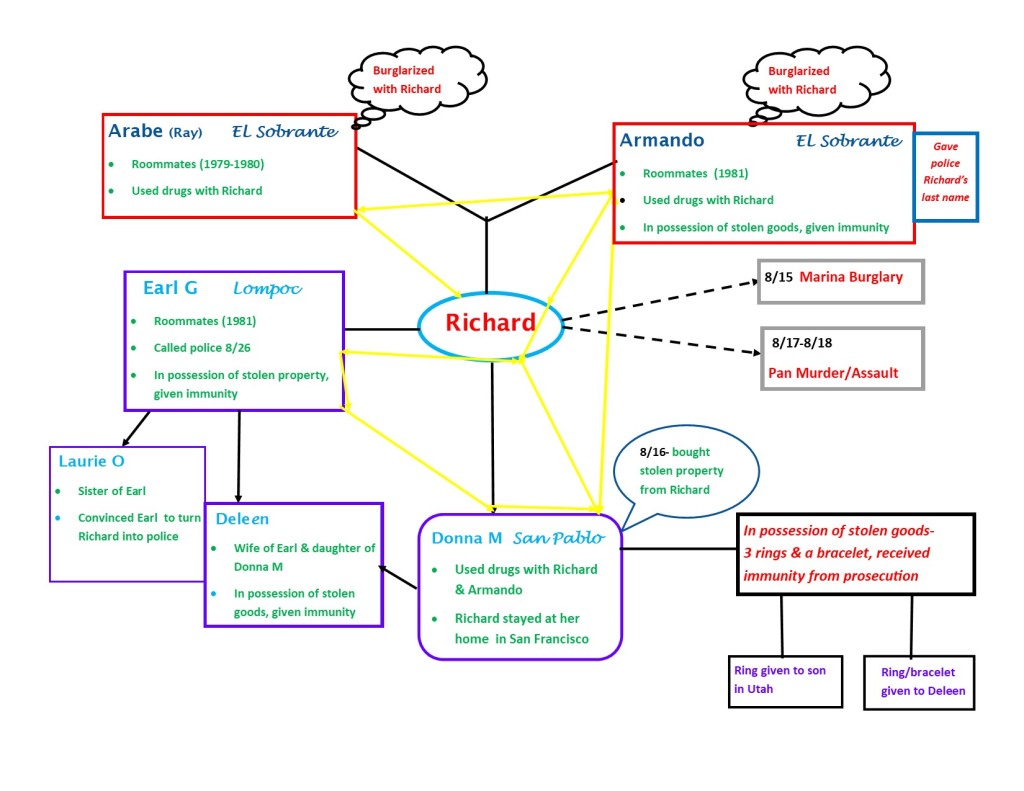
* A visual representation of the complex web of interactions Richard had in San Francisco.
As the San Francisco court documents are not publicly available and Richard was never brought to trial in San Francisco (the charges were stayed indefinitely), we are left with more questions than answers.

23/10/2023
Kaycee & VenningB
-
California Dreamin’
A Den of Thieves
We usually do not write about the charges against Richard Ramirez in San Francisco (SF) because the SF legal documents are unavailable. Most of what we know about the San Francisco charges against Richard comes from news articles available at the time, as well as small pieces of information contained within the 2008 Federal Petition for Writ of Habeas Corpus. Because we seek to be authentic and write about things that can be verified with reliable sources, and most of what is written about Richard outside of legal documents is based on speculation, outright lies, or the result of a “he said-she said” scenario, we are limited in writing about the San Francisco case. However, as there are many questions surrounding the SF case against Richard, we want to discuss the limited information that is available and where it came from.
The purpose of this post is to provide the reader with some of the information presented by the media regarding the San Fransico case against Richard. While the news articles give us some helpful information, we must take the newspaper writings with a “grain of salt” as law enforcement and the media were highly biased towards Richard and continue to be so to this day. This post is an introduction to the people Richard spent time with in San Franciso. The SF crimes will be discussed in a future post.

Richard Ramirez had several relationships that had a significant influence on his life. Exploring some of these relationships is essential to understanding the events leading up to his arrest in August 1985.
Richard grew up in El Paso, Texas, and per his mother’s statement to federal public defenders in 2008, he moved to California in 1979. He spent time in Los Angeles and San Francisco, vacillating between the two cities from 1979 to 1985. Richard’s key relationships in California were with Reyes Garcia, also known as “Arabe” or “Ray,” Antonio Reyes, Armando Rodriguez, Donna Myers, and Earl Gregg. Reyes Garcia (Arabe), Armando Rodriguez, and Antonio Reyes were all childhood friends of Richard’s from El Paso who moved to California in 1979-the early 1980s.Cynthia Melendez, Reyes Garcia’s one-time girlfriend, was also a childhood friend of Richard’s. She gave a sworn statement to federal public defenders in 2008 describing her interactions with Richard and Reyes (Arabe) in 1979 and early 1980s. In 1978, Cynthia and Arabe had a daughter they named Gretchen. Cynthia stated they moved into a house together in early 1979 in “La Roca,” in El Paso. They both smoked and sold marijuana, not only in Texas but in other states such as California and Oklahoma. They also had LSD parties. Richard smoked marijuana and took LSD with them. Arabe and Cynthia had a separate building on their property that they cleaned up for Richard to move into in March 1979. Cynthia stated she never hesitated to leave her daughter with Richard, and sometimes he babysat for her.
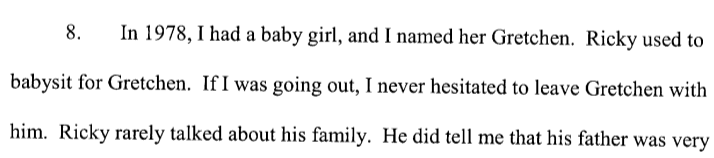
*from 2008 Federal Petition for Writ of Habeas Corpus supporting document 20-8
In June or July of 1979, Cynthia and Arabe moved in with her mother, and around this time, Richard moved to California. In the early 1980’s, she and Arabe went to San Franciso to meet up with Richard. Cynthia, Arabe, Richard, and another friend from El Paso, Armando Rodriguez, rented a house together in San Francisco for a brief time. Cynthia described an occasion when she, Arabe, and Richard drove from San Francisco to a nice neighborhood in Orange County, California. Richard and Arabe got out of the car and told her to wait in the vehicle. A while later, Richard and Arabe returned to the car and drove back to San Francisco. Shortly after returning to San Francisco, Cynthia saw Richard and Arabe with jewelry and guns stolen from the home in Orange County.
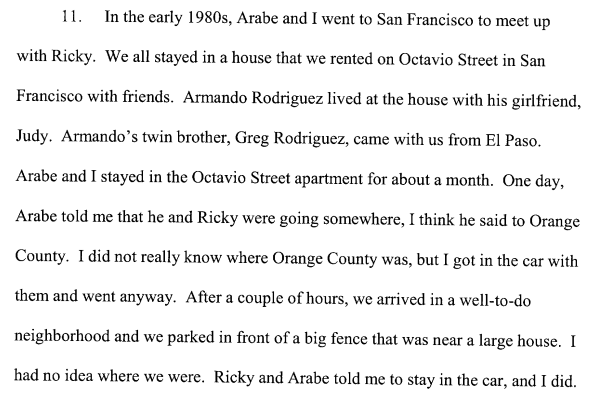
*from 2008 Federal Petition for Writ of Habeas Corpus supporting document 20-8
Shortly after Richard’s arrest, Arabe spoke to reporters from the San Francisco Examiner on September 1, 1985. His remarks were contradictory to the sworn statement given by Cynthia Melendez to Richard’s attorneys in 2008. Arabe told reporters that he only saw Richard at game arcades and 7-Eleven convenience stores while living in El Paso. He failed to mention he and Richard were schoolmates, had burglarized and partied together, and that Richard had lived on his property for several months in 1979. Perhaps Arabe suffered from selective amnesia and conveniently forgot to mention his long-time connection to Richard.

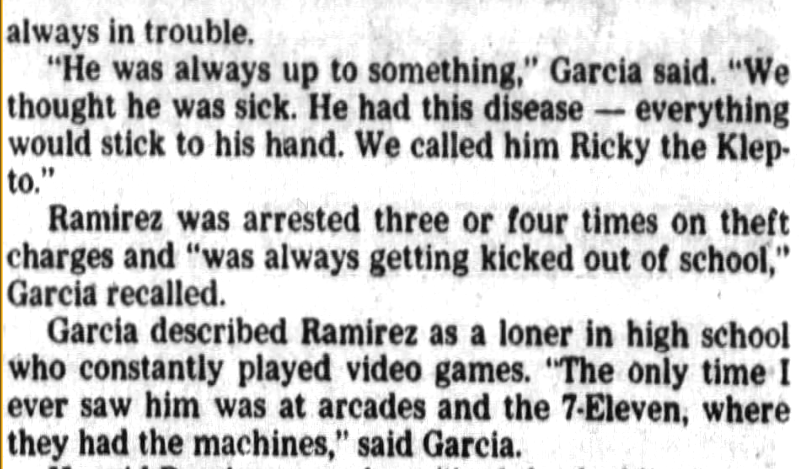
San Francisco Examiner, September 1, 1985, p.20
Antonio Reyes was also a childhood friend of Richard’s who gave a statement to federal public defenders in 2008. Antonio stated sometime during 1979-1980, he moved to Richmond, California, along with another childhood friend, Armando Rodriguez. Shortly afterward, Armando met and moved in with a woman named Donna Myers. Richard often visited Armando at Donna’s home. Antonio described an incident in 1984 or 1985 where he and Armando found Richard in a motel on Mission Street in San Francisco. He stated all the lights were off in the room, and Richard was “out of it” and looked sick, pale, confused, and depressed. Richard told him he was not feeling well. Antonio thought Richard appeared to have just recently had a seizure.
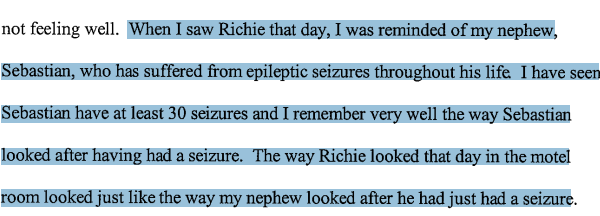
*from 2008 Federal Petition for Writ of Habeas Corpus supporting document 20-8
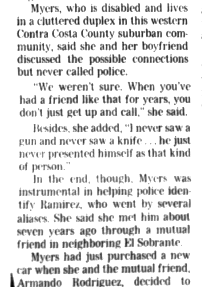
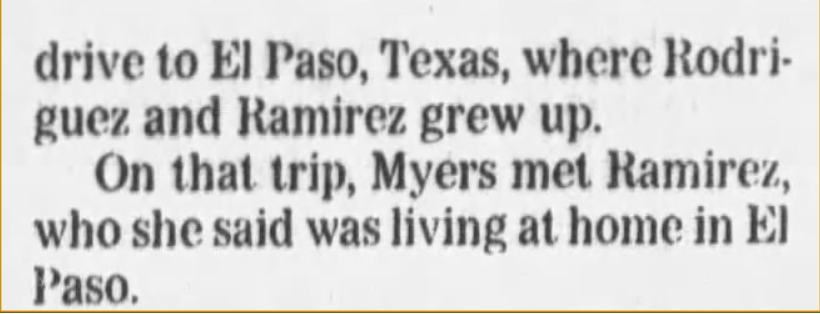
Donna Myers was an acquaintance of Richard’s who lived in San Pablo, California. Per the San Francisco Examiner, on September 4, 1985, Donna said she met Richard through Armando Rodriguez. In 1979, she and Armando made a trip to Armando’s hometown of El Paso, and it was at that time she met then-19-year-old Richard. Between 1979 and 1981, he stayed at her home in Richmond, California, a few times. She later moved to San Pablo, where Armando and Richard visited her frequently. Donna said Richard, whom she knew as Rick, was never violent, and she never saw him with any weapons. She described him as being “very nice and very polite.”
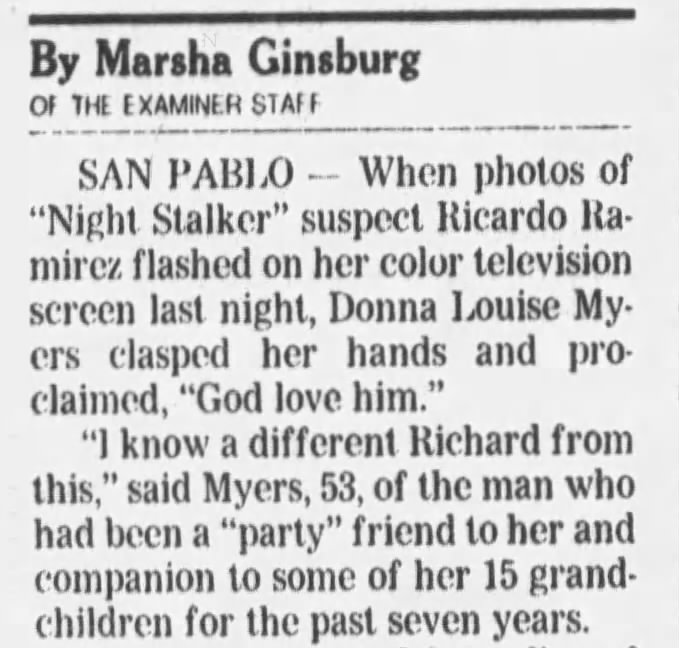
*San Francisco Examiner, September 4, 1985, p.10
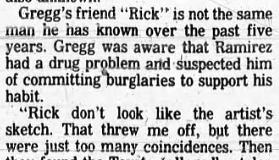
Earl Gregg, another San Francisco acquaintance of Richard’s, was Donna Myers’s son-in-law. He was married to Donna’s daughter, Deleen. Earl reportedly also met Rick (Richard) through Armando Rodriguez. In the Lompoc Record from September 5, 1985, Earl claimed he lived with Richard in Richmond, California, in 1981 for four months. The suspicion about Richard being the Night Stalker was triggered by Gregg’s sister, Laurie Ochoa, who convinced Earl that their friend looked like the Khovananth police composite. Gregg did not initially agree. Although the teeth sounded similar, the composite did not resemble Richard – the chin was too long, the hair too curly, and the eyes large and bulging. Even though he believed the police composite of the Night Stalker suspect did not look like Rick, Earl stated, “There were just too many coincidences.” Seeds of doubt had been planted.
*Lompoc Record, September 5, 1985, p.1
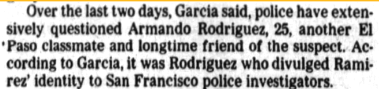
Armando Rodriguez and Richard Ramirez grew up together in El Paso. They were childhood friends and lived together briefly in California, hanging out and partying with a mutual friend, Donna Myers. Armando is the one who gave police Richard’s legal name, allowing police to put a name and face to the Night Stalker. It seems Armando did not readily sell his long-time friend down the river but only did so after succumbing to police brutality at the hands of San Francisco Police Detective (SFPD) Frank Falzon, an incident in which the retired investigator brags about in the Netflix documentary, Night Stalker: The Hunt for a Serial killer. “Not my best punch, but definitely not my worst,” he recalled.
San Francisco Examiner, September 1, 1985, p.20
Why do these relationships matter and why should we care?
It’s fair to say Richard did not surround himself with the most upstanding individuals. Every person that betrayed him had something to gain. For decades, all we have learned of Richard has come from biased sources, such as law enforcement, the media, and those seeking fame and fortune from his sad, unfortunate story. Excluding the 2008 Federal Petition for Writ of Habeas Corpus, this is the first time his history has been described based on what can and cannot be found in legal records and his relationships in San Fransico have been explored.
All of the individuals discussed above interacted with Richard regularly. They knew about his lifestyle and were either involved in the same activities as Richard, specifically burglarizing and drug use or were a willing recipient of stolen goods. Three individuals mentioned, Armando, Donna, and Earl were instrumental in Richard being identified and arrested as the Night Stalker. But why did they turn on Richard? What motive did they have for doing so? By the time Richard was arrested, the monetary reward for the capture of the Night Stalker was over $70,000. Perhaps they were merely trying to cover their ass or collect the reward money.
Et tu Brute?
On August 26, 1985, Earl Gregg, at the insistence of his sister, Laurie, called the San Francisco Police Department (SFPD) and told them he thought his acquaintance, Rick, might be the so-called Night Stalker. The call was made on August 26, four days after San Francisco police announced the Night Stalker had arrived in their city. Even though the Greggs admitted the idea that their friend could be the Night Stalker was preposterous, they reported him anyway. After all, a large reward was being offered by both Los Angeles and San Francisco, and the Greggs were struggling financially. Earl did not have a last name for Rick, so he led the police to his mother-in-law, Donna Myers, who also knew Rick. Although Richard had visited Donna’s home numerous times, she only knew him as “Rick Mena.” However, she knew someone who did know “Rick’s” last name: Armando Rodriguez.
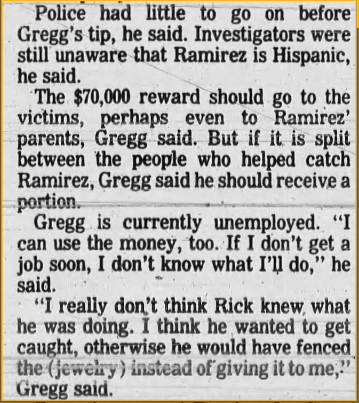
Lompoc Record, Sept. 5, 1985, p.5
Shortly after Donna disclosed this information to police, the nearly two days of “questioning” of Armando Rodriguez by SFPD and Detective Falzon began. After Rodriguez was taken in for questioning and told he would be charged with accessory to murder unless he gave up information, he admitted to seeing Ramirez on August 16 and receiving stolen goods. Deleen’s mother, Donna, with whom Richard was staying, alleged that she had received stolen jewelry from Richard on August 16, as well. She had given two of the stolen items to her daughter, Deleen. Earl Gregg also claimed he received stolen property from Richard approximately two weeks before Richard’s arrest.

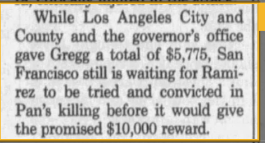
The San Francisco Examiner, Feb 20, 1995, P. 5
Are we to believe that of those that Richard hung out with, he was the only one with a drug problem or who committed burglaries? I have a hard time believing these acquaintances did not commit burglaries and engage in drug use, just as Richard did. We know, per Cynthia’s Melendez’ sworn statement, that Arabe, in fact, did commit burglary and use drugs with Richard. If these SF associates weren’t involved in similar activities, why did they willingly accept stolen goods and pass them on to family members? Why did they willingly have Richard in their home?

There are at least three potential reasons why Richard’s so-called friends may have turned on him: Immunity from prosecution for possessing stolen property, accessory to murder, and reward money.

KayCee & VenningB
-
The Murder of Mei Leung
This is a long, double post by VenningB and Jay – split into two sections: the history of the incident (Venning) and the DNA aspect (Jay).
This blog is primarily focused on the Los Angeles trial. Because the alleged Night Stalker crimes in San Francisco (the Pan Incident) and Orange County (the Carns/Erickson Incident) never went to trial, it has proved impossible to examine them in depth.
As discussed in this post, Richard Ramirez has had various other San Francisco murders informally connected with his name: Edward Wildgans (shot) Mary and Christina Caldwell (stabbed) Masataka Kobayashi (bludgeoned, his neck broken, possibly with the butt of a gun). Ramirez is not the prime suspect for Kobayashi.
One particular San Francisco case that was not tied to Ramirez at the time was the murder of nine-year-old Mei “Linda” Leung. Mei was found raped, stabbed and strangled with her blouse in the basement of a residential hotel in San Francisco’s Tenderloin district on 10th April 1984.
Habeas Corpus – Convenient Timing
Richard Ramirez’s lawyers had worked hard on his Federal Writ of Habeas Corpus, which was submitted to be read by the Ninth Circuit Court of Appeals in 2008. It was formally accepted into the long queue in March 2009. As demonstrated throughout this blog, it was very thorough and was not just focused on constitutional violations as most Habeas Corpus appeals are – it presented extensive evidence of “Actual Innocence” and sought to overturn all thirteen murder convictions in Los Angeles. As such, it seems most convenient that suddenly, just seven months after the Habeas Corpus was accepted, DNA evidence purported to tie Ramirez to the murder of Leung. Should the Ninth Circuit have overturned the L.A. convictions, the San Francisco District Attorney (then Kamala Harris) would have moved to charge Ramirez with Leung, thus keeping him locked up for good.
Murder: Fact or Fiction?
The story of the violent death of Mei Leung seems to have been embellished with time, in the same way that all the other Night Stalker suspects had been changed to fit him. The most recent newspaper stories of Leung’s murder tell a story of Mei returning from a friend’s with her younger brother Michael, eight. As they ascended the stairs to their apartment, Mei dropped a dollar bill down the stairwell into the basement. Michael carried on. Mei went down to retrieve it and never reached home. Michael was sent to find his sister – but he discovered her body, hanging from a spigot. This article from the New York Post interviews Inspectors Ron Schneider and Mike Mullane, the two detectives who were called to the scene. Schneider describes Leung’s hanging position as “like Christ on the cross” – her head was drooped down and her feet just inches from the ground. An anonymous expert in the occult was also interviewed, explaining Mei’s position was that of a “ritual killing” of a Satanist in the “symbolizing of a desecration.” With Ramirez’s reputation, this is easy to believe – only it is not what was said in the papers at the time.
765 O’Farrell Street
First, we must discuss the layout of the building, a “residential hotel”. The basement is not a basement as we know it. It was not subterranean. It was street level with access via two garages, one door, and another main entrance up some external steps that led to the lobby. This lobby also gave access to the ‘basement’ and there was also access via the maze of backyards and alleyways at the rear of the building. The ‘basement’ was essentially a corridor that led from front to back and contained large bins for the many residents overcrowded into 33 tiny dwellings in the building above.
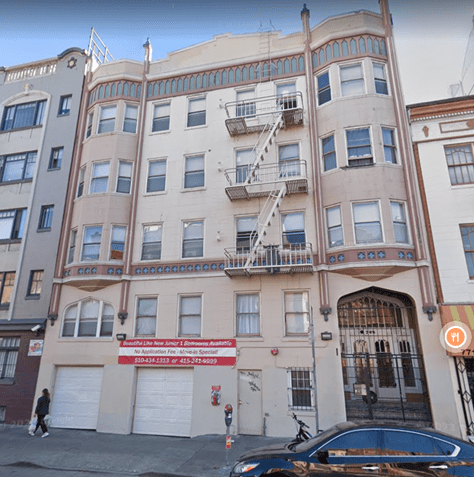
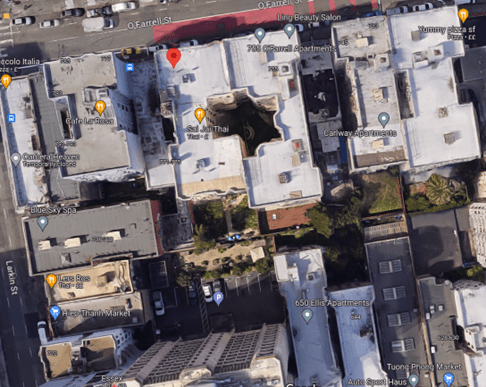
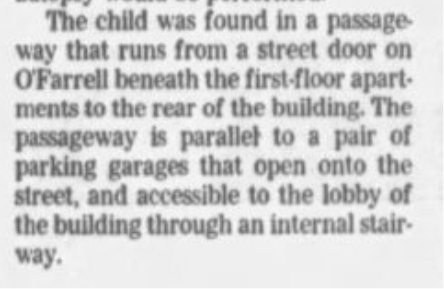
San Francisco Examiner, 11th April 1984 Two families actually lived on the basement level, and it was one of them who found Mei Leung’s body, not her little brother. It is likely that Mei and Michael began their ascent from this level. It was on the first floor that the manager, Alice Kwan, said she heard two children arguing over whether to take the elevator or the stairs to the fourth floor (the very top). Michael went up and left his sister to ascend on foot. Back in 1984, there was no mention of a dollar bill fluttering into the basement way below. After half an hour (it was between 7 and 7:50pm), Mei’s mother Yuk Yin asked Michael to find Mei, who she presumed was playing in the building. When Michael reached the first floor, he was greeted by the police who told him to go straight back up – the ‘basement’ was now a crime scene.
The Position of the Body
In the San Francisco Chronicle, a 50-year-old man who lived on the ‘basement’ level with his two pre-school age daughters claims his children found Mei Leung’s body a few feet from their door. The area in which she was found is referred to as a basement garage.
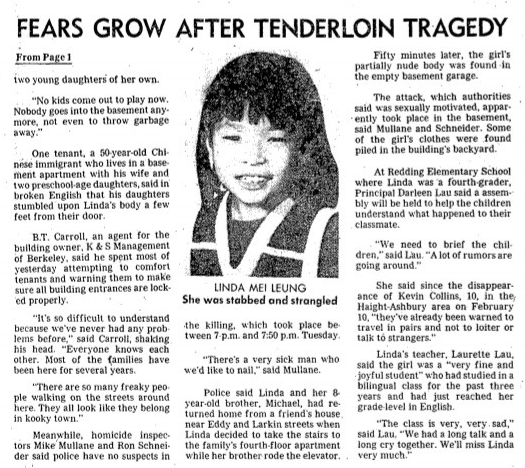
San Francisco Chronicle, 12th April 1984 On 5th May 1984, the San Francisco Examiner stated that she was “wedged” in some overhead pipes.
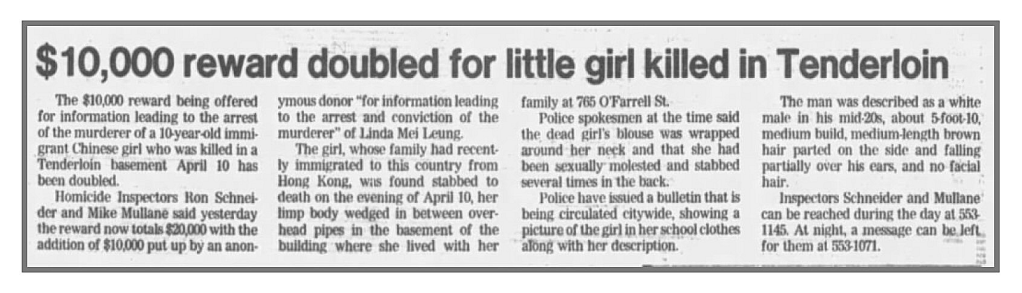
Later that year, the same paper repeated that she had been wedged in “a maze of overhead pipes” in an attempt to hide her body. Seeing as she had been stabbed, it is likely that blood dripping from above gave her location away, and although this is never stated something must have made the unlucky finders look upwards.
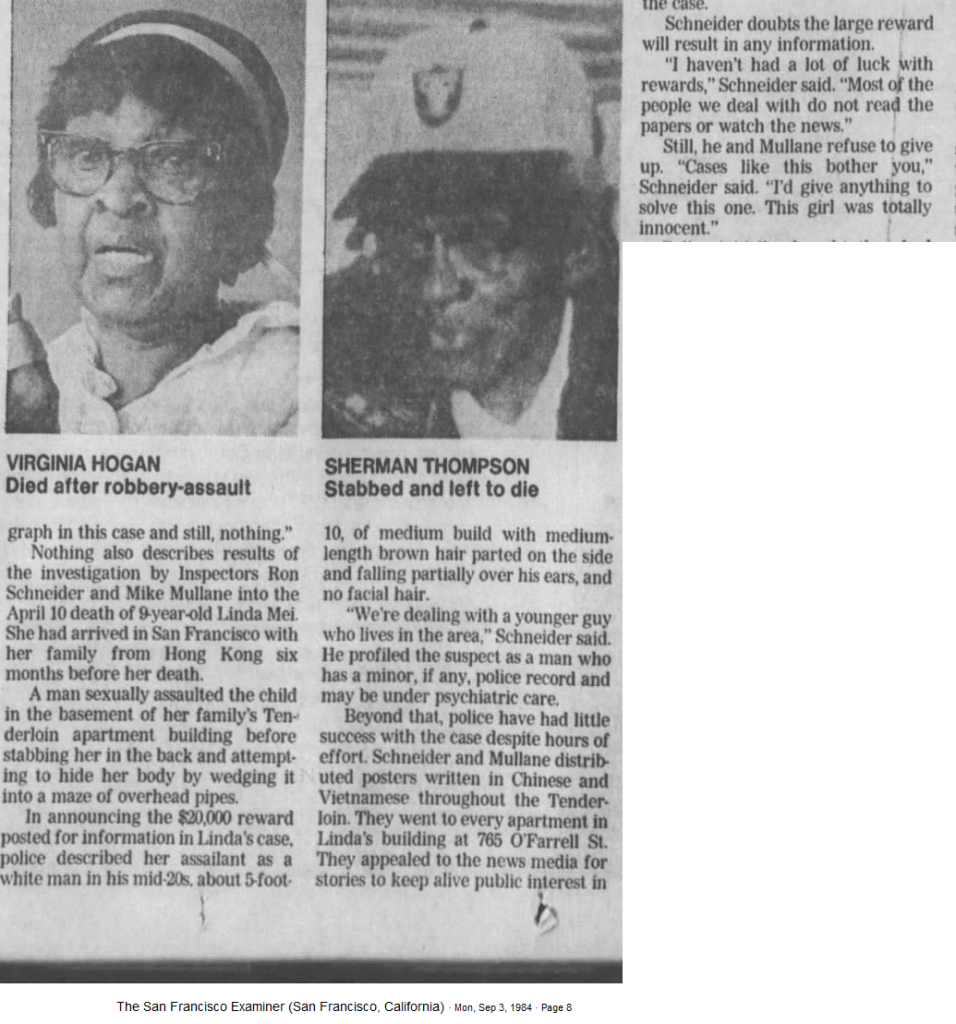
3rd September 1984 Nothing is mentioned about Mei Leung being found hanging like Jesus from a spigot by her blouse, although the blouse was tied around her neck. The coroner does not state the exact cause of death but she had also been stabbed multiple times in the back. There was nothing to suggest this horrific crime was connected with the occult and given that America was in the midst of the ‘Satanic Panic‘, even the slightest whiff of Satanism would have sent the press into overdrive. Yet there was nothing. It seems to be a 2009 invention to support the DNA ‘hit’ for Richard Ramirez.
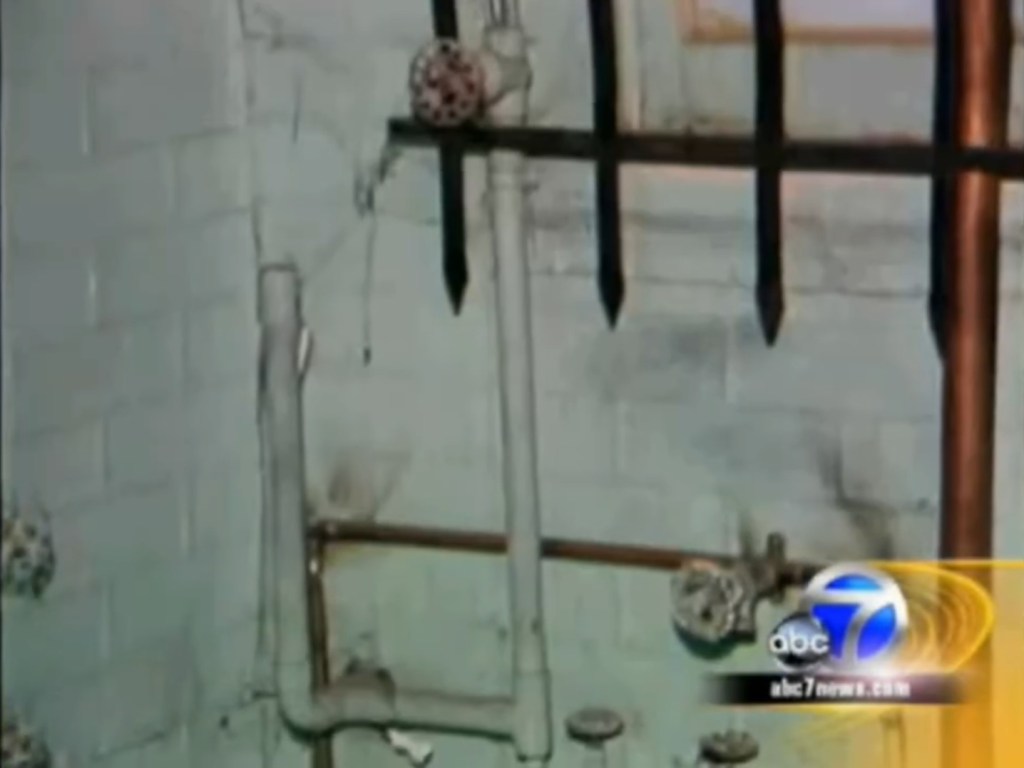

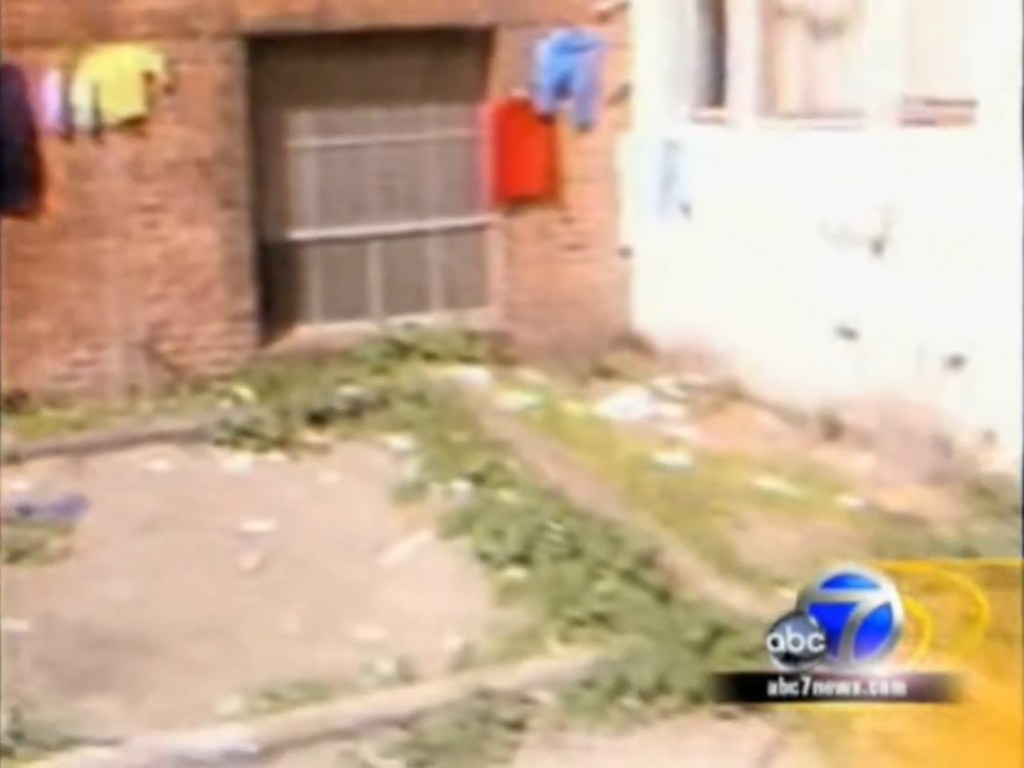
The thin wall pipes, the floor and the back yard The rest of Mei Leung’s clothes had been dumped in the back yard. These must have been taken for serological testing.
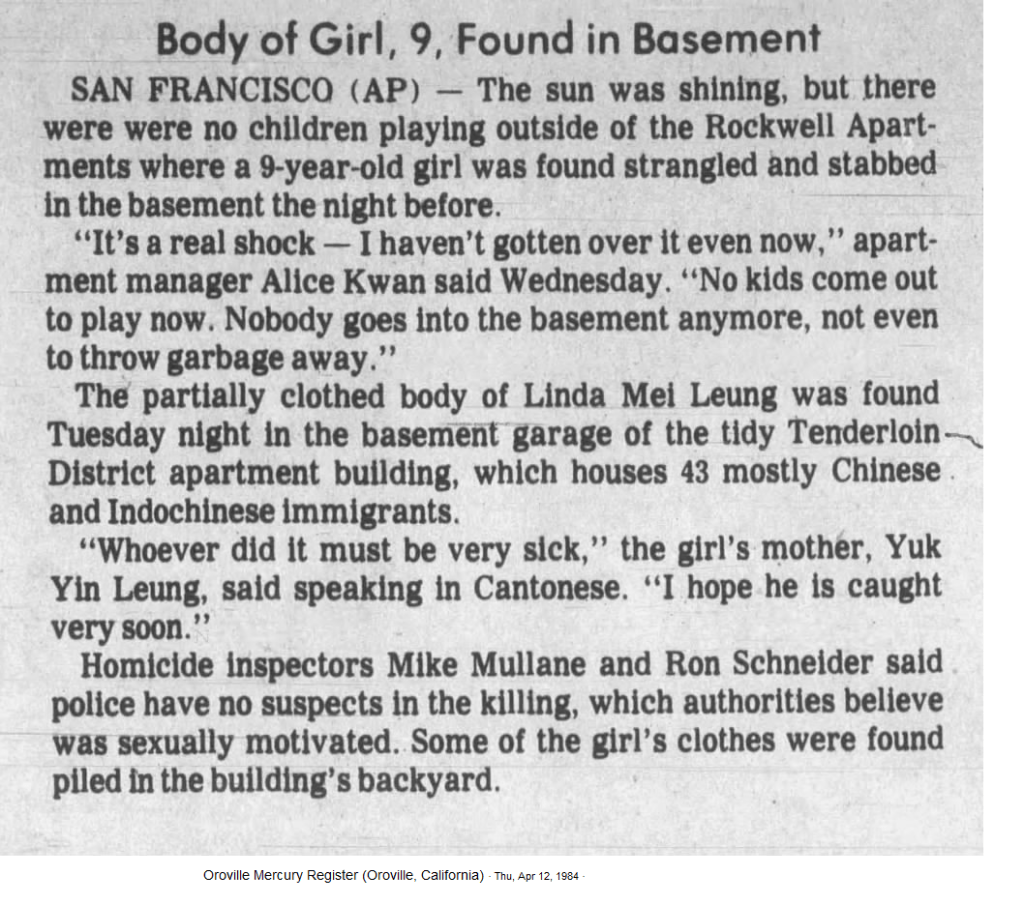
Alice Kwan is again quoted, saying that the residents no longer want to throw garbage away – this means the ‘basement’ and its bins were in frequent use by all the families. The killer must have been very quick and therefore very familiar with the building and how to escape. Nobody reported a child screaming, so she must have been silenced somehow, or lured by someone she trusted.
The Suspect
In April, straight after the murder, Inspectors Mullane and Schneider stated that there were no suspects. However, by May 1984, a description was given in the San Francisco Examiner: a white male, about 5’10”, medium build, clean-shaven, brown hair, side-parted and slightly over his ears, who – according to an article in a 2009 edition of Central City Extra magazine – was seen in the elevator. It is not stated who reported this.
This building was exclusively inhabited by Chinese and Vietnamese families, so a white man would have stood out, but the suspect given in the above articles sounds so ordinary, with no distinguishing features and most importantly, nothing like tall, dark, curly-haired Latino, Richard Ramirez.
Below is the composite sketch of the suspect from Central City Extra.
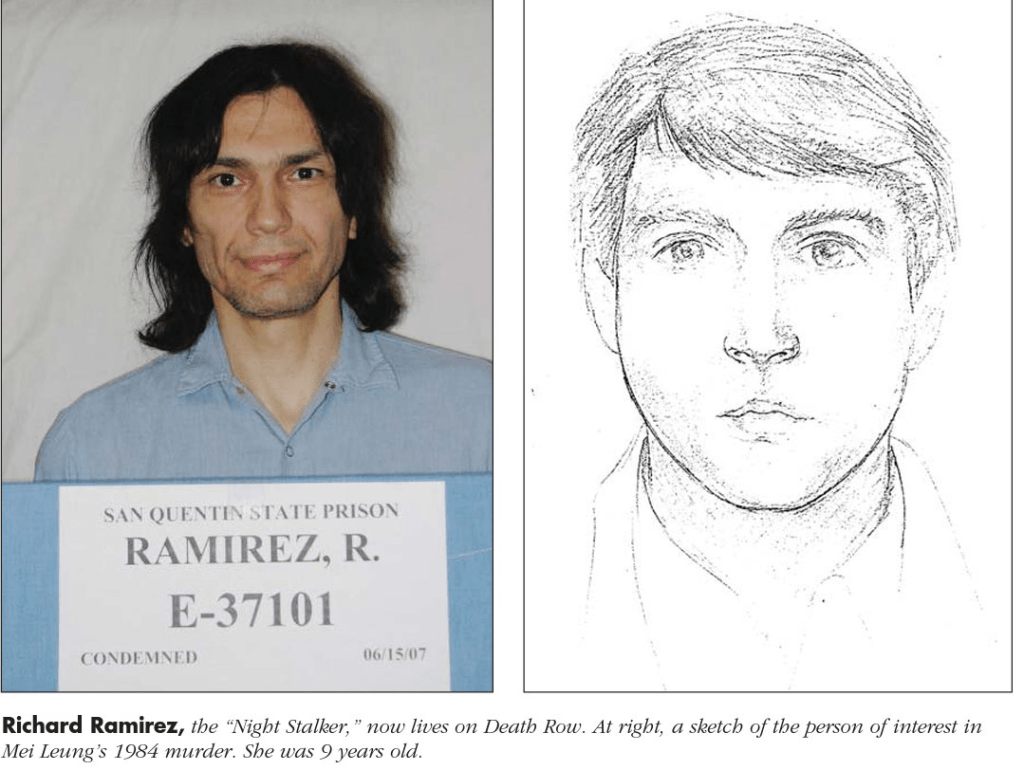
In 2009, when the DNA story broke, detectives claimed that Ramirez had lived in a residential hotel on the street behind O’Farrell Street: Ellis Street. Their evidence was supposedly a medical record giving that address, as well as Mason Street which runs perpendicular to O’Farrell and Ellis. This of course means nothing – the Tenderloin is a densely populated area with a high crime rate. Even if they could prove he once resided there, it is not enough to prove murder and it seems this is just like the other cases: a nebulous suspect and a story that has been sensationalised and embellished with time.
One must also ask, if the cold case detectives were so sure Ramirez was at the scene because of a DNA match – and they knew he stayed in the area – why were they appealing for informants to provide information about his whereabouts in 1984? Was that necessary? This brings us to the second part of the post: DNA evidence.
Part 2: DNA
DNA typing, or profiling, has become the most powerful tool in the arsenal of forensic science. It can convict the guilty, exonerate the innocent, and identify suspects and victims. It is considered (by the public) to be infallible, with most juries expecting the presentation of DNA evidence in court.
Juries comprise a cross-section of the public, laymen, most without scientific knowledge. They rely on prosecutors and defenders to give them the correct information to enable them to reach a verdict, hopefully, the correct one.
Programmes such as CSI and Law and Order tend to quickly solve a case using forensics, but the reality is somewhat different. Contrary to these shows and public perception, DNA analysis is open to misinterpretation, a fact that investigators don’t always emphasise to a jury.DNA Testing – Then
In 1986, the first criminal case using DNA to get a conviction occurred in the UK. One wonders why the same did not happen in the Night Stalker case, considering the serology testing they did seemingly excluded Ramirez, as shown in the Abowath incident, where the PGM marker obtained from a semen sample collected from the victim was not a match to him. None of the LA rape victims were proven to have any serology that matched the accused. In the incidents where unidentified blood (Bennett and Cannon) was present and that unknown blood came from neither the victim nor Richard, a DNA test, even in its infancy, would have been valuable
In the 80s, DNA testing and the results were a much more simplistic affair; it either matched or it didn’t. Even a non-expert can readily understand what that means.
Things have changed.
A Brave New World?
With the advancement of technology, DNA testing has become extremely sensitive. Great! Yes and no. We constantly shed DNA when touching anything, coughing, sneezing, talking, or biting an apple. These traces and mixtures have always been present at crime scenes; however, with the lower sensitivity of previous years, they were unlikely to have been detected. That is no longer the case. Today, they can generate a profile from just a few skin cells, enabling forensic science to solve a more extensive array of crimes. It can also cause complications when analysing ever more complex mixtures, especially where contamination from improperly collected and stored evidence is concerned. Or when a result yields more than one profile.
Cold Case – 2009
With impeccable timing and convenience (Ramirez’s habeas appeal having been filed just months before), San Francisco’s cold case unit, consisting of just two officers, Holly Pera and Joseph Toomey, announced the preliminary findings that would link Ramirez to the murder of Mei Leung.
The cold case unit, formed two years previously in 2007, had looked at cases that could be added to Ramirez’s rap sheet. Her determination to solve this crime was her main goal when the cold case unit came into being.Homicide Inspector Pera had been a new police officer at the time of Mei’s death, serving the neighbourhood where the crime occurred; the horror of which had never left her.

CBS News 23rd October 2009 Although the cold case unit had been formed in 2007, one DNA expert with the San Francisco crime lab, Matthew Gabriel, said in a San Francisco Examiner news report on 22nd October 2009 that he had been working on the case for five years and with great difficulty managed to generate a profile from an undisclosed piece of evidence collected in 1984. That evidence was later explained as a cloth or a handkerchief, reportedly discovered in the basement of 765 O’Farrell Street, either by the rubbish bins or near the stairs.
“We’ve been working on this case for approximately five years now,” said Gabriel, in the news report.
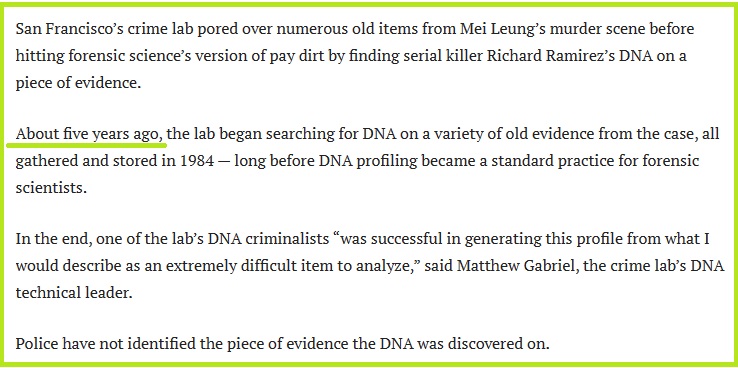
San Francisco Examiner, 22nd October 2009 Why they were working on the case in 2004, and yet Pera says they didn’t start until 2007, isn’t explained. 2004 is the date of one of Ramirez’s appeals; it is also the date that the Californian Proposition 69 was voted into legislation, whereby all convicted felons had to supply a DNA sample to be loaded into a database. A notorious criminal, such as Richard Ramirez, would most certainly been made to provide a sample at that time.
In 1984, DNA typing was yet to be the standard practice we see today, and the items collected from the crime scene were unlikely to have followed what is now routine protocol. How the items were collected – and stored – is paramount. We have not been told how or where these 25-year-old items were stored, under what conditions, and whether or not they were in a controlled temperature. The probability of all the evidence being stored in boxes piled on shelves with many others consigned to “unsolved” is a likely scenario. As we learn more about the science of DNA, we also discover the most vulnerable part of any evidence collection begins at the crime scene, where contamination is its weakest link, especially in a situation where a discarded cloth was discovered in the vicinity of many people’s garbage.
No photographs of the evidence and no details of the storage conditions have been released.
A “cold hit” from the CODIS database matched Ramirez; Holly Pera duly served a warrant on him to collect a buccal swab. Richard was compliant, and neither he nor his lawyer, Michael Burt, commented.
SFPD asked anyone who may have seen Ramirez in the area of O’Farrell Street in 1984 to get in touch. DNA was insufficient; they apparently needed eyewitnesses, even though the eyewitnesses in 1984 had described someone other than Ramirez.

What they were hoping for in 2009 is anyone’s guess.
A Second Suspect – 2012 to 2016
In 2012, SFPD got a second hit from the database, from what turned out to be a mixed sample on the handkerchief. It went unreported, unsurprisingly, as the last thing anyone wanted was their science to be challenged. They had got a hit on the one man they wanted; nothing else mattered, and the 2012 hit remained hidden for four more years. Richard died in 2013, so it is safe to assume that no one disclosed this information to him or his lawyers. The incompetent Hernandez duo no longer represented Richard; his new lawyers would have known precisely what to do with the latest news.
“On Monday, The Post exclusively reported that a “second suspect” had been tied to the case around 2012 after police got a DNA match from a handkerchief left at the crime scene, according to SFPD Homicide Inspector John Miller.”
New York Post 16th March 2016SFPD disclosed that the second suspect was known to them; he was a convicted felon (hence his DNA profile in the database), but they refused to name him, saying he had been a juvenile at the time of the murder of Mei Leung. Juvenile suggests a young person, perhaps under 18, a youth; it does not suggest a child. Had the second suspect been a child in 1984, that is the word they would have used.
In sudden haste to explain this new revelation, and in doing so undermined its original scientific findings, SFPD declared the second sample flawed and that it should never have been uploaded to the CODIS system. How convenient.
Because of the new suspect, Mei’s case had remained open, although it had been pinned on Ramirez, without him being charged or tried. The word DNA is usually enough to satisfy the public. However, more was needed to satisfy DNA expert Rockne Harmon, former prosecutor and consultant on Mei’s case.
He dismissed SFPD’s explanation as “gibberish”.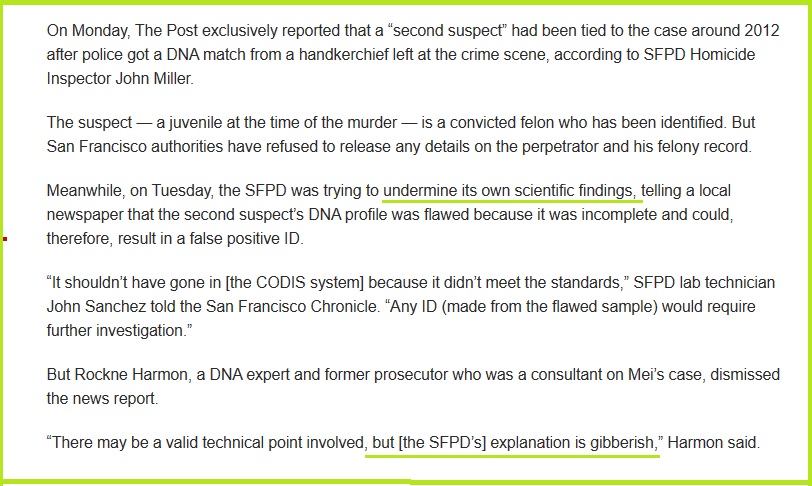
New York Post 16th March 2016 From the New York Post:
“Multiple sources told The Post that authorities now know the man’s identity because — while a juvenile at the time of Mei’s murder — he went on to commit other felony crimes. That enabled California lab tech Cherisse Boland to get a “cold hit” on him after repeatedly running the evidence through CODIS, the FBI-maintained forensic DNA database.”
New York Post 16th March 2016Rockne Harmon, who also worked on the OJ Simpson case, had this to say in the same news report:
“The handkerchief had stains in several places that were tested,” said former prosecutor and DNA expert Rockne Harmon, who reviewed the Leung case while doing consulting work for the San Francisco District Attorney’s Office in 2009.
New York Post 16th March 2016
“The stain that produced the hit was a mixture of three people, two different semen sources. One of the sources matched Ramirez, and the other source linked the second male to the handkerchief by the stairs,” Harmon told The Post.
“It’s significant because it connects the two sources to the body,” added Harmon.”He went on to say, in an excerpt taken from the New York Post:
New York Post 16th March 2016
“The “co-existence” of the other man’s DNA on the cloth “suggests a connection between Ramirez, the second male and the victim associated with her death,” Harmon said, urging authorities to come forward with any new information they have.
“Only a thorough, intense investigation to ascertain the truth about the presence of his [DNA] in such a sinister context will satisfy public safety interests. Anything less will not do so.”The San Francisco Police Department said nothing and still has not released the second suspect’s name. He is protected for reasons unknown.
The Problem With Mixed Samples
The information in this section has been taken from DNA Mixtures: A Forensic Science Explainer | NIST
Even the most experienced DNA analysts can have difficulty separating the profiles within mixed samples. For these reasons
- How many people contributed DNA to the mixture? More contributors make a mixture more complex and more challenging to interpret.
- How much DNA did each person contribute? Even if a mixture contains plenty of DNA, one or several people might have contributed only a tiny amount. The lower those amounts, the more complex the mixture.
- How degraded is the DNA? DNA degrades over time and with exposure to the elements. This can also increase the complexity.
Currently, there are no established protocols for determining how to analyse mixes; different labs follow different rules when confronted with mixed samples. It helps to understand how DNA typing is done by looking at how interpretations are determined. Forensic scientists only analyse part of the genetic sequence when generating a DNA profile. Instead, they look at roughly 40 short segments of DNA that vary from person to person. Those variations are called alleles; the key to knowing a person’s DNA profile is knowing which alleles they have.
To discover this, scientists make millions of copies of the alleles to amplify their genetic material. Then it’s processed and sorted, ending up as peaks on a chart, and those peaks tell the analyst which alleles are present, and that is how they determine someone’s DNA profile.
A mixed sample would look something like this.
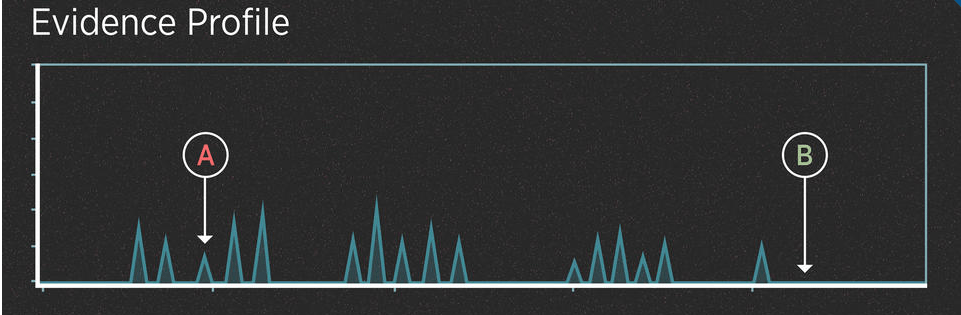
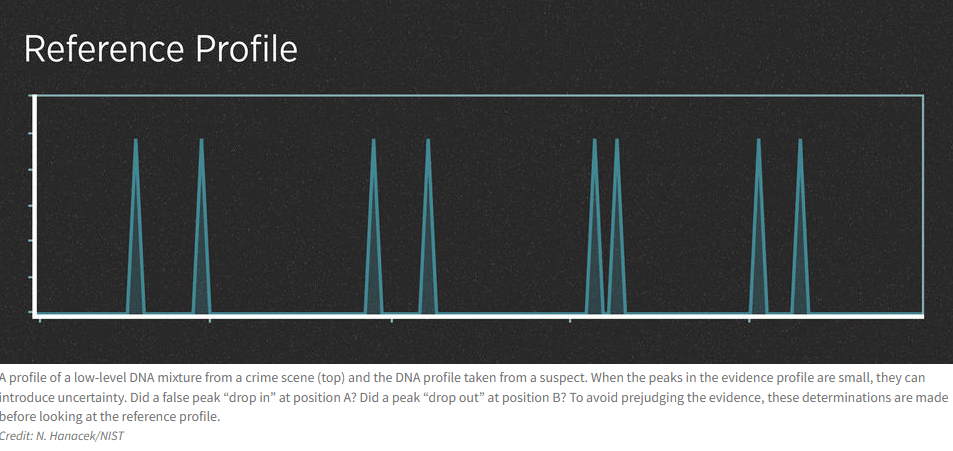
http://www.nist.gov A profile of a low-level DNA mixture from a crime scene (top) and the DNA profile taken from a suspect. When the peaks in the evidence profile are small, they can introduce uncertainty. Did a false peak “drop in” at position A? Did a peak “drop out” at position B? Those factors should be assured before examining the reference profile. A single profile would have two peaks at one location; looking at the top image, we can see multiple peaks at each locus, whereby it’s safe to assume more than one person contributed to the mix.
These images are a reference point; they are NOT profiles taken from the crime scene or Ramirez and the second suspect.
In an analysis of a mixed sample, alleles from each contributor appear on the chart; picking them apart is problematic because they have made MILLIONS of copies of each allele. Now, they are all together in a test tube.
In teasing them apart, they cannot, with certainty, be sure which allele belongs to whom. It is like contemplating a colossal bowl of letters from a million Scrabble games and trying to form a coherent sentence, or maybe the word “suspect”, with your eyes closed. One mistake could cost someone their freedom, or indeed their life.
To combat that, scientists developed software to help, and a system where they calculate probabilities is used. It is a highly complex and complicated matter. For more information, please read the link highlighted above.
Uncharged – Again.
Richard Ramirez was never formally charged or taken to trial over the murder of Mei Leung; the then DA, Kamala Harris, declined to arrest and charge him, stating that as he was already on death row, she did not want to prolong his life by another trial and the ensuing appeals. It was far easier to say it was him and let the science go unchallenged by his new, competent defence lawyers.
Without a doubt, had the petition rendered his LA convictions unsound, which we have demonstrated throughout this blog, it would have been a different story; they would have charged him.
From Crime Scene to Courtroom
The principles of evidence collection at any incident are many, with priority given to:
- Contamination
- Degredation
- Chain of custody
Today, crime scene investigators know how vital these fundamental principles are; they learn to work in a sterile environment, keep unwarranted people away from the scene, and properly dry samples and evidence before bagging them. In 1984, as the DNA expert Mathew Gabriel said, they did not have the knowledge they do now. They must also ensure correct preservation, enabling the defence lawyers to conduct independent testing.
Chain of custody is vital, and each and every person who ever came into contact with any evidence must be logged and its journey every step of the way from the incident scene to the lab, thus avoiding the risk of contamination or (God forbid) tampering. A piece of cloth from a filthy basement floor, deposited near some garbage bins would already be contaminated enough.
That leaves the question what happened to her clothes? As Venning has mentioned in the section above, they were piled up in the yard. Mei was found partially clothed, surely they had stored these evidence exhibits in the same way the cloth had been? Did they not test those too? If not, why not?
Any improperly kept and maintained samples may be degraded after twenty-five years of being stored in boxes in a “cold case room”, as we might assume. Information has yet to be released to the public to suggest otherwise, and they went to some lengths to conceal the appearance of another DNA profile for some years. Had it not been “leaked,” it is doubtful anyone would have known.
San Francisco Police Department, to this day, still have not released the name of the second suspect; one imagines they never will. Their reasons for refusing to accept a second profile are doubtful. They claim the additional profile was “flawed”, which adds a reasonable doubt to the validity of either sample. If they question the results of one person’s forensics, they should surely question the validity of both suspects’ profiles. Or if the science was as infallible as they claimed, where Richard’s DNA was concerned it should have been independently tested.
DNA never was and never will be 100% conclusive; it is a powerful tool, but a tool that judges prefer to have backed up by further evidence. Evidence they did not have.
Mei
One cannot fail to be moved on viewing the face of Mei Leung staring out from the news reports. Did she receive the justice she deserved? When her family were informed of the link to Ramirez, they were reported to have said they were “grateful” by SFPD.
But was this honest and actual justice? Or was her tragic death used as an insurance policy? An insurance policy against the eventuality that the Supreme Court may have granted the order for relief. Without full transparency detailing the name of the second suspect and the details questioning the science attributed to his DNA profile, are we really seeing light shed on the case?
This brings us back to 1985 when, after his arrest, SFPD scratched around to tie him to as many.”unsolveds” as possible, but they did not peg him for the murder of Mei Leung.
It feels like yet another curtain has been drawn across, a veil not to be lifted.
For further reading on the uses and abuses of DNA within the criminal justice system, I highly recommend the book “Inside the Cell: The Dark Side of Forensic DNA” by Erin E Murphy.
~ Jay ~ & -VenningB-
30/08/2023
-
Eight Richard Ramirezes
The unreliability of fingerprint forensics was previously discussed in Kaycee’s article on the Vincow Incident. Vincow’s was the only murder scene that supposedly linked Ramirez to a crime scene – or at least the outside of it – for the incriminating print was on a window screen. This was a latent print (invisible to the naked eye) and was not the only one on the screen – there were multiple, and those remain unidentified. When Ramirez had his fingerprints taken after his arrest, they were manually compared to the Vincow print (along with another handprint allegedly found at a burglary scene) by Deputy Sheriff Hannah Woods. In other words, Woods made the judgement with her eyes and not a computer. Despite Ramirez enduring two stints in county jail for car theft, somehow his prints had evaded law enforcement and he was never linked with Vincow until after his arrest, with the excuse being that the computer system was not advanced enough.
Much is also made of another latent partial print on an orange Toyota station wagon, thought to be connected to the attempted murder of Bill Carns, which was some of the weakest circumstantial evidence in the entire Night Stalker case. They have not sufficiently proved that the car was in Orange County and was spotted more than a mile from the crime scene.
Using information from the police, the newspapers reported that the latent partial print was run through a brand-new computer system, “Cal-ID”, which was apparently in the middle of a software update. Police insisted that the installation of Cal-ID be interrupted so they could enter the “Night Stalker’s prints” from this car.
From the Los Angeles Times, 5th September 1985.

Ramirez’s print being selected quickly out of 380,000 prints sounds very impressive. But other newspapers told different stories. The following is from News Pilot on 3rd September 1985.
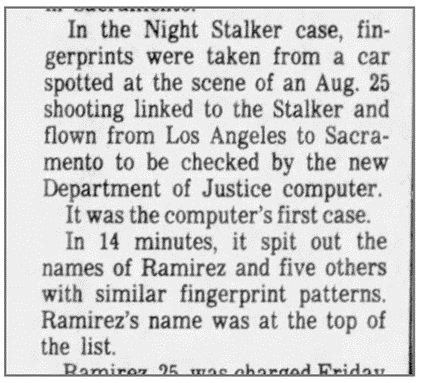
Five other suspects were flagged and the time it took has increased from three minutes to fourteen. Not such a “fluke” – but to narrow 380,000 down to five does still look impressive. However, the claim that they ‘fed his print into the system’ does not appear to be true…
Nothing Is Ever As It Seems
Philip Carlo’s biography – in spite of its fictionesque retelling of the Night Stalker story – often provides interesting nuggets of information, especially when it comes to poor evidence and the trial. He wrote (on page 124) that the above version was just the ‘official story,’ and the truth is police merely searched the database for the names Richard or Ricardo Ramirez.
Carlo was telling the truth – his claim was later confirmed on the Netflix documentary by Carrillo and Salerno themselves, who said eight Richard/Ricardo Ramirezes came up and of course ‘our’ Ricardo Muñoz Ramirez matched one of them. So, they were down to eight men, all with the same or similar names, whose fingerprints all looked alike – because, as mentioned in the Vincow article – fingerprints are not as unique as we are told. From these Ramirezes, just one of his prints was matched manually with the naked eye and not from a scientifically advanced computer database.
From Night Stalker: The Hunt for a Serial Killer, 2021, Netflix. Carlo quotes Richard Ramirez as claiming this evidence was a “travesty of justice” and that “these fingerprints should not have been allowed in at all. They had only three discernible loops, and for a print to be admissible in court, it’s supposed to be seven loops.” One might argue, ‘of course Richard would say that – he doesn’t want to be sentenced to death’ – but what if he was telling the truth? This whole case was built around flaky evidence and police manipulation that simply was not adequately defended in court.
At the Los Angeles trial, Ramirez’s attorneys failed to explain to the jury the significance of unidentifiable prints on Jennie Vincow’s window screen and should have argued that they were not from Ramirez. Not only that, but the prosecution also failed to preserve the other prints, so they could never be matched to other potential suspects in future. The defence attorneys moved for sanctions on this in the pre-trial hearings but in the actual trial, they neglected to raise the issue. So, it was assumed only Ramirez’s prints had been left on the window screen.
Then of course, Ramirez was never tried in Orange County nor San Francisco, so the prints’ veracity remain untested. But the fact that names rather than fingerprints were inputted into the system surely invalidates another print connected with Ramirez – one at a burglary in San Francisco, that police linked (based on a hunch) to Peter Pan’s murder. (A post on this case will be written in the near future). This print was also on the external side of a window and not inside the burglary scene itself.
Attempts by the Habeas Corpus lawyers to obtain the fingerprint evidence so their own expert Ron Smith could examine them were obstructed by the government (it is unclear whether this was the California government or the US Federal Government). If the fingerprints still exist and the state’s evidence is valid and reliable, then why should they fear re-examination? Is it because they know it might not withstand scientific scrutiny and consequently cast reasonable doubt, thus resulting in an overturned conviction?
-Venning B-
29th August 2023





 Expendable For A Cause.
You must be logged in to post a comment.