
“The world has been fed many lies about me..”
Richard Ramírez
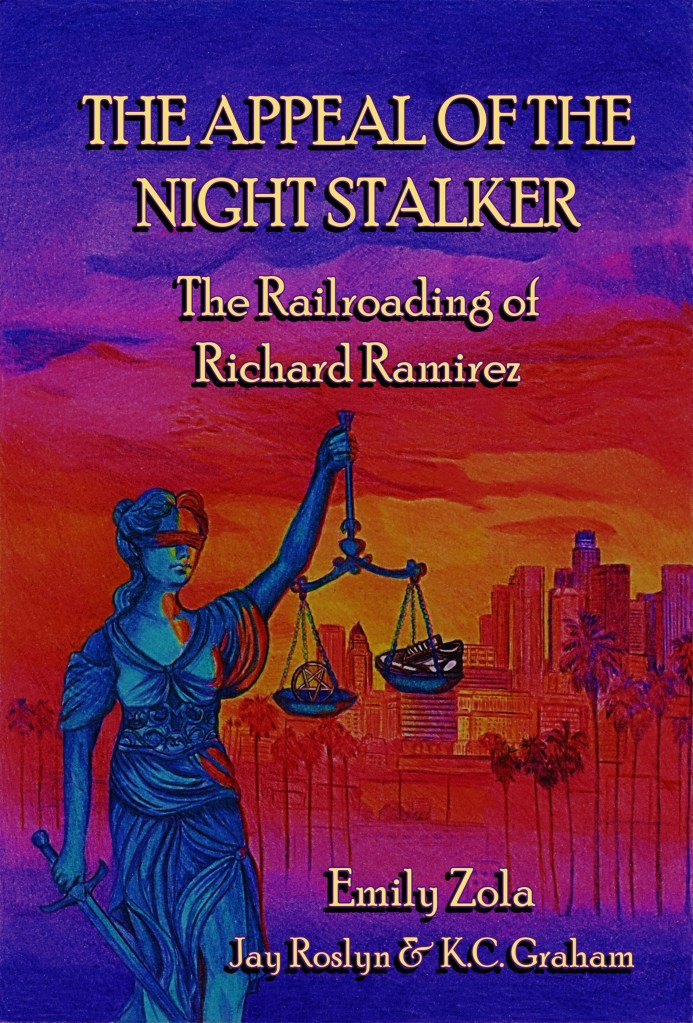
Now available, the book: The Appeal of the Night Stalker: The Railroading of Richard Ramirez.
Welcome to our blog.
This analysis examines the life and trial of Richard Ramirez, also known as The Night Stalker. Our research draws upon a wide range of materials, including evidentiary documentation, eyewitness accounts, crime reports, federal court petitions, expert testimony, medical records, psychiatric evaluations, and other relevant sources as deemed appropriate.
For the first time, this case has been thoroughly deconstructed and re-examined. With authorised access to the Los Angeles case files, our team incorporated these findings to present a comprehensive overview of the case.
The Writ of Habeas Corpus
The literal meaning of habeas corpus is “you should have the body”—that is, the judge or court should (and must) have any person who is being detained brought forward so that the legality of that person’s detention can be assessed. In United States law, habeas corpus ad subjiciendum (the full name of what habeas corpus typically refers to) is also called “the Great Writ,” and it is not about a person’s guilt or innocence, but about whether custody of that person is lawful under the U.S. Constitution. Common grounds for relief under habeas corpus—”relief” in this case being a release from custody—include a conviction based on illegally obtained or falsified evidence; a denial of effective assistance of counsel; or a conviction by a jury that was improperly selected and impanelled.
All of those things can be seen within this writ.
The Writ of Habeas Corpus is not a given right, unlike review on direct appeal, it is not automatic.
What happened was a violation of constitutional rights, under the 5th, 6th, 8th and 14th Amendments.
Demonised, sexualised and monetised.
After all, we are all expendable for a cause.
- ATROCIOUS ATTORNEYS (4)
- “THIS TRIAL IS A JOKE!” (8)
- CONSTITUTIONAL VIOLATIONS (9)
- DEATH ROW (3)
- DEFENCE DISASTER (7)
- INFORMANTS (6)
- IT'S RELEVANT (17)
- LOOSE ENDS (15)
- ORANGE COUNTY (3)
- POOR EVIDENCE (16)
- RICHARD'S BACKGROUND (7)
- SNARK (12)
- THE BOOK (4)
- THE LOS ANGELES CRIMES (22)
- THE PSYCH REPORTS (14)
- THE SAN FRANCISCO CRIMES (5)
- Uncategorized (5)
-
You, the Jury
Questioning
The word “occult” comes from the Latin “occultus”. Ironically, the trial of an infamous occultist and Satanist is the epitome of the meaning of the word itself: clandestine, secret; hidden.
We’ve written many words; a story needed to be told, and we created this place to enable us to do just that.
Here, in this space, we intended to present the defence omitted at Richard Ramirez’s trial in violation of his constitutional rights. Our investigations have taken us down roads we’d rather not travel along, but as we did so, we realised that there was so much hidden we could search for a lifetime and still not see the end of it. Once we’d started, there was no turning back; we followed wherever it led.This was never about proving innocence; that was never the intent or purpose. We wanted to begin a dialogue, allowing this information to be freely discussed and for us to verbalise the rarely asked questions. We asked, and we’re still asking.
We can’t tell you, the reader, what to think; you must come to your own conclusions, as we did.
And so
We’ve said what we came here to say; with 114 articles and supporting documents, we’ve said as much as we can at this point.
This blog will stand as a record of that, and although we will still be here, we intend to only update if we find new information, if we suddenly remember something we haven’t previously covered, or to “tidy up” existing articles and examine any new claims (or expose outrageous lies) that come to light. The site will be maintained, and we’ll be around to answer any comments or questions.
What Next?
We will focus on the book being worked on; we’ve also been invited to participate in a podcast. When we have dates for those, we’ll update you.
The defence rests? Somehow, I sincerely doubt that; ultimately, we’re all “expendable for a cause”.
~ J, V and K ~
-
“Murder Clothes” – The Myth of the Night Stalker’s Appearance
We have examined the eyewitness descriptions and composite sketches of the Night Stalker many times on this site but we have never really discussed his clothes. The Night Stalker is a caricature. He invaded in the dark, clad in black from head to foot. He wore a “black Members Only type jacket”, dark baseball caps and most famously, black Avia sneakers. Victims only briefly glimpsed him under lights as he examined their jewellery or shone a torch, sneaked inside their garage, or lurked inside dark cars. But what did the surviving victims actually say in their police statements? Were their assailants really so shadowy? (Other discrepancies with the suspect’s physical appearance shall be put aside for this post). All police statements can be found in Petition supporting Document 20-3.
Maria Hernandez said he wore a black jacket, white shirt, dark trousers/pants.
The Yu witnesses, described the following attire:
Witness 1: Light blue shirt and light blue pants.
Witness 2: Black jacket. His other clothes were not described.
Carol Kyle: leather jacket, black and tan checked shirt, black pants, black gloves and a loose belt with big silver holes. Yes, the rapist’s jacket was black, but it does not quite fit with the image of the Night Stalker as a walking shadow.

From Carol Kyle Sophie Dickman did describe someone in all black, but she could not keep her story straight. From her police statement: black leather jacket, dark jeans, black hi-top sneakers and black mesh gloves.

Dickman’s first statement The following is from the Petition (pp. 78-79): black clothing, black hi-top sneakers with a white line around the sole. The mesh gloves have been changed to black leather with ridges.
In Philip Carlo’s book (pg. 310), he states that Dickman was challenged in court over a third police statement in which she claimed her attacker was dressed as a hiker or mountain climber!
Somkid Khovananth said her husband’s killer wore brown pants and a multicoloured shirt (pg. 87 of the Petition). In Philip Carlo’s book it is described as a blue shirt with multicoloured patterns. This is ironic, because the Khovananth Incident was the case where detectives really emphasised his dark clad appearance, including on the ‘wanted poster’.


Closer The Petersens. Despite chasing the ‘Night Stalker’ around the home, Christopher Petersen could not identify the suspect. Virginia Petersen is another who changed her story, although she did see someone in all black, apparently wearing a turtleneck shirt. At first, she could barely make out his hands and assumed he was wearing white gloves as there was a strong demarcation between the arms and hands. Later, she gave a detailed description of his fingers and claimed there was a light source to enable this which was proved impossible.
The final survivor is Sakina Abowath, the victim who first described a BLONDE MAN. He was wearing blue jeans and according to Carlo’s book, big stompy boots that took a long time to lace up. Kinney Stadia shoeprints were supposedly discovered at the scene, but evidence has not been sufficiently demonstrated.

The Myth
While Richard Ramirez did prefer dark clothes, the source of the all-in-black image seems to be Detective Gil Carrillo and he talks about it wherever he is invited. He repeatedly claims that all victims, including the child abductees, described the man in black with dishevelled hair and bad teeth. It is false information. Nevertheless, he had been pursuing someone who dressed in black from the start, which was why he targeted Arturo Robles.
In this podcast, around the 1:18:00 mark, he claims that the Task Force referred to the Night Stalker’s black costume as his “kill kit”, “killer outfit” and “murder clothes” and they were exclusively worn for the purpose of “dirty deeds.” Preposterously, he insists that they were stored in Ramírez’s Greyhound Bus Depot locker “that stunk like shit” because they were covered in the blood of the victims. But no police report, appeal petition, newspaper article or book corroborates this. No massively incriminating, smelly, blood encrusted clothes were submitted as evidence by the prosecution. A bag and a leather jacket were removed from the locker, but there was no blood. Carrillo was not in charge of raiding the locker, so this “pungent” “shit” smell is a figment of his imagination.
As mentioned in various posts in our CRIMES category (and here), three pairs of incidents occurred on the same nights. 30th May (Kyle & Bell/Lang) 7th July (Nelson & Dickman), and 20th July (Kneiding & Khovananth). None of the survivors reported that their attacker was covered in blood. If he was wearing a blue/multicoloured shirt as Somkid Khovananth said, then surely it would be at least spattered – the Kneidings were left in a terrible state. Surely the tan and black shirt Carol Kyle saw would be smeared with reddish-brown stains. In other posts we have discussed the complicated diversions the killer would have needed to take for a shower and change of clothes. Dumping them at a bus depot is no more plausible. The depot was always busy, and no one reported a man bundling bloody shirts into his locker. We are hesitant to directly accuse people of lying on this blog, for libel reasons, but there is no point in dissembling: Carrillo’s blood-sodden black “kill kit” is a proven whopping lie.
But at some point, he must have truly believed it, because when he went searching for the enigmatic Avia sneakers, he was only able to buy a white pair – he assumed the black ones did not exist… so… he dyed his pair black. This sounds absurd, so here is a video of him actually saying it.
Credit to Joseph Giacalone. Watch it here. And there is this photo where you can see the dye around the edges.
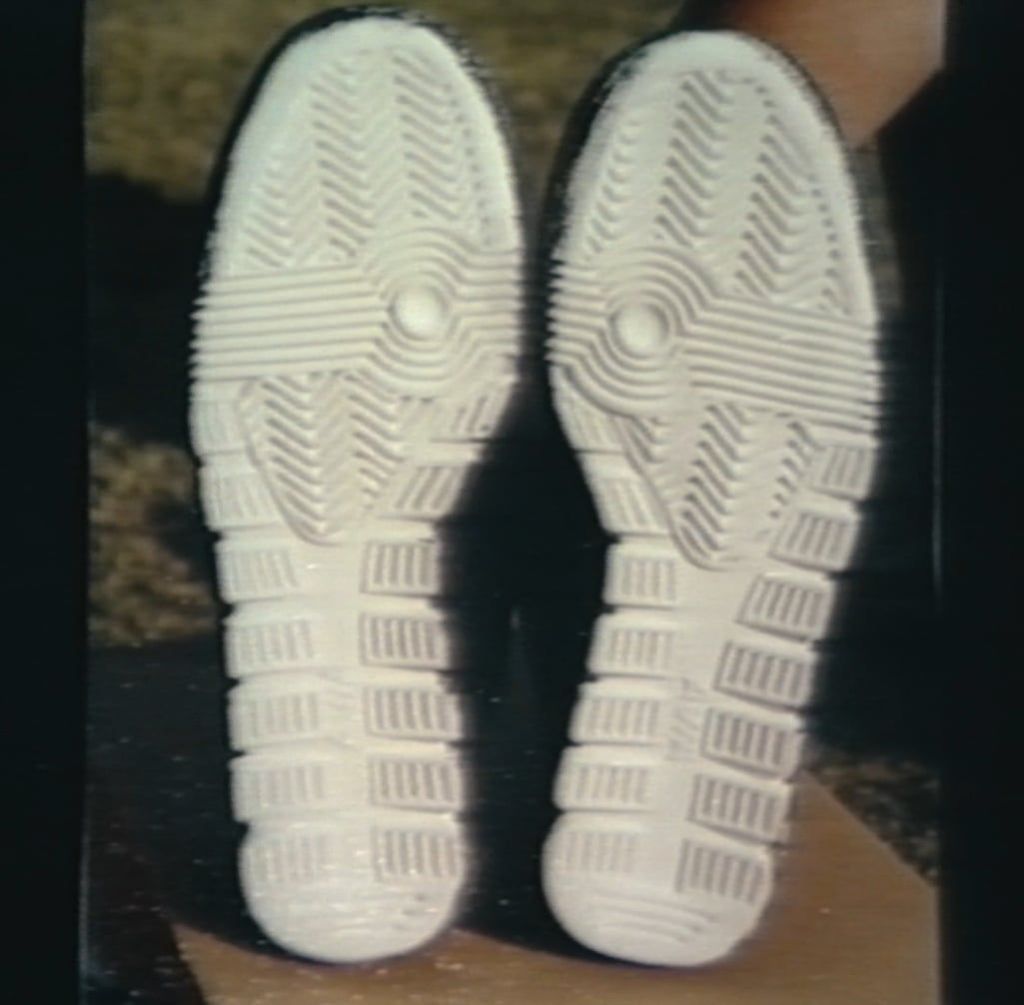
👀 This is a detective who is unable to abandon a hypothesis when it is disproven. See here for another example of Carrillo Logic. However, detectives soon created a way to make the Avias seem unique (one cannot solely blame him – Frank Salerno was also walking around with a pair). It transpired that black size 11.5 Avia aerobic models did exist and famously, only three pairs were sent to California and the latest serial killer ‘just so happened’ to select these “newly invented” sneakers out of all the brands in the world. This made them almost unique. However, there is no evidence that the killer was wearing black shoes. That is just Carrillo’s theory. The one victim who mentioned black shoes (Dickman) was not describing Avias. The killer(s) – yes, plural – could have been wearing any colour Avias, because, contrary to the official Night Stalker lore, THEY WERE NEITHER NEW NOR UNCOMMON SOLES. And he keeps saying they were 440s. They were the 445B model.
Here is an advert showing Avias with identical sole prints in December 1982.

There has to come a point where somebody interrogates Carrillo on this constant misinformation.
-VenningB-
See here for yet another bizarre claim from Carrillo.
13/11/2023
-
A Web of Informants: Part 3. Sandra Hotchkiss
Sandra Hotchkiss was a burglar, drug addict and prostitute who committed burglary with Richard Ramirez in 1985. Significantly, Hotchkiss was yet another burglar who traded with Felipe Solano, in her words, 15 to 20 times.
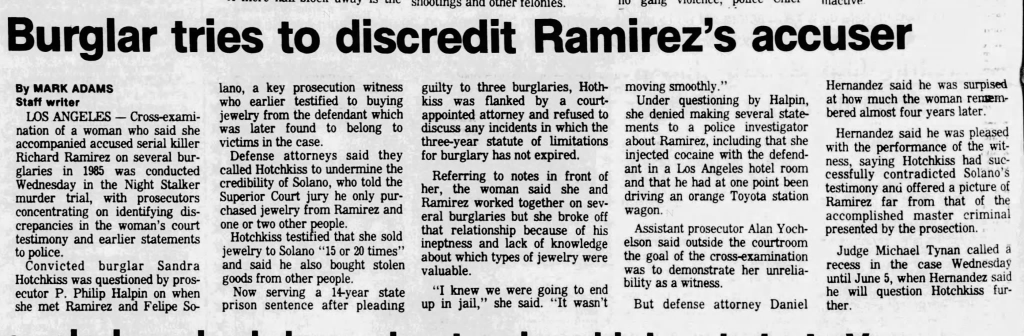
This image is best viewed on desktop Like Ramirez, Hotchkiss suffered from epilepsy. She spotted him unsuccessfully trying to sell jewellery at a pool hall and exploited him by paying less than the items were worth. She then turned around to another ‘fence’ and sold them for triple the price Ramirez was offering.
She seemed to have taken Ramirez under her wing, teaching him ‘tricks of the trade’ such as painting his fingertips with clear nail polish and how to hold things so as not to leave fingerprints. She taught him how to tell when people were away on holiday – if the mailbox was full, then they were safe to break in.
Solano’s Arrest
Sandra Hotchkiss had been working as a police informant since 1975, in return for a suspended sentence (for burglary). Her main role was entrapping ‘fences’ by selling them stolen goods. Then the police make the arrest. Because of her knowledge of downtown Los Angeles, the Night Stalker Task Force recruited her to help them take down Felipe Solano. As mentioned in Part 1, Alejandro Espinoza was the man who told the police his burglar friend ‘Rick’ sold to Solano.
Thinking this was an ordinary ‘sting’, Hotchkiss agreed. She had no idea that she was involved in the hunt for the Night Stalker. Detectives gave her jewellery and asked her to sell it to Solano at the pool hall, but he rejected it. Next, they told her to go to his house. Hotchkiss was reluctant: although she had sold items to Solano in the past, he had never told her his address, which meant he would be suspicious. She was correct: as she approached Solano’s house, he was furious and asked her if she was working for the police.
According to Hotchkiss’ testimony in court, the police ‘jumped’ him, put him in a chokehold and ‘roughed him up’. She testified that Solano initially denied taking items from Richard Ramirez and was coerced into saying it was him by the police. Hotchkiss claimed that she reported this to the District Attorney but was ignored. (This information is not in the Petition but comes from Philip Carlo’s book on pg. 370).
Hotchkiss also claimed the deputy District Attorney, Philip Halpin (who acted as prosecutor at trial) came to her and demanded “don’t screw up my case.”
How Did Sandra Hotchkiss Describe Ramirez?
Hotchkiss was the leader in the burglaries or ‘capers’ as she called them. However, she described him as “jumpy,” “spooky” (as in scares easily), “inexperienced”, “messy/dirty” (in his technique) and “amateurish.” He “tossed” things around, creating an unnecessary disturbance. Because of his ineptitude, she relegated him to getaway driver, but sometimes he would not stay in the car, or would panic and drive away. The pair often ended up arguing.
Importantly, Ramirez was non-violent. She never saw him with weapons, except a pocket-knife. He never behaved in an aggressive manner – not even when the other criminals rejected him.
After she had completed her work for the police regarding Solano, she began to work for the defence. However, the police reneged on their promise to keep her sentence suspended. They claimed she broke her parole obligations, and she was sentenced to fourteen years in prison. Could this be punishment because she chose to support Ramirez and alleged police brutality against Felipe Solano?
Impeachment at Trial
At trial, Sergeant Yarbrough (a senior detective in the Night Stalker Talk Force) discredited Sandra Hotchkiss by claiming she was a liar and had switched to the defence in the hope they would pay her. This seems unlikely given that the defence were working pro bono and Hotchkiss never changed her story, even when she was not paid. She seems to have had a genuine belief that Ramirez was not the Night Stalker. However, the jury is more likely to believe a police sergeant than a criminal and so she was impeached, despite painting a portrait of Ramirez that helped the defence.
-VenningB-
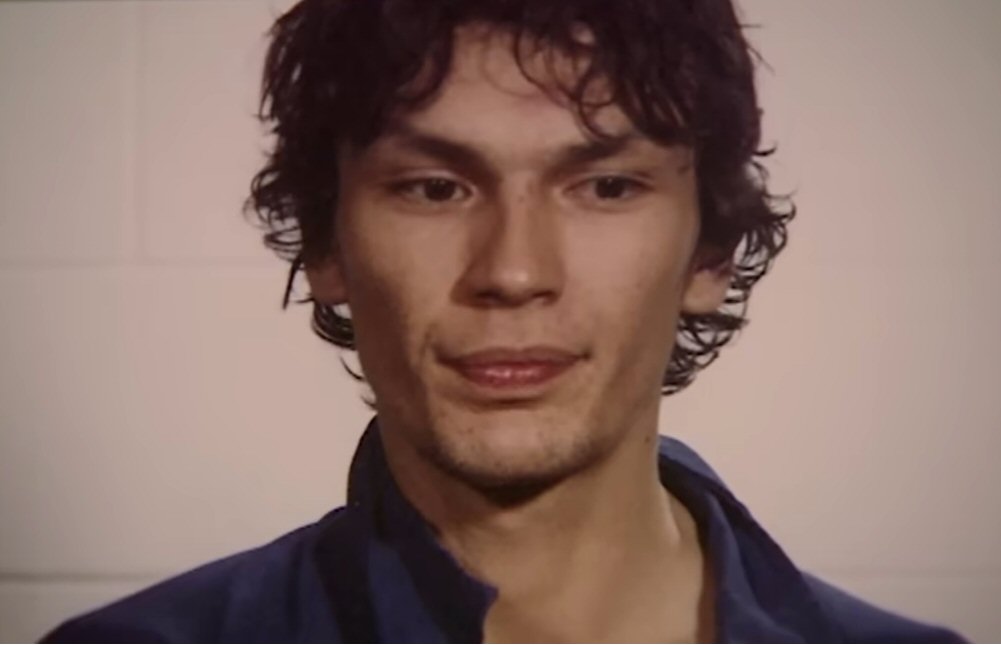
Screenshot from The Satanic Night Stalker That Terrorised LA Next, Part 4: The Mugshot.
-VenningB-
6th Nov 2023
-
A Web of Informants: Part 4. The Mugshot
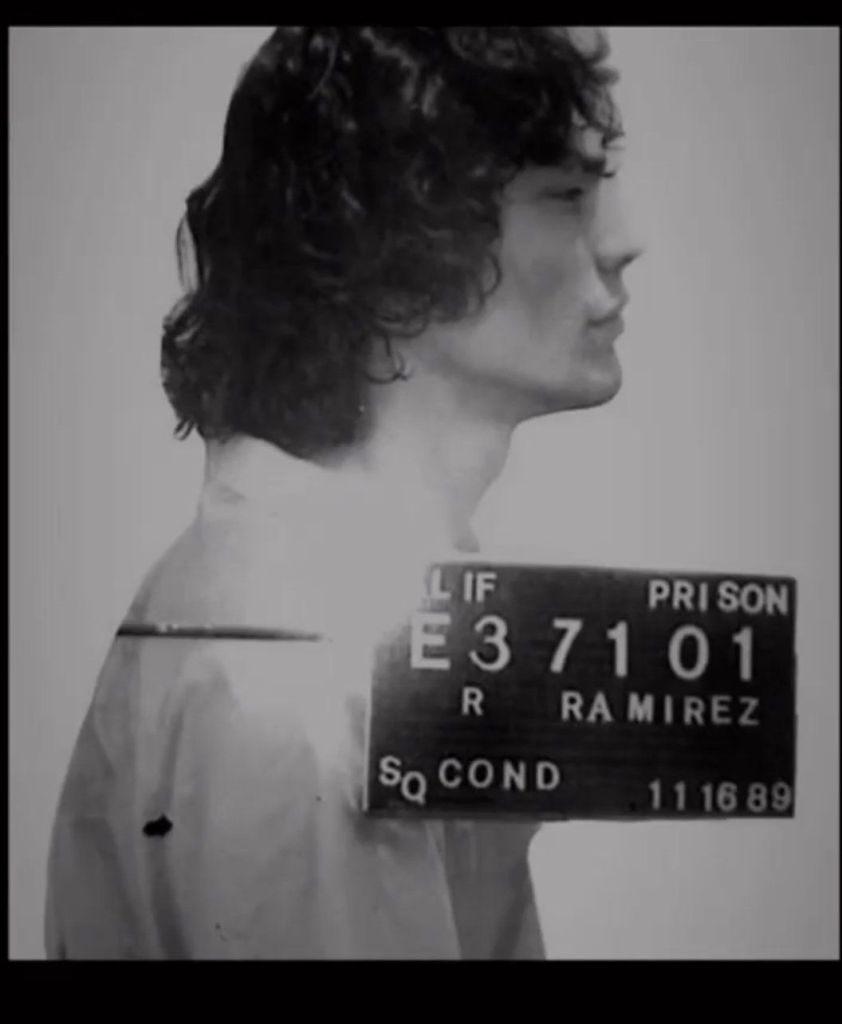
As mentioned in Part 1, two sets of Ramirez’s ‘friends’ independently reported him to police for his burglaries that occurred close to dates of Night Stalker attacks. SFPD’s Frank Falzon was led to Ramirez’s friend Armando Rodriguez who told him Ramirez’s name. Police argued over whether to release Richard Ramirez’s 1984 mugshot, with Falzon insisting they should, as the media will blame police if another person was murdered over the weekend. On 30th August 1985, in both San Francisco and Los Angeles, press conferences were held, and his face was released. Ramirez was visiting Arizona, so had no idea he had been named as the prime suspect.
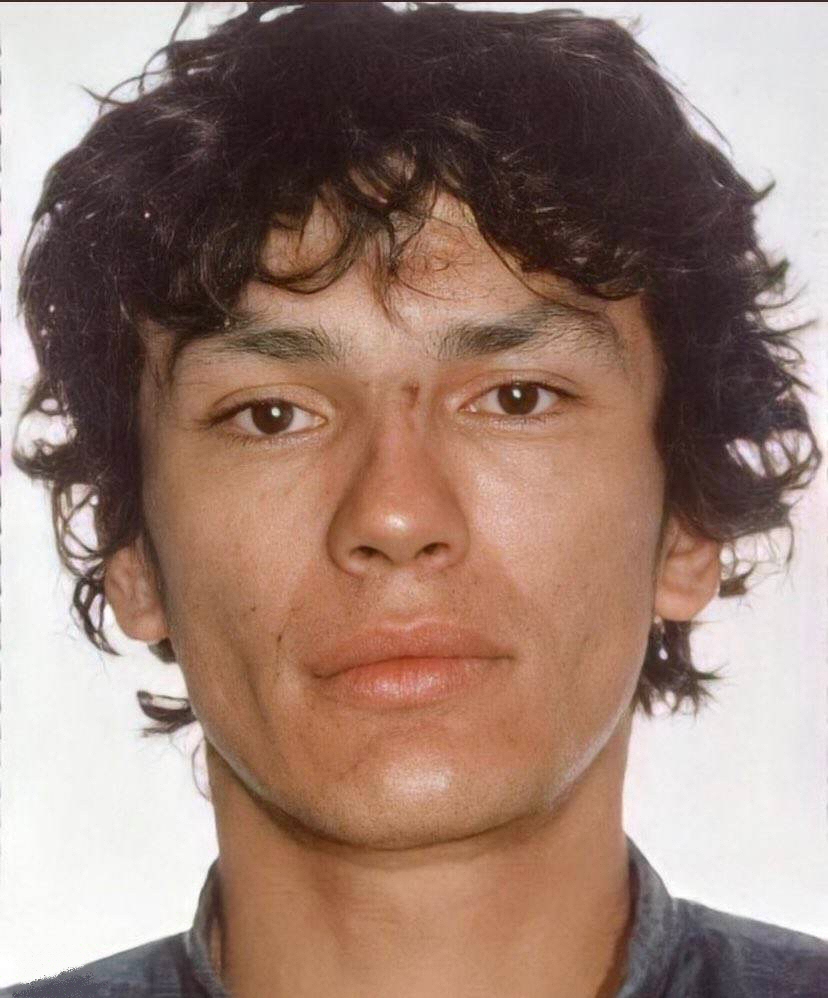
As soon as Ramirez’s friend Manuel “Cuba” Hechavarria saw his face on the news, he went to a phone box in Garvey and (under the false name of Dave) and told police he knew ‘Ricky’ or ‘Despinada’ (dishevelled or uncombed in Spanish). Felipe Solano also saw the mugshot on the news. Because the Night Stalker had been connected to an orange Toyota, and Ramirez had one at some point, Solano panicked and left his house for the night. He must have gone to the pool hall – this is where Sandra Hotchkiss tried to sell him jewellery for the police. He evidently returned to his house by the next day; the events of this were covered in Part Three.
Cuba’s Police Statement
Hechavarria revealed that he had met Ramirez at the food market, through a woman named Maria Felix. He and Felix were both Tijuana Taxis (like Jesse Perez). Hechavarria and Ramirez began committing purse thefts in Glendale and Pasadena, and Hechavarria would act as getaway driver, taking half the money.
They graduated to car burglaries along the Orange County stretch of the Pacific Coast Highway, although Hechavarria said Ramirez did most of it (anything to make himself seem innocent). He said they were joined in these escapades by a man named ‘Julio.’ Hechavarria named someone else with whom they committed crimes: Eva Castillo, and he took police to her former home.
Hechavarria claimed he had stopped his criminal activity, but still possessed some stolen jewellery that he had won off him during a bet, while playing a game of ‘craps’ (a dice game).
How did Cuba Describe Ramirez?
Of all the Los Angeles informants, Hechavarria was the only one who mentioned Ramirez’s psychotic behaviour, such as praying to and communicating with Satan via Ouija board, throwing a bible from a moving truck, while yelling ‘there must be something wrong’ and drawing pentagrams on himself. Nevertherless, he liked Ramirez enough to remain in contact with him after ‘going straight’ and becoming a security guard. Hechavarria’s police statement can be found in the Petition supporting file Document 7-5.
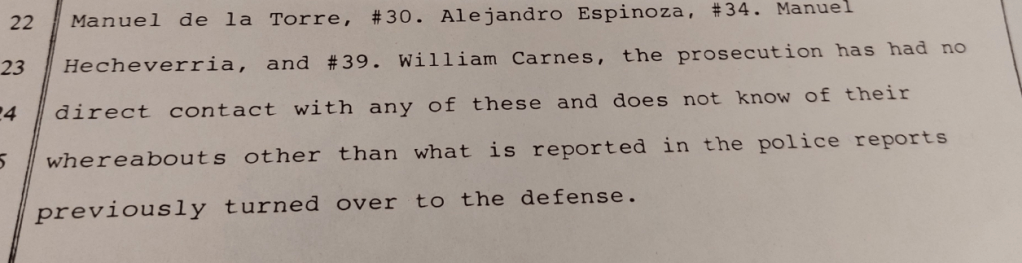
Hechavarria was never arrested for possession of stolen jewellery, his involvement with burglaries and car break-ins, nor was he called as a witness in court because the prosecution claimed they were unaware of his location. When the defence asked them for his contact details (as well as those of Alejandro Espinoza), the district attorney’s office said they should already have his address from the original police reports and refused to cooperate. This is highly suspicious: Cuba (and others) traded with Felipe Solano, and should have been a key prosecution withness. Incidentally, Armando Rodriguez was also ‘missing.’
Some people wonder: if Ramirez had nothing to do with the Night Stalker attacks, how were unconnected friends convinced it was him? If it was not for the police telling people the Night Stalker had curly hair and dental problems, they would have continued to trade with him, receive jewellery and perhaps even commit crimes with him. If they had known the truth about what victims had really described, none of this would have happened.
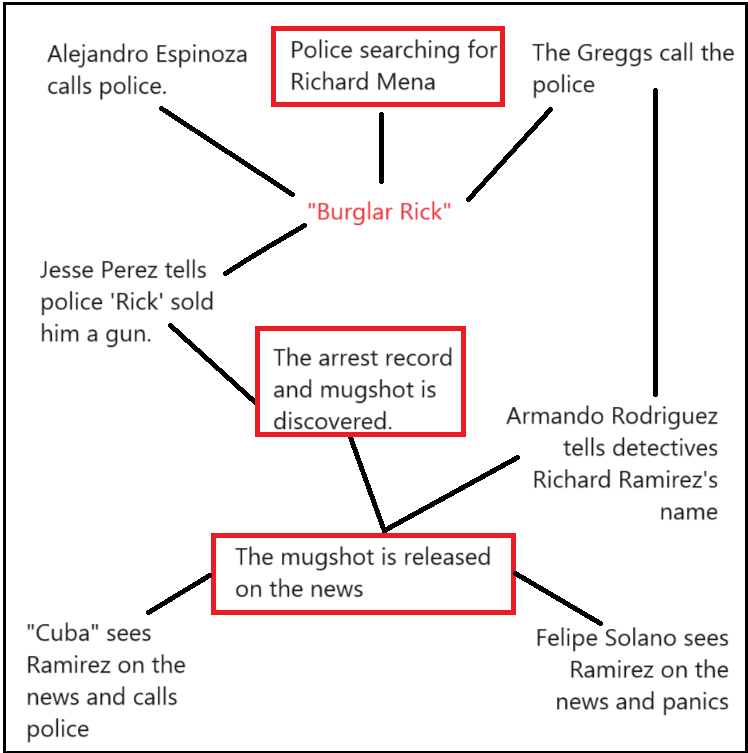
How police closed in: it was very simple -VenningB-
06/11/2023
-
A Web of Informants: Part 2. Jesse Perez
As explained in Part One, Detectives were hoping to link the ‘Burglar Rick’ reported by Alejandro Espinoza to the ‘Burglar Rick’ reported by the Gregg family. The same time all this was going on, another informant called the police: Jesse Perez.
Jesse Perez had met Ramirez through his older brother Julián, who was his neighbour. Perez was a convicted felon, for both manslaughter (he stabbed someone in a bar fight in Texas) and burglary. He also illegally taxied Mexicans across the border. Perez also knew Felipe Solano and that Ramirez sometimes sold stolen goods to him. While Solano is only tangential to this part of the story, it always comes back to him.
Perez claimed that he knew a burglar called “Rick Moreno.” He was tall with curly hair and bad teeth, just like police had described the Night Stalker. Perez said Ramirez had sold him a Jennings pistol: a .22 calibre long rifle semi-automatic. This was later supposedly tied to the murder weapon in the Doi Incident, so this was very exciting news for the Night Stalker Task Force.
However, there was no such person called Rick Moreno that fit the description, so detectives hit a wall. Returning to Perez, they asked for more details. Perez revealed that Rick had told him he was from El Paso, and that he had been arrested and imprisoned for joyriding in a stolen vehicle in December 1984. “If you find that arrest record, then you will find the Night Stalker.”
They found a Ricardo Muñoz Moreno in the records, complete with a fingerprint and mugshot. Again, they returned to Jesse Perez and asked him to confirm whether this was his Rick. It was. So, detectives had their man, but not his real name.
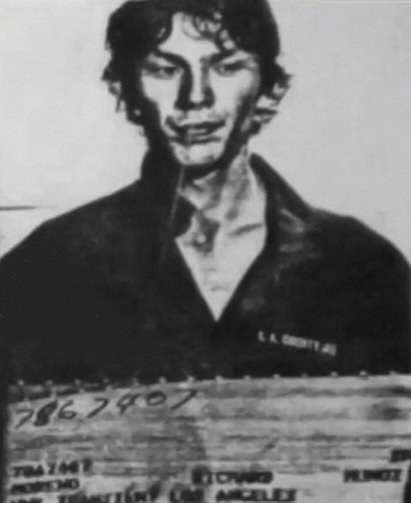
You can just about read “Ricardo Muñoz Moreno” Meanwhile, in San Francisco, Donna Myers, her son Floyd Dvorak and the Greggs were asked to identify the mugshot and they too confirmed it was their ‘sweet’ friend Rick, who often gave them stolen jewellery.
Fingerprints
At this time, an orange Toyota station wagon had been found abandoned in downtown Los Angeles. This was thought to be linked to an attempted murder in Orange County. As discussed in this post, the orange car was merely weak circumstantial evidence, but to detectives, this was one of their main leads. The car apparently contained a partial fingerprint on the interior mirror. Finally, Frank Falzon punched Ramirez’s name out of Armando Rodriguez, and they had his identity.
The official narrative is that the car print matched Ramirez’s on the CAL-ID system and was matched within seconds. But the truth is that they inputted Ramirez’s name, up popped eight Richard Ramirezes and obviously, only one of them was him – only one fitted the description of the man police had decided was the Night Stalker. The prints themselves were actually only examined manually, not through a computer. This post examines the issue in more detail.
To police, they thought this was solved: Three people had named Rick, there was a murder weapon and – so they told the public – a fingerprint that supposedly tied Ramirez to a suspicious car. This is when they – with Falzon’s urging – decided to go public with the mugshot.

As mentioned in this post, the evidence around the Jennings pistol was a complete farce. Witnesses who supposedly saw it described a completely different gun, the gun shown on the Netflix documentary was the wrong type, and it was lost during the trial! Best of all, Jesse Perez admitted he had bought it off Ramirez six to nine months before the Doi murder took place, claiming senility as the reason he forgot he had said this, which brings the total of recovered murder weapons down to zero.
So, the police were now very close to catching Ramirez on what would ultimately turn out to be a non-murder weapon, unverified fingerprints in a random stolen car. But most people are completely unaware of this – in the well-known story of the Night Stalker, the build up to the capture is gripping and amazing, but once deconstructed, there are gaping chasms in its narrative.
-VenningB-
2/11/2023
-
A Web of Informants: Part 1. Closing In
The Net Closes
A series of events caused detectives to home in on Richard Ramirez. After the Khovananth attack, the LAPD disseminated a police bulletin as well as a ‘wanted poster’ of the suspect. They told the public that this man, a Latino, had attacked a dozen people and was armed and dangerous. His distinguishing features were curly brown hair, and stained, gapped teeth, as well as wide, crazy eyes. Sometimes he wore a baseball cap and he preferred black clothing.

The police bulletin We now know from the victims’ original police statements that this is untrue. The police had already decided the Night Stalker’s appearance, based on an encounter with ‘Richard Mena’ (Richard Ramirez’s alias) in which he drew a pentagram on a stolen car. The Khovananth attack was the only incident where the suspect’s features matched who police believed was the Night Stalker.
Two Ricks in Two Cities
By August 1985, Los Angeles was in a state of hysteria, with many people reporting sightings of the Night Stalker. Police were inundated with thousands of calls about shady neighbours, or even people in the local pizza parlour who vaguely resembled the composite sketch. Tall, curly-haired men were being stopped and searched. Ramirez was unlucky. Due to his looks and his proclivity for burglary, two seemingly separate sets of ‘friends’ reported him to the police.
On 26th August, a mysterious man called Alejandro Espinoza called the police (in Los Angeles) and reported that he had a friend called ‘Rick’ who sold stolen goods to a ‘fence’ named Felipe Solano – close to the dates of murders. Espinoza later went ‘missing.’
Next, in Lompoc, Califonia, Earl Gregg and his wife Deleen had recently received some jewellery from Ramirez, while visiting Deleen’s mother Donna Myers in San Pablo (these events and relationships are detailed in this post).
Earl Gregg’s sister Laurie Ochoa suggested Ramirez was the killer – after all, a murder had recently occurred in San Francisco (Peter Pan), where Ramirez had recently visited. Despite Earl and Deleen’s incredulity, Ochoa successfully encouraged her brother to call the Lompoc Police Department to report their ‘burglar friend Rick.’ Lompoc PD contacted San Francisco PD, as a stolen bracelet was engraved with an S.F. driver’s licence number.
It turned out the items Ramirez had given them were not from the Pan murder, but a burglary in the Marina District. However, SFPD’s Inspector Frank Falzon had a hunch that the crimes were connected and he demanded that Lompoc PD put him in contact with the Greggs. He and his partner Carl Klotz interviewed them and they guided them to Donna Myers.
Myers described Ramirez, which matched the false information the two Los Angeles police agencies had been spreading. Myers told police about Ramirez’s childhood friend Armando Rodriguez, and the SFPD detectives travelled to El Sobrante to find him. Rodriguez attempted to give Ramirez an alibi.
Because detectives were already persuing a lead on ‘Richard Mena’ via city dentists, having two different informants naming a ‘burglar called Rick’, was a very promising lead. Especially as ‘Rick’ had visited San Francisco in the same week as a murder.
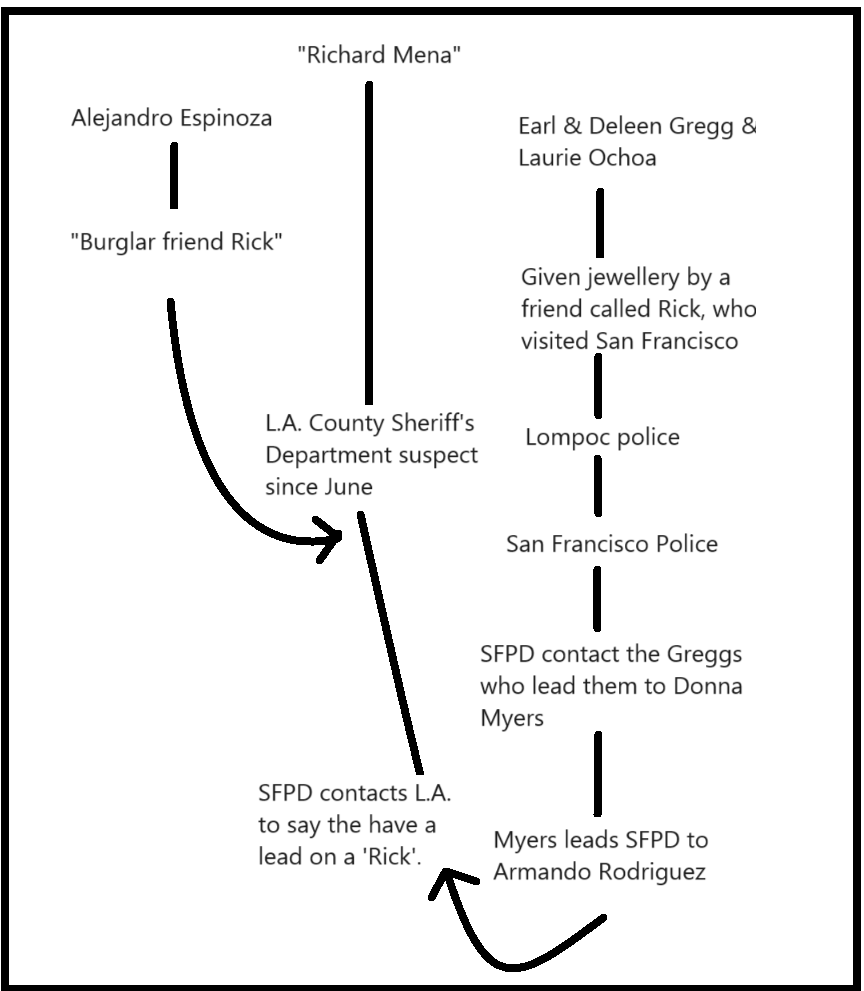
There was absolutely nothing wrong with police assuming a connection and following this lead, but everything wrong with continuing to hunt down one man, especially after a tangled web of potential suspects began to emerge. From this point, events snowballed for Richard Ramirez, and weak circumstantial evidence appeared to come together.
Next: Jesse Perez.
-VenningB-
1/11/23



 Expendable For A Cause.
You must be logged in to post a comment.