
“The world has been fed many lies about me..”
Richard Ramírez
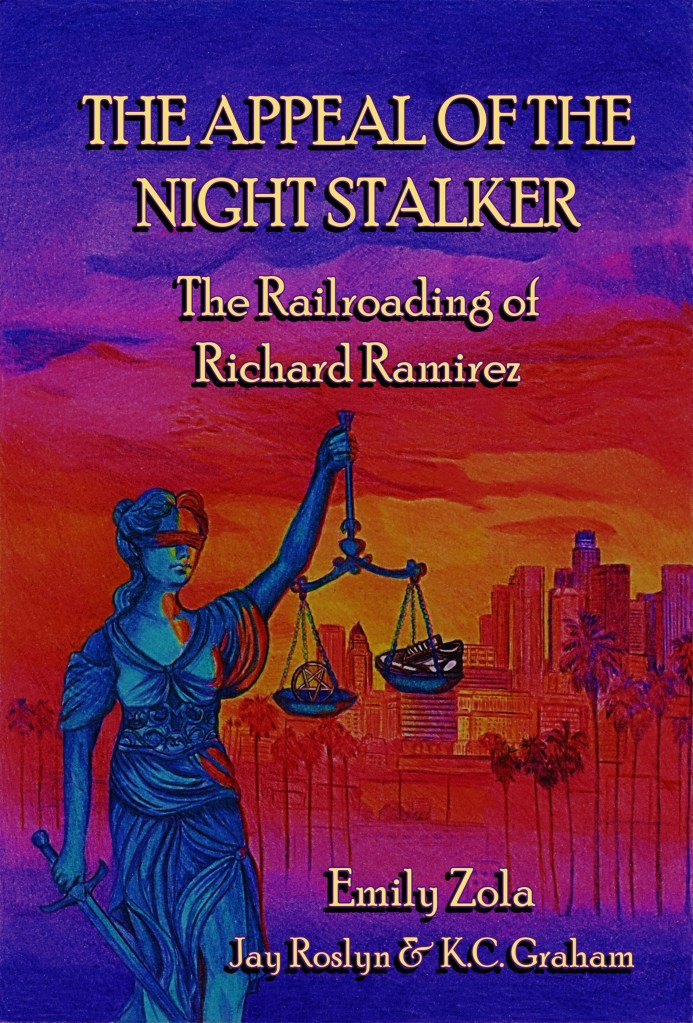
Now available, the book: The Appeal of the Night Stalker: The Railroading of Richard Ramirez.
Welcome to our blog.
This analysis examines the life and trial of Richard Ramirez, also known as The Night Stalker. Our research draws upon a wide range of materials, including evidentiary documentation, eyewitness accounts, crime reports, federal court petitions, expert testimony, medical records, psychiatric evaluations, and other relevant sources as deemed appropriate.
For the first time, this case has been thoroughly deconstructed and re-examined. With authorised access to the Los Angeles case files, our team incorporated these findings to present a comprehensive overview of the case.
The Writ of Habeas Corpus
The literal meaning of habeas corpus is “you should have the body”—that is, the judge or court should (and must) have any person who is being detained brought forward so that the legality of that person’s detention can be assessed. In United States law, habeas corpus ad subjiciendum (the full name of what habeas corpus typically refers to) is also called “the Great Writ,” and it is not about a person’s guilt or innocence, but about whether custody of that person is lawful under the U.S. Constitution. Common grounds for relief under habeas corpus—”relief” in this case being a release from custody—include a conviction based on illegally obtained or falsified evidence; a denial of effective assistance of counsel; or a conviction by a jury that was improperly selected and impanelled.
All of those things can be seen within this writ.
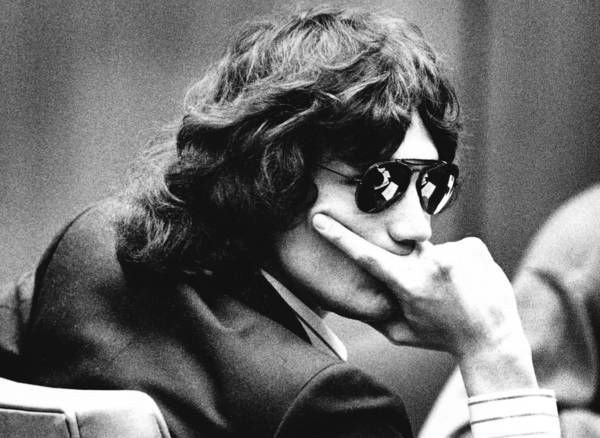
The Writ of Habeas Corpus is not a given right, unlike review on direct appeal, it is not automatic.
What happened was a violation of constitutional rights, under the 5th, 6th, 8th and 14th Amendments.
Demonised, sexualised and monetised.
After all, we are all expendable for a cause.
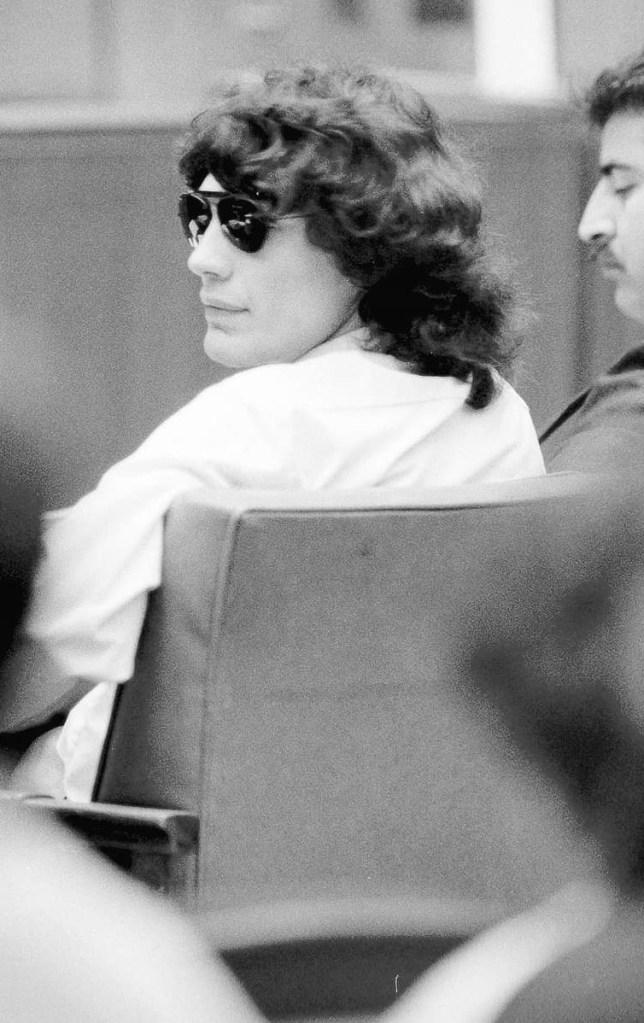
- ATROCIOUS ATTORNEYS (4)
- “THIS TRIAL IS A JOKE!” (8)
- CONSTITUTIONAL VIOLATIONS (9)
- DEATH ROW (3)
- DEFENCE DISASTER (7)
- INFORMANTS (6)
- IT'S RELEVANT (17)
- LOOSE ENDS (15)
- ORANGE COUNTY (3)
- POOR EVIDENCE (16)
- RICHARD'S BACKGROUND (7)
- SNARK (12)
- THE BOOK (4)
- THE LOS ANGELES CRIMES (22)
- THE PSYCH REPORTS (14)
- THE SAN FRANCISCO CRIMES (5)
- Uncategorized (5)
-
You, the Jury
Questioning
The word “occult” comes from the Latin “occultus”. Ironically, the trial of an infamous occultist and Satanist is the epitome of the meaning of the word itself: clandestine, secret; hidden.
We’ve written many words; a story needed to be told, and we created this place to enable us to do just that.
Here, in this space, we intended to present the defence omitted at Richard Ramirez’s trial in violation of his constitutional rights. Our investigations have taken us down roads we’d rather not travel along, but as we did so, we realised that there was so much hidden we could search for a lifetime and still not see the end of it. Once we’d started, there was no turning back; we followed wherever it led.This was never about proving innocence; that was never the intent or purpose. We wanted to begin a dialogue, allowing this information to be freely discussed and for us to verbalise the rarely asked questions. We asked, and we’re still asking.
We can’t tell you, the reader, what to think; you must come to your own conclusions, as we did.
And so
We’ve said what we came here to say; with 114 articles and supporting documents, we’ve said as much as we can at this point.
This blog will stand as a record of that, and although we will still be here, we intend to only update if we find new information, if we suddenly remember something we haven’t previously covered, or to “tidy up” existing articles and examine any new claims (or expose outrageous lies) that come to light. The site will be maintained, and we’ll be around to answer any comments or questions.
What Next?
We will focus on the book being worked on; we’ve also been invited to participate in a podcast. When we have dates for those, we’ll update you.
The defence rests? Somehow, I sincerely doubt that; ultimately, we’re all “expendable for a cause”.
~ J, V and K ~
-
A Cloak of Competence
The Woods Report
George Woods was a neuropsychiatrist who evaluated Richard at the San Francisco County Jail and San Quentin State Prison, interviewing him on five separate occasions for approximately 14 hours. Woods also spent extensive time observing Richard’s interviews and interactions with his San Francisco defense attorneys, screening LA trial footage, and reviewing his medical history, school, Texas Youth Council records, and police reports.
Woods determined that Richard suffered from an “organically based mental disorder,” specifically a psychotic disorder, caused by temporal lobe syndrome.
Organic-based Mental Disorders
In organic-based mental disorders, a medical condition or treatment causes altered mental functioning and behavioral changes. An organic-based mental disorder may be caused by conditions such as epilepsy, brain damage, or dementia. A physical change or injury to the brain can cause symptoms of psychosis, such as hallucinations, delusions, disorganized thoughts, speech and behavior, and social withdrawal. Psychosis can be a symptom of several types of mental health disorders and substantially impair functioning and quality of life.

Declaration of Dr. George Woods, document 20-3
The following terms were used to describe Richard’s cognitive and mental functioning:
- Over-inclusive thinking-characterized by incorporating unconnected ideas, making thoughts less precise and more abstract (including paranoia, delusions, hallucinations, and disorganized speech).
- Loose associations-consists of disconnected and fragmented speech, with the individual jumping from one idea to another unrelated or indirectly related idea, causing speech to be vague and confusing.
- Delusions-fixed beliefs that do not change, even when a person is presented with conflicting evidence. They may be bizarre or non-bizarre. An example of a bizarre delusion is when an individual believes that their organs have been replaced with someone else’s without leaving any wounds or scars. A non-bizarre delusion is based on things that can really happen, such as the belief that one is under police surveillance despite a lack of evidence.
Temporal Lobe Syndrome
Temporal lobe syndrome consists of personality and behavioral disturbances associated with temporal lobe epilepsy.
Temporal lobe syndrome is a neurological disorder that affects the temporal lobes of the brain. The temporal lobes are responsible for processing emotions and short-term memory and allow us to assign meaning to the world around us and interact with it. When this brain area is damaged, individuals experience difficulties interacting with their environment. Temporal lobe syndrome can be a result of issues such as traumatic brain injury and temporal lobe seizures, both of which Richard experienced from a young age. Temporal lobe syndrome can’t be cured but is treatable, and many complications can be reduced or even prevented.
Symptoms: (Richard experienced every symptom on this list at some point in his life).
- Seizures
- Difficulty with executive functions (attention, focus, concentration)
- Forgetfulness
- Hallucinations
- Poor impulse control /addiction
- Difficulty learning new information
- Changes in personality
- Problems with memory
- Staring into space
- Compulsive behaviors
- Delusions
- Understanding social cues
- Emotional regulation
- Hyper religiosity
Temporal lobe syndrome significantly affected Richard’s functioning in many areas of his life: the following comes from Dr. Woods’ assessment:
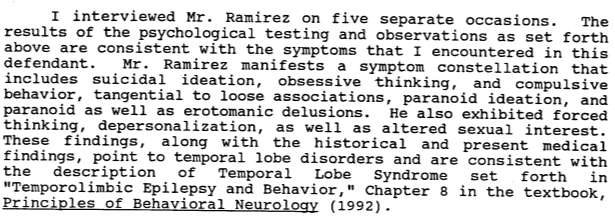
“Mr. Ramirez manifests a symptom constellation that includes suicidal ideation, obsessive thinking, and compulsive behavior, tangential to loose associations, paranoid ideation, and paranoid as well as erotomanic delusions. He also exhibited forced thinking, depersonalization, as well as altered sexual interest.
These findings, along with the historical and present medical findings, point to temporal lobe disorders and are consistent with … Temporal Lobe Syndrome set forth in “Temporolimbic Epilepsy and Behavior,” chapter 8 in the textbook Principles of Behavioral Neurology (1992).”– Declaration of Dr. George Woods, document 20-3
Below is an image taken from Woods’ declaration.
Mental Incompetence vs Insanity Defense
Mental competency is not a concept from psychiatry but a legal term. Nor does it mean an individual cannot take care of basic needs or are “insane.” Richard was not, for lack of a better word, “witless.” It’s about understanding, reasoning, and processing.
An “insanity” defense is not the same as “mental incompetency.” Insanity refers to a defendant admitting they committed a crime but claiming they didn’t understand it was wrong at the time. In contrast, mental incompetency refers to whether a person can currently understand the legal process and assist in their defense. It’s entirely possible for someone to be found competent to stand trial but argue insanity at the time of the crime.
Richard did not use an insanity defense in either his Los Angeles or San Francisco cases. He pled not guilty to all charges, and the competency proceedings initiated by his San Francisco attorneys were based solely on his present ability to participate in his defense – not claims of insanity.
Maybe some people just can’t accept the idea that Richard Ramirez was mentally incompetent. Maybe they prefer to see him as a criminal mastermind who manipulated every expert and attorney over decades. But that’s not what the evidence shows.
Richard read a lot and spoke fairly well. Perhaps this makes it difficult for some people to believe he was mentally incompetent from a legal standpoint. While reading and speaking proficiency can be signs of intellectual functioning, they do not necessarily reflect the ability to process and comprehend information.
None of the professionals who evaluated Richard believed he was malingering – that is, faking his symptoms. His test results consistently showed he was not pretending, and his behaviors and thought processes remained strikingly consistent across evaluations, from the first in 1976 to the last in 2004. (Exhibit 72, Declaration of Dr. Anne Evans, Document 16.7, p. 8).
Judge Soper
Shortly after his arrest in 1985, Richard appeared in Judge Elva Soper’s courtroom and the exchange that occurred was printed in The Los Angeles Times:
There are multiple issues with Judge Soper’s findings including:
- Someone answering “intelligently” doesn’t mean they understand the charges against them, can rationally participate in their defense, or are mentally competent to stand trial.
- The defendant stating, “I am sane,” and have had 11 years of education and a year of trade school, does not indicate their present level of functioning and comprehension.
- The defendant saying, “I don’t want to go to no hospital,” should have prompted Soper to investigate Richard’s mental status further.
Richard made that statement but did not elaborate, nor did Soper inquire any further about this statement and why he made it. While she may have been a legal expert, it’s fair to say she was not a mental health expert. As the judge, Soper was responsible for being the “gatekeeper, “ensuring that court proceedings were just and fair. She did neither of those things.
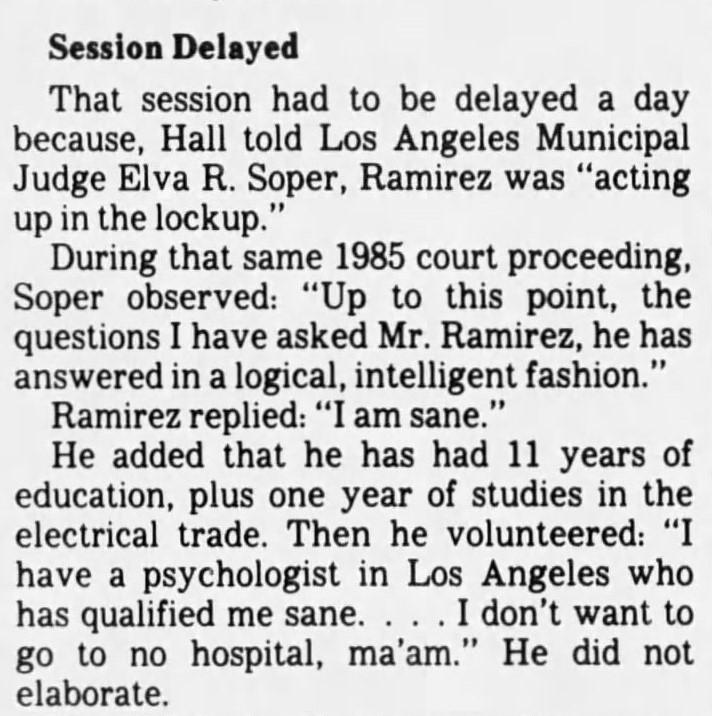
from The Los Angeles Times, January 30, 1989 Many mentally ill incarcerated individuals have an unusual presentation of psychiatric symptoms, and those with cognitive impairments often manifest a “cloak of competence,” which is an attempt to mask deficits that define serious mental illness. Because of the stigma that has historically been associated with mental illness, it is not uncommon for individuals to attempt to conceal their symptoms.
Richard did not want to be seen as sick or “crazy.” He often publicly exhibited behaviors that covered what multiple individuals encountered “behind the scenes” when interacting with him. Such was the stigma of mental illness that this 25-year-old man did not want to be treated as though he had a mental disorder. He would rather have gone to jail than a mental health facility. Just ask yourself, ” What rational person would prefer incarceration over hospitalization?
So Many Experts
Just how many experts needed to evaluate Richard Ramirez and declare he suffered from mental and cognitive health issues that rendered him unable to rationally participate in his defense and was incompetent to stand trial before the so-called United States criminal justice system would accept these findings? Apparently, a multitude, because that’s what we have. Considering what we have learned from the statements of other experts who evaluated Richard, Dr. Woods’ findings should be no surprise.
The image below shows Dr. Woods’ competency evaluation.
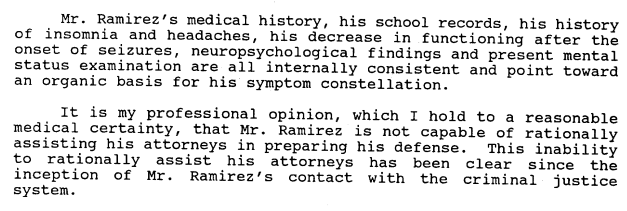
Why did so many professionals proclaim that Richard suffered from significant mental and cognitive impairments that affected his daily functioning and impacted his ability to stand trial? Typically, we only need one or two professionals to evaluate and diagnose a health issue for it to be considered a valid diagnosis. In Richard’s case eleven experts evaluated him over decades, reaching the same or very similar conclusions. And that doesn’t even include the professional opinions of the multiple attorneys who worked with him.
Every person who evaluated Richard was highly competent and qualified in their respective fields. None of them had any reason or motivation to skew their findings or to report inaccuracies. They reported what they observed and found based on facts and evidence stretching back to Richard’s childhood.
Declaration of Dr. George Woods, document 20-3
Ninth Circuit Court of Appeals
The United States Ninth Circuit Court of Appeals is the largest of the 13 federal appeals courts in the United States and has more power than a state or district court. The only United States court with more authority than a circuit court is the United States Supreme Court. The Ninth Circuit Court has a history of overturning decisions of lower courts, such as the California State Supreme Court and the California Central District Court, for reasons such as due process violations and incompetence of attorneys.
The goal was to get Richard’s 2008 Federal Petition for Writ of Habeas Corpus to the United States Ninth Circuit Court of Appeals. Richard’s case was filled with multiple due process violations, including representation by attorneys who had no qualifications or experience to defend a single capital murder charge, much less multiple capital murder charges.
We can only wonder what decision the Ninth Circuit Court would have handed down considering the blatant and numerous violations in Richard’s case. Would they have had the “balls” to go against popular opinion, the biased media, law enforcement, and the likes of the lead detectives on the “Night Stalker” case? Unfortunately, we will never know because Richard became very physically ill during the long, complicated process of getting his petition to its destination and passed away on June 7, 2013. Again, we are left with more questions than answers.
I’ll leave you with Richard’s final words at his Los Angeles sentencing. I think he summed things up pretty well.
“It is nothing you would understand, but I do have something
to say. In fact, I have a lot to say, but now is not time or the place. I don’t even know why I’m wasting my breath, but what the hell. As for what is said of my life, there have been lies in the past and there will be lies in the future. I don’t believe in the hypocritical moralistic dogma of this so-called civilized society and need not look beyond this room to see all of the liars, the haters, the killers, the crooks, the paranoid cowards, truly the trematodes of the earth, each one in his own legal profession.
You maggots make me sick. Hypocrites one and all. We are
all expendable for a cause, and no one knows that better than those who kill for policy, clandestinely or openly, as do the governments of the world which kill in the name of God and country and for whatever else they deem appropriate. I don’t need to hear all of society’s rationalizations. I’ve heard them all before and the fact remains that is what it is.
You don’t understand me. You are not expected to. You are
not capable of it. I am beyond your experience. I am beyond good and evil. Legions of the night, night breed, repeat not the errors of night prowler and show no mercy. I will be avenged. Lucifer dwells within us all.”Statement of Richard Ramirez (included in the 2008 Federal Petition for Writ of Habeas Corpus, Document 14)
KayCee
- Over-inclusive thinking-characterized by incorporating unconnected ideas, making thoughts less precise and more abstract (including paranoia, delusions, hallucinations, and disorganized speech).
-
“Cupcake Cindy”
This is another aspect of the Night Stalker case that descends into the realms of the absurd. It is well-known that Ramirez had many admirers during the trial and beyond. One was a juror, Cynthia “Cindy” Haden. Haden started as an alternate juror. According to Philip Carlo’s book, on Valentine’s Day 1989, the female jurors brought in sweets for the judge, which hardly seems appropriate, but perhaps California is different… Haden went one better and baked cupcakes, adorned with “I love you” in icing. She asked a bailiff to give one to Richard Ramirez, who obliged. Ramirez ate it and they got on with discussing the horrific Zazzara case. Bon appetite…
Big Carrillo is Watching
Carlo repeatedly mentions how Gil Carrillo, Frank Salerno and prosecutor Philip Halpin heard about the cupcake “incident” and Carrillo began monitoring her, which is raised four times in his book. This could of course be dramatisation of the main ‘characters’ thoughts, as parts of Carlo’s book read like fiction. First, Carrillo was thankful that Haden was not on the actual jury – if she had developed a crush, she could potentially cause a hung jury.
“Gil Carrillo watched Cynthia closely to see if she communicated with Richard in any way. If she did, he’d have her thrown off the jury. The Valentine incident did not sit well with Sheriff’s Homicide.”
Carlo, pg. 290.A juror is entitled to cause a hung jury if they wish. It is not for detectives in the public gallery to interfere. God forbid someone should sympathise with Richard Ramirez, although their conclusion should come from evidence and not lust. Every time a juror was dismissed, Carlo writes that Carrillo feared Haden would take their place because her stares made them “uneasy.” Eventually, Carrillo’s fears came to fruition, when juror Fernando Sendejas was dismissed after Ramirez freaked out at him knowing a witness – his former public defender Allen Adashek (even though Adashek was testifying for the defence, Ramirez told a psychiatrist that Adashek shared information with the District Attorney, therefore they were colluding against him). Ramirez’s paranoia often caused problems, as we shall see). Cindy Haden took Sendejas’ place and according to Carlo quoted Ramirez as saying of the grinning Haden, “She looks like she won the fucking lottery.”
Ever salacious, Carlo’s book focuses on groupie rivalry and also frequently mentions the disapproval of Ramirez’s future wife, Doreen Lioy. Lioy believed Haden was up to no good and was eventually proved correct. Luckily for Gil Carrillo, his fears were unfounded: Cindy Haden was too weak to stick to her conviction that he had been railroaded, and despite her supposed questioning looks described by Carlo, she voted for Ramirez’s guilt. Later, she claimed to have been invited to the prosecutor’s office, where Philip Halpin and Alan Yochelson thanked her for the verdict. She subsequently discovered she was the only juror who had been personally thanked. It seems unlikely that a busy prosecution team would be monitoring the gazes of a juror throughout a long and arduous trial. Who was watching her and reporting back?
Haden Votes for the Gas Chamber
At the penalty phase, Cindy Haden voted for Ramirez to be executed, while apparently – according to Carlo – crying and mouthing “I’m sorry.” Proving once and for all that irrational people were allowed on this jury, she was one of several who drew childish little pictures on their decision papers. Haden’s was a tombstone, with a heart.
Despite failing to cause a hung jury, Haden claims she suddenly found the courage to confront Ramirez’s attorneys, Daniel Hernandez and Ray Clark after the trial, when she should have raised this in deliberation. First she “laid into” Hernandez for omitting Ramirez’s fixation with Satan, suggesting this was mitigating evidence. Haden believed that Ramirez was “possessed by some demonic force.” While it is true that his mental illnesses should have been used in mitigation, perhaps the defence wished to distance themselves from that aspect because of the pentagrams at the crime scenes. It is unclear why Haden thought that Ramirez’s beliefs would save him from a guilty verdict. And it seems that the jurors themselves also believed in this occult mumbo jumbo, so was Ramirez any different? When Haden asked Clark about the lack of evidence at the penalty phase and how they had “sold him down the river”, he simply blamed Ramirez for being stubborn, when the court had given the attorneys permission to override him. Haden had the temerity to write to Ramirez to apologise for sending him to the gas chamber and he, the “evil serial killer” forgave her.
Chasing Richard Ramirez
What follows reads like a corny teenage hybristophile’s fanfiction: Haden who had now apparently filled her room with photos of Ramirez, began travelling up to San Francisco to visit him, sometimes camping out in her car all night to be first in the queue. She even brought her parents to meet him and eventually moved to the city. After being made redundant from her job, Haden trained as a private investigator through a security firm and inveigled her way into his new lawyers’ offices. She claims (in Carlo’s book) that she charmed one of his public defenders (probably Randall Martin) into allowing her to speak to Ramirez in private. The book goes on to detail how, unbeknownst to his lawyer, she touched Ramirez’s thigh with her foot under the table, and when the attorney left the room, took the opportunity to kiss and fondle an affection-starved Ramirez – something she claimed happened often.
Dr Anne Evans’ psychiatric report mentions that Ramirez had also tried for several months to have Haden appointed as a “paralegal,” and blames Ramirez’s delusions, but this ingratiation seems to have been initiated by Haden manipulating him into believing she was the key to his freedom (from the Declaration of Dr Anne Evans, Document 16-7).
Cindy Haden was a negative distraction. Ramirez’s paranoia grew to a degree that he became convinced that Randall Martin – and a private investigator hired by Martin – had both had sex with Haden when they had travelled to meet her in Los Angeles. This led Ramirez to file a Marsden motion to have him fired from the case. Ramirez’s appellate lawyer attempted to convince him to stick with Martin – a highly competent defence attorney. Despite Ramirez’s respect for the appeal lawyer’s judgement, his Cindy-shaped delusions gained the better of him. He abused Randall Martin on his answering machine, in a “bizarre”, “hysterical” and “infantile” manner. Martin felt he could no longer work with Ramirez and ceased to represent him.
Cindy the Talkshow Star
Ramirez believed Haden could assist with his appeals, However, her television appearances had the opposite effect. On the Geraldo Rivera talkshow, the host referred to Ramirez as a “butcher” and said he had a “dreadful side”. Haden could have explained that Ramirez might have been innocent – that if he had been given a fair trial and a competent defence team, he might have been acquitted. Instead, she attempted to justify her attraction to Ramirez by stating “That’s just one side of him” and “everybody has a dreadful side.”

Cynthia “Cindy” Haden on the Geraldo show. Randall would never… For balance, Judith Arnold, the daughter of Max and Lela Kneiding, spoke on the phone. Haden appeared to roll her eyes. Rivera said, “you sat on that jury; you saw the evidence.” Haden could have said there was no scientific evidence to tie Ramirez to the Kneiding crime scene (which was known in court – a “bloody shirt” tested negative) but instead, she weakly replied, “Yes, I did,” before adding, with wide eyes and a giggle, that she looks “beyond that.” Perhaps she was nervous in the studio, but she came across as vacant, simple and trying to make weak excuses for falling in love with a sick killer. To a victim’s family, this is highly insulting.
Haden repeated unconvincingly that Ramirez did not have a fair trial. A lawyer, Robert Bryan, who assisted Ramirez’s Habeas Corpus lawyers spoke from the audience and challenged her on voting for the death penalty despite her misgivings. When Bryan agreed with her that the jury heard insufficient evidence for reasonable doubt, Geraldo Rivera spoke over him. He might not have done this had Haden made a convincing argument.
When asked by Rivera if she believes Richard Ramirez almost cut Max Kneiding’s head off, she evaded the question and said, “I convicted him.” After much inane giggling to an outraged audience, she went on to portray him as someone with an anger management problem that he has learned to control. She refused to answer whether she would like to see him freed.

Haden “looks beyond” throat slashing and shooting faces off… Not content with humiliating herself the first time, Haden went on another episode of Geraldo where she was asked why his crimes do not make her hate him. “I don’t hate him… I don’t agree with what he did in any way, shape or form.” This time the Kneidings’ granddaughter Robin Sandoval joined her in the studio. Presumably, the family was chosen because Haden lived close to them in Glendale. Sandoval believes Ramirez was guilty because her grandparents’ belongings were found with Ramirez’s fence, Solano. Haden could have explained that Solano was impeached for lying, (albeit inadequately) that another witness claimed he was beaten into telling the police the property had come from Ramirez and that some jurors felt he was shady. She could have explained that the defence performed poorly and there were unanswered questions, like witnesses who never showed up. However, Haden sat there expressionless; the only evidence of her being something other than a bot sent out to passively destroy Ramirez’s appeals was the occasional blink.

On a further show, she said of his crimes, “he does it because he likes it; he likes doing it. He enjoys it. he’s really opened my eyes to the darker side of the world. She added that should he be freed, he would revert to “exactly what he did before; like you have a job, I have a job; he has a job. His job is killing people. That’s what he was trained to do.”

Haden on another documentary Perhaps this statement was jealous revenge after Ramirez had proposed to Doreen Lioy. Whatever her purpose, she paints herself as was nothing but an attention-seeking hybristophile who manipulated Ramirez into thinking she could help him on the case, just to gain access to his body.
-VenningB-
-
A Web of Informants: Part 6. Felipe Solano
23/10/2024: This post now has new, updated information.
One can easily say Richard Ramirez did not commit the crimes based on the complete lack of evidence in some cases or the serological test results in others. But how do we explain how the victims’ stolen property ended up in the home of ‘fence’ Felipe Solano? After all, Solano testified that Ramirez sold him all of it and was given immunity from prosecution, as if he was an innocent man caught up in the Night Stalker’s evil web.
Because the detectives failed in their duty to thoroughly investigate other criminals because they were hell-bent on pursuing one perpetrator, the Solano issue is more complicated than the public have hitherto been told. You have Gil Carrillo and his lone serial killer theory to thank for that. He was able to convince all the other detectives that his theories were valid and gradually, they came to believe him. (Frank Salerno originally believed there were two killers working at the same time – far more plausible, and originally, the FBI rightly thought Carrillo’s theories were preposterous and discarded his files. See this video after 25:00).
Solano appeared to be exploiting disadvantaged and homeless Hispanic youths and drug-addicted women for financial gain. They would rob houses, he would buy items at low prices and hide them in his (and his son’s) properties. He had some influence over Ramirez and his mother even used him as a contact when her son was ‘missing’:
I didn’t know how to contact Richard directly after he moved to California, so when I wanted to speak to him, I called Felipe Solano. Somehow, Felipe always knew where Richard was and how to get in contact with him. Whenever I left a message for Richard with Felipe, Richard returned my call within 10 – 15 minutes without fail.”
Declaration of Mercedes Ramirez, Document 20-5.Blaming Richard Ramirez
Felipe Solano had a gun inside his maroon Chevrolet truck. When asked why he had a weapon, he claimed he had it for “safety reasons” and had no idea what calibre it was. When asked why he felt so unsafe that he needed a gun, he claimed it belonged to “Rick.” It was a .38 blue steel revolver and was not connected to any Night Stalker crimes. Below is a timeline of Ramirez’s movements that come from both Solano’s claims and known police activity.
- Unspecified day in August: Solano bought jewellery from Ramirez at “ridiculous prices.
- 28th August: Rick asked him for money to leave Los Angeles, claiming he was “very hot” (as in wanted by police). Solano saw a gun-shaped object under his shirt.
- 30th August: Solano was watching TV when it was announced that Rick was the prime suspect. The news bulletin mentioned an orange Toyota. Solano had once seen him in an orange car. He panicked and moved out of his house. Solano claimed he received a phone call from Rick asking for $1000. He allegedly said, “In the morning, I’m going for it.” He did not provide insight into this conversation’s meaning.
- 30th-31st August: Detectives asked informant Sandra Hotchkiss to sell goods to Solano at a pool hall. The goal was to entrap him.
- 31st August: On the day of Ramirez’s arrest, Hotchkiss was asked to sell goods to Solano at his home. Solano was angry and guessed it was a trap.
Over the next few days, around 1,500 stolen articles were seized from Solano’s properties, including his son’s home in West Covina, and two family-owned table factories. After the initial raid, Solano admitted to having even more stolen goods. Solano’s son, Felipe Jr., and nephew, Alejandro, were never investigated for their role in hiding stolen property.
Solano, despite being personally acquainted with Ramirez, was invited to the tainted line-up, mingling with victims, which was improper because he had been involved in the theft of their property. This property was in an adjacent room. Of the items, less than a quarter had come from the victims.
Felipe Solano in Court
Solano’s stash of loot is regarded as the second most compelling piece of evidence in the Night Stalker case (after the Avia trainers). However his testimony was littered with inconsistencies, was corroborated by no one, and he even contradicted himself.
He could not provide a definite date for meeting Ramirez, claiming it was either late November or early December 1984. Nevertheless, he gave Ramirez his address and Ramirez attempted to sell him a car. A week later, he began receiving stolen electrical goods from him, then soon after, a steady stream of jewellery. However, Ramirez was arrested on 12th December and imprisoned for a month, so Solano must have been lying.
Solano admitted to ripping Ramirez off and he even received some items for free. He claimed he had no idea the items were stolen, but the idea he mistook Ramirez for a reputable salesman is laughable. He was asked, by prosecutor Halpin what type of hats Ramirez wore, but was led by being shown the hat from the Okazaki crime scene. It had also been reported in the press that the suspect wore an AC/DC hat, so of course Solano would confirm this. However, the defence failed to ask him what dates he saw Ramirez in the hat, so he was never eliminated as a suspect in that crime.
“Subornation to Perjury“
As mentioned in other posts (links at the bottom), Solano admitted he had been protecting other thieves, namely Eva Castillo, Cuba Hechavarria, Monje, Charlie, Cameron and Julio. He allegedly also traded with Sandra Hotchkiss. Solano confessed that some of the stolen goods had come from Eva Castillo and were mixed in with those from Ramirez. By admitting he knew Castillo, Solano was forced to admit he had known Ramirez for longer, giving a new date of August 1984. However, he knew that Castillo was acquainted with Ramirez. And Castillo had gone to prison in September 1984. So it is likely they both knew Ramirez for longer than they claim.
Halpin knew Solano had lied – he had been going through the evidence and worked it out and Solano was made to identify the articles that came from Castillo. Halpin told the court that his star witness had lied – but that it was not “earth shattering.“ Instead, it was spun into an act of chivalry, with Halpin saying, “There’s nothing so unusual about [protecting a ‘lady’].“
Ray Clark asked for Solano’s testimony to be stricken from the record in its entirety. Daniel Hernandez claimed that Halpin had deliberately brought a liar to the witness stand and that this was subornation to perjury. The jury should not be forced to listen to a liar – and if proven to be a liar, the prosecution case would crumble: the shoes and eyewitness testimony was not enough. If this was discovered post-conviction, it might cause the convictions involving stolen property to be overturned. According to Philip Carlo, Halpin had a tantrum, in which he blamed Hernandez’s incompetence for not discovering Solano’s lies himself (which is fair), and moaned that he been accused of being a felon (for committing perjury by-proxy). It seems as if Halpin knew he had been caught out, and was annoyed that – despite his incompetence – Hernandez spotted what he was up to. Hernandez demanded a 402 Hearing to determine how much Halpin knew about Solano’s connections to other burglars but Judge Tynan refused and told the defence to cross-examine Solano as normal.
Was Solano Coerced by the Police into Framing Ramirez?
This is not mentioned in the Petition (where most of the above timeline comes from) but from Carlo’s book. As mentioned in Part 3, Sandra Hotchkiss traded with Solano and was later ordered to sell a stolen necklace to Solano at his house. He immediately knew it was a set-up and asked her if she was an undercover detective. Hotchkiss was wired up to a recording device and claimed that what occurred next should have been caught on the tape: after Solano confronted her, police seized upon him and threw him to the ground, pinning him by the throat. Hotchkiss claimed Solano denied on the spot that he had received stolen goods from Ramirez and that they came from multiple people. Hotchkiss testified that she reported the incident to the District Attorney Ira Reiner, but she was ignored. Later, she said, Halpin and Sergeant Yarbrough of the Task Force came to visit her in prison, and Halpin warned her “not to screw up his case.” Of course, Hotchkiss was impeached and discredited by Yarbrough, so nobody appeared to notice the implications of what Hotchkiss was alleging – that Solano was beaten into blaming Ramirez and was given immunity if he stuck to the story that Ramirez was the only person who gave him the victims’ property.
Julio El Rubio
As mentioned, in their police statements, Manuel Hechavarria and Eva Castillo kept talking of a burglar acquaintance, ‘Julio.’ According to the Petition, in 1985, he was approximately 21, six feet tall with blonde, centre-parted hair. According to Hechavarria, Julio lived on Vinevale Avenue, Maywood, Los Angeles County, with two brothers. However, there is no evidence that Julio was ever traced and interviewed. It is possible that his surname was Romero. When Richard Ramirez was arrested under the alias “Ricardo Muñoz Moreno” and imprisoned for car theft, he claimed that he had borrowed the vehicle from “Julio Romero from the Greyhound bus depot,” and that he “Didn’t steal the car… I sort of knew the car was stolen.”
“Commander William Booth confirmed to several news agencies that the 25-year-old suspected serial killer was found driving a stolen car in the Harbor area December 12, 1984, and that he ultimately admitted to a misdemeanour auto theft charge.”
Police Correct Report on ‘San Pedro’ Arrest, Breeze Newspaper, 6th September 1985 (Document 17-8), pg. 26.The Habeas Corpus lawyers suggest that Julio fits the description of the attacker in some of the incidents and repeatedly mentions him, believing he should have been investigated as a suspect. In particular, they believe Julio was a fit for the suspect in the Abowath crime in which the survivor described a blonde possible Hispanic who was six feet tall.
Philip Halpin made a fuss about being accused of perjury by proxy over the Solano, Castillo, ‘Cuba’ and Monje loot. But surely he also knew about Julio before the trial too. While there is no explicit connection, both Cuba and Castillo had mentioned Julio in their police statements as somebody with whom they committed crimes and knew him to commit burglary with Ramirez. Cuba said he and Ramirez had met Castillo through Julio. Surely Julio cannot be the only person in this network who did not trade with Solano? Halpin’s mocking is quoted in the Petition:
“Again in his opening statement Mr Hernandez promised you he was going to prove that Eva and Julio were committing these burglaries … Never happened, bunk, never happened.”
“So again, Mr. Hernandez harps upon Eva and Julio and yet nothing
came forward; nothing.”
“The same volume at page 20834, Mr. Hernandez told you that the defendant was working with a fellow … Well, you really don’t have any evidence of that.”
“Oh, again now, again … page 20837, talking about Felipe Solano … dealing in all sorts of things … there is absolutely no evidence of that at all … so that again is off the wall.”
“Page 20839 … Mr. Hernandez … indicated that the defendant will show that Felipe Solano bought items that he said he bought from the defendant but were actually bought from other people. Now, this is important. There is no such evidence in this case.”
“You see, Hernandez stands up and gives the clear indication that … Solano is a big dealer … Absolutely not one shred of evidence of that.”
Federal Writ of Habeas CorpusNone of these people connected to Solano testified in court. Alejandro Espinonza (the first informant mentioned in Part 1) went missing. Eva Castillo went missing. Julio is a complete mystery. Archived court documents reveal that Cuba Hechavarria was also untraceable. The papers show that the defence asked the prosecution to hand over the contact details for both Cuba and Espinoza, but Halpin refused, claiming that the defence already knew how to find them. It is difficult to determine who is the most at fault here. Why would the prosecutor not know the whereabouts of a significant informant whose loot was discovered inside Felipe Solano’s house?
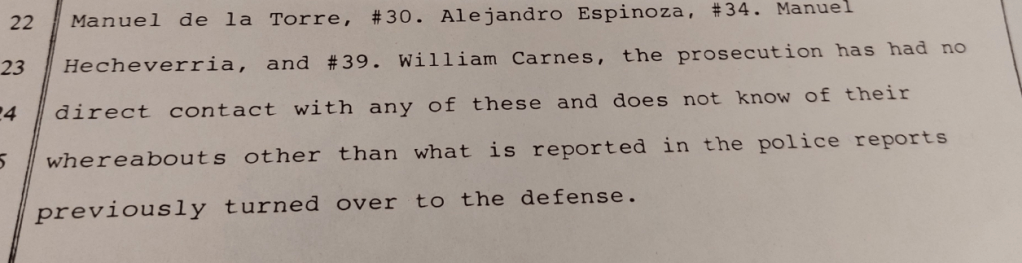
And although more related to the Pan case in San Francisco and seemingly not connected to Solano, Armando Rodriguez was also missing at the time of the preliminary and pre-trial hearings. There is no evidence he attended the trial.
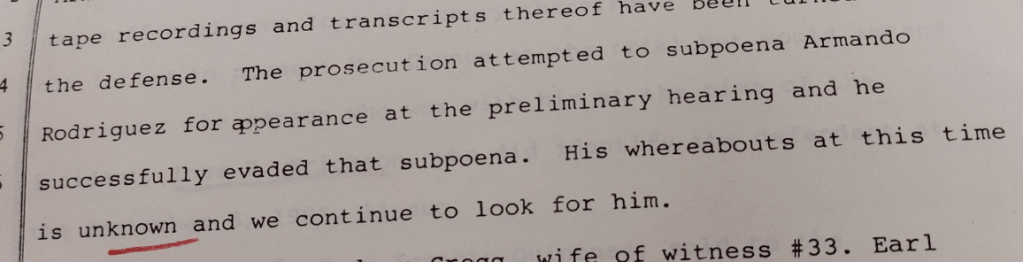
This of course leaves us with more questions than answers and with most people deceased or untraceable, we will probably never know how Solano ended up with property belonging to the victims. But it seems to suggest that detectives and the prosecutor were determined to pin everything on Ramirez regardless of the lack of evidence and so many other leads. By not pursuing this grounds for reasonable doubt, the defence allowed the prosecution to mislead the jury as to Ramirez’s culpability, rendering this inaffective assistance of counsel and constituted another miscarriage of justice.

The Solano connection -VenningB-
The other posts relating to Solano and the Greyhound Bus Posse are below:
13th December 2023
-
The Orange County Attack
On 25th August 1985, Bill Carns was shot three times in the head and his partner Inez Erickson (sometimes named as Carole Smith in books/media) was raped. The couple lived in Mission Viejo, Orange County, meaning the Night Stalker had moved south. The Carns/Erickson incident never went to trial so this post cannot examine any of the evidence. There was a preliminary hearing, but there is nothing in the press regarding the discussion of serological (semen) or ballistics evidence. The hearing itself was delayed three times. First because the defence team wanted it closed to cameras and reporters, but the judge sided with the news media. Secondly, the Orange County Deputy District Attorney did not want Erickson to be filmed because her therapist thought she was “fragile”. However, reporters described her as composed and speaking in a “clear, strong voice” when she gave her testimony.
The prosecution argument centred around Inez Erickson’s eyewitness identification (Bill Carns was brain injured and remembers nothing about the attack) and alleged utterances by the gunman. Erickson identified Richard Ramirez at the 5th September 1985 line-up based not on his face – which she admitted she never saw – but his walk and voice. And even then, she was unsure, and asked to watch the line-up tapes two years after the attack to remind herself (“Woman Tells About Rape and Shooting,” Miami Herald, 12th September 1987). At the 1987 preliminary hearing, it was decided that Erickson’s identification was sufficient; despite admitting she had seen Ramirez’s mugshot in the newspapers, she had not been influenced to choose him. (“Alleged Night Stalker to Face Trial,” The Tribune, 14th November 1987).
The attacker allegedly forced Erickson to surrender the couple’s valuables, taking her around the house with him. According to some newspapers, she was dragged around the house by her hair. Would a man doing such things have a gait comparable to Ramirez slowly walking onto a line-up stage? It would make him very calm and casual while committing such a violent crime.
Another issue is with his voice. At the line-up, Ramirez was asked to say lines such as, “shut up bitch”, “where’s the money?” “where’s the jewellery?” He did not say the given lines in a demanding manner. For Erickson to recognise her attacker’s voice in Ramirez suggests the gunman was very lacklustre in his supposed angry demands and taunting such as “This [small amount of cash] is all you’re worth” (more on his words later in the post). One newspaper claims Erickson knew it was Ramirez by the way he pronounced jewellery strangely, like “jewerly”. However, in the line-up footage, there is nothing unusual about the way he says it.
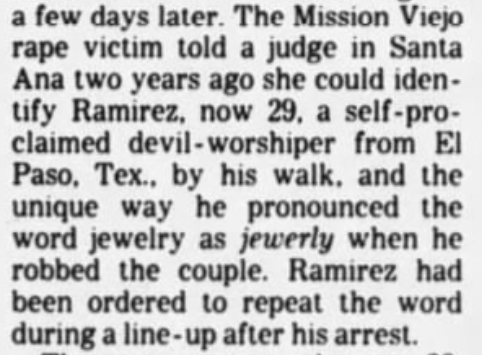
From the Los Angeles Times, 9th November 1989 For the Habeas Corpus appeal, an expert psychologist for eyewitness identification, Dr Kathy Pezdek, wrote an analysis of all the witnesses’ testimonies. What Pezdek said about Carol Kyle’s identification (regarding the “inflection in his voice”) applies to Inez Erickson.
“Several of the eyewitnesses in this case identified Mr. Ramirez at the live line-up based on his voice. The research on voice identification suggests that voice identification is even less reliable, and fades over time even faster than face identification. For example, when Carol Kyle identified Ramirez at the live line-up she noted down on her witness card “I’m absolutely positive. Even the inflection in his voice is the same.”
Declaration of Dr Kathy Pezdek, Document 16-7Pezdek cited a psychologist, B.R. Clifford, whose studies demonstrate that memory for unfamiliar voices rapidly declines in accuracy over a short period. After one week, one might remember at 50% accuracy. After two weeks, this becomes 43%. After three weeks, it falls to just 9%. If the voice is unfamiliar and speaks for less than a minute each time, the accuracy of the victim’s memory will only be 50%.* This is what a defence expert witness would have argued should this case have gone to trial.
Erickson became yet another victim to embellish her description on the witness stand. Despite only identifying him by his walk and voice, in court she apparently added that she knew it was Ramirez because of his “thick lips”. None of the other victims described their attacker’s lips. By ‘coincidence’, the words “thick lips” were only used by journalists to describe Ramirez’s mugshot on the day it was released in the papers – these papers spread false information that the victims had reported their attacker’s lips as being “thick.” Could she have been influenced by this? We know victims will change their description under pressure, as seen in the San Francisco Wildgans murder case.
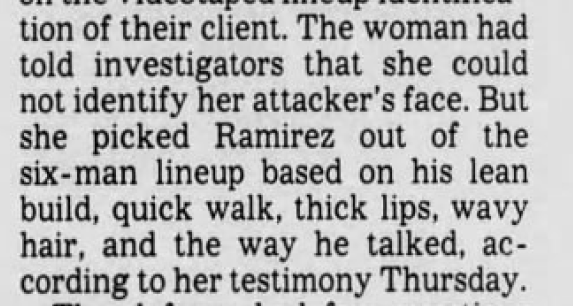
From this 1987 Los Angeles Times Article 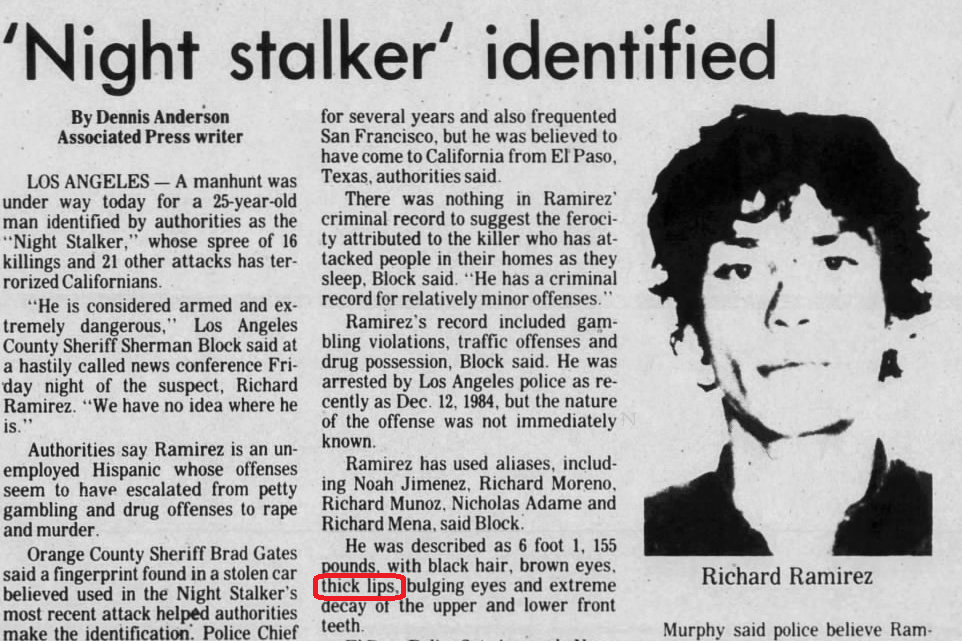
Ramirez’s “thick lips” were mentioned repeatedly on the night before his arrest. From The Daily Item (Pennsylvania) As demonstrated on this blog, the victims’ police statements never describe his full lips. All of the composite sketches display thin or normal lips.
During the Orange County preliminary hearing, Ramirez’s lawyers accused a police officer of coaching Inez Erickson. Detective Michael Stephany denied it, but given that other victims were being coached by Los Angeles deputies, it is not a stretch of the imagination to think Stephany might do the same.
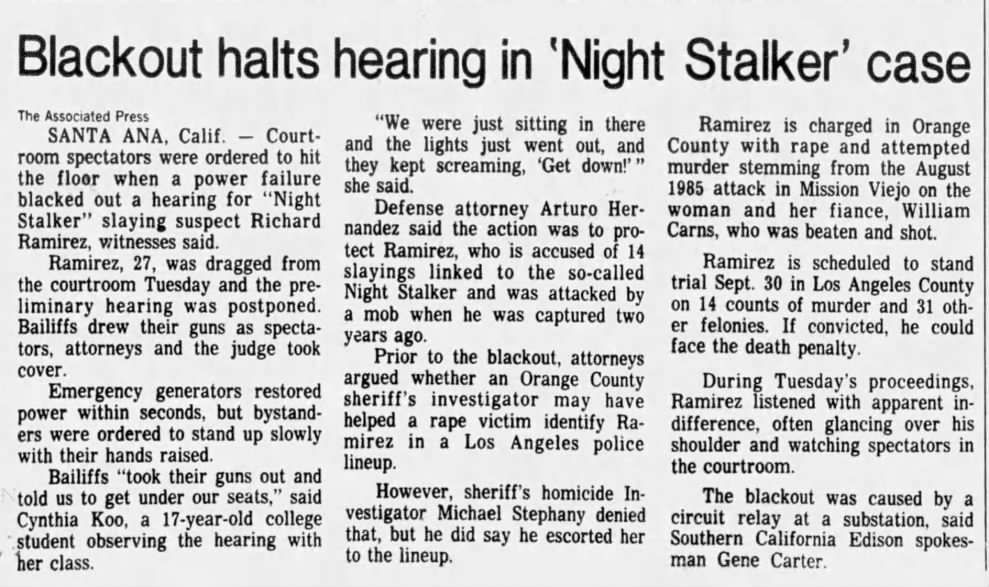
From the Atlanta Journal, 2nd September 1987. After this identification testimony ‘evidence’, no more was mentioned – the case was given the go-ahead to proceed to trial, but only after the Los Angeles trial.
The Gun?
Going solely by the papers as they are all we have, the ballistic links are not mentioned at the preliminary hearing. According to an affidavit from the police on 1st September 1985 (Document 7-4), a firearms expert, Sergeant Robert Christansen, suggested that the bullets used on Bill Carns were .25 calibre, and matched those found at six incidents: Kneiding, Khovananth, Petersen, Abowath, Pan and Carns. This makes no sense: in the end, Kneiding was matched to Okazaki and Yu (.22 revolver), Khovananth to Zazzara (another .22 revolver). Pan was supposedly matched to Petersen and Abowath (.25 automatic), but Pan also never went to trial so we cannot truly know. See this post for a detailed breakdown of the firearms evidence used in the Night Stalker case.
The Petersen/Pan/Abowath connection was based on red primer on the casings. If Carns was matched with those three, it suggests it was a .25 automatic. But because Christansen contradicted another “expert” Hawkins, and also Edward Robinson, the firearms expert eventually used by the prosecution, his opinion is disputed. Therefore, the calibre of the gun at Carns must remain a mystery.
Modus Operandi Breakdown
Inez Erickson claimed that the attacker instructed her to tell the police she had been visited by the Night Stalker, and demanded that she say, “I love Satan” and “You know who I am, don’t you? I’m the Night Stalker. You’ve read about me in the newspapers and heard about me on TV. So, you know if I kill one, I might let the other one live.”
The modus operandi the attacker allegedly referenced only happened in three previous attacks (Doi, Khovananth and Abowath – although with a difference in Doi**). In Petersen and Pan, both the male and female were shot with intent to kill. The rape of the woman and shooting of the man method might suggest it was the same attacker in the Khovananth and Abowath incidents. However, both Somkid Khovananth and Sakina Abowath described a different man in their original police statements: his only common trait was being tall and curly haired – the hair colour and skin tone differed. Lillian Doi also described a different man, of average height.
Whether Erickson was attacked by the same person as Sakina Abowath, we will never know, although Erickson told her neighbour that the attacker wore big heavy boots, just like Abowath said. If it was the same man, it could not have been Richard Ramirez per the rape kit tests from that scene. No semen was mentioned at the Orange County preliminary hearing.
Circumstantial
The rest of the evidence for the Carns/Erickson case is circumstantial. The first is the orange Toyota station wagon ‘spotted near the murder scene.’ As explained in that post, the car was seen more than a mile from the victims’ house and the child witness only saw a man in the dark from the back. A fingerprint purportedly left by Ramirez was found on a similar car found abandoned in Los Angeles but much of what the public has been told about this fingerprint seems to be a myth. See this post.
Eventually it was decided that the Orange County charges would be dropped. Inez Erickson no longer wanted to testify, as Ramirez already received many death sentences. However, it seems as if Orange County never had any intention of holding a second trial if Ramirez was convicted in Los Angeles. Enright said, “If Ramirez is convicted in Los Angeles County, Orange County might decide not to go to the expense of a trial.”
-VenningB-
* Cited in Handbook of Eyewitness Psychology Memory for People Rod C. L. Lindsay, David F. Ross, J. Don Read, Michael P. Toglia)
** It is unclear if Lillian Doi was actually raped. The newspapers said she was, but the charge was dropped.
8th Dec 2023
-
There Will Be a Book!
A dream of ours was to eventually write a book on the Ramirez case. In January, it seemed like fantasy. I (Venning) have written other books, and the process can be exhausting – non-fiction especially fries my brain. At the end of every book I say, “Never again!” but writers always feel that finishing a book leaves a hole in their lives. Seeing as I write for this blog anyway – and I finished another project in February 2023 – there was a hole… I thought I may as well begin our Richard Ramirez book.
It won’t be a simple rehash of all of our blog posts; there will be additional details and theories. The issues and crimes covered on here will be explained more thoroughly, and also chronologically to show a month-by-month timeline leading up to Ramirez’s capture and beyond. This was not easy as it meant carving some of our blog posts into three or four chunks.
It will detail how detectives engineered the image of the Night Stalker and the turning point at which multiple suspects were amalgamated into one. As with the blog, hundreds of newspaper articles have been referenced, police reports analysed and Ramirez’s appeals dissected and reassembled in order of occurence.
First, we want to search for a ‘real’ publisher. The chances are remote, and publishers can take months to review even tiny samples of manuscripts, so we might self-publish in the meantime (we haven’t decided yet). A lot of publishers may be reticent to give us a chance. Our take on the Ramirez case is ‘controversial’ because we are contradicting a long-established story and essentially suggesting those murders are open cases. However, it shouldn’t be controversial. It’s not a conspiracy theory unless one believes Ramirez’s later defence/appellate lawyers are liars. There is no reason to be offended by public legal documents. As such, we don’t have any release date, but a first draft will likely be completed by the end of the year. As of today, the book is around 112,000 words, with several parts still to go.
Stay tuned for more information…
-VenningB-

Photo not mine – and it’s not real L.A., it’s Los Santos from GTA…but I needed a picture for this post…
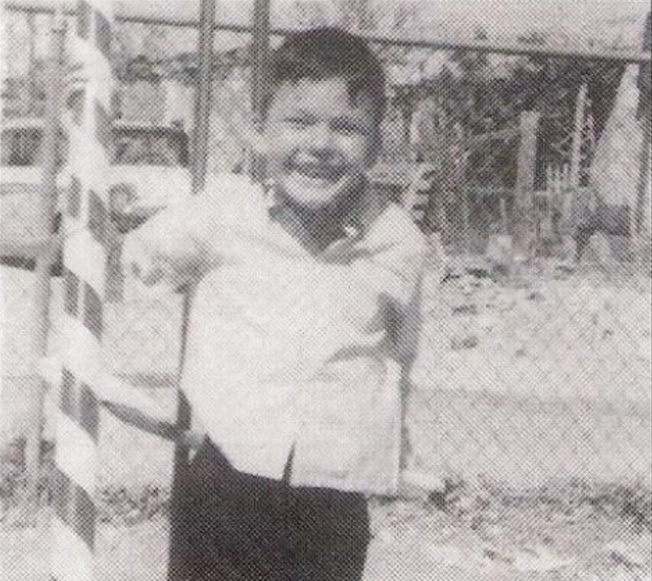
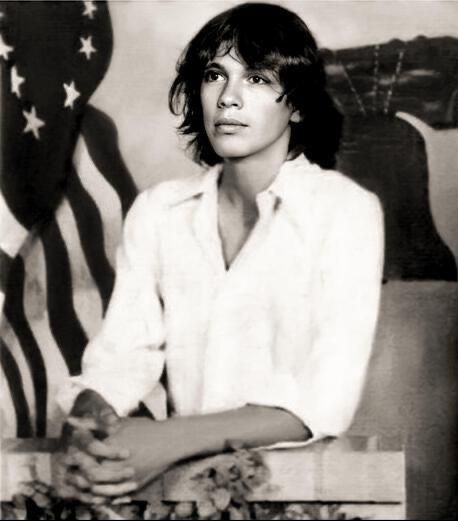

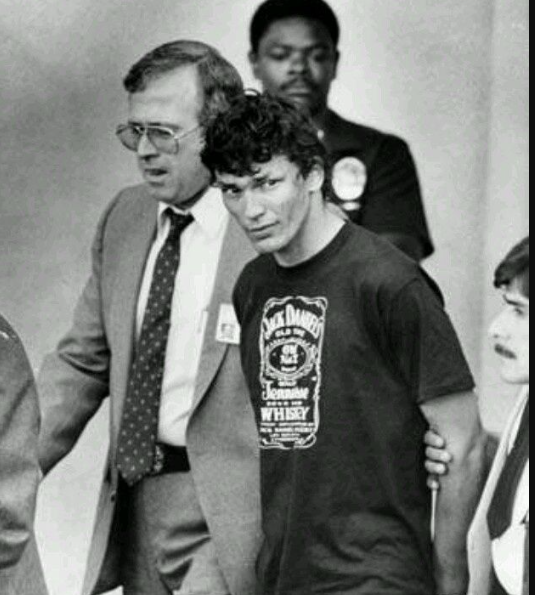




 Expendable For A Cause.
You must be logged in to post a comment.