
“The world has been fed many lies about me..”
Richard Ramírez
Now available, the book: The Appeal of the Night Stalker: The Railroading of Richard Ramirez.
Welcome to our blog.
This analysis examines the life and trial of Richard Ramirez, also known as The Night Stalker. Our research draws upon a wide range of materials, including evidentiary documentation, eyewitness accounts, crime reports, federal court petitions, expert testimony, medical records, psychiatric evaluations, and other relevant sources as deemed appropriate.
For the first time, this case has been thoroughly deconstructed and re-examined. With authorised access to the Los Angeles case files, our team incorporated these findings to present a comprehensive overview of the case.
The Writ of Habeas Corpus
The literal meaning of habeas corpus is “you should have the body”—that is, the judge or court should (and must) have any person who is being detained brought forward so that the legality of that person’s detention can be assessed. In United States law, habeas corpus ad subjiciendum (the full name of what habeas corpus typically refers to) is also called “the Great Writ,” and it is not about a person’s guilt or innocence, but about whether custody of that person is lawful under the U.S. Constitution. Common grounds for relief under habeas corpus—”relief” in this case being a release from custody—include a conviction based on illegally obtained or falsified evidence; a denial of effective assistance of counsel; or a conviction by a jury that was improperly selected and impanelled.
All of those things can be seen within this writ.
The Writ of Habeas Corpus is not a given right, unlike review on direct appeal, it is not automatic.
What happened was a violation of constitutional rights, under the 5th, 6th, 8th and 14th Amendments.
Demonised, sexualised and monetised.
After all, we are all expendable for a cause.
- ATROCIOUS ATTORNEYS (4)
- “THIS TRIAL IS A JOKE!” (8)
- CONSTITUTIONAL VIOLATIONS (9)
- DEATH ROW (3)
- DEFENCE DISASTER (7)
- INFORMANTS (6)
- IT'S RELEVANT (17)
- LOOSE ENDS (15)
- ORANGE COUNTY (3)
- POOR EVIDENCE (16)
- RICHARD'S BACKGROUND (7)
- SNARK (12)
- THE BOOK (4)
- THE LOS ANGELES CRIMES (22)
- THE PSYCH REPORTS (14)
- THE SAN FRANCISCO CRIMES (5)
- Uncategorized (5)
-
You, the Jury
Questioning
The word “occult” comes from the Latin “occultus”. Ironically, the trial of an infamous occultist and Satanist is the epitome of the meaning of the word itself: clandestine, secret; hidden.
We’ve written many words; a story needed to be told, and we created this place to enable us to do just that.
Here, in this space, we intended to present the defence omitted at Richard Ramirez’s trial in violation of his constitutional rights. Our investigations have taken us down roads we’d rather not travel along, but as we did so, we realised that there was so much hidden we could search for a lifetime and still not see the end of it. Once we’d started, there was no turning back; we followed wherever it led.This was never about proving innocence; that was never the intent or purpose. We wanted to begin a dialogue, allowing this information to be freely discussed and for us to verbalise the rarely asked questions. We asked, and we’re still asking.
We can’t tell you, the reader, what to think; you must come to your own conclusions, as we did.
And so
We’ve said what we came here to say; with 114 articles and supporting documents, we’ve said as much as we can at this point.
This blog will stand as a record of that, and although we will still be here, we intend to only update if we find new information, if we suddenly remember something we haven’t previously covered, or to “tidy up” existing articles and examine any new claims (or expose outrageous lies) that come to light. The site will be maintained, and we’ll be around to answer any comments or questions.
What Next?
We will focus on the book being worked on; we’ve also been invited to participate in a podcast. When we have dates for those, we’ll update you.
The defence rests? Somehow, I sincerely doubt that; ultimately, we’re all “expendable for a cause”.
~ J, V and K ~
-
The Shoe Prints: Avia, a Cinderella Story
*Some images are better viewed on a desktop due to size and for clarity*
“I need not look beyond this room to see all the liars, the haters, the killers, the crooks, the paranoid cowards. Truly the trematodes of the earth, each of one his own legal profession.”
Richard Ramirez, taken from transcripts during his court address prior to sentencing.If you condemn someone to death, you’d better hope you’re in possession of all the facts. All of them, 100%, beyond any reasonable doubt. All evidence laid out, cast iron; irrefutable. You had better be sure.
But what if a jury is wilfully and deliberately misled? What if false testimony and unsound facts are presented? Expert witnesses who are not actually “experts” or fully trained in the intricacies of the subject in question? What if the defence counsel is woefully inadequate, unequal to the task, lacks experience, or sometimes not even present? Who defends the undefended?
In this item, I want to discuss the most recounted pair of sneakers, the infamous black Avia Aerobic shoes, model 445b, size 11 1/2. Model 445 came in white, and white aerobic shoes didn’t fit the profile of the so-called Night Stalker. Interestingly, in the Netflix documentary Night Stalker: The Hunt for a Serial Killer, the detectives refer to the Avia model as a 440, which they inexplicably show instead. That is incorrect.
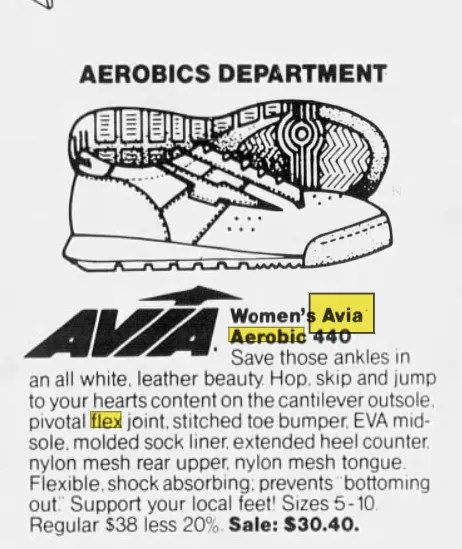
Avia 440s are women’s aerobic sneakers. They came in size 5 to 10, Richard was size 12. Yet celebrity detectives would like us to believe that the 6ft 1 Ramirez crammed his size 12s into a woman’s shoe. The “phantom sneakers” have followed this case all the way from 1985. Footprints, partial prints and impressions were found at eight of the crime scenes and it was these prints that law enforcement used, along with ballistics to link the crimes together. More information can be found in in this post and also in this one.
The jury and the world have been persuaded that only one pair of shoes could possibly have made those prints, one shoe, one perpetrator. This, on the contrary, is incorrect.
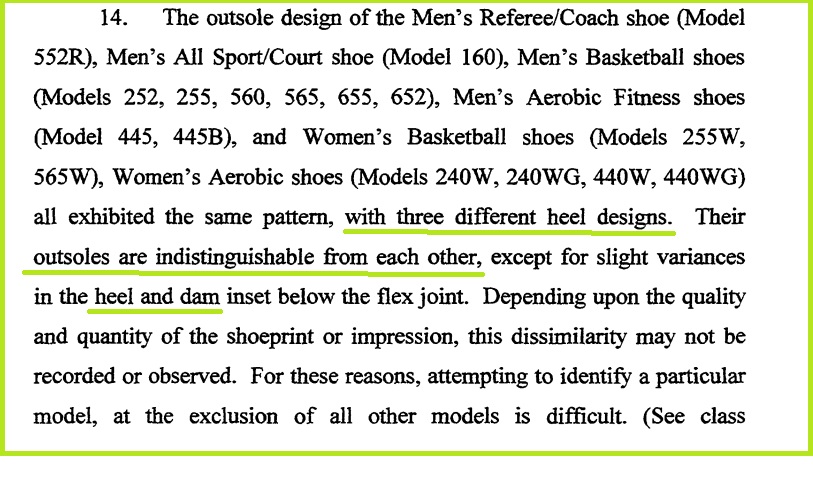
Declaration of Forensic Specialist Lisa DiMeo, document 7-19. To clarify, it is the heel design that is needed to identify an Avia model. Partial impressions and prints are not good enough. The information within this article comes from the Federal Petition of the Writ Of Habeas Corpus, filed by the Public Defenders Office in 2008, and the declaration of Forensic Specialist Lisa DiMeo (document 7-19). Both of these are available through the Plainsite.org for anyone looking.
Lisa DiMeo is a forensic specialist, trained in crime scene analysis and impression evidence, including latent prints, footwear, tire treads and bloodstain patterns. She has repeatedly provided expert testimony in both Federal and State jurisdictions.
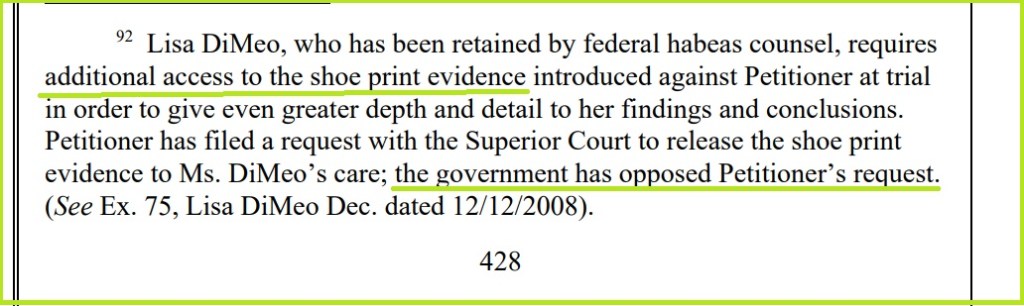
Additional access to evidence was denied by the government. You have to ask the question why? Habeas Corpus, page 428
Oh, Those Avias…
The narrative that Richard Ramirez left a trail of footprints at eight of the crime scenes has been universally accepted. It’s true that shoe prints and impressions were found, but as for the truth of it, well, that’s a little more hazy.

Supplementary Declaration of Lisa DiMeo, document 7-20. There is no proof whatsoever that Richard ever purchased, owned, borrowed, danced the Tango, or ever wore a pair of Avia sneakers. No evidence, and no one who knew him ever said so, apart from law enforcement and counsel for the prosecution.
We have also been led to believe that once Richard realised that they had his footprints, thanks to (the now late) Mayor, and later Senator Dianne Feinstein’s San Francisco press conference of 23rd August 1985, he, at 8pm that very night, strolled into the centre of the Golden Gate Bridge and threw those incriminating Avias into the bay and began wearing the Stadia brand instead. However, the Stadias had already appeared at the Abowath incident on 8th August, so we can discount that nugget of information, too.
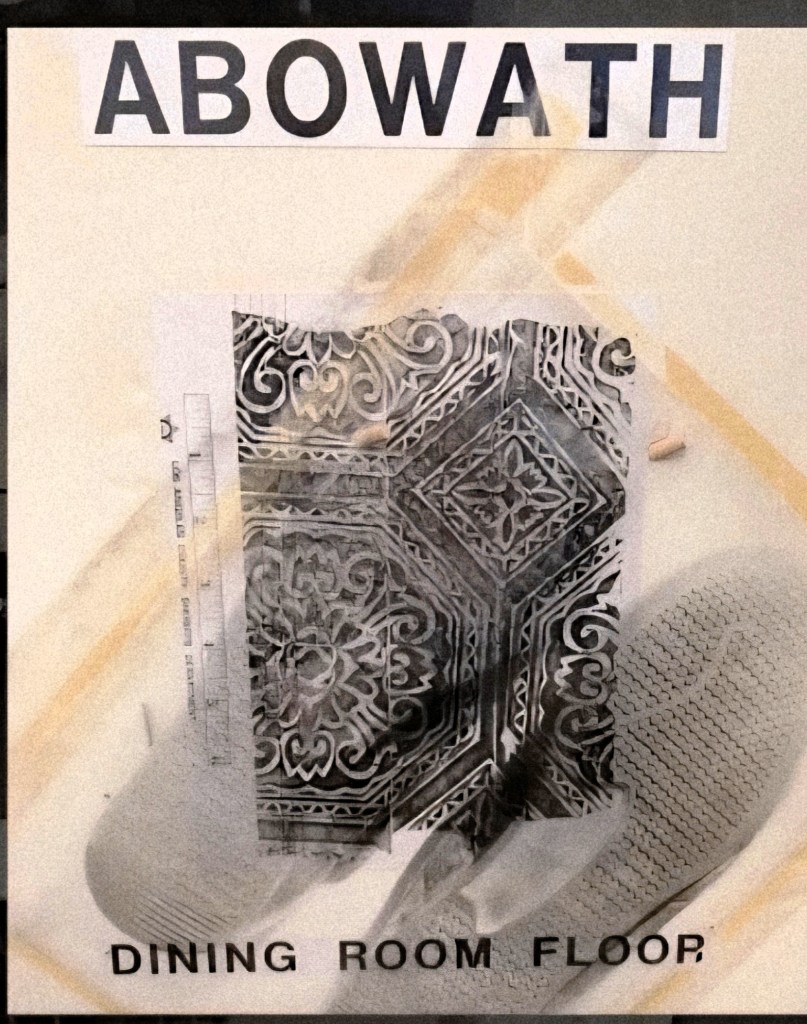
This image, taken from the Fox documentary, shows an acetate overlay of a Stadia, so it is hard to make out any partial sole pattern on the actual floor. Sakina Abowath said in her police report that her attacker was wearing boots. 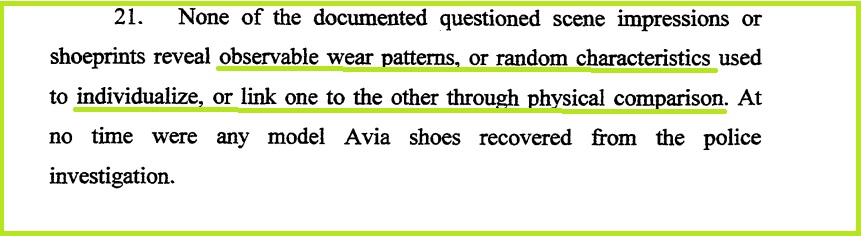
Declaration of expert witness, Forensic Specialist Lisa DiMeo, document 7-19. Once more, there is no proof, evidence, or witnesses that this ever happened. Indeed, Richard never said anything of the sort. It was all so convenient, perhaps to explain why they failed to discover the shoes in question. This erroneous rhetoric has been accepted as gospel, retold and recounted repeatedly, and, rather like a macabre Cinderella story; only one shoe is possible...but not the one pictured below.
In Jerry Stubblefield’s design patent for the Aerobic sole, there were TWO heel designs in the Aerobics class.
The sole pictured here featured three graduating bars in the heel and was found in Avia models 252, 255, 225w, 552R, 560, 565w, and 565.
The heel design associated with the Night Stalker crimes had a slightly different heel design; the three bars were all of equal length; in other words, they didn’t graduate. Models with this heel included 160, 240w, 440w, 440wg, 445 and 445b. (There is no available patent picture for these models, probably because they were so similar).Without those heel inclusions, it cannot be narrowed down, and as this sole patent was in use for the other models before 1985 (only the 445 and 445b were released that year), just how many different shoes do you imagine were already out there with that same sole pattern?

Stubblefield’s design patent. 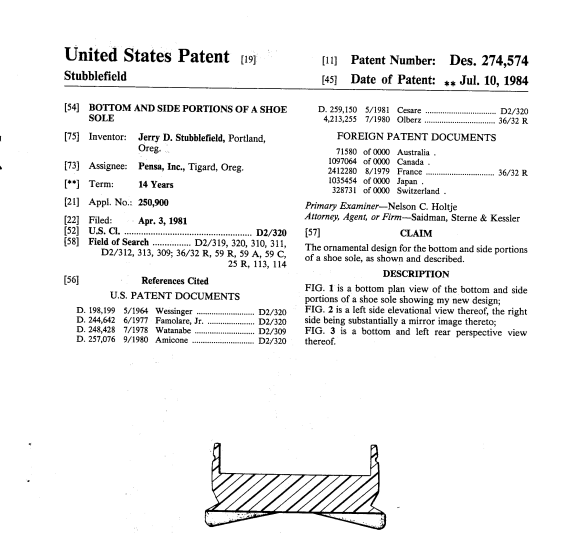
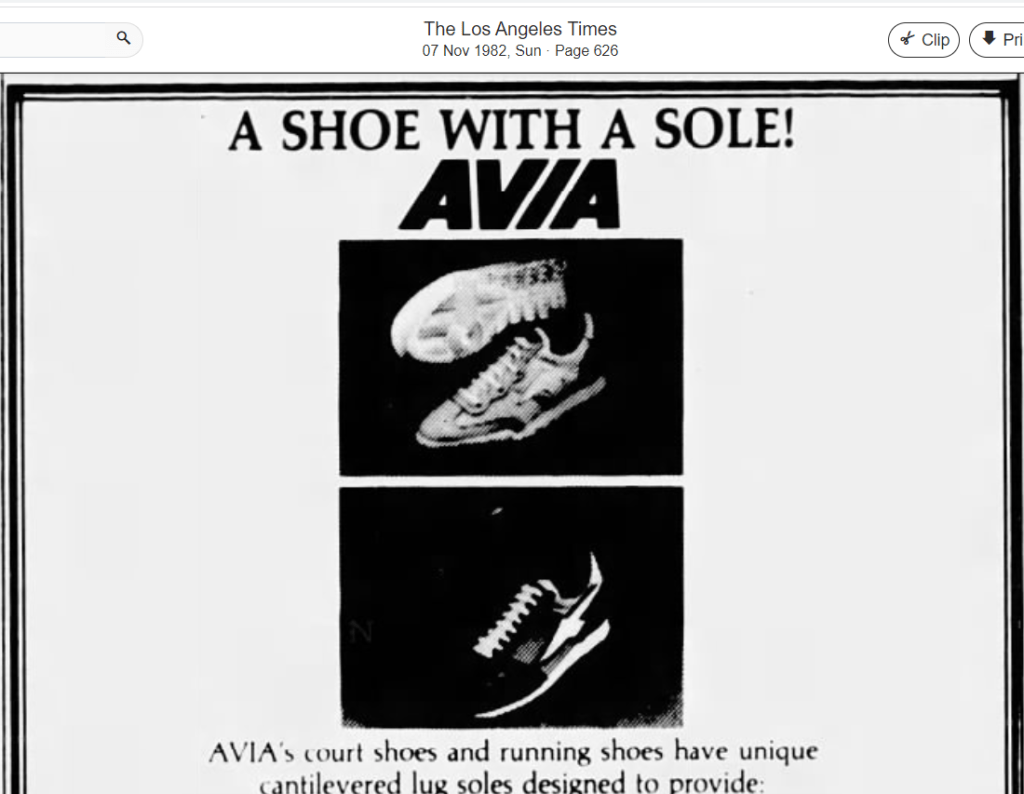
A November 1982 advert featuring a sneaker with an identical sole pattern If The Shoe Fits..
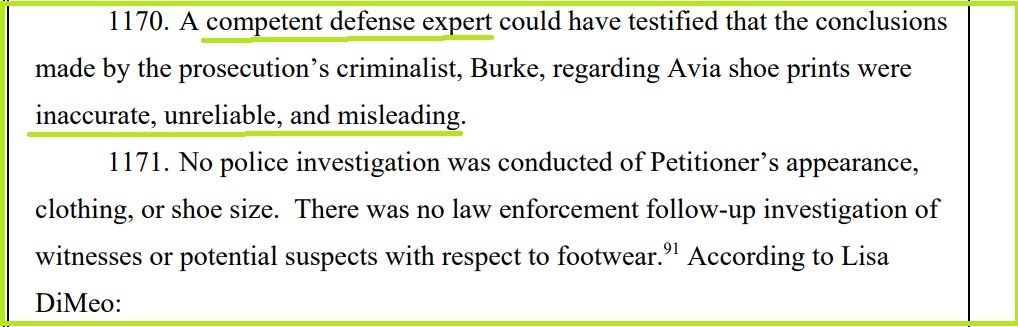
Habeas Corpus, page 427 Gerald Burke, a Sheriff’s Crime Lab criminalist, examined the prints and impressions. He had no previous experience in either shoe print or impression evidence. Subsequently, he lacked the necessary training to compare evidence correctly.
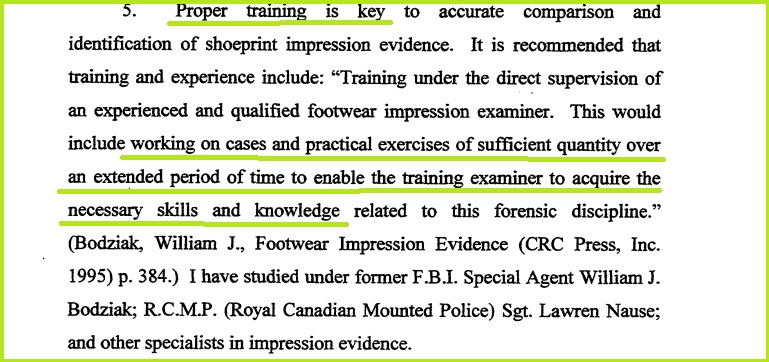
. Retained as an expert witness for the prosecution, his testimony regarding shoe print evidence contributed to the misconception that only one pair of Avia shoes could have made the impressions. Burke, after comparing 97 brands, determined that the prints were made by an Avia shoe, size 11-12, and after a visit to Avia HQ, announced it was model 445b.
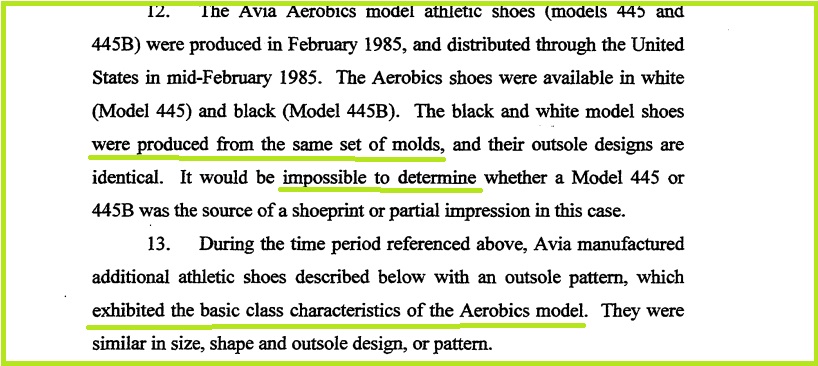
Declaration of Forensic Specialist Lisa DiMeo, document 7-19. 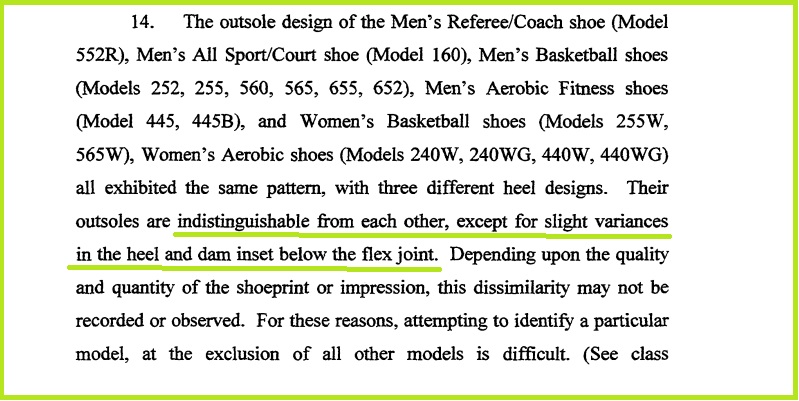
Declaration of Forensic Specialist Lisa DiMeo, document 7-19. Gerald Burke was incorrect in telling the jury that only one model of shoe could be considered. Without the complete heel impressions there is no way to tell. Furthermore, Avia Footwear data processing manager, Jeff Brewer, testified in court that in Southern California, from January to July 1985, twenty-four pairs of Avia shoes, model 445b, were sold. Of these, only one pair was size 11 1/2, and black. This information led the jury to believe that only one pair of shoes in Southern California could have made those impressions and prints. This was simply not true. In addition, Jerry Stubblefield, designer of the Avia aerobic shoe, misled the jury into believing that the soles of models 445 and 445b were different. Both Brewer and Stubblefield were themselves mislead by Carrillo telling them that the man he was hunting wore black sneakers, when he had no evidence of that.

Totalling tens of thousands of shoes.. Declaration of Forensic Specialist Lisa DiMeo, document 7-19 Here, as in the rest of the trial, Richard was severely let down by his defence counsel, who failed to challenge any of these points. How this trial was allowed to continue is mystifying. Everyone, no matter who they are, is entitled to a competent defence, especially during a trial where life is at stake. That is a fundamental right. The defence introduced no expert witness of their own.
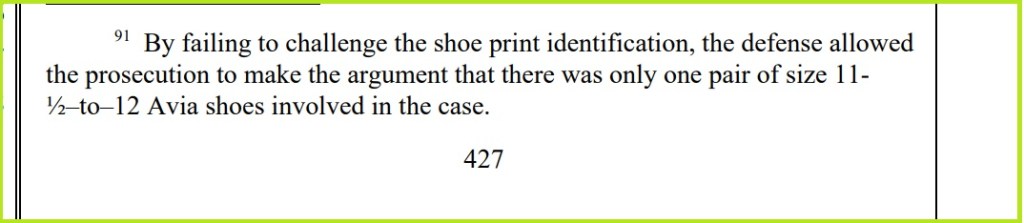
Habeas Corpus, page 427. 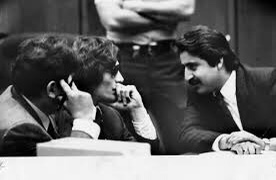
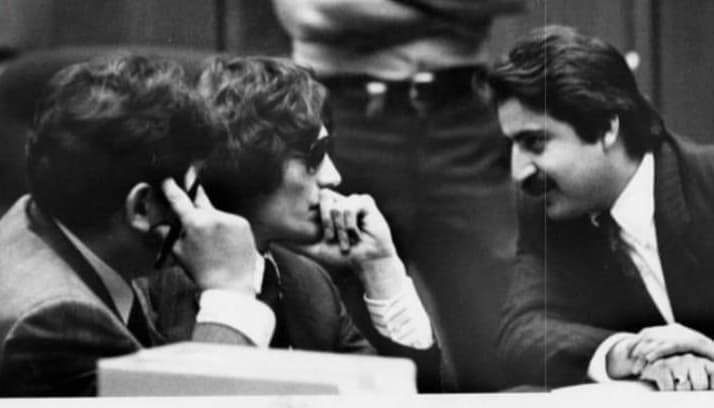
Defence counsel, Daniel Hernandez and Richard Salinas (paralegal) in court with Richard. (From the Herald Examiner Collection).
The Incidents
I use the word “incident” instead of “crime”, as this is the wording used in the petition and other documents. It is not to downplay or distract from what happened in Los Angeles during 1985, nor do I wish to focus on the horror of it, as that is not the purpose of this piece. Here expert witness testimony will be applied to misconceptions and misleading information delivered during the trial.
Of the eight incidents detailed below, one is referred to as the “uncharged incident”, however it still featured as part of the trial.
Please refer to our LA CRIMES section for a full analysis of the individual incidents.
Vincent and Maxine Zazzara
“The two impressions that were cast in the Zazzara incident are sufficient to identify Avia Aerobics as the source based upon several design features, however the exact size cannot be determined. The inclusion of the various sizes increases the pool of possible sources by tens of thousands. Other shoeprint impressions, which appear to be Avia Aerobic shoes were photographed, but not cast. The partial patent print on the top of the yellow bucket depicts a herringbone pattern of unknown origin. The size or design of the shoe that made this impression is also unknown. A measuring scale placed in the photograph would have assisted in determining the size of the herringbone pattern. Any shoe exhibiting a similar herringbone pattern could have been the source of this partial print”.
Supplementary Declaration of Lisa DiMeo, document 7-20William and Lillian Doi
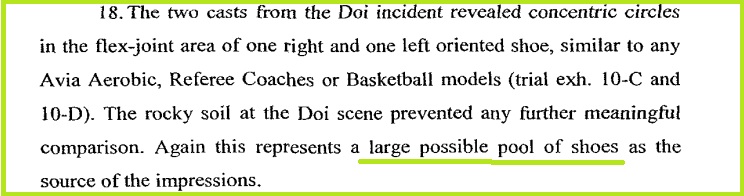
Supplementary declaration of Lisa DiMeo, document 7-20
Mabel Bell and Florence Lang
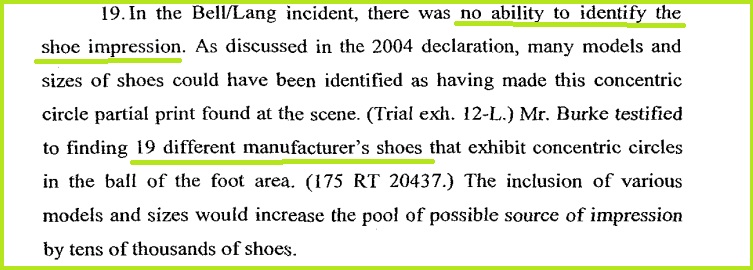
It’s not even limited to Avias here because of lack of clarity. Declaration of Lisa DiMeo, document 7-20.
Mary Louise Cannon
“In the Cannon incident, Mr. Burke testified that a partial shoe impression in carpet was made by a right Avia Aerobic shoe. (175 RT 20406.) He did not go to the scene, but the section of carpet was brought to him at the laboratory. (175 RT 20405.) Burke admitted that by the time he got the carpet sample he was unable to observe any specific pattern. (175 RT 20407.) In a written report prepared by Mr. Burke, dated July 15, 1985, (see exh. 1, Burke’s one-page report attached to the supplemental declaration) regarding his examination of three carpet samples through GB-3), bearing impressions collected from the Cannon scene, he stated as to GB-l(tria1 exh. 19 D-I), “There is no definite pattern present to identify the print as being made by a specific brand of shoe. [Carpet samples] GB-2 and GB-3 were neither photographed nor examined due to lack of detail on the carpet imprints.” (See exh. I.) However, by the time of trial he had made an identification of one of the carpet impressions as a right Avia Aerobic shoe”. (175 RT 20407.)
Supplementary declaration of Lisa DiMeo, document 7-20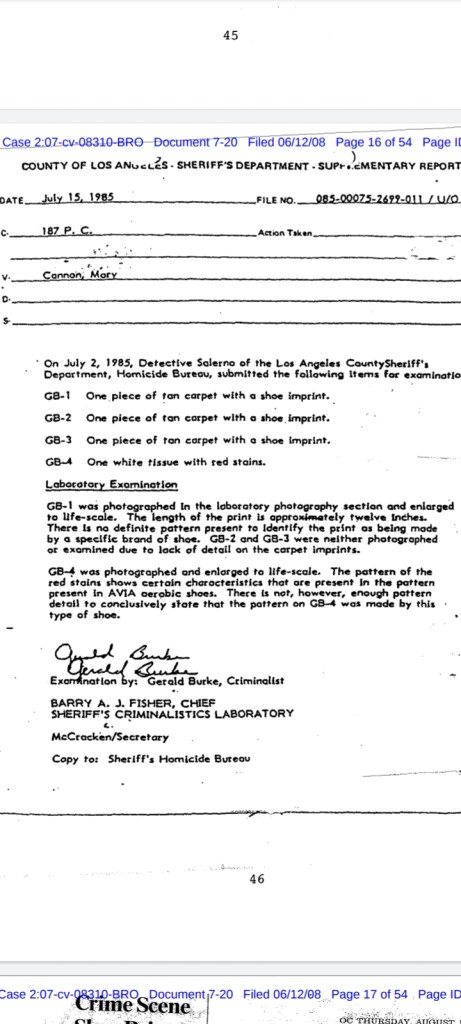
Attachment 20. Originally, Burke never found discernible shoe prints on the carpet, he changed his mind by the time he was called to testify. The taped overlay of an Avia sole attached to the carpet photo in his display, led the jury into believing the print was there. Oh well, we’ll just make it fit! 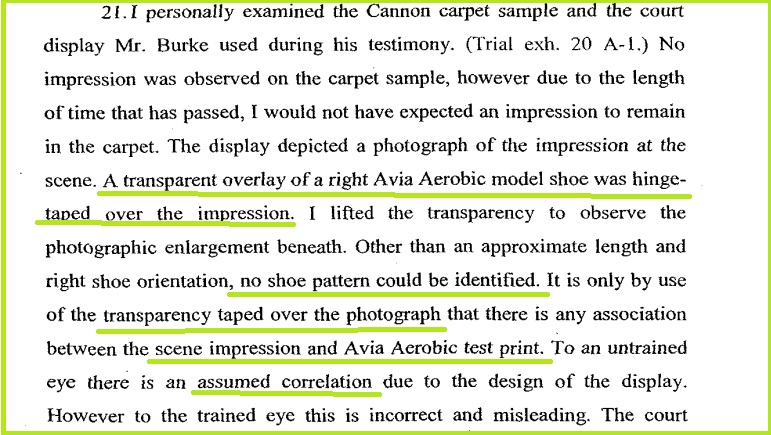
Did Burke deliberately mislead the jury? Document 7-20, supplementary declaration of Lisa Di Meo. “The court display (trial exh. 20 A- I) also showed a photograph of a partial print on a white facial tissue. The print consisted of eight short parallel lines, none exceeding one inch in length, and two “V” shaped patterns. Gerald Burke testified that a left Avia Aerobic shoe was the source of the partial print on the tissue based upon his observation of the eight straight lines and chevron pattern. (175 RT 20408.) Based on my review of the evidence, the eight lines could be part of the pivotal flex-joint design, which is not exclusive to the Avia Aerobic model, and is in fact present on all men’s Coaches and Basketball models, as well as several women’s Avia shoe models”.
Lisa DiMeo, document 7-20
Whitney Bennett
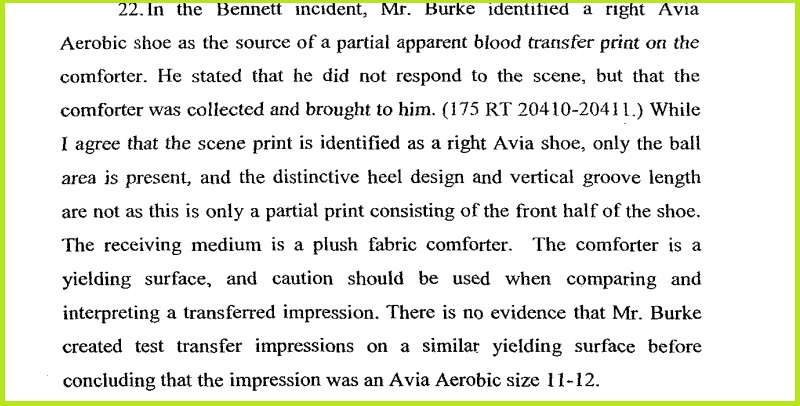
Lisa DiMeo, document 7-20. “ Mr. Burke’s explanation of how he determined the model of the shoe that left the print in the Bennett incident was based on “the lower chevron pattern, it comes up to meet the lower straight line in the ball area of the foot.” (1 75 RT 20412.) I disagree with Mr. Burke’s explanation. All men’s and women’s Avia Aerobic, Basketball and Referee Coaches shoe models share this same feature: the chevrons below the flex joint meet the lower straight line [of the flex-joint] in the ball area of the foot“.
“Mr. Burke made an identification based on his assumption that only the Avia Aerobic model contains ten chevrons below the flex-joint without having examined all the other Avia model and size shoes produced. Mr. Burke should not have made an identification to the exclusion of all other possibilities without empirical observations and testing. A qualified analyst would not state an absolute without collecting all the available data. Again, Mr. Stubblefield never stated when asked about distinguishing design features that the shoe models were dependent upon a certain number of chevrons. Forensic experts frequently use qualifying terms to support an association between a questioned piece of evidence and a defendant, including coincide, consistent with, not dissimilar, could have originated from, could not be excluded as a possible source, or compatible with. The concern is with respect to an analyst’s testimony that there is an association between a questioned impression and a known shoe which will be improperly interpreted by jurors as a definite match. The inclusion of additional possible Avia shoe models would increase the pool of tens of thousands of shoes that could have left the impressions on the comforter”.
Lisa DiMeo, document 7-20Note: There were two differing shoe prints found in the Bennet incident, more information on that can be found in this post.
Joyce Nelson

Lisa DiMeo, document 7-20 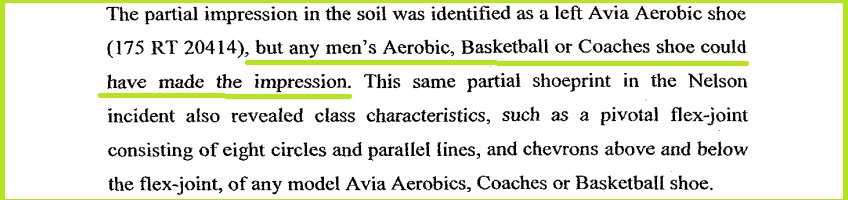
Continuation of the Nelson incident. Lisa DiMeo, document 7-20.
Chainarong and Somkid Khovananth
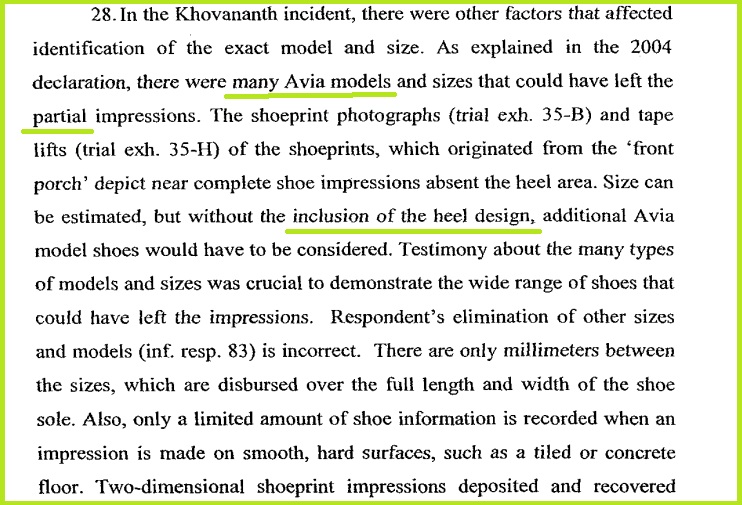
Lisa DiMeo, document 7-19. Without the all-important heel impressions identification isn’t possible.
The “Uncharged” Incident – Clara Hadsall
See THIS POST for a breakdown of the Hadsall incident.
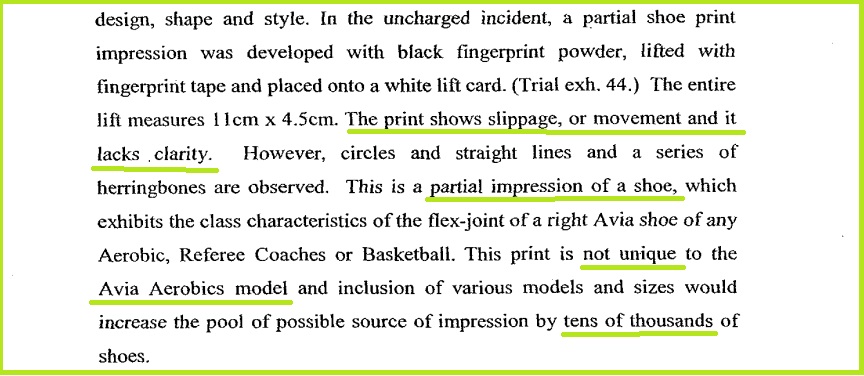
Tens of thousands of shoes could be the source of these prints.. Lisa DiMeo, document 7-20. In Conclusion..
The finding of expert witness and forensic specialist Lisa DiMeo refutes the prosecution about the incidents detailed above. Her expert testimony cannot be disregarded and shows conclusively that misinformation was deliberately introduced and fed to the jury in the increasingly circus-like atmosphere both inside and outside the court. Gerald Burke had neither the experience nor training to compare footprints and impressions. The casting impressions were distorted, measurements incorrectly obtained, and the lack of individual print characteristics rendered the prosecution findings scientifically unreliable and unsafe.
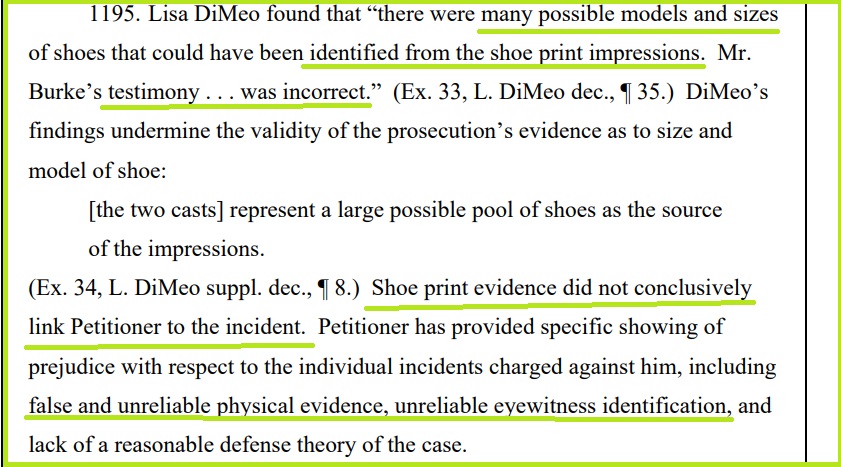
Habeas Corpus, page 434. Had Richard Ramirez had a competent defence counsel with an expert witness, such as Ms DiMeo, they could have challenged this flimsy evidence and presented to court evidence regarding the massive pool of possible shoes and testimony regarding shoe measurement. Competent counsel would have done so, but Arturo and Daniel Hernandez failed to provide a proper defence. By any reasonable account, it is clear that Richard was abysmally represented. Indeed, several jurors made statements indicating that a different outcome may have been possible had all the evidence and mitigating facts been presented.
But that didn’t happen.
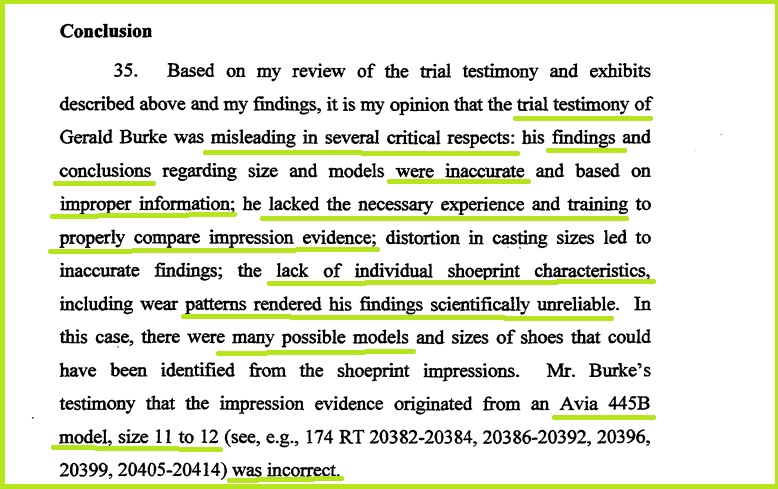
Conclusion of Lisa DiMeo, document 7-19 And so..
I will go back to the beginning and ask, what if the person on the witness stand, swearing that the evidence they shall give is “the truth, the whole truth and nothing but the truth”, isn’t delivering the facts?
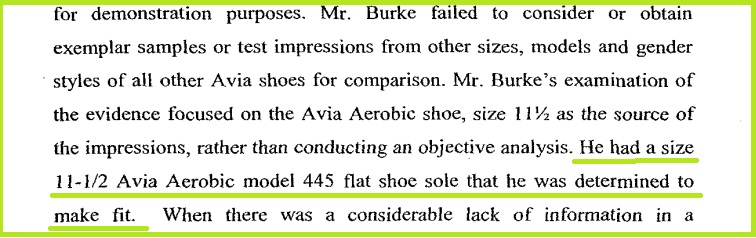
If this doesn’t make you angry, it should. Document 7-20, Lisa DiMeo
“The worst form of injustice is pretended justice.”
PlatoAnd there it is..

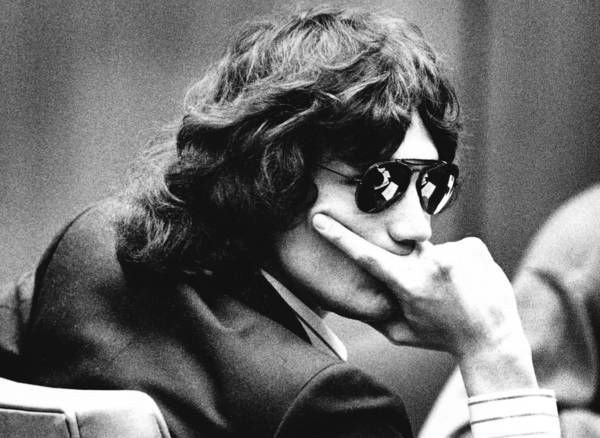
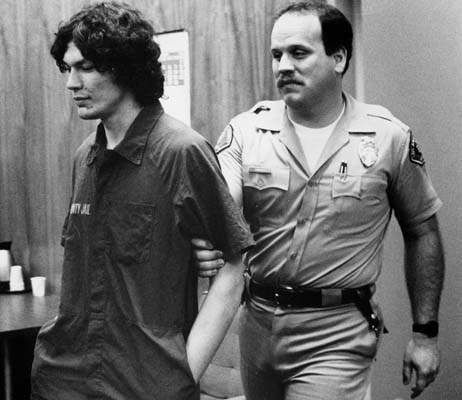
Richard Ramirez pictured during a court hearing.
~ Jay ~
-
Identity Charade
Arrest
On the 30th of August 1985, the final police sketch of the man suspected of being the “Night Stalker” was created with the help of Carol Kyle, who had been brutally raped and robbed at gunpoint on the 30th of May. It was the second composite Kyle had assisted with, the first being produced in June. That same day, the police had finally put a face to the nebulous entity that had terrorised the city and broader county of Los Angeles, and the first image of Richard Ramirez was released to the media and the world.
The circumstances surrounding Richard’s capture and subsequent arrest are worthy of a dedicated article, but a brief explanation must suffice for now.

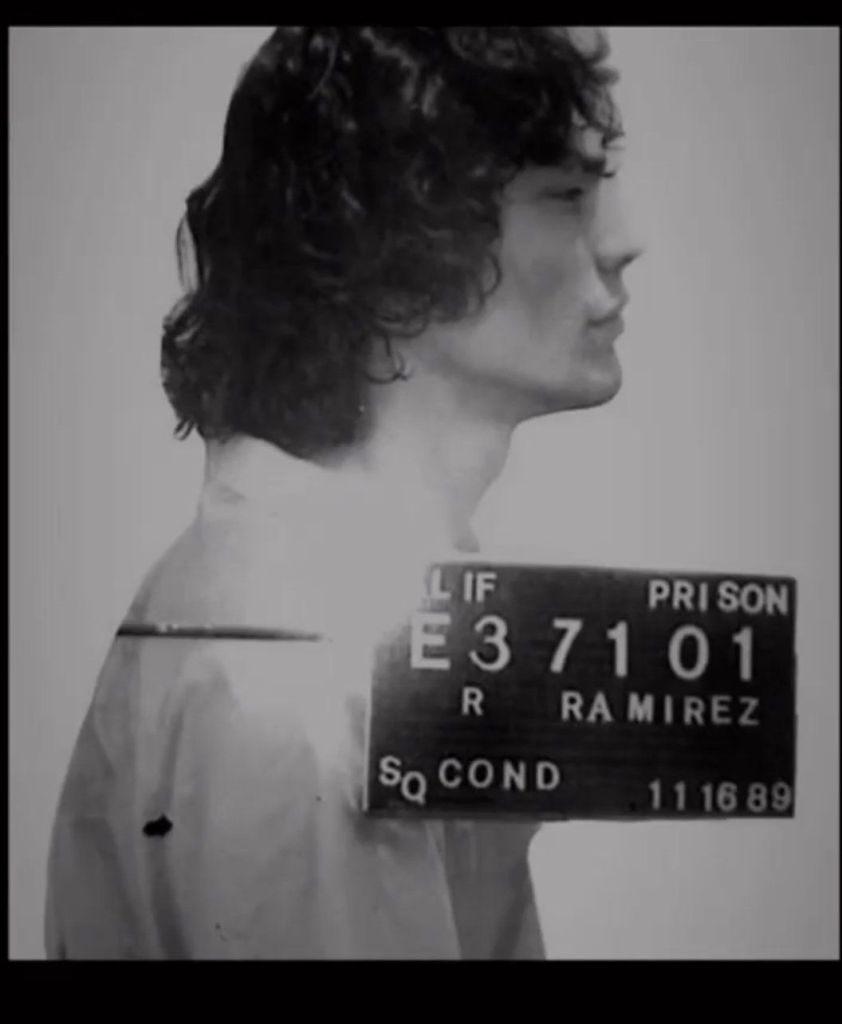
1984 booking photo of Ramirez 
Carol Kyle’s second composite Ramirez was captured the morning after his image was released, in Boyle Heights, East LA, by a crowd of angry citizens immortalised as The Hubbard Street Heroes, during a failed car-jacking as he tried to make a run for it. Beaten to the ground and bleeding from a head injury caused by a metal pole wielded by Manuel Delatorre, Richard was held until police and paramedics arrived, whereby Deputy Sheriff Andres Ramirez (no relation) of the LAPD, arrested him for attempted grand theft auto and assault. The enraged residents of Boyle Heights, engaged in protecting their community from a car thief, had not immediately realised that they were chasing down America’s most wanted.
Deputy Sheriff Andres Ramirez received a call at 9:00 a.m. on August 31, 1985, to respond to an incident on East Hubbard Street. When he arrived, Deputy Ramirez saw a group of seven to eight men on the street surrounding a man, later identified as Petitioner, sitting on the ground with a bloody head. Manuel Delatorre told Deputy Ramirez that Petitioner had attempted to take his wife’s car and had assaulted his wife. (170 RT 19811-14.)
Deputy Ramirez placed Petitioner under arrest for attempted grand theft and assault. Petitioner said his name was Ricardo Ramirez. He was not armed; neither contraband nor a weapon was found. He was cooperative. (Id. at 19819-21.) Petitioner was handcuffed and treated by paramedics. Petitioner was turned over to Los Angeles Police Officers Strandgren and Vidal who arrived shortly thereafter. (Id. at 19814-16, 19819-21.)Federal Petition of Habeas Corpus, page 119
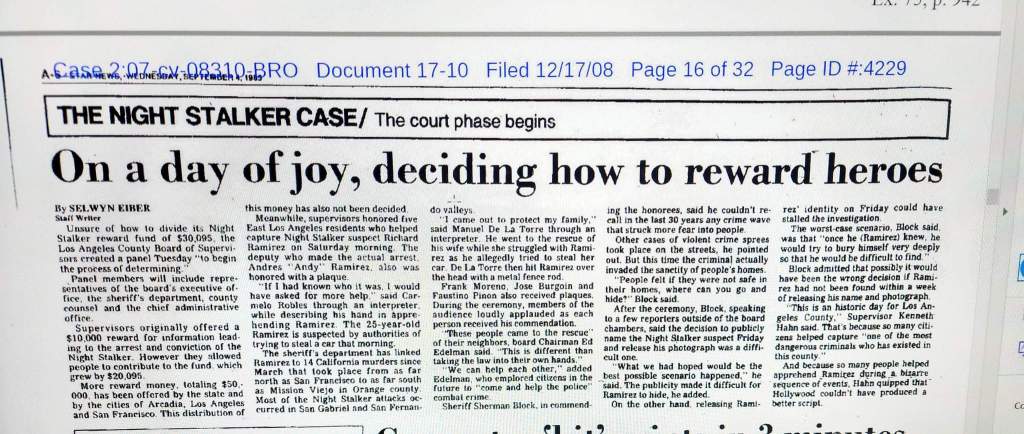
The image below shows the Hubbard Street Heroes receiving plaques given to them on the 4th of September 1985. At this early stage, Ramirez had not been arraigned, formally charged or identified in a lineup, demonstrating that such formalities were unimportant in this case. Cementing this point, Los Angeles Mayor Tom Bradley would declare that they didn’t need a trial, the concept of the 6th Amendment seemingly lost on him.

Credit: Mike Sergieff, from the Herald Examiner Collection. The photo is dated 4th September 1985. On the far left stands Deputy Andres Ramirez who received a plaque for doing his job. After a ceremony Friday honoring the men who captured Ramirez, Los Angeles Mayor Tom Bradley commented: “We don’t need to wait for an arbitrary legal process to run its course before handing out the rewards. . . . We’re satisfied that based on the evidence, we have the right man.”
Ramirez’s New Lawyer Seeks Change of Venue – LA Times, 10th September 1985
Mayor Tom Bradley contributed to the impossibility of Ramirez receiving a fair trial by enforcing the media view that he was guilty, a fact noted by Public Defender Allen Adashek, a lawyer briefly assigned to Richard.
“I think it’s bothersome when public officials make statements that appear to presume the guilt of a person who has only been arrested and charged with a crime and hasn’t even entered a plea yet,” he said.
Ramirez’s New Lawyer Seeks Change of Venue – LA Times, 10th September 1985
Tom Bradley was re-elected in April 1985, only four months before. He was a popular choice; this would be his fourth term. It is safe to say he probably knew a thing or two about “crowd-pleasing”, like most politicians.

Mayor Tom Bradley (pictured on the right) visiting Hollenbeck station, 31st August 1985. Credit: Chris Gulker from the Herald Examiner Collection.
“It’s Me, Man!”
His head wounds treated and covered in bandages, Ramirez was handed over to Officers James Kaiser and Danny Rodriguez, who drove him to Hollenbeck police station. During this ten-minute journey, Richard allegedly blurted out, “It’s me, man”, which has been (mistakenly) assumed by some that his statement was a confession. However, Ramirez likely noticed his mugshot attached to the police car’s visor; the photo had been distributed that morning at roll call.
Outside Hollenbeck station, angry crowds were gathering. With helicopters circling above and many cameras, this drama was now playing out directly under the public gaze. Everyone had seen his face staring out from every newsstand and directly from their TVs into their homes; he was instantly recognisable.
The Live Lineup
Law enforcement did not hesitate to get Ramirez into a live lineup arranged for the 5th of September, 1985, a couple of days after two award ceremonies had taken place honouring those citizens instrumental in bringing the infamous Night Stalker off the streets. Honours first, identification second.
Richard was reluctant to participate. The circumstances of his arrest, echoed by every media outlet, threatened to taint the procedure, making an unbiased identification a distant reality. Among the six individuals on the viewing platform, he feasibly stood out with his injured head; in identity parades, all participants must closely match each other and the eyewitness descriptions. The last part is ridiculous, as no eyewitness clearly described Richard Ramirez; their descriptions varied in height, ethnicity, dental health, age, and hair colour.
He was assigned position two and hung a card bearing that number around his neck. The media scrutiny, both excessive and unavoidable, was a significant problem, for amongst the millions of viewers would be the victims and witnesses themselves.

A still captured from the lineup.
Witness Coaching – A Tainted Procedure
“Deputy Allen Adashek, who was appointed to represent the defendant soon after his arrest, testified regarding the circumstances of the lineup, in which the defendant was identified by several of the victims. Deputy Public Defender Judith Crawford was also present as an observer for the defendant. Just prior to the lineup Crawford saw a police officer, who was conversing with some children, raise his index and middle fingers. When the lineup formed the defendant was the second person in line. Crawford later saw another officer make a similar gesture, raising two fingers. A still photograph taken from a videotape of the lineup showed a police officer raising two fingers”
Item 15, People v. Ramirez, No. S012944 (Cal. 2006) 7th of August 2006.
In a wholly inappropriate procedure, the many eyewitnesses called to the live lineup were allowed to congregate and swap notes. An article from the Monrovia Post claims that the witnesses gathered together could hear and see when an identification had been made.

Monrovia News Post – Sunday March 9th 1985 They likely influenced each other, encouraged by the officers’ suggestive showing of two fingers. One might wonder if they were being subtly coached to pick the man whose guilt was already assumed; there was pressure to make that identification
Worse still, Felipe Solano, a criminal associate of Richard’s, who was found in possession of stolen goods belonging to some victims, was present. He was allowed to attend the lineup to identify a man he knew well.
Confusing and conflating an already complicated matter, tables laden with the items collected from Solano were in an adjacent room. Witnesses and family members were invited to look over these to discern what (if anything) belonged to themselves or their deceased relatives. Out of over 1500 items, less than a quarter were identified. It should be noted that none were recovered from Ramirez himself.

A still captured from the September lineup; leading the witnesses. The public defenders who had attended the lineups filed an objection sheet, pointing out the media saturation, visible head wounds and the deputies and their fingers. However, during the trial itself (according to Philip Carlo’s book, Night Stalker: The Life and Crimes of Richard Ramirez), Prosecutor Philip Halpin said he’d never been given it. As it turns out, that wasn’t correct, the objection sheet was duly produced and handed to Public Defender Ray Wallen for the jury to read. Halpin was proven to have been “economical” with the truth.
Picking Ramirez
Maria Hernandez identified Richard first at the lineup and then again at the preliminary hearing, where she admitted to having seen his face on the TV and in the paper multiple times. In the original crime report, she described a Caucasian or light-skinned Mexican man with brown eyes, between 5ft9 and 6ft1.
On her witness identification card, she wrote that although he had a little beard and moustache on the night of the attack, “I feel it’s 2”. Maria didn’t seem sure who she had seen during the brief interaction with the man who shot her, later admitting she could not identify her assailant from memory.

The composite sketch created by Hernandez. Carol Kyle, in her original police statement, described her attacker as having “straight, white teeth”, emphasised when she created her second composite (see above). She, too, chose Ramirez, identifying him by his voice.

Federal Habeas Corpus, document 20-3 Kyle identified him again at the preliminary hearing, where she testified that before the lineup, she had seen his face in the newspapers and on the TV after the police had identified Richard as the Night Stalker. The police also told her that the Night Stalker would be in the lineup, a blatant leading of a witness. Although Kyle stated that she had seen Ramirez on TV, she did not call the police and tell them that he was the man who raped and robbed her at gunpoint
Sophie Dickman initially told the police that the man who raped her was a white man, approximately 5ft8 or 5ft 9; she repeated this to the officer who helped her to create the composite of her attacker.
Sophie went on to identify the 6ft 1 Hispanic Ramirez at the lineup and again at the preliminary hearing. During the hearing, she testified she had seen Richard’s photograph in the news “lots of times” before she picked him out. Five days earlier, Dickman was told by the police that the man who attacked her was the Night Stalker. However, she did not recognise him when she first observed him on her TV, arousing suspicion that the police information led her to choose the man from her television screen rather than her recollection
At trial, Sophie Dickman denied she twice told the police that her attacker was a 5ft 8 Caucasian and blamed the mistaking of his ethnicity on not wearing her glasses.
Somkid Khovananth initially identified Ramirez at the lineup and again at the preliminary hearing; her description of the man who murdered her husband and raped her is, perhaps, the closest we come to Ramirez. She recalled a Caucasian man, 30 to 35 years old, tanned, brown-eyed, with gapped, stained teeth and curly brown hair, who stood around 6 feet tall, although she initially told her sister-in-law that he was dark-skinned. She testified that she had seen him on TV a few weeks after the attack and knew it was him, but did not call the police.

With her assistance, police artist, Fernando Ponce, created the most famous Ramirez composite of all.Virginia Petersen described a tall male with a light complexion, angular face, with hair combed back from his face. She identified Ramirez at the lineup, the preliminary hearing and again at trial, where she changed the description of his hair to “wild and shaggy”. Of course, the man in chains at the defence table did, by that time, have what could be described as wild, shaggy hair. That is not how Richard’s hair was in August of 1985.

Just after his arrest in 1985 
The “wild, shaggy hair” Virginia admitted that before the lineup, she had seen him on TV and in the newspapers “six or seven times” and recognised him, but, like the others, she did not call the police.
Sakina Abowath: It is unclear whether Sakina attended the lineup, as sources differ, although she appears to have participated in the property identification. From her original police statement and crime report, we know she described the man who murdered her husband, raped and beat her, as a white male, 6ft – 6ft 2, with blonde or light brown curly hair.

From the Abowath incident report, document 20 -3. (MW means a white male) Abowath was to change her testimony after subsequent police interviews, with the suspect’s appearance changing until she identified the unmistakably dark-haired Ramirez later in court.
Jorge Gallegos, prosecution witness in the Yu incident, in his police statement, given the night of Tsai Lian Yu’s murder, described her killer as either “Oriental” or “Latino”, dark-haired and around 5ft 6 to 5ft 7. Although he only saw the suspect from behind, how he knew or thought he may be Asian is anyone’s guess.
He did not attend the lineup; instead, he identified Ramirez as the 5ft 7, possibly Asian killer, at the preliminary hearing. Surprising everyone, perhaps even himself, as he initially told police that he could not identify Ramirez.Launie Dempster described a “young Mexican male,” but it wasn’t until after his arrest, when she saw him on TV and in the papers she delivered on her daily round, that she decided he was tall and “lanky.” She did not attend the lineup; she identified him at the preliminary hearing and again at trial.
Inez Erikson identified Ramirez, not from his face, which she never saw; instead, she could recognise him from his voice and walk. Two years after the attack, Erikson seemed unsure and asked to view the videotapes of the lineup again to jog her memory, telling the judge that she could identify him because of the unusual way he pronounced the word “jewellery”. However, the video in THIS POST shows nothing distinguishing about how the word was spoken. Erikson admitted at the preliminary hearing in 1987 that she had seen his face in the papers.
This Orange County case ultimately never went to trial.Kathy Moore originally described the man who attacked her and her boyfriend, Edward Wildgans, as a 5ft 8 Caucasian man with thinning hair. At the lineup, she saw Richard Ramirez’s hair as “thinning” and chose him. He could hardly be regarded as balding even with a head injury and shaven patch; there is also a marked difference between 5ft 8 and 6ft 1.
Ramirez was never charged with this crime.
“The suspect was described to police as a white male, 5ft 8 inches tall with thinning hair. He was wearing jeans and a dark jacket. The woman told police the man had a “dazed look” about him”
From the San Francisco Examiner 3rd of June, 1985
Of the child abduction victims, including the one adult witness, the descriptions were given of a white man, around 5ft 8, with dirty-blonde hair and a medium build. The exception was Anastasia Hronas, who recalled a white man with dark hair, around 5ft 7 in height, aged between 35 and 45; he appeared to have a tattoo of (what she described as) a Native American headdress on his arm.
These children are almost certainly among the group observed being coached that day. (see above)
Media Influence and Memory
How could an audience of witnesses be induced to identify someone who appears not to match the descriptions given initially to the police? Memory fades with time; clarity lessens; it doesn’t grow.
In criminal cases, the role of expert witnesses is crucial, particularly in complex cases like this one. Richard’s defence counsel did engage an expert, Dr Elizabeth Loftus, PhD, a renowned professor of psychology and social behaviour, criminology, law and society. However, their amateurishness was glaringly evident as the defence failed to provide her with the necessary case details for her testimony. This shocking display of incompetence, a recurring theme throughout the trial, should be no surprise to our regular readers.
In 2004, Dr Loftus provided a statement as part of Ramirez’s appeal process. She revealed that during her trial appearance for the defence, their ineptitude was evident. They limited her to general information about witness memory retrieval and retention, failing to draw her on crucial factors related to the actual case she was appointed to assist with.
“In petitioner’s case, I was not asked to render an opinion about the facts and circumstances of eyewitness identification. If I had been asked, I would have rendered an opinion based on the following:
(a) Procedures employed during preparation of composite drawings prepared by law enforcement with the assistance of eyewitnesses.
(b) inconsistencies in physical descriptions of the suspect given by eyewitnesses.
(c) massive publicity following petitioner’s arrest on August 311985, including extensive television coverage of petitioner’s face.
(d) the impact of post-event information on eyewitness identification, including the circumstances surrounding the September 5, 1985, pretrial live lineup and simultaneous property lineup, and multiple viewing of petitioner in court, which had the potential to alter, supplement, or contaminate the witnesses’ recollection”.Declaration of Dr Elizabeth Loftus, document 7-20 from the Federal Petition of Habeas Corpus, 2008
This lack of preparation and utilisation of her expertise is a clear testament to the defence counsel’s lack of professionalism.
What the jury heard from Dr Loftus was a general, academic explanation that probably caused them to switch off, as it bore no relation to the case they were actively engaged in.They needed to hear how what she was saying fitted in with each of the eyewitnesses, such as influences from the media or the police and the inconsistencies of their statements. This is known as “post event information”, which Loftus talked about as a technicality but didn’t explain its importance concerning the Ramirez case – just how much information coming from each witness was from their memory? They all admitted to seeing Ramirez’s face on the TV; their stories changed. Eyewitnesses are more likely to remember post-event information received rather than the event itself, according to Dr Loftus.
“Post-event information may contaminate or alter memory. (Id. at 22712, 22718-19.) Witnesses who are exposed to media coverage or asked leading questions during interviews may have distorted memory. Retrieval of memory occurs when a witness answers questions or makes an identification.”
Id. at 22712-15.” Federal Petition of Habeas Corpus, page 141
The jury didn’t learn how fear, stress and the focus of attention on weapons can have a considerable effect on the retention of memory in many victims. Some jurors and alternates waited for explanations and cross-examinations that didn’t materialise, leaving them questions without answers regarding eyewitness testimonies.
“I remember that at least one of the victims described their attacker as having dirty-blond hair and Mr Ramirez’s hair was clearly dark. That distinction was really significant and his lawyers didn’t do anything to address just significant this discrepancy was”
Declaration of alternate juror, Bonita Smith. Document 20-8 from the Federal Petition of Habeas Corpus.
In some cases, even race has a part to play. However, Loftus explained that even science isn’t entirely sure why, but when victims, eyewitnesses and perpetrators are from different races, making a reliable identification becomes more difficult.
“429. Mistakes frequently occur in the eyewitness identification of strangers if the witness and stranger are of different races. In Dr. Loftus’s opinion, cross-racial identification is difficult for reasons that researchers do not fully understand. (194 RT 22715-16.) On cross-examination, Loftus admitted that she did not interview eyewitnesses in this case with respect to reliability of cross-racial identification”.
Federal Petition of Habeas Corpus, page 141.
Voice Identification
Dr Kathy Pezdek, PhD, in her 2008 declaration, gave her opinion on the voice identifications given by Carol Kyle and Inez Erikson as follows:
“Several relevant eyewitness factors were not included in Dr. Loftus’s testimony. These are factors about which relevant research was available at the time of the trial in 1989. These factors include the following:
(i)Voice Identification Accuracy – Several of the eyewitnesses in this case identified Mr. Ramirez at the live lineup based on his voice. The research on voice identification suggests that voice identification is even less reliable, and fades over time even faster than face identification (cf. Clifford, 1983). For example, when Carol Kyle identified Ramirez at the live lineup (156 RT 17972) she noted down on her witness card ‘I’m absolutely positive. Even the infliction (sic) in his voice is the same..’”Declaration of Dr Kathy Pezdek, document 16-7
The Bias of an In-Court Identification
Identifying a suspect in court can be a very biased affair. It differs from a lineup situation in that the witness isn’t given a similar set of individuals to choose from.
For many witnesses, the mere fact that a defendant is there, wearing a prison suit and usually in chains, must mean that the individual is guilty, especially when constant media coverage tells them so.
In the Ramirez case, some witnesses, notably Jorge Gallegos and Launie Dempster, made their first identifications during the preliminary hearing. Neither attended the lineup, and both of their testimonies were unreliableThere are many factors to consider when questioning why eyewitnesses changed their stories. Still, the constant, relentless media attention and coverage of this case, coupled with the considerable pressure to get that conviction at any cost, must all be held responsible for the impossibility of a fair trial.
In the aftermath of this tainted lineup, public defender Alan Adashek told the LA Times:
“The publicity is so intense, so intense and constant, over so many days, it’s really a problem. A major problem. The effect of all this massive publicity can be very negative in terms of a fair trial.”
And so it came to pass; the first stage in the railroading of Richard Ramirez. The errors surrounding the live lineup denied Ramirez due process and effective assistance of counsel, violating his constitutional rights under the Sixth Amendment.

Credit: Mike Sergieff from the Herald Examiner Collection. Additional source: Document 16-7 from the Federal Petition of Habeas Corpus.
(Originally written and published June 2022)
-
The Monster Under The Bed
“I’m for truth, no matter who tells it. I’m for justice, no matter who it’s for or against.”
Malcom XIn the summer of 1985, Los Angeles was in the grip of fear from a spate of seemingly random and brutal killings, all committed by one man, the infamous “Night Stalker”. America in the 70s and 80s was struggling with two separate concepts, soon to be inexorably linked, the well-publicised “Satanic Panic”, which swept east to west, with its cults, heavy metal music, which many believed contained subliminal demonic messages hidden within lyrics, and sacrificial murders. On top of that came “stranger danger”, missing children with faces of the lost appearing on milk cartons.
After his famous, well publicised arrest by an angry mob on 31st August 1985, Richard Ramírez, already tried, convicted and condemned in the court of public opinion, fuelled by an hysterical media, became the living embodiment of everything most feared. A demon made flesh, the stranger in the midst, the outsider; held up as an example to all. The proverbial monster under the bed. Do not be fooled by the untrue statements that the killing stopped after the arrest of Richard, nothing could be further from the truth. The media, and the police never let the truth get in the way of a good story; gaslighting seems to be a speciality.
Never before had such media attention and coverage been given to a case, it reads almost like a Hollywood script. Apprehended while trying to escape angry citizens bent on retribution, indeed, these same citizens were hailed as heroes in a ceremony even as Richard was sitting in jail awaiting arraignment.
Before he was convicted. “He’s the suspect we’re looking for, so now comes all the hard work of tying him to all the OTHER CRIMES we’re looking at.”
Lt Dan Cooke, LAPDMake the crimes fit? IF he’s the only suspect, shouldn’t they already have done that part? Not the other way round?
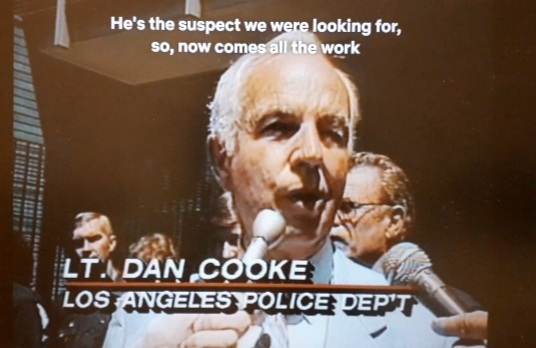
Taken from Netflix – Night Stalker – The Hunt For a Serial Killer. 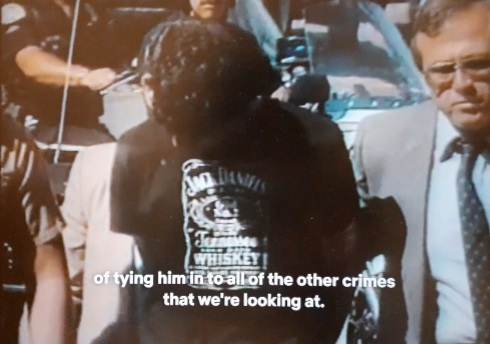
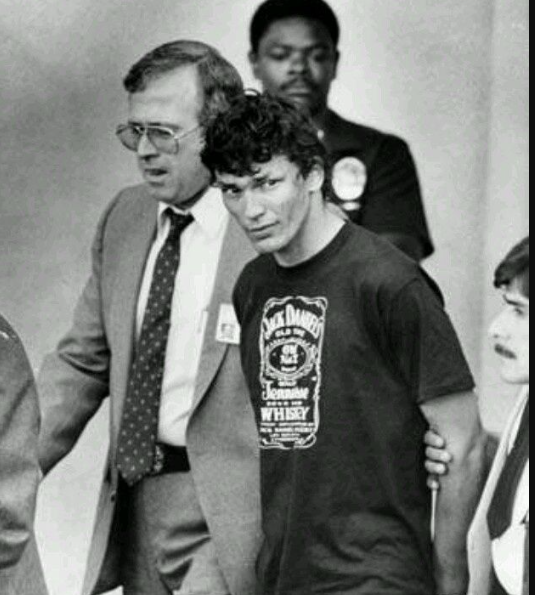
Richard Ramirez, after his capture on 31st August 1985. Pictured with Frank Salerno. 
If you subscribe to the Holy Church Of Netflix, you may have digested the story of the grisly murders, rapes, molestations, also the blood and the gore. While no one is denying the heinous nature of these crimes, or seeking to overlook them, Netflix managed to repeatedly dwell on the horror, so much so that many missed the obvious flaws staring them in the face. Instead, preferring to drink in all the sensationalism in all it’s bloody detail. If that is your preferred version of Richard Ramírez, then perhaps this blog is not for you.
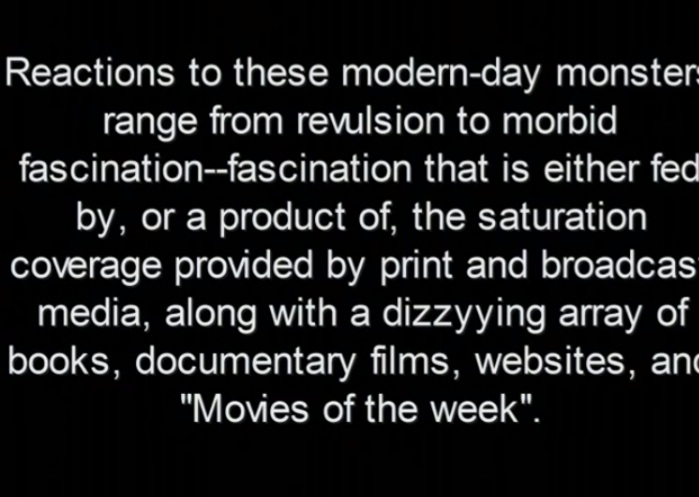
You may also believe the highly inaccurate fiction of The Footprints, left allegedly, by the only pair of Avia aerobic shoes (in a particular style and size) everywhere the killer trod. Indeed, these obligatory footprints, around which has been built some of the sketchiest evidence ever seen, have followed this case around for over 30 years. More info on THOSE prints can be found in this post.
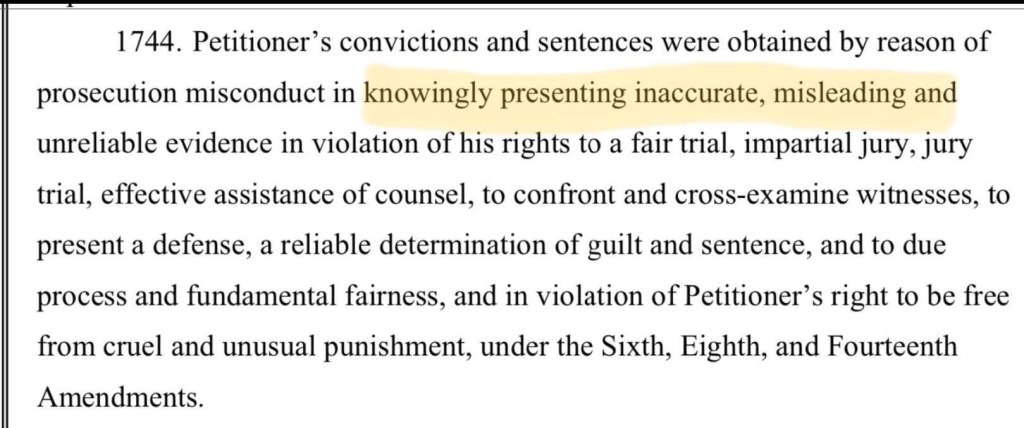
From the 2008 Writ of Habeas Corpus. In reality, there was very little physical evidence linking Richard to these crimes, although disturbingly, there was evidence, hair and blood samples, which belonged to neither Richard nor any victim. Not forgetting the mystery semen found not to be his, either. However, law enforcement determined to make what little they had stick to their man, once they had him in their sights.
Much of what will be discussed here comes from the Federal Petition of the Writ of Habeas Corpus and supporting documents, filed by the Federal Public Defenders Office in 2008, which is available on line for anyone who cares to look.
This blog does not seek to give a halo, to whitewash or exonerate. In presenting these articles, we are merely disclosing counter evidence, highlighting the inept and (in my opinion) downright criminal negligence of his defence counsel, along with inaccurate prosecution expert witness statements, shown to be neither expert or factually correct. The holes in this case loom so large you could stick your head into them and shout into the void!
Justice is not served if the whole system is a facade, it serves neither victim or society. Where is innocent until proven guilty? Every person brought to trial is required to have justice. The right to a non-conflicted and competent counsel. The absolute right to a fair and unbiased trial.
Richard Ramírez was granted none of these things.
~Jay~
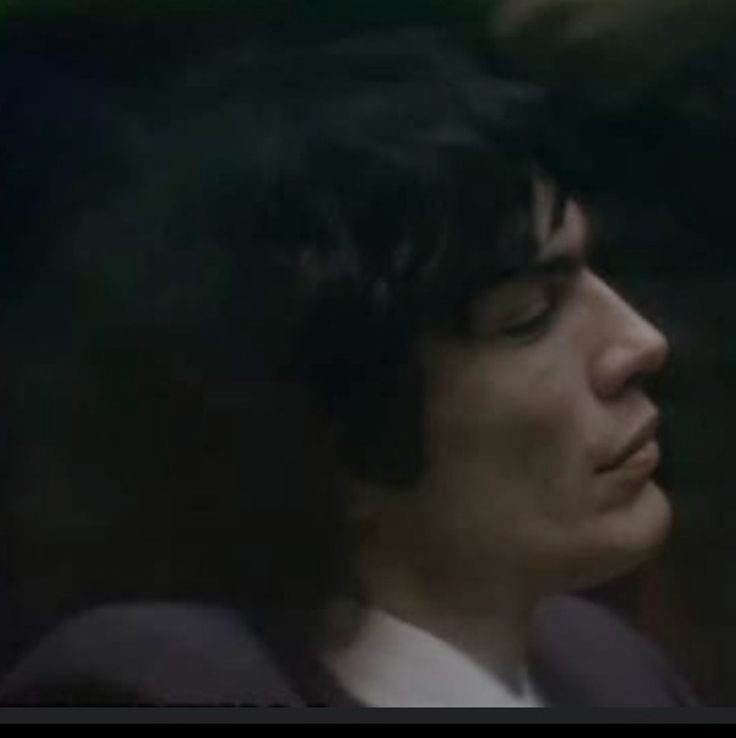
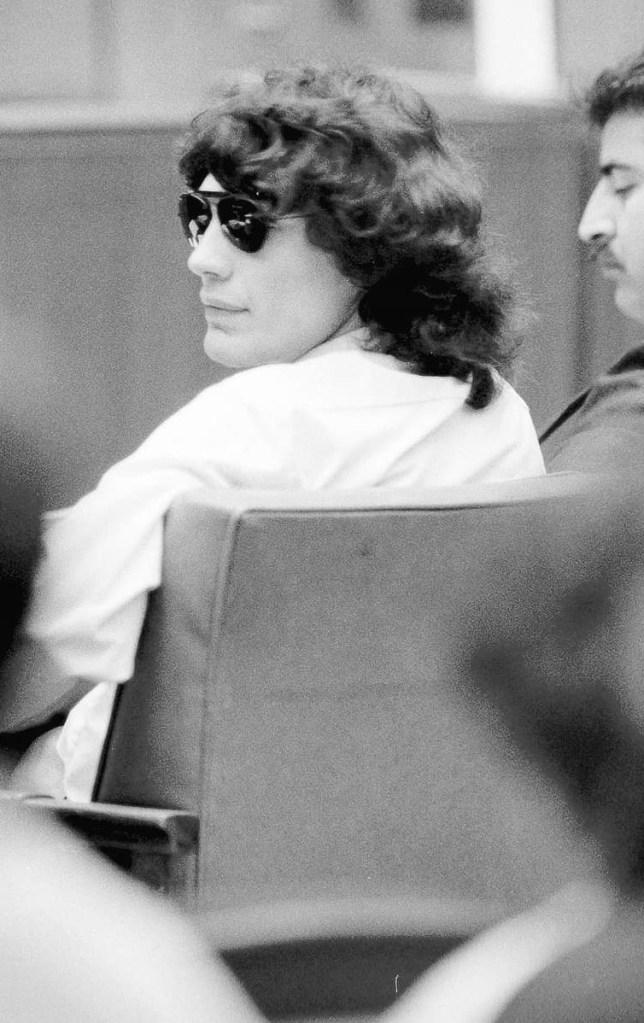
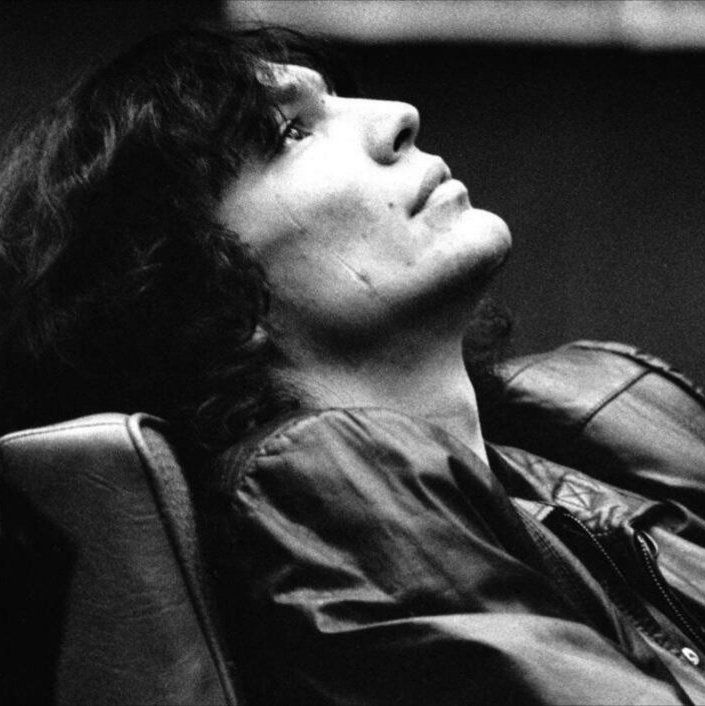
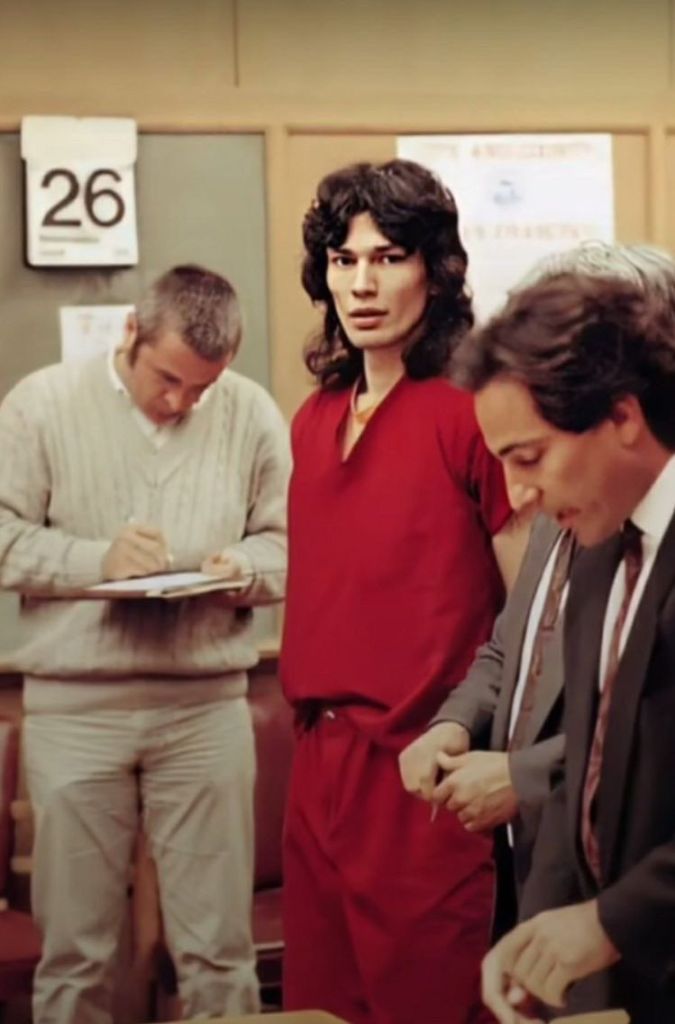
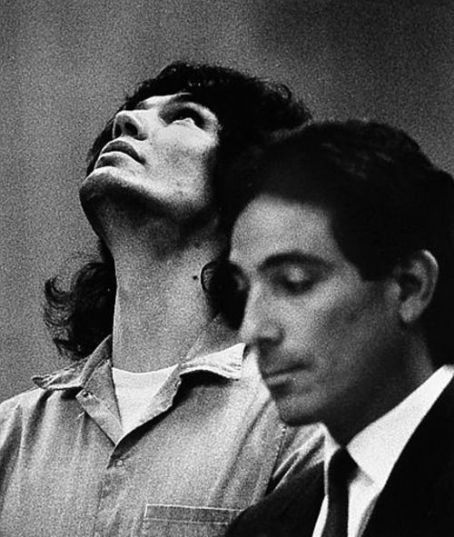
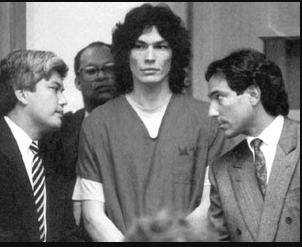
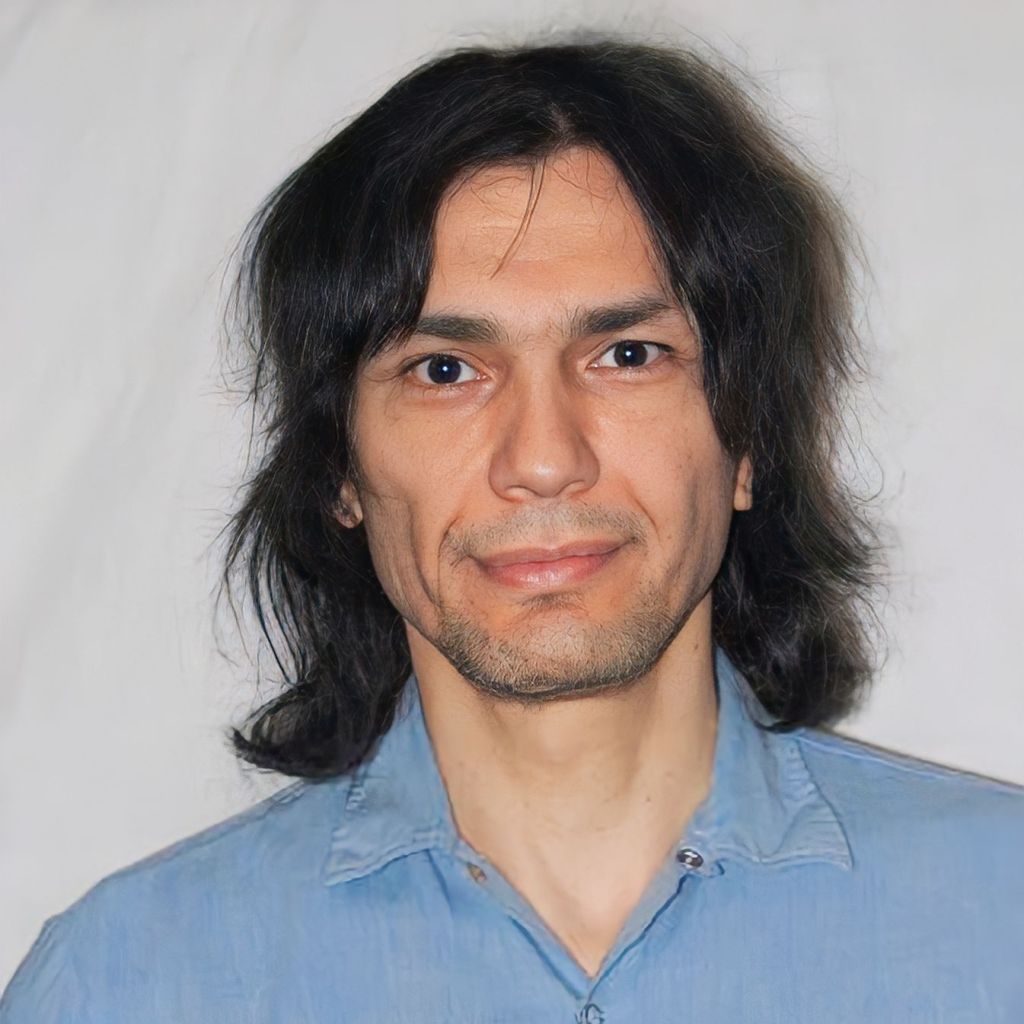
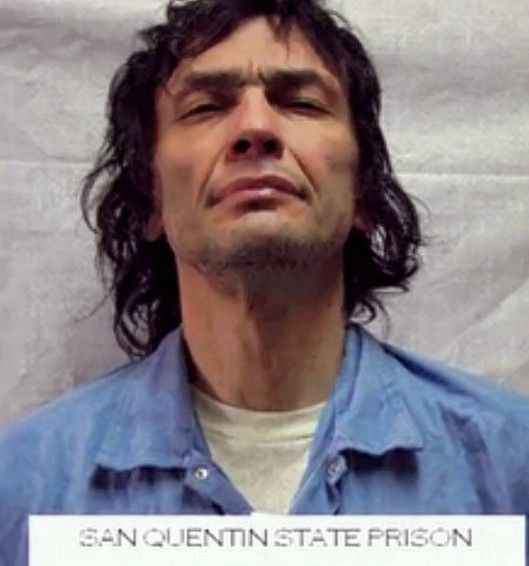
Richard Ramírez in court 1989


 Expendable For A Cause.
You must be logged in to post a comment.