One More Time..

*some images are best viewed on a desktop, due to size*

“I don’t need to hear all of society’s rationalisations. I’ve heard them before, and the fact remains that what is, is.”

Richard Ramirez

Why?

We did not wake up one morning and decide to start writing about this case, it was a slow realisation that, after months of reading, researching, trawling through news archives, and asking questions, there was something dreadfully wrong with the “Night Stalker trial”.  The books, the ridiculous documentaries, the endless podcasts, they wallow around in blood, embellishments, and inaccuracies, and they all have one thing in common – apart from seemingly revelling in the gore, and not caring about facts.   No one seems to want to acknowledge the obvious; the trial was unfair.  
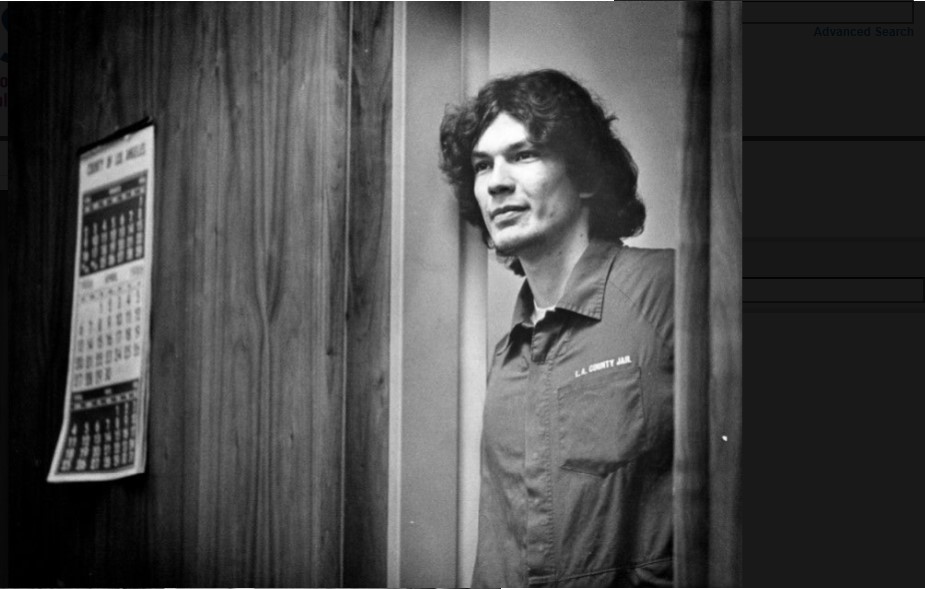

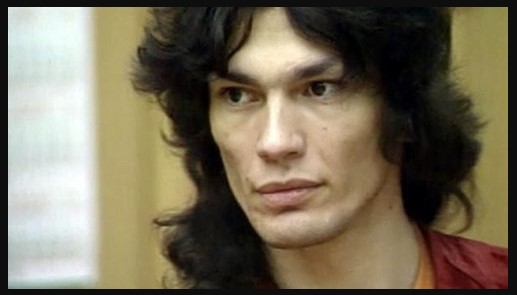
Photo from the Herald Examiner Collection, dated September 20th 1989. Credit: Mike Mullen

There are two sides in every argument, two sides in every case — the prosecution and the defence. Pretty obvious, right?

The biggest, most infamous, media-soaked trial of the 1980s was a joke. A bad one, and no one is laughing.

What’s the point, he’s dead!

As if we didn’t know, but seeing as Richard was filing status updates two weeks before he died and had scheduled a meeting with lawyers for August 2013, it evidently mattered to him.

I will repeat this one more time, although it has been explained on the home page.  The Federal Petition of the Writ of Habeas Corpus is not about guilt or innocence.  That is not their purpose. Neither are they automatic, unlike review on direct appeal. Their purpose is to investigate whether a person’s incarceration is lawful under the US Constitution. 

The most common ground for relief (release from custody, in the case of habeas corpus) being whether a conviction was based on:

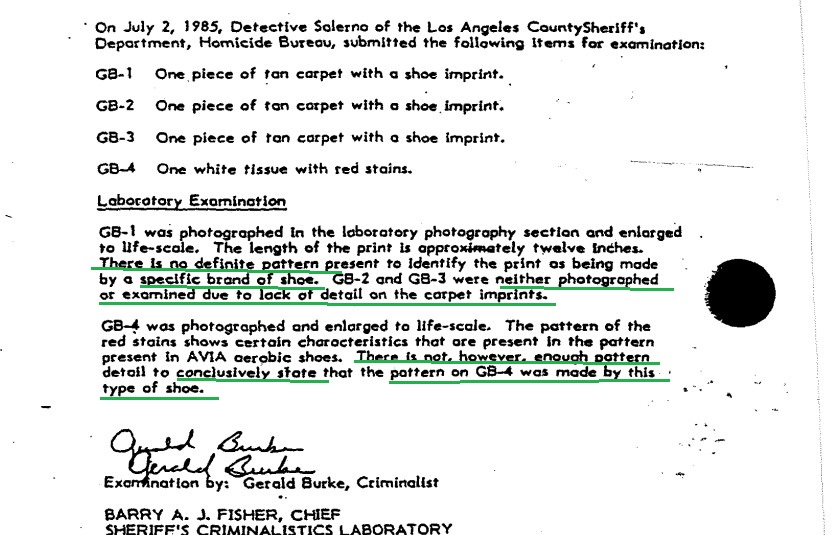
Crime lab report from Gerald Burke, expert witness for the prosecution. He says quite plainly that he cannot identify the shoeprints found at the Cannon incident, neither on the carpet or the tissue. Yet in court, he stood up and did just that, wrongly. He lied, and it went unchallenged as the defence did not retain an expert witness. In effect, they conceded.

Declaration of Lisa DiMeo, forensic specialist, retained by Richard’s lawyers for the habeas corpus writ. Doc 7-20

Ms DiMeo explains how the prosecution tricked the jury into believing there were discernible shoeprint impressions, underneath a transparent overlay of an Avia sole, attached to a photograph on the in-court display.


California Law Association rules. Not applicable in the Ramirez case?

“When the courts are not likely to provide proper enforcement of the rules sua sponte, attorneys must seek to enforce the rules else their clients will die.

Californian Law Association.

Declaration of alternate juror, Bonita Smith.

Declaration of juror James Muldrow

That is a just two juror declarations; there are more. Regular readers will know that we have provided examples of court violations throughout this site.


“You’re not the FBI!”

Yes, we know; we’ve never made that claim. 

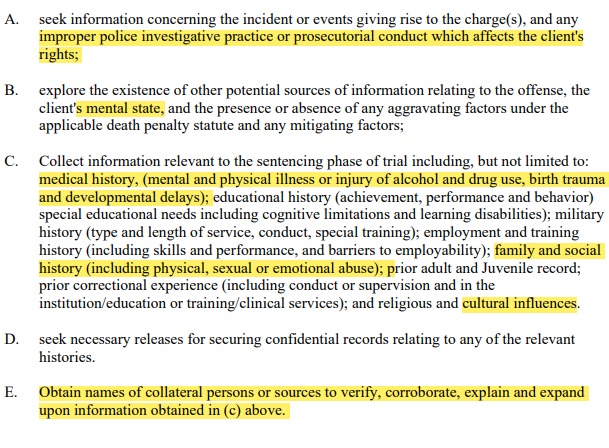
Every defendant brought to trial is supposed to have an effective assistance of counsel, that is (funnily enough) how it works. Or how it’s meant to.  Defence counsel are duty bound to investigate and develop strategy to fight prosecution charges.  For Richard Ramírez none of this happened he had no defence to speak of, leaving him virtually undefended in a trial that culminated in him receiving nineteen death sentences.

A proper defence team would have been able to show how flawed and inaccurate the evidence against him was, and how weak.  A conflicted defence team ignored his mental impairments, as it devalued his marketability, and the trial court, fully aware of this, did nothing to stop it.

In this blog, we have merely presented and laid out the defence as developed by his habeas lawyers, the defence he should have been given in 85-89, but because he was poor, and his lawyers at trial, hopeless, inexperienced, and downright rubbish; a defence he never received.  Later, some of the jurors and alternates made statements in which they, too, questioned the fairness, and lack of defence.  That in itself, is shocking, especially as they returned the “guilty” verdict knowing this.
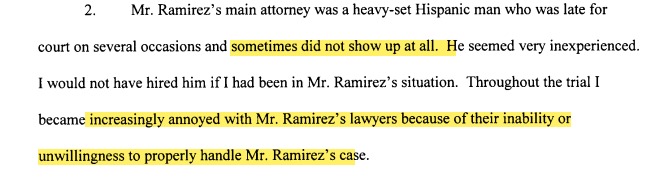

Juror Janice McDowell

Richard’s case is a famous one, but this miscarriage of justice is not limited to only him. Carlos DeLuna, another Hispanic man, poor, with a shoddy defence team, was horrifically executed for a crime he did not commit.  One glance at the Innocence Project tells us that this is happening all too often.  Law enforcement, the courts, do this all the time, through coercion and false evidence.   The system is broken.

In the trial of Richard Ramirez, bizarrely, the onus was never on the prosecution to prove guilt, the media had already done its work, and the denial of a change of venue, coupled with a non-sequestered jury, resulted in the problematic reality of a case where the defence had to prove his innocence, which they catastrophically failed to do, through their own incompetence. These are themes that we return to time and again, and remain at the heart of this blog.

  • Unqualified, incompetent defence
  • False and misleading evidence
  • Failure to investigate mental competency
  • Failure to challenge evidence
  • Denial of venue change
  • Denial of motion to sever charges
  • Media influence
  • Non sequestered jury
  • Unreliable eyewitness testimonies
  • Failure to defend charges
  • Hiding of possible exculpatory evidence

For some, Richard Ramirez and this trial, have provided (and continue to do so) a meal ticket, fame, and a never-ending round of media appearances.  

When weighing up evidence, there is a choice. 

The State, in its zeal to convict the petitioner, presented evidence that was false and unreliable”

Writ of Habeas Corpus

You decide what you believe.

(Originally written and published 27th February 2023)

~ Jay ~

6 responses to “One More Time..”

  1. I came across this site fairly recently. I never would have thought that I would be seeing something like this about the Richard Ramirez case, but I’m sure glad I found this site. That is, I’m glad but also incredibly sad. This has been hitting me really hard, to be honest. It’s like multiple problems in our society converged, and he was buried under them. And I think about the fact that he was only twenty-five years old when he was arrested, and then he spent all those years in prison and died there. And then the possible irony that the process of this Habeas Corpus petition was happening just before he died; what if it had worked? But then he died of cancer. The whole thing is just so horrible.
    This really was a modern witch hunt, where a “serial killer” was just created – somebody who people could project their fears onto. And others got to be hailed as saviors.
    I have questions: What about the Innocence Project in this case? Does anybody know if they ever had any involvement in this? And what can be done now? I don’t know what the specific legal issues are in taking another look at a case after a convicted person has died. But there have been people who have somehow been found to be innocent after dying. (Such as Carlos DeLuna, who you have mentioned here.) And of course, there is the issue of the multiple unknown perpetrators who got away in this case; you would think that this would create some interest, if the right people took another look at this. One thing seems obvious to me: Any existing forensics from this case need to be retested using advanced technology and science, such as DNA testing! And of course it should be done by neutral third parties; NOT anyone connected to the LAPD, apparently. I wonder what it would take for this kind of thing to happen.

    Liked by 3 people

    1. Hi, thanks so much for this comment, we’re glad to have you with us. Richard’s case can not be taken on by the Innocence Project, he is dead and they won’t look at this. When he died the Habeas Corpus petition was dismissed, and that was that. In a petition for Habeas Corpus, the defendant has to be alive, they must be physically brought before a judge, that can’t happen when are they are deceased.
      We are discovering more information as we go on, and yes, it’s horrifying that this could ever be allowed to happen. No one will touch this case, it is too big, too famous, and as we’ve said, when the forensic specialists (retained by his habeas lawyers) requested deeper access to the shoe print and fingerprint evidence, the government said no.
      Many of the trial transcripts have been sealed, and you can’t get access, even his lawyers were unable to obtain something that they needed, and some transcripts were destroyed.
      As for DNA, yes that would be very useful, but I have to say, there is a dark side to that, too. It is not the fail-safe the media would have us believe. It can exonerate, it can also be manipulated. Soon we will make a post about it, and try to explain how and why. This is especially important in the case of Mei Leung.
      There was a very good possibility that finally his petition would be read by the Ninth Circuit, but do you really think they would ever have allowed that to happen? In a podcast, Carrillo states he glad he’s dead, because there would be no re trial, no more petitions..

      Richard Ramirez was denied a fair trial, and hardly anyone wants to acknowledge that. We are trying to show via court documents and police reports what happened, and why. The whole damn case is disturbing.

      Liked by 3 people

      1. As far as I know, the Innocence Project won’t take a case if there was DNA evidence either. I read about a case where two men were falsely accused of rape (mistaken identity) and DNA evidence proved them guilty, despite them having alibis and being too tall to be the suspects. One of their mothers contacted the Innocence Project and they refused her on these grounds. Eventually the sentence was overturned – the DNA turned out to be a false positive for BOTH men. Crazy.

        Liked by 1 person

      2. I think they’re currently involved with the Anthony Sanchez case. A mixed sample is problematic, they cannot successfully tease the alleles apart, meaning they can’t tell which bits belong to whom; they get false positives. But that is a very long post for another day.

        *Edit* Actually, it might be Death Penalty Action who’s on the Sanchez case, I will have to look again. (I follow both, and can’t remember)

        Liked by 1 person

    2. I would love for the blood samples to be revisited. Obviously you had the Type A blood found at the Bennett scene and then blood at the Cannon scene didn’t match either. Surely they kept the sample? Although I wouldn’t put it past them to plant DNA evidence. The case is that messed up. Thanks for reading though!

      Liked by 1 person

      1. *update:
        The Innocence Project has changed it’s policy regarding DNA-based convictions, and now counts faulty DNA typing among the contributers to erroneous convictions in cases that have been over turned. Too late in this instance, but it’s step towards lifting the veil regarding flawed testing.

        Liked by 2 people

Leave a reply to ~ Jay ~ Cancel reply