
In the book, there are two small sections on Arturo Robles, a suspect who was featured in the Netflix documentary. Although released, Robles is significant in the timeline of Ramirez’s case and the creation of the Night Stalker. This post will put those events in one place.
Robles had previously been driving around the streets of East L.A. trying to entice women when he was cautioned by police following harassment allegations. Gil Carrillo heard about this and because he was looking for a shooter in the Okazaki case, he thought Arturo Robles might be an interesting lead. He ordered deputies to put him under surveillance. Meanwhile, surviving victim Maria Hernandez identified him from a photo spread.
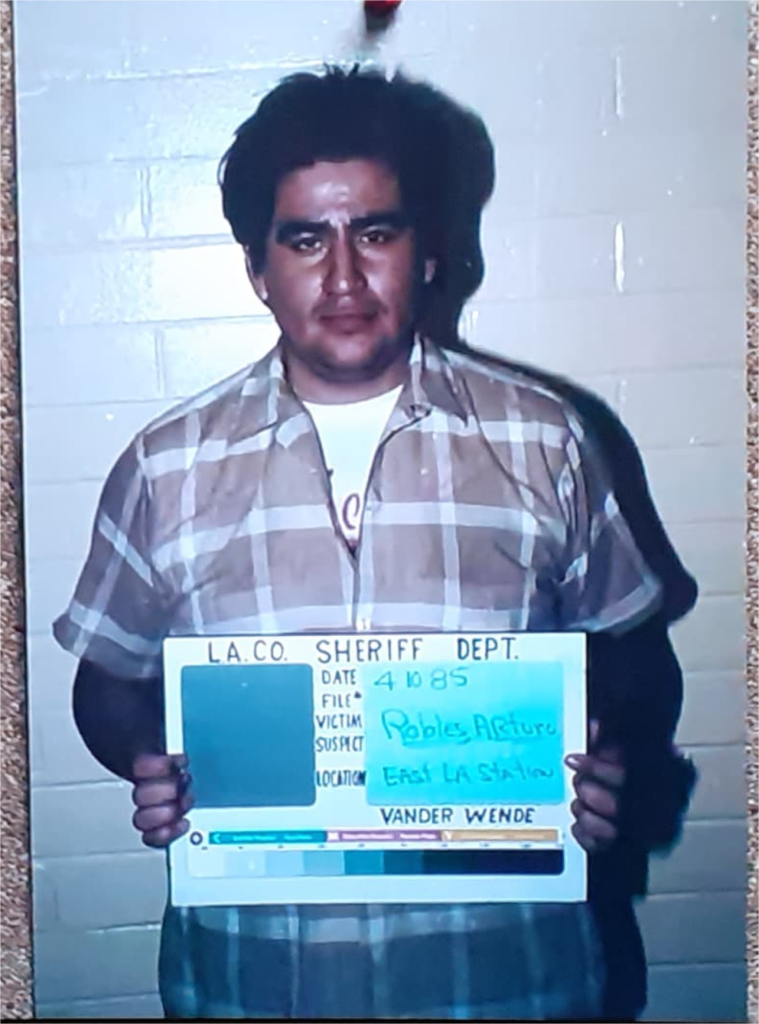
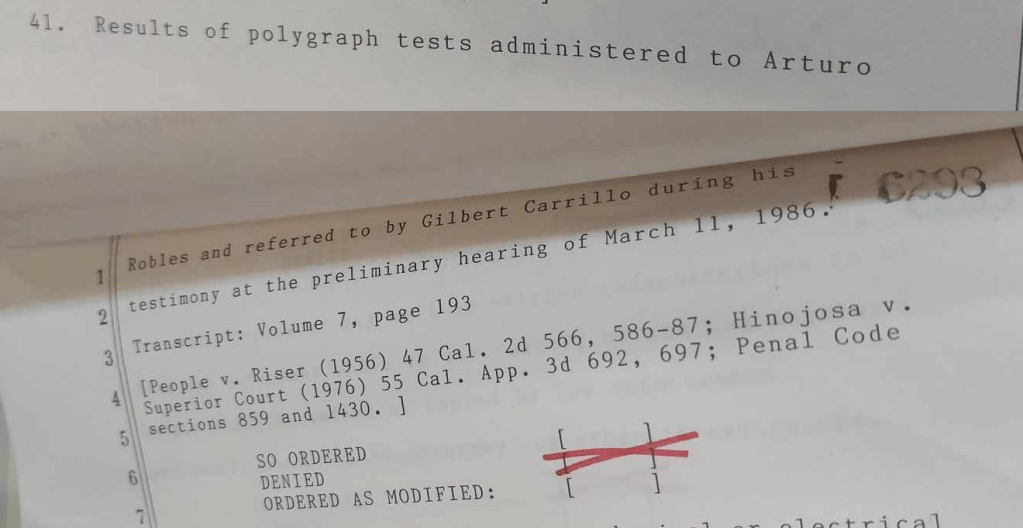
Robles was arrested in connection with Dayle Okazaki’s murder on 10th April 1985. He was initially unaware of the reason for his arrest, believing it to be cocaine possession. He was taken to the police station under the pretence that it involved “following minors” which he denied, insisting the females he followed appeared to be adults. When he arrived at the station, Gil Carrillo questioned him over some bars he frequented, one of which happened to be a favourite haunt of Dayle Okazaki. Robles’ house was searched, and some possessions were confiscated. Robles was made to take a polygraph test (the results of which were denied to Ramirez’s defence team). He also gave blood and saliva samples.
Robles was asked to attend a line-up. Significantly, he said he heard police discussing a serial killer: “the words serial killer hung in the air”. This was early April 1985, so before the main killing spree had commenced – when there was a rapid succession of attacks between late June and early July. This shows that Carrillo was already pursuing a serial killer before there was any real reason to, based on his eye-contact theory. To recap, by early April, the only cases under his radar were Okazaki, Yu and Zazzara. The Yu case was dealt with by the Monterey Park Police Department and nothing to do with Carrillo or the LASD, but he was determined to connect the crimes behind the scenes. The Yu case was taken over by the LASD in August 1985.
Ramirez’s biographer, Philip Carlo, calls Arturo Robles “Paul Samuels” in his book. They are definitely the same person, but back then, Robles’ name was not public, so it was changed for legal reasons. Carlo wrote that when “Samuels” did the line-up, the witnesses for the Yu case were called in, but so were the children from the abduction cases. As discussed in the Yu post, and our book, this is ridiculous: Arturo Robles was six feet tall and is Mexican. The Yu witnesses both saw a possible Asian man who was around 5’6”. The children saw a white man who was around 5’9” and fair-haired. So, here is more evidence that Carrillo was attempting to weave a serial killer narrative. Ultimately, nobody identified Robles and he was allowed to go home. In his interview, Robles says that Carrillo joked with him that he was identified as “not the serial killer.” The interview with Arturo Robles can be found here. His recollections are quite amusing.

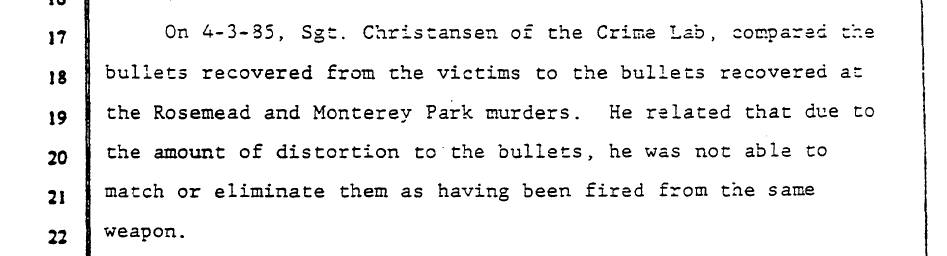
Robles’ line-up was in early April, but Carrillo’s attempts to connect the crimes predated that. On 3rd April, he asked the firearms expert to check whether the bullets at the Zazzara scene matched those at the Okazaki scenes. They were distorted beyond comparison (yet miraculously matched to Khovananth much later, if you can suspend your disbelief for long enough) There was no real reason to connect Zazzara. The nature of that crime was very different. But we know Carrillo was fixated on the Avia shoeprint theory, and the shoeprint was dubiously connected to a child abduction.
The hounding of Arturo Robles seems to have continued. The 2006 automatic direct appeal petition says that, from a photo spread, Sophie Dickman also chose the same man Maria Hernandez selected. How strange that two women should both pick Carrillo’s chosen suspect, despite each describing someone different – Dickman’s assailant never matched Hernandez’s on paper. Therefore, it seems more than coincidental. As discussed in this post, Dickman’s attacker was too short and thin to be Arturo Robles.

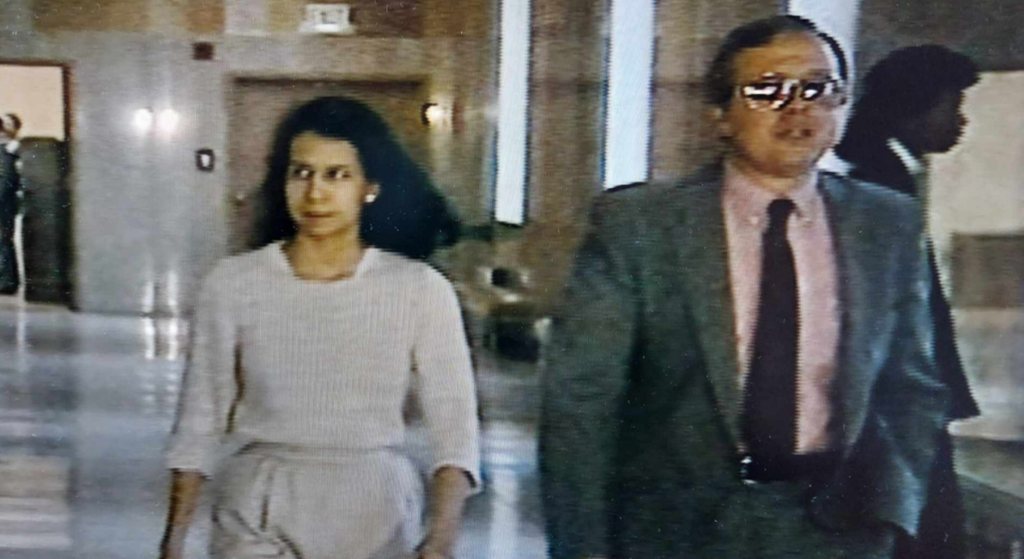
Later, it was revealed in the media that construction workers had been shown photos of a police mugshot as well as composite sketches. It is likely that this was the above photo of Robles from his 10th April arrest.
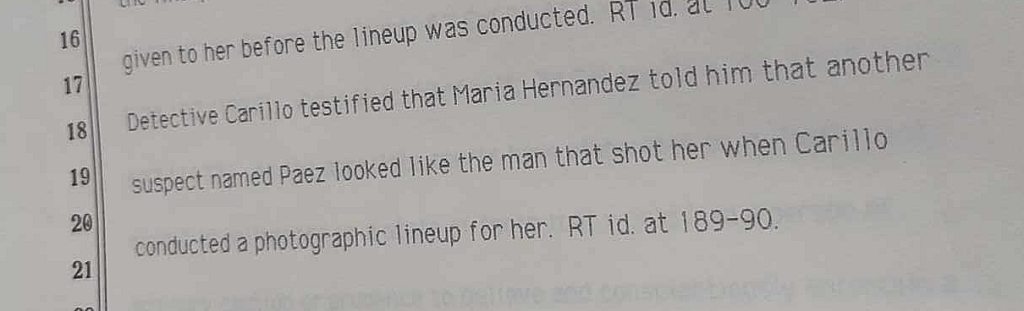
If it was not Arturo Robles, it was probably a man called Miguel Angel Paez. Paez was arrested sometime in mid-July 1985. In a defence motion obtained from the court records, it was revealed that Maria Hernandez identified Paez from another photo spread. However, she saw him at another line-up and was unable to positively identify him either. Paez’s alibi was strong and he was released on 19th July 1985. The suspect Dickman identified was more likely to be Robles, because Carrillo has repeatedly mentioned him.
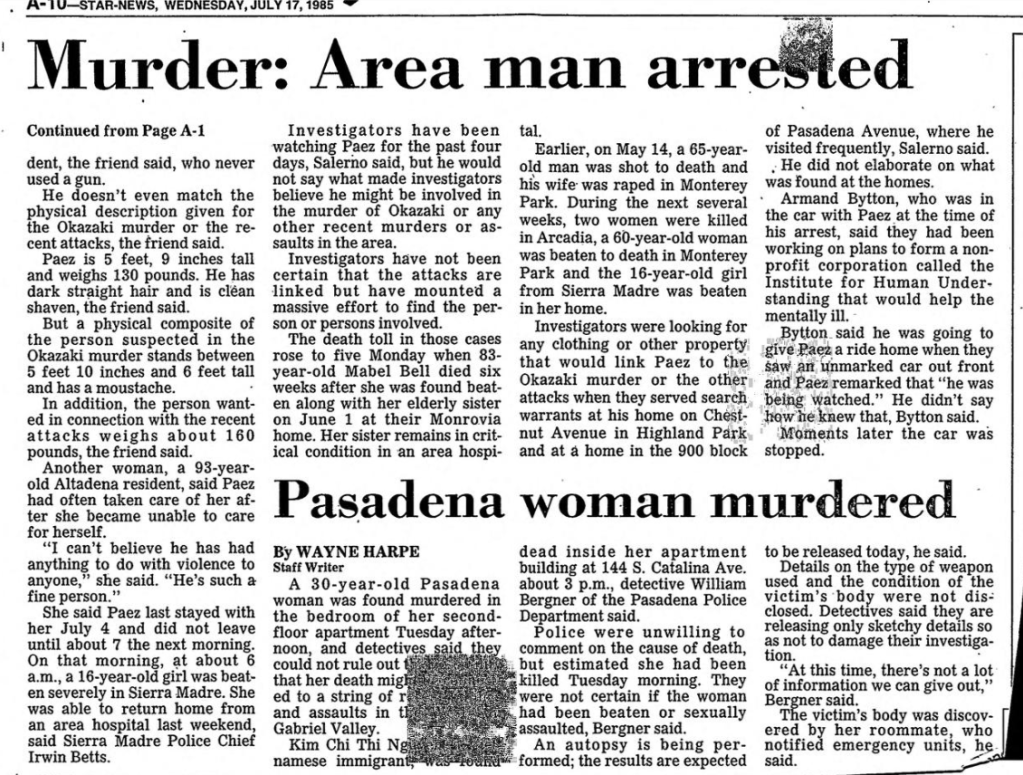
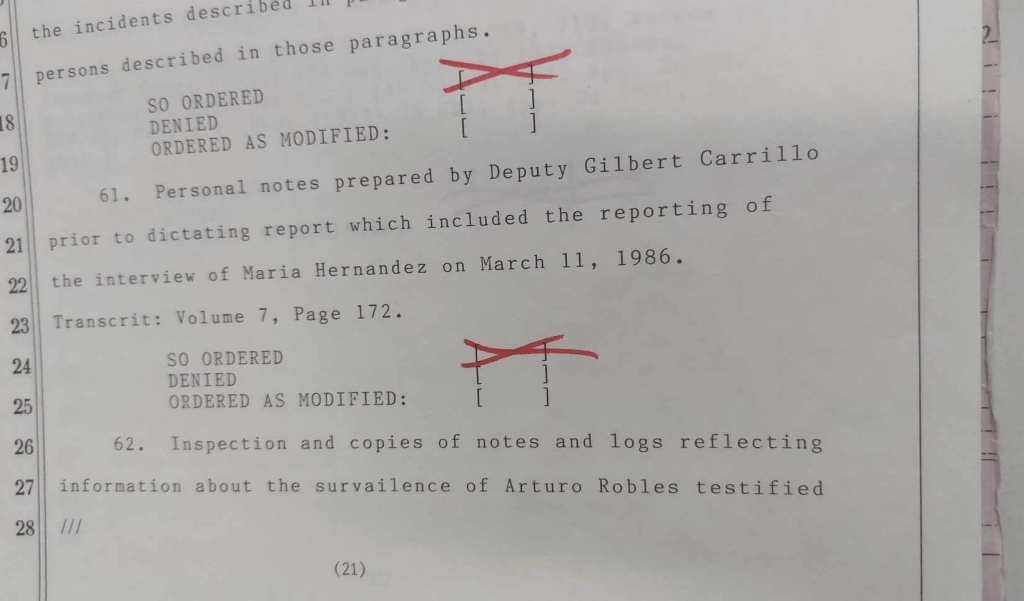
Once the target shifted onto “Richard Mena” (Ramirez’s alias), the narrative changed so the suspect was “six feet tall and thin, with curly hair and stained, gapped teeth”. Robles obviously did not match this, but Ramirez did. The rest is history. Or myth perhaps. Out of all the victims, Maria Hernandez seemed the least certain, sometimes admitting Ramirez did not look like the suspect, yet sometimes she said it was definitely him. On the day she testified at the preliminary hearing, on 11th March 1986, she was interviewed by Gil Carrillo. Why did a detective need to speak to her on the day she was in court? To make sure she said the right thing? It could be interpreted as intimidating or coercive. The idea that the gunman shot her while wearing a hat was also planted in Hernandez’s head by Carrillo. The defence requested his dictated notes from the meeting as well as information on his surveillance of Arturo Robles (they were hoping to suggest he was the real killer), but whether this was raised again at trial is unknown.
There was something else interesting in the court documents. The defence filed that Maria Hernandez only saw the killer for two seconds. It all happened so fast.
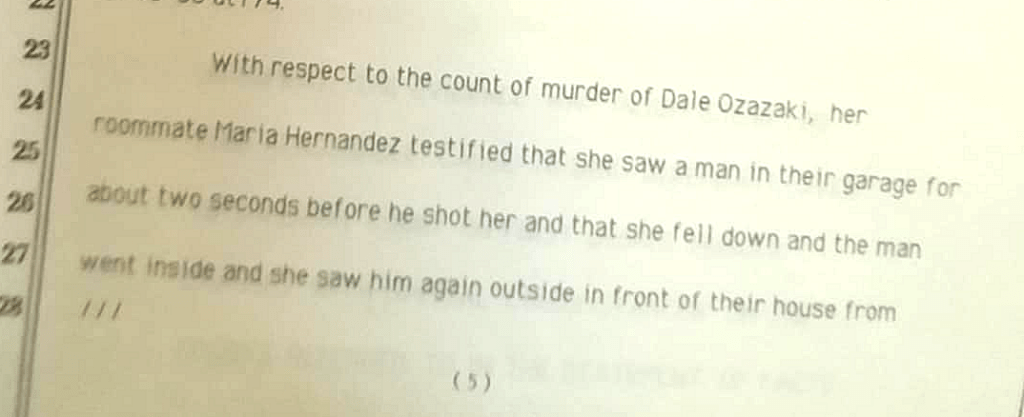
It has previously been written in the petition, and subsequently by ourselves, that Maria Hernandez only saw the killer for eight seconds, because that is how long the light in her garage stayed on. But that was only from Carrillo’s findings. In reality, she must have exited the car, walked quickly around both vehicles and the moment she touched the other door to enter, the killer came in, she looked round, he walked towards her, fired the gun and everything went dark. She next saw him outside in the dark with no streetlights. No wonder she struggled to identify him. It explains why Ramirez and Robles look so different to the composite (we do not know what Miguel Paez looked like). She really struggled with this identification for good reason and the whole process must have been quite intimidating. It is shameful that documentaries and films peddle the lie that she had a clear view of a dishevelled man with rotten teeth. How could she have seen his teeth when he never spoke to her?
Also, a reminder that our book is for sale here. Spread the word (if you feel like it)!
-VenningB-
Disclaimer: we have since seen several people online citing our blog or book as evidence that Robles was the child abductor. We are not. We have never said that, merely that Carrillo has implied he was.


 Expendable For A Cause.
Leave a reply to VenningB Cancel reply