San Quentin Part 1: Ramirez’s Life on Death Row

San Quentin, what good do you think you do?
Do you think I’ll be different when you’re through?
You bent my heart and mind, and you warp my soul
. 
Your stone walls turn my blood a little cold.”

– Johnny Cash “San Quentin“ 

San Quentin Prison and Richmond Bridge (photo Yahoo News)

Founded in 1852, San Quentin State Prison is California’s oldest correctional facility. Located on a peninsula north of San Francisco in Marin County, San Quentin is surrounded by barbed wire fence, tall walls, and watch towers with expert sharpshooters and assault rifles. Yet, it boasts breathtaking views of the San Francisco Bay. San Quentin was initially established to replace a prison ship. Legend has it that on July 14, 1852, Bastille Day in the French Revolution, the ship arrived off the coast of San Francisco with over 40 prisoners. Hence, San Quentin has been known as the “Bastille by the Bay.”

San Quentin has been the site of executions in California since 1893. In 1938, lethal gas became the official method of capital punishment, with prisoners being gassed to death in the sinister, 7½-foot-wide, octagonal, green death chamber. In 1972, the United States Supreme Court struck down the death penalty, declaring that “the imposition and carrying out of the death penalty constitutes cruel and unusual punishment in violation of the Eighth and Fourteenth Amendments,” only to reinstate it in 1976.

Since then, over 1,000 people have been condemned to death in the state of California, including Richard Ramirez. Of that 1000, 13 have been executed, while more than 100 have passed away from other means inside the prison walls.

Due to the lengthy appeals process in the state and the procedural safeguards required by the courts in capital cases, prisoners typically spend over 20 years on death row. They are more likely to die from illnesses, suicide, or be killed by a fellow inmate or prison guard than executed. The vast majority of those sentenced to death have been people of color, and more than one-third of individuals on death row have been diagnosed with severe mental illness.

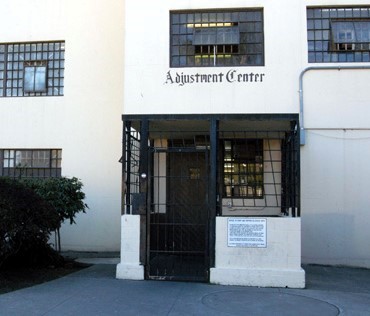
San Quentin Adjustment Center (National Geography)

The Adjustment Center is SQ prison’s maximum-security cell block, also known as “the hole.” This is where prisoners are sent for punishment, and new death row inmates begin their sentences. It is described as a “prison within a prison.”

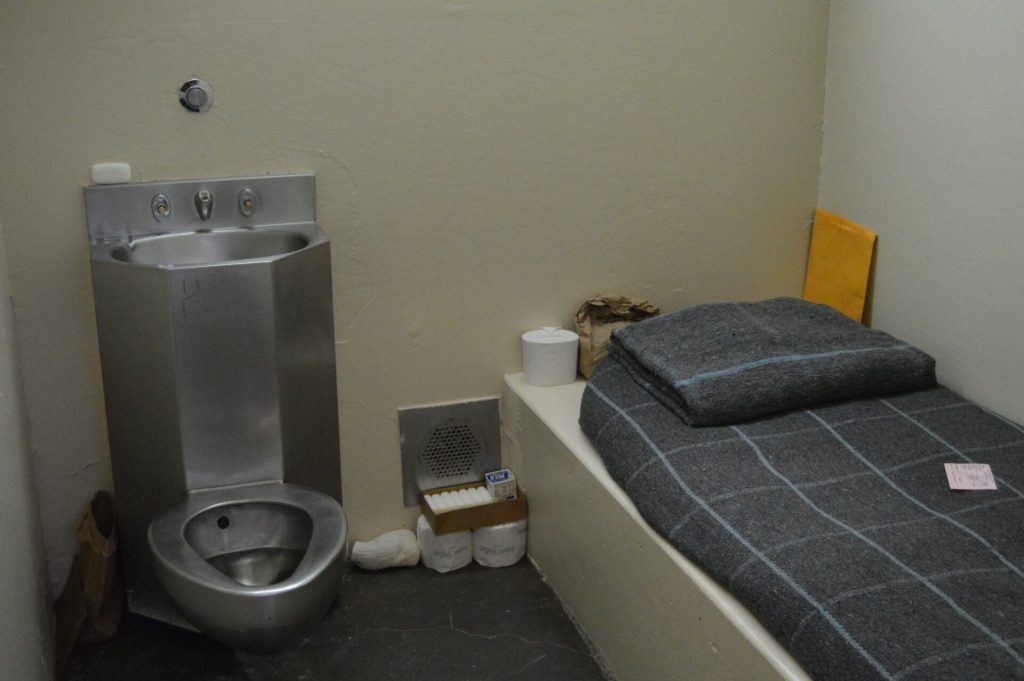
The Adjustment Center is the harshest of the three death row units at San Quentin. It is severe even compared with other isolation units in the California prison system and most death row units in other states. Residents spend between 21 and 24 hours a day, sometimes for years, inside cells smaller than a standard parking space. There is no natural light (cells do not have windows) or airflow; temperatures fluctuate from hot to cold. Beds consist of a thin mattress on steel or concrete slabs; there are no chairs or desks.

Those living in the Adjustment Center are constantly exposed to noise due to the slamming of security gates and cell doors and residents shouting or banging, either in attempts to communicate with one another or as a primal response to their intolerable conditions. The ongoing commotion contributes to chronic sleep deprivation, one of the many adverse health effects of long-term confinement in the Adjustment Center.

Before and after any movement within the Adjustment Center, inmates are routinely strip-searched, often in front of other prisoners and guards, even if they have not come into contact with anyone else during their time out of the cell.

Inmates may only leave their cells for a few reasons:

  • Yard visits, in an exercise “cage,” at most three times per week for three hours each.
  • Showers (no more than three times per week).
  • Medical visits (ONLY if prison guards decide you warrant a trip to medical).
  • Rare opportunities for visitors, which occur behind a dirty Plexiglas window through a poor-quality two-way intercom.
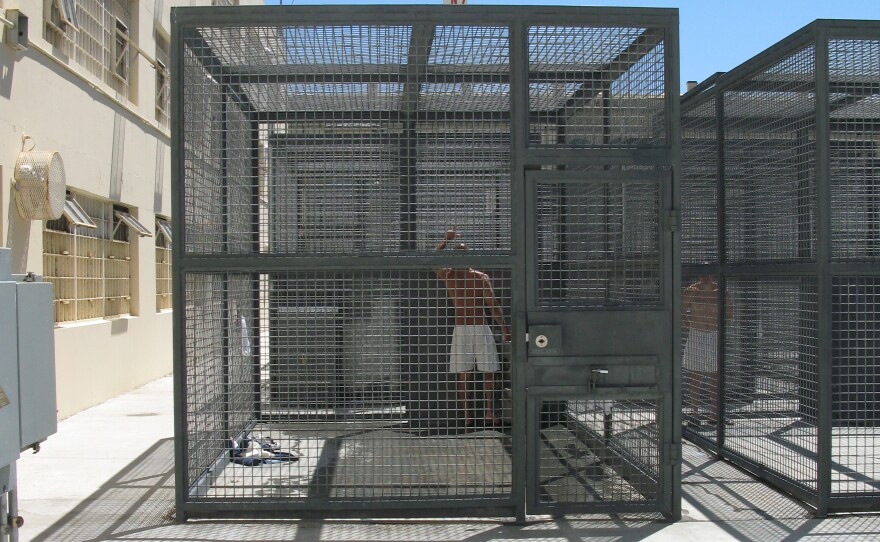
“Exercise cages” for Adjustment Center prisoners (Getty Images)

Richard Ramirez in “The Hole”

On November 17, 1989, Richard found himself being flown by helicopter from the Los Angeles County Jail to the San Quentin Adjustment Center. The cell was 6’x8′ cell with an aluminum toilet, sink, and bunk bed. Per Philip Carlo’s The Life and Crimes of Richard Ramirez, Richard’s cell was “3AC8” pictured below.
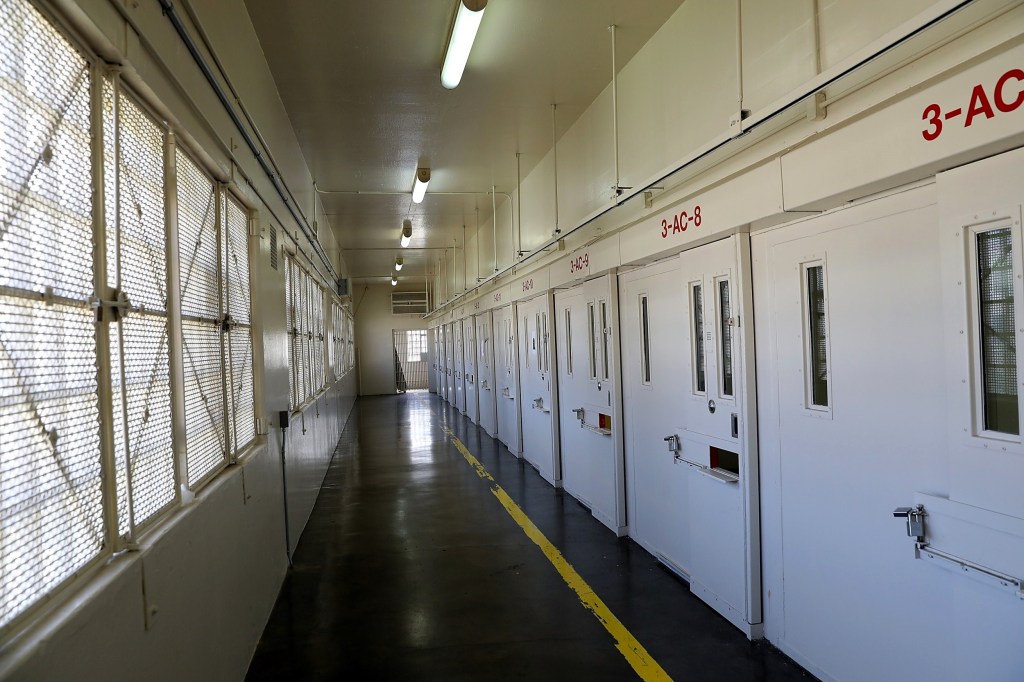
  Cell block at San Quentin’s Adjustment Center (Justin Sullivan/Getty Images)
Adjustment Center cell at San Quentin (Metroactive Archives)

He had no phone access and was only allowed visitation through a Plexiglas window for two hours a week. He remained here until he was transferred to the San Francisco County Jail to await trial for the Pan crimes in February of 1990. He was transferred back to San Quentin on September 21, 1993, although legal proceedings had not concluded in S.F. This is because his “groupies” presented security problems. The following is from the San Francisco Examiner:

“The [San Francisco County] Sheriff’s Department sought the transfer because “the Sheriff’s staff must spend an inordinate amount of resources in an effort to accommodate Ramirez. [He] has numerous visitors … which require an additional deputy to be assigned to the jail’s visiting lobby.”

– San Francisco Examiner, September 3, 1993
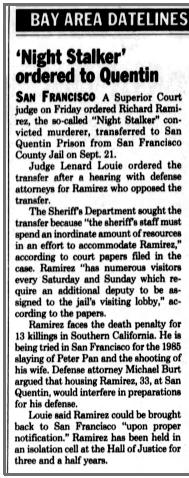
Richard was returned to the Adjustment Center. Even though a prisoner was not supposed to be kept there for longer than three months, Richard spent over three years there. His attorney, Michael Burt, had to make repeated requests to prison officials for Richard to be moved to a unit where he could have phone access and increased visitation.

When Richard was transferred, prison guards performed a metal detector scan that revealed Richard allegedly concealed objects inside his body. Consequently, he was escorted to the prison hospital, where an X-ray confirmed the presence of items in his rectum. We can only speculate on the desperation that compelled Richard to resort to such extreme measures – that is if the story is true. Below are two newspaper clippings.
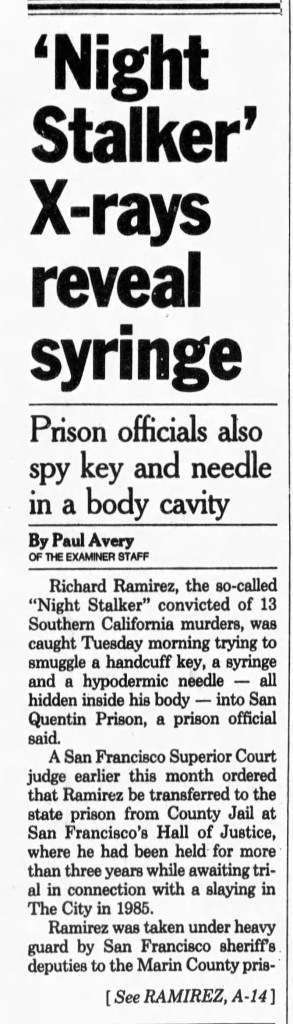
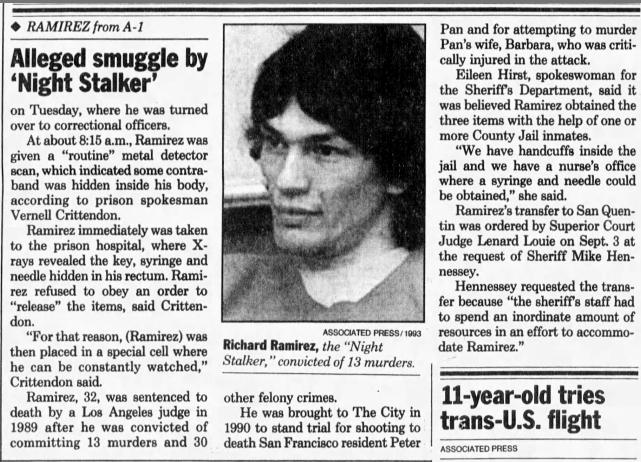
San Francisco Examiner, September 21, 1993

East Block

Richard was moved to East Block, the five-tier, main death row cell at San Quentin, in June 1996. This is where he spent the remaining 17 years of his life. There are few sources available detailing what life was like for Richard as a condemned prisoner. In his interview with Philip Carlo, Richard said his cell in East block was even smaller than the one he had occupied at the Adjustment Center.
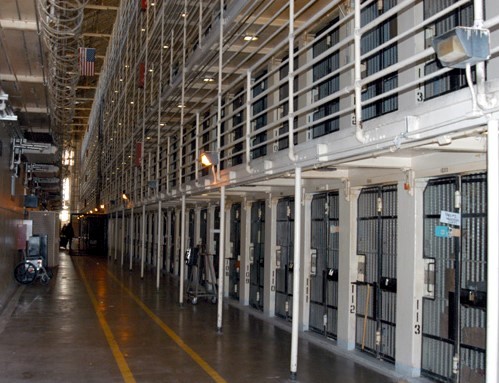
East Block (AJ Hardy)

Although Carlo used creative license in writing his book, he did include excerpts from his interviews with Richard in the special update of the tenth-anniversary edition. Below is a portion of an interview conducted by Carlo while Ramirez was incarcerated in East Block:

Carlo: What’s it like living on death row, Richard?”

Ramirez: It is monotonous, it is boring … because it is so boring it breeds tension. There’s a lot of tension in here. Frustration … you never get used to it. I myself only tolerate it. I have acquaintances – no friends. Every day, it’s the same routine. The walls close in on you.

Carlo: How many hours a day are you actually in your cell?

Ramirez: Well, like I told you, the program they have me on now – which is maximum security – I got out sixteen hours a week.

Carlo: So are you locked up twenty-four hours a day?

Ramirez: On some days, some days, yeah. I go outside for about five hours on Tuesday, I got out five hours on Friday and I go out five hours on Sunday.

Carlo: How’s the food on death row?

Ramirez: Edible.

Carlo: Are you able to eat with the prisoners on death row or do you –

Ramirez: They feed us in our cages.

Ramirez, in his interview with Carlo, gave his opinion on how unnatural it felt to be on death row.

“Sometimes it feels very strange to wake up and be in that cage, in that cell and … I don’t think man was meant to be locked up in such a way. Maybe they had a thing going on in the Western days [old West] where they would just lynch the guy right off the bat, see what I’m saying? But they don’t do it now like that.”

Richard theorized on the reasons the death penalty appeals to people and who is more likely to end up on it:

Ramirez: As far as the death penalty is concerned, I think it is a power against the powerless. There are not many millionaires on death row … The death penalty is … to me … is not a very dignified way.

Carlo: Do you think that the government does not have the right to take a life, or do you feel that in certain crimes –

Ramirez: Well, they’re doing it for the victims. If the relatives of the victims want the killer’s blood … uh … I think one of the relatives should pull the plug, the switch. But they leave it up to the state and … that is something to look at.”

Death Row Romeo

In a Current Affairs episode aired in 1991, Richard was labeled the “Death Row Romeo” due to his reputation with “groupies.” How does one become a “Romeo” when locked behind iron bars, under the watchful eye of security guards 24 hours a day?

Ramirez downplayed his “sex symbol” status as shown in this San Francisco Examiner article, dated August 3, 1991. It claims that eight to 10 women arrive every week. Other times, there were so many that they had to be turned away.
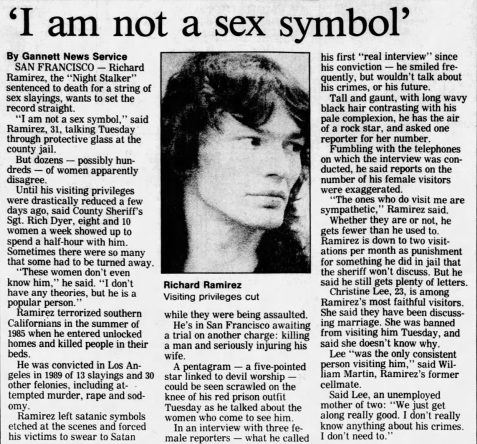
Richard was modest about why women were visiting him. It says:

“He said reports on the number of his female visitors were exaggerated. “The ones who do visit me are sympathetic.”

While many women wrote letters to Richard and visited him, that was the extent of his relationship with most of them, as he was not allowed physical contact visits, except for Night Stalker trial juror, “Cupcake” Cindy Haden, and Doreen Lioy – who later married Richard.

Haden was only allowed physical contact visits after becoming a private investigator and alleged that she wanted to help with Richard’s case. Doreen wasn’t allowed contact visits until Richard was moved to East Block in 1996, four months before the “Death Row” wedding, on October 3, 1996. Below are two newspaper clippings about his marriage.
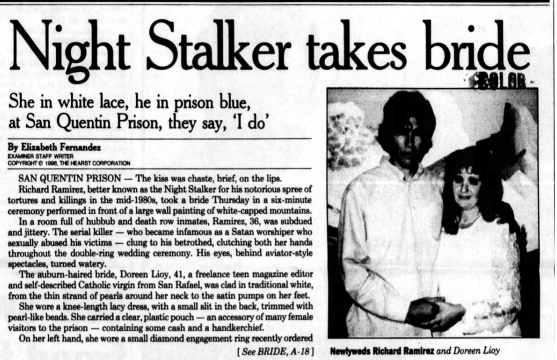
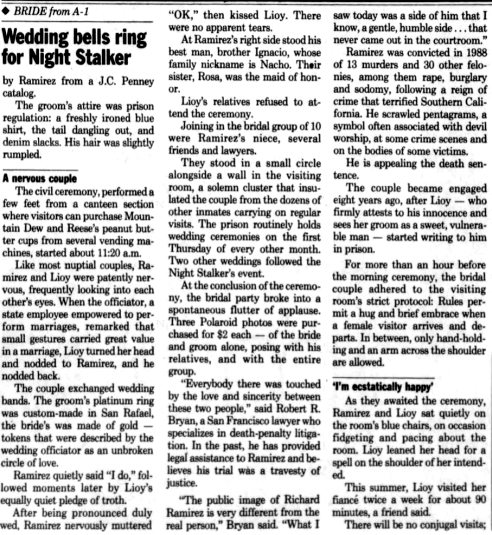
San Francisco Examiner, October 4, 1996

Carlo’s interview concludes with Richard’s hopes for his future:

He says he was railroaded and has hopes in the appeal. He has changed much in the eleven years since August of 1985. He’s gained thirty-five pounds and he’s mellowed out … But by no means has he adjusted to the reality of his existence. He does not like being in the adjustment centre, saying it’s cruel and unusual punishment, and he often paces his cell like a caged panther … Richard believes he will win the appeal, win at a new trial, and be set free”

2008 Federal Petition for Writ of Habeas Corpus, Richard Ramirez vs. Robert Ayers

Night Stalker. The Life and Crimes of Richard Ramirez, Philip Carlo, 1996

https://www.cdcr.ca.gov/facility-locator/sq/

A look at the hard life inside San Quentin’s Death Row (sfgate.com)

What it’s like on California’s Death Row | KCRW

Death Row prisoners challenge torturous conditions in San Quentin’s ‘Adjustment Center’ (sfbayview.com)


KayCee

Jan 14, 2024

40 responses to “San Quentin Part 1: Ramirez’s Life on Death Row”

  1. This is disgusting to read, such conditions are inhumane and violate so many rules and regulations. This is not a place where someone’s supposed to stay for weeks, imagine decades!

    I’m glad Doreen stuck with him till the end. In one of his last letters from 2013 he was telling a pen pal thanks for writing, because so many people suddenly stop. I wonder if they did stop, or if the guards didn’t simply throw a whole lot.

    Liked by 4 people

    1. That was sad. Also there was one letter where he asked a boy to write bigger, because he was in the ‘hole’ and didn’t have his glasses. That’s wrong to take someone’s glasses away.

      Liked by 4 people

      1. It is wrong to take a basic need like glasses away from someone, especially when that is their means of communicating with the outside world. It’s incredibly sad and screwed up!! When someone is sentenced to death, they’re aren’t sentenced to be tortured also. Clearly the conditions are comparable to that and happen routinely.

        Liked by 4 people

    2. Yes, it’s terrible. Even people on death row shouldn’t be subjected to torture or inhumane conditions. I’m also glad Doreen was there for him. That’s a good question about his mail. Considering how the mail is scrutinized, it wouldn’t surprise me if they withheld his.

      Liked by 3 people

  2. Thank you for this article, Kaycee. It was very informative.

    Liked by 1 person

    1. You’re welcome. Thanks for reading and commenting.

      Liked by 1 person

  3. Idk.. He went in and out “the hole” all the time. I think sometimes that he provoked it. For a loner like him East Block must have been horrible too. There you don’t even have solid doors, just mesh. No privacy. If I imagine the noise, the smell etc, I believe, I’d have preferred “the hole” . The problem is that “the hole” doesn’t only mean the location, but there are other restrictions too. And that again would have made me wish to leave the hole. I don’t know if it was similar for Richard, but somehow I got the impression.
    Regarding Doreen. I don’t think that she was there for him until the end. They were still married, but he didn’t have any visitors during his last years.
    I’ve seen a letter, in which he wrote: Oh, I CAN get visits, but at the moment I’ve decided not to see anyone. (or similar wording, the letter was partially covered by the envelope, so I couldn’t see every single word) There was no date, but it must have been an after 2009 letter. He also wrote in another letter that it was his biggest mistake that he had married Doreen. I don’t think that they were still in contact during his last years.

    Liked by 2 people

    1. Yeah they definitely lost contact. We don’t know why at all. People say it was over Mei and it’s tempting to speculate that he was upset that she believed he did it because of ‘DNA evidence.’ Maybe that’s why he wanted to isolate himself because he felt that his chances of getting out were over. I heard he would expose himself to guards and was punished for it; maybe that’s why he was in the hole. But he was never going to stop doing stuff like that because of temporal lobe disorder.

      Liked by 3 people

      1. Yes, I’m not sure if it was because of temporal lobe disorder or if he did it purposefully (to scare certain people away, to provoke someone, to provoke punishment etc. He didn’t do it to everyone.
        Regarding Mei, that was a big break in richards life. People couldn’t not react on it. Even if someone didn’t say anything, there were glances that asked etc. I believe Richard wanted to avoid all that.

        Like

      2. It’s not a normal behaviour, so it probably was caused by the brain damage. A rational person doesn’t get their dick out to scare.
        Yeah I guess because the murder was more horrific than others because of her age, people would be extra disgusted. In prison, paedophiles are treated with extra contempt.

        Liked by 3 people

      3. I’ve thought of “Misty” for example. That woman in that documentary about women who have relationships with killers/prisoners. She has 2 children and a husband and anyway she had written Richard 20 letters a week for months. They also wrote about sex intheir letters. When she visited him, Richard exposed himself to her. Considering the content of their letters maybe he thought that was the purpose of the visit. Or 20 letters a week were too much for him and he thought: ok, if I “do it” and she then stops writing me, I’m fine with that. No effort, double win. (she didn’t stop writing him)
        Regardin Mei: the situation would have been difficult in any case. If he did it and people would react on it. Or if he didn’t do it and people wouldn’t believe him because of the DNA that was found.

        Liked by 1 person

      4. The penpals interest me a lot less than the case/trial, if I am honest. However, with Misty, and all the others that exchanged sex letters with him, what did they expect? I agree with everything you’ve said.

        Liked by 1 person

      5. He wrote about sex in a lot of his letters. For a man locked up with other men, never free to have intimate relationships, he didn’t have anything else to deal with those kind of needs.

        Liked by 3 people

      6. Indeed. It shouldn’t be that surprising, really.

        Liked by 2 people

      7. In one letter (a later one, written in capitals) he wrote that he got about 50 letters a week. To answer them is literally work ( and I think he saw it as his “job”, his way to to get what he needed: stamps, stationary, money, magazines but also sexy pics and “sex talk”.) I think that’s one reason why his letters were so “strange”. As I already said in another comment, he tried to write just enough to make them look like real letters, to place his requests in them. He also said he was a business man.

        Liked by 3 people

      8. I think that’s a fair analysis, and his letters were strange, without a doubt. It was a good way to keep his mind busy, to be entertained and keep the cash coming in for the supplies he needed. He would have even needed extra cash for food and toiletries. Prison food isn’t plentiful, it’s hard luck on any incarcerated person who has no one in the free world to help.

        Liked by 3 people

      9. It likely helped take his mind of the reality of his situation and gave him something to occupy his time.

        Liked by 3 people

      10. I agree with that. She encouraged and led him on and he was obviously desperate. You’d need to be desperate to flop it out for Misty. 🤣

        Liked by 4 people

      11. He had several illnesses that were definitely contributing factors to his inappropriate behaviors. I have some information on temporal lobe disorder and compulsive behaviors . If you want to see, let me know.

        Liked by 3 people

      12. And we know he exposed himself because of compulsive behaviors.

        Liked by 2 people

      13. His TLE had a definite bearing on those behaviours.

        Liked by 2 people

    2. Doreen was his biggest mistake? Ha ha!! That’s quite a take on his life, when you think about it, if he thought she was the worst mistake. He did refuse contact with her, and with everyone else, but when all was said and done, when he died she stepped up and dealt with things. You may have seen KayCee say on another post, that it was Doreen who had his ashes scattered in accordance with his wishes.

      Liked by 4 people

      1. No, I haven’t seen this comment. Regarding his ashes, I’ve heard that too, but could never verify it.

        Like

      2. Yes, it’s true. She did step up and was there to see it through. Whatever happened between them, I admire her for that. But not for ghoulishly selling the box that contained the ashes and the toe tag, that’s just grim.

        Liked by 1 person

    3. Based on information from someone who actually knew him, it seems Richard was the one who pushed Doreen away. I think there was a point when he chose not to have visitors because he had become quite ill ( lymphoma). As for provoking incidents leading to him going to the hole, I really can’t speculate on that but I’m not sure he would have preferred the hole to East Block. He couldn’t even use the phone in the hole. Plus it’s even more restrictive.

      Liked by 3 people

      1. But Sam Robinson said that he wasn’t ill, only at the very end for a few weeks. And he refused to have visitors for several (3,4?) years. I think it was because of Mei. He didn’t want to get asked about it and he didn’t want to see the reactions of people. Even if they wouldn’t have talked about it, there would always have been that elephant in the room.

        Liked by 2 people

      2. His death is another mystery. The certificate said the onset of his illness was just weeks. Not to mention that it sounded like liver failure yet that is not listed as the primary cause of death. And he didn’t see people for about three years, you’re right. Police told the world it was his DNA at the scene before confirming it in the lab, then by 2010 it was supposedly confirmed and it coincides with his refusal to see others.

        Some people who he called said he sounded fine just weeks before death. It’s suspicious to me. And weird.

        Liked by 2 people

      3. I was just going to mention the death certificate, you beat me to it. Yes, avoidance of the “elephant in the room” is a good explanation for those last few years of solitude.

        Liked by 1 person

      4. If it was liver failure, he would have been chronically sick for years before passing away, with the symptoms gradually getting worse over time. Yet another mystery. Remember that news article that said one of the security guards at the hospital said he was doing stretches in the bed the day before he died? Which if he were actively dying, I don’t think would have happened. But who knows? My niece passed away when she went in for scheduled inpatient treatment for non-Hodgkins’s lymphoma. She felt okay when she was admitted but went into cardiac arrest during one of the treatments. But I doubt Richard was getting any treatment that would have caused him to go into cardiac arrest. How I wish I could get his medical records and make some sense out of all of this.

        Liked by 2 people

      5. Maybe, then again maybe not. Someone who knew him and his family said he only wanted to see one individual the last few years of his life, his brother Nacho. This person believes it was because he was ill, and he knew Nacho could relate because of all that he had been through. Sam Robinson can’t actually disclose anyone’s health information so I wouldn’t consider his statements about Richard’s health to be factual. Him telling anyone anything about Richard’s health violates privacy laws because health information is not a public record even after someone dies. The only reason we can find Richard’s death certificate is that death records are considered public records. The whole Mei situation makes me feel bad for him. It was just another way for law enforcement to malign him and darken his name.

        Liked by 3 people

      6. I tried to find the interview with Sam Robinson, but until now I could find only that part of it in which he talks about Richard exposing himself towards guards etc “about half a dozen times” . The reporter had asked him also if Richard had dementia or anything like that and then she said that Robinson said that he was “sharp as a tack” and of all of his full capacities until the end. I know that there was more of this interview, but can’t find it anymore. And I don’t remember what exactly Robinson said and what the reporter said.

        Liked by 1 person

      7. I found the interview with Sam Robinson. He really doesn’t say much about Richards health, but he answers the reporters question if Richard was sick with “Recently, yes.” The video is only available on the Internet Archive . If you search for “KRON June 7, 2013 5:00pm-7:01pm PDT” and then scroll through whe snippets you should find it. They talk about Richard the entire evening and there are some interview snippets with Robinson on the 5.00 pm and on the 6.00 pm news.

        Liked by 3 people

      8. It makes me sad, hearing them talk about his death, does it you? Especially knowing what really happened in his trial.

        Liked by 1 person

      9. Richard would probably say sth like: Don’t defend me to the naysayers. (as he wrote to a pen pal) Me? As I already said in another comment, Richard is my “black mirror” . He somehow had/has a revealing quality. People reacting on him often show who they really are. And often they don’t even realize how cruel and violent their own thoughts are (or sometimes just dumb or arrogant) . And yes, it hurts to see how people are. The so called good people! (or people who consider themselves good people) I guess it’s just the truth to face.

        Liked by 2 people

      10. I find it interesting how polarising he is/was, but people see what they want (or expect) to see.

        Liked by 3 people

  4. Per quanto riguarda Dooren ,pare che avesse rimandato indietro una lettera di Richard ma è davvero difficile credere a qualsiasi cosa si trovi in rete ,ognuno come al solito dice la sua .

    Like

    1. Questo non lo so, ma ha interrotto i contatti con lei, quindi è del tutto possibile. Temo di non parlare italiano, quindi spero che la mia risposta abbia senso.

      Like

  5. Si grazie 😊

    Like

  6. karinac110a37110 Avatar
    karinac110a37110

    I’ve been intrigued by RR and his case for over 6 years now.. but have never once read Carlo’s book after hearing RR wrote in a letter that it’s 70% true 30% incorrect or exaggerated. Should I still read it? Does it include any information that hasn’t been covered? 🤔

    Like

    1. The only part of Carlo’s book that’s worth reading is the trial section. The rest reads like a crime novel, or a story that’s ‘based on true events’.
      Carlo writes well, and he’s engaging, but take it as Richard said; Carlo takes liberties with ‘accuracy’.
      It doesn’t contain anything we haven’t covered, apart from the latest edition, which contains snippets of his conversations with Richard at the back.

      Liked by 1 person

Leave a reply to kaycee0823 Cancel reply