
* Images may need to be viewed on a desktop for greater clarity*
“I wonder if I can write this history or if on every page there will be some sneaking show of a bitterness I thought long dead. I think myself cured of all spite, but when I touch pen to paper, the hurt of a boy bleeds out with the sea-spawned ink until I suspect each carefully formed black letter scabs over some ancient scarlet wound.”
Robin Hobb – Assassin’s Apprentice.

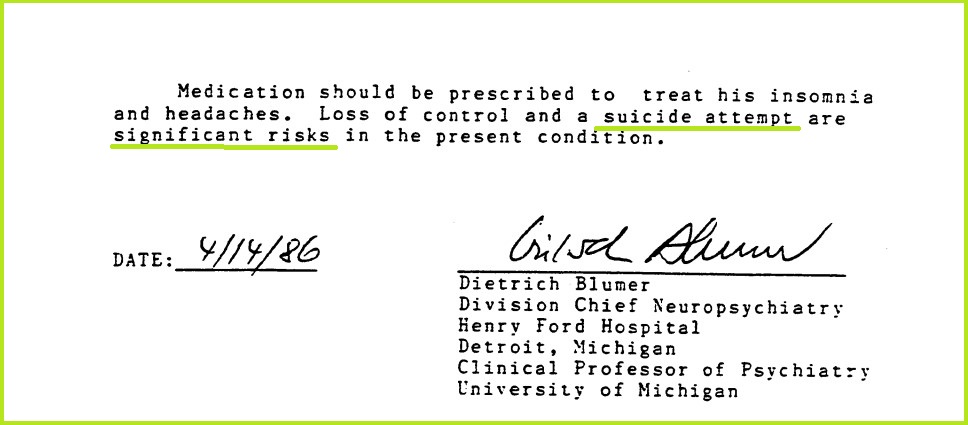
On January 19th and 20th, 1986, only a few months after Dr William Vicary had seen him, Dietrich Blumer, M.D., neuropsychiatrist, examined Richard Ramirez at trial counsel’s request and found he suffered from temporal lobe disorder.
What, another one? Yes, one more in a long line of psychiatrists coming to the same conclusion, pre-trial and post-conviction.
He reviewed Richard’s elementary and high school reports, TYC custody records, and medical history during his evaluation. He also interviewed three of Richard’s siblings.
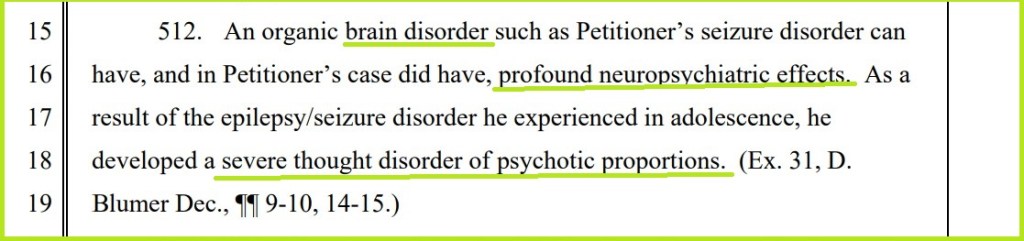
Dr Blumer found Richard “guarded and uncooperative” Blumer was probing him about his affiliation with Satanism and naturally found him closed regarding this; he did not want to be judged insane.
He seems particularly interested in the satanic aspect; this could be explained because of Richard’s famous in-court palm flashing of the pentagram on October 24th 1985, during a hearing to establish his change of lawyers. As a neuropsychiatrist, Dr Blumer possibly found that fascinating.
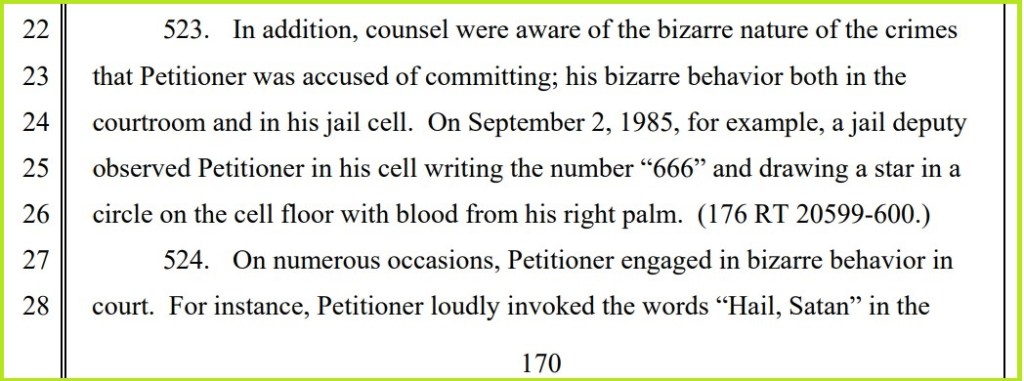
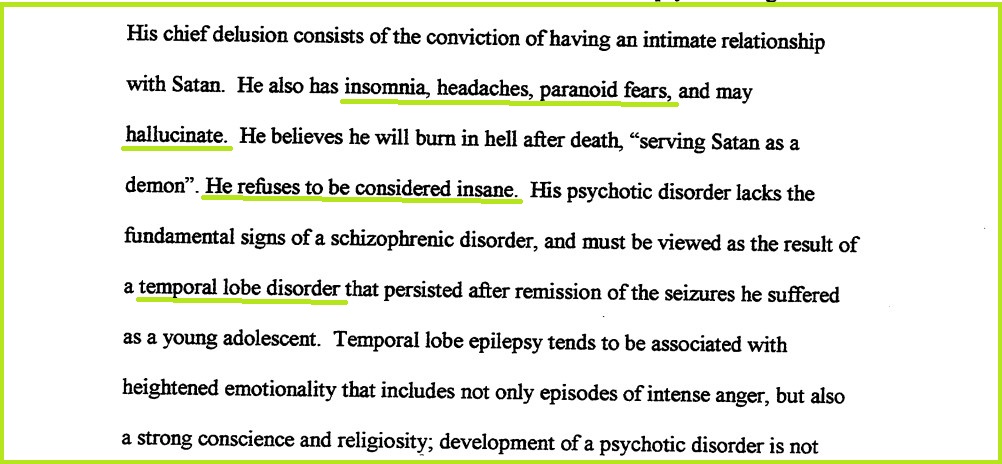
A man with years of experience and many published books and articles on temporal lobe epilepsy and related neurological conditions, Dr Blumer was well placed to give his recommendations; he had successfully treated many patients and opined that Richard’s condition was treatable with the proper medication. He indicated that Dr Henderson, who had seen Ramirez previously, “would know what needs to be done”.
“All of His Life”
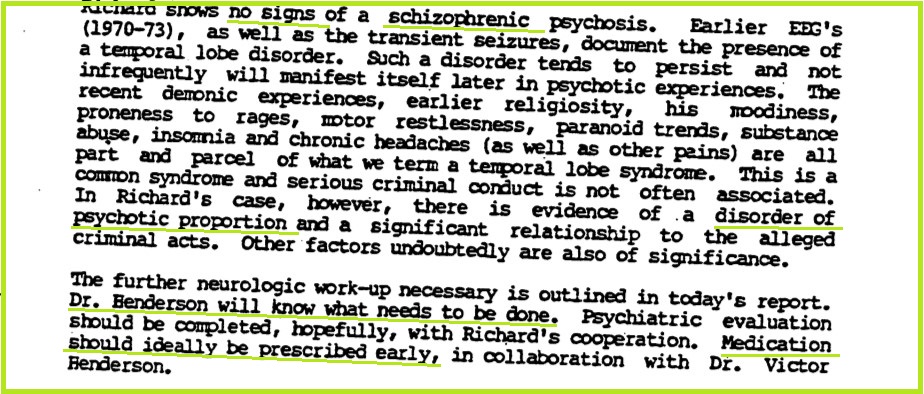
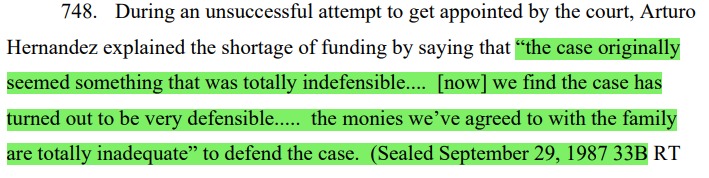
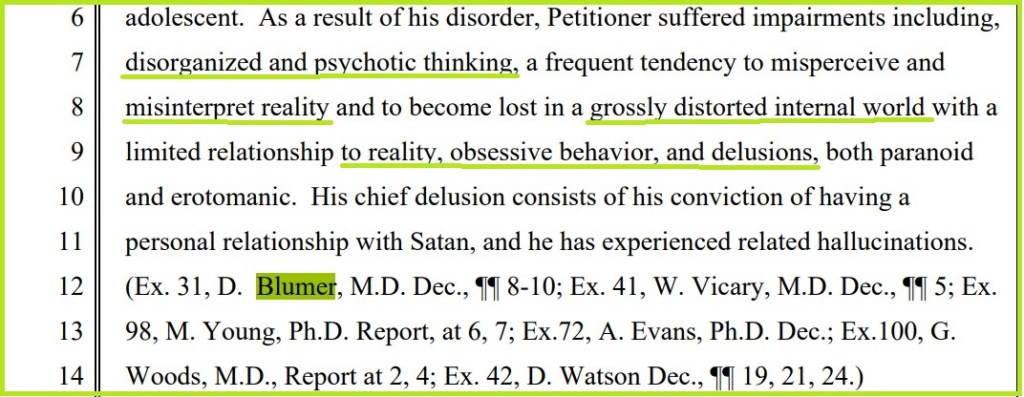
“Dr Blumer has stated that Petitioner’s multiple impairments require ‘proper care and treatment for serious, lifelong neuropsychiatric deficits because [of] … debilitating effects of organic brain dysfunction.’ (Ex. 31, D. Blumer, M.D., dec., ¶ 15.) Dr Blumer’s findings establish that Petitioner is permanently afflicted; he will not recover or regain normal functioning. Treatable, in this instance, certainly does not mean curable. Petitioner has been ill for at least thirty-five years and probably all of his life.”
Writ of Habeas Corpus – page 687
The above statement is taken directly from the 2008 Writ of Habeas Corpus, twenty-two years after Dr Blumer’s original report on Richard was made. He was mentally ill, unable to assist in his defence or understand the proceedings against him, yet the world knows nothing of this. It’s been swept aside because labelling him (incorrectly) as a psychopath draws the crowds.
How can anyone watching the minimal court footage available to us honestly think he was “right”? It is beyond all imagining. What is being witnessed there is disassociation, an act, a character given to him by law enforcement, the court and the media. The image he portrayed, the psychopath known as the Night Stalker, had gone beyond Richard’s control, and, as he said, he would not “give them the satisfaction of seeing me down”. His guilt was already presumed, so he gave the media what they wanted.
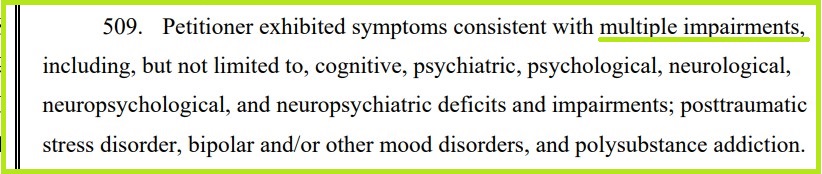
Richard’s mental state during his arrest was exacerbated by involuntary withdrawal from drugs and being locked up in a cell so tiny that his defence team jokingly called it the “phone booth.” Only it wasn’t a joke. His paranoia made him unable to trust those around him, and his main concern was that he did not want to be considered insane. Only Richard could have fully answered why; we can only take a guess. Pride? Stigma? Or his fear of being committed to a psychiatric hospital.
His psychosis, left untreated, dictated how he reacted to the most stressful situation one can imagine, fuelled by paranoia and his instinct telling him that everyone was “out to get him”. In that, at least, he was correct.
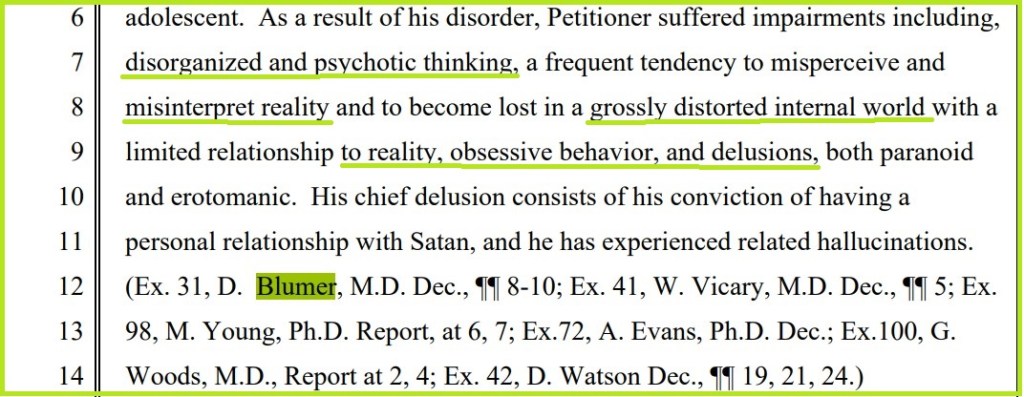

His judgement was severely compromised; he could no longer function rationally, was utterly debilitated, and could not discern who (if anyone) was acting in his best interests. No one was. His defence was working in their best interests, trying to fund a defence as the court refused to appoint them because they were not qualified to practise under the Californian Bar Plan. The case they had taken on thinking it was “indefensible” had been discovered to be defensible after all. Still, they didn’t have the experience, competence or money to enable them to rise to the task, which showed. Daniel and Arturo Hernandez did not develop an alternative defence strategy involving Richard’s mental health for reasons we have explained in previous posts concerning his defence counsel. They knew Richard was mentally unwell, but monetary concerns overrode any other action they could and should have taken.

Eleven
This is a list of the doctors and psychiatrists who all came to the same conclusions in the twenty years following Richard’s arrest. This doesn’t include the ones who saw him during the 1970s.
- William Vicary
- Dietrich Blumer
- Victor Henderson
- Elise Taylor
- Anne Evans
- George Woods
- Myla Young
- Marilyn Cornell
- Robert Schneider
- Dale Watson
- Jane Wells
Eleven doctors discovered how incapacitated Richard was, and it’s about time we put to bed the myth that Ramirez was a “smart” criminal, a mastermind able to outfox and run rings around law enforcement until he met his match. There is nothing further from the truth. In the free world, he could function by self-medicating, existing on a cocktail of drugs as his life spiralled out of control. And although he seems to have been able to interact with those around him, a criminal mastermind, he was not.
It should be noted that out of these eleven, only three saw him before his trial began in 1989. The reason why has been given in previous posts, but I will remind you that it was his San Francisco lawyers who did the work that Los Angeles failed to complete.
“Trial counsel did not ask me to appear in court and testify about my findings and conclusions. I was not directed by trial counsel to evaluate the impact of Petitioner’s disorder upon his behaviour at the time of the alleged criminal acts and his arrest. Moreover, I was not consulted regarding the entry of a plea of not guilty by reason of insanity, Petitioner’s capacity to assist counsel at his capital trial, or Petitioner’s ability to waive his legal rights during trial, including his purported waiver of a penalty trial. If I had been asked to render an opinion regarding Petitioner’s conduct and mental capacity, I would have done so based on my findings set forth in this declaration”.
Declaration of Dietrich Blumer – doc 7-18
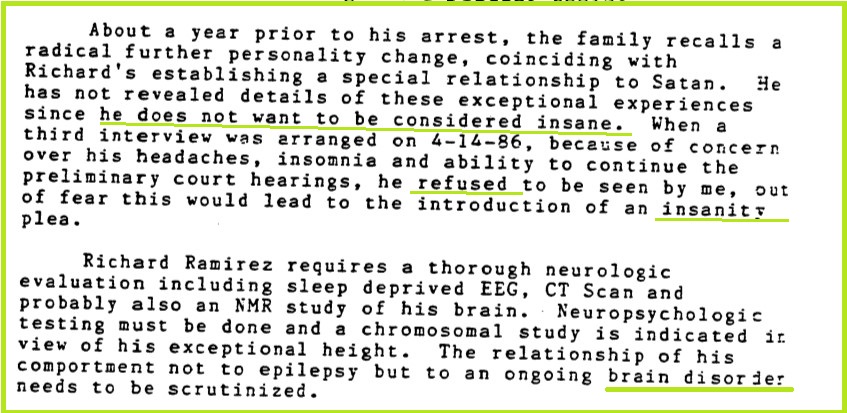
Richard was supposed to see Dr Blumer a third time, an appointment scheduled for April 14th 1986; he refused. Blumer stated that it was because of his fears that an insanity plea would be introduced. Perhaps another reason could be that Richard did not want to be subjected to a chromosomal study; Blumer had indicated that it might be a good idea because of his “exceptional height”. Richard was 6ft 1, very tall but not “exceptional”, surely?
The chromosomal study was never done, and the findings of Dietrich Blumer were not followed up, developed, or presented in court.
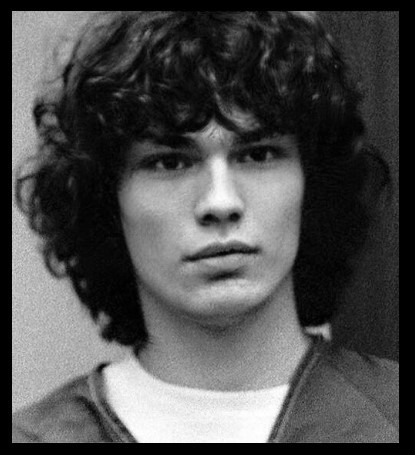
~ Jay ~


 Expendable For A Cause.
Leave a reply to VenningB Cancel reply