
*Images may be better viewed on a desktop*
The One in which a Neurologist Determined he had Brain Damage, and Everyone Looked Away.
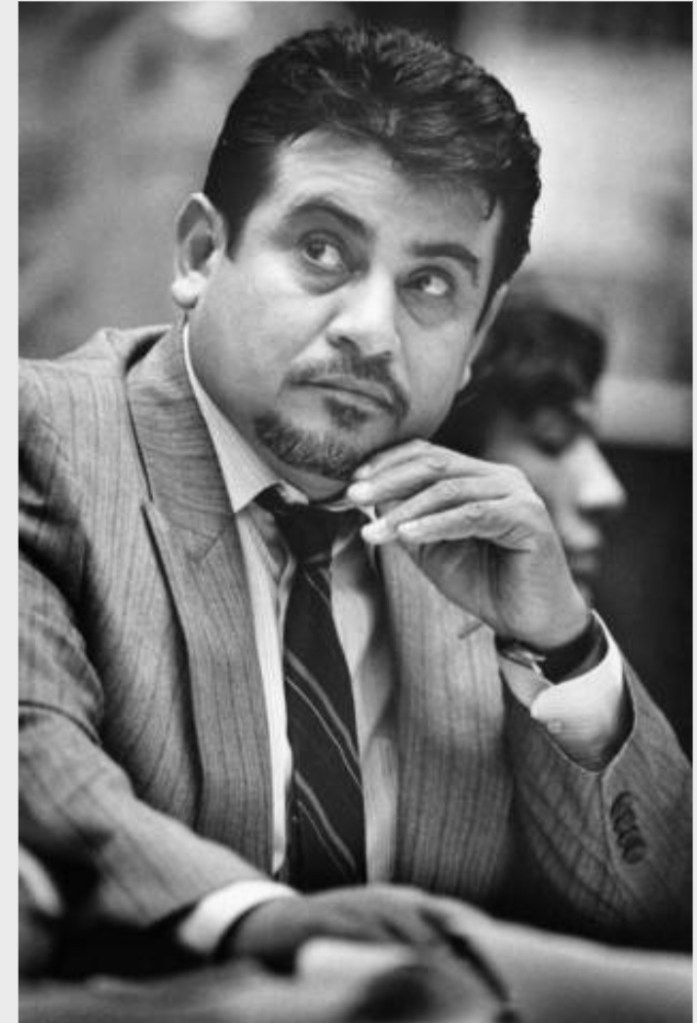
“Denial of due process of Law in a capital trial violates the Fifth, Sixth, Eighth, and Fourteenth Amendments to the United States Constitution.“
The details surrounding the cognitive deficiencies suffered by Richard Ramirez are not something you see disclosed often. The failure of trial counsel (his defence) and the trial court to act upon the findings of psychiatrists who had seen him contributed to a miscarriage of justice.
We have covered some of the mental impairments in previous posts, and those are available to read, so I need not repeat everything here.
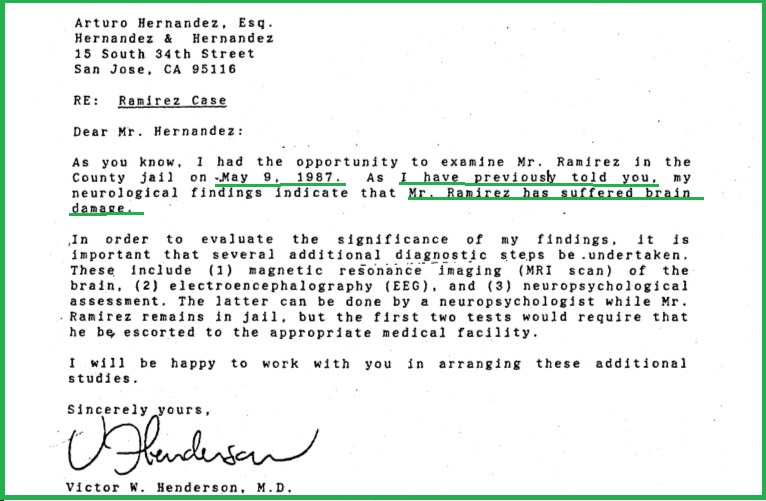
In May 1987, Victor Henderson, M.D., a neurologist, examined Richard and concluded that he had suffered brain damage. He informed the defence counsel of his findings. They provided constitutionally deficient performance in failing to follow up and present the information.
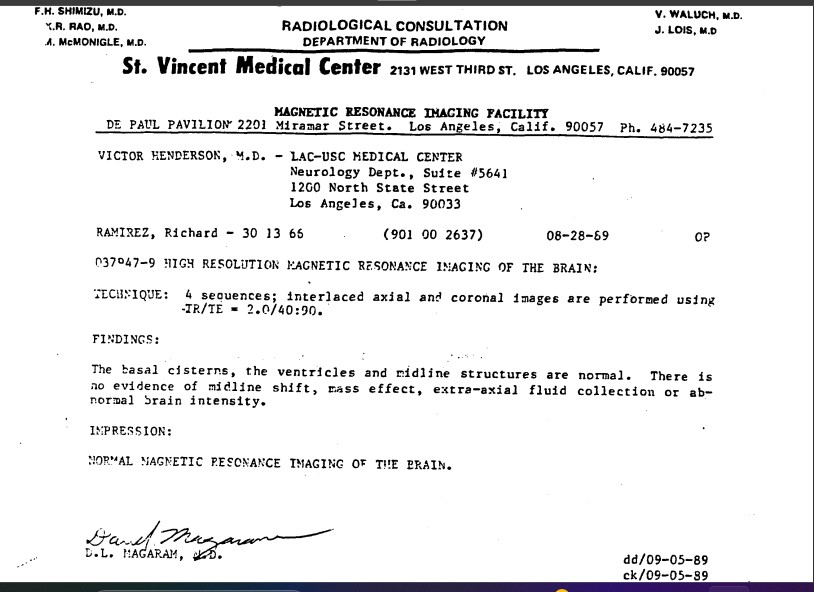
Richard was given an MRI scan, and the results were normal. MRI scans look for physical damage; they can see cysts, tumours, brain bleeds, etc. It looks for physical injury, such as Richard suffered in the 1970s when his EEG results indicated temporal lobe disorder. He would have had to have been having a seizure for the scan to pick it up; most importantly, an MRI cannot detect mental health issues. In the 1990s, the fMRI scan was introduced; the difference between this and the MRI is that the fMRI (functional magnetic resonance imaging) can “see” your thoughts and feelings; it reveals which part of the brain is active if a person is asked to think about something. It helps doctors to diagnose, monitor and treat psychological conditions. More information on the difference between the MRI scan, given to Richard, and the fMRI can be found HERE.
Under California Law Association rules, an attorney must seek to investigate all mental illnesses suffered by their client; they must investigate any improper police or prosecution conduct which will infringe the client’s constitutional rights. Any sources of information must be brought forward and scrutinised, especially in cases where death could be an outcome.
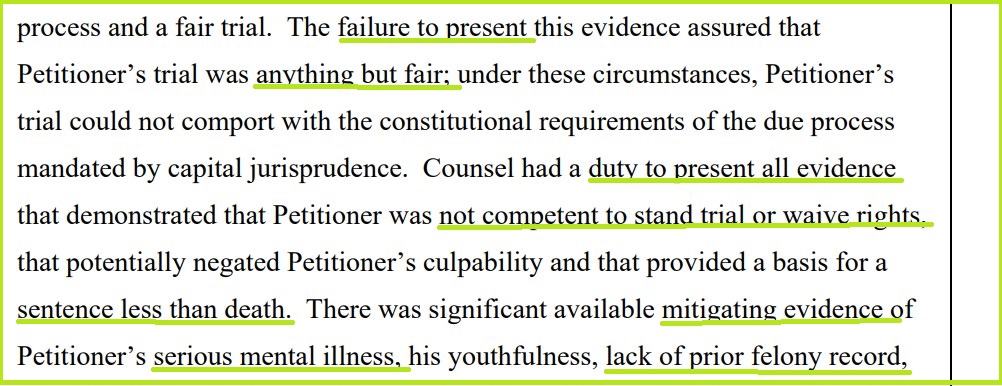
The duty of the attorneys was to present all evidence that showed that Richard wasn’t competent to stand trial, waive his rights and assist in his defence.
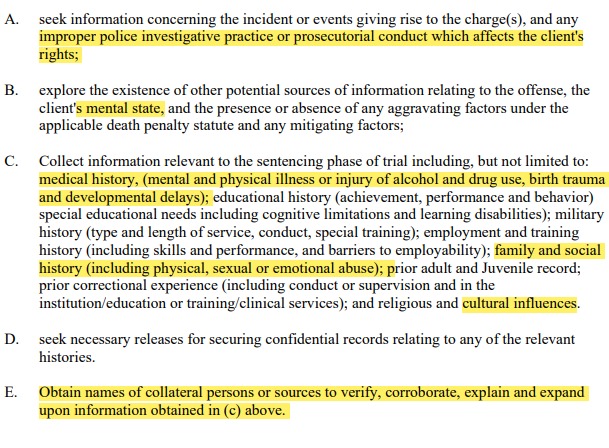
In the Best Interests of the Client
In Richard’s trial, we’ve seen how a conflict of interest led to his mental state being covered up due, in part, to his defence counsel being short of funds and the trial court turning a blind eye as he was hustled on towards a judgement of death. Under the Constitution of the United States of America, Ramirez should not have been considered “death worthy”. Having failed to present the evidence to challenge the prosecution over the charges, his defence counsel should have used their information about his mental capabilities, as it was in his best interests. In this, they also failed.
“When the courts are not likely to properly enforce the rules sua sponte, attorneys must seek to enforce the rule.
Else their clients will die.”
(Sua sponte – Latin for “of one’s own accord; voluntarily.” In Law, it means that a court has taken notice of an issue on its motion without prompting or suggestion)
California Law Association Rules
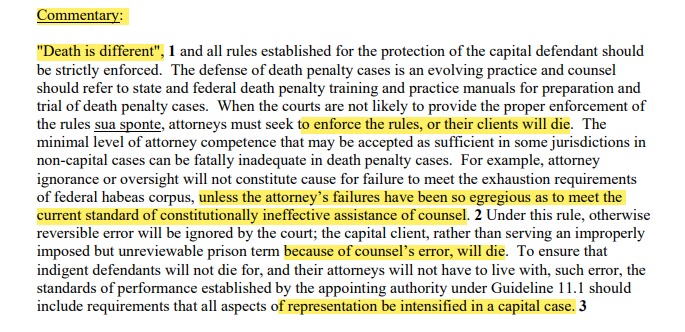
It is self-evident that no one enforced that rule.
“Trial counsel’s errors and omissions denied Petitioner the right to present a defence and to present all relevant evidence; the right to cross-examine and confront witnesses; the privilege against self-incrimination; the right to a jury determination of every material fact; the right to compulsory process; the right to a reliable, rational, and accurate determination of guilt, death-eligibility and death-worthiness, free from any constitutionally unacceptable risk that those determinations were the product of bias, prejudice, arbitrariness or caprice; the right to be subjected to the death penalty only if reliable evidence was properly introduced proving that Petitioner was death-eligible and death-worthy; the right to a trial free of intentionally, demonstrably or inferentially false inculpatory evidence; the right to the effective assistance of counsel; the right to due process and the equal protection of law; and the right to a fair trial and to a reliable and appropriate penalty as guaranteed by the Fourth, Fifth, Sixth, Eighth, and Fourteenth Amendments”
Writ of Habeas Corpus page 488
A Circus
I have read other petitions of Habeas Corpus; most are a couple of hundred pages long; the 2008 Habeas Corpus petition of Richard Ramirez contains nearly 800 pages, with perhaps another 300 pages of supporting documents; it is immense, and most of the information it contains is unknown, nor does it feature in the countless podcasts and websites dedicated to the subject of “true crime”. No one talks about it. “Oh shhh, there’s nothing to see here”, “Fake news”, and “It never happened”. Well, it did happen, and few want to acknowledge that a mentally ill man was sentenced to death in the face of weak evidence in a case that the prosecution did not prove beyond a reasonable doubt. A case in which forensic specialists working for post-conviction lawyers were denied greater access to the evidence to further their conclusions. When ballistic and projectile testing is faulty, the participating firearms officers cannot agree on the outcome.
The inconsistencies persist, even down to the details of what model of Avias he purportedly wore.
His illnesses changed to manipulations and a DA being soft on crime in San Francisco. Are we supposed to discount all the reports and tests on him?
In favour of the accepted story?
We are, or so it seems.
If you ever find yourself in similar circumstances, get a decent lawyer if you can afford it. To be poor and saddled with incompetent attorneys means death.
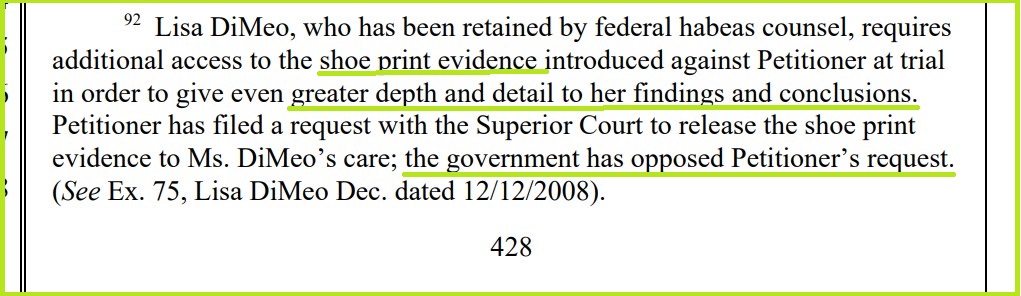
Why the government refused a forensic specialist working for the defence, a deeper look at the evidence, you can make up your own mind about.


There are more questions than answers.
~ Jay ~


 Expendable For A Cause.
Leave a comment