Spill-Over

This post will concentrate specifically on Claim 20 of the Writ of Habeas Corpus, filed in 2008: the trial court’s denial of the motion to sever unrelated incidents.


Richard, not looking particularly blonde or Asian, in court, despite eyewitness reports.

Facts: On September 30th, 1987, Richard’s counsel moved to sever counts compromising of fifteen incidents: forty-three charges and nineteen special circumstances. The grounds given were:

  • The crimes were not connected in their commission.
  • The offences were not cross-admissible.

They wanted to sever the charged crimes into eight separate trials, based on cross-admissibility of the evidence, as follows:

  • Petersen and Abowath (common ballistics evidence)
  • Hernandez/Okazaki, Yu and Kneiding (common ballistics evidence)
  • Khovananth and Zazzara (common ballistics evidence)
  • ** Higgins (absence of any cross-admissible evidence) ** see note
  • Vincow (absence of cross-admissible evidence)
  • Bennett, Bell/Lang, Cannon, Nelson, and Doi (similar shoe print evidence)
  • Dickman (absence of cross-admissible evidence)
  • Kyle (absence of cross-admissible evidence)

** On December 9th, 1987, the court amended the charges, as counts 19 and 20 – Higgins – were dropped.  There was not enough evidence to charge Ramirez, as the only thing linking him to the murder of Patti Higgins was the unreliable eyewitness from Arcadia, who said she saw him with a cat and a tub of ice cream (!) a few blocks away. Unsurprisingly, this bizarre sighting was never substantiated. No physical evidence was present. **
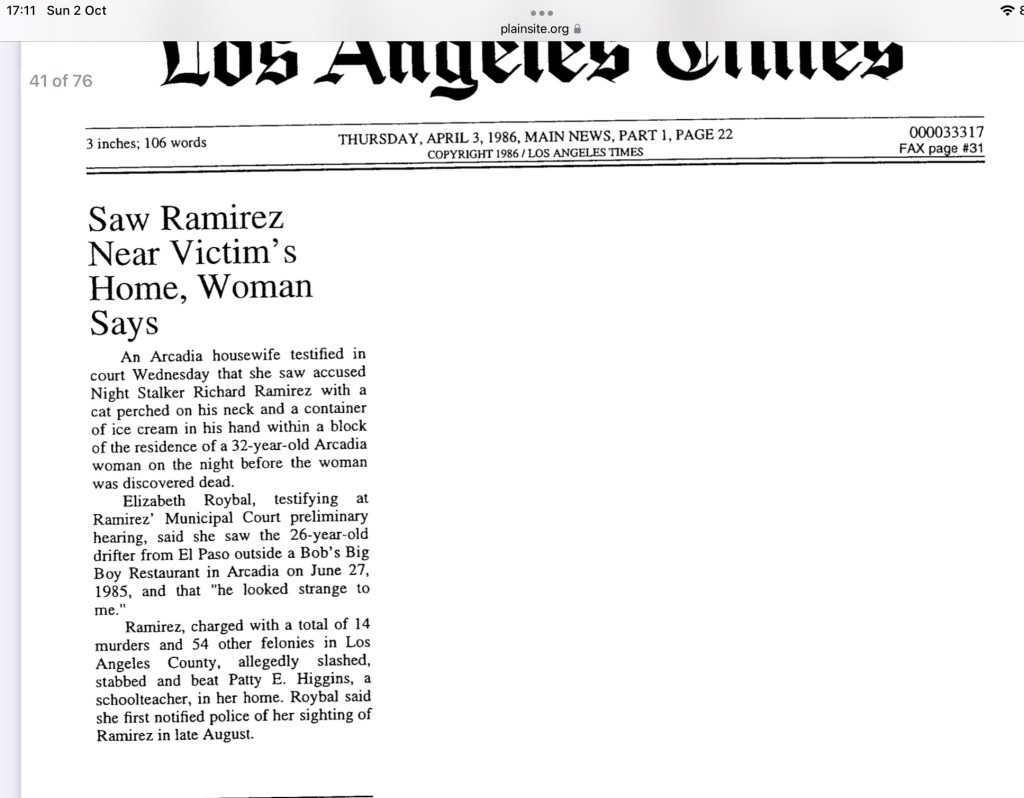

The prosecution conceded this, realising that it would cast doubts on other counts, where the evidence was also highly sketchy, and may undermine their case against Richard. 
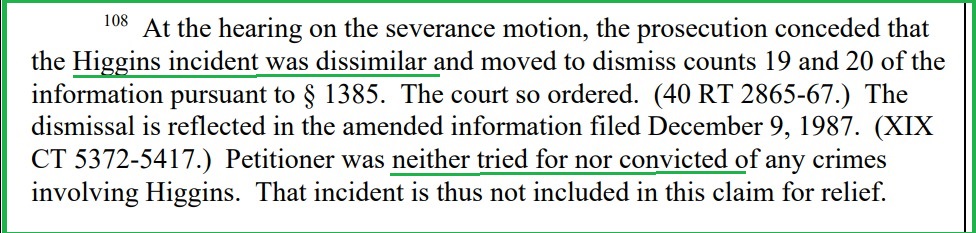

Writ of habeas corpus, claim 20

The court so ordered.

Despite the charges being dropped and no conviction made, Ramirez is forever guilty of this crime, regardless in the eyes of the world. 

Counsel for the prosecution argued that all counts were joined correctly and cross-admissible: all crimes were of the same class. 

Motion denied!

The consequences of this denial were, for Richard, massive and devastating; for the prosecution, like all their Christmases had come at once. 

The physical evidence against Richard Ramirez was relatively weak; they relied on the joinder of offences with perceived strong proof to those with none or more invalid. Thus, making the inferred guilt more plausible and likely to the jury. In contrast, the State would have had problems proving a connection between the incidents if this motion had been granted.
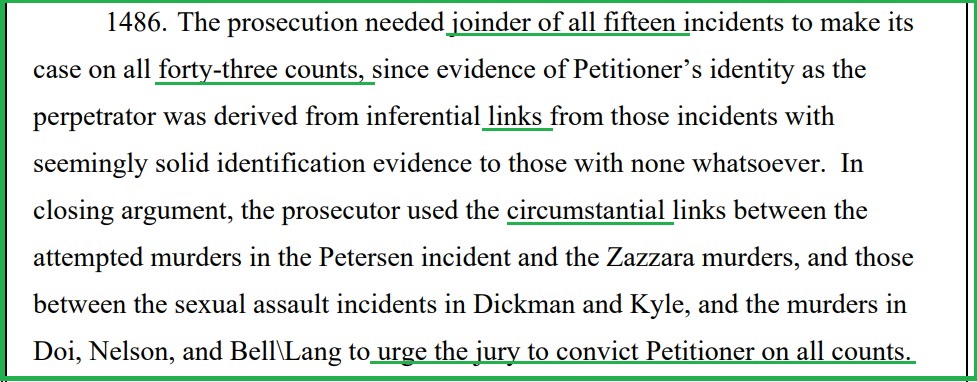

The spill-over effect and its consequences

How did they do it?

It all seems so complete, so overwhelming, but is it?  If we start to pull at the threads, the overall picture isn’t so obvious.

From the very beginning of the case, law enforcement had gone to some trouble to convince everyone that what was unique about the Night Stalker was his lack of modus operandi: he had no pattern.  The prosecution had to do the opposite; they must convince a jury that there was a pattern, that all crimes were cross-admissible, and they would show how by linking crimes through ballistics, shoe print, unique wounding, and eyewitness testimony.  For only through demonstrating this would a joinder be permitted.

In our previous posts we have shown how expert witnesses, retained by the habeas lawyers, examined the shoe print and ballistics evidence. Where the evidence presented by the prosecution was inaccurate and misleading.  Please read the articles to avoid unnecessary repetition, but as a brief recap, the Avia prints were not unique and the firearms expert, in his declaration, advised that the ballistic evidence was faulty and needed retesting. This article discusses how it isn’t possible to even definitively prove that a certain bullet came from a certain gun.

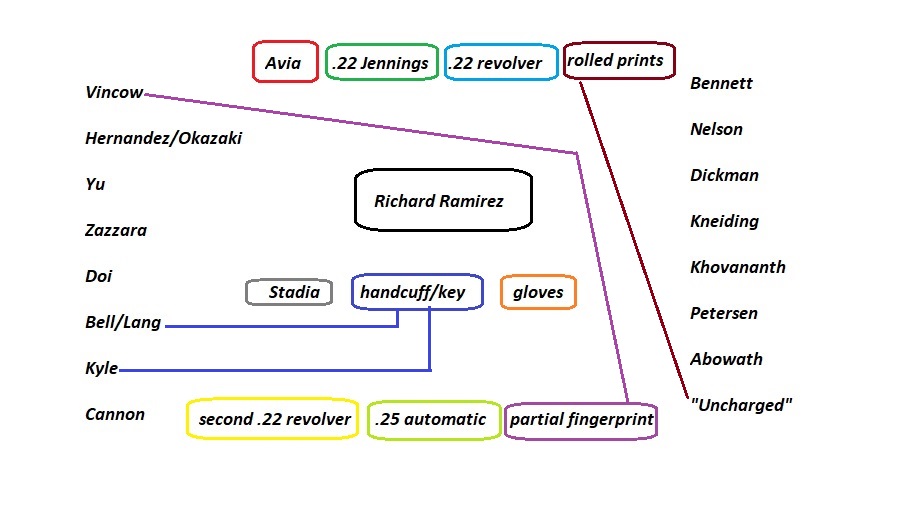
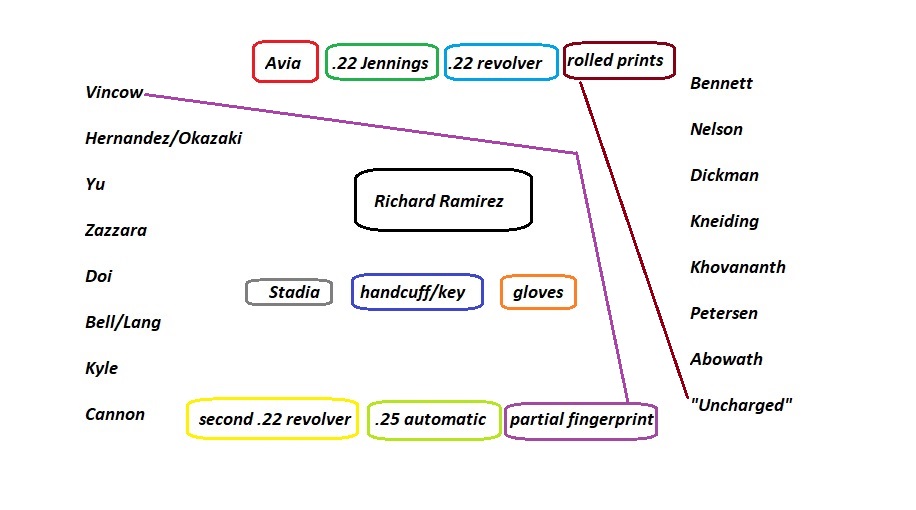
Here’s a chart, showing where and how each offence was linked. It’s quite a web, with Ramirez trapped in the middle, as the evidence is woven around him. * A desktop is advisable to view clearly. *
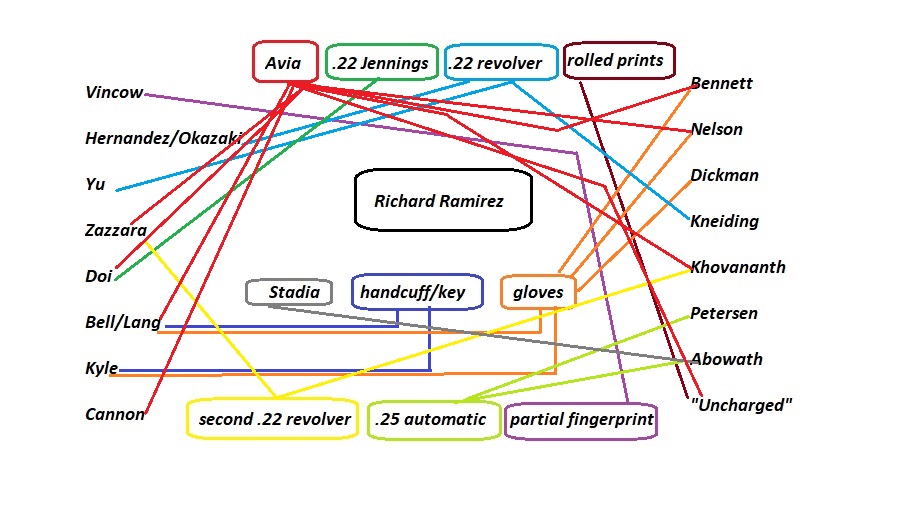
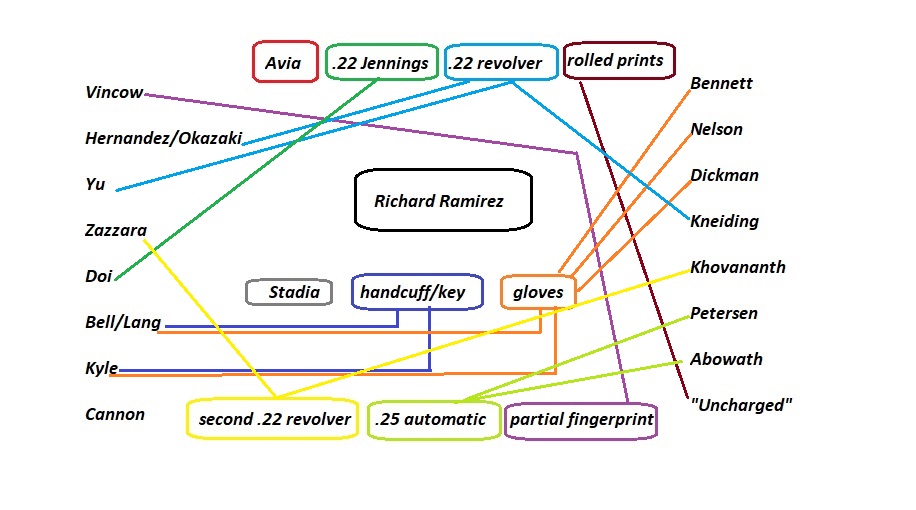
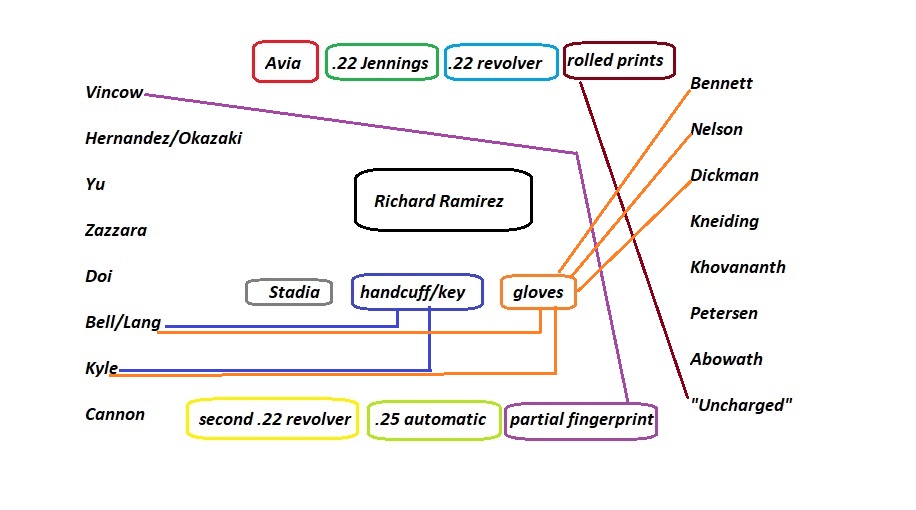
Swipe through the gallery above, and as the layers are removed, it becomes apparent why the joinder was necessary for the prosecution. *Note: Neither Mabel Bell nor Florence Lang were restrained by handcuffs, nonetheless, this is an accurate depiction of the linked incidents as produced in court by the prosecution.


Partial prints are inconclusive, and the prints at the “uncharged” remain the last layer. It’s a grey area, with different law enforcement agencies employing various techniques and requirements regarding how many loops and ridges are considered admissible evidence in court. As explained in the highlighted post, it is not an exact science and could have been quickly challenged, but of course, it wasn’t.

We are left with the rolled prints at the uncharged incident, allegedly lifted by the “enterprising” Officer Wright, who conveniently had all the fingerprinting technology in his regular (but amazingly equipped) patrol car, and who managed to do all the required forensic work, without calling in the specially trained officers who would usually attend a burglary, bringing in the tools needed to carry out the job. And no one is claiming that Richard Ramirez was not a thief!

His attorneys should have been able to challenge all the evidence. Still, as we have shown, the defence counsel needed help investigating or developing a defence strategy. Something needed to be more forthcoming to challenge or defend the case.

I have to keep referring back to what is central to the theme of this blog, the lack of defence. Not guilt or innocence but a failure of the system. 

To quote Lt Dan Cooke from LAPD:

“Now begins the hard work of tying him to all the other crimes we’re looking at”.

Lt Dan Cooke

As stated on our front page, shouldn’t that have been done already? If he was their only suspect? Primarily, he was already referred to as the Night Stalker by the slavering media.   


His M.O was he had no M.O

To show a criminal identity via modus operandi, the evidence must show common marks, or “identifiers”, which together or singly show a “strong inference” that the defendant committed all the crimes so joined.

The People versus Bean
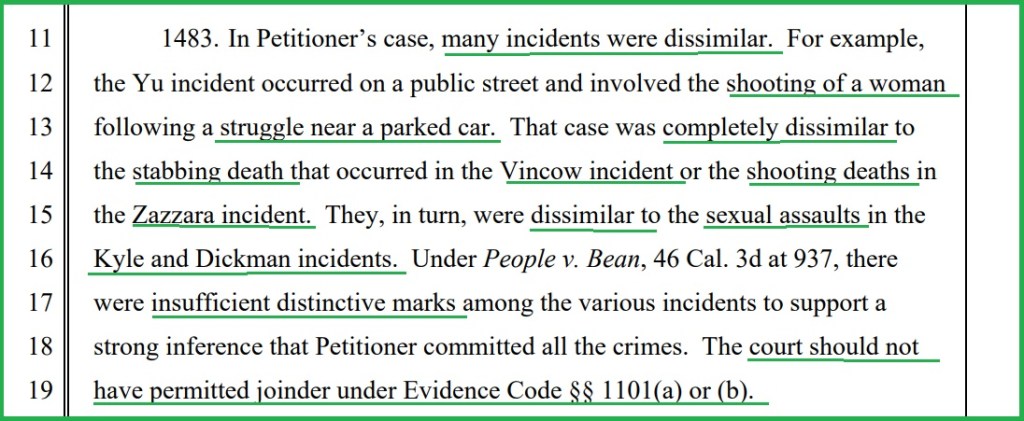
Writ of Habeas Corpus, claim 20, page 538

Richard’s case was so unusual and unique that once some evidence had linked him to one incident, the jury would presume his guilt on every charged crime. At the time of the court’s ruling, each joined offence was highly inflammatory, with the media already identifying him as the perpetrator of the four non-murder incidents. Before the farcical line-up, the police had already indicated to Carol Kyle that “the Night Stalker” would be there, adding to an already biased procedure.

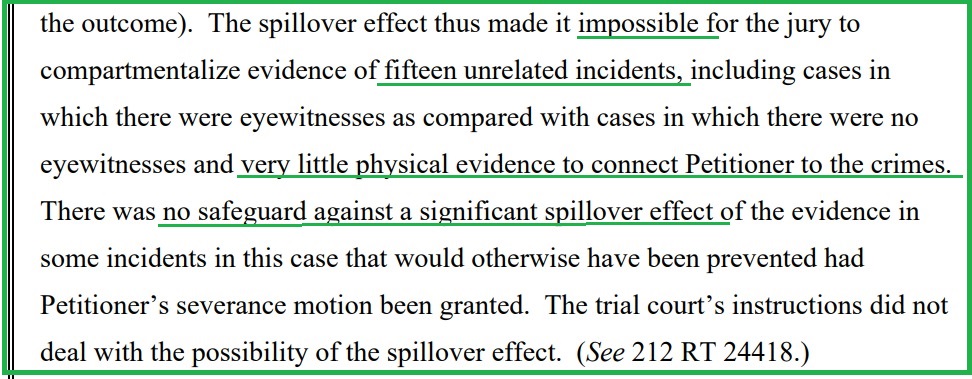
The disparity between the strength of evidence between the murder and non-murder charges (remember, at this juncture, the prosecution holds those cards) would cause the impermissible “bootstrapping” or spill-over effects and inevitably lead to a conviction on all counts, regardless of the weak evidence.
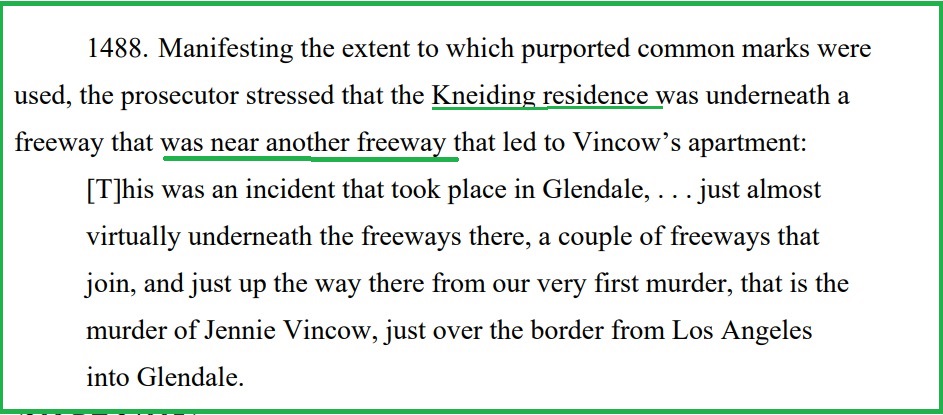

Because there’s a road, near a road and it goes somewhere. This is a common mark?

By upholding the joinder, the trial court made it impossible for the jury to consider each count separately when weighing up the evidence, the inevitable spill-over, caused by the joining of all fifteen incidents, rendered them unable to compartmentalise. Putting this together with a total denial of effective defence at the guilt phase and lack of mitigation during the penalty phase, the likelihood of the jury considering evidence solely related to each separate offence was null and void.

The judicial economy was not an overriding concern. It should not have outweighed inflammatory evidentiary concerns or the spill-over effect. The court could have easily severed this case into four separate groups: the separate Vincow incident; those involving inflammatory evidence, such as mutilation and Satanism; incidents with minimal inflammatory evidence; and incidents in which no murders occurred.

Like this:

  • The Zazzara, Bell/Lang, Cannon, Nelson, and Khovananth incidents.
  • The Hernandez/Okazaki, Yu, Kneiding, and Abowath incidents.
  • The Bennett, Kyle, Dickman, and Petersen incidents.
  • The Vincow incident,

No safeguard against the spill-over

Even then, at this point, had Richard had a competent defence, a team capable of rebutting the charges, and providing their own expert witnesses, the evidence against him could have been challenged. This is one of the most infuriating things about this case and he, with his mental impairments, was seemingly oblivious, lacking the understanding that he was entitled to a strong defence.
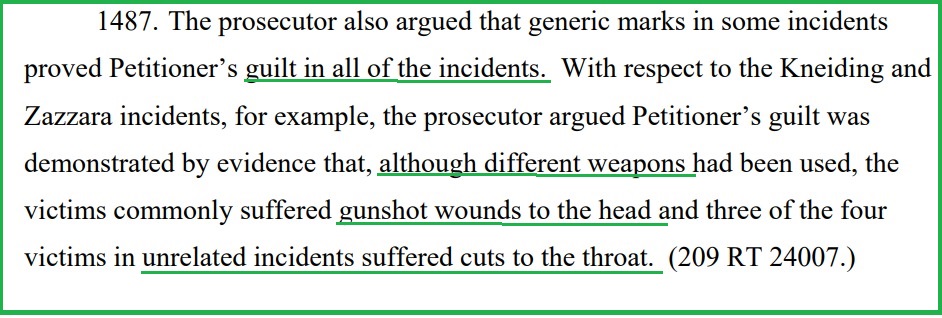

Here, at least, they tried

Saying he was severely disappointed is a vast understatement, especially considering the implications. To properly examine the case, jurors must have both sides because that is how trials are supposed to work. What will they do if they are not shown anything in either defence or mitigation?  

Had the defence counsel retained a criminal expert to show that the incidents were unrelated, the jury may not have been swept away by anger and revulsion. It may have been able to dispassionately categorise the incidents and considered more deeply that some of its members had specifically noted the eyewitness testimonies did not sound like Richard Ramirez at all.

The habeas lawyers did retain such an expert, and this is his conclusion: 


Declaration of Steve Strong, expert witness, specialising in serial murder. Doc 7-21

A full breakdown of the findings of Steve Stong can be found HERE.


Richard with attorney Arturo Hernandez

“A jury consists of twelve persons chosen to decide who has the better lawyer”

Robert Frost

An uncomfortable truth.


~ Jay ~

40 responses to “Spill-Over”

  1. how on earth can crimes that aren’t related even be linked! GILS bs once again

    Like

    1. The prosecutor, Halpin, is mostly to blame for this one. They needed to join the crimes somehow, so contrived it. Of course the police and firearms examiners were all involved.

      Like

      1. wow they really just seemed like they wanted to just clear and move on from this case that they’d literally do anything! And RR having no MO made it way too easy for them

        Liked by 1 person

      2. Exactly. The prosecutor was shady.

        Like

  2. How can other criminals have an MO but then RR not have one? He’s the only one in crime that I’ve heard of that doesn’t at all have an MO! It was an excuse for Gil to link him with the crimes he didn’t do! On top of that his Brain damage, mental health problems, criminal record also made it easier. Makes no sense they did everything they can to just link him to those crimes and say they got their guy, instead of investigating other suspects that fit the NS cuz to me RR DIDN’T AT ALL FIT THE NS. He was a petty thief that’s it looking for help and got mixed up with the wrong people that had so much motive to get rid of him and then playing with his mind.

    Like

    1. Yes it’s too convenient to clear the books of unsolved cases. They keep saying no one’s done it in criminal history before or SINCE Richard Ramirez and that’s just absurd. You can tell the way they’ve tried to link the crimes is contrived and desperate.

      Like

  3. Exactly what reasoning did they give for not severing the charges (I’m a little confused)? A lot of the crimes don’t follow the same pattern and they were committed in several different locations.

    Like

    1. Exactly, but they used cross-admissible evidence. This is how they linked the crimes (after a lot of messing around and changing things)
      Petersen and Abowath (common ballistics evidence)
      Hernandez/Okazaki, Yu and Kneiding (common ballistics evidence)
      Khovananth and Zazzara (common ballistics evidence)
      Vincow (absence of cross-admissible evidence)
      Kneiding, Bennett, Bell/Lang, Cannon, Nelson, and Doi (similar shoe print evidence)
      Dickman (absence of cross-admissible evidence)
      Kyle (absence of cross-admissible evidence)

      But we know the ballistics evidence was unreliable and faulty, and the shoe prints evidence was inconclusive, and (in the Cannon case) engineered,
      The trick they used was to link crimes with weaker evidence to those with stronger, so if he was convicted of doing one, then he must’ve done them all. In April of 85, Carrillo asked the firearms experts to try and link the Zazzara ballistics evidence to that of Hernandez and Okazaki, proving that as early as that he was hunting for a serial killer; it’s in the affidavit. In the end they couldn’t link Zazzara to the Okazaki/Hernandez cases, so they linked it (via ballistics) to Khovananth instead.

      Halpin used emotive language to the jury in his closing arguments, he tried to put the link between Yu and Zazzara in the jurors’ minds by claiming that Richard had “no time to mutilate” Yu -.out on the street. These words are powerful to a jury.

      Liked by 2 people

  4. Christ no wonder there was 3 year delay! It gave them ample time to come up with this mess. The chart you guys created was pretty helpful, but just looking at it is overwhelming at first and hearing the explanation is even more confusing. Haplin may have been the one connecting the crimes together in court, but Carrillo’s’ idiotic serial killer theory started this whole mess. He wanted to be a ‘super cool serial killer catching hero’ cop like his buddy Salerno.

    Liked by 2 people

    1. It is confusing, I am sorry if the writing up of it is a bit messy. The swipe gallery helps a bit, but I do appreciate how convoluted it is.
      Gil was desperate to catch a killer, why else in April would he be scratching around trying to link random crimes. The affidavit proved very useful.

      Like

      1. The writing is excellent. I definitely wouldn’t be able to put it into words like that. It’s their thinking process that’s confusing to me. No amount of explanation will make their idiocy make sense.

        Liked by 1 person

      2. Thank you! I will get round to re writing some of the early posts eventually, It’s a mess, and blows my mind every time I think about it, which is quite often, Ha ha! Most of my anger is directed at the Hernandezes for being pathetic, but there are so many other facets at play. In the end, it was inevitable, Richard was doomed and he always knew it. Can you imagine the outcry if (and it would take a miracle) his lawyers had done their job correctly, and he’d been found “not guilty”? The public would’ve gone mad. All that money on a trial and the Night Stalker gets off.
        That was never going to happen.
        The prosecution never proved that case beyond reasonable doubt; the defence failed to put it to proper adversarial testing.

        Liked by 2 people

      3. I’ve always thought about what would’ve happened if Richard had proper competent lawyers and if by some miracle they won the case. From what I’ve heard the Hernandezes were getting death threats and I wouldn’t doubt that his other lawyers got them as well for representing him. Richard would’ve probably had to leave California altogether and not return for years. They instilled hysteria and paranoia within these people flying helicopters over the city and such, some of it was justified as people were being murdered and assaulted left and right, but people really weren’t thinking rationally they just wanted someone to take the blame. The crimes really didn’t stop after he was caught they just weren’t reported about as much.

        Liked by 1 person

      4. He’d have been torn apart, either that or the American fascination with “celebrities” (even notorious ones) might have kicked in, and he’d have been signed by a modelling agency to promote shades and sneakers…
        You’re quite right, the crimes definitely didn’t stop, I know we have a post about it, but there’s more about that in the book. Public perception because of media influence, and then suddenly the lack of hysterical reporting, lulled people in a false sense of security. People opened up their windows and the rapists and killers came in.

        Liked by 1 person

      5. I agree the media influence was a key player in this case. I read some of the articles that were written at the time from the writ of habeas corpus and there was an incredible amount of bias and prejudice not only against Richard, but the defense itself as well. It seemed like they were always trying to make the prosecution seem like heroes no matter what mistakes they made.

        Like

      6. People really need to change their perception of how courtrooms work. The prosecution should necessarily be seen as the ‘good guys’ and the defense as the ‘bad guys’. One side simply brings charges and the other side has to defend themselves. Hollywood has created a spectacle of the courtroom and made it into a battle between good vs. evil.

        Like

      7. I hate the way the defence was mocked for coming up with a ‘mafia story’ for Zazzara, when it was their own son who told police this information. Then they were laughed at in the LA Times for suggesting workmen killed some victims or that Vincow’s son was seen entering her home. I think those are reasonable lines of questioning. Some people would like to live in a justice-free dictatorship where the accused are executed immediately.

        Liked by 1 person

      8. The gaslighting and mockery is sickening. This case is more akin to the Salem Witch trials than an actual case.

        Like

      9. I have to admit tho Richard would’ve been a great model.

        Liked by 1 person

      10. Running along in an Avia shoes commercial with a sweatband on, his curly hair bushing out the top like John McEnroe…

        Liked by 2 people

      11. Lol such a wasted opportunity.

        Like

      12. I love how multiple similar attacks happened in September and October ’85 and the police just downplayed them as “don’t panic it’s probably just a copycat” when it was happening all the time! I feel that the people of California were tricked into hysteria

        Liked by 2 people

      13. It’s sad to think that if the actual culprits were caught and proper justice administered there would have been far less victims. Richard having all these crimes pinned on him probably made the actual culprits more bold thus resulting in the suffering of even more people.

        Like

      14. And if the defence bothered to challenge the evidence in the 1986 hearings, then he’d have been let go and police could go on with hunting for anyone else connected to Solano. Instead, four years elapsed with everyone assuming it was Ramirez and the real killer/s? Long gone. So much time was wasted.

        Liked by 1 person

      15. If they had properly challenged the evidence others would’ve started to see things in a different light. But I doubt that they would’ve let him go. Law enforcement was either too lazy or didn’t care enough to do proper investigative like the idiot who was doing forensics in his squad car. They would’ve found another way to essentially keep him trapped.

        Like

      16. Yep, they’d have come up with another murder to keep him in. Like the case of Bobby Maxwell, the Skid Row Stabber. When he was acquitted for some, the DA tried to lay more cases on him. They won’t admit to mistakes. He was innocent but conveniently died when his convictions were overturned… was he killed?! This would have happened to Richard. I’m certain. Maxwell’s convictions were actually quashed by the Ninth Circuit too. Comforting to know that appeals do work sometimes…

        Liked by 1 person

      17. I don’t think these people are aware that they are screwing around with a human life. It’s revolting!

        Like

      18. In addition to that in the 80’s people had limited means to gaining information about stuff like this, unlike today where we have the internet. They took whatever was on the news and in newspaper as gospel cause they had no other way to see other narratives of the same stories. Even if they had their doubts there wouldn’t have been ways to prove those doubts.

        Like

      19. It’s so easy for people to be whipped into suggestibilty too. Rumours snowball and turn into urban legends. Most people just read newspapers on the bus/train to work, and don’t analyse properly because they’re busy. It’s easy to see how things are believed.

        Liked by 1 person

      20. Not much has changed since back then. People still live in caves and believe everything they hear.

        Like

  5. I’m having trouble understanding the legal reasoning behind dropping the Higgins case while allowing other cases without cross-admissible evidence to proceed in the joinder. If there’s no cross-admissible evidence, wouldn’t that imply a lack of direct connection between the cases, potentially undermining the rationale for trying them together? Could someone clarify how this aligns with the legal standards for joinder?

    Like

    1. Hi, Higgins was dropped because the evidence was so weak (reliant on the eyewitness report of Elizabeth Roybals) they didn’t want to risk this case undermining any other charges. The others with no cross-admissable evidence, Kyle and Dickman, had both of their eyewitness identifications to add significant weight to the prosecution. With Higgins they had nothing, only a weird sighting of “Richard” a block away the night before the killing, with a cat on his shoulder, carrying ice cream.
      That isn’t evidence of anything, and without more, it would be hard to convict.
      Does that make sense?

      Liked by 2 people

  6. Thank you for the explanation—it definitely makes sense now. I can see how the lack of substantial evidence in the Higgins case would make it too risky to include, especially with something as tenuous as an odd sighting. The additional eyewitness identifications in the Kyle and Dickman cases seem to provide a stronger basis for prosecution, especially since the evidence in some of the other cases was somewhat ‘weak’ in tying Richard in. I appreciate the clarification!

    Liked by 1 person

    1. Weirdly, in a podcast at the end of last year, Carrillo suddenly said that CAT HAIR had been found at the Higgins incident scene, meaning he actually believes that Richard took a cat to a murder with him. He changed the distance that Roybals viewed the Cat Man, making it closer to the crime scene, but as for the Night Stalker actually bringing a furry friend with him, it seems preposterous, The guy that interviewed him didn’t even blink at this bizarre addition; he didn’t say a word. Not one.

      Liked by 1 person

      1. LMAO, someone really needs to sit down with this guy and properly challenge him on the absurd things he says. However, considering he only participates in ‘scripted’ interviews, I doubt that will ever happen. I can only imagine how the three of you would verbally destroy him with questions. Somebody needs to hold him accountable for what he says. Just because Richard is dead does not mean that it won’t affect anything or anyone.

        Liked by 1 person

      2. Yes, he follows a prescribed formula in all his interviews, with a few deviations (such as the cat) from time to time. No one questions him or draws out any info, asking him to expand on these strange things. The cat thing is ludicrous which ever way you look at it. He’s either saying Richard took the cat with him, or, he found a random cat, stuck it on his shoulder for a while, bought ice cream and wandered around for a while, ate ice cream, dropped the cat and went and committed murder, leaving behind cat hairs.
        Carrillo said “Patti Higgins didn’t have a cat”, yet we’re meant to believe that the homeless Ramirez did, similarly to his having chained up dogs somewhere in a house he didn’t own. It’s so crazy.

        Just editing to add in that Elizabeth Roybals couldn’t be arsed to mention anything to the police about Cat Man until August, two months after the supposed sighting.

        Liked by 2 people

      3. I find that really strange too. If there was an incredible amount of violence happening and you saw a ‘shady’ guy near one of the crime scenes, why wait so long to report it? The same goes for the victims who delayed reporting that Richard might have been the one who attacked them, despite his face and identifying details being broadcast on TV multiple times a day and printed in the papers. If I were in their position, I would’ve reported it immediately, especially considering the horrific crimes he allegedly committed.

        It’s understandable that they were likely still in shock from what they experienced and may not have been able to fully process or recall what happened right away. However, it’s important to remember that our memories can deteriorate over time, and key details can fade or even become distorted, especially if someone is ‘influencing’ their recollection of events.

        Liked by 1 person

      4. Both Hernandez and Dickman saw him on TV and didn’t recognise him as the man who attacked them, the others saw him and didn’t call the police, either.
        Sophie Dickman said it wasn’t her job, it was up to the police.
        Carol Kyle, who’d seen Ramirez all over the media named as the Night Stalker, was told by the police that she’d been attacked by the “Night Stalker ” and he would be included in the live lineup.
        She was primed.

        Liked by 1 person

      5. Sophie Dickman’s comment about it not being her job is particularly striking—it really highlights how some people might have felt disempowered or overly reliant on law enforcement.

        There is so many constitutional and due process violations in this case. It makes me head spin. Even for the 80’s it’s far too much corruption.

        Liked by 1 person

      6. I know, it’s so crazy it’s almost unbelievable that it could happen.

        Liked by 1 person

Leave a reply to ~ Jay ~ Cancel reply