
“Justice will not be served until those who are unaffected are as outraged as those who are”.
Benjamin Franklin
To begin with, this post had the working title of “Ray Clark was a Bit of a Twat”, you’ll probably understand why when you reach the end.
For any who may be interested in the processes involved in a capital trial, here’s some info.
I admit I write a lot about the trial, the truth is there is so much to say, so many facets, so many failings, so much that was wrong; one could go on for weeks, and still uncover more horrors. Many assume that Ramirez had his day in court, got a fair hearing, and was found guilty on all counts, due to the overwhelming evidence against him.
They are wrong.
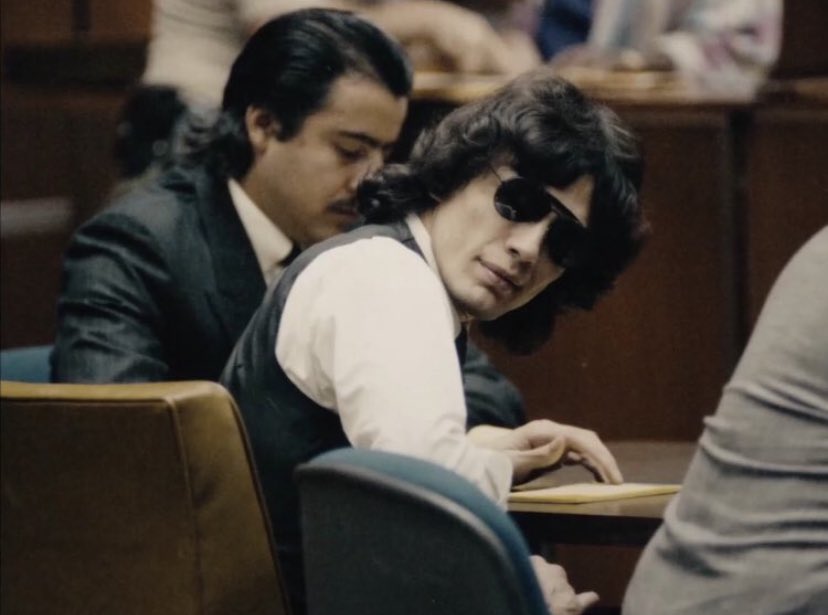
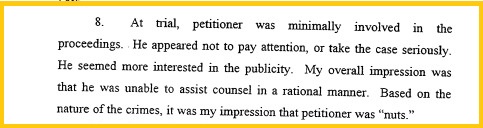
Throughout this post I will show some declarations from the jury, taken after the trial. Why were they not shouting from the rooftops about what they could see happening? Worse, how could they see and still vote death? How is this justice?
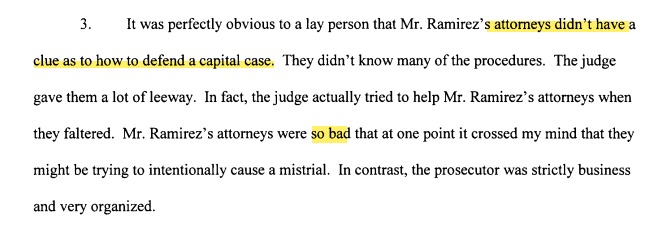
His trial was a mess from beginning to end, with falsified evidence, “expert” prosecution witness deliberately misleading the jury. A string of constitutional violations and unethical practices. It starts and ends with his defence.
Here we are again with another instalment of Clown Central, or in other words, the charade that passed for the trial of Richard Ramirez.
I’ve discussed how unqualified the defence counsel was, and how a conflict of interest led to his mental impairments being covered up for profit. Here, I am going to talk about something else.
What was the point of Ray Clark?
That’s a question I ask myself, and even now, I am unsure of the answer. To give the veneer of, “We’re doing our best, and honestly, this trial isn’t a joke.”? Possibly. To account for his mid-trial appointment, I must back track a little, and refer to incidents already mentioned in previous posts. Forgive me, but it is important to include them again here; briefly.
Ramirez was unlucky enough to land himself with what could possibly be the worst defence team in history, and through no fault of his own, was effectively denied the assistance of counsel, which was a violation of his constitutional rights.

By March 1989, Daniel and Arturo Hernandez were not doing so well, Daniel was often ill and Arturo had effectively given up bothering to attend court sessions, which landed him in serious trouble with trial court. He was fined, and eventually did jail time for being found in contempt. Oh, the irony, he was held within the same jail as the client he’d more or less abandoned.
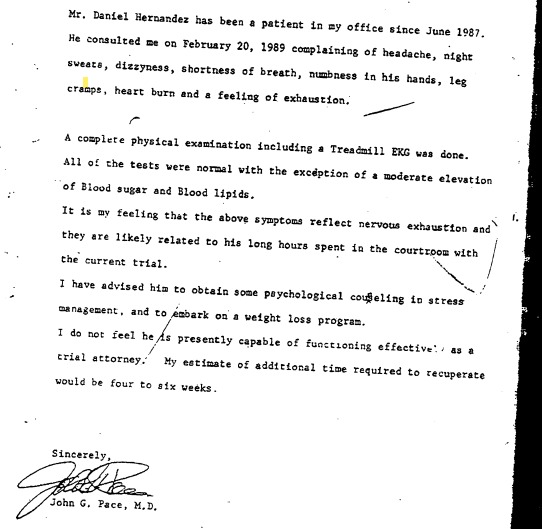
Daniel Hernandez submitted a letter from his doctor, he was suffering from stress, and needed a month or so off, to recuperate and asked the court for additional support, to help him “carry the load”. At this point, seeing that the defence had effectively ceased to function, they should have called a halt to the proceedings. The court found no legal reason to do this. I wonder if they would have arrived at the same conclusion, had it been the prosecution who had crumbled? Somehow, I doubt it.
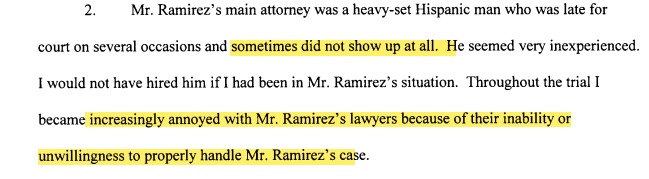
This is what happens when you allow people to do a job that they are not qualified to do. This was a trial for someone’s life, not a jaunt in a park!
On March 1st 1989, the court appointed Ray Clark to assist the defence counsel, pursuant to § 987.2 (penal code), He was a retained attorney, and his qualifications were accepted under the State Bar of California, therefore, he was paid by the state, receiving $100 an hour, unlike the Hernandez’, who were receiving nothing.
So did they stop the trial at this point, to allow Clark to investigate, prepare and come to court armed with the defence Richard so desperately needed, and by law, was entitled to? No, of course not.
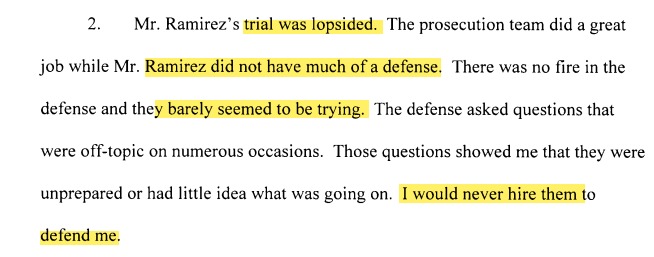
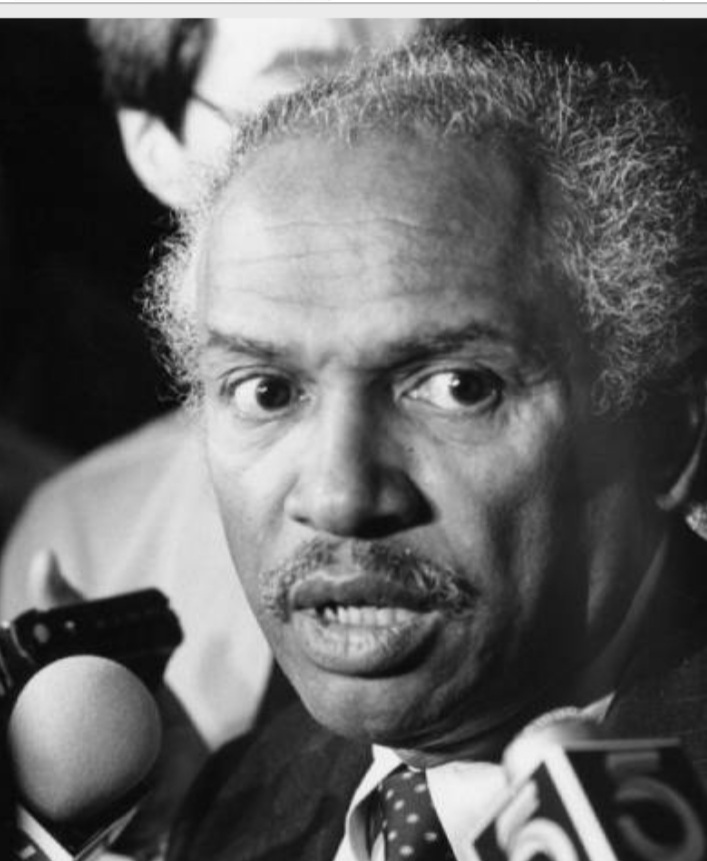
As Clark was also experienced in the defence of capital crime, one might think that this was good news for Richard. Unfortunately that wasn’t the case, as his appointment, mid-trial, meant that he had not had the time to review the case, or to determine much (if anything) about Richard, his family, his background, or to insist that he had a full mental competency check, once it became apparent that Ramirez was unable to assist with his defence, or to fully comprehend what was happening.
To Clark, so it would seem, this was blatantly obvious, given his rather unprofessional assessment of Richard in his statement, and yet he did nothing to call attention to the problem. One more lawyer who failed to do his duty and look out for the best interests of his client.
“I had no time to prepare for the trial due to the fact that I was appointed when the case was in trial. I had no opportunity to review any discovery or defence reports, prior to my participation in the trial. However, I was able to review police reports and other records throughout the trial”
Declaration of Ray Clark, doc 7-4, from the Writ of Habeas Corpus
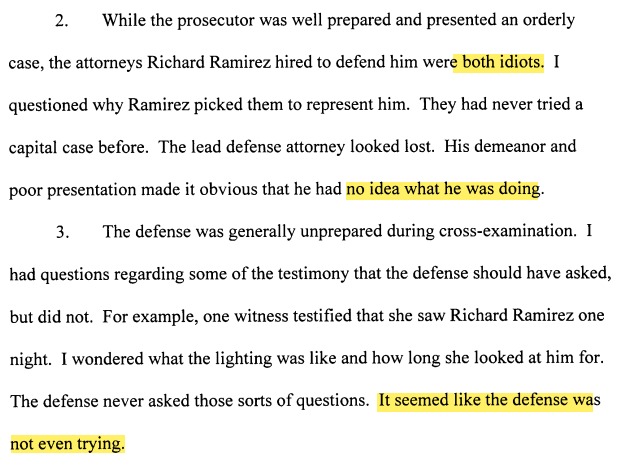
Trial court, by refusing to stop the trial to give the defence team’s new appointment the time he needed to catch up, to review, to do his job, again denied Richard the assistance of counsel. What is the point of a defence attorney who doesn’t have the material he needed to fight the case? Are you beginning to see at pattern here?
Clark goes on to say:
“I handled cross-examinations of prosecution experts without advance preparation, because expert testimony is largely generic, and requires technique, more than anything else”.
Ray Clark declaration. doc 7-4
Such a pity that “technique” didn’t seem to manifest itself in court, because the so-called expert witnesses, used by the prosecution, were not particular “experts”. For example, Gerald Burke, the prosecution’s shoe-print expert wasn’t even trained in shoe-print impressions, deliberately misleading the jury during his testimony, the fire arms experts that couldn’t agree on the ballistics reports, and finger print evidence that should have been challenged as scientifically unreliable. Had Richard’s defence had their own experts to give evidence, such as Lisa DiMeo, Forensic Specialist in shoe-print impressions, Paul Dougherty, firearms expert, who they did hire, but then didn’t provide him with the evidence he needed, and criminalist and specialist in crime patterns, Steve Strong, they would have been able to counter the evidence put before the court. Instead of conceding at every turn.

“To my knowledge, a mental state defence was not developed by Daniel Hernandez for the guilt trial. To my knowledge, there was very little discussion about petitioner’s mental state or background, at least when I was on the team”.
Ray Clark declaration. Doc 7-4
And yet they knew that something was seriously wrong with Richard Ramirez!
As discussed in my previous post, there was another reason why Ray Clark did not pursue an investigation into the mental impairment of Richard, that being that he also was blighted by his own conflict of interest. Feeling somewhat beholden to Daniel Hernandez for his being retained by the court, he stayed with the strategy already in progress, and a different course of action wasn’t considered. As we have mentioned frequently, his mental state is a huge subject, and one which we will be covering in-depth, in the future. It is a vast and tragic topic, reaching back years, something that has been lied about, covered up and swept aside, in favour of calling him “manipulative” and “doing deals with the D.A up in San Francisco”.
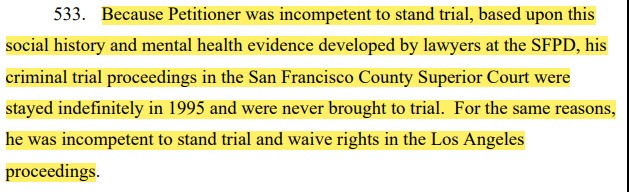
What happened in San Francisco is a matter for a future post.
Over to Ray Clark in Los Angeles..
So how was he doing? The defence hadn’t done too well during the guilt phase so far, where they had expected to win, without producing any of the necessary counter evidence to do so. (I wish I could insert a rolling eye emoji here) With neither Hernandez present in court during closing argument, how on earth was Ray going to swing this all on his own? Like an avenging angel, swooping in to save the day? You already know the answer to that.
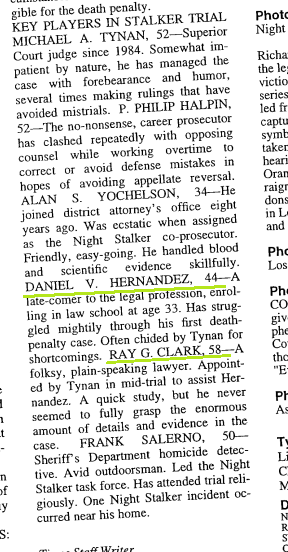
This was one reporters view of him and Daniel Hernandez, as a “key players”. In true media style the prosecution (victorious) are given positive mention, the defence, not so much, unsurprisingly. Arturo Hernandez isn’t mentioned at all, again, no one is surprised.
Guilt Phase Closing Argument
Capital trials come in phases, first comes the guilt trial, which as it sounds, is where guilt or innocence is proven. In capital offences, guilt must be proven beyond a reasonable doubt.
In law you are innocent until proven guilty, but the prosecution had, in this case, flipped it around, citing Richard’s own unproven admissions, through coercion, hearsay, and trial court’s refusal to grant the motion, to render this inadmissible, as proof of his guilt. (yes, we will do a post about this) Now the responsibility of defence counsel was, horrifically, that they must prove his innocence.

“You know and I know there’s no evidence anywhere that he confessed to any of the murders”.
Judge James Nelson
The physical evidence was very little, the eyewitnesses unreliable, the footprint evidence falsified, fingerprints arguable, the hair and serological evidence pointed to someone other than Ramirez being responsible for the crimes, and yet they got it badly wrong. Conceding points, failing to provide counter argument, failing to get their own testing done, failing to retain their own expert witnesses, and struggling to cross examine the witnesses for the prosecution. The list is endless and shocking.
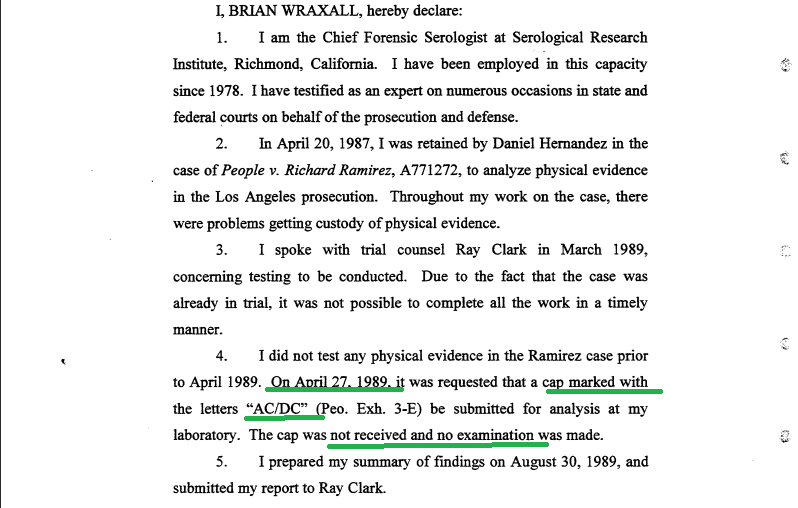
The above image shows that the infamous AC/DC hat (which every aspiring Satanist-come-heavy-metal-fan clearly must own) was never submitted for testing by either the prosecution or the defence. The hat can never be conclusively tied to Ramirez and should have been disregarded as evidence if no one bothered to get it tested.
It was not about proving guilt beyond a reasonable doubt. It was because they failed to prove his innocence.
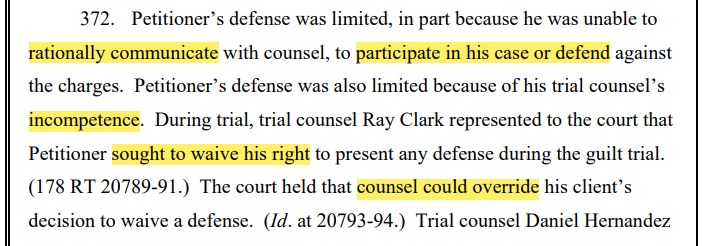
And for that, they tried to point the finger at Richard, stating that he had waived his right to defence, so as a team, had decided to put on a limited defence. Why? Richard had been despondent and distraught, saying that it “would do no good”, knowing he was already judged and condemned. His defence deferred to his wishes, even though they knew he wasn’t competent to give such instructions, and even so, they could have overruled this, if it was in his best interests to do so, and as his lawyers, they owed him a duty, a duty to fight for him.
Clark Addresses the Jury
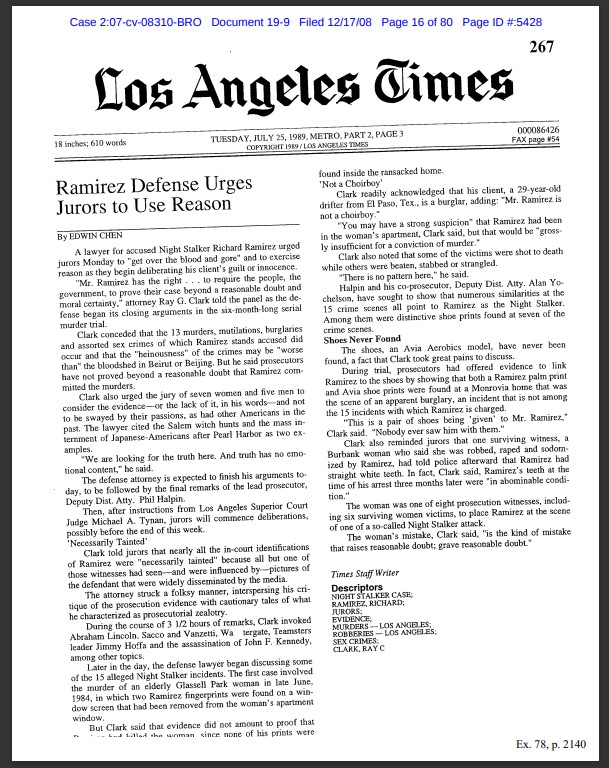
In his closing argument for the guilt phase, Clark did try to impress upon the jury points for consideration, not very convincingly, it should be said, as he meanders around, referencing the Salem Witch Trials, Watergate and Abraham Lincoln. For a man of experience, as Clark was, it seems very vague, I can only put this down to the lack of preparation and team strategy. Oh, and incompetence. Telling the jury to “get over the blood and gore”, whilst sensible, as they are supposed to be weighing up facts, not getting bogged down with emotions, they had just had two weeks of Halpin and Yochelsen describing Richard as “evil personified”.
Trial reporters’ transcripts are unavailable, so I have had to find news articles to discover what was said. This is from the LA Times; you may need a desktop to view this image.
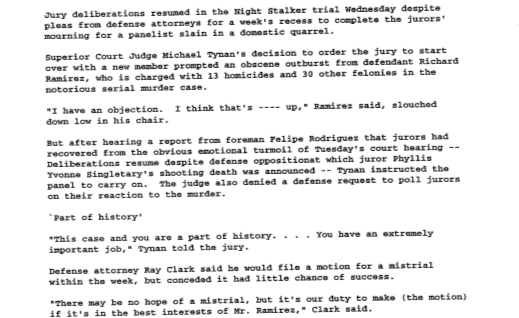
The jury began deliberation, in the middle of which, something happened. One of their number, Phyllis Singletary, juror no.8, was murdered.

“The jury was not told by the trial court what happened to Juror Singletary on Monday, August 15, 1989. Instead, they were sent home. As the trial court predicted, news of the juror’s murder inundated the county. Rather than from the court, the media’s inflammatory and sensational reporting about the jurors’ murder were the first the jury heard about their fellow juror’s murder”
From the Writ of Habeas Corpus
The media speculated that it had something to do with Ramirez, and the non-sequestered jury members, sucking it all up, like sponges . With one, Cynthia Haden (yes, THAT Cynthia Haden) making the panicked suggestion that he was going to bump them off, one by one.
“My first thought was that we were all going to be picked off, one by one. Who’s next?”
Cynthia Haden
(Cynthia “Cindy” Haden became quite well known as the “juror who fell in love with Richard Ramirez”. More on that lady HERE)
Quite how Richard was going to “pick them off” whilst locked up is a mystery. In any event, the murderer wasn’t the shape-shifting, devil-worshipping Ramirez, locked up in his cell; it was the boyfriend of Ms Singletary. Too late, for how could the jury not be infected by media bias.
Trial court then added to the fear of the jury by stating:
“I want to emphasise it has, as far as we are able to determine, and I’m sure, has nothing to do with this case.”
Judge Tynan, making things worse.
At this point, a mistrial should have been declared, and defence put forward a motion, not unreasonably, for that to happen. Judge Tynan denied it. Richard declared that the decision was “fucked up”. Not an unreasonable assumption.
They found him guilty on all counts. It’s truly unbelievable.


The Appalling Closing Argument of Ray Clark
At the penalty phase in a capital trial, the defendant has been found guilty beyond a reasonable doubt. (Well, supposedly, anyway) What remains is the form of punishment. There are two options: death, or life without hope of parole. It is at this stage that defence counsel must use everything at their disposal, every shred of evidence about their client’s life, mental health, family history, history of abuse and trauma to plead for mercy. This is mitigation. Richard, who was not mentally fit to participate in his own defence, was purportedly adamant that he would not plead for his life. His defence should have overridden this, as it was in his best interest to do so. But Ray Clark did not. Instead, he gave what must be one the worst closing arguments in mitigation ever heard.

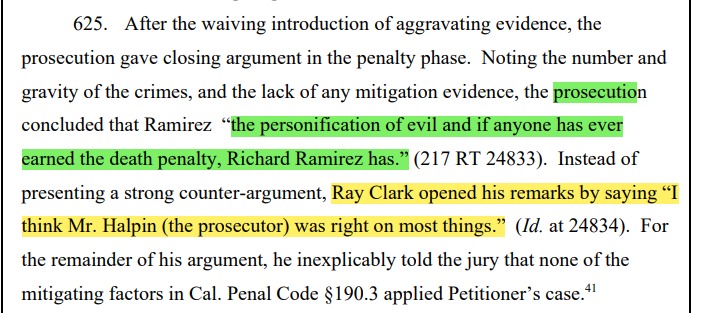
After the waiving introduction of aggravating evidence, the prosecution gave closing argument in the penalty phase. Noting the number and gravity of the crimes, and the lack of any mitigation evidence, the prosecution concluded that Ramirez was:
“The personification of evil and if anyone has ever earned the death penalty, Richard Ramirez has.” (217 RT 24833).
Prosecution at penalty phase, from the Writ of Habeas Corpus
Instead of presenting a strong counter-argument, Ray Clark opened his remarks by saying
“I think Mr. Halpin (the prosecutor) was right on most things.” (Id. at 24834). For the remainder of his argument, he inexplicably told the jury that none of the mitigating factors in Cal. Penal Code §190.3 applied Petitioner’s case.
As to Richard’s mental state at the time of the crimes, counsel told the jury:
“What possessed Mr. Ramirez to do this we will not know soon. Psychiatry is in whatever state it is in. What possessed [Petitioner] to permit Ms. Kyle to live, I will never know.”
He said, “I think it is inescapable that something was wrong [with Richard Ramirez] and that we don’t know what it was. Even if we knew what it was, I’m not sure that would change your task any.” (Id. at 24853). Later he added, “There is a lot we do not know about [Ramirez], about his behaviour, which we will not know probably in our lifetimes, which man will never know about the man.” (Id. at 24857)
If they had done their job correctly, IF they had not turned a blind eye to Richard’s mental impairments, in case they de-valued his marketability; what was wrong with “Mr Ramírez” would have become apparent. That is your task, as counsel for defence, to KNOW these things.
Later, he bizarrely added more and said that even if they had known, and disclosed to the jury mitigating circumstances, it would not have impacted the jury’s decision. That is untrue, as several jurors statements clearly show.
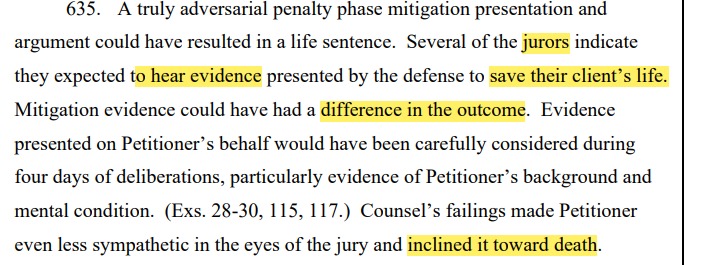
When discussing the possibility of abuse in Richard’s upbringing, counsel told the jury:
“There is inferential evidence here that (sic) is not the kind of home from which Mr. Ramirez came.” (Id. at 24841.) He even suggested that there was no evidence of the reverse—of Petitioner’s redeeming qualities– noting “There is not a lot to be said here as to—as to he was a good boy, he did this, he went to this school or that school. Obviously don’t even consider that. That wasn’t presented and I don’t know what school he went to.”
Why didn’t he know? It is his job to know everything about his client’s background and life!
Even when discussing the only factor that was apparent without the presentation of evidence, Mr. Ramirez’s age, counsel said it did not apply:
“He is a young man. . .. but there is nothing, absolutely nothing, not even close to anything that would justify in any fashion whatsoever a single one of these 43 counts.” Id. at 24854
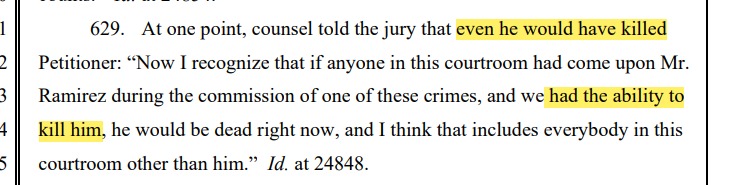
Yes, you read that correctly. That statement is astounding, astounding in its shameful hostility. Ray Clark was being paid to defend Richard, and to try and save his life. He would’ve killed his client? Since when does defence counsel act as the prosecution?
On the back of that horrendous argument, the jury returned recommendation that he be given the death penalty, having heard NOTHING to make them think anything else. They were given nothing of his traumatic life, or mental deficiencies. Instead, they had to listen to this waffle:
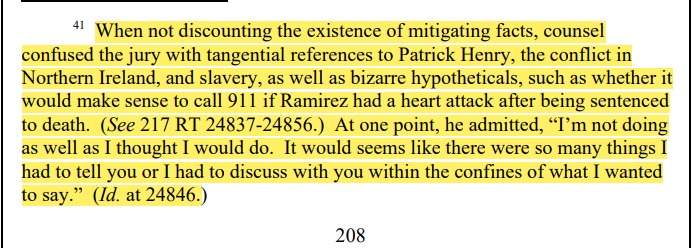
The defence of Richard Ramirez was so riddled with constitutional violations, errors, so as to render it completely ineffective. His defence was no defence, and he was failed badly at every step.
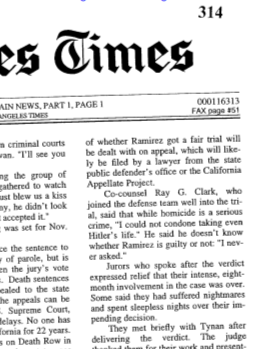
Richard was sentenced to die in the gas chamber of California, the jury had a party, and Ray Clark stepped outside the courtroom to face the cameras. What did he have to say? He rambled on about Hitler and then said he didn’t know whether Richard was guilty or not.
“I never asked”. Oh…
Perhaps he should have said something like this instead:
“Petitioner was incapable of understanding what he was entitled to before, during, and after his trial. Petitioner did not understand how the court functioned or how his attorneys should be functioning. He could not understand that he had a right to a strong and vigorous defence in a trial where his life was at stake. Petitioner’s counsel failed to protect his interests throughout their representation of him, a four-year period. In so failing, counsel prejudiced Petitioner’s rights, including his purported waivers of his right to wear an unobtrusive leg brace; his refusal to remove his sunglasses at the court’s direction; his inability to present a proper defence at trial; his waiver of his presence at the guilt verdicts; and his purported waiver of his right to present any mitigation evidence at the penalty trial. Petitioner lacked the mental competency and knowledge to remedy the repeated and glaring abuses in his case.”
Writ of Habeas Corpus
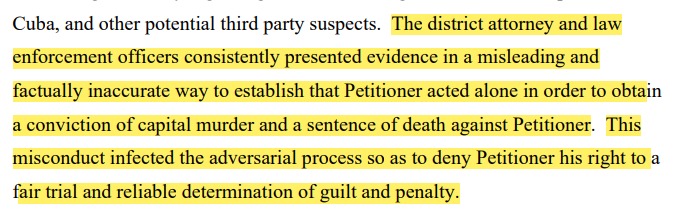
Do you still think this trial was fair?
~ Jay ~
23rd December 2022

 Expendable For A Cause.
Leave a comment