
The purpose of this blog is not just to demonstrate how Richard Ramirez was wrongfully convicted of each individual crime, but also to reveal that he was a victim of multiple miscarriages of justice, due to repeated violations of his constitutional rights. Even if he was absolutely guilty of some of them, these arguments still stand.
Richard’s Habeas Corpus Petition was not only based on refuting the crimes themselves: his team of public defenders was filing 42 separate claims against his illegal incarceration, each constituting a miscarriage of justice in its own right.
This post will focus on Claim 23, that the trial court violated Richard’s constitutional rights by admitting inflammatory photographs. This means that unnecessarily disturbing images were shown to the jury, which essentially traumatises jurors into hating the defendant, making them more likely to find them guilty. It makes them partisan when they are supposed to begin from a neutral and open-minded standpoint.
The petition states,
“It has long been held to be an abuse of discretion for a trial court to admit explicit autopsy photographs or photographs of post-mortem examinations where the victim’s body is badly decomposed or disfigured.”
The prosecution introduced inflammatory images in fifteen unrelated incidents, both taken at the scene and during autopsy. The court accepted these images, deciding that they were relevant to the time and manner of death and that they were not “unduly gruesome” – however, this is untrue.
For Jennie Vincow’s murder, the issue was not how she was killed (her throat was slit), but the time of death. Images of the body were not probative – they did not assist the jury to ascertain the time of death – to do this, they only needed information on body temperature and lividity, gleaned from reading autopsy reports or listening to the testimonies of pathologists.
During their closing argument, the prosecution was allowed to urge the jury to consider the photograph of Vincow’s gaping throat wound as evidence of a “signature mark”, but this makes no sense – none of the other victims was murdered in the same way as Jennie Vincow. Richard Ramirez is the only serial killer in history whose modus operandi is ‘not having a modus operandi’. None of the Night Stalker attacks demonstrated any kind of pattern. The petition states that these photos should have been excluded under the Evidence Code § 352.
Images were shown of Dayle Okazaki’s body on the floor of her kitchen, as the prosecution attempted to speculate the motive of the killer, in comparison with other killings. However, this told the jury nothing, except that a woman was shot in the head. No motive could possibly be established from this, especially as no robbery took place. Other images of the home only served to have a cumulative effect on the jury – the more blood they saw, the more their opinions were influenced and prejudiced against Richard.
The petition cites other cases, for the purpose of contrast: in People v. Scheid, the crime scene photos bolstered the witness’ credibility, and in People v. Frank, the photos were highly relevant evidence. This was not necessary for Okazaki because the witness, Maria Hernandez, did not see Dayle Okazaki being shot. The nature of death was not being questioned.
For Tsai-Lian Yu, the jury was shown horrifying images of her with mechanical devices and intubation down her throat. Not only is it undignified for the victim, but it also does not tell jurors who killed her. The only purpose it served was upsetting them and prejudicing them against Richard, who – also unconstitutionally – was chained like a monster. Contrast this with People v. Taylor, where the jury was able to see the victim face down but close-ups were inadmissible.
The Zazzara case was particularly chilling, with Maxine Zazzara’s eyes removed. However, the judge simply acknowledged them as “unpleasant” and admitted them anyway. The jury knew the nature of the murder and did not need to see graphic images but the prosecution’s excuse was to show ligature marks in comparison with those in other killings. Even the ligature mark images were unnecessary, as there was nothing unique about them to suggest a pattern.
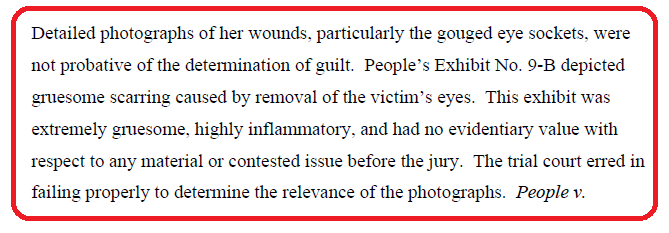
Similar to the Yu case, William Doi’s autopsy images were also shown, again with a breathing apparatus in his mouth. A further image of Lillian Doi showing her facial bruising was admitted despite the fact that Richard was not charged with the murder of Lillian, who survived. This had a prejudicial effect on the jury and outweighed any probative value under Evidence Code § 352. Again, this is compared to People v. Frank.
Trial counsel, on Richard’s behalf, objected to Mary Cannon’s gory neck wound photos, but the court admitted not one, but two.
Two photos of Lela Kneiding’s mutilation wounds were also admitted, which were unnecessary, for her cause of death was not being questioned.
The Spillover Effect
The ‘Night Stalker’ attacks should have been divided into categories, not just to reduce the length of the trial, but also to prevent stronger evidence for more violent incidents influencing the jury to accept weaker evidence in less violent incidents. This will be discussed in a future post.
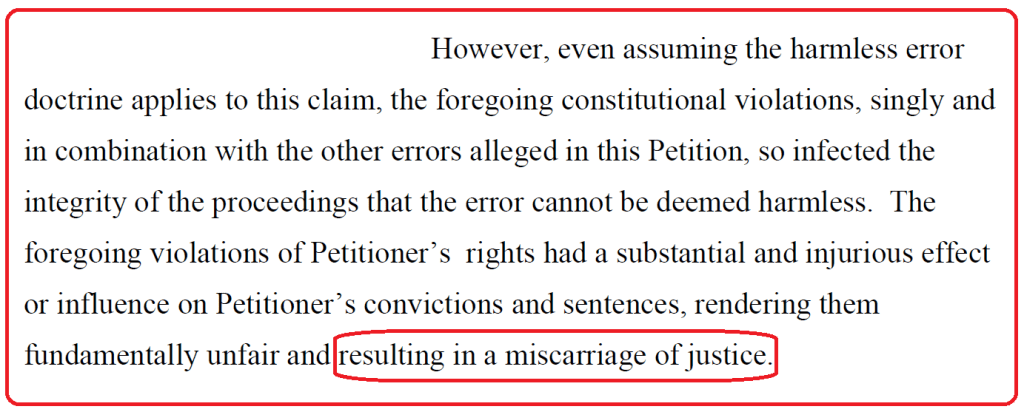
Compartmentalisation is particularly important in the Ramirez case as inflammatory photographs were used to link serious crimes with weaker evidence at other crime scenes. The prosecution created a ‘prejudicial spillover effect’ in which the jury was unable to group similar crimes together. This caused a violation of Richard’s right to a fair trial, to a fair and reliable determination of guilt, to have every element of the charge proven beyond reasonable doubt and to due process and fundamental fairness under the Fifth, Sixth, Eighth and Fourteenth Amendments.
The petition lists some cases in which death judgements had been reversed when found to be violating the rules relating to photographs:
Spears v. Mullin, 343, “Photographs so infected the sentencing proceeding with unfairness as to render the jury’s imposition of the death penalty a denial of due process.”
People v. Love, (1960) “[photographs] served primarily to inflame the passions of the jurors … and probative value was more than adequately conveyed by the doctor”
United States v. Sampson: “[photographs] excluded to protect the defendant’s due process right … to a fundamentally fair [penalty] trial”
Beck v. Alabama: “The trial court’s abuse of discretion in admitting this photograph also violated Petitioner’s right to due process and made his trial fundamentally unfair.”
The petition concludes: For these reasons, Petitioner’s death sentence must be reversed.
Inflammatory images alone were enough to warrant the overturning of Richard’s death sentence – this is without including the other 41 claims against his incarceration.
-VenningB-


 Expendable For A Cause.
Leave a reply to Expendableforacause Cancel reply