
“A series of crimes involves distinctive features, offences or signature mark to indicate that particular individual likely committed all of the crimes. Distinctive features of a modus operandi include cause of death, type of weapon used, or victim. By definition, a series of crimes requires similarity among the criminal acts; crimes linked together because of unusual or unique characteristics not present in other crimes. In the absence of a distinctive pattern, crimes are not necessarily connected together; they may be random acts allegedly committed by one or more suspects”
(Declaration of Steve Strong, criminalist and expert witness in gang-related crime, homicide investigation, and narcotics investigation. From the Writ of Habeas Corpus
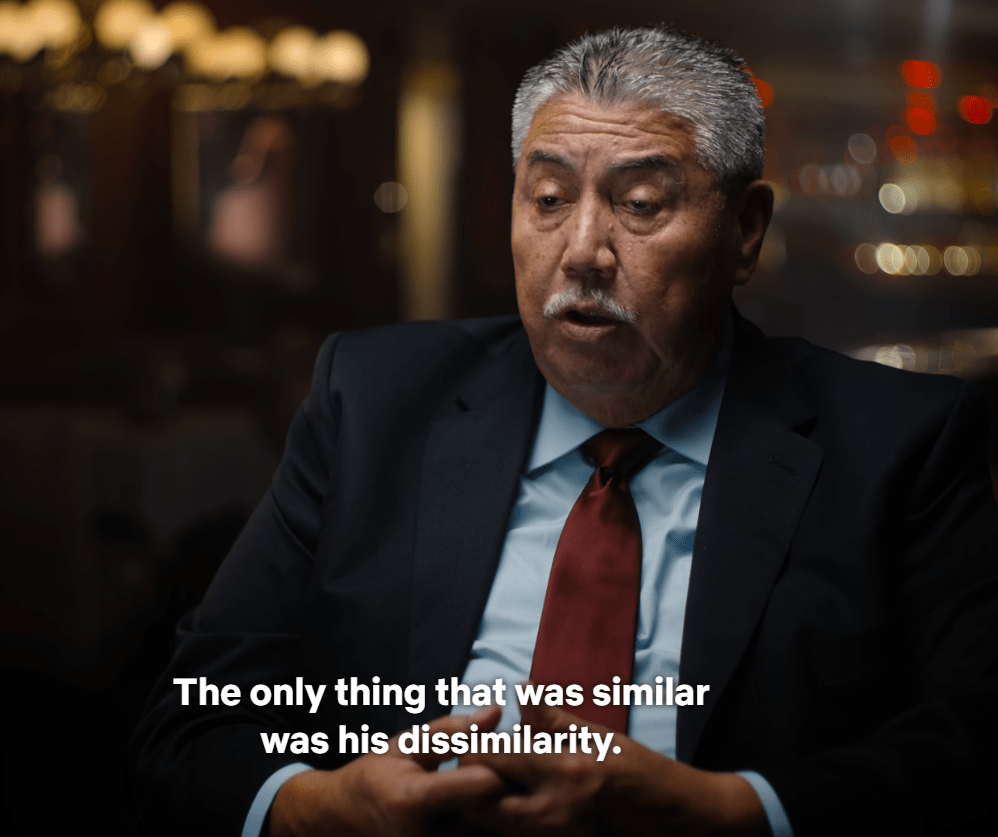
The police authorities were so desperate to declare they had a serial killer on their hands, they began to link the incidents together, unconcerned that there was a distinct lack of pattern, or any M.O, they announced the lack of pattern was the M.O. Of course, how obvious. Nice one, Gil Carrillo!
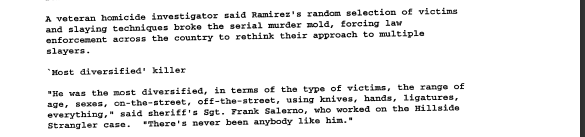
In closing argument, the prosecution emphasised to the jury that physical evidence, specifically shoe print impression and ballistics, linked Richard Ramirez to the series of crimes. The prosecution argued, improperly, that the crimes constituted a pattern of offences. There was significant evidence to show that the incidents were not all linked to one another. Criminalist and expert witness, Steve Strong, described the prosecution’s evidence as demonstrating a lack of pattern with respect to many of the incidents.
In the Vincow incident, for example, a print was found on a window screen but not inside the residence. Time of death was estimated to be in the afternoon, unlike the night- time intrusions in many of the cases ( Zazzara, Doi, Bell and Lang, Cannon, Bennett, Nelson, Kneiding, and the uncharged incident), it is not possible to determine how many persons were involved in each incident. It is not so obvious that he was the only suspect due, in part, to the lack of evidence at the scenes. Another massive fail from his deficient defence, who didn’t even bother to investigate the dodgy characters surrounding Richard, the fence, Felipe Solano, with his entourage of thieves, liars, police informers and those who betrayed him for the money. (More about these particular individuals in an up-coming post.)
The reason it was hard to apprehend a suspect in the so-called Night Stalker crimes was because there was no discernible pattern. The locations of the scenes had no particular pattern, except for four incidents in Monterey Park, and the geographical range was wide. (See map pinpointing the incident locations)
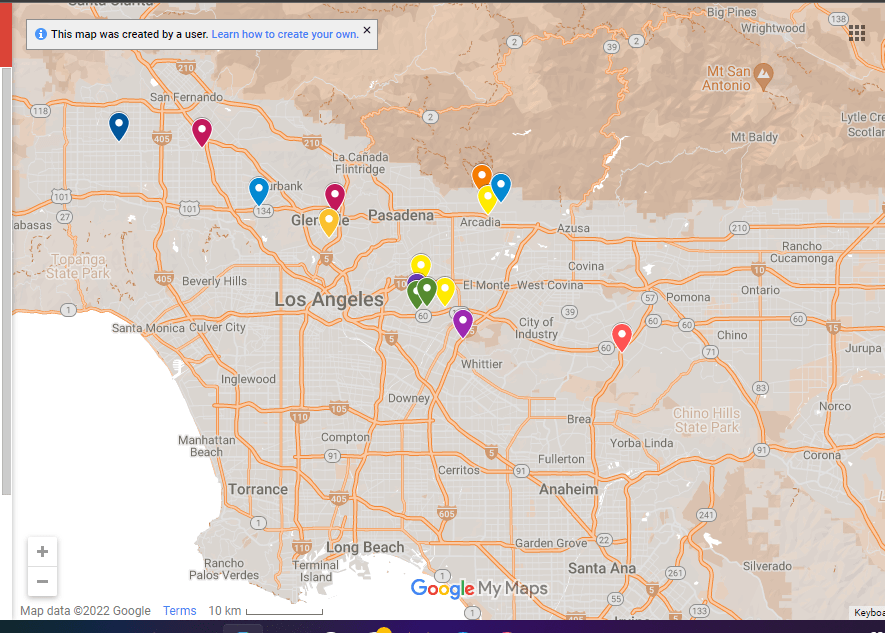
Let’s examine just one part of this geographical range and a brief look at two incidents within.
The map below shows the locations and distance between two crimes committed on the same night, Kneiding and Khovananth. The details of these crimes will be discussed in a future post, but for now, I will concentrate on the logistics because I find this one particularly interesting, as they occurred during the early hours of the same day, and yet were not “linked” together by evidence from ballistics or the obligatory Avia print. The M.O is also completely different, one being a double murder, the other, murder/rape/burglary.
What Happened?
Maxon and Lela Kneiding were both murdered during a terrible and bloody attack at their Glendale home during the early of 20th July 1985. No time of death has been released, but we are told that the Kneidings daughter discovered their bodies at 8am on the morning of 20th July, and the only other indication given is that the bodies were said to be in “full rigor” by 8pm.
At an unclarified time after 12.30am on the same morning Somkid Khovananth was woken up in the Sun Valley home by a man holding a gun. Her husband was shot, and Ms Khovananth suffered a sexual attack, a beating and a robbery. We are not told the time the attack happened, only that at 6am she heard an alarm clock sound and by 7am the police were in attendance.
Multiple weapons were used in the Kneiding murders, .22 calibre gun, machete, knives. In the Khovananth incident, again a .22 calibre but, we are told, not the same one as in the Kneiding incident.
So why Richard Ramirez?
We are led to believe that the attacker, for unknown reasons, drove to Glendale in the very early hours of the 20th, committed a heinous, brutal, double murder, using an array of weaponry. Then, deciding that more murder was on the agenda, drove 14 miles to Sun Valley (within minutes, according to the prosecution) to perpetrate another attack on the Khovananth household.
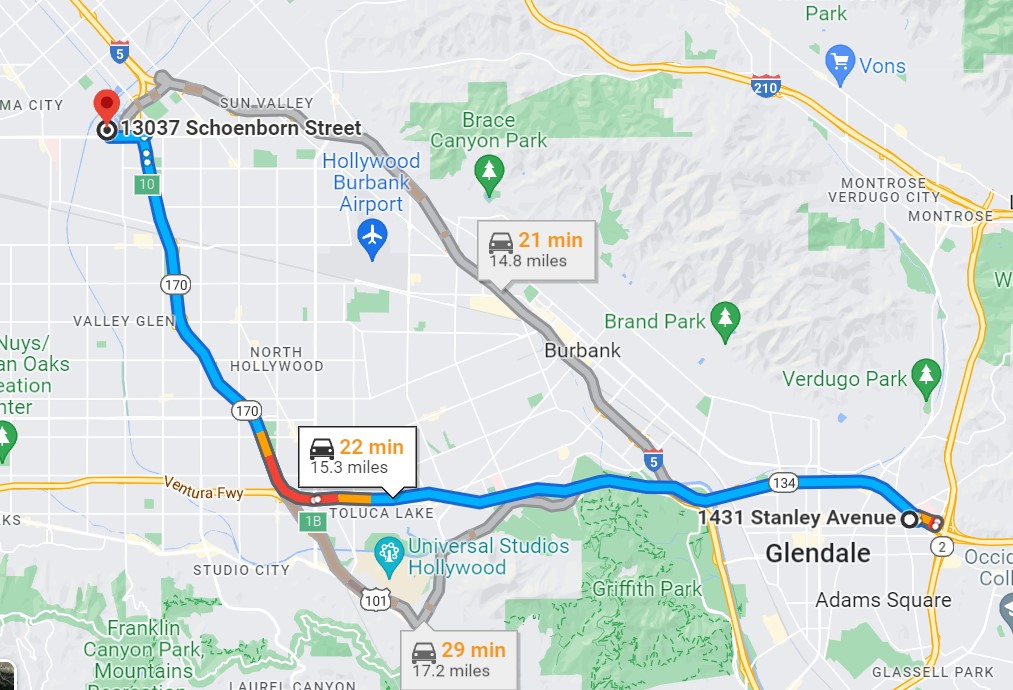
Given that the Kneiding attack was horrific in its brutality, whoever conducted this crime could not fail to be blood-drenched, it is impossible to think otherwise. However, Ms Khovananth does not mention her attacker being blood stained, she says nothing of the sort. There is also no transfer of blood from one crime scene to the other, no smearing of blood anywhere at all. Not one drop. The attacker also used a different gun.
Are we to believe that Richard Ramirez, seeing as he was convicted, we might as well use his name, coming from the Kneiding murder, stopped somewhere along the way to change his clothes, have a shower and thoroughly clean out his undoubtedly bloody car? To then appear at the Khovananth residence devoid of any blood stains? This is the man, after all, who was known as “despeinada”, “uncombed or dishevelled” by some of his dodgy associates, the man sleeping in cars who doesn’t care about hygiene. Yet he’s suddenly capable of forensically scrubbing himself down as if he’s about to enter an operating theatre.
Did he also, perhaps, ditch all his weapons somewhere along the way and decide to use another .22? Twitter readers and Netflix watchers will undoubtedly scream, “He went to the Cecil Hotel!” Did he really? There is no evidence that that happened, and to do so would mean he doubled back on himself a good 8 miles, making it even more ridiculous. Are we supposed to really believe that Richard, who, according to the prosecution, seems to have been more tooled up than a GTA character with a weapons stash to match, somehow managed to get rid of them all? Bearing in mind that no weapons were ever recovered from him that could be linked to any of the incidents.
Perhaps, he threw them all off the Golden Gate Bridge, alongside his “phantom Avias”, maybe they just vanished into the ether, along with any credibility belonging to either his deficient attorneys or indeed, this case.
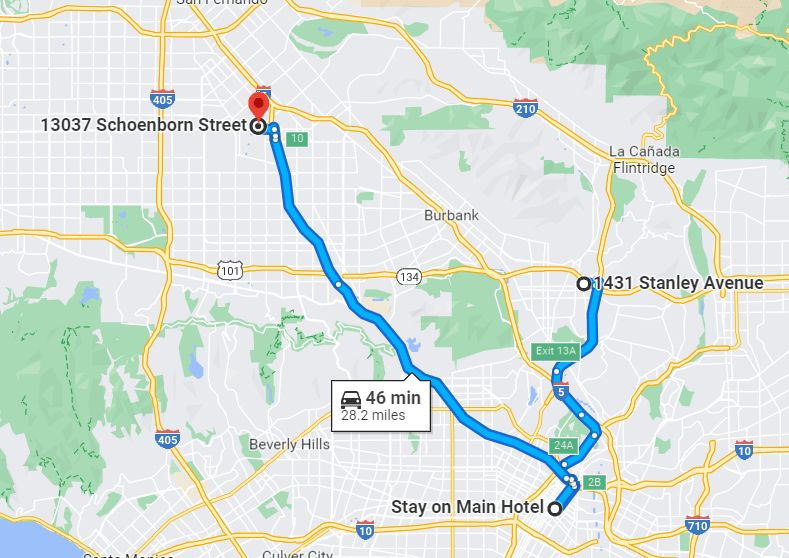
So why was he blamed for these crimes? Because the prosecution determined that the gun used in the Kneiding incident was used in the Okazaki and Yu incidents. The shoeprint found at the Khovananth, linked to the other supposed Avia prints found elsewhere and her eyewitness testimony, which she changed. That is indeed a far reach because, as has been shown, the evidence put forward by the prosecution was found to be false and unreliable, as discussed in THIS POST.
It seems to be a clear case of deciding the outcome and then trying to make the evidence fit around that. Yet again, none of this was questioned. What of the unidentified hair found in both scenes? Was that ever assessed to see if it matched? Nothing is ever mentioned about it. It wasn’t Richard’s; let’s all just move on and forget about it.
The only pattern I see beginning to emerge is one of mystery semen, blood, hair and sets of unidentified fingerprints, none of which seemed to belong to Ramirez.
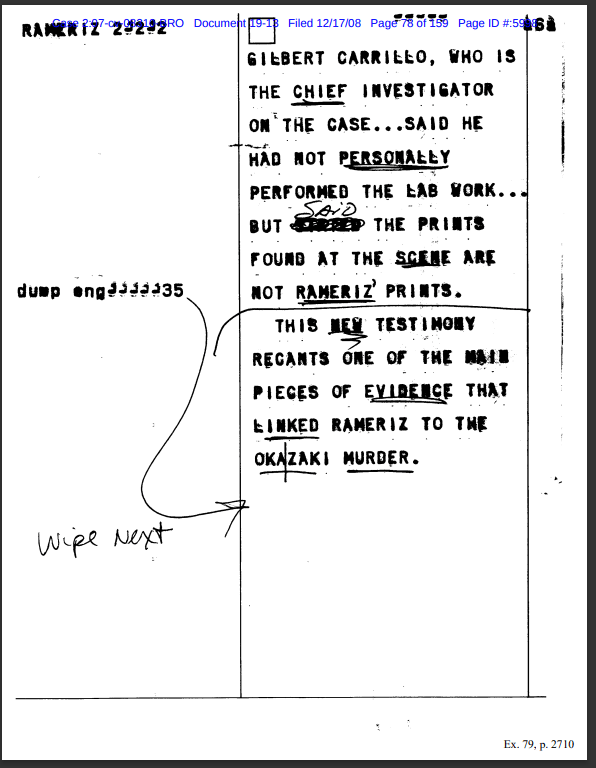
Look at the above image again.
“This new testimony recants one of the main pieces of evidence that linked Ramirez to the Okazaki murder”.
That information was dumped from the network that day, so no one watching the TV got to hear it.
The killings had no distinctive pattern; different weapons were used in many incidents, and none were ever found in Richard’s possession. The state’s theory that Richard must have put gloves on upon entry does not make sense because the crimes lacked organisation, according to the victim’s testimony. The anomaly here is the “uncharged incident”, where for some inexplicable reason, the prosecution alleged that he removed his gloves after convincing the jury that the reason for lack of fingerprints was, well, he wore gloves, of course!
As an aside, the “uncharged incident” has another differing profile, featuring what must be the most well-appointed squad car in history. No need to call in for fingerprint and footprint technicians, not when Officer Wright had the whole lot in the boot of his car or up his sleeves. He was, so he claimed, able to dust for prints, take photographic evidence and even had the special, extra-large lifting tape required for shoeprint impressions. He did all that without calling in the people specifically trained to do this work. Amazing! No charges were made, and as the resident passed away sometime later, no one was around to dispute any of this.
Ballistic Simplistic or Unrealistic
Ballistics evidence was involved in only eight of the incidents. The firearms comparison evidence did not determine who fired the weapons, and as the ballistics evidence was found to be unreliable, no link can be conclusively established.
Incompetence strikes once again, for in 1986, firearms expert, Paul Dougherty, was hired by Richard’s woeful defence counsel, to examine ballistics evidence gathered by the prosecution, of course, in their usual style, they failed to communicate with him and ignored his request to provide evidence itself, you know, so he could do his job. His work was terminated before it even began. Let me repeat this:
Counsel for the defence did NOT provide an expert witness with the evidence they had hired him to investigate.
This resulted in defence conceding ballistics charges without a whimper of protest.

Paul Dougherty, for the purpose of Habeas Corpus, was again asked to examine the ballistics evidence and his preliminary findings are interesting.

In his statement, he explains that the law enforcement work was inaccurate and inadequate. In reviewing the work performed in this case, he found that:
“There are internal conflicts in the written reports with regard to the testing conducted, such as condition of the bullets.”
Ex. 35 Declaration of Paul Dougherty
In Dougherty’s opinion, all the ballistics evidence should be retested. The State, in its zeal to get a conviction, presented evidence that was unreliable.
“It is impossible to say with certainty whether the findings . . . are accurate”.
Ex. 35 Declaration of Paul Dougherty
His examination discovered there was evidence of bullet distortion and lack of unique rifling characteristics, moreover, the three officers who first examined the ballistics evidence, could not agree on their findings. Because of this only one was called upon to testify in court because his report fitted the prosecution case and the prosecution relied on ballistics evidence to try to link the crimes.
It is worth knowing that there is NO scientific foundation in the claim that a specific bullet can be matched to a particular gun; the same goes for shell casings.
“In Okazaki and Yu to Kneiding, Zazzara to Khovananth, and Petersen to Abowath. Prosecution witness Edward Robinson testified that ballistics evidence conclusively linked the incidents above (172 RT 20034-52.) He also testified that a recovered Jennings .22-caliber semi-automatic pistol was positively compared to the Doi case (172 RT 20061.) Robinson was the last of three law enforcement firearms examiners to evaluate the general rifling characteristics of the ballistics evidence. Yet the two other examiners, who did not reach entirely the same conclusions, were not called to testify at trial, because they did not have the answer wanted by the prosecution. For example, in the report prepared by Robert Christansen on March 28, 1985, he concluded that due to distortions of the .22-caliber bullet in the Okazaki case, no positive comparison can be made to the Yu case. In the Kneiding case, firearms examiner Hawkins found there was 60% mutilation of an expended bullet but identified the bullet as having been fired from the same firearm as the bullets fired in the Yu case. This finding raises questions about the reliability of the testing.”
Writ of Habeas Corpus, page 634
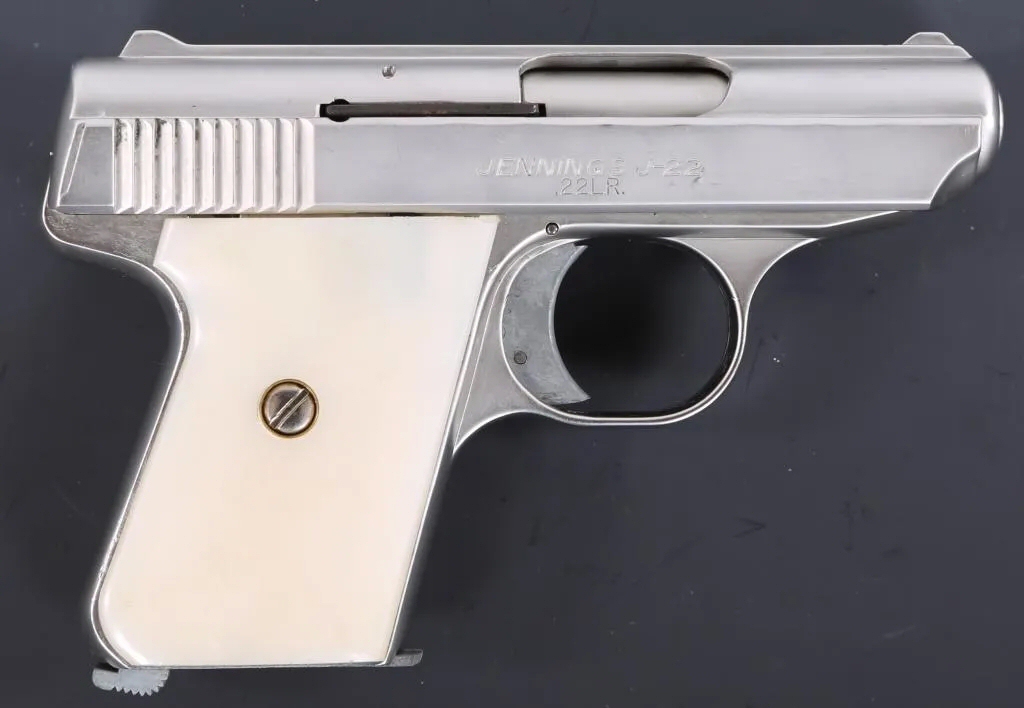
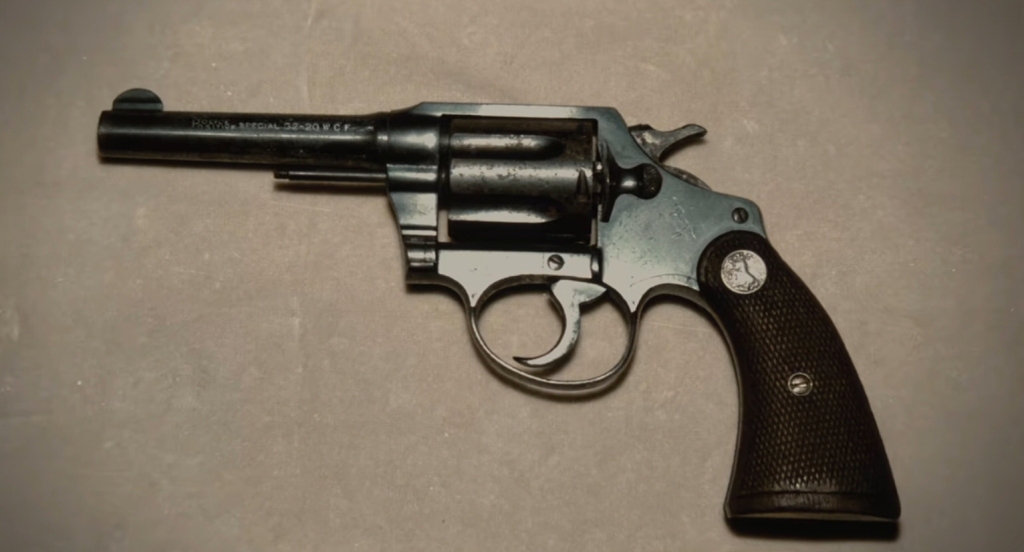
A point of interest is that the Netflix documentary, the sensationalised and often factually incorrect, “Night Stalker: The Hunt for a Serial Killer“, when discussing the Jennings, inexplicably show a completely different weapon. The gun they show is a revolver, a black double-action Colt Police Positive, all photographed up to look like evidence.
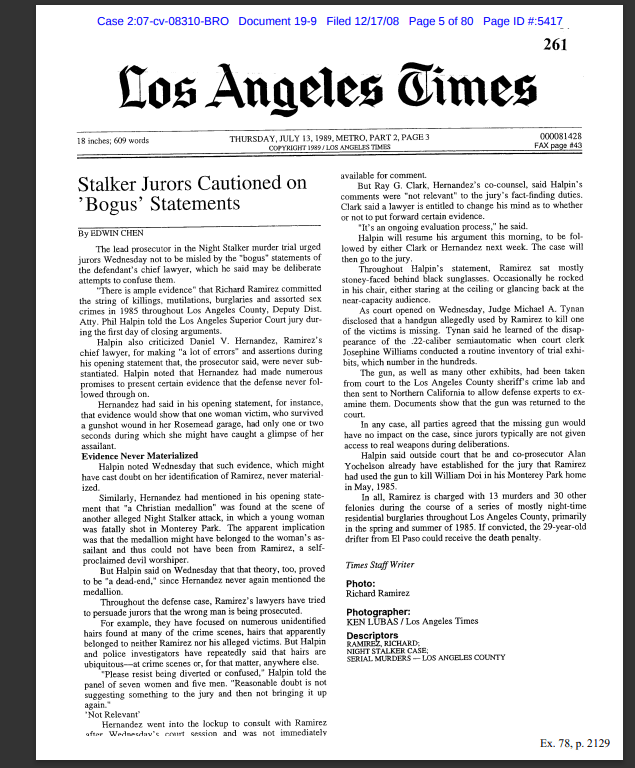
Not the Avias again!
Shoeprint impressions were discovered in only eight incidents, and as shown in this post, false evidence regarding shoeprint impressions was knowingly presented to the jury. A full breakdown of shoeprint evidence is given in the previously mentioned post within this blog, please read it as to include it again here would be repetition.
“I mean that is – you know, you are not allowed to make up evidence, and that is one of the rules”
(Prosecution statement in trial transcripts, taken from the Federal Writ of Habeas Corpus)
Shamefully, that is exactly what they did, as shown HERE and also HERE.
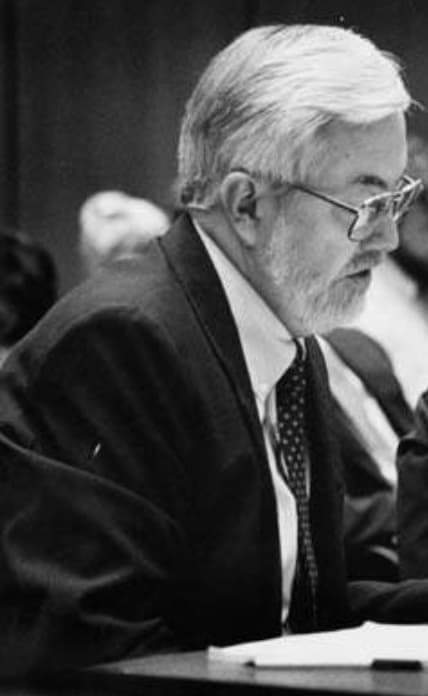
At NO point was the shoe size of Richard Ramirez even mentioned, or determined, during his trial. No proof that Richard even owned a pair of Avia shoes ever materialised either, just some ridiculous fiction about him chucking his “phantom sneakers” off the Golden Gate Bridge. Which no one saw him do.
Summary re: Lack of Distinctive Pattern.
Below is a chart showing how the prosecution tried to link the crimes into a pattern, which there never was. Law enforcement made a big deal out of repeatedly saying that the pattern was there was no pattern, see? That way they could make a link out anything, it didn’t matter whether it was real or imagined.
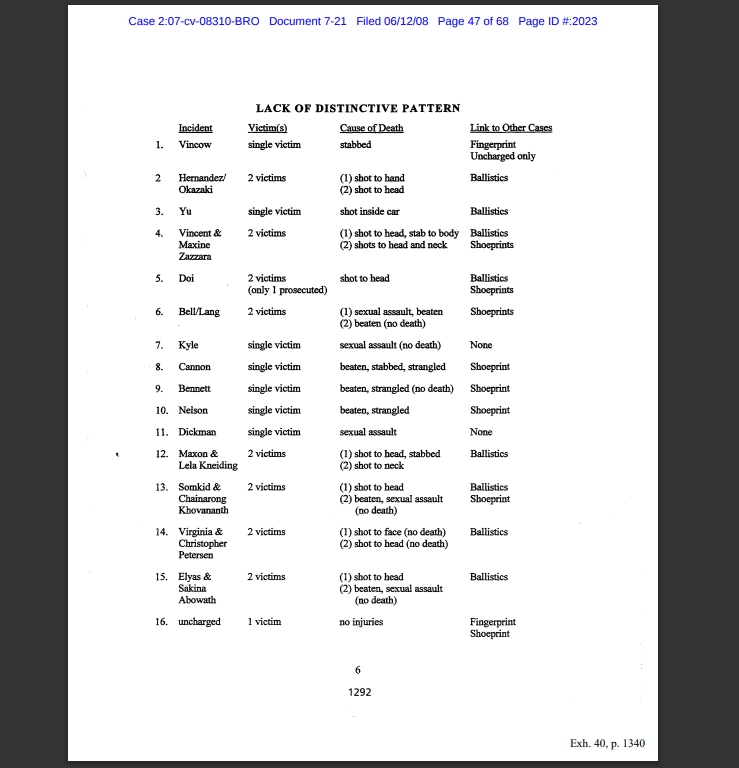
With that in mind, let’s look at each incident where we can see there really wasn’t anything viable to link these crimes together or even to show that one person committed them, or that the one person was Richard Ramirez.
Distorted, dusty bullets, do not show who pulled the trigger!
- Vincow
- No fingerprints belonging to Richard found inside apartment
- No property stolen or recovered
- Wounds not unique
- Could have been committed by more than one person
- Location: Los Angeles City
- Hernandez/Okazaki
- No fingerprints found inside or on doors of residence
- Unidentified fingerprints found, not Richard’s
- No property taken
- Wounds not unique
- No weapon found or recovered from Richard
- Location: Rosemead
- Yu
- No fingerprints found in recovered stolen car
- Wounds not unique
- No property taken
- No weapon found or recovered from Richard
- No apparent motive
- Location: Monterey Park
- Zazzara
- No fingerprints found belonging to Richard
- Unidentified prints were found not to belong to Richard
- Exact model or size of Avia shoeprint not determined
- No weapon found or recovered from Richard
- No property recovered
- Could have been more than one person
- Location: Whittier
- Doi
- No fingerprints found belonging to Richard
- Exact model or size of Avia shoeprint not determined
- Wounds not unique
- No inventory of property stolen from earlier burglary was done
- Trail of stolen property not investigated or questioned
- Could have been more than one person
- Location: Monterey Park
- Bell/Lang
- No fingerprints found belonging to Richard
- Exact model or size of Avia shoeprint not determined
- Scene disorganised, multiple shoe impressions
- Hair found at scene did not belong to Richard
- Wounds not unique
- No weapon traced to Richard
- Trail of stolen property not questioned
- Could have been more than one person
- Location: Monrovia
- Kyle
- No fingerprints found belonging to Richard
- Kyle gave inconsistent statements regarding identification
- Trail of property not questioned
- Location: Burbank
- Cannon
- No fingerprints found belonging to Richard
- Model and size of Avia shoeprint not determined
- Wounds not unique
- Hair found at the scene not Richard’s
- Blood found on the mitten and lamp, not Richard’s
- Trail of stolen property not questioned
- Could have been more than one person
- Location: Arcadia
(I will interject here to say that prosecution failed to preserve important blood evidence or to try and determine just who bled on that lamp. and tried to stem the flow with the mitten! Someone cut themselves during that horrific attack, that someone was shown not to be Richard. Unless he was capable of bleeding someone else’s blood)
- Bennett
- No fingerprints found belonging to Richard
- Scene disorganised
- Hair found at scene inconclusive
- Blood found not Richard’s or Bennett’s. Someone cut themselves again, that someone was not Richard. Both Richard and Bennett were blood group O, the unidentified blood was from group A.
- No property recovered
- Could have been more than one person
- Two types of shoe print on her comforter. One, the obligatory Avia print, size and model undetermined. The other had a herringbone pattern, brand and size not known.
- Location: Sierra Madre
- Nelson
- No fingerprints found belonging to Richard
- Exact model and size of Avia shoeprint not determined
- Hair found at the scene did not belong to Richard
- Trail of stolen property not questioned
- Could have been more than one person
- Location: Monterey Park
- Dickman
- No fingerprints belonging to Richard
- Trail of stolen property not questioned
- Location: Monterey Park
- Kneiding
- No fingerprints found belonging to Richard
- No weapons found or recovered from him
- Hair found at the scene did not belong to Richard
- Trail of stolen property not questioned
- Could have been more than one person
- Location: Glendale
- Khovananth
- No fingerprints found belonging to Richard
- No gloves found or recovered from Richard that matched impressions.
- No weapon found or recovered.
- Trail of stolen property not questioned
- Hair found at scene not Richard’s
- Location: Sun Valley
- Petersen
- No fingerprints found belonging to Richard
- No weapon found or recovered from him
- No property taken
- Location: Northridge
- Abowath
- No fingerprints belonging to Richard
- No weapon found or recovered from him
- Trail of stolen property not questioned
- Semen from vaginal swab not Richard’s, and not her husband’s
- Semen on bedsheets inconclusive
- Location: Diamond Bar
- Uncharged Incident
- Model and size of Avia shoe impression not determined
- Could have been more than one person
- Location: Monrovia
Now We’re Reaching
“In nine incidents (Zazzara, Doi, Bell/Lang, Cannon, Bennett, Nelson, Khovananth, Abowath, and the uncharged case), trial counsel failed to challenge or refute the testimony of the prosecution’s unqualified, inexperienced shoe print witness. In eight incidents, ballistics evidence went unchallenged. The testimony of the prosecution’s firearms expert attempted to link the Okazaki homicide to those of Yu and Kneiding; attempted to link the Zazzara homicide to the Khovananth incident; attempted to link a Jennings semi-automatic pistol that fires .22-caliber long-rifle ammunition to the Doi case; and attempted to link the Petersen and Abowath incidents. Defence counsel failed to competently challenge this evidence”
from the Writ of Habeas Corpus
Of course, they failed to challenge the evidence and inexplicably made it worse, if that were possible.
“I didn’t have any evidence to prove that it was a different gun, therefore you didn’t hear any. I certainly would have brought it in if I had, you could rest assured of that.”
Writ of Habeas Corpus, page 418
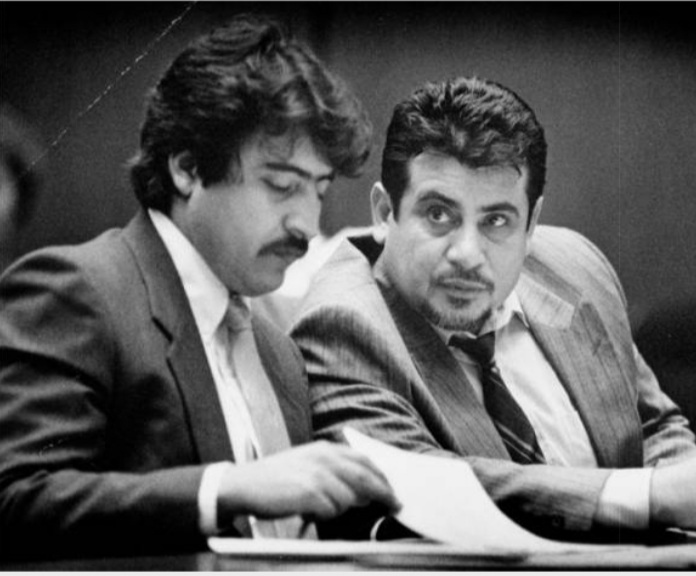
Perhaps, if you’d given the firearms expert the evidence he requested, you’d have had the evidence you needed for the rebuttal. Just a thought. What a fool.
There was significant evidence to show that the offences were not all linked to one another, enough to create reasonable doubt and yet Richard Ramirez was convicted on dodgy physical and ballistics evidence, the unreliable testimony of a “fence” (who was impeached for perjury) and inconsistent eyewitnesses, who could not decide if Richard was tall, short, Asian, white, Hispanic, who may have been blond with bad teeth, or perhaps straight white ones.
Conclusion of Steve Strong, or a lesson in serial blunders..
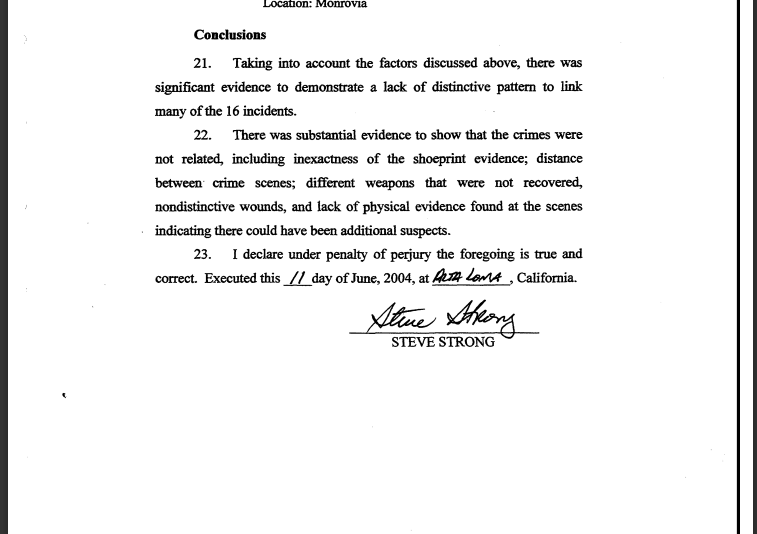
One more step along in the railroading of Richard Ramirez, a series of catastrophic blunders, where his defence counsel conceded ballistic and shoeprint evidence, whilst simultaneously arguing that there was no pattern.
This case never fails to disappoint in its sheer disregard for the truth and the violation of rights. The prosecution improperly relied on inaccurate and unreliable evidence, urging on the jury the significance of such “evidence”, knowing it was incorrect, and using emotive language as it tried to forge links that just weren’t there.
“‘The prosecutor compared less sensational murders, such as the Yu incident to more sensational murders which involved mutilation: “So you didn’t have the mutilation [in Okazaki] that you had in a number of these other cases, but certainly very cold-blooded, deliberate act and inexcusable. . .. March 17 also, the murder of Ms. Yu out on the street . . .. Another terrible act again with no time to mutilate. ‘”
From the Writ of Habeas Corpus, transcript of the prosecution.
There was no link but using the phrase “no time to mutilate” in addressing the jury had the purpose of imprinting a connection between random and unrelated crimes.
A competent defence team should have challenged on all counts, but they did not, having neither experience nor proper preparation. Which culminated in Richard being forever branded a serial murderer and receiving the death penalty multiple times.
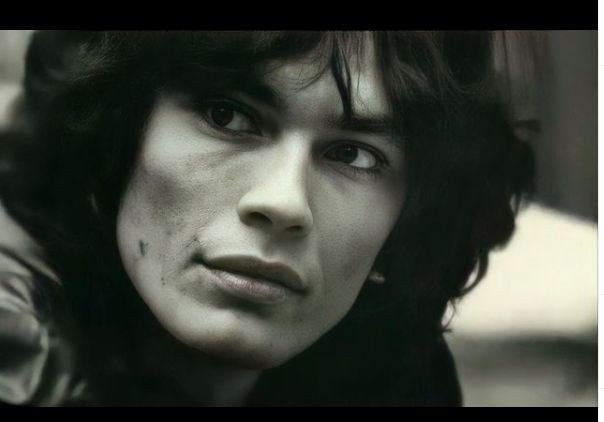
“Those who plead their cause in the absence of an opponent can invent to their heart’s content, can pontificate without taking into account the opposite point of view, and keep the best arguments for themselves. For aggressors are always quick to attack those who have no means of defence.”
Christine de Pizan
It is painfully obvious there was no defence for Richard Ramirez.
~ Jay ~


 Expendable For A Cause.
Leave a reply to Zazzara – Expendable For A Cause. Cancel reply