
After months of persistent efforts to obtain documents from the LA Archives and Record Center regarding Richard’s case, we finally received hundreds of pages of transcripts from the preliminary hearing. However, it was a small fraction of what we are seeking, as we received a limited number of documents from 1985 and 1986. Nonetheless, within those transcripts, we uncovered interesting information that sheds light on the relationship between Jack Vincow and his mother, Jennie.

The day Jennie Vincow was brutally murdered, she was found lying in bed, with her feet toward the headboard, dressed in what appeared to be a nightgown. A blanket was lying on top of her, partially tucked around her, covering her body up to the lower portion of her neck. The medical examiner, Lawrence Cogan, reported that she had suffered multiple stab wounds to her body and a deep slash wound to her neck. Several of the wounds she suffered had the potential to be fatal on their own. Cogan also emphasized the significance of the stab wounds being located on the front of her body, indicating that the assailant and victim were likely in a face-to-face position when the wounds were inflicted.

(Statement by Detective Jessie Castillo, Court Reporter Transcripts, 3-4-86)
By all available accounts, including the 2008 Federal Habeas Corpus Petition and various contemporary news reports, Jack Vincow was portrayed as a devoted and loving son who was deeply attentive to his mother, Jennie. However, the court transcripts from March 4 and March 5, 1986, reveal some interesting findings that contradict the widely accepted portrayal of Jack as a caring son.
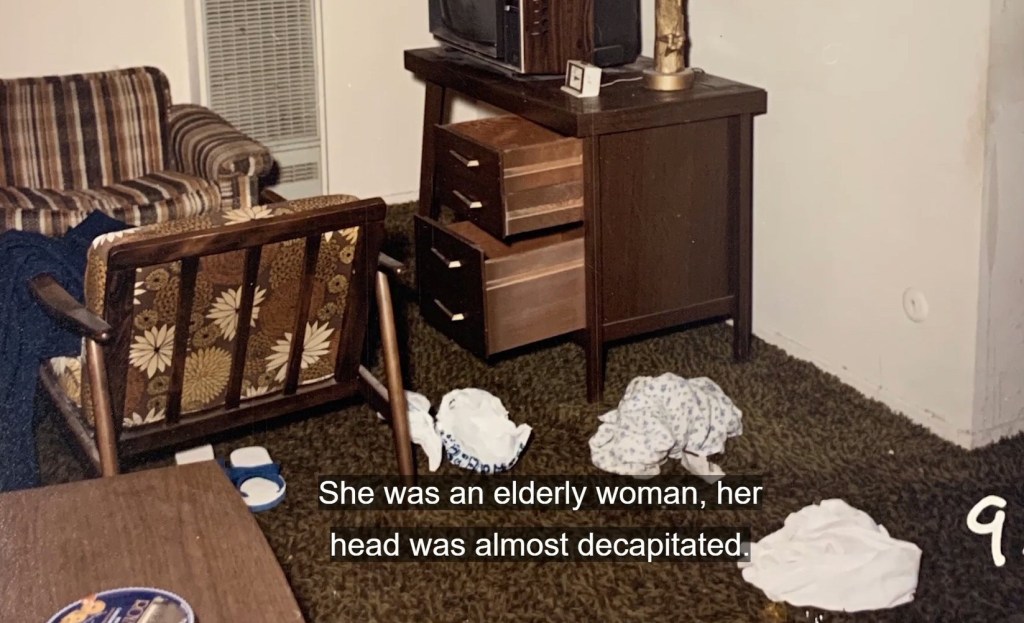
Appearance of Jennie Vincow’s living room the day she was found murdered
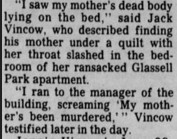
Monrovia News Post, March 5, 1986
Jack Vincow was reportedly a caring and attentive son who visited his mother daily. Yet, the condition of Jennie’s apartment on the tragic day of her death raises questions about the image of Jack as a caring son and contrasts sharply with the portrayal of filial devotion. When LAPD officers arrived at the scene on June 28, 1984, they found the apartment in a disarray. It was assumed that whoever had murdered Jennie had ransacked the home in search of valuables. However, the condition of the apartment indicated much more than mere ransacking. In Jennie’s bedroom was a chest of drawers; four drawers were pulled out, with clothing both hanging out of the drawers and strewn across the floor. The contents of a brown vinyl purse were spilled on the floor, and various items were randomly placed on top of the dresser, including two pairs of shoes and toiletries. Papers were also scattered across the floor. The kitchen table was cluttered with an assortment of items, including two Soup bowls (discussed in a previous post), several boxes of cereal, Styrofoam cups, soup cans, and a plastic dish. Upon inspecting the refrigerator, officers found it “very dirty and filthy,” with several open cans of soup and rotting food, causing a foul stench. The condition of the refrigerator led Detective Jessie Castillo to express disbelief that anyone could continue to use it in such a state. Several LAPD officers described the home as overall “unkempt, very dirty, and filthy,” indicating it was in a deplorable state and appeared to have been in that condition for a long time.
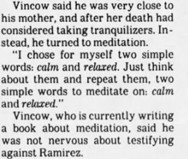
from Los Angeles Times January 31, 1989
Jack claimed he was “very close to his mother.” Would a devoted son allow his elderly mother to live among filth and rotting food? The harsh reality of Jennie’s living situation stands in stark contrast to the image of Jack as a caring son who was involved in his mother’s care, undermining his credibility.
Overkill
Was Jennie’s murder an example of “overkill”? Overkill refers to the excessive trauma inflicted on a victim that goes beyond what is necessary to cause death. Some homicide investigators argue that the presence of overkill indicates a crime of passion and suggests a connection between the perpetrator and the victim. Additionally, the act of covering a body may indicate that the perpetrator had a relationship with the victim and was remorseful. Jennie suffered multiple wounds, several of which could have been fatal on their own. She was discovered in bed, covered and “tucked in” with a blanket, suggesting the presence of overkill in the brutality of her murder.

KayCee


 Expendable For A Cause.
Leave a reply to selflessrebel Cancel reply