Mark the Card With His Number

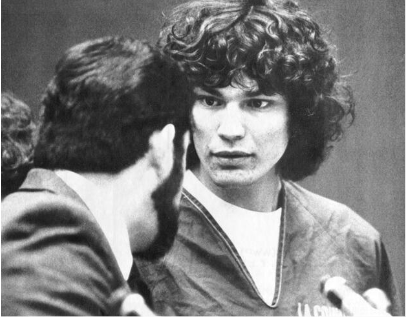
Richard with Arturo Hernandez, pictured during the preliminary hearing.

And so the Tall, Short, Balding, Blonde, Dark, Moustachioed, Dark or Light Skinned, Asian/Hispanic/Caucasian Man Was Identified.

We’ve discussed the infamous lineup many times on this blog and in the book. You can read more about it HERE, HERE and HERE.
It’s hard to imagine that anyone with critical thinking could look at the lineup procedure on 5th September 1985 and not see it for what it was: corrupt, manipulated, and influenced by the media and law enforcement to guarantee an outcome everybody wanted.  

The prosecution needed the eyewitnesses to positively identify Richard, as they had little physical evidence to link him to any of the crimes. Witnesses were permitted to gather and mingle in the presence of the media and camera crews, and they were coached via hand gestures. All were able to see and hear who each was choosing.

We’ve used the still taken from footage of the lineup in a few previous posts. In it, we can see an officer, probably Deputy John Jones from the Sheriff’s Department, clearly holding up two fingers as he signals to the assembled audience who they should identify.
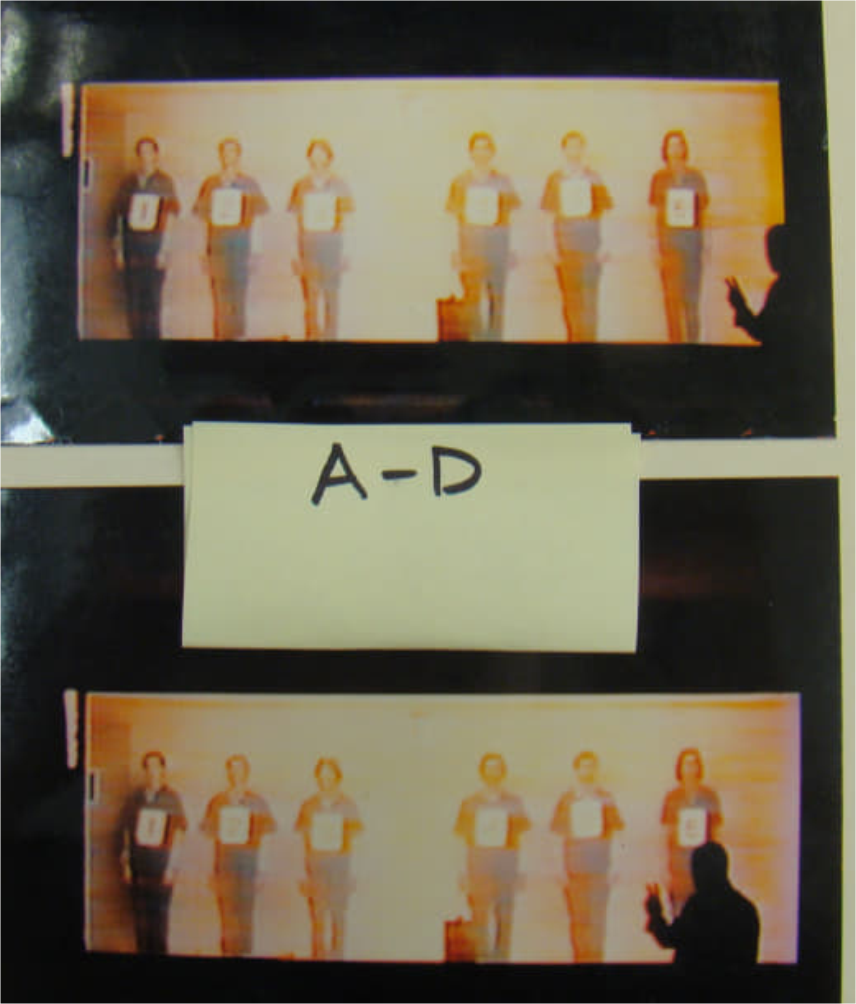
One photograph could be argued away, but when you watch the accompanying video footage, it becomes more apparent what the officer is doing. He is leading the witnesses and telling them the number of the suspect they want to be identified. Jones himself declared that it was a gesture to an elderly lady who was hard of hearing. That seems nonsense unless the lady in question inserted herself into both adult groups and then joined the children, who were separately instructed. His reasoning also does not explain why he needed to show a deaf lady two fingers; what was he trying to tell her?

“Mark the card with his number”. These words are spoken at the exact moment the fingers are held up to the audience, as the officer walks in front, making sure he is seen.

Judith Crawford

The unscrupulous behaviour did not go unnoticed by Public Defender Judith Crawford; she witnessed the deputies controlling the lineup repeat the gesture to the adults and children on separate occasions. Crawford made notes regarding what she had seen, which became the basis for two pre-trial motions and a big part of the later post-conviction appeals.
Watching what was unfolding in front of her, Crawford scribbled in her notepad, because, one imagines, she didn’t trust herself to look away and miss something important. We discovered the note she made as we read through the case files. (We did strain our eyes over this one!)
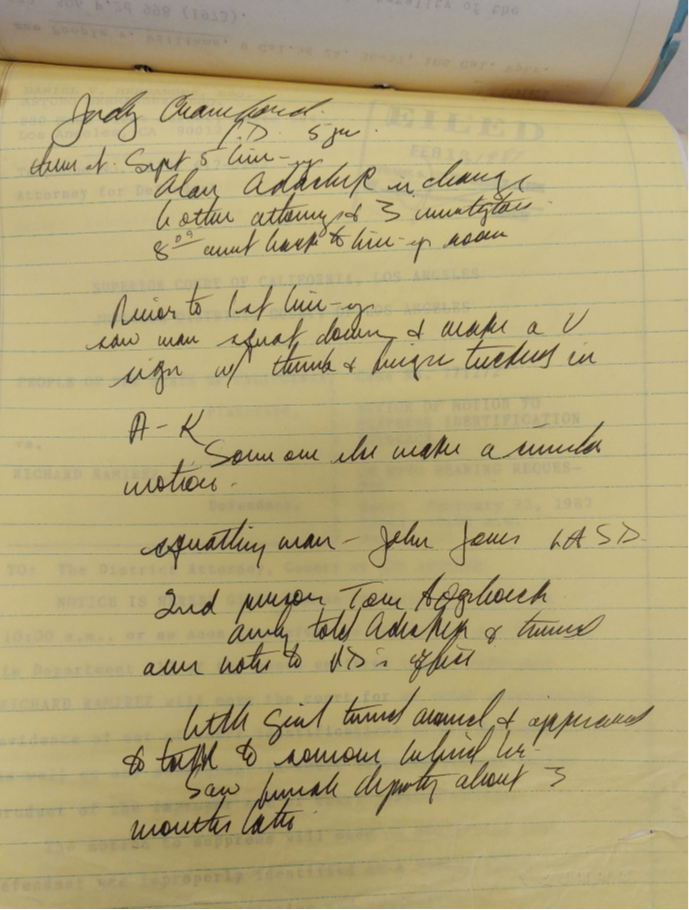
Judith Crawford’s hurried scrawl we found in the case files.

“Prior to 1st line-up, saw man squat down and make a V-sign with thumb and finger tucking in.

A-K [probably refers to the surname order of witnesses]: “Someone else make a similar motion. Squatting man – John Jones, LASD.” [L.A. County Sheriff’s Department].

“2nd person, Tom Hageboek, and told Adashek [Ramirez’s attorney] & turned own notes to ? Office (probably the district attorney). Little girl turned around and appeared to talk to someone behind her. Saw female deputy about 3 minutes later.”

(Thanks, Venning!)

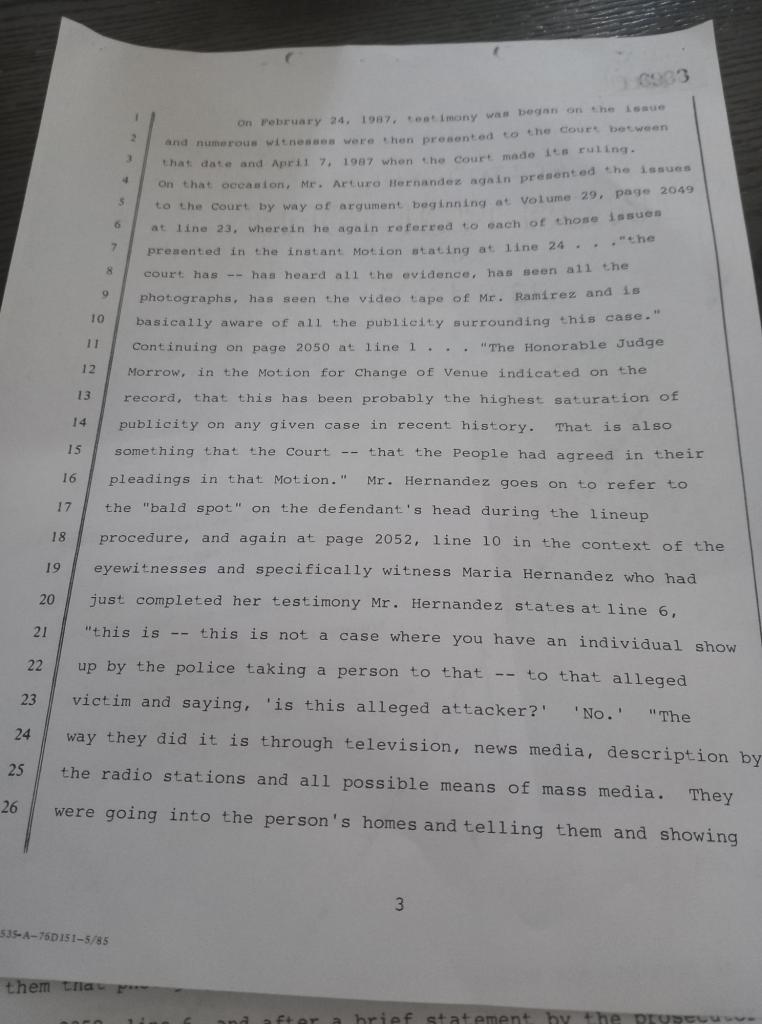
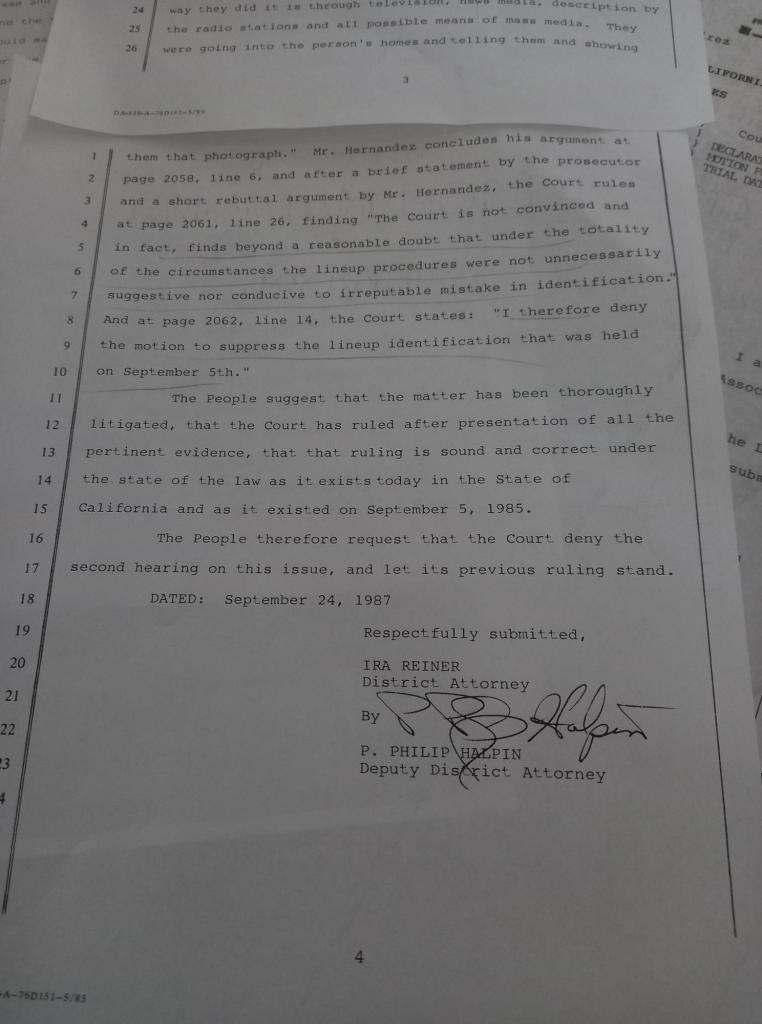
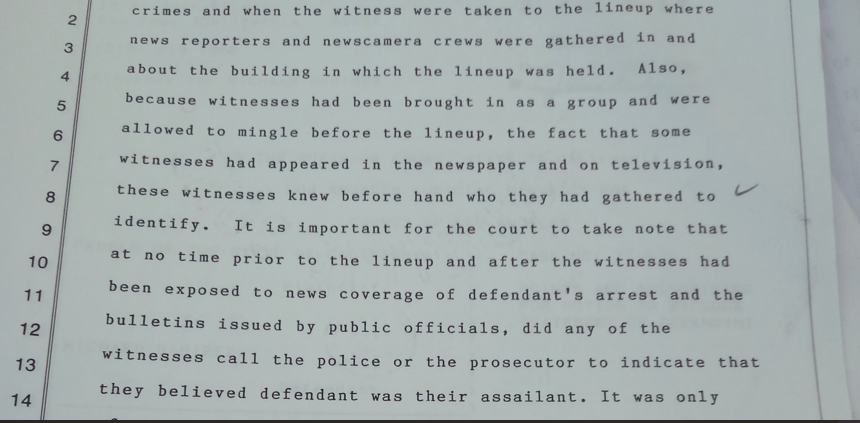
We unearthed a statement of facts relating to the lineup during our visit to the Hall of Records in LA. The document we found was Richard’s defence’s attempt to overturn the earlier court ruling that had denied the motion to disallow the eyewitness identifications due to unethical procedures.  The document is dated 24th September 1987, just over two years since the live lineup occurred.
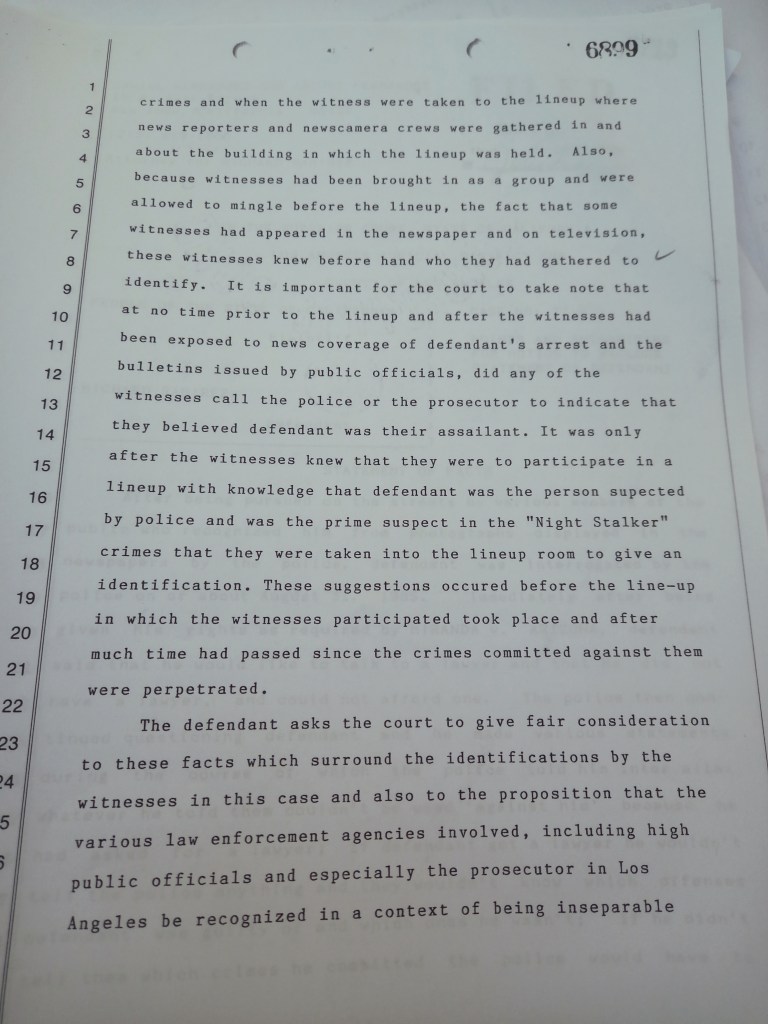
“…witnesses were taken to the lineup where news reporters and news camera crews were gathered..”

It is important for the court to take note that at no time prior to the line up, and after the witnesses had been exposed to news coverage of defendant’s arrest and the bulletins issued by public officials, did any of the witnesses call the police or the prosecutor to indicate that they believed [the] defendant was their assailant..

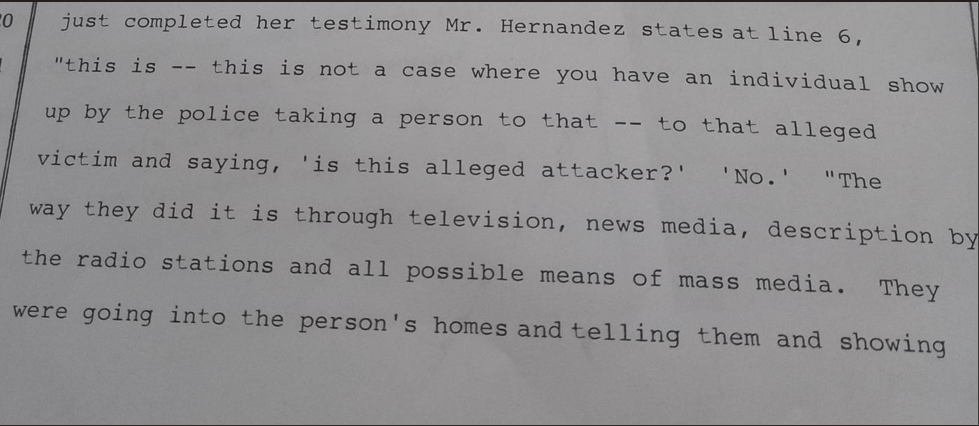
We had to take these photos surreptitiously with our phones, as they had not yet given us permission to take pictures; that came later. Apologies for the bad quality; below are some cropped versions. (You will probably need to enlarge)

Arturo H

I make no secret about my feelings regarding Richard’s defence (they were appalling) and have written articles about it, but as inadequate, ill-informed, and ineffectual as Arturo Hernandez was, he was doing something (it is incredible to see him actually turn up), although much more should have been done. A better qualified and competent lawyer would have had a better chance against the wily Philip Halpin, who had been weaving the narrative for a month before Richard was even a suspect; P. Philip Halpin, Deputy District Attorney, knew precisely how he would prosecute the case.
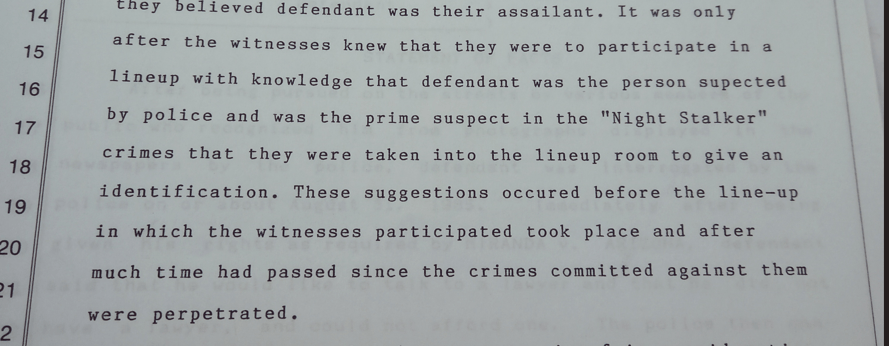
…it was only after the witnesses knew they were to participate in a lineup with knowledge that defendant was the person suspected in the “Night Stalker” crimes that they were taken into the lineup room..

“The way they did it is through television, news media, description by the radio stations and all possible means of mass media. They were going into the person’s homes and telling them and showing..”

Hernandez was correct in his representation of what occurred in September 1985. The media, with law enforcement and  Deputy District Attorney Halpin, drip-fed the witnesses (and the wider public) the description of the “Night Stalker” and then projected him into their homes before telling them exactly who they were gathered together to identify. 

It’s interesting how that sort of messaging works. It induced a victim of a completely unrelated crime to want to go and identify Richard Ramirez as her own attacker. Even though she categorically knew it wasn’t him.
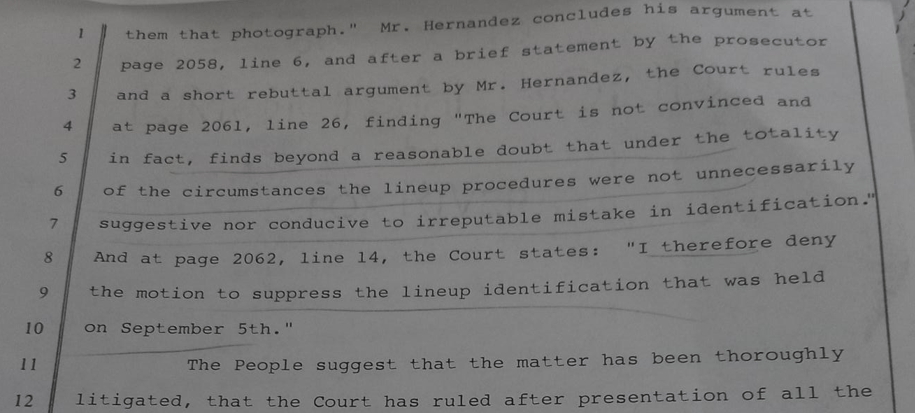
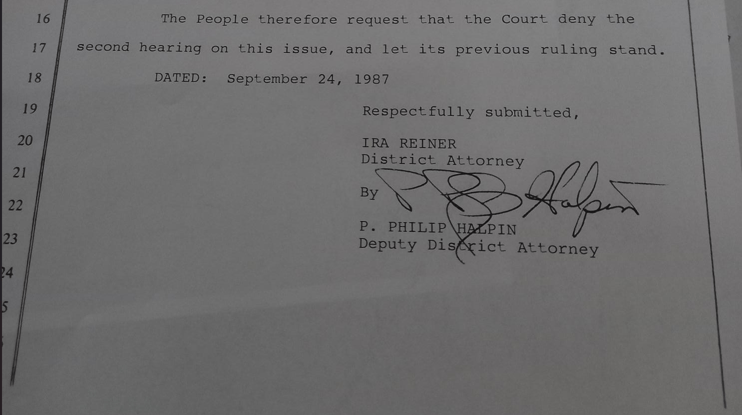
Statement of facts: we were intrigued by the pencil markings, probably made by post-conviction lawyers.
The final denial of the motion, signed by Halpin, on behalf of DA Ira Reiner.

Additional information:

Richard Ramirez: False Child Abduction Allegations – Expendable For A Cause.

“Murder Clothes” – The Myth of the Night Stalker’s Appearance – Expendable For A Cause.

Why the Khovananth Incident Was a Pivotal Moment – Expendable For A Cause.

Our BOOK

182 responses to “Mark the Card With His Number”

  1. I’ll admit, it’s nice to see that the Hernandezes at least made an effort during this whole shoddy trial. But I do have a question—I know Richard had other lawyers before the Hernandezes took over, but why is this document dated more than two years after the live lineup took place? That lineup was one of the so-called “strongest” pieces of evidence in the prosecution’s case against Richard, so wouldn’t it have been crucial to challenge it in a more timely manner? It seems like something that should have been addressed much earlier. Maybe I’m getting the dates mixed up regarding when the Hernandezes officially took over Richard’s case, but the delay still seems odd to me.

    Liked by 2 people

    1. It was, but the court decided there was nothing wrong with the lineup and denied the motion to have the identifications ruled as inadmissible. This was an attempt to get a second hearing on the matter but the court decided the earlier ruling still stood.

      The Hernandezes took over in October 85, and yes, the delays were prolonged. They were good at delaying.. but not good at being attorneys.
      They needed those identifications because they had scant physical evidence putting him at the crime scenes.

      Liked by 3 people

      1. Would you happen to know why they said the earlier ruling still stood?

        Liked by 1 person

      2. Yes.. because they refused to acknowledge that there was a problem with the lineup. The court ruled that it had been fully litigated and that was the end of the matter.
        Without those identifications the case would likely have collapsed.

        Liked by 3 people

      3. I see that reasoning as a possible indication of collusion between the prosecution and the court. I’ve come across discussions on YouTube and other platforms where people who vehemently believe Richard was the Night Stalker still find the lineup footage odd. Many have pointed out the strange coincidence of the officer holding up two fingers just as Richard happened to be holding the number two card in the lineup. The whole thing feels a little too “convenient”. It leaves a bad taste in my mouth.

        Liked by 3 people

      4. I believe there was collusion, yes. Even Judge Morrow said that he’d never seen such media saturation in any case he’d previously been involved with. Of course, Halpin got rid of Morrow, to be replaced by Tynan.
        The information about Richard was consistently fed to the public, and that included all the witness, who curiously didn’t seem to recognise him. That is until they were primed by the deputies from the Sheriff’s Department.

        Suddenly witness Kathy Moore’s attacker, an older, shorter man with thinning hair, suddenly became the tall, slender Ramirez. Even though he’d got a visible head wound, it’s obvious he had a thick head of hair.

        People are right to doubt the authenticity of the process, especially when the video shows exactly what Jones did.

        Liked by 3 people

      5. Every time I revisit this case, I can’t help but wish that Judge Morrow had presided over it instead of Tynan. I don’t know much about Morrow, but there’s a possibility that he wouldn’t have been as easily swayed or convinced by Prosecutor Halpin—or any other entity—to manipulate the trial in their favor. It makes me wonder if the case would have been handled more fairly under his watch. I know that Judge Morrow stepped away, citing an overwhelming caseload as the reason, but at this point, I wouldn’t put bribery or aggressive persuasion past any of the key players involved. There were too many questionable decisions made throughout this trial, and given the level of misconduct that seemed to take place, it’s hard not to speculate whether there was something more at play behind the scenes.

        Liked by 2 people

      6. Morrow “stepped back” because Halpin filed a motion to get him removed. That came soon after Morrow took Richard into his chambers to warn him that his defence team were shit and his rights were not being protected.
        He said he wanted everything done correctly, and you can see why.
        Morrow was a clever man, he understood that if Richard’s right to due process was denied because of incompetence, it meant years of appeals going forward.
        He knew that was going to happen and he had to make Richard aware that he was being short changed in the legal process.

        I do feel Morrow was a fairer judge than Tynan, who’d worked with Halpin for 20 years, but I believe the outcome for Richard was always going to be death. No matter who presided.

        I think (and someone correct me if I am wrong) it was Morrow who ruled on the change of venue motion as one of his last actions.

        Liked by 3 people

      7. That’s true—I constantly find myself thinking of ways Richard could have been spared from his death sentence. I’m grasping at straws at this point. But the reality is, when you’re uneducated, lacking resources, and financially struggling, once you get caught in the legal system’s web, it’s damn near impossible to break free. The justice system isn’t designed to favor people like that; instead, it entangles them further, making any chance of escape feel like an illusion. I can only imagine that for Richard, it must have felt like being trapped in a never-ending maze—one filled with unexpected twists and dead ends, where every possible path led him deeper into hopelessness until, eventually, he had nowhere left to turn and perished within it.

        Liked by 1 person

      8. He never had a chance, and he always knew he’d be found guilty. I suppose that’s why he “flip flopped” between pleading not guilty and guilty. He knew he was doomed and probably wanted to spare his parents the ordeal of the trial.

        If you’re poor and get stuck with a lousy defence, there’s no hope. The State holds all the cards,and there’s no way out. The justice system needs a complete overhaul. There’s no justice for an indigent client.

        The prosecutor, the judge and LASD knew those convictions were shaky, hence the panic over the San Francisco trial; they knew a wrong move there could overturn the LA convictions.

        Liked by 4 people

      9. I can’t even begin to comprehend just how painful that realization must have been for him—to know that he would spend the rest of his life rotting in prison for crimes where there was a very high possibility that he didn’t commit them. The sheer weight of that knowledge, the hopelessness of being trapped in a fate he couldn’t escape, must have been crushing. And yet, despite everything he endured, he displayed an immense amount of strength.

        I truly believe that if Richard had competent attorneys from the start, he might have had a real chance at creating doubt within the public. But even then, he faced another nearly insurmountable obstacle—the media. No matter what he said or did, every breath he took was twisted, manipulated, and sensationalized to fit the narrative they wanted to push. When the media paints you as a monster from the very beginning, the truth becomes irrelevant, and the possibility of a fair trial all but disappears.

        Liked by 3 people

      10. Sad and infuriating.

        Liked by 2 people

      11. There was nothing wrong with the lineup? Not only that they made signs with their fingers and allowed the witnesses to communicate with each other. There was also Richards visible head injury after the pictures or videos of him in the police car, with his huge head bandage were all over the media. And I still can’t get over it that they rewarded James Romero with money and a motorbike right before the lineup. I don’t blame James for anything, but the people who had the idea to tell him he was the hero of his hometown and give him lots of money and a motorcycle and apparently believed this for sure wouldn’t influence a 13 year old kid. Of course not. He would just say : “Sorry, that’s not the guy I saw.” and give his reward back.

        Liked by 4 people

      12. I know, it’s such a joke, right? They might as well have painted an arrow on the wall that pointed to Richard.
        What a disgusting farce.

        Liked by 4 people

      13. It definitely feels as if James was groomed by the police.

        Like

      14. I even forgot that they introduced him to Inez Erickson and that she hugged him and thanked him and then they were sitting next to each other at the lineup. And he was flown by helicopter to LA right after getting all the rewards. All that sounds like a manual: How to make a teenager feel mega-important. And again, I don’t blame James for anything. I don’t know if all this influenced him or if he was able to remember and to tell what he really saw. But all the adults involved, and especially the police, must have known that it could influence him and that’s why all of it should have been avoided.

        Liked by 1 person

      15. I feel very sorry for James, I think the whole experience blighted his life. Law enforcement handled it very badly, giving out the rewards and gifts before Richard even set foot in court just seems so wrong. What did that signal to the public? Of course, Tom Bradley was up for re election as mayor, and the photo ops looked very good. It goes way beyond justice, and slips into pure “Hollywood” drama.

        Like

      16. His family have had to live with the mental scar of believing they had a near-miss with a brutal death that night.

        The Romeros probably weren’t aware how common prowlers, rapists and burglars were in Orange County. Someone did some research into a 20 year period of attacks and creeps in the area. It’s sort of related to the Golden State Killer. They believe they’re safe in suburbia but it never was.

        Tustin Rapist

        Liked by 1 person

      17. The influence shows when, even in his 50s, James recites the killers clothes in the same order Carrillo does, almost verbatim.

        Like

  2. I just don’t get I understand everything you 3 have said smith why people did this to Richard but still just why?! They calm themselves good people but good people don’t do this anybody! I’ve seen so many killer documentaries and all the cops and detectives have worked their puts off with their cases and did nothing to seek fame or money or anything except Richard’s case the cops were messed up!

    Liked by 4 people

    1. And ..we don t must forget that there was this big amount of sheer envy on Richard ! You can even feel it in some letters of his socalled penfriens . There is this weird combination of admiration and envy , almost everywhere.

      Liked by 3 people

      1. And Gil with his very weird and obvious obsession.

        Liked by 3 people

      2. His weird obsession that he’s made a lot of $ from.

        Liked by 2 people

      3. It all adds to the pension fund.

        Liked by 1 person

      4. oh for sure it was crazy and weird, I feel like Gil I remember we all mentioned was like secret groupie 😂

        Liked by 1 person

  3. Rather in the comments of male penfriends than in the letters themselves. Envy and jelousy .

    Liked by 1 person

  4. What a tragic story , cant get over it somehow . Thats because all the open questions . And 27 years in prison…Wine and Dine.

    Liked by 2 people

    1. Yes, there’s still too many questions and things we will never know.

      Liked by 1 person

      1. If Doreen Ramirez wrote a book …

        Liked by 3 people

      2. She never will and I admire her for that.

        Liked by 2 people

      3. Yes ..Me too , I have such respect for Doreen . No she won t write a book.

        Liked by 4 people

      4. I hope Doreen does read your book and reaffirms her beliefs that Richard really did have no involvement in those crimes and was more than likely setup by his associates to take the fall for what I believe were crimes that they committed.
        After all, how do you suppose that fence got the loot he ended up with if he didn’t get it from them, because he didn’t get it from Richard. Unless they were fencing it through him without him knowing where they got it. But that seems like a longshot.

        Liked by 1 person

      5. Poor Doreen, I hope she does, too.
        Good to see you, Donna.

        Like

      6. I have a lot of respect for Doreen. She could sell her story for a lot of money, but she chooses not to. I think that shows how much she really cared about Richard, and it says a lot about her character.

        Liked by 3 people

    2. So incredibly sad and frustrating.

      Liked by 2 people

  5. What Arturo stated at line 6 was incredibly insightful and powerful. With how aggressively they blasted Richard’s image and name on television—constantly associating him with the crimes and labeling him as the “Night Stalker”—it’s not beyond common sense to recognize that they were subliminally and psychologically embedding that image into people’s minds. Even just a few days of that kind of media exposure would have been enough to solidify the connection. As Arturo pointed out, they were essentially entering people’s homes through their television screens and spoon-feeding them the idea that Richard was the Night Stalker, leaving little room for objectivity.

    I’m not sure how much of a difference it would have ultimately made, but a change of venue was absolutely necessary. The reasoning the court provided for denying it was highly biased, and anyone with at least two brain cells could see that the potential jury pool in Los Angeles County was irreparably tainted, regardless of its size. Witness identifications and statements were inevitably influenced, altered, and biased, while the jury itself was primed to be prejudicial against Richard from the start. Law enforcement, the court, and the media were undoubtedly in cahoots with one another, working together to ensure that he never had a fair chance at defending himself.

    Liked by 2 people

    1. I agree with you. When I first read that statement from Arturo I was determined to include it in a future post, because he summed it up completely and succinctly.
      The media, fed by the police, told everyone that, without a doubt, the Night Stalker was Richard. The mayor told the media that no trial was needed because he was guilty, and after those sorts of comments it was impossible to ever get a fair trial in LA.
      The social scientist, Dr Bronson, working on the case, said it was the worst case of media saturation he’d ever witnessed.
      The change of venue motion should definitely have been granted.

      Liked by 2 people

      1. I read through the document on PlainSite, where they analyzed the media coverage of Richard and his trial by quantifying the number of inflammatory or biased terms used throughout the reporting. When I looked at the numbers, they were absolutely jaw-dropping. Words like “devil-worshipper” and other sensationalist labels were used in nearly every mention the media made about Richard and his case.

        People who vehemently insist on Richard’s guilt should take the time to look at these posts, as well as the PlainSite documents, to truly understand just how severely compromised his due process was and how many of his constitutional rights were blatantly violated. The purpose of the justice system is not to provide emotional or moral closure but to ensure that the accused receives a fair and impartial legal process. Richard did not receive that—not at any step of the way.

        When procedural failures of this magnitude occur, the charges should have been dropped—even if this means that someone who is subjectively viewed as guilty is set free. This is the only way to prevent the irrationality of emotions, public opinion, and even moral biases from dictating what happens to a person’s life when they are accused of crimes as horrendous as those Richard was accused of.

        The same people who dismiss these violations would be outraged if the same injustices had happened to them. The legal structures and procedures are in place to ensure that no one is deprived of their life, liberty, or property without due process. In Richard’s case, they did not prove his guilt beyond a reasonable doubt, yet he was stripped of all three.

        Liked by 2 people

      2. What you’ve described is why we started this project/blog in the first place.
        No one was talking about the monumental fuck ups that were evident throughout the whole case.
        From the investigations through to the trial itself, and beyond.
        The whole thing was a disaster. Even now most are reluctant to examine the procedures properly.
        It’s quite extraordinary how they willingly accept the misinformation/disinformation thrown around, without even the slightest attempt to understand what was going on.

        Liked by 4 people

      3. I believe the reason for this is that it is far more profitable to continue exploiting the gruesome infamy of the Night Stalker persona. When you strip away the sex, violence, gore, and Satanic panic, and instead attempt to view the case objectively, seeing Richard as a person rather than some twisted, fetishized figure, the hybristophiles and fangirls suddenly have nothing left to romanticize or obsess over.

        But beyond the spectacle, the real tragedy here is that what happened to Richard—while extreme—was not entirely unique. Due process violations and constitutional breaches still occur today, affecting people who lack resources, knowledge, or legal representation to fight back. The public needs to be educated on the intricacies of the legal system because the reality is that anyone can become entangled in it.

        Richard’s case should not be remembered as just another blood-soaked horror story for people to sensationalize. Instead, it should be a cautionary tale—a stark warning about what happens when the justice system prioritizes narratives over facts, hysteria over truth, and profit over fairness.

        Liked by 2 people

  6. there’s a lot of confusing stuff about this case such I believe weeks before Richard got arrested they already claimed he was the nightstalker and as you mentioned Jay the mayor said no trial which is dumb, they we so positive he was the bad guy makes me wonder they didn’t out in enough effort for the case they just wanted to hurry up with it and rush off etc… every case needs a trial no matter what and it’s always innocent until proven guilty!

    Liked by 2 people

    1. I ve just read the posts and it made me really annoyed again too that the Media coverage had such power to poison the entire athmosphere at that time by using imflammatory language about the evil , devilish Nightstalker Ramirez … I ve read the statistics about that in Plain Site too when I was so upset about the Carlo book and about those disgusting edits which I saw then. Still I can t get over this , its so annoying. Should nt be allowed !

      Liked by 2 people

      1. The media is a massive problem. Of course “some” things have to be covered, but what should never be forced onto a watching public are statements asserting that the suspect (any suspect) is definitely guilty.
        It prevents justice being done as there cannot be a fair trial. One side plays with a loaded dice, especially in a case with a massive public profile.
        Richard’s trial was a “show trial”, an excuse for something that was passed off as justice served.

        Liked by 2 people

      2. Yes you’re right and I agree! Non of this should be allowed at all! This is a persons life we are talking about here and cases like this should be taken seriously not as a joke or money grabber!

        Liked by 2 people

  7. And…I just remember the Pan case . That LAPD was quite excited when they heard about the possible connection between AC / DC cap found in the Hernandez case and Jack the Ripper writing and Judas Priest Rockband and the connection to Satantic Panic….and that the killer is a ROCKFAN …All of this was very exotic at the time ! I think this contributed to this ” witchhunt ” in the Media and in Reality too.

    Liked by 1 person

    1. No , what I mean is that L.A police drew the conclusion that the Pan attacker must be a rockfan , as they made this connection between AC/ DC cap and Judas Priest Band . Not at all knowing wether the Hernandez attacker was indeed a rockfan just because he was wearing a AC/ DC cap. Oh Oh …this is complicated ! Haha. But ..I guess you understand what I m trying to say. They tried to make joinders everywhere possible , which is actually normal. But of course one can be wrong with those joinders !

      Liked by 1 person

      1. And then it became : Satanic evil rockfan serialkiller with rotten teeth. One leeds to another in the Media…

        Liked by 1 person

      2. I have always found it ridiculous how they put it all together with the rock music connection as if being a fan must be unique when there must have been hundreds of fans of these bands in both cities. AC/DC even toured that year. The joinders are quite weak. I can see why they might make the connection too, because really it was all they had!

        Liked by 2 people

  8. Its just about the power of influencing people in a very negative , obscure way which always should be taken into account . But this is in the responability of the creators , we all know that. Thats why this book of yours is so important and still so amazing.

    Liked by 2 people

    1. It’s a massive problem, and it’s far worse in the USA. Here, many details of a case/suspect aren’t revealed to the public until after the trial. Our system isn’t perfect, and sometimes keeping details from the public until after a verdict often gets called a cover up, but in reality, they don’t want the public heavily influenced because it results in a jury chosen from a poisoned well.
      Even so, the general public here are still massively media influenced.

      Thanks again for your support. It means a lot to us.

      Liked by 2 people

      1. But its much better here then. It just takes so much efforts and time for people to acknowledge that they might have been wrong ! If at all.

        Liked by 2 people

  9. I know that, based on some of my comments, it may seem like I am completely against the media. However, I do recognize that, objectively, the media serves as a crucial source of information for the public. That being said, it is imperative that they strive to minimize bias as much as possible (though, of course, complete neutrality is unrealistic). Their primary duty should be to report the facts in an objective and responsible manner, rather than sensationalizing events to fit a predetermined narrative.

    In Richard’s case, the media utterly failed in this regard. Instead of presenting unbiased coverage, they employed manipulative techniques, including inflammatory imagery, loaded phrases, and fear-inducing rhetoric, effectively prejudicing the entire state of California against him. Rather than simply reporting neutral facts—for instance, announcing that his preliminary trial was set to begin—they seized every opportunity to hammer home the label of “Night Stalker”, reinforcing the idea that he was guilty before the trial had even properly begun.

    To me, the media in this case acted less like responsible journalists and more like ravenous vultures, circling and feasting on the pain and suffering of both the victims and Richard himself. Their priority was never justice or truth—it was sensationalism, profit, and public hysteria.

    Liked by 3 people

    1. There was that list made by Dr Bronson that listed all the emotive language used on news broadcasts and the papers. It was so over the top and surely designed to induce panic in everyone. Surely they knew they’d have this impact. After all, this was the only media people had back then. Crazy.

      Liked by 4 people

      1. I’m genuinely impressed that someone took the time to sift through what was likely hundreds of articles and endure a nauseating amount of news footage about Richard to compile that list. It really puts into perspective just how insurmountable the obstacles in front of him were.
        Sometimes, I can’t help but wonder if the general public wanted Richard to be found guilty—not just because of the biased media coverage, but because they were desperate to put an end to the hysteria and panic that had consumed Los Angeles for months. Living under the constant fear that someone could break into your home, assault you, and bludgeon you to death must have been mentally and physically draining. Being defensive, paranoid, and on high alert at all times is exhausting, and I can understand why people latched onto the idea that Richard’s arrest would bring them peace of mind.
        However, despite the public relief, we now know that similar attacks did not stop after Richard’s apprehension. The public had been lulled into a false sense of security, believing that the danger had passed simply because someone had been arrested and convicted. In reality, their fear had been exploited, manipulated into accepting a convenient resolution rather than seeking the truth.

        Liked by 3 people

      2. Bronson said it was the worst case of media saturation he’d ever seen.
        I think what you say makes a lot of sense, the fear had been ramped up to overwhelming proportions, and then (as the “Night Stalker” had been apprehended) it was all over.
        It’s a cycle of rinse and repeat. The media had done this in the Manson case and also for the Golden State Killer. You can see in old news articles where they’re emphasising the sales of locks, window bars, dogs and yet more guns.

        Liked by 2 people

    2. Yes ..and I hate what they have done. And I think that all those films , including Netflix , Peacock and Co. are a shame . To me at least .

      Liked by 3 people

      1. They are a travesty, a joke.

        Liked by 1 person

      2. I think their “Richard cash cow” will eventually run dry, simply because there hasn’t been much new or interesting footage or audio of Richard released in a long time. And honestly, I’m grateful for that—at least it means there’s a limit to how much they can continue to exploit him.
        That being said, I can’t deny that the controversy surrounding these media materials does drive people to this blog and spark discussions. However, that comes at a cost—more falsehoods, misinformation, and the continued distortion of Richard’s character.

        Liked by 1 person

      3. We can but hope. Just yesterday Carrillo released yet another of his infernal interviews. He says the exact same thing that he says in every other interview. Venning and I joke that he has a script taped to his screen; no deviation, and no one asks any questions of importance, or asks him to fully explain what he’s rambling on about. Kerching! I wonder how much he charges? LOL

        Liked by 2 people

      4. If he does have a script, he should definitely get it proofread—because every time he opens his mouth, he can’t seem to resist sprinkling in details for dramatic effect that don’t quite add up.  

        Knowing Carrillo, he probably charges a fortune for his appearances. I saw that he was scheduled for multiple events at CrimeCon in previous years particularly around when the Netflix Documentary came out, and of course, he was there to talk about Richard’s case yet again. It’s honestly frustrating how he’s turned it into a personal brand, milking every possible opportunity for attention and profit. The way he carries himself, it’s like he sees the whole thing as one big joke, rather than a case that involved real people, real lives, and real consequences.

        Liked by 3 people

      5. He has made plenty of inappropriate comments, including female attorneys “flashing” Ramirez in court, and also regaling diners with the gruesome details of Maxine Zazzara’s murder (bon appetite) during one of his public appearances and, infamously, accusing Julian Snr of molesting Rosa, cos he definitely “knows” it happened. How distasteful is it, to go and have a dinner, especially to hear all the horrific details of those murders and rapes? How sick is that.
        It’s all about Gil, he has become the “star” of the show, and it pays him well, I am certain.

        Liked by 3 people

      6. Again, I wonder what his trajectory in life would’ve been if the NS case didn’t fall into his life?

        Liked by 2 people

      7. Like any other old, retired cop.
        He’s nothing without Richard and he’s admitted as much.

        Liked by 2 people

      8. LMAO he said it himself that he would just be another fat old cop without this case, openly admitting that he wouldn’t have done anything substantial with his life without it. Grifter!

        Liked by 2 people

      9. He’s lived off it ever since, and I imagine he’s made a lot of money, seeing as he inserts himself everywhere.

        Liked by 2 people

  10. I know this comment isn’t directly related to the post, but I have a question that I’ve been trying to understand. How exactly did authorities confirm that Richard’s fingerprints were found at some of the crime scenes? Did they use the AFIS system, or was a different method used? I’m still a bit confused about the process. I also know that many of the fingerprints collected at various crime scenes were partial prints, which makes me wonder how they were able to make a definitive match. Could you clarify how this was done?

    Liked by 1 person

    1. The prints were not independently verified and fingerprints at the crime scenes were in very short supply;
      The latent partial print taken from the Toyota was revealed using ninhydrin, and later, according to the LA Times, was ran through the new system known as Cal-ID. That’s the official story, but it appears that the prints were sent to Sacramento and put through their database, however, they only input the name “Richard/Ricardo Ramirez”, not the prints themselves. The eight names and their finger prints that emerged from that, were then analysed by the naked eye.
      As for the Vincow scene, 5 latent prints were lifted, one from the window interior (not Richard’s) and four from the window screen itself, only two of those were apparently identifiable, and those two were said to come from Richard, from the left thumb and right index finger, again, partial prints, dusted, lifted and analysed by human eye. They did not know whether the prints were on the inside or outside of the screen because it had been removed, not did they know how long ago they had been left there. The unidentifiable prints left alongside the ones allegedly belonging to Ramirez, were not preserved by the prosecution.
      On March 9th 1986, the Monrovia News Post reported that LAPD expert, Darnell Carter, testified that prints on the screen were matched to another suspect, but the name wasn’t released, and then law enforcement said they belonged to Ramirez. Twice, Judge Nelson refused to allow Richard’s defence team to examine that window screen.
      The only other prints were those left at the “uncharged” Clara Hadsall crime scene. Hadsall was not attacked, and no one was there to identify anything of hers that may have been in the property lineup. We do not have her statement, and the break in wasn’t mentioned at the time it happened, probably because a non violent burglary wasn’t newsworthy in a place where break ins were a regular occurrence..
      Officer Wright, the on-duty cop that evening, didn’t call in forensics, he seemed to have all the equipment necessary in this squad car an did all the CSI himself. The prints there were lifted by tape and dusting powder. The whole Hadsall incident is extremely questionable, and was used to try and get those Avias on his feet. As for “definitive match”, the only definitive match appears to be the prints Richard left on his own things, in his own car.

      Liked by 2 people

      1. Thank you so much for clarifying and refreshing my memory! I really appreciate it—sometimes parts of this case slip my mind, so I apologize for that, lol. I honestly don’t know how you, Venning, and Kaycee manage to keep track of all these details so well.

        I asked out of curiosity because I was researching how fingerprints were collected and analyzed in the 1980s, and I was honestly surprised by how primitive the process was compared to today’s standards. One thing that never made sense to me is why they took Richard’s fingerprints off objects from his own car. If they were trying to find victim prints inside the car to establish that they had been in his vehicle at some point, that would at least be logical. But taking Richard’s own prints from his car? That just seems unnecessary—unless, of course, the goal was to potentially plant evidence. That’s the only explanation that makes sense to me.

        Also, I still don’t understand why the prints from the Vincow case were admissible in court, considering that they were contaminated due to law enforcement and investigators’ negligence. It seems like a clear breach of proper forensic procedure. And regarding the Hadsall case, what’s even the point of having forensic scientists or specialized testing labs if law enforcement officers are just going to take and analyze prints from inside their squad cars? That’s absolutely laughable!

        Liked by 2 people

      2. Hadsall is a strange one, why a “regular” on-duty cop, who just happened to be in the area when the all came in, would have all of the CSI stuff in the trunk of his car, doesn’t make sense. There is nothing to say that Officer wright was a trained CSI who was just passing by. Not only did he lift prints (using his equipment from the best appointed cop car in history) he also made plaster casts of the shoeprints, allegedly Now that is a specialist’s job, and they’re lab trained. None of this is explained, and none of it makes any sense whatsoever.

        Liked by 2 people

      3. Yet another convenient loophole in Richard’s case. Even if he had been certified in forensic procedures, the equipment available in a squad car is nowhere near sufficient for conducting proper forensic analysis. The environment alone is completely unsuitable for preserving evidence with the level of care and precision required. Honestly, the idea of a cop haphazardly attempting to take plaster casts of shoeprints in such conditions is almost laughable.

        Richard’s case feels like a jigsaw puzzle—but instead of carefully fitting the pieces together, some have been forcefully jammed into place, whether they fit or not, while entire sections are missing altogether.

        Liked by 2 people

      4. Taking plaster casts of treads/shoeprints is highly specialised, so he’d have to be lab trained, and as DiMeo pointed out, the taking of measurements, the terrain, conditions and equipment, has to be meticulously carried out. Even Gerald Burke, who WAS from the Sheriff’s lab failed at that, as he did not have either training or experience to carry out such work. Let alone Officer Wright.
        It was all very hit and miss. As DiMeo said, “Burke had a size 11 and half shoe that he was determined to make fit”, or something like that.
        If ONLY they’d had her working for the defence in 85.

        Liked by 2 people

      5. Was anyone involved in this case actually trained or competent in their field? Because looking at the way things were handled, it sure doesn’t seem like it. The composite sketches look like they were drawn by a child with no artistic skill, barely resembling anything useful for identification. The evidence? A complete disaster—none of it was collected properly, examined thoroughly, or stored with any regard for standard procedures. Chain of custody? Practically nonexistent.

        And let’s not even get started on due process. Every single right Richard was entitled to was blatantly disregarded. From the way evidence was mishandled to the sheer negligence of those in charge, it’s hard not to see this case as anything other than a catastrophic failure of the justice system.

        Liked by 2 people

      6. Halpin was competent, the defence had no chance. Even Ray Clark, who was supposed to be a damn good attorney, failed miserably but he got paid very well for it. Over $17,000 in one month alone! We saw his expenses claim in the LA archives. I will share that and add it to a post, it’s an eye opener.

        Liked by 4 people

      7. Wow! I had no idea that Clark was paid that much for just a month’s worth of work. That’s an astonishing amount, especially considering how late he was brought onto Richard’s defense team. If I remember correctly, you guys mentioned that he was only added toward the very end of the trial, so it’s honestly surprising that he managed to secure such a hefty payment despite his limited involvement. I believe he was being paid by the state right?

        Liked by 1 person

      8. Clark was appointed by the court in March 89, so yes, he was late and yes, the State paid his expenses. He did a deal with Daniel to pay him (Daniel) 30% of the cash. So he had his own conflict of interest, his agreement with Daniel.
        One of his expenses claims, and what they were for, was left in one of the case files, so we got a photo of it. I assume they meant to remove it as it does contain some personal info which I will have to erase before I post it. I imagine i will just upload it into the post I wrote about Ray. If he got that much every month.. wow, what a joke! He got his money, I doubt he gave a shit about the client. He said Richard was “nuts”.
        Some of the jury later said that things “improved” when he was appointed, just imagine how bad it must’ve been before, if they thought he was an improvement.

        Liked by 3 people

      9. Well if Clark actually showed up to court proceedings he was definitely ahead of Arturo in that regard. Nonetheless, I think he is an ass because of his closing remarks.

        Liked by 1 person

      10. Oh, that was shocking, absolutely appalling.

        Liked by 2 people

      11. Do you know if Richard was there when Clark was saying all that crap? I don’t even know how I would feel if I was him.

        Liked by 1 person

      12. I think Richard was present. I am not 100% certain, but I think so.

        Liked by 2 people

      13. Yikes, if I were in his shoes, I’d be furious! It’s possible that Richard was somewhat disconnected, almost in his own little world—something he appeared to be throughout much of his trial. I think Clark’s pent-up frustration might have finally boiled over in that moment, leading him to make such a vile remarks. It’s well-documented that Richard was notoriously difficult to work with, partly because of his cognitive impairments, which made communication and collaboration especially challenging. Still, it’s hard to excuse the way Clark let his emotions get the best of him in such a critical situation.

        Liked by 1 person

      14. I think Richard had completely disassociated, and seemed very disconnected, as if it was all happening to someone else. I imagine it was a coping mechanism, and he was merely going through thee motions.
        I think Clark had a total meltdown at the end.

        Liked by 2 people

      15. In my mind, I try to be fair to Clark. He was late to appointed, and was there to assist Daniel, who’d been abandoned by Arturo. He wasn’t given enough time to examine the details, nor to investigate, nor question the route Hernandez had taken with the defence.
        He didn’t dissent, he didn’t try to change the course of action because he felt beholden to Hernandez for getting him the gig in the first place. But, and it is a big but, he lost control, conceded evidence without a whimper, agreeing that the ballistics was probably right. He took no interest in Richard, he admitted he didn’t even know anything about him or his background, he said he wanted to kill him.
        He rambled on about Hitler and a load of other nonsensical things and after it was all over, when reporters spoke to him outside court, they asked him whether the trial was fair and if he thought Richard was guilty. “I don’t know, I never asked him”.

        Liked by 3 people

      16. I understand that he was brought onto the case late, which must have been incredibly anxiety-inducing and overwhelming, especially given that this was a capital case with numerous crimes and charges to navigate. However, despite that, it doesn’t seem like he made a real effort to give the case the attention it needed. To his credit, I will say that Daniel Hernandez seemed to try a bit more than Arturo did. Though, Daniel was completely unequipped and lacked the experience to take on Richard’s case. When he realized he had bitten off more than he could chew and saw the potential for building a solid defense, it was already too late. He faced significant challenges, including almost universal opposition—both from the media and the court system. While I do believe he could have done much better, and he probably shouldn’t have taken the case on in the first place, I do think, comparatively, he was better than Clark and certainly better than Arturo.

        Liked by 1 person

      17. Daniel may have been emotionally invested in Richard an the case, and he did try, on occasion, but he was useless, really.
        I stop feeling sorry for Daniel the Underdog when I remember he had done this sort of thing before, it was how they operated, the two of them. That makes me angry, so angry, that this was allowed to happen.

        Liked by 2 people

      18. I completely agree—it was incredibly disheartening to read about how he and Arturo essentially abandoned their clients. Every person, regardless of their situation, deserves a strong defense, especially when their freedom or life is on the line. Unfortunately, it seems like they viewed their roles as lawyers more as a quick cash grab than a genuine commitment to justice. They would take on a client, give the illusion of helping while only doing the bare minimum, collect their fees, and then file motions to try and withdraw from the case once the money was secured.

        Liked by 1 person

      19. That’s about how it was. They were still under sanctions in 1991, we found a document about that, too.

        Liked by 2 people

      20. I don’t understand the point of their schemes if the money they’re making is just going right back out the door in the form of court-imposed fines. It seems counterproductive to me.

        Liked by 1 person

      21. They wouldn’t have been so broke if they hadn’t of incurred so many fines. I put a list of the fines on “And Justice for all”, I think.

        Liked by 2 people

      22. Not only does this expose the harsh reality of Richard’s case, but it also serves as a glaring reflection of the deep flaws and inherent imperfections within the U.S. justice system—issues that persist and demand urgent reform. A person’s financial status, access to resources, level of education, or mental and cognitive functioning should never be a determining factor in whether they face incarceration. Justice should not be a privilege reserved for the fortunate few but a fundamental right guaranteed to all. The system must be founded on principles of fairness and equal access, ensuring that every individual, irrespective of their background, socioeconomic status, or personal circumstances, is afforded an equal opportunity in the legal process. The continuation of these systemic inequalities undermines the very core values of justice that the system is meant to protect and uphold.

        Liked by 1 person

      23. Yes. For me, that is the main reason I started down this road. The one-sided trial. Yes, it has given me a lot of backlash, and accusations of not caring about victims. That is simply not true, I care very much about justice, but what happened wasn’t justice. It was a public show trial, and nothing more.
        This only happens to poor people, for those who can’t fight back, and that is so wrong. The whole case has been erroneously marketed as a “sure thing”, a “slam-dunk” but, as we know, that’s just not the truth.

        Liked by 2 people

      24. People often forget that legal justice operates on a very different foundation than moral justice or retribution. In a courtroom, justice is not about personal beliefs or emotional reactions—it is about upholding constitutional rights and ensuring due process is followed. A person may be objectively guilty, but if their rights were violated or if there was a significant misstep in their legal proceedings, then the charges should be dropped, or the improperly obtained evidence and testimony should be deemed inadmissible. This is not a loophole—it is a safeguard designed to prevent wrongful convictions and government overreach.

        I understand why people lose faith in the justice system when someone they believe to be guilty walks free. It can feel like a failure of justice, but in reality, that is precisely how the system is meant to function. The courts must be as free from bias and emotional irrationality as possible, especially when a person’s life and freedom hang in the balance. The justice system is supposed to prioritize procedural fairness over public outrage or moral judgment. However, in Richard’s case, the opposite happened. His trial became a spectacle, driven more by public hysteria than by the principles of due process. A witch hunt had begun, and the system was more focused on securing a conviction than on proving his guilt beyond a reasonable doubt. Instead of ensuring justice, they sought a scapegoat—someone to hang for the crimes, regardless of whether the evidence truly supported the verdict.

        Liked by 2 people

      25. Sorry lol I reply to the wrong comment.

        Liked by 1 person

  11. they event with the naked eye examined the finger print to just 3 mins cuz they were in a rush! How on earth was all of this allowed and led them to convict Richard like this?!

    Liked by 2 people

    1. Their official line is the computer matched his prints in just three minutes, after whipping through 380,000 others. We now know that isn’t true.

      Liked by 2 people

      1. And people actually fell for this?! Wow, how did you guys find out this isn’t true I’m just curious?

        Like

      2. Please , what is the story about putting his prints into the computer with 380 000 other prints and finding him in 3 minutes..? They didn t do that ? They sent them to Sacramento or so.?

        Like

      3. That claim likely originates from a news article stating that a fingerprint taken from Richard’s car was entered into the CAL-ID system, a relatively new forensic database at the time, considered a major technological advancement. According to reports, the system supposedly found a match within three minutes, identifying Richard’s print from a database of over 300,000 prints. Given the primitive nature of forensic technology back then, this would have been an impressive feat.

        However, the reality appears to be quite different. Instead of using the system to directly match a fingerprint, police allegedly searched for the name “Richard” or “Ricardo Ramirez”. From the results, they manually selected Richard and compared the fingerprints by eye. If this version of events is accurate, it represents a significant deviation from the official narrative and raises serious concerns about the reliability and objectivity of the fingerprint analysis.

        Not only does this suggest potential bias in the forensic process, but it also means the prints were never subjected to truly independent verification. To ensure accuracy and eliminate confirmation bias, the prints should have been sent to an independent forensic facility for thorough examination.

        Furthermore, the prints in question were partial, which adds another layer of doubt. As I may have previously mentioned, fingerprints are not as unique as we’ve been led to believe—especially when dealing with incomplete prints that were neither properly lifted nor stored.

        To make matters worse, when Richard’s habeas corpus lawyers requested access to the fingerprint evidence for further testing and analysis, the state refused. This wasn’t an isolated incident—many pieces of evidence that the defense sought for reexamination were also denied access. If the fingerprint evidence was as strong and irrefutable as the prosecution claimed, why would they block independent verification?

        Liked by 1 person

  12. And what do you think about that judge Nelson did nt allow to examine that window screen . And they compared the prints with naked eye . Did nt they have better methods at that time ? Obviously not . ( sorry for my naive questions ) but its so frustrating . I d like to ask also wether they differentiate between circumstancial evidents . ( good ones / bad ones ).

    Liked by 2 people

    1. Circumstantial evidence is still evidence (of sorts) but they needed more. They had faulty identifications, which they heavily relied on, because they really didn’t have much else. They got lucky because the defence failed to give the retained Dr Elizabeth Loftus the specifics of the case (she was the identification expert witness) and so she talked in general terms, that had very little bearing on anything the jury heard. In fact they probably switched off cos it was so dry. They failed to give the retained firearms expert, Paul Dougherty, the evidence at all, and they did not retain any shoeprint expert. The defence failed to “defend”, that made it so easy for the prosecution.
      Of course, with Nelson denying them access to the screen (I don’t know why he did that) they had little chance of doing anything, although (to be fair to him) Daniel Hernandez tried, he spent at least two hours trying to get the prosecution’s fingerprint expert to demonstrate where exactly the prints were located on the window screen. He did not have to window screen..and so made his own model from a piece of cardboard, which subsequently collapsed and hit him on the head. LOL Halpin out-classed and out-smarted them at every turn, even defying the court and refusing to bring in the firearms officer, Robert Christansen, to be questioned by the defence. Christansen was the officer who’s ballistics report said something very different to the accepted one. Bloodwork was lost, the only gun they had was lost, the AC/DC cap never tested by anyone, unidentified fingerprints were not preserved. And the lineup, so obviously rigged.
      That is “justice” at work.

      Fingerprints were indeed examined by eye, and that includes the eight sets they got from the computer.

      And let’s not forget, during the appeals process, when the habeas lawyers did retain a fingerprint expert, the US government refused to give Ron Smith the evidence to retest. Now why was that?

      Liked by 3 people

      1. Thanks for this detailed explanation !! There s obviously still so much interest in this Richard case .

        Liked by 1 person

      2. You’re welcome. Well, we’re all interested, that’s for sure.

        Liked by 1 person

      3. Yes..Just read about the fingerprints in Sacramento ..they just put the name in instead of prints to compare ..out of 380 000..wow ..At least there came 8 Richard Ramirezes …one of them was Richie ..and they examined only 1 partisaprint

        Like

      4. Yes, so they’ve never been very transparent about their methods.

        Like

      5. Does the scenario of them finding Richard’s print from 380,000 others in 3 minutes sound absurd to you guys when technology in the 80’s wasn’t that advanced?

        Liked by 1 person

    2. Not every piece of evidence in a case is going to be particularly strong on its own. However, when weaker evidence is supported by stronger, more compelling evidence, it can help bolster the overall case. If you’ve seen the web of evidence laid out on this blog, the analogy makes perfect sense.

      Think of it this way: if you only have a few strings connecting here and there, the web would be weak and easy to break. But if you have multiple strings crisscrossing and overlapping, even if some of those connections are flimsy, they give the illusion of strength. This is exactly what happened in Richard’s case. Many of the links between evidence and testimony were tenuous at best, contrived at worst, but because they were tangled together, they gave the appearance of legitimacy.

      Halpin was calculated and strategic in creating this chaotic web of evidence and testimony—a tangled mess designed to confuse, overwhelm, and ultimately mislead. He knew exactly what he was doing. By presenting the case in a way that bamboozled both the jury and the public, he ensured that Richard would be seen as guilty beyond a reasonable doubt, regardless of the actual strength of the evidence. He pulled the wool over everyone’s eyes, and the most frustrating part is that no one even attempted to lift it and take a deeper look.

      This wasn’t just a trial by jury—it was a trial by public opinion. Almost nothing about it was legitimate. Richard was railroaded, and on that, we can be absolutely certain.

      Liked by 3 people

      1. You explain that so beautifully, have you ever thought about writing an article? I mean.. we’d publish it here for you. LOL

        Liked by 2 people

      2. I sometimes feel like I’m not a very good writer, to be honest. But when it comes to this case, I can’t help but feel so passionate about it that the words just come naturally. If you saw some of my school essays, though, you’d probably think differently—I’m sure they’d make you second-guess that impression, haha!

        Liked by 2 people

      3. You write really well, and your passion shows.

        Liked by 2 people

      4. Thank you so much! That’s such a kind thing to say. I’ve definitely thought about writing more, and I’d love the opportunity to help out with an article! I think it would be a great experience, and I’d be excited to contribute in any way. Just let me know how I can get involved!

        Liked by 1 person

      5. Well, we would be very happy to publish on here for you. Is there something you’d particularly like to talk about? Maybe stemming from your studies, which are very pertinent to this case. Have a think, there’s no pressure, as I know you are busy. But I like the way you write, and so the offer stands. Just reach out and let us know.

        Liked by 2 people

      6. My studies primarily focus on the intersection of law and society, psychology, with a bit of political science mixed in. I’m not entirely sure how relevant that might be, but I’m always happy to dive deeper into research if needed. I’m more than willing to explore additional angles or gather more information to contribute effectively to whatever we’re discussing!

        Liked by 2 people

      7. And that’s really what we’re discussing here, law and society, and we do talk a lot about media influence, etc. It is all so relevant. The media, fed by law enforcement, created the monster, the myth, and named him the Night Stalker; the name is a by-word for everything that is dark and wrong with the world.
        It’s only when we peel back the layers that the light starts to seep in.

        Liked by 4 people

  13. 1001 Questions ..haha ..Sorry .

    Liked by 3 people

  14. And …attorney Ray Clark was the one who said Richard was ” nuts” … That shows that he( actually nobody) didnt take Richard serious . I thought about this a lot…Its like in some American movies I ve seen .

    Liked by 2 people

    1. diet Clark also say he’d kill his client?

      Like

      1. sorry meant didn’t not diet 😂

        Liked by 1 person

      2. “..and we had the ability to kill him, he’d be dead right now, and that includes everybody in this court room other than him”
        So yes, in a roundabout way, that’s what he was saying.

        Liked by 2 people

      3. Oh wow that’s really messed up for a lawyer to say about a client not cool or nice at all so mean! It like he wasn’t even trying to do anything for Richard or even cared about him a any lawyer should for their clients

        Like

      4. I sometimes have to re read about Clark to remind myself of just how dreadful he was.

        Liked by 1 person

      5. He truly was the way he talked I feel as though he was for with side of the prosecution than defendant

        Like

      6. Haha! Yes, I said the same when I wrote about him. I will update that post soon.

        Liked by 1 person

      7. Idk if this true or not I might be wrong but I couldn’t help but wonder if the prosecutors hired a bad lawyer for Richard on purpose to ruin it for him idk?

        Liked by 1 person

      8. Clarke was a very accomplished attorney, with a lot of experience in capital cases. I honestly think he was brought on board way too late and was led by Daniel Hernandez, who hadn’t got a clue what he was doing. The jury (afterwards) felt the defence did become more organised but it was way too late. Too late for any investigative work, any of the background work that was needed during the preceding four years.

        Liked by 1 person

      9. Oh wooow jeez. Right now I’m just filled with emotions those Hernandez goofs just wow, I’ve never ever seen any trial this crappy and messy before like what is happening my goodness

        Liked by 1 person

      10. When it came to the Hernandezes, Richard was simply dealt a terrible hand—just as he was in so many aspects of his life. From what I understand, the Ramirez family was introduced to them by Manuel Bazzara, who had originally intended to represent Richard himself. However, since Bazzara wasn’t licensed to practice law in California, the Hernandezes took on the case instead. It’s possible that the family had ulterior motives in hiring them, perhaps seeing financial potential in the case. But given Richard’s deteriorating physical and mental state at the time, I doubt he had the ability to refuse or even fully comprehend what was happening to him.

        On top of that, Richard likely didn’t want to burden his family any further. He had already gone to great lengths to keep them out of the case as much as possible, and it’s not hard to imagine that he may have simply gone along with whatever decision they made. Technically, he could have stuck with the public defenders, but from what I know, the Ramirez family didn’t trust them. That said, even if Richard had been represented by a highly skilled and experienced defense attorney, the outcome might not have been any different. The intense media frenzy and the hostility from law enforcement had already poisoned public perception. There was far too much at stake—someone had to take the fall for the attacks, and Richard was the perfect scapegoat.

        Liked by 2 people

      11. Yes that’s true! I can’t believe they did that to him, the poor can’t afford a highly skilled lawyer so they suffer alot makes me cry makes me angry that society treats anyone like this. The family had a right not to trust anyone I don’t blame them, and yes ofc Richard truly loved his family and wanted them to keep out of the light so that he wouldn’t bring shame to them. So sad! A lot couldn’t have been done and avoided but sadly with such law enforcements around how can you do anything! Then there’s GILY BOY 😒

        Liked by 1 person

      12. I really wish there were a way to uncover whether there was external pressure on law enforcement to ensure that Richard remained the sole suspect as the Night Stalker. Was there someone pulling strings behind the scenes—someone threatening careers, manipulating evidence, or influencing the investigation to guarantee that Richard’s conviction happened without a hitch?

        People would be shocked to learn just how deeply intertwined law enforcement is with politicians and other influential figures. There is an undeniable interplay of power, reputation, and self-preservation within these institutions. It’s not far-fetched to consider the possibility that higher-ups had a vested interest in seeing Richard convicted swiftly, regardless of whether the case against him was truly airtight.

        I know this might sound conspiratorial, but when you really examine the shambles of a case that unfolded, it’s hard to believe that only incompetence was at play. The sheer level of misconduct, procedural failures, and reckless disregard for due process suggests that there were forces working behind the scenes—whether out of political motivation, public pressure, or personal gain.

        It wouldn’t be the first time that powerful figures influenced the course of a high-profile case, and it certainly won’t be the last.

        Liked by 2 people

      13. Oh I totally agree with you, I’ve been thinking the same thing and suspecting someone behind the scenes doing something idk what but something to make sure Richard took the fall!

        Liked by 1 person

      14. Something I’ve thought about a lot is the way media access was handled during Richard’s trial. It’s clear that the number of media personnel allowed inside the courtroom was restricted—likely due to security concerns, an attempt to mitigate bias, or other procedural reasons. I would assume that access was mostly limited to reputable and well-established news outlets within Los Angeles County.

        Yet somehow, every single news channel had the latest scoop on what was happening in that courtroom. Even the most minute details seemed to make their way to the press almost immediately. Perhaps I don’t fully understand the inner workings of investigative journalism and how stories are gathered for news reports, but the sheer speed and consistency of the media coverage makes me wonder: was someone on the inside leaking information to the press? This thought has crossed my mind several times, especially considering how sensationalized and one-sided much of the coverage was.

        Liked by 2 people

      15. Yes I agree and what you said makes absolute sense dw! I also thought maybe there was someone on the outside whom knew Richard and at the same time was working against him with tv e cops that’s just my thought idk if it’s true or not but with this case anything is possible

        Liked by 2 people

      16. Richard had a terrible habit of surrounding himself with the wrong people. While he certainly wasn’t innocent—he had his own shady tendencies, even if they were relatively minor in comparison—his choice of friends only made things worse. A significant influence on the type of people he associated with likely came from his older brothers.

        Richard never struck me as a leader; rather, he seemed more like a follower. If he trusted someone, even to a small degree, he appeared willing to go along with whatever they said or suggested without much hesitation. This susceptibility made him an easy target for manipulation, especially by those who had stronger, more dominant personalities.

        Looking back at his life, I can think of only three or four people who could genuinely be considered upstanding individuals—people who weren’t exploiting him, leading him down a destructive path, or using him for their own benefit. It’s unfortunate that Richard gravitated toward the wrong crowd, but given his background and personality, it’s not all that surprising. I think a large percentage of them were sell-out weasels.

        Liked by 2 people

      17. Yes you summed it up very well! I couldn’t agree more! And also the crazy fact that his own brothers were teaching him how to get properly high and introduced him to criminals is crazy

        Liked by 1 person

      18. We did find an interesting and “head scratching” document in LA. It appeared to be a motion or declaration (not exactly sure) that all and any other suspects and facts known to the prosecution and law enforcement that might indicate persons other than the defendent (Richard) committed the crimes should be disclosed. The court denied it. We have no info other than that.

        Liked by 2 people

      19. Of course the court denied. This may be a dumb question. But, why did they deny it?

        Liked by 1 person

      20. We have no idea. There was no information.

        Liked by 2 people

      21. I know that the prosecution is not required to reveal such information if they believe that those leads are unsubstantiated. But with the Brady Rule, aren’t prosecutors required to disclose exculpatory evidence?

        Liked by 1 person

      22. Yes, the Brady rule requires the prosecution to disclose exculpatory evidence. It’s infuriating but we don’t have any other information to give you about that denial.

        Liked by 2 people

      23. Damn, yet another missing piece in the puzzle!

        Liked by 1 person

      24. Yes, and it’s so frustrating. So many questions and not enough answers.

        Liked by 2 people

      25. When you look deeply into the case, see the holes, the inconsistencies, the bad handling, etc, and then add in the media, it is an easy jump to then start wondering how political it was. The Reagan era was about family values, law and order, drugs and of course, the whole Satanic nonsense (which is still high on the radar in the USA, they’re always going on about Satan and regularly “trends” on X).
        In Richard, they found the perfect example of everything that was feared, hated and reviled.
        The McMartin case was running concurrently, and was being tried at the same time. It doesn’t take a huge leap of the imagination to see the links.

        Liked by 2 people

      26. I can understand, to some extent, where the fear and hysteria surrounding Satanism stem from, especially given my keen interest in theology. Throughout history, religious and cultural anxieties have fueled moral panics, often leading to misinformation and unjustified paranoia. However, a courtroom is no place for religious or cultural fanaticism—it should be a space governed by logic, evidence, and due process, not irrational fear.

        If Richard had been represented by competent attorneys who genuinely had his best interests at heart, they might have encouraged him to take the stand and explain what Satanism actually meant to him. While he may not have been receptive to the idea—or it may not have changed the outcome—it could have provided some clarity, challenging the misconceptions that painted him as some kind of devil-worshiping monster.

        Many people use Satanism and other pre-Christian or pagan belief systems as scapegoats to justify or explain the terrible things they do, even when those belief systems do not encourage or condone such actions. Unfortunately, the public tends to conflate personal interpretations with the actual tenets of these religions, which only fuels further ignorance and bias. At the end of the day, theology is deeply personal, and its meaning varies from person to person. If given the chance, Richard might have been able to provide insight into his own beliefs—though whether that would have mattered in such a prejudiced trial is another question entirely.

        Liked by 2 people

      27. What ? …Ray Clarke said ..if we had the possibility to kill him . ,? Whom …He means Richard ? Thats so bad , maybe I ve misunderstood this ? But I often wondered anyway what they thought about Richard . And then I thought that Richard was lost with all these people. Mr Clarke did really say that ? OMG .

        Liked by 1 person

      28. Yes he did, it’s in the petition and I covered it in a very early post about the attorneys.

        Liked by 1 person

      29. He also pondered over whether or not they should ring 911 if he had a heart attack.

        Liked by 2 people

      30. Oh yes I remember that part but oh wow that’s just wrong! Ofc you freaking call 911! No Matter what especially in Richard’s situation with his head and stuff.

        Liked by 1 person

      31. Ray Clark, pondering, dithering and blathering on about Watergate, Hitler, the Salem Witch Trials and Abraham Lincoln. None of which helped Richard, or the jury, for that matter.

        Liked by 2 people

      32. Oh of course non of that even relates to Richard’s anything that sounds even a bit satanic he most likely would say.

        Liked by 2 people

  15. yes Vivil I totally agree with Jay! You’re an excellent gifted writer I too can see you’re passion for it I’m 28 in less then 2 months and even I can’t write like that haha! Don’t stop or give up on the success of your writing skills!

    Liked by 3 people

    1. Yes, we’d definitely all love to read it.

      Liked by 2 people

      1. oh for sure it will be an amazing read for sure she writes very well just like you 3 do! You all are very gifted writers! A skill i definitely wish I had!

        Liked by 1 person

      2. I am nowhere near as disciplined as Venning, this writing stuff has been a learning curve for me.

        Liked by 2 people

      3. Even so you write very well!! And skilled as well!

        Like

      4. You’re very kind.

        Liked by 1 person

  16. The U.S. justice system is deeply fractured. The checks and balances meant to keep power in check are routinely ignored, and far too many people are denied procedural due process.

    Objectively speaking, the way the system is designed on paper is decent—it has the framework to ensure fairness and justice. But in practice, its execution is disastrous. This is one of the biggest reasons why the U.S. has such alarmingly high rates of mass incarceration, especially among impoverished, uneducated, and cognitively impaired individuals. The political landscape only exacerbates this issue, as legal proceedings are often influenced by partisan agendas and public sentiment rather than objective justice.

    For clarification, when I talk about education, I don’t mean that someone needs a college degree or any form of post-secondary education. What I mean is that people should at least have a basic, working knowledge of their rights and an understanding of how the system operates—even if only at a layman’s level. Unfortunately, many people either lack the ability to grasp these concepts or are simply too complacent to learn.

    The media has become too involved in shaping public perception, to the point where it has, in many ways, become the enemy of the people. Even in an era where we have unprecedented access to information, where we can cross-check sources and verify facts with just a few clicks, people fail to take advantage of these tools. Instead, they skim headlines, read a few out-of-context lines, listen to a short soundbite, and then rush to social media to rage-post on X (Twitter), blindly parroting whatever fits their preconceived beliefs.

    As citizens of the U.S., people need to take accountability for their role in spreading misinformation. It is our responsibility to do our due diligence—to research, verify, and critically analyze information before forming opinions or, worse, broadcasting those opinions online as facts. Yes, it is the media’s job to provide factual, unbiased reporting, but sensationalism takes priority over truth far too often.

    The reality is, we now have more tools than ever before to pull back the curtain and uncover the truth that has been deliberately obscured from us. That is a privilege that people in the 1980s didn’t have, and it should not be taken for granted. Instead of passively consuming manufactured narratives, we should use these resources wisely to stay truly informed and understand the full scope of any given event or situation.

    Otherwise, we will be left to wallow in the filth of ignorance, blindly accepting whatever is fed to us without question.

    Liked by 3 people

  17. I just wanted to say how much I appreciate this blog—it’s truly eye-opening. I agree, there is much misinformation and lack of education on how the justice system works and doesn’t work. I’ve read that there have been concerns about the possibility of this blog being taken down. I wanted to ask your thoughts on sharing it on other platforms, specifically through highly viewed videos on RR. I would like to know what people can do to share but with caution, respect and safety. Any insights would be greatly appreciated!

    Liked by 3 people

    1. Hi, thank you for your comment, we really appreciate it.
      Yes, we do worry that it will be removed, luckily we have copies of the articles and, of course, there’s the book.
      As for the other platforms, most of them remove anything that shows evidence of the mishandling of the case, or any police reports, etc, that don’t fit the accepted story.
      We’re happy to hear any thoughts you may have.
      One of our followers has set up a YouTube channel, and also a blog on Substack. But of course, we want everyone to feel safe if they do share any of our work.

      Liked by 3 people

      1. This blog could be taken down , could be removed ? I ve just read about this . ..Oh . Then everything would be gone ( apart from your copies ) ? That s not funny But ..I hope the blog can go on !! There are still the 1001 questions , ha !

        Liked by 2 people

      2. I hope it never happens, but you know how it is.

        Liked by 2 people

      3. Thanks for your reply. What a shame postings get removed. I saw the YouTube channel, I was very excited to see it, hope it gains traction.

        Liked by 2 people

      4. Yes, the videos are really good, I hope more and more people take notice.

        Liked by 1 person

  18. But …Just in case , what could we do then ..?? Of course .. it won t happen.. But if ? We couldnt do anything ..?

    Liked by 1 person

    1. I think we’d move over to Substack. I don’t think it will happen, though.
      I love how you’ve all taken this blog to your hearts.

      Liked by 3 people

  19. this blog and book will always be in our hearts I’ll make sure my future kids and my descendants read it! Hehe or I’ll haunt them 😆 this blog gives us hope!

    Liked by 2 people

    1. Bless you, Sarah. You are the sweetest person, thank you for being part of this.

      Liked by 2 people

      1. You bet! This blog is truly important and we can’t let it be taken down they want this blog hidden to we don’t continue spreading the truth and they can continue the lies to look good! Idk why it’s just with Richard cuz that’s just insane and shows what kind of people they are!

        Liked by 2 people

      2. Don’t worry, it’s going to be fine. We’ll be three years old this June, and we’ll be here to celebrate. We’re not going anywhere.

        Liked by 4 people

      3. Yay! Wait 3?! Congrats you 3!!!!!

        Liked by 1 person

      4. Yes. We went live on 7th June 2022, so three years this coming summer.

        Liked by 2 people

      5. Wow amazing! Congrats once again!

        Liked by 1 person

  20. This blog is just so good , I often think about how well it s structured , its amazing and also its highly informative and intelligent in every way ! Its so interesting too for all of us .

    Liked by 3 people

    1. Thank you, Isabella, I’m glad you enjoy it, and thanks again for being here with us.

      Liked by 1 person

  21. Long time no see …and I had made a pause with my Richard research …but then today I went through You Tube again ..Just for fun , haha , and there I saw a 45 min film/ edit about Mike Watkiss and a guy , Mike ( forgot the last name) and they talked about The Nightstalker crimes . Film is from about 3 or 4 years ago . Mike Watkiss talks about the Carn / Erickson case and describes what Richard did to them in a very dramatic way ….and I thought I ll have to look it up in the book. And then I saw that the Carn / Erickson case never went on trial . So ? Mike Watkiss and the other guy just don t tell the truth , both of them exagerrating about Richards intelligence and brutalness , when he attacked Bill Carns. ..It was nt even on trial ..how can they say in detail what Richard did ..? Is this possible or legitim , people believe what they say !

    Liked by 1 person

    1. But , I know they just do things like this , obviously ..I actually have a question about the Pan case . Richard was declared incompetent to stand trial here. It was in 1995 ? When did they say he s incompetent , was that during those examinations he had in St. Quentin or before that ? I didnt quite understand this.

      Liked by 1 person

      1. The pan trial was stayed indefinitely in 1995, due to the complex medical and social history gathered by the San Francisco lawyers and presented to the court. It’s the result of the evaluations given both in San Francisco jail and San Quentin, when he was moved back there.
        Here is some info for you.
        Psych Evaluations
        Peter and Barbara Pan

        Liked by 1 person

    2. Oh yeah, I think Watkiss said he’d been convicted of the 14th (Pan) murder. Um no, you’d expect a reporter to get his facts correct before making a news segment.

      Liked by 1 person

      1. Not Watkiss, clearly.

        Liked by 1 person

      2. And I wondered why they come across so unsympathic…haha , really so arrogant and snobby. Thanks for the Info about the Pan case .

        Liked by 3 people

  22. Ah…I understand about the stayed Pan trial . Around 1990 to about 1993/4 they did lots of psychriatric examinations with Richard in St. Quentin ( or in San Francisco jail ? ) which they had never done before, and this is what the attorneys ( Randall Martin ) then could have used as mitigating reasons or for reasons of insanity plea !? I just wanted to understand the direction they took , it must have been very unpleasant for Halpin and Co to watch those examination Prozesses.

    Liked by 1 person

    1. They were to show that Richard did not have the level of competence required to stand trial. A defendant must be able to rationally assist in his own defence and it was quite obvious that Richard couldn’t do so. If he was found incompetent in SF, it meant he was also incompetent in LA, and that fact put the LA convictions in jeopardy of being overturned.
      That is the reason the trial in SF was stayed ‘indefinitely’.
      Halpin was very concerned about it.

      Liked by 2 people

      1. Sure Halpin was concerned about this …Thats all soo unbelievable . Really I m sorry for Richard . And I m really so annoyed about the attitude of M.Watkiss last film I saw on You Tube again , he knew exactely that he was lying and he 100% knew about Richards mental / cognitive impairments by now.. So why again did he just repeat how highly smart and intelligent Richard was…!

        Liked by 1 person

Leave a reply to Vivi Cancel reply