Richard Ramirez: False Child Abduction Allegations

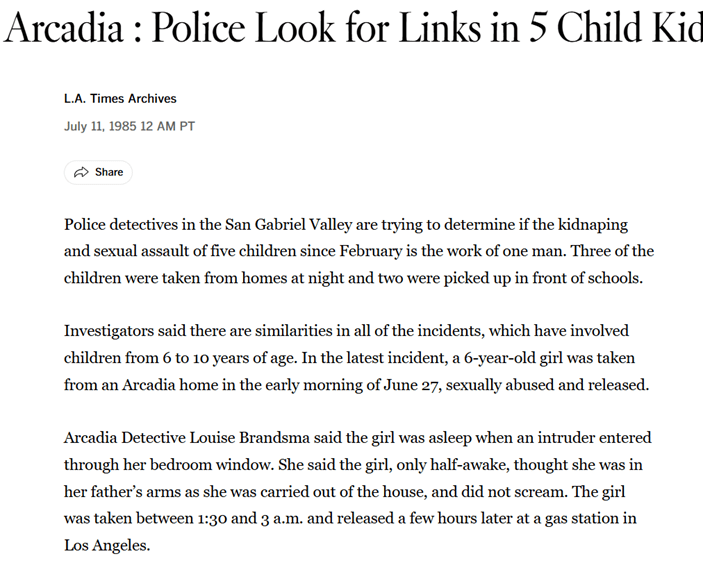
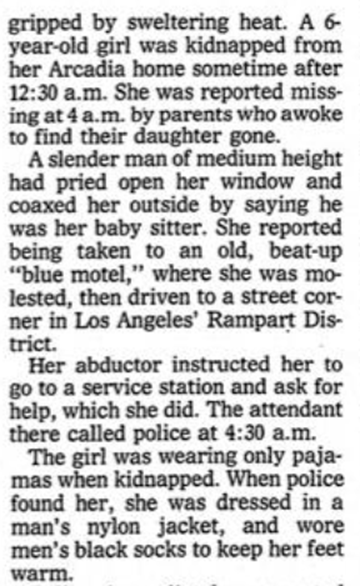
After watching Netflix’s Night Stalker: The Hunt for a Serial Killer documentary a few years ago, my co-writer Jay decided to research the abductions. It was surprising to discover old Los Angeles Times articles (from March 1985) that urged the public to watch out for a 5’9” blonde or light brown-haired man of medium build who had snatched or attempted to kidnap children from outside schools. A man fitting a similar description had entered a home and taken another male child. These are the newspaper clippings. The images might appear too small if you’re using a small device.
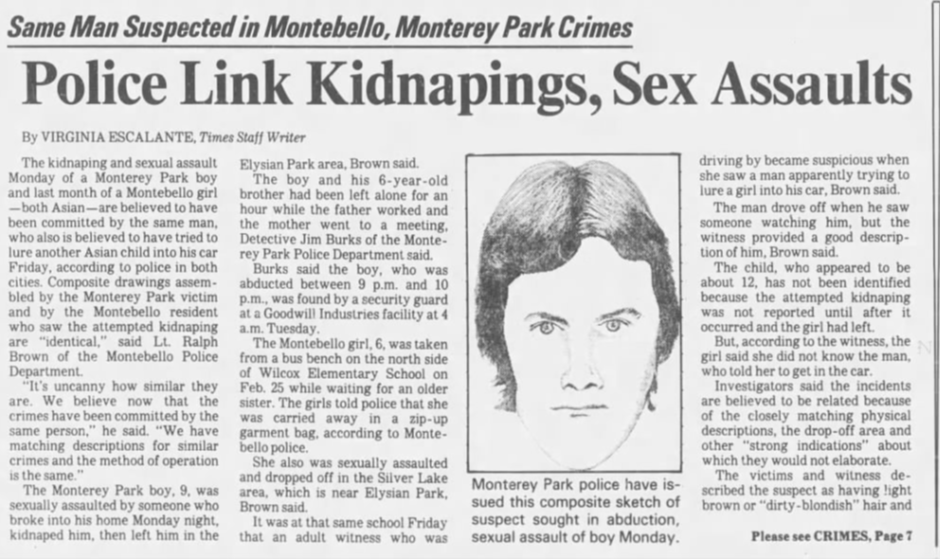
14th March 1985

The article cuts off but here is the rest from an online copy:
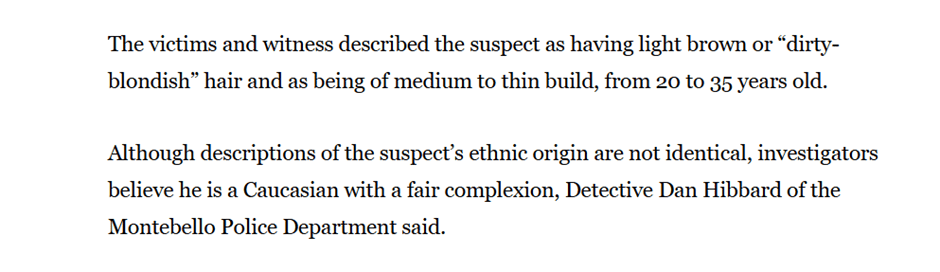
A bedroom abduction happened again just two weeks later on 20th March, this time to a girl in Glassell Park. Other articles say she was from nearby Eagle Rock. She will be referred to as “Girl S.”
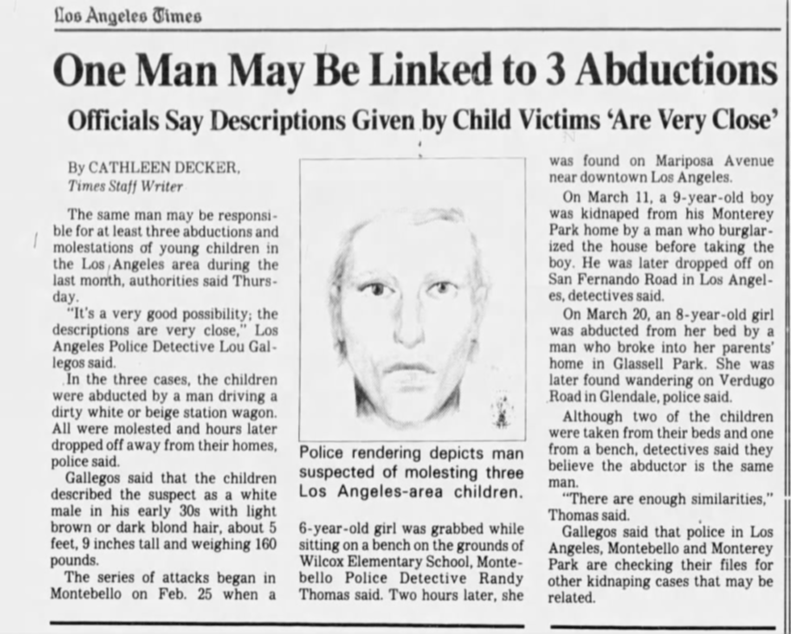
As you can see, the suspect does not resemble Richard Ramirez – not the composite sketch nor the drawing by Fernando Ponce (who later drew the infamous Khovananth sketch and also Carol Kyle’s first). Here is a coloured and clearer version of the image:

Blue eyes?

This was the point where Detective Carrillo explained that he felt it resembled the Maria Hernandez sketch so he theorised that the crimes were connected (also to the Tsai-Lian Yu case). This is a matter of debate.
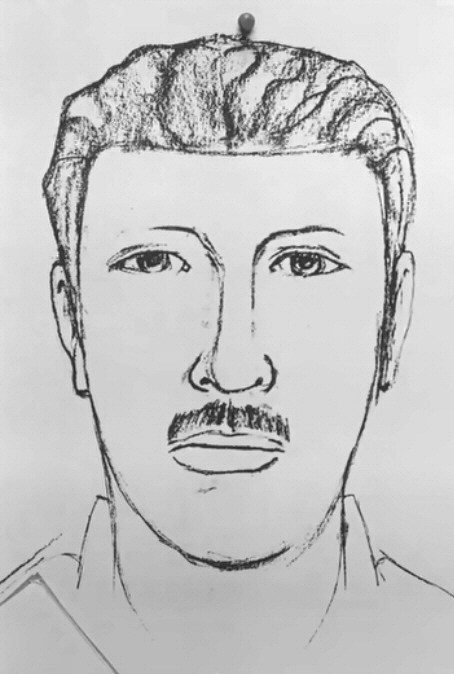
Maria Hernandez’s sketch

By making this child molester into the shooter seen by Maria Hernandez, it looks as if Carrillo discarded what the children described: a blonde/light brown-haired white man. Hernandez said he had dark hair and was possibly slightly tanned.

One can try to argue that the children were mistaken. But the school kidnappings happened in daylight and there was an adult witness. It may be difficult to accept that a detective could either be lying or making mistakes, but not impossible. According to biographer Philip Carlo, Carrillo was so invested in connecting the children to the murders that they were made to view another suspect in an April 1985 line-up.

By late August 1985, the media was reporting that “Girl S” said the Eagle Rock abductor resembled the Night Stalker.
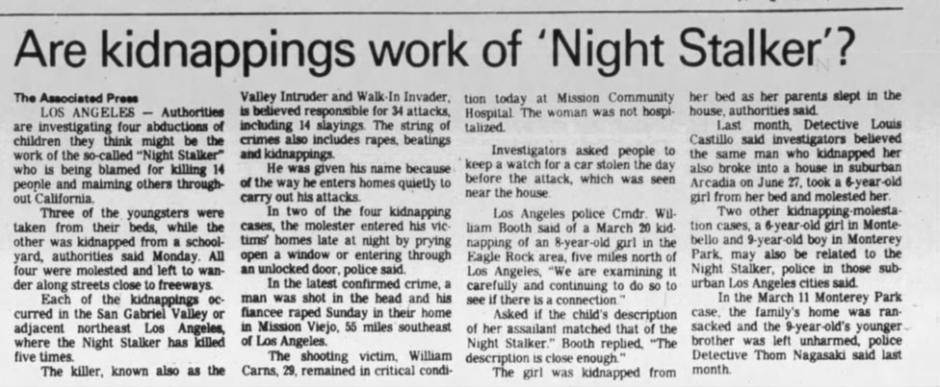
After Ramirez’s capture, on 8th September, an Orange County Register article claimed that the Montebello child (the 25th February attack) described a tall, thin man. He was originally described as average height and build. As with the adult victims, the molester is slowly being manipulated into the form of the Night Stalker, although he was always nebulous.
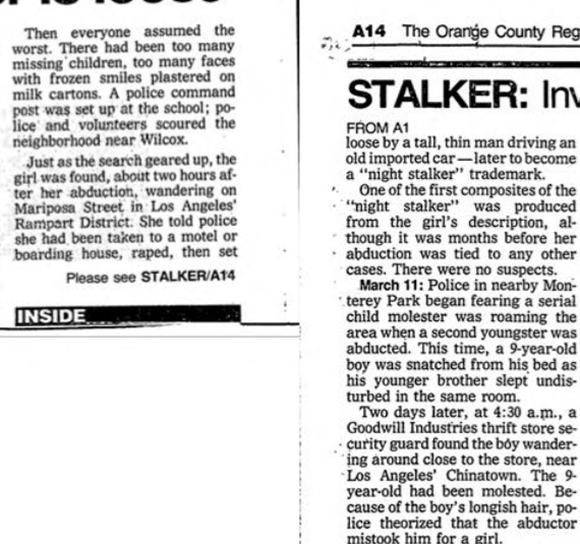
June Abductions

To return to June 1985, there were three child cases. One was a school abduction in Rosemead on 5th June. The child was unable to give a good description and nothing more was heard about it. Information on the second abduction on 15th June is difficult to find. The following details can be found in the Affidavit (Document 7.4 of the 2008 appeals documents): an attempted kidnapping was reported on Garvanza Avenue in Highland Park around 3:45pm.
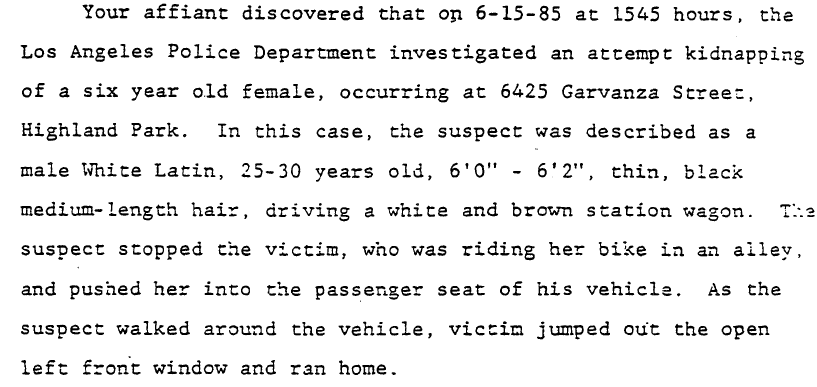
There were no news articles on the incident. Carrillo had been searching through teletypes of other unrelated cases and decided it was Richard Ramirez because he was caught jumping a stop light three miles away on Delevan Drive/York Boulevard. This was the incident where they found his dental appointment card in the car and discovered his alias, Richard Mena.

The third incident on 27th June involved Anastasia Hronas, who spoke on the Netflix documentary. This is how the incident was described in news articles – he is probably a different kidnapper to the one in February:
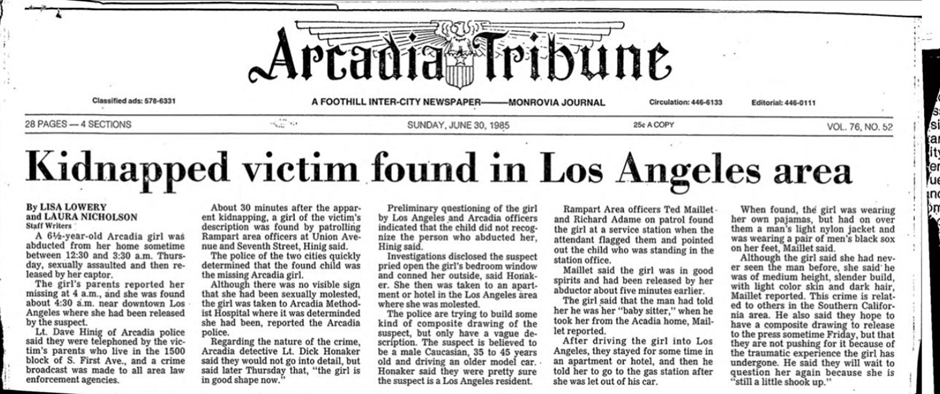
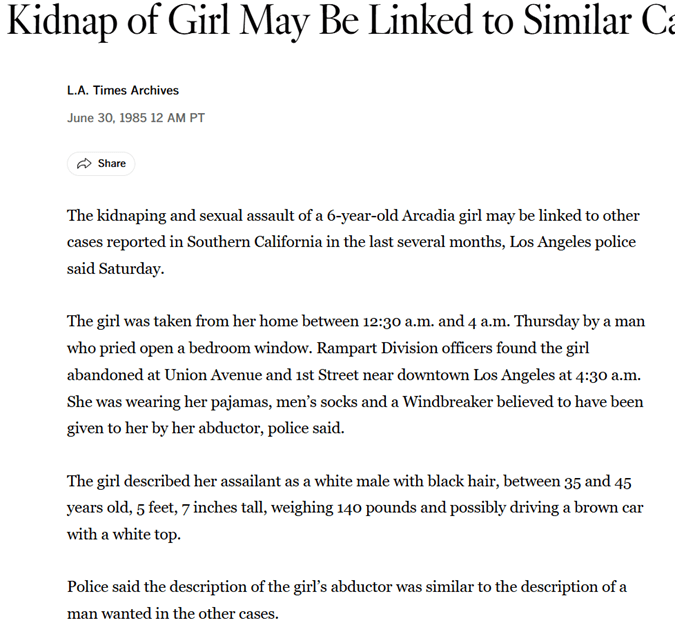
30th June 1985 in the Arcadia Tribune

Gil Carrillo recently revealed that Hronas told him her abductor had an “Indian headdress” tattoo on his arm. He said he corrected her that she saw a pentagram, therefore it was Richard Ramirez. This could be interpreted as another instance where he has dismissed what the child described to make it fit with his theories, just as happened with the children who saw the average build blonde man. Children are simply brushed aside as being mistaken – even when they give very important pieces of information like distinctive tattoos.

Hronas also said on the documentary that the man took her to a home with a chain-link fence which contained two dogs, and he put a Madonna record on repeat. These should have been amazing leads, but they were dismissed. Does this sound like Richard Ramirez who was notorious for listening to heavy rock, which the media claims influenced his crime spree? He was homeless and lived in cars but somehow, he had a house and dogs.

After reading both the 2006 Automatic Direct Appeal and the 2008 Federal Habeas Corpus documents, we discovered that both children and adults were encouraged to choose Ramirez at the September 1985 line-up.
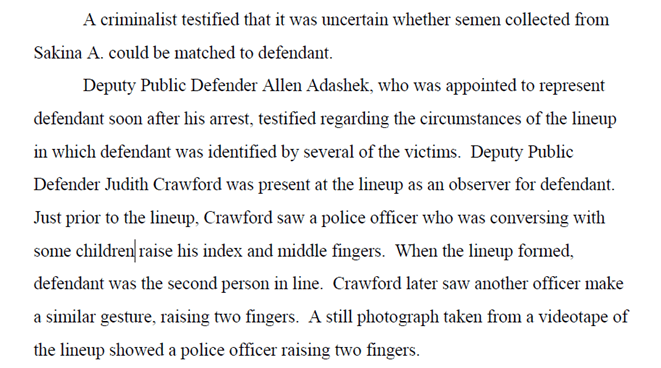
Below is an image of Judith Crawford’s notes that we found in the Los Angeles County Hall of Records. If you can read it better than us, please leave it in the comments! It [probably] says from the second paragraph:

“Prior to 1st line-up, saw man squat down and make a V-sign with thumb and finger tucking in.

A-K [probably refers to the surname order of witnesses]: “Someone else make a similar motion. Squatting man – John Jones, LASD.” [L.A. County Sheriff’s Department].

“2nd person, Tom Hageboek, and told Adashek [Ramirez’s attorney] & turned own notes to ? Office (probably the district attorney). Little girl turned around and appeared to talk to someone behind her. Saw female deputy about 3 minutes later.”

The girl referenced might be Anastasia, or “Girl S.” See the video below for the deputy telling them who to choose using a hand signal.

The 2008 Federal Habeas Petition revealed that Ramirez was only charged with two child cases; both were dropped in 1986. This motion suggests that it was Hronas’ parents who did not want her to participate although Carrillo, Salerno and Halpin claim it was their magnanimous decision to spare the children pain. Besides, even with such poor defence attorneys, surely these abductions would easily crumble under scrutiny and damage the credibility of other cases.
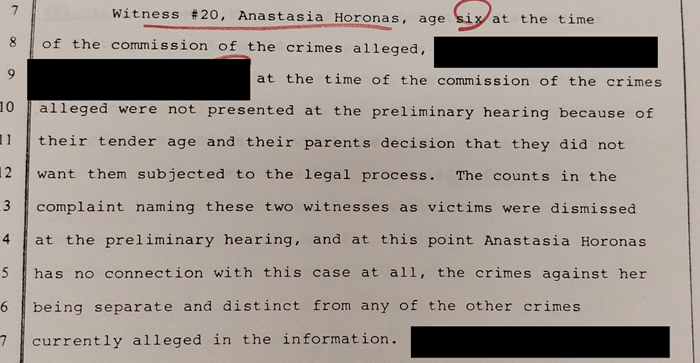
The above was a defence motion. One might argue that defence attorneys lie and grasp at all kinds of theories to save their clients’ lives. Yes, some of them do but the Ramirez case is unusual. One: his defence made the minimal effort, even when exculpatory evidence was revealed in court by independent scientists. Two: these cases clearly had nothing to do with Ramirez. There is also suggestion that Ramirez was threatened by detectives to confess to the crimes otherwise they will pin the abduction cases on him.

People often accuse us of disrespecting victims as if showing old newspaper articles is bullying children of the past, who are now middle-aged adults. We know the children were traumatised. We aren’t blaming them for changing stories or giving inaccurate information, because they were all under 12-years-old and terrified. We are merely showing that justice was not served and we aren’t the people you should be angry with. We will never know who attacked these children now because everyone believes that it was Richard Ramirez and the victims have been given a false peace of mind: “case closed”.

There were also other similar attacks occurring in the same area after Ramirez was imprisoned. One of these men could have been the real perpetrator. If so, he went on to traumatise more children because detectives ‘cleared the books’ by sweeping them away with the Night Stalker hysteria.

You might have come to the end of this article wondering if we have an explanation for Mei Leung’s murder in San Francisco, 11 months before these Los Angeles abductions commenced. We do: the DNA sample was flawed and again, the suspect looked nothing like Ramirez and the crime has been ‘Satanized’ with time.

Whatever comes out on future documentaries or books regarding new allegations of molestation, they do not invalidate our investigations concerning the 1985 abductions. The perpetrator was most likely to be someone else.

-VenningB-

Further reading:

Children were invited to a line up in April 1985.

Further evidence of rigged identification.

Our article on Mei Leung’s case.

L.A. County child abductions after Ramirez’s arrest.

Richard Ramirez’s alleged confessions.

Anastasia Hronas and the Native American tattoo.

108 responses to “Richard Ramirez: False Child Abduction Allegations”

  1. I think that is what most fail to understand, and to me it’s vitally important to consider how, in early 85, no one was describing Ramirez. One could put this down to trauma, and many people do, but if they were all giving a description of someone who resembled him, no one would say such things. It is a prime example of how an image can be manipulated. No one is denying the horror and torment of what happened to these children, no one, and yet in questioning the police tactics as spring turned to summer in 1985, that is the accusation levelled at anyone who dares to analyse the case as a whole.
    The prime example of this would be Carol Kyle. In the YouTube comment section was a person who knew her, lived near her, and was (rightly) outraged at her attack and the suffering it caused. The composites Carol helped to create showing her attacker were mentioned, only to be met with hostility, as if to mention what Carol herself said was denying what happened to her. That is not the case at all.
    Carol helped create her first composite one month after her attack, and she was adamant that the man had a nice set of teeth (she mentioned it more than once). On August 30th, 1985, she made another composite, this time the picture showed an open mouth to emphasise the teeth she clearly saw that night. August 30th, the day Ramirez’s mugshot was released to the world and long after the police had said the suspect was tall, with dark curly hair and stained, gapped and broken teeth. Yet Carol was still insisting the police artist included the teeth, it is even written on the edge of the drawing.
    So what do we make of this? To deny what Carol saw and described is to brush aside her experience, in favour of what the police later said she saw. So who is right? In her trauma, did she imagine the nice teeth? And the later composite artist, an officer who would have been aware of the accepted suspect description, still went ahead and drew in those good teeth, and it was signed off, although never circulated to the public. One can assume it’s because they already knew who they were looking for, and Ramirez just did not fit with that picture.
    Kyle did not contact the police, after seeing Richard’s capture on the TV, and in the papers. However, as we know, she did go on the identify him at the lineup, therefore discounting her own descriptions. Knowing how eyewitnesses were mingling and swapping notes before the viewing, along with being coached by the officers present, is the only way to explain this anomaly.
    With the children concerned, it is not just one description, it is all of them (including one adult) , apart from Anastasia’s. The police have basically said they were wrong, even though they had believed them at first, and given out the descriptions to the media.
    Many attack us because of what we say, but how many of those people have had access to the files kept in the archives, as we have? Not many, is my guess.

    Liked by 5 people

    1. and thank you for the publication of these documents and intelligent research.

      I think the victims deserve a good and careful investigation….. but we all know this!! so many (wanted?) mistakes and failure in this serious case.

      Liked by 4 people

      1. I’d love for an investigator to look and see if there are any other children who were attacked by a man with a Native American headdress tattoo. I did look through California newspapers but couldn’t find any reports.

        Liked by 2 people

      2. It’s easy to get the impression that law enforcement agencies were so keen to close the cases and give the public a false perception of law and order. It seems more advantageous to them to pretend a crime is solved to prevent hysteria. But the result is that children have lived a lie.

        Liked by 1 person

    2. If trauma is affecting someone’s memory regarding an attacker, those memories aren’t likely to improve as more time passes. The memories will become more distorted and less accurate.

      Liked by 3 people

  2. I have learned to judge by psychology and reality. My trust in humans was absolutely shattered a few years ago and the result was a deeper understanding of “truth”. I guess this is why we call older humans “wiser with age”.

    I absolutely know Richard was not this phantom molester by these reports and what came from both Carillo’s mouth and the adult Anastasia in the Netflux yellow mockumentary.

    Every point stated in this article in Richard’s defense is reality. How could a hungry street kid have all these opportunities for homes and pets, let alone the supposed ‘gun in the glove box’ to scare a young victim ?

    I honestly could go on and on but I know it’s all been said before.

    Thank you for not letting these documented sources be forgotten like ‘the creation of The Night Stalker’ has.

    Liked by 5 people

    1. If only people would believe us! I’ve attempted to tell people about these abductions and the blonde man and it’s always ignored. They can’t believe a “stranger” over detectives. I doubt people would even look for the newspaper reports themselves to confirm what we’re saying.
      It was one of the first things Jay researched and it’s a shame others don’t show the initiative.

      Liked by 2 people

      1. And I searched for it because what they were saying on the documentary made NO sense. None.

        Liked by 1 person

  3. I totalyl agree with both of you guys in eveything you said! I remember even Gil saying that children are to young to remember anything or something like that, all to give an excuse as to them not describing Richard at first. It’s crazy and unfair to Richard and the victims that the cops had to morph the suspect to look like him Richard cuz as you guys told me before they were completely tunnel visioned and delusional about Richard to the point they did all this!

    Liked by 3 people

    1. I don’t know how he had the nerve to praise Hronas for her observational skills when he doesn’t even listen to them!

      Liked by 3 people

      1. She was 6. Her observational skills wouldn’t have been that astute. I work with young children and even advanced 6 year olds are poor historians.

        Liked by 2 people

      2. Yeah I don’t know how they can take weight and build descriptors from a child. They can say when someone is tall or small. But even I can’t tell how much someone weights by just looking at them. She may have been more articulate than the others but she was a little kid and her story kept changing.

        Liked by 1 person

    2. It’s crazy how the newspaper articles genuinely show how the suspect evolved into Ramirez over time. It’s so obvious! Yet no one seems to believe us, except all you commenters right here!

      Liked by 1 person

      1. I know, it is (quite literally) in black and white.

        Liked by 3 people

  4. I feel like with her case the one thing that really stood out for me that I don’t think anyone can mistake or forget is that Native American tattoo!

    Like

  5. We’ve wondered about that, too. Weed stinks and lingers on hair and clothes.

    Liked by 2 people

  6. Yes, it’s a strong sweaty kind of smell that carries in the air and sticks to everything. No one said a thing. It’s another aspect of Ramirez that should have made him distinguishable. But because Carrillo tells people that he smelled “pungent” you see thousands of comments around the internet saying all the victims said he smelled when it was one! Very frustrating.

    Liked by 2 people

    1. Many people seem to have biases where Richard is concerned, plus a lot of people like the sensationalized gore of it all. Especially in America. People are ignorant. They believe everything they hear on so callled true crime documentaries without questioning it. Unfortunately, it’s easier to believe the lies than search for the truth.

      Liked by 1 person

      1. They believe everything and say, “I have no reason to doubt a detective.” Or, “why would anyone have a reason to lie.” Which is very naive. People lie for all sorts of reasons, a lot of the time for glory and attention.

        Liked by 3 people

      2. Police lie all the time. They regularly twist things to create the narrative they want. A better question is why should I believe them when they are known to operate through tunnel vision and take the path of least resistance.

        Liked by 1 person

      3. I find both documentary and social media comments on Ramirez completely hysterical. Everything is dramatic and exaggerated and people are overemotional about it. Accusations and insults flying around. Adding their own stupid encounter stories. Repeating bits of Night Stalker lore all excited. It’s the strangest topic…

        Liked by 3 people

      4. All the false encounter stories are the funniest, especially all the “night before his capture” ones, where he’s scaring people in alleyways, hiding in bushes, peeping through windows, all simultaneously in various locations. He was (in reality) travelling on a bus coming back from Arizona. Morons never do enough research.

        Liked by 2 people

  7. More importantly there was no serology evidence.

    Liked by 2 people

    1. Also she was the one who pointed out the straight white teeth?

      Liked by 1 person

      1. Yes, she was the one. She was insistent on it which makes it even weirder that she picked him at the line-up because his “rotten” teeth were emphasised so much in the media.

        Liked by 2 people

      2. We can’t blame her, even though she had got the composite guy to draw the good teeth just 6 days before she picked him out. The coercion was real, she’d seen him announced as the Night Stalker on the media for 5 days straight, the police had told her specifically that he would be in the line up and she would have been in the group coached by the police (as witnessed by public defenders). Perhaps she felt she’d been mistaken, and that law enforcement were never wrong. She must’ve have realised her description did not match, but remember, all present that day could see and hear who was being picked. It should come as no surprise that she also chose him, it was engineered that way.

        Liked by 1 person

      3. Police coercion is another thing that people won’t believe us on. We tell people that the victims were possibly encouraged and coached and they twist our words into victim blaming. Apparently they’ve never heard of bent cops or psychological manipulation. You can easily plant ideas in people’s heads and it’s happened in many cases I’ve seen on TV or read about. But for Richard Ramirez, the public has a blind spot. He’s a cult and his killer fetish followers won’t be questioned.

        Liked by 2 people

      4. This! He has become a fetish, cult, bogey man for all of them.

        Liked by 1 person

      5. Police coercion is actually not uncommon in the U.S. people are obtuse to believe that it doesn’t happen regularly.

        Liked by 1 person

  8. Yeah, as Venning said, it took over our lives. I began looking into the child abductions nearly 3 years ago. Then it all snowballed and took on a life of it’s own. The blog was started 6 months after that, and then the book. It’s been rather intense.

    Liked by 3 people

    1. It’s definitely been a journey and a bit adventurous!

      Liked by 3 people

  9. Me too. I know I’m going to be drop curse words through out the whole thing!

    Liked by 1 person

  10. I have looked at it a lot and think I finally understand flex joint, dam, etc because you break it down very well.

    Liked by 1 person

  11. I didn’t know that! Proper English has several differences from the American version!

    Liked by 1 person

  12. Within 10 mins a certain someone
    has falsely reported (again) how Maria Hernandez described her attacker, then they show the Khovananth composite, not hers. Whoever put that together did it deliberately to mislead.
    We all know what the Hernandez composite looked like. And she never mentioned a thin face or bad teeth.
    Lousy.

    Liked by 2 people

    1. An odd thing about them showing the Khovananth composite then is that it actually contradicts what was in the Netflix series. I just really hope that people will start to notice things like that, and it will lead to more people looking into the whole thing.

      Liked by 5 people

      1. I hope so, too.
        They really put up misleading info there..
        And don’t get me started on what Pera said.

        Liked by 2 people

    2. Yet they lap it up like a dog laps up it’s own vomit.

      Liked by 2 people

    3. Incredibly poor research. No one ever fact checks these documentaries. Weirder still that the associate producer claimed she was fascinated with this blog. Did she not come across the post about the composite sketches? We come up a lot in search engines.

      Liked by 1 person

  13. They’ve done that before in another documentary. They showed the Hernandez composite as Carol Kyle’s. Then the actual Carol Kyle sketch (the first one) was shown for Khovananth. That was a bad one.

    Liked by 3 people

  14. I’d wondered where you’d got to! My mind is in a mess about it all. I have so much to say that I can’t even type. The second episode was the worst because of the emphasis on his allegedly paedophilia and Rosie inserting herself into Mei Leung’s murder.

    Liked by 3 people

    1. I wanted to post some comments so bad. But I was up to my neck in assignments lol. I thought I would let off some steam watching the “documentary”. But it only just made me more pissed. I really shouldn’t be surprised since Gilly was involved in the making of it.

      Liked by 2 people

      1. I understand, it was ugly and badly done.

        Liked by 2 people

  15. The whole thing felt like yet another cash grab to me. There was little substance or new information presented. Honestly, I doubt there’s much to the so-called “Carlo tapes.” If there was truly groundbreaking or incriminating information, they would’ve released it years ago to capitalize on the opportunity. It seems more likely that they didn’t have much material to work with, which is probably why the documentary was padded with so many filler scenes and interviews with other people. It wasn’t much different from the Netflix documentary, to be honest.

    The production wasn’t educational or genuinely informative. Instead, it leaned heavily into sensationalism and over-sexualization—both of Richard and the crimes themselves. It felt poorly organized and haphazardly put together, as though they were grasping at straws to stretch the content. I genuinely don’t see the point of its existence beyond making a quick profit.

    I was also baffled by the inclusion of Eva O. She and Richard were together for such a short time, and her involvement doesn’t seem to add anything meaningful to the broader “Night Stalker” narrative. Her appearance felt more like an afterthought or an unnecessary detour.

    I completely agree with you—it seemed like the main purpose of this so-called “documentary” was to promote Rosie’s book, given how heavily the allegations were focused on. It makes me wonder if Gil was running out of ways to keep milking this story for attention and decided to throw together another documentary just for the sake of it. The whole thing felt lazy and exploitative.

    Liked by 4 people

    1. There was no purpose to it, just more exploitation is yet another cash-for-stories docco. Doreen wasn’t there to defend herself and so they felt entitled to mock her and take the flack for loving him. She’s an easy target. Yet they were wrong about her turning away from him in 2009; it was the other way round and she was very hurt by it. She said that in the same letter where she talked about the ashes.

      Liked by 2 people

      1. It’s absolutely okay if this request isn’t something you’re able to fulfill—I completely understand. However, would it be possible for me to see the letter from Doreen that you mentioned? I want to emphasize that I have no intention of intruding on Doreen’s privacy or her personal life. My curiosity comes from a place of genuine interest in her perspective, especially since we rarely get to hear her side of things.

        Like

      2. Hi, the letter was deeply personal, written a few weeks after Richard died. We were trusted to read it’s contents, but we said we would never post it publicly, and to do so would betray a trust. We have only mentioned a couple of bits from it to debunk the ashes debacle and the end of the marriage.
        I am sorry. I hope you understand.

        Liked by 2 people

      3. Thank you for letting me know and I truly appreciate you being transparent and protecting Doreen’s privacy and wishes.

        Liked by 2 people

      4. I am truly sorry, for I know you’re a good person. I know plenty would’ve spread that info far and wide, but we are not like that.

        Liked by 2 people

      5. I completely understand. It’s refreshing to see people that treat Richard and Doreen like human beings. I’m very grateful to be able to talk to good decent people like you guys.

        Liked by 3 people

      6. I truly feel for Doreen. It seems like every few years, she is metaphorically placed in a pillory, subjected to public ridicule as if people are throwing tomatoes at her to tarnish her character and diminish her very existence. Documentaries, movies, books, and murderabilia are nothing more than tools for those with no genuine purpose or passion to line their pockets and inflate their egos. These exploitative creations reopen old wounds, create new ones, and cruelly rub salt in them—all for profit.

        It’s as if they can’t come to terms with the fact that their fleeting moment of fame has passed, so they resort to digging up the past to keep themselves relevant. All Doreen ever did was defend and stand by the man she loved, even when the entire world turned against him. That takes an incredible amount of courage and strength, and it’s something that should be recognized, not condemned. She made immense sacrifices for him, sacrifices that most people wouldn’t even begin to comprehend.

        I think she’s a remarkable woman when you look at the whole picture. Her loyalty, resilience, and unwavering commitment are qualities that are all too often misunderstood or dismissed. Instead of vilifying her, perhaps people should take a moment to reflect on the strength it takes to stand by your principles and someone you love, even in the face of relentless judgment.

        Liked by 3 people

      7. I agree, I felt so sorry for her, the way they publicly ridiculed her, they might as well have tied her to the ducking stool. They all think she’s fair game to be insulted, or she is somehow simple in the head and to be pitied. I think she was a very strong woman, and I am glad she has managed to keep her integrity intact and not sell out to the media. I hope she is well and living in peace now.

        Liked by 4 people

  16. I have something to say about that arsehole SFPD inspector Toomey and his ludicrous remark about meeting Richard. I can’t believe a cop would be such a pussy.

    Liked by 3 people

    1. I laughed at that bit.

      Liked by 2 people

      1. Saying his hail Marys about meeting a man in a cage. Please. He wasn’t entering a crime scene with an active shooter.

        Liked by 4 people

      2. These people talk and talk, but say nothing of worth.

        Liked by 2 people

  17. It’s unsettling to see how some people latch onto someone with slightly tan skin, black hair, and dark eyes and immediately label him as “Richard.” The way they gush over him is honestly disturbing. While I can’t definitively say whether he’s guilty or not, as his trial is still ongoing, I firmly believe in the principle of innocence until proven guilty beyond a reasonable doubt. However, regardless of the outcome, the crimes he’s accused of should never be sensationalized or sexualized.

    Murder is not “sexy.” A man lost his life—an act that should be met with somber reflection, not romanticization. The victim was stripped of his future, and that’s something that should never be trivialized or glorified in any way.

    As for the broader implications, while I’m not a fan of the insurance industry, which I believe to be deeply corrupt, resorting to violence to express disagreement sets a dangerous and unacceptable precedent. It normalizes harm and undermines the very foundations of civil discourse and justice. We need to be cautious about the messages we send when we condone or sensationalize such actions.

    Liked by 2 people

  18. LOL I must be a sadistic psychopath then cuz my eyes are as dark as coal.

    Liked by 2 people

    1. Ha ha! Just a quick browse of YouTube reveal all the “His eyes were black and evil” or “His soulless eyes” comments. His eyes were very dark, yes, like many of his heritage. This view, that his black eyes = Satan, is SO medieval.

      Liked by 3 people

  19. I think they can take immense pride in knowing that there are passionate, intelligent individuals like yourself contributing to this blog, tirelessly inquiring, analyzing, and digging deeper into the complexities of this case. Your dedication to seeking the truth and refusing to lose faith, even in the face of strong opposition, is truly remarkable. That alone is a monumental achievement and speaks volumes about the strength of your convictions.

    As someone who is notoriously stubborn in my own beliefs and perspectives, I can attest to how challenging it is to change someone’s mind. Yet, in such a short amount of time, their hard work, thoughtful insights, and compelling arguments completely transformed my understanding of this case. That is no small feat—it is a testament to their diligence, persistence, and unwavering commitment to uncovering the truth. Their efforts have clearly made an impact, and I have no doubt that they will continue to do so.

    Liked by 4 people

    1. Thank you for this, and for all of your insights that you freely share.
      We are really so grateful of the time and effort that you (and our other regulars here) give to us and this project.

      Liked by 3 people

  20. I believe so, yes. Good for her.

    Liked by 2 people

  21. Don’t be sad, be glad that you’re here and contributing to what we do. We appreciate your support so much.

    Liked by 2 people

  22. I’ve pondered that myself, and I think it comes down to a combination of factors unique to Richard’s circumstances and mindset. Richard seemed to have a deep misunderstanding of how his words would be perceived or the long-term consequences of sharing such thoughts, especially given his cognitive impairments and lack of proper guidance throughout his life.

    In a way, he might have been so desensitized by his environment—his exposure to violence, trauma, and unhealthy influences—that he failed to recognize the weight of what he was admitting to. His comparison to skydiving, for example, reflects his inability to articulate or process his emotions in socially acceptable terms. It doesn’t excuse what he said, but it does provide context for why he might have expressed himself in such a damaging way.

    I also believe that part of this behavior stems from his attempt to play into the “character” that the media and public had painted him as—the notorious, sensationalized “Night Stalker.” He may have felt pressure to live up to that image, especially in front of someone like Carlo, who was crafting a narrative about him. It’s almost as if he leaned into the infamy because it was the only identity he felt he had left.

    Lastly, it’s worth considering the possibility that he was trying to shock or provoke a reaction, not realizing the harm it would cause to his reputation. People in his position often seek control in small ways, and saying provocative things might have been a misguided attempt to assert some agency in a situation where he otherwise felt powerless.

    It’s sad when you think about how much his own words were used against him, reinforcing the very narrative that imprisoned him both legally and socially.

    Liked by 2 people

    1. I suppose as well, that before the Night Stalker, he was nothing, essentially a tramp. He told Carlo that his relationships with women only developed after his arrest. He referred to himself as “walking death.” He was an empty husk, the only thrills being burglary, the brief high from drugs and maybe gambling with other burglars at the pool halls… and probably dangerous driving. Then with the Night Stalker, he’s someone. He realises he can be loved and has love to give others. Like Eva O. And Doreen.

      But people will hear “I was walking death” and assume he’s admitting he was the grim reaper for all those victims.

      Liked by 4 people

      1. I always believed that Richard’s statement about being “walking death” meant the complete opposite of what most might think. To me, it seemed as though he felt like a shell of himself—almost like a zombie. He was aimlessly wandering the streets, lost in a haze of drugs, seeking refuge wherever he could find it, whether in the form of shelter or fleeting distractions. There was a deep emotional numbness in his life; he kept people at arm’s length, unable to truly connect with anyone or allow himself to feel anything genuine. The drugs and dangerous behaviors he engaged in weren’t just about seeking pleasure—they were ways for him to feel something, anything, just to remind himself that he was still alive.

        When Richard said he was “walking death,” I interpreted it as a reflection of how disconnected he felt from the world and from himself. It wasn’t just about physical death; it was a metaphor for his emotional and spiritual decay. It seemed like he was trapped in a cycle of self-destruction, constantly trying to numb the pain but never finding peace or resolution. His actions, his behaviors, and his mindset were all rooted in the overwhelming sense that he had already lost something vital within himself, and he was simply drifting through life, surviving but not truly living.

        Liked by 2 people

      2. Yes, I am of the exact same opinion as you, and after having seen “walking death” for myself in Los Angeles, I can absolutely understand what he meant by that phrase.

        Liked by 3 people

      3. Pershing Square… That is all.

        Liked by 3 people

      4. The city is poorly managed and policed, with corrupt politicians driving it further into chaos. It feels like nothing has changed since the 1980s—just a new era of the same dysfunction. The entire state is starting to resemble a real-life Purge movie, where lawlessness and disorder are becoming the norm, and people are left feeling unsafe and abandoned by the systems meant to protect them. I remember a while back a homeless man was allegedly seen in Wasco, California cannibalizing a human leg that was from a man who got hit by a Amtrak train.

        Liked by 1 person

      5. Omg, that is horrific!

        Liked by 2 people

      6. I genuinely don’t understand what is happening to this country anymore!

        Liked by 3 people

      7. It sometimes makes me feel as if I won’t be able to have a successful career,a family, or be able to buy a house.

        Liked by 3 people

      8. Our society is screwed up, but you can still have those things.

        Liked by 1 person

      9. I saw the video again recently,unblurred mind you, that’s why I remembered it. I’m traumatized for life! We have a huge homeless crisis here in the states. Did you guys hear about the cats and dogs being eaten as well?

        Like

      10. Yes, I heard about that. Is it true?

        Liked by 1 person

      11. I’m afraid so.

        Like

      12. This is article that I found talking about a single incident where a woman was caught killing and eating a cat. From what I understand, there’s even bodycam footage of the event available on YouTube. I can’t say how common it is. But there were several isolated incidents that were reported. I had a hard time believing it at first because the MSM spews bullshit 99% of the time. But after doing a little research I found a few incidents that occured over the past few months that had validity to them either through footage or images. I’m not sure why it’s occurring, but it’s disturbing to say the least.

        https://www.wkyc.com/article/news/local/canton/ohio-woman-allexxis-ferrell-eating-cat-killing-canton-stark-county-sentenced-springfield/95-a8a276b8-f4b0-49e2-a82b-cca64f727517

        Liked by 1 person

      13. That is disturbing.

        Liked by 2 people

      14. What on earth!

        Liked by 2 people

      15. When I heard that statement, I immediately thought about how he must have been so traumatized, so mistreated, so neglected that he basically felt numb/ dead on the inside. That’s one of the effects that traumatic experiences can have on someone. And he didn’t just have a few traumatic things happen, which is bad enough, but he was subjected to traumatic events for the majority of his life. He never had anyone to help him heal or to help end the repetitive cycle of trauma that was his life. It’s so incredibly sad.

        Liked by 2 people

  23. I completely agree. It was probably in Richard’s best interest, at least in his mind, to shield his true personality and character. It’s far easier to scare people and keep them at a distance than to allow them in and risk being vulnerable. He had spent his entire life being forced to suppress his emotions, shut out his problems, and numb himself to the pain through substance use and thrill-seeking behaviors like stealing. Revealing his true self wouldn’t have made sense in the environment he grew up in. Vulnerability requires trust, and it’s doubtful Richard felt safe enough to truly open up to anyone—maybe Rosa, but even then, not about everything he was dealing with.

    I remember in Carlo’s book when Rosa visited Richard after his arrest. He started crying, and she told him, “no enseñas el cobre,” which loosely translates to “don’t show the copper” or “don’t show your true feelings.” Hearing something like that from someone he trusted and admired would only reinforce the idea that he needed to keep his emotions locked away. In Hispanic culture, the concept of machismo—where men are expected to be hyper-masculine, stoic, aggressive, and dominant—would have been very prevalent during Richard’s upbringing. These cultural expectations, combined with the abusive and aggressive nature of his father, likely made it impossible for Richard to feel comfortable expressing vulnerability. His father’s physical abuse likely compounded this by teaching him that emotions were a weakness to be punished rather than a part of being human.

    This cultural and familial pressure may have led Richard to create a hardened persona. The “Night Stalker” image was a mask—a way to meet the world’s expectations while shielding his true self. I’m not saying he should have bared his soul for everyone to see, especially considering how people exploited and used him both during his life and after his death. Making himself vulnerable would have left him open to even more harm, as everyone around him seemed ready to take a piece of him for their own gain.

    However, I do think he leaned too heavily into the “Night Stalker” persona, exaggerating traits like egotism, menace, and indifference. This exaggerated facade left people with a one-dimensional view of him as a cocky, unfeeling, cold-blooded murderer. But anyone who’s listened to the tapes or watched his few edited interviews can tell it was an act—a role he felt he had to play in the circus of his case.

    In reality, Richard comes across as a more complex individual: someone who was shaped by his environment, made terrible choices, and had an unusual perspective on life. Beneath the act, he seemed like a laid-back person who had unconventional opinions but wasn’t the monstrous figure he was made out to be. He wasn’t the “Night Stalker” he pretended to be; he was an actor playing a part, caught in a storm of sensationalism and exploitation.

    Liked by 1 person

    1. I hate that people haven’t looked deeper into him like we all have here. I saw a YouTube psychoanalysis, which was really bad. The woman on it called him “beige” because she perceives him as a boring edgelord in love with himself. But we know better than that. The [really irritating aristocratic sounding] man on it repeatedly called Richard vain and a liar (even when he was telling the truth). And that’s the problem, they all believe that Night Stalker persona. They don’t understand the culture of the time, the hysteria in Los Angeles at the time and everything Richard was dealing with. It was a pure coping mechanism. They found him unlikeable but I find him the opposite.

      Liked by 3 people

      1. Oh that appalling little man, shrieking “lies”, when Richard was absolutely being truthful about his TYC incarceration. Why make a podcast when you know so little about a case?

        Liked by 2 people

  24. I remember someone on Twitter saying that when he “confessed to Peter Pan” to a guard, it must have been genuine because he mentioned going upstairs to shoot and most houses in California are bungalows. But the Pans two-floor house was repeatedly shown on the news, so he’d have seen it. Same with his statements to Carlo about the best way to kill people. Most people know that the temple is a weak spot on the skull. Stab-slash is also obvious. And he could have learned this off Miguel. But also anywhere.

    Liked by 3 people

    1. It’s baffling how people can simultaneously label Richard a monster, ostracize him, and yet put him on a pedestal as if his words are groundbreaking and profound. They almost glorify someone they believe to be a cold-blooded killer, treating every word he speaks as if it carries deep meaning or hidden wisdom. I’m not denying that Richard had moments of insight—he did—but much of what he said could easily be deduced by any true crime enthusiast. For instance, in the so-called “documentary,” they spent considerable time focusing on the “death rattle,” which Richard described simply as the final movements and jerks a person’s body makes before death. While morbidly interesting, there’s nothing particularly special or revelatory about that explanation. It’s strange how the same people who condemn him for his crimes also elevate him, as though he holds some secret, forbidden knowledge. The dynamic is weird.

      Liked by 2 people

  25. There was nothing new that hadn’t been chewed over for years.

    Liked by 3 people

  26. The value of Carlo’s recordings with Richard is heavily overhyped, almost as if it’s part of a calculated marketing ploy. His fangirls and groupies eagerly latch onto anything that might reveal even a fleeting five seconds of those tapes, hoping to uncover some new tidbit to fuel their fantasies. But in reality, I highly doubt there’s anything truly substantial or groundbreaking on them—just as we’ve seen with the current “documentary”.

    Most of the recordings likely consist of Richard recounting his childhood or tossing around true-crime buzzwords and ominous quotes to appear more menacing. If there were genuinely revealing or valuable content on those tapes, you can be sure they would have capitalized on it long ago. The fact that they continue to dangle the possibility of “exclusive” material is just another way to keep the public engaged.

    Liked by 1 person

  27. They were separated by the time of his death, and that appears to have been his choice. Even so, she was there to take care of things when he died.

    Liked by 2 people

  28. I’ve mentioned before that religion can be a valuable tool for some, offering comfort, guidance, and a way to make sense of this complex world. It can help people cope with challenges and navigate life’s uncertainties. However, what I cannot stand is when people use religion to justify their delusions or impose their beliefs on others in an oppressive or overbearing manner.

    In Richard’s case, there was far too much religiosity involved, which only served to muddy the waters. From what I’ve observed, Richard didn’t even seem to be a genuinely committed follower of Satanism; it felt more like an identity thrust upon him by others or a product of public sensationalism. Yet, the pervasive religious rhetoric surrounding his trial overshadowed the critical need for objective analysis and rational judgment.

    Liked by 3 people

  29. Yes, definitely!

    Liked by 2 people

    1. I struggle to understand why Mercedes seemed to do so little to defend her children from the abuse they endured. She clearly knew it was wrong, yet she often remained a bystander—and, in some instances, even added fuel to the fire by reporting every little thing the children did to her husband while he was away at work. I can understand that societal expectations at the time often dictated that women remain submissive and deferential to their husbands, leaving them with little autonomy or authority in the household. But still, as a mother, there had to have been more she could do.

      Julian Sr. wasn’t just disciplining them; he was beating them with household items like wires and other objects. How could a mother, who is supposed to protect her children, simply stand by and watch such horrific abuse take place? It’s hard to fathom. The incidents described in Carlo’s book, as well as the declarations, likely only scratched the surface of what really happened in that household. I can’t help but think there was far more going on behind closed doors—more violence, more fear, and more emotional damage—that wasn’t fully captured in the accounts we’ve read.

      It’s possible that Mercedes herself was a victim of Julian’s control, perhaps facing emotional or physical abuse that rendered her too afraid or too powerless to act. But even so, her inaction—and at times, her complicity—must have deeply affected her children. It’s tragic to think about how isolating and helpless they must have felt, knowing they couldn’t even rely on their mother for protection. This family’s dynamics were steeped in toxicity, and the lasting scars of that environment are painfully evident.

      Liked by 4 people

      1. While I agree with what you are saying, I try not to judge Mercedes too harshly. Certainly, I think she could have done better for Richard and all of her children. I don’t believe that Julian’s so-called form of discipline was acceptable on any level. But I think we have to consider that most of us have never been in her situation, so it’s easy for us to say what we would or wouldn’t do if we had been. She was an American citizen but couldn’t proficiently speak English, so she was limited to menial jobs. She had 5 children that she pretty much took care of by herself plus worked full time in a toxic factory. She and Julian had moved to the U.S. so their children could have a better life than they had, but they didn’t assimilate into American culture. They kept to themselves and had no support system as their families remained in Mexico. I think that Mercedes and Julian both had a lot of trauma that influenced what they did and didn’t do. Unfortunately, their children suffered as a result. It was a vicious cycle of trauma that was repeated and affected their children emotionally and physically. It’s incredibly sad, and I think a lot of the trauma inflicted on the kids could have been prevented with appropriate resources or at least reduced.

        Liked by 3 people

      2. Now that I reflect on it, I realize I overlooked many of the obstacles Mercedes faced. My earlier comment came from a place of frustration after watching the documentary and hearing once again about the traumatic experiences Richard endured in his childhood. I apologize for the harshness of my words. While I can’t directly relate to Mercedes’ situation, I see parallels between her experiences and what my mother went through as an immigrant.
        Like Mercedes, my mother also faced significant challenges. She came to America from a relatively uneducated and impoverished background in a third-world country, and she, too, came from an abusive household. When she first arrived, she didn’t speak English or understand American culture, which made it difficult for her to assimilate. She was far away from her own family and community, leaving her isolated with no one to confide in or relate to. All she had was my sisters and me, but as young children, we didn’t fully grasp the complexities of our situation or the challenges of being immigrants—and the children of immigrants—navigating an entirely foreign world.
        My mother, like Mercedes, was only able to find menial, low-paying jobs that didn’t require an education or English-speaking skills. While her jobs weren’t dangerous like Mercedes’ work, she still endured harassment and mistreatment. Her coworkers often overworked her, took advantage of her by forcing her to share a large portion of her tips, and treated her unfairly. After long hours at work, she would come home to cook, clean, and care for us because there was no one else to help. Her marriage, though I won’t delve too deeply into it, was toxic and unsupportive. For most of our lives, my sisters and I were raised by her in every sense—financially, physically, and emotionally.
        Despite all of this, my mother couldn’t leave her marriage for a long time. My father was the only means for us to survive in a foreign country where she had no family, no resources, and no one to turn to for help. It was a difficult and isolating path, but she managed to push through these barriers. Through sheer resilience and hard work, she learned English, assimilated somewhat into American culture, and eventually secured a well-paying job. However, the journey was anything but easy.
        I still vividly remember going with her to places like grocery stores, where I would act as her little translator, helping her understand and communicate in English. Unfortunately, people would often speak down to her, treating her as if she were less capable or intelligent simply because of her accent or limited language skills. Those moments crushed her confidence, reinforcing the belief that she was somehow “less than,” a mindset she still struggles with to this day. As a child, it was incredibly painful to watch her endure such mistreatment and feel powerless to defend her.
        While Mercedes and my mother’s experiences as immigrants in America had different trajectories and circumstances, there are undeniable similarities between their struggles. Both faced cultural isolation, economic hardship, and toxic home environments. Reflecting on my mother’s journey has reminded me to approach Mercedes’ situation with more empathy. She, too, was likely overwhelmed by the challenges she faced as an immigrant with limited options. I should strive to be more understanding of her plight.

        Liked by 3 people

      3. I don’t think you were harsh. I’ve had those thoughts about Mercedes as well. I made similar comments to a friend who knows a great deal about Richard. Something she said helped me see Mercedes in a different light. My friend said to me that Mercedes did the best she could at that time with the knowledge and limited resources she had. Those simple words caused me to shift my focus. I do still have moments when I get upset that she didn’t do more to help Richard, especially with treatment for his seizure disorder, which I think was the source of many of the issues he later experienced. Assimilating into a foreign culture would be very difficult, especially if you don’t speak the language. I think I could probably assimilate into English or Scottish society without extreme difficulty because I am a native English speaker, but of course, British English does have subtle differences from American English. But learning the language is only one aspect of assimilating. There would still be a lot to learn. I think learning to drive on the “wrong side of the road” would be extremely challenging. Lol. I can only imagine how difficult it would be to assimilate into a Spanish speaking society. I’m glad that your mom was able to overcome the obstacles she faced.

        Liked by 3 people

  30. It’s possible. As for any specific illnesses, it’s difficult to determine. I do think he likely suffered from a traumatic stress disorder, which can cause mood regulation issues.

    Liked by 2 people

  31. The Hubbard Street thing? I thought it was October, but it might be delayed? I am not sure.

    Liked by 2 people

    1. The delay was likely because he was pushing for the new “documentary” to be released sooner than planned. You can see it in the rushed production quality and the way the information about the cases was presented—it felt haphazardly put together, as though corners were cut to meet a deadline. I’m planning to watch the Hubbard Street piece next, mainly for a quick laugh lol. After the intensity of the new documentary, I think it’ll be a much-needed breather. It will be interesting to watch Gilly make his acting debut.

      Liked by 3 people

      1. I bet it’s shit like Maxxxine. Gil’s part as an aged cholo will send me into hysterics, no doubt.

        Liked by 4 people

      2. Maxxine was pretty trashy in my opinion. I think the actress is good. But the story line made no sense. They were just trying to use Richard’s notoriety to boost viewership. Are their writer’s so shit that they can’t come up with a Satanic serial killer in the 80’s? America was virtually crawling with mass murders and rapists during that time. Surely they could’ve gotten some inspiration.

        Liked by 2 people

  32. According to Carrillo he was an animal lover, too.
    I mean, he must be, right?
    Taking an abduction victim back to his house with the dogs.. not that he had a house or dogs. Then just a day later, he took his pet cat out for ice cream as he was on his way to commit murder.
    Does the esteemed detective ever stop to think how preposterous that is?

    Liked by 5 people

    1. His level of thinking is copying what a professor said to him and projecting it onto the case.

      And no one questions this. Remember his story that Richard apologised for letting a child victim’s puppy escape. The child was Girl S referenced in this post. Yet we know that Richard was most disgusted by the child abduction accusations and never would have confessed to them.

      Liked by 6 people

      1. It’s ridiculous.

        Liked by 4 people

  33. What about the molestation claims made by two of Ramirezes nieces? I think they are credible, so why shouldn’t he have done this to other children too?

    I don’t want to offend anyone, it’s just a question.

    Like

    1. The nieces’ allegations don’t really have anything to do with the 1985 molestation claims and should be treated separately in my opinion. Considering the 1985 newspapers were telling the public that the suspect was a 5’9″ blondish man, it’s unlikely to have been Richard Ramirez. Certain detectives were trying to sweep loads of unrelated cases away as those of the Night Stalker based on flimsy evidence – it’s a pattern with the entire case.
      As for the nieces, who knows what their motivations are. One openly admits her uncle is her side-hustle. The other is trying to sell a book and her abuse timeline makes no sense. If it happened, it doesn’t suddenly make the 1985 molester Richard, there are many child abusers around, after all. There were many child abductions in the Los Angeles area after Richard’s arrest too.

      Liked by 3 people

    2. As Venning said, the two are unrelated. You have to go back to earliest sources, and there all the children claimed it was a blonde, shortish guy. That was confirmed by the police who put it out to the media in late Feb/early March 1985, before they had any thoughts of pinning them on Ramirez. Did you know those children were coached on who to pick out at the line up? The police actions were witnessed by public defender, Judy Crawford. We saw her notes when we were allowed to view the original case files.
      As for the nieces, one made a hustle from selling faked letters, and also stole family photos to sell. The other has misunderstood when Richard was committed into the custody of the Texas Youth Council, and so her timeline of events doesn’t quite add up.

      For me, the story changes so much, and there has been too much public bickering between them as they argue over who knew him best, and who got what out of him. Accusations of blackmail, rings bought with groupie money; it’s as bad as a fangirl spat on Tumblr. The final straw was asking the fangirls what should be put into the upcoming book and giving out instructions to another of what to put on a Day of the Dead altar in his honour. I am not interested in anything they say or do, it’s all for the grift.

      On this site our focus has always been on the events that led up to the trial, the trial and the appeals.
      We’re not offended, and if you think they’re credible, you are entitled to do so, and we don’t mind the questions, as long as they are asked in an appropriate way. I hope you read everything we have to say, it is all backed up by legal documents.

      Liked by 3 people

    3. This may not be my place to say, but you are so right to ask these important questions. Unfortunately, once something about Richard Ramirez hits the internet, it is immediately treated as gospel truth, even when there’s little to no real evidence to back it up. This has been the painful reality for over forty years. The narrative about Richard—who he was, what he did, and why—has been forced down people’s throats by sensationalist media and distorted public perception. It’s not the truth; it’s a story that was created to sell, to entertain, and to profit.

      But here’s what I believe, from the core of my heart: the most honest, most comprehensive, and most credible account of Richard’s life, his crimes, the evidence, the trials—everything—is found in the 2008 Writ. That document goes beyond the media circus and gives a much-needed, clear-eyed perspective on the facts. Legal professionals have a duty to present only the most accurate and truthful information in their documents, because the stakes are real. Falsehoods in legal records have consequences, and they are harmful—they ruin lives. Those who provide declarations or psychological reports must do so with integrity, knowing that the truth must be held up to the light, no matter how uncomfortable it may be.

      Sadly, anyone can get online and make accusations about Richard, because he’s not here to defend himself. And that’s where the real tragedy lies—no one holds anyone accountable for what they say about him. People believe whatever they want to believe, because they’ve been conditioned to see Richard as “The Night Stalker,” a monster. That image is seared into the collective consciousness, and it’s hard for anyone to break free from it. But that doesn’t make it the truth.

      If you care about the truth, if you’re genuinely interested in understanding Richard’s story beyond the sensational headlines, I beg you to read the posts on this blog and the book by its owners. Dive into the 2008 Writ—it is an invaluable resource. Far too many books, documentaries, and media outlets profit off the tragedy of Richard’s life and the crimes associated with him, but they don’t seek truth. They seek sensationalism. They exploit pain, they exploit fear, and they exploit Richard’s name.

      This isn’t just about uncovering a story; it’s about justice, about dignity, and about the relentless pursuit of truth, no matter how inconvenient or uncomfortable it may be for those who prefer the comforting lies. If you truly care about understanding Richard, look for the legitimate resources—the ones that don’t have a profit to gain or a narrative to sell. It’s easy to accept what the media tells us; it’s harder to do the hard work of sifting through layers of distortion. But the truth is worth that effort. The truth will always be worth it.

      Liked by 2 people

Leave a reply to N. S. Cancel reply