
“Robinson was the last of three law enforcement firearms examiners to evaluate the general rifling characteristics of the ballistics evidence. Yet the two other examiners, who did not reach entirely the same conclusions, were not called to testify at trial. For example, in the report prepared by Robert Christansen on March 28, 1985, he concluded that due to distortions of the .22-caliber bullet in the Okazaki case, no positive comparison can be made to the Yu case.” (2008 Petition of Habeas Corpus page 634)
When we visited the Hall of Records in Los Angeles, we found a few pieces of information that were worth sharing.
This is an addition to the article I wrote concerning the flawed and contradictory ballistics reports. It’s relatively short, which I am sure you’ll be grateful for, as the original article is quite long, but you should read it to understand the overall picture.
Joinders Get Convictions – A Brief Recap
As the physical evidence in the Night Stalker crime spree was relatively scant and circumstantial, the prosecutors needed to apply joinders to bolster the weak evidence. They had to show a connection between random incidents through cross-admissible evidence, whether firearms, shoeprints, fingerprints, etc. A detailed post on joinders can be found HERE
Firearms evidence was used in eight of the crimes Ramirez was found guilty of and two incidents where the trials were stayed or charges dropped. The final conclusions, made by Deputy Sheriff Edward Robinson, looked like this:
- .22 calibre revolver – Okazaki, Yu and Kneiding.
- .22 calibre revolver – Zazzara and Khovananth
- .22 Jennings semi-auto – Doi
- .25 auto – Abowath and Petersen (Pan – trial stayed indefinitely, Carns – dropped)
It was not always so.
Deputy Sheriff Edward Robinson worked in the firearms identification section. He became involved in the case in April 1986, almost a year after firearms officers Robert Christansen and Robert Hawkins examined the evidence. He was the one who gave the prosecution what they wanted and, consequently, the only one called to testify; the other two firearms officers either disagreed with him or each other.
Sgt Robert Christansen, was the first of the three firearms officers to examine the bullets.
His findings differ significantly from Deputy Sheriff Edward Robinson’s, the last of the three officers to examine the distorted bullets, casings, and fragments. Their conflicting reports can be found in documents 7-20 of the 2008 petition and in the original ballistics article; there is no need for me to repeat that again.
Discovery
During the preliminary hearings, Richard’s defence counsel requested that prosecution witnesses be made available for cross-examination.
From the documents found within volume two of the case files –
“The Court: Make that request, and it will be granted.
Arturo Hernandez: We are making that request at this point.
Philip Halpin: That has been an open offer since we began this thing, so there is no problem. ”
In March 1987, the court ordered Halpin to make Sgt Christansen available to the defence for an interview. Halpin did not comply.
The court: I will order you to have Mr Christansen here, Mr Halpin, on the 7th. But I would like Mr Christansen here for the discovery proceedings and consultation with the defence on the 7th. I think that is reasonable”. (Volume 2, People V Ramirez case files)
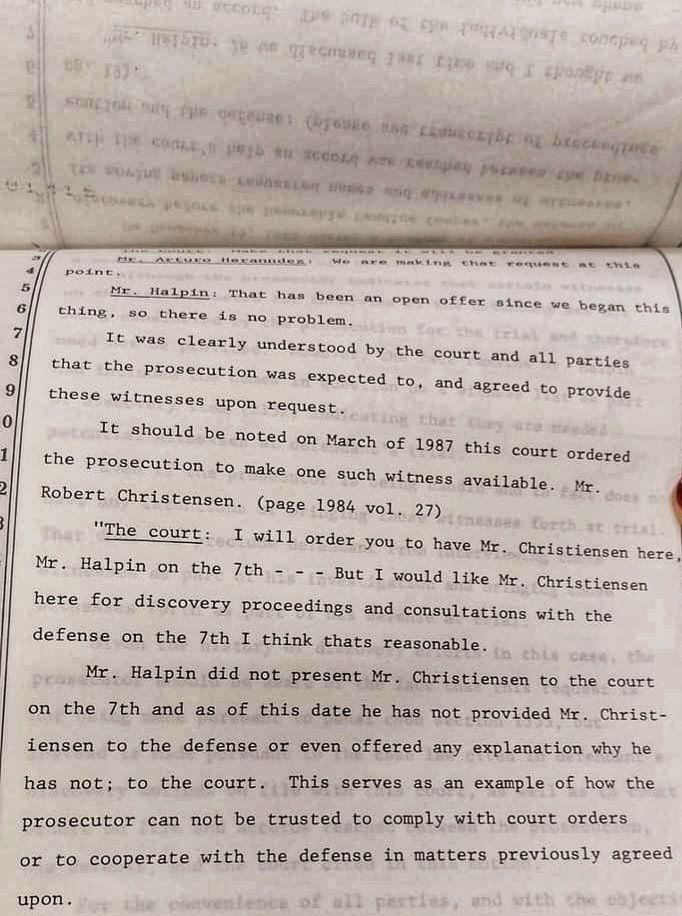
The document goes on to say:
“Mr Halpin did not present Mr Christansen to the court on the 7th and as of this date he has not provided Mr Christansen to the defense or even offered any explanation why he has not to the court.
This serves as an example of how the prosecutor can not be trusted to comply with court orders or to cooperate with the defense on matters previously agreed upon.” (I have used the correct spelling for Christansen’s name in my transcript)
The Law is an Ass?
Halpin cited Walker v Superior Court, a case that stated a witness did not need to submit to an interview (an interview differs from cross-examination). As we hear nothing more about the matter, we can assume that the trial court did not overrule and force Halpin to comply with the court order. However, that citation denied Ramirez due process.
It is thanks to the affidavit (found in document 7-4) that we have been able to examine the conflicted firearms reports. Sgt Christansen, whose report disagreed with the prosecution and their chosen expert witness, never testified in court; therefore, he was never cross-examined by the defence, and his conclusions were never heard by the jury.
The wily prosecutor managed to avoid the earlier ballistics reports coming under close scrutiny by circumventing cross-examination, and the defence, at trial, conceded the ballistics evidence because of their failure to give their own firearms expert the evidence to test.


 Expendable For A Cause.
Leave a reply to Vivi Cancel reply