
While reviewing the Ramirez files at the Los Angeles Archives and Records Center, we came across an original trial document that sheds additional light on the Vincow case. Notably, a statement made by Detective Jesse Castillo, who was assigned to investigate the Vincow crime scene, caught our attention. Detective Castillo reported that when he arrived at the crime scene on the afternoon of June 28, 1984, he discovered the brutal murder of Jennie Vincow and also noticed two soup bowls in the kitchen.
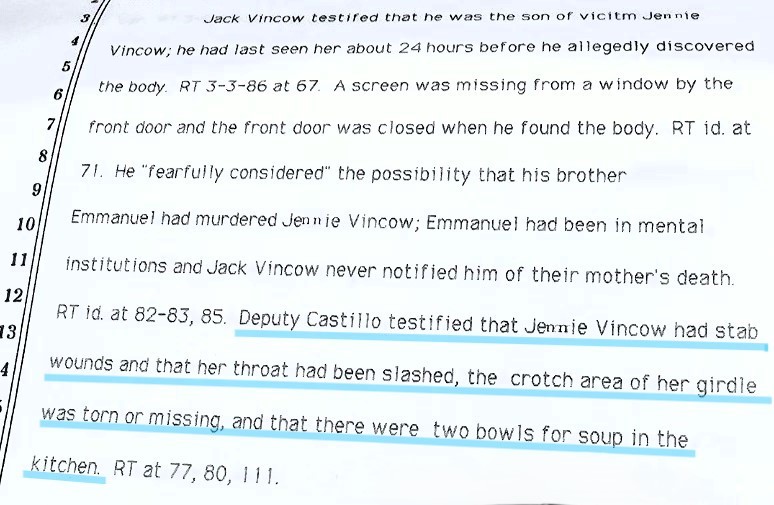
Although the details about the soup bowls may seem inconsequential, they raise significant questions when we consider Jennie’s relationship with her sons, especially Jack, who visited her each afternoon. The fact that Jennie prepared two bowls of soup on the day of her murder is noteworthy. Why had she prepared two bowls of soup the very day she was murdered? Was she anticipating a visitor for lunch? If so, who could it have been? Jack Vincow confirmed he visited his mother daily between 1p.m-2 p.m. So, was Jennie preparing soup for herself and Jack fully aware of his daily routine? We can be certain Richard Ramirez hadn’t been invited over for soup.
It is concerning that the soup bowls in the kitchen were overlooked and seemingly disappeared, as they may have been key pieces of evidence. Why were these potential sources of evidence disregarded? Testing these bowls for trace evidence may have helped identify who was in Jennie’s apartment on the day of her murder. Furthermore, why has the fact that there were two soups bowls on the kitchen table been hidden for decades and buried deep in the files of the Los Angeles Archives? As of the writing of this post, no further information is available regarding these mysterious soup bowls. Once again, we are left with more questions than answers, a common theme in the so-called Nightstalker crimes.
Philip Carlos’s book includes some interesting information concerning Wanda Doss, the owner of the apartment building where Jennie and Jack Vincow lived. The source of his information is not noted. However, regarding the trial, Carlo seems to have had access to sources we do not. Perhaps he had access to the documents buried in the archives files that were unavailable to us. According to Carlo, Wanda Doss reportedly wrote a statement claiming that she saw Jack having breakfast in Jennie’s apartment just hours before she was found dead. When the Hernandez’s sought to present this as evidence, Halpin promptly objected, dismissing it as “hearsay.” Judge Tynan quickly concurred and sustained the objection, which prevented the information from being presented in court.
When we consider that Jennie’s time of death was estimated to have been within 2-3 hours of when she had been found, this aligns closely with when Wanda Doss was alleged to have seen him in the apartment. If Wanda Doss had indeed written a statement about seeing Jack in his mother’s apartment on the morning of the day she was murdered, this could explain his reluctance to cooperate with law enforcement. Jack Vincow’s lack of cooperation with police after his mother’s murder raises substantial concerns about his potential involvement in the crime.
Fingerprint evidence from the Vincow crime scene
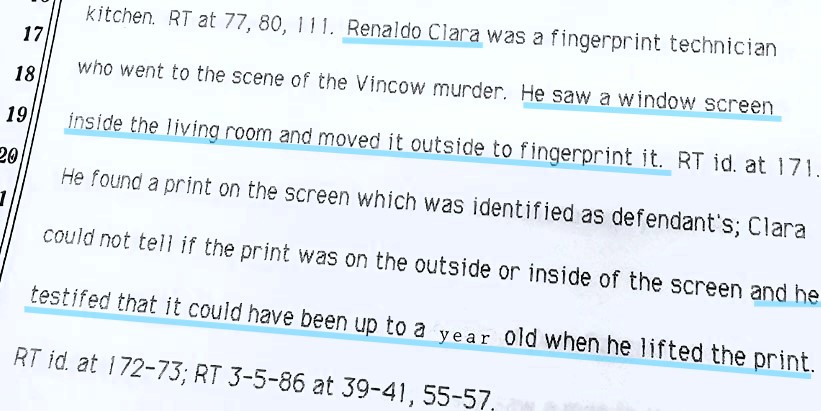
Within the same document that addresses the mysterious soup bowls, statements from LAPD latent fingerprint technician Renaldo Clara emerge, highlighting his analysis of the window screen at the Vincow crime scene.
During the trial in 1989, Clara testified that he could not determine when the fingerprint had been left on the window screen. However, his initial statement reported that it could have been left up to a year before the crime occurred.
While this may seem like a minor detail, it is important because Clara’s original statement directly contradicts his court testimony. He initially claimed that the fingerprint on the window screen “could have been left up to a year before the crime” but later stated that he could not determine the timeframe for when the partial fingerprint was left. The inconsistency in his statements highlights further uncertainty regarding the timeline of the evidence.
There were also issues with Clara’s fingerprinting procedure. He prematurely removed the window screen from the crime scene before lifting for prints, exposing the evidence to potentially compromising environmental factors that could affect the integrity of the findings. This important detail has been conspicuously omitted from other trial documents.
The inconsistencies in Clara’s statements and his fingerprinting method raise further doubt about the reliability and integrity of the fingerprint evidence in the Vincow case.
KayCee


 Expendable For A Cause.
Leave a reply to sarah1997 Cancel reply