
“His self-image is fragile and vulnerable, as well as unrealistic. He has a lot of angry feelings and a great deal of mistrust toward others. This combination of factors is also part of a very self-destructive pattern”.
Declaration of Anne Evans, document 16-7.
Forensic Psychologist Anne Evans, PhD, was formally retained as an expert defence witness in 1991 as part of the Pan trial. We have covered her report in several POSTS already; it’s a large document.
Although she was working for the defence, her exasperation, and at times, hostility, percolate throughout the 35-page report. Ramirez was found guilty, and in the eyes of Anne Evans, there were no grounds for reasonable doubt. Her perception of his lack of remorse and “bizarre and psychotic” ranting, including (in her words) the “scary” Satanic overtones, at the time of his sentencing, was to her, proof of his mental impairment, rather than his perception, that he was railroaded; the death penalty a foregone conclusion whatever he said. Both views are valid in this particular circumstance.
In 1991, Ramirez found himself with excellent and competent lawyers; unlike his 1985-89 experience, the new attorneys were prepared to do everything they could to help with his defence; their primary obstruction in performing their duties was Richard himself. He was still unable and unwilling to try and help himself, often sabotaging their efforts on his behalf.
He cannot be blamed entirely for his irrational behaviour; he did have reasons to mistrust following the disaster of the LA trial and the betrayal by everyone around him. His San Francisco lawyers bore the brunt of the fallout from LA, as he made work impossible for them without considering (or understanding) how detrimental these actions could be to himself.
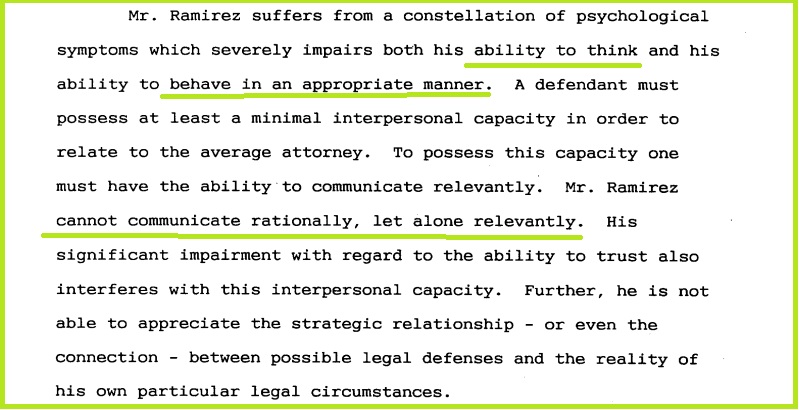
Realistically, his attorneys knew there was no possibility of his ever being able to either testify or rationally challenge witnesses and potential evidence against him; the ability to process information or to coherently respond was severely immobilised. Richard’s level of paranoia, mistrust and lousy judgement grew to such a level that all his lawyers, at one point or another, had to run the gauntlet of psychotic and unreasonable behaviour.
Explosion
Ramirez really liked Dorothy Bischoff, one of his defence lawyers, but he didn’t trust her, requesting that she not write down any information he gave her. In 1994, she informed Richard that she was going to El Paso to speak to his family, and according to Evans, he told Bischoff that she could only go “as my girlfriend, but not as my lawyer”. She went anyway, and when he discovered what she’d done, he went on a tirade, screaming, pacing and yelling, his rant making absolutely no sense to anyone.
Rather than focusing on his case, Ramirez would become distracted by Bischoff and what she was wearing, preferring to try and flirt with her instead of paying attention to the proceedings in the courthouse.
“Mr. Ramirez has shown a consistent pattern of delusional attempts to block his own attorneys’ communications with other counsel by trying to require each attorney to communicate only with him. Each is constantly tested and any violation of this procedure was, and is, considered disloyalty.”
Report of Anne Evans, document 16-7.
Co-counsel for the defence, Daro Inouye, felt the full force of Ramirez’s delusions and paranoia – Inouye likened him to a child, stating that Richard was unable to hold a thought in his head for a moment before switching to another topic.
In what was probably a vulnerable moment, Richard revealed some information about his background to Inouye and seemingly regretted it. He banned his besieged attorney from sitting near him, saying he “knew too much”, and refused to speak to him upon discovering that Inouye had done some investigative work for Lieutenant Kennedy from the Sheriff’s Office, who had the office next door. He felt sure they were collaborating against him, his mind linking “Deputy Public Defender” and “Police Deputy” as one and the same.
He told Anne Evans, “They’re deputies- they’re police!-They work for the court. They work hand-in-hand. It’s all a game to them.”
He was out of control and potentially explosive; Inouye described his experiences with Ramirez as “volcanic”, while Michael Burt, another defence attorney, likened him to a “trapped animal” whilst in that state. Burt mentions a “verbal panic”, destroying his ability to follow his attorneys’ efforts to communicate with him.
On one such occasion, Burt tried to explain to Richard that he couldn’t keep having all his “girlfriends” clogging up the jailhouse because it was causing issues with security; they needed extra guards in the hall. This led to yet another diatribe featuring conspiracy theories and betrayals. His poor lawyers must’ve been glad to get home!
Ramirez was convinced that Michael Burt, who was diligently working on his behalf, was colluding with the attorney general, denying him his rights and doing “backdoor deals”. He also sent letters accusing him of working for the prosecution because he couldn’t understand why they wished to discuss the evidence with him. Why would they do that unless they worked for the other “team”? Richard’s refusal to talk about the LA crimes, or the San Francisco one, led him to more conflict with Public Defender Randall Martin.
“Some examples of behaviors the numerous professionals who have attempted to help Mr. Ramirez have been subjected to include: banging on the walls, screaming and yelling, volatile nonsensical rantings, arm flailing, constant body motion and angry, paranoid tirades“.
Report of Anne Evans, document 16-7.
One thing that I find interesting is that Ramirez didn’t appear to have worn heavy-duty restraints when he was with his lawyers; he’s flailing his arms, pacing, screaming and throwing tantrums. Surely if Richard was handcuffed and chained to the floor or wearing leg restraints, he wouldn’t be free enough to do that, and the tone from each of his attorneys is laced with exasperation, frustration and disbelief; not fear. The lawyer meeting occurs in a room, not behind plexiglass in a cage; that’s how Cindy Haden was physically close enough to “kiss and fondle” him. Ramirez wasn’t trussed up in a straight jacket and delivered on a sack truck to his defence counsel, like Hannibal Lecter, complete with a bite mask.
Of course, guards were outside the room, but no one felt it necessary to put him in cuffs and no one appears to have called for assistance, even when he was “volcanic”.
The lawyers compare the angry screams of the Night Stalker to those of a thwarted child.
Self-Destruction
Randall Martin, an extremely successful attorney from the Public Defenders Office, came to loggerheads with Ramirez after travelling to Texas to gather information pertinent to the case. After an irrational verbal assault against Martin, Ramirez declared that none of the gathered data would ever be used in his defence. Once again, this demonstrates that he would rather receive another guilty verdict than involve his family in his defence. He refused to accept Martin’s superior knowledge of what was best for him.
Randall Martin told Evans that although Ramirez “very much wanted to live”, he stubbornly blocked any attempt to contact his family. To his credit, Martin told him that he would work to save his life even without his help.
Richard threatened him: “I know how to remove you!” And later, he did just that. Richard filed a Marsden motion to remove Martin from his counsel; the threat was a legal one, not a “Night Stalker” one.
The client-attorney relationship finally imploded due to one Cindy Haden, who and what she was to Ramirez is discussed HERE; her manipulations causing the increasingly paranoid mind of Richard to go into overdrive. Finally he decided Martin was working with the judge and had designs to “Do him [Ramirez] in”. He verbally abused him in a series of hysterical, name-calling and psychotic phone messages.
“Unable to maintain or understand boundaries, he had distorted his relationship with Mr. Martin by projecting his own psychotic thought processes onto him. Because Mr. Ramirez was unable to focus on anything other than his own emotions and persecutory beliefs, he could not stay in reality. He also exhibited extremely poor judgment about other people and their motives. He was totally unable to appreciate that Mr. Martin was working for him to try to save his life”.
Report of Anne Evans, document 16-7.
Randall Martin ceased to work on his case.
A former appellate lawyer described him as a “child in an adult’s body”, frustrated beyond belief when Ramirez (who respected him) refused to listen to advice and appeared on the Maury Povich show, oblivious to the damage this could cause his case.
“The defendant was so lacking in rationality and judgment that he could not grasp that he was saying “crazy” things. He also had no awareness that he was irrationally obsessed with his own notoriety- in favor of and to the detriment of his legal proceedings. He had no understanding of cause and effect with regard to his actions or verbalizations. When the lawyer tried to explain to Mr. Ramirez that he had been manipulated by women trying to sell their stories about the defendant, his only reaction was one of upset at the lawyer for suggesting such a thing”.
Report of Anne Evans, document 16-7.
Richard
Richard’s cognitive deficiencies rendered him incapable of working with his attorneys. He couldn’t concentrate, articulate, or assist with his own defence. The legalities surrounding his precarious position seemed to hold no fear or importance, and he was unable to participate in the machinations of the court. Although he understood the finality of the multiple death sentences handed down to him, he believed it would never actually happen.
To the frustration of his defence counsel, other matters entirely took up his focus. He spent his time (when he wasn’t abusing his lawyers) obsessing over his phone privileges, books, money and girlfriends.
This may seem petty and ridiculous when weighing that up against the death penalty, but to Richard, perhaps this was his last vestige of control. He couldn’t control the outcome of the LA trial, nor could he control the result of the San Francisco one – eventually stayed indefinitely due to his incompetence to be tried.
When your world is narrowed to four small walls, when everything is taken away, and all you have left are phone calls, letters, books and people visiting you and maybe even talking about you, it isn’t hard to understand why these things matter so much. Especially as he had valid reasons for having little faith in the justice system.
Perhaps Evans should have recognised that in her understanding of his mental instabilities.

~ Jay ~
(Originally written and published 10th Jan 2024}


 Expendable For A Cause.
Leave a reply to YesIAmEvil Cancel reply