
The Death Penalty in America
“The question we need to ask about the death penalty in America is not whether someone deserves to die for a crime. The question is whether we deserve to kill.“
– Bryan Stevenson, founder of Equal Justice Initiative
The United States is the only Western industrialized nation that practices capital punishment, putting it in the company of notorious dictators in countries such as North Korea, Iran, Iraq, China, and Saudi Arabia. The American death penalty system is marred by bias, wrongful convictions, unfair application, and dependence on the defendant’s financial resources and legal representation. It is disproportionately imposed on the poor, uneducated, and people of color. Moreover, it does not effectively deter violent crime, fails to enhance public safety, and is significantly costlier than a life imprisonment without parole sentence. Ultimately, it favors the wealthy and guilty over the poor and innocent.
One in ten prisoners executed in the United States are considered “volunteers,” meaning they have waived key trial or appeal rights to facilitate their execution. This decision is often driven by the appalling conditions they are subjected to on death row for many years before their sentence is carried out.
Since 1978: 1,582 individuals have been executed, while 181 have died from non-execution-related deaths. Richard’s death is included in the non-execution related numbers, as he died from an illness while on death row. Fifteen individuals have had their death sentences carried out. The state of California has carried out 13 of those 15 executions.
California Death Penalty
As of January 2023, 2,463 prisoners were on death row in the United States, with 665 of those being in California. California’s death row is the largest in the Western Hemisphere. An estimate from The National Academy of Sciences concluded that at least four percent of individuals on death row are innocent. California’s death row population is representative of the inherent racism in capital punishment, with Latinos comprising 26% of death row prisoners and 39% of the state’s population.
Does anyone want to guess which county has sentenced the most people to death? That’s right, Los Angeles! Los Angeles County also has the highest number of exoneration cases among all California counties.
East Block was the home of California’s only death row until it was shut down in early 2023. Currently there is a moratorium on the death penalty in California, but it is still legal.
Life on the Row
Death row prisoners are stripped of nearly every freedom while waiting to die. Life is a bleak existence marked by isolation, exclusion from educational and employment programs, restricted visitation, and the ever-looming possibility of execution.
Solitary Confinement: Richard Ramirez spent most of his time alone in a small cell, with limited social interaction and exposure to sunlight, subjected to much more deprivation and harsher conditions than general population inmates.
Limited Time Outside Cells: Richard spent more than 20 hours a day in his cell, only allowed to shower a few times a week, with limited access to exercise and visitations.
Frequent Checks: In California, death row inmates are checked on average 48 times a day. This means Richard had to go through these checks constantly. The checks involve loud noises from keys, voices, and lights, making it hard to sleep without interruption, leading to severe sleep deprivation. Richard spent 24 years on death row (except for the 3 years in the San Francisco County Jail). Imagine how it would feel to be sleep-deprived for over 20 years.
Declining Mental Health: The combination of isolation, limited sunlight, and severe restrictions can lead to a condition known as “death row syndrome.” While it appears Richard had some physical and mental health issues before he was sent to prison, the conditions on death row seem to have exacerbated his illnesses.
Mental Health
Death Row Syndrome: Being confined to death row for an extended period of time can cause deteriorating physical health, agitation, delusions, suicidal tendencies, paranoia, depression, and anxiety. Prisoners wait decades for execution and are subjected to prolonged isolation, which many legal experts have concluded is comparable to torture.
Mental health issues significantly impact death-penalty cases. Individuals with mental illness are more vulnerable to police pressure, less able to assist their attorneys meaningfully, and are typically poor witnesses. Living conditions on death row are deliberately inhospitable, based on the presumption that those subjected to them are not only the most serious offenders but also predatory individuals who pose a continuing danger to others. The American Psychological Association states that the narrative about the danger posed by death row prisoners is unsupported by evidence. However, the evidence demonstrates that a disproportionate number of individuals on death row experience serious mental health disorders that are predictably worsened by the onerous conditions of confinement.
Inside San Quentin
Every death row inmate at San Quentin falls into one of two categories: grade A or grade B. Grade A comprises individuals who mainly abide by prison rules, while grade B includes those who have violated rules, been violent in prison, or have gang affiliations. Those considered “grade B” spend an indefinite period in the Adjustment Center – this includes Richard Ramirez.
From the confines of their cells, prisoners have a view of black bars, a sheet of perforated metal, a railing, and a daunting forty feet of open space before reaching a wall of windows. The cells in East Block measure a mere 48 square feet and stand at a height of 7’7″ – about the size of a walk-in closet.
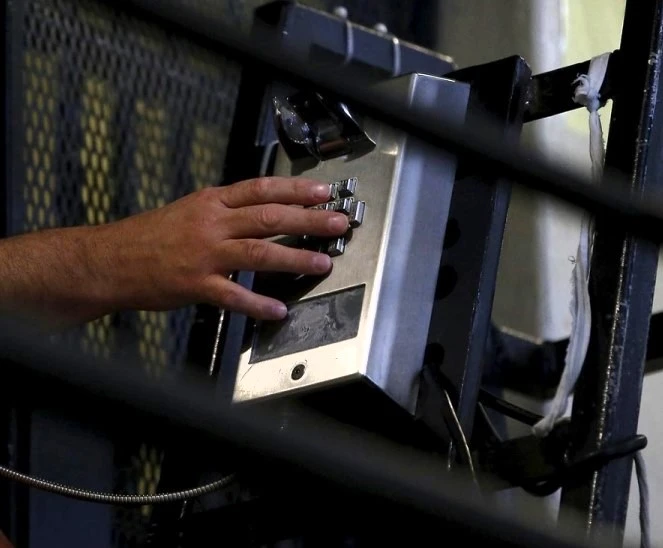
Any mail sent to prisoners is meticulously examined before being delivered. Adjacent to some of the cell doors are shoulder-high, A-frame metal structures with attached telephones.
“Because these guys can’t exit their cells freely, we actually have a phone apparatus on wheels, as we say, and we push it in front of the individual cell. We leave his food port open, and he is allowed to extend his hand out, grab the receiver, and place a call.“
Nancy Mullane, a reporter for KALW Radio in San Francisco, did a series of interviews with SQ public information officer Sam Robinson about life in the Adjustment Center. The following excerpt is from her 2012 piece titled The Adjustment Center: Where no one wants to go.
“Peering out through security fencing, I see two sorts of recreation yards. Officers direct me out a back door, to a yard of cages. On the far side, a dozen inmates are shooting hoops in one of two group yards, each the size of a basketball court. Guards armed with rifles observe from a walkway above. A little closer are 32 walk alone yards, which are cages the size of small living rooms. Inside each cage a single inmate dressed in white boxer shorts and T-shirt stands or sits alone.
Robinson says these yards are for inmates who either can’t get along with others or have been violent on the group yard. I am hoping to be able to actually see inside one cell in the Adjustment Center. It was one of the conditions I had requested as part of my press access to the facility. But as I press the officers to let me see the inside of just one empty cell, so that I can accurately describe the condition, Robinson says “absolutely not.” You don’t have one empty cell? I ask. “We may have empty cells, but you and I can’t just go down a tier ourselves.” Robinson never lets me see a cell…”
Can you envision this being your life every single day, year after year, decade after decade.

San Quentin, I hate every inch of you.
You cut me and you scarred me through and through
And I’ll walk out a wiser, weaker man.
Mister Congressman, you can’t understand.
San Quentin, what good do you think you do?
Do you think I’ll be different when you’re through?
You bent my heart and mind, and you warp my soul.
Your stone walls turn my blood a little cold.
San Quentin, may you rot and burn in hell.
May your walls fall, and may I live to tell?
May all the world forget you ever stood?
And may all the world regret you did no good?
San Quentin, I hate every inch of you.”– The song “San Quentin” was recorded by singer Johnny Cash in 1969, at San Quentin State Prison).

Additional Sources:
2008 Federal Petition for Writ of Habeas Corpus, Richard Ramirez vs Robert Ayers
The Nightstalker. The Life and Crimes of Richard Ramirez, Philip Carlo, 1996
Time on Death Row | Death Penalty Information Center
California is closing San Quentin’s death row. This is its gruesome history.
Los Angeles County Sheriffs – Past to Present (laalmanac.com)
Wrongful Convictions (eji.org)
The Death Penalty Worldwide – Death Penalty Focus
California Death Penalty Facts – Death Penalty Focus
https://innocenceproject.org/innocence-and-the-death-penalty/
KayCee
Jan 20, 2024


 Expendable For A Cause.
Leave a reply to ~ Jay ~ Cancel reply