
A Cloak of Competence

George Woods was a neuropsychiatrist who evaluated Richard at the San Francisco County Jail and San Quentin State Prison, interviewing him on five separate occasions for approximately 14 hours. Woods also spent extensive time observing Richard’s interviews and interactions with his San Francisco defense attorneys, screening LA trial footage, and reviewing his medical history, school, Texas Youth Council records, and police reports.

Woods determined that Richard suffered from an “organically based mental disorder,” specifically a psychotic disorder, caused by temporal lobe syndrome.

In organic-based mental disorders, a medical condition or treatment causes altered mental functioning and behavioral changes. An organic-based mental disorder may be caused by conditions such as epilepsy, brain damage, or dementia. A physical change or injury to the brain can cause symptoms of psychosis, such as hallucinations, delusions, disorganized thoughts, speech and behavior, and social withdrawal. Psychosis can be a symptom of several types of mental health disorders and substantially impair functioning and quality of life.

Declaration of Dr. George Woods, document 20-3

The following terms were used to describe Richard’s cognitive and mental functioning:

  1. Over-inclusive thinking-characterized by incorporating unconnected ideas, making thoughts less precise and more abstract (including paranoia, delusions, hallucinations, and disorganized speech).
  2. Loose associations-consists of disconnected and fragmented speech, with the individual jumping from one idea to another unrelated or indirectly related idea, causing speech to be vague and confusing.
  3. Delusions-fixed beliefs that do not change, even when a person is presented with conflicting evidence. They may be bizarre or non-bizarre. An example of a bizarre delusion is when an individual believes that their organs have been replaced with someone else’s without leaving any wounds or scars. A non-bizarre delusion is based on things that can really happen, such as the belief that one is under police surveillance despite a lack of evidence.

Temporal lobe syndrome is a neurological disorder that affects the temporal lobes of the brain. The temporal lobes are responsible for processing emotions and short-term memory and allow us to assign meaning to the world around us and interact with it. When this brain area is damaged, individuals experience difficulties interacting with their environment. Temporal lobe syndrome can be a result of issues such as traumatic brain injury and temporal lobe seizures, both of which Richard experienced from a young age. Temporal lobe syndrome can’t be cured but is treatable, and many complications can be reduced or even prevented.

Symptoms: (Richard experienced every symptom on this list at some point in his life).

  • Seizures
  • Difficulty with executive functions (attention, focus, concentration)
  • Forgetfulness
  • Hallucinations
  • Poor impulse control /addiction
  • Difficulty learning new information
  • Changes in personality
  • Problems with memory
  • Staring into space
  • Compulsive behaviors
  • Delusions
  • Understanding social cues
  • Emotional regulation
  • Hyper religiosity

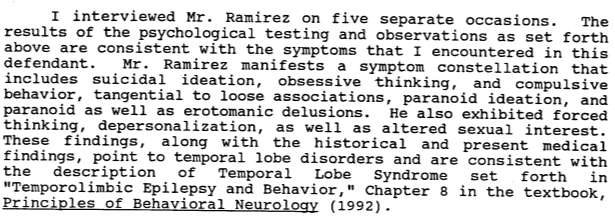
Temporal lobe syndrome significantly affected Richard’s functioning in many areas of his life: the following comes from Dr. Woods’ assessment:

Mr. Ramirez manifests a symptom constellation that includes suicidal ideation, obsessive thinking, and compulsive behavior, tangential to loose associations, paranoid ideation, and paranoid as well as erotomanic delusions. He also exhibited forced thinking, depersonalization, as well as altered sexual interest.

These findings, along with the historical and present medical findings, point to temporal lobe disorders and are consistent with … Temporal Lobe Syndrome set forth in “Temporolimbic Epilepsy and Behavior,” chapter 8 in the textbook Principles of Behavioral Neurology (1992).”

– Declaration of Dr. George Woods, document 20-3

Below is an image taken from Woods’ declaration.
Mental competency is not a concept from psychiatry but a legal term. Nor does it mean an individual cannot take care of basic needs or are “insane.” Richard was not, for lack of a better word, “witless.” It’s about understanding, reasoning, and processing.

An “insanity” defense is not the same as “mental incompetency.” Insanity refers to a defendant admitting they committed a crime but claiming they didn’t understand it was wrong at the time. In contrast, mental incompetency refers to whether a person can currently understand the legal process and assist in their defense. It’s entirely possible for someone to be found competent to stand trial but argue insanity at the time of the crime.

Richard did not use an insanity defense in either his Los Angeles or San Francisco cases. He pled not guilty to all charges, and the competency proceedings initiated by his San Francisco attorneys were based solely on his present ability to participate in his defense – not claims of insanity.

Maybe some people just can’t accept the idea that Richard Ramirez was mentally incompetent. Maybe they prefer to see him as a criminal mastermind who manipulated every expert and attorney over decades. But that’s not what the evidence shows.

Richard read a lot and spoke fairly well. Perhaps this makes it difficult for some people to believe he was mentally incompetent from a legal standpoint. While reading and speaking proficiency can be signs of intellectual functioning, they do not necessarily reflect the ability to process and comprehend information.

None of the professionals who evaluated Richard believed he was malingering – that is, faking his symptoms. His test results consistently showed he was not pretending, and his behaviors and thought processes remained strikingly consistent across evaluations, from the first in 1976 to the last in 2004. (Exhibit 72, Declaration of Dr. Anne Evans, Document 16.7, p. 8).

Judge Soper

Shortly after his arrest in 1985, Richard appeared in Judge Elva Soper’s courtroom and the exchange that occurred was printed in The Los Angeles Times:

There are multiple issues with Judge Soper’s findings including:

  1. Someone answering “intelligently” doesn’t mean they understand the charges against them, can rationally participate in their defense, or are mentally competent to stand trial.
  2. The defendant stating, “I am sane,” and have had 11 years of education and a year of trade school, does not indicate their present level of functioning and comprehension.
  3. The defendant saying, “I don’t want to go to no hospital,” should have prompted Soper to investigate Richard’s mental status further.

Richard made that statement but did not elaborate, nor did Soper inquire any further about this statement and why he made it. While she may have been a legal expert, it’s fair to say she was not a mental health expert. As the judge, Soper was responsible for being the “gatekeeper, “ensuring that court proceedings were just and fair. She did neither of those things.
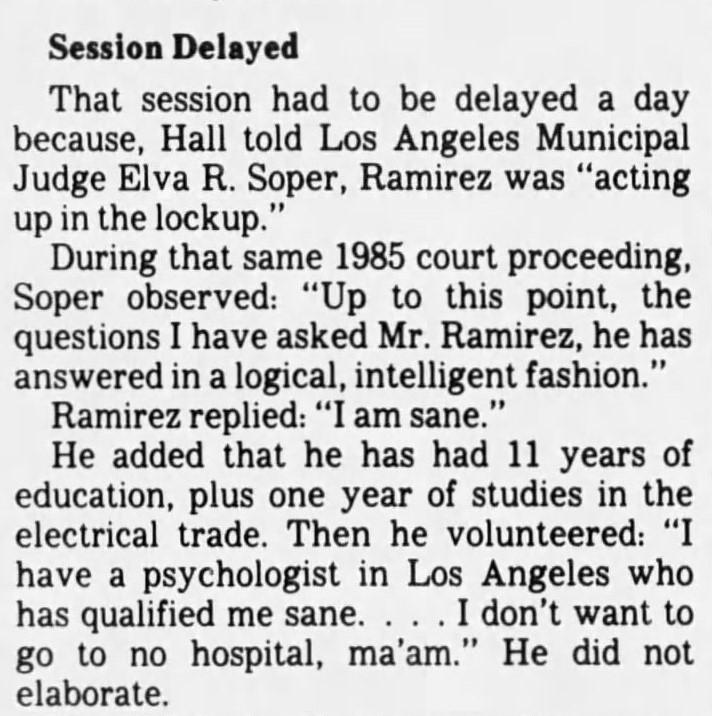
from The Los Angeles Times, January 30, 1989

Many mentally ill incarcerated individuals have an unusual presentation of psychiatric symptoms, and those with cognitive impairments often manifest a “cloak of competence,” which is an attempt to mask deficits that define serious mental illness. Because of the stigma that has historically been associated with mental illness, it is not uncommon for individuals to attempt to conceal their symptoms. 

Richard did not want to be seen as sick or “crazy.” He often publicly exhibited behaviors that covered what multiple individuals encountered “behind the scenes” when interacting with him. Such was the stigma of mental illness that this 25-year-old man did not want to be treated as though he had a mental disorder. He would rather have gone to jail than a mental health facility. Just ask yourself, ” What rational person would prefer incarceration over hospitalization?

Just how many experts needed to evaluate Richard Ramirez and declare he suffered from mental and cognitive health issues that rendered him unable to rationally participate in his defense and was incompetent to stand trial before the so-called United States criminal justice system would accept these findings? Apparently, a multitude, because that’s what we have. Considering what we have learned from the statements of other experts who evaluated Richard, Dr. Woods’ findings should be no surprise.

The image below shows Dr. Woods’ competency evaluation.
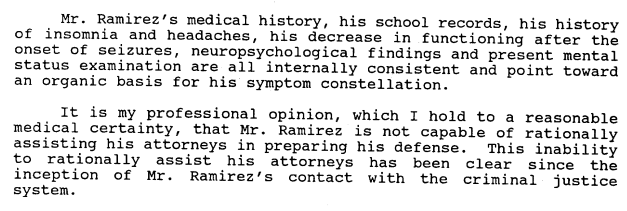
Why did so many professionals proclaim that Richard suffered from significant mental and cognitive impairments that affected his daily functioning and impacted his ability to stand trial? Typically, we only need one or two professionals to evaluate and diagnose a health issue for it to be considered a valid diagnosis. In Richard’s case eleven experts evaluated him over decades, reaching the same or very similar conclusions. And that doesn’t even include the professional opinions of the multiple attorneys who worked with him.

Every person who evaluated Richard was highly competent and qualified in their respective fields. None of them had any reason or motivation to skew their findings or to report inaccuracies. They reported what they observed and found based on facts and evidence stretching back to Richard’s childhood.

Declaration of Dr. George Woods, document 20-3

The United States Ninth Circuit Court of Appeals is the largest of the 13 federal appeals courts in the United States and has more power than a state or district court. The only United States court with more authority than a circuit court is the United States Supreme Court. The Ninth Circuit Court has a history of overturning decisions of lower courts, such as the California State Supreme Court and the California Central District Court, for reasons such as due process violations and incompetence of attorneys.

The goal was to get Richard’s 2008 Federal Petition for Writ of Habeas Corpus to the United States Ninth Circuit Court of Appeals. Richard’s case was filled with multiple due process violations, including representation by attorneys who had no qualifications or experience to defend a single capital murder charge, much less multiple capital murder charges. 

We can only wonder what decision the Ninth Circuit Court would have handed down considering the blatant and numerous violations in Richard’s case. Would they have had the “balls” to go against popular opinion, the biased media, law enforcement, and the likes of the lead detectives on the “Night Stalker” case?  Unfortunately, we will never know because Richard became very physically ill during the long, complicated process of getting his petition to its destination and passed away on June 7, 2013. Again, we are left with more questions than answers.

I’ll leave you with Richard’s final words at his Los Angeles sentencing. I think he summed things up pretty well.

“It is nothing you would understand, but I do have something
to say. In fact, I have a lot to say, but now is not time or the place. I don’t even know why I’m wasting my breath, but what the hell. As for what is said of my life, there have been lies in the past and there will be lies in the future. I don’t believe in the hypocritical moralistic dogma of this so-called civilized society and need not look beyond this room to see all of the liars, the haters, the killers, the crooks, the paranoid cowards, truly the trematodes of the earth, each one in his own legal profession.

You maggots make me sick. Hypocrites one and all. We are
all expendable for a cause, and no one knows that better than those who kill for policy, clandestinely or openly, as do the governments of the world which kill in the name of God and country and for whatever else they deem appropriate. I don’t need to hear all of society’s rationalizations. I’ve heard them all before and the fact remains that is what it is.

You don’t understand me. You are not expected to. You are
not capable of it. I am beyond your experience. I am beyond good and evil. Legions of the night, night breed, repeat not the errors of night prowler and show no mercy. I will be avenged. Lucifer dwells within us all.”

Statement of Richard Ramirez (included in the 2008 Federal Petition for Writ of Habeas Corpus, Document 14)
KayCee

74 responses to “A Cloak of Competence”

  1. This time I disagree with you. I think he was competent to stand trial. He probably had some issues, but not to an extent that made him incompetent to stand trial. Of course he has been evaluated by competent psychologists etc.,but most of them were engaged by the defense. They couldn’t lie, but of course they knew which diagnosis Richard’s attorneys wanted to get for him. It’s just normal. The prosecution tries and finds incriminating things and the defense tries everything that might help the defendant. And why did Richard prefer prison and even death over being considered insane or incompetent to stand trial? Because he would have lost the power to make his own decisions. They could have forced him into medication, turning him into a drooling vegetable.

    Liked by 1 person

  2. Hi, “legally incompetent” is, of course, not the same as “legal insanity”. The subject of whether he was competent to stand trial was raised first in September/October 85, then again early 86.
    His competence to stand trial would be based on his ability to rationally discuss his case and assist his counsel, which he couldn’t or wouldn’t. (Probably both) Or if there’s a development disibility which began before the age of 18. Under Californian Law Association rules at the time, that should be enough to table a code 1368, whether or not it’s agreed to.
    The defence counsel, not the Hernandez, as it didn’t suit them, but the public defenders and Joseph Gallegos pre-trial, and the post conviction lawyers definitely had grounds for questioning his ability to assist his defence. Anne Evans’ report (post conviction)in particular is an interesting one, especially his need for control, as you said, and his irrational behaviour.
    Showing the psychologists reports is important, as we see nothing of a defence, and their failure to follow up on the reports is part of what happened in court. Especially the early evaluations as they reflect directly on the conflict of interest within the defence team, and the later ones as they led to the stay of the San Francisco proceedings. It is part of the whole picture. As ever, thanks for your input and thoughts.

    Liked by 1 person

    1. And yet Ramirez made an escape attempt in September 93. His plan was to feign an illness (here we are) to be transported to the hospital and from there escape. I don’t know whether hospitalized in another context would have increased security around him or not, but strategically he could have tried and seriously considered this option of psychiatric internment with a view to a future escape!

      Like

      1. I am not familiar with the details of that escape plan, although I have heard of others, I am not sure they’re verified or hearsay. I would be happy to hear your source, though? I don’t think security would lessen for him, wherever he was.

        Liked by 1 person

    2. Here are my sources:

      https://nypost.com/2014/03/10/night-stalker-serial-killer-plotted-2-escapes-from-max-prison-sources/

      Of course the source of the media relay is less certain, it is “a source”. So let’s admit that this fact is true, psychiatric internment, for an inmate lacking freedom and planning to escape, was the right option and in this sense he could have been more inclined to collaborate with his lawyers and work on his case defense towards recognition of mental failure.

      Thank you again for all your work and your extensive research that we would not find so easily without your help. the comments are also a good complement and everything helps to understand this matter which turns out to be very complicated!

      Liked by 1 person

      1. That’s great, thanks for the links, and all sources (apart from Netflix and YouTube comments 🤣) are worth reading.

        Thank you for your words and for being a part of what we’re trying to do. We really appreciate the input.

        Like

  3. While you have a right to your opinion, I respectfully disagree with you. Yes, Richard’s attorneys did want him to be evaluated and diagnosed by mental health professionals but mainly because they knew he suffered from mental illness that had a profound affect on his functioning. It’s important to consider that evidence supports Richard experienced many of the symptoms that he exhibited during his LA trial and imprisonment as far back as 1976. His symptoms were not isolated occurences. Richard “preferred ” prison, if one can say that, over being deemed mentally incompetent because he did not want to be declared “crazy.” Although insanity and mental competency are vastly different, many people think they are the same thing. Richard could only have been forced to take medication if it was court orderd. Being declared mentally incompetent doesn’t mean you are forced to take medication. That’s an entirely different issue that would have required further hearings and court battles to strip him of his right to make medical decisions for himself. Even hospitalized mental health patients have the right to refuse medications and therapies. I appreciate you taking the time to read the post and for your sharing your thoughts.

    Liked by 1 person

  4. Ok, maybe Richard wasn’t able to care for himself. He was a drug addict and wasn’t able to hold a job or to earn money in a legal way. But he clearly knew what he wanted and even more what he didn’t want. He didn’t want to live with his parents anymore, he didn’t want to stay in El Paso, and he clearly didn’t want to go to a mental institution. Idk… Just imagine anyone (your parents, your boyfriend, your doctor) telling you that you don’t know what is good for you, but they do and now they would decide what you have to do , where you have to stay, with whom you can talk, which pills you have to take etc. For the rest of your life. Every single day. And you already know that most people don’t understand you and that they’ll just try and put their ideas on you. Believe me, I’d prefer to die too. Not being competent to stand trial is a trap. It can be a way to avoid jail if it is about a misdemeanor. But in a serial murder case? The trial would be postponed for 2 years and if you’re still incompetent they put you in a hospital for the rest of your life.

    Liked by 2 people

    1. That’s surely one of the contradictory aspects of his personality. He did not want to be considered “insane”, yet he also didn’t want to die.
      In the Evans report she states “Mr Ramirez very much wants to live” (or something like that) but seemed unable to do anything to assist his post-conviction lawyers who were trying to save his life.

      Liked by 1 person

      1. No, he didn’t want to die. But I think he had found a way to deal with his situation. I wouldn’t say that he had accepted it, but he had certain routines, certain methods to get what he wanted, certain things that helped him to pass the time. Somehow he knew how to help himself. And he didn’t need to assist his post conviction lawyers. They did everything for him anyway. It wouldn’t have made any difference. Not really.

        Liked by 1 person

      2. He found unhealthy ways to cope-hence the compulsive behaviors he engaged in and the disassociation. Can you imagine what life is life not just in prison but on death row? San Quentin has a history of being one of the worst prisons in the U.S. I can only imagine how awful being locked up was for Richard who was a free-spirited person.

        Liked by 2 people

      3. Hi, he did need to assist them, though, that’s the issue with the “competency” penal code. A defendant has to be able to rationally assist and he couldn’t. Even when his post-conviction attorneys tried to carry on the business without his “help” he then tried to sabotage their efforts by forbidding anyone to talk to them, especially his family, who he was intensively protective of. The information in his 2008 petition was still incomplete because of it, even after all those years. He wouldn’t focus on what they were saying, spending too much time worrying about his “girlfriends”, his books, phone privileges and things like that; I can only imagine their frustration. The one lawyer he did like was Dorothy Bischoff, but he refused to let her go to El Paso to talk to his family. He told her “You can go as my girlfriend, but not as my lawyer”. He was paranoid about “spies” and refused to let one of his attorneys (Daro Inouye) sit near him because he though he was in collusion with D.A. In some ways his fears were grounded in reality, after all, he had no reason to trust lawyers after what happened in LA with the Hernandezes, in fact he had very little reason to trust anyone in the system, or actually, anyone at all.
        I think he must have found a way to superficially cope throughout the years, but when you read the psychology reports from the early 1990s, the picture you get is very different. A cycle of deep depression, disassociation and coping mechanisms. Would his assistance have helped? In the long-run the outcome would probably have been the same, but the prosecutors back in LA had very real fears that the convictions could have been overturned because of the many constitutional violations, and in San Francisco the attorneys had every intention of fighting the Pan case, but the trial was stayed instead because of his proven mental disorders. I imagine had his LA appeals worked they’d have brought it forward again.
        In my opinion I think the psychiatric/psychological reports are hugely important, which is why we were determined to show them, as it’s one part of this whole mess that is rarely talked about. Detective Carrillo likes to say that Richard was the “smart criminal”, instead what’s revealed is utter confusion, paranoia and a lot of delusional thinking.
        It’s good to be able to rationally discuss this, though, without it descending into reactionary arguments like there used to be on Twitter. As ever, thanks for your input.

        Liked by 3 people

      4. Yeah and as I mentioned in the Cindy post, he sabotaged his relationship with a good lawyer, Randall Martin, because of a belief that he was banging Cindy, followed by some delusional phone calls. He stopped Martin from assisting with his defence and obstructed him from building an alibi over something that wasn’t real. That’s incompetence.

        Liked by 2 people

      5. The lawyers needed to have him found incompetent in order to be able to work in the background for him without interaction. If they hadn’t done so, the cycle of craziness, outbursts, incoherent ramblings, obstructive behaviours and firing lawyers would have continued indefinitely. This is why he didn’t assist them. He had the choice taken away from him.

        Liked by 2 people

    2. I agree that being declared mentally incompetent would be a difficult situation to deal with. I’m certain being on death row was also an incredibly difficult situation to endure. I would imagine it’s worse that hospitalization. It’s dehumanizing and every aspect of your life is controlled in prison, but even more so when on death row. When you wake up, when you do basic hygiene, what you eat, when you eat, how often you can have visitors, who can visit, and even where you take care of bodily functions are all controlled very strictly on death row. You can’t even engage in educational or vocational activities like the “regular ” prison population. Although no one wants to be confined to a mental health facility, you still retain some basic human rights, whereas on death row you essentially have none. Yes, one can end up being hospitalized then still made to stand trial if returned to mental competency. However, that is not necessarily the case. I would give the example of Andrea Yates who was sent to a mental institution after drowning all 5 of her children. From what I’ve read, she could leave the institution now if she chose to without another trial. Also, that of John Hinkley Jr. Who attempted to murder President Reagan. He spent several years in a state hospital and then was released ( he didn’t have another trial either). So the precedent isn’t necessarily that the individual would have a new trial if mental competency is restored. But in Richard’s case, I doubt they would have just let him walk free. So he likely would have had another trial.

      Liked by 3 people

      1. Exactly, they wouldn’t have released him. Nobody would have dared to take the risk. Idk, I just get “One flew over the cuckoo’s nest” vibes when I think of those state mental hospitals. I know, nowadays it’s not like in the 70s anymore. But it still depends on the staff how you get treated there. In prison at least they didn’t try to change him, but left him alone most of the time. Idk .. he often stated that he liked himself, that he liked his mind, that he considered himself intelligent etc. He also wrote in his letters that he was always fine, even when he felt bad (because it was still kind of interesting). And I believe him (maybe because I feel in a similar way). He said he didn’t want to be in a mental institution and I would have respected that.

        Liked by 1 person

      2. As someone who works in inpatient psychiatry, I can tell you that mental health facilities are not like in “One flew over the cuckoo’s nest. “Gone are the days of forcing patients to be medicated, unless they are a significant danger to others-and I mean visibly acting dangerous at a given moment-not because they are perceived that way, like Richard was. If a patient is a danger to others, they are more likely to be put in seclusion until they no longer pose a threat. I’m not saying it wouldn’t have been an uphill battle, but I do think his federal petition had a decent chance of getting him a new trial. I’m not sure if you have read the petition but his attorneys were prepared to take his case to international courts if they could not get justice for Richard in the United States. And they weren’t just seeking to have him declared mentally incompetent -they were seeking to have his convictions overturned. Mental competency doesn’t have anything to do with intelligence. Being smart doesn’t mean someone makes reasonable, rational decisions. He was alone in prison, basically 23 hours a day with no ability to participate in any kind of educational activities or programs-death row is pretty similar to solitary confinement. And he really didn’t cope, at least not in healthy ways-Richard stated in one of the interviews that he did not care about himself. He clearly suffered from very low self-esteem and deep depression-I think what he was displaying for people to see in the letters he wrote was the “cloak of competence” I referred to. He was good at masking symptoms. I get he didn’t want to be in a mental institution. I have yet to meet anyone that does. Living on death row is considerably worse than being in the general prison population. I don’t think he was fine-I think he disassociated as a means of coping.

        Liked by 3 people

      3. I have a copy of a newspaper interview where he said he liked his own mind or was comfortable with himself, but I have a suspicion it was an act. According to his psychologist Anne Evans, he had an incredibly low self esteem, very low ego and “compared himself unfavorably to others”. There’s even a letter where he wrote that he didn’t like his own face.
        I don’t know if you’ve read Evans’ long report, but it really does indicate severe incompetence in the ways Jay has listed in the above reply. He was a nightmare for his lawyers and appeared to have little understanding of the roles of court personnel and never seemed to recognise the gravity of his situation. It’s the most frustrating thing I’ve ever read. Sometimes his lawyers couldn’t even decipher what he was rambling.

        Liked by 3 people

  5. He could never understand that the title “Deputy” did not automatically mean a person was in law enforcement or had something to do with the D.A.’s office or the prosecution. In his mind, a Deputy Public Defender was in cahoots with police.

    Liked by 2 people

    1. Really? And that wasn’t just sarcasm? Idk, if you read some of his letters (to Synn or to Merle Allin and some others) or his Hustler interview … In my opinion those letters show that he did understand very well what was going on around him. Regarding his appeals I think he did just enough to keep them running. Because to stop them would mean that they could set the date for his execution. But as long as the appeals were running he didn’t care much about the outcome. He indeed did care more about his family and about the few pleasures he had in his prison life. But what’s wrong with it? Of course death row is a horrible place, but in my opinion, at least for him, a state mental hospital would just be horrible in another way. He had chosen what he considered to be better for him and not to take the risk to change anything about it. On Tumblr I said that his appeals were a bit like a lottery ticket for him. You know that the chances to win the jackpot are almost zero, but would you throw your ticket away?

      Liked by 2 people

      1. It wasn’t sarcasm, and in the early 90s, that was the situation and just one example of how he caused trouble within his legal teams. I don’t believe I have said anything was “wrong” with him caring for his family; again, it demonstrates another reason why he continuously made life difficult for those trying to do their jobs properly. None of it was new; as far back as 76, he was reported as having thought disorders and neurological problems. It wasn’t something made up just for the appeals process. I have read the Hustler interview.

        Liked by 1 person

  6. I know what you mean and I agree that his post conviction attorneys did a good job and tried their best to help him. And I agree that he maybe had some unhealthy coping techniques. But anyway, it was his damn right. If he would have been lucky he maybe would have found a place in a hospital where he really would have felt better. But what if not? He wasn’t violent while he was in prison. But what would they have done if he would have masturbated in front of anyone at the hospital? What would they have done regarding his beliefs? I have just watched a video about someone who had been released after 8 years in a State Mental Hospital. He had been restrained there (because it was necessary, yes) he got strong medication which still didn’t help to calm him down. He said that he was trying to figure out what was going on with him but couldn’t understand it. Until he started praying and then he realized that God took care of him etc. He told how happy he was now and praised the Lord and his wife did the same and all the people who commented on the video did the same. Ok, good for him, but the right thing for Richard? If he would have ended up in such environment Idk what would have happened. Don’t get me wrong, he should have gotten any psychological or psychiatric or medical help he wanted. I just think that he really didn’t want any. The psychologists that evaluated him, of course had to find issues that met the requirements of his appeals. As I already said, they couldn’t lie, but interpret, emphasize in any way that seemed helpful. Do you really think that any psychologist engaged by the defense or post conviction lawyers would have said “No, sorry, but he’s sane/competent.” ?

    Like

    1. I had a relative who was a nurse in a psychiatric hospital. She told me the masturbation is common in people with psychiatric conditions so was unfazed by it! As hypersexuality, unwanted stiffies and compulsive wanking are symptoms of his known condition, I’m sure they wouldn’t have punished him for it. As I understand it, this compulsive behaviour in prison led to him being unable to see visitors at times, as well as the loss of other privileges. He needed those fidget toys!

      Liked by 2 people

      1. Yes. Typically in mental health, we present things as choices. Some things are natural consequences of behaviors not punishments. I don’t think he would have been punished for masturbating in a hospital. And in a mental health facility he would have still had a decent amount of privacy. Unlike in jail/prison. And they would have tried to teach him healthy ways to cope. Sorry, not sorry, but hospitalization would have been better for him than lifelong incarceration on death row with no treatment, minimal social interaction, and just left to deteriorate. I wonder what his sister’s perspective would be on this issue?.

        Liked by 1 person

  7. I do think that if a psychologist/psychiatrist thought he was competent to stand trial they would have told his attorneys that. Of course, the attorneys would not have used their testimony if that was the case. But here we have 11 experts over decades that declared him mentally incompetent. Not just one or two. That’s unusual. Richard needed treatment that he never got in prison and would never have gotten. Prisons/jails do not care about people’s physical or mental illnesses. Regardless of what their official statement is, I’ve seen what they do. If we consider mental health to be as important as physical health, which I believe it is, then we should seek to promote the importance of treating it. We would not tell a person with high blood pressure or diabetes to not take medication or treatment for their condition. We would explain their condition, the importance of treating it, and the adverse effects of not treating. Those with physical illnesses have as much right to refuse treatment as anyone else but society does not see it like that. Yet, with mental illness we say things like “It’s their choice to go to a hospital. It’s their right to not take any treatment or medication.” Which is true. But we don’t tell people with physical conditions those things because there’s no stigma attached to treating physical conditions like there is with mental illness. In his letters Richard was not going to come across as, “Poor me. I’m depressed. I’m paranoid. I need help.” Those things would not have drawn anyone to want to write to him or visit him. Plus that wasn’t his personality. Typically what happens in the criminal justice system is individuals that are mentally competent try to get declared incompetent so they can get out of prison and be moved to a less restrictive facility. Not vice versa. Most often it doesn’t work though.

    Liked by 1 person

    1. An example of that in the UK would be Peter Sutcliffe “the Yorkshire Ripper”. He ended up in Broadmoor high security hospital. But I don’t believe he was insane. His sudden Christianity and claims of schizophrenia seems to have manifested after arrest. But in Broadmoor, there are nice gardens to sit in, TV rooms etc. Horrible, but better than prison.

      Liked by 1 person

  8. The test sets he did weren’t emphasised in a way that merely supported his appeals; they were tests, and the results were the results. He wasn’t malingering, as that is also tested. Where he is shown to fall at the first percentile that is simply a fact. In other test sets he fell at the 8th percentile, again those are the results. Had he have performed exceptionally well, those would also be on court record.

    Like

  9. Do you know how I feel right now with you all telling me how wrong I am with my perception of Richard and his situation? I can’t even keep up with reading everything, not to talk about thinking about it, looking things up and answering your posts in a language that is not my first language. I’m at the point to give up. Which still doesn’t mean that I agree. I just give up to discuss my thoughts. Does that sound familiar? However, Richard had not only 3 or 4 people telling him what’s good for him without listening to him and what his wishes were. I’m just rereading his appeal documents including the full documents/attachments which were not available yet when I did my research years ago. At least I didn’t find them. Anyway until now they didn’t change my mind either. But I haven’t read the Evans report yet.

    Like

    1. Hello, isn’t this how discourse works? Kaycee posted her article, and you disagreed (that’s fine) and put forward your views, which you are entitled to do, and you are more than welcome to share them. Your perception is yours, and ours we’ve taken from the official accounts, the reports, and supporting documents that go back to 1976. It’s ok to see things from another perspective.
      All the psychological reports are attached to the main petition, when we discuss them in the posts we give the document numbers to make it easier to find. The petition and documents total nearly 1000 pages, so we always provide the source. We are not here to change your mind or anyone else’s; we’re here to share information, and how people perceive or respond to it is entirely up to them. Unlike Tumblr, Twitter or anywhere else, we will never resort to personal insults, attacks or other things. Your views are welcome here. All the psych reports are well worth reading, I found them interesting, disconcerting, and in places, very uncomfortable.

      Liked by 1 person

    2. We aren’t saying you are wrong. Your perceptions are your own and that’s okay. We are merely trying to share the details of what we have learned after several years of research. The petition is daunting and comes with hundreds of supporting documents. It’s great that you are working on reading through them. And I can only imagine how difficult it is to read legal documents in a second language. We encourage everyone to read the documents for themselves. You are always free to share your thoughts about Richard.

      Like

      1. Thank you! When I was on Tumblr people there asked me if I wanted to talk to anyone involved in the case. I said that I didn’t want to, because I was shy and I probably wouldn’t believe them (some of them? most of them?) anyway and that I just wanted to get my hands on the ‘damn’ case file ( with more than 8000 pages, if I remember it correctly). So you can imagine how happy I am that I have all the attached documents now. 🙂 l just wrote a long reply to Jay’s comment. Now I’ll continue to read the Evans report and then I’ll try and explain my point of view again. But it can take a few days. Right now I have just a big pdf-chaos on my laptop. 🙂

        Liked by 3 people

  10. You do not only share information, but also opinions (of course, and that’s fine of course too). When I did my research years ago there weren’t any attachments. (I believe you could have asked for them somewhere (?) , not sure about that, but I wouldn’t have done that. But there were no links. And some time later I stopped doing research and didn’t go back to check out my “old” sources. If I would have found any linked documents I would have saved them all. (I have now, but of course haven’t had the time to read them all) However, in the 700+pages document they mentioned the most important things, so the attachments were new to me only in their details. What is new to me are the documents from El Paso, when he was a kid/juvenile. I always wanted to know about that time of his life. And of course some of the LA Trial documents/police documents etc. I haven’t read them yet, because I was looking for the Evans report. Yes, I know that you gave the document numbers. But I thought that you somehow got them and didn’t realize that they are available online now. So l have them only now. Beside that I’m new to WordPress and I usually write from my phone. My files regarding Richard I have on my laptop instead. Then sometimes I can reply directly to your comments, sometimes I can reply only to the post, not on any comment. Beside all that l have some real life here and already dedicated some years of my life to Richard. I didn’t expect this to become “work” again that quickly.

    Like

  11. Hi, I know what you mean about a “real life”, believe me.
    WordPress is glitchey and sometimes I can’t reply directly, depending on which device I am using.
    I got the documents about two years ago, by then all attachments were there, apart from the sealed ones.
    Your opinions are welcome here and as valid as ours, if you need any help trying to locate certain document numbers just let us know, we’re happy to help.

    Anne Evans report is document 16 – 7.
    Elise Taylor is 20 – 3 , that one is also interesting.

    Like

    1. Thank you, I think I have everything now. I did my research in 2018/19. I would have been happy if I had found all the documents that are there now. I was already happy when I found the petition. I never shared the link because the document contains a lot of personal information about the family and other people and on Tumblr there were a lot of crazy fan girls too. I thought that who was really interested in the case would find the document and who wasn’t able or not interested enough to find it, didn’t need to know certain details. Richard always wanted to protect his family and he didn’t want to tell his lawyers about them. And they promised that they wouldn’t tell anyone about it. And they didn’t, but everything that found the way in the appeal documents ist available now to the public. Ok, Richard is dead, but his family is not. So, I’d say he had a point with his “paranoia”. That’s one of the things that I criticize about his lawyers. Of course he needed help and he needed a defense (defense strategy etc.) and I can see what they wanted for him. But he always said that he didn’t want his family to be involved. I can literally feel his pain when he saw his father testify in the LA court. The Hernandezes made him testify against Richards will. And did it help in any way? Not really. And then what did his SF lawyers? Just the same. Richard said that he didn’t want that they interviewed his family. They just did it anyway. As I already said, I get what they wanted, but just do it without Richards consent was just not right. How should he trust them? They just showed him that his wishes (again) didn’t matter. Maybe there would have been other possibilities, (like talking only to his teachers, doctors, psychologists or only to one family member etc )to which he might have agreed. That “you can go as my girlfriend but not as my lawyer” is somehow cute. However, she went anyway and Randall Martin too. And then they wonder why he freaked out? I don’t understand either why he didn’t want his family to be interviewed. Especially because they all were willing to help him. But I would have respected his wishes anyway as much as even possible. I mean, he already had his 19 death sentences and apparently he kind of had accepted it. Not his death, but the fact that “The People” obviously wanted him to die (preferably more than 19 times). No, he didn’t want to die, but I believe he had somehow put his fate in “God’s” (in his case in Satan’s of course) hands and just thought “Ok, as long as I can l’ll try and make the best out of the whole situation and when ‘Satan wants me to be with him’ I’ll go. ” Christians state things like that all the time. If Richard does it, it’s crazy. I think it wasn’t that crazy. (I’m an atheist btw , so I somehow look at religions generally “from the outside”. )
      That Evans report is pretty long. I have read half of it until now. At least I know what to do over Christmas now. 🙂

      Liked by 1 person

      1. I understand his paranoia about the family. Although I’ll never understand his weird Stockholm syndrome towards them. They must shoulder some blame for the mess he was in. Julian Jr got him into injecting drugs and he and Roberto taught him how to steal cars.
        His epilepsy developed into brain damage because they never took him to follow-up appointments.
        When someone’s going to be gassed to death, their psychotic paranoia about involving their family must be overridden. Yes it goes against his wishes, but it’s tough. If a defendant wants to live, then their background must be raised, however painful. That’s the law in America and probably elsewhere. It is in Britain at least (I’m not American).

        Liked by 1 person

      2. Considering all that happened, he certainly had legitimate reasons for some of his paranoia, especially about the legal system. While being on death row itself can predispose someone to certain mental health conditions, if you already have a mental illness, it can definitely make those conditions worse. So, if Richard was already prone to paranoia, and it seems he was, then locking him in a cell the size of a parking space would only have heightened that and brought out other issues-which from the numerous psychological reports we can see that is exactly what happened. I think that despite the hardships he grew up with, Richard still deeply loved and cared about his family, and did not want them to be blamed for what happened to him. Even some children that experience worse abuse than he did will never openly blame their parents and are very protective of them. He knew that messed up stuff happened to him, yet he would not open up about it to anyone-this is not uncommon with individuals that have traumatic experiences. Their way of dealing with it is to not deal with it, classic “avoidance.” To act like it wasn’t a big deal. And if they do decide to talk about it, you better make sure you have someone that specializes in trauma therapy to help them, otherwise you can cause their mental health to deteriorate. Remember Faye Snyder? That arse actually asked Richard to tell her about his childhood traumas during an interview. I am appalled, that as a psychologist, she did such a thing. She knew better! Yet, she just wanted to be the one to write a book about the so-called Nightstalker! In the American judicial system, a lawyer’s job is the save the clients life-even if it’s against their wishes. Also, they are supposed to ensure their client is mentally competent. If they suspect the client isn’t, then it is their duty to expose that and bring the information to the courts. If that means they have to do what Richard’s attorneys did in SF, then that is exactly what they are supposed to do. Having his help would have been idea, but they didn’t need his consent, because they were doing what they were legally obligated and responsible to do. Randall Martin and the others in SF had every right to legally do what they did to get the information they needed to develop Richard’s case. Yes, Richard was pissed because he didn’t want his family involved or anything about his background exposed. But when the death penalty is involved, the attorneys have the right to go against the clients wishes if they believe it’s in their client’s best interests. The SF and post-conviction attorneys did everything they could and should have for Richard! Whereas the Hernandez’ did no such things!

        Liked by 1 person

      3. I definitely agree that they cared for him. They also had their own challenges and impediments. According to Carlo’s book, Julian Jr felt really bad for encouraging his little brother down that path. But because Julian was struggling himself, he might not have been thinking rationally when teaching Richard the ‘tricks of the trade.’

        Liked by 2 people

      4. From their statements to the attorneys it seems Richard’s siblings all had something they were struggling with. I doubt his brothers ever wished the kind of harm Richard experienced on him. After all, he was their baby brother. I think they were likely operating from their own pain and trauma. And unfortunately, they couldn’t even help themselves much less someone else. It’s a sad situation all around.

        Liked by 2 people

      5. Hi, thanks for sharing more of your insights, I do understand what you’re saying about his family, you explain very well and with empathy; I get it.
        For me this whole case has revolved around how appallingly the LA attorneys handled it, that’s why I wrote 3 posts about it (and a 4th is underway). They did not act in his best interests, even if that went against his wishes, their duty is spelled out by the California Law Association rules. They had a duty to him, which they failed to fulfill. Judge Morrow saw it and called a hearing telling Richard his rights were not being protected, his lawyers did not know the law well enough.
        I am horrified that a case so huge was allowed to be taken on by Daniel and Arturo, who had a history of letting people down and being incompetent and in contempt of court. Californian Law says a client can choose his own attorneys, even if they’re under qualified; which they were. I feel so angry that a poor defendant must play the “justice lottery”, especially in capital cases. The process is horrific.

        Hope you have a good Christmas, and I am sure we’ll discuss more in the future.

        Liked by 1 person

  12. Ok, here I’m back with my unpopular opinion… and I’ve done some work yesterday. I have read the Evans declaration and also the reports/declarations of Young, Taylor, Wood etc. Anne Evans evaluated Richard in 1991. Between February 23rd and April 13th of 1991, she spent a total of 12 hours with him. She interviewed him and did “a full psychological test battery, including extensive personality testing”. She stated that she obtained his informed consent and Richard was able to paraphrase what she had explained to him. Ok, but apparently in 1991 she did not consider him incompetent to stand trial, if she had they probably wouldn’t have pled “not guilty” in June 1991 (if someone is incompetent, he’s incompetent, or not?) Every delay just wasted a lot of time and money and kept Richard away from getting proper help. However nothing happend in the rest of 1991, in 1992, 1993 and half of 1994. They still wanted to take the case to trial and tried to get the LA trial documents etc. They wanted a preliminary hearing. They challenged the indictment etc, still with the goal to let the case go to trial. They didn’t do anything regarding Richards competency to stand trial. Until.. I don’t know what exactly happend, but at the end of 1994 they all were very busy to evaluate Richards mental state. You just need to look when they all signed their declarations. Anne Evans April 18, 1995. George Wood (who also referred on the Evans report and her evaluation in February 1995) signed his decalaration on April 19 1995. (What? Really? Only 1 day later?) – Myla Young: Evaluation: 12/9/94, 12/10/94 12/28/94
    Report: 03/13/95 – Elise Taylor: Report signed: 03/06/95
    Taylor stated: “When I was brought into the Ramirez case, it was with the primary intent of working with Mr. Ramirez to prepare his psychosocial history for use in his penalty phase (!) ” She didn’t state when she was brought into the case, but mentioned periods of months and “over a year” , so I think it was somewhat over a year before she signed her declaration (??) . At that time they thought about a penalty phase, not an incompetent to stand trial plea. So until the end of 1994 Richard was just an innocent (until proven guilt) young man (at least in the SF case) who turned within weeks into man with a longstanding mental illness who is unable to make his own decisions. What did he say what a defendant does? “Sit and watch the whole facade”
    And btw. it was not about another death penalty. They had offered a plea bargain. If there was enough evidence to prove Richards guilt, he could have plead guilty and would have received a life without parole verdict. So, it wasn’t to safe his life. (It was not their job to safe him from his LA convictions, the appeals were already running anyway) And if there was not enough evidence to prove his guilt, then they should have challenged the charges even more.
    Ok, I know they wanted the best for Richard. Or rather what they considered to be the best for him. And maybe it would really have been the best for him. At least in the best case. In the worst case he could have been trapped in a place that would for him have been worse than death row. Unfortunately there was no choice, no chance to try it out. And he apparently did not want to take the risk. I’m not denying that Richard had several mental issues, but I think you can’t just take his evaluations as “the truth” , they were made when they were needed as a strategy and the were made to match the requirements of the incompetency plea. No, no lies, but a bit of streching in the right direction. In my opinion his perceptions weren’t that wrong, his views on the world were unusual, but not that crazy. Some of his issues become understandable if you consider his situation. Some of his views become understandable if you consider his mexican background (mexican culture with ghosts and Día de los Muertos etc) or just the fact that something like (yes, even Christian) demonology exists. He just was into such stuff. Some people pray, some people go to fortune tellers and Richard draw his pentagrams and tried to draw power from demons. It’s not that different. So, I’m just pulling a bit in the opposite direction.

    Liked by 1 person

    1. I mentioned in another post that some of his delusions had foundations in reality. We don’t simply take Evans at face value. I actually have a few criticisms of her analysis that will be in the book.
      The reasons those declaration dates are so close was because they were gathering them at the same time for hearings. In the same way all the jurors’ and family’s declarations are close in date (2004 for the appeals).
      There’s nothing more to say on the matter.

      Liked by 1 person

      1. We’ve never taken Evans at face value, and have been critical of her using Linedecker as a point of reference.

        Liked by 1 person

      2. I know that it was for a reason. It was a strategical move of course. It’s just contradictory to state that he was incompetent only after more then 5 years and at the same time to say that it’s a “longstanding” illness and that he always had behaved strangely.

        Like

    2. It took a lot of time for the SF attorneys to get a psychosocial history, Richard’s childhood medical, legal, and TYC records. There were also multiple delays because the LA trial court would not turn over documents they needed in SF. I don’t believe the SF attorneys just decided one day they wanted him declared incompetent. The initial strategy was to go to trial. But as things were revealed during the course of gathering information and investigating, that’s when they realized he had serious mental health issues, that they could not reason with him, or work with him in any sort of constructive capacity. Developing his case for SF trial took several years. If only 2 or 3 people had said Richard wasn’t mentally competent to stand trial, then I could see your point. However, there were numerous individuals that said so as far back as 1985, shortly after his arrest. The psychiatrist that deemed him “borderline competent” at that time spent only 10-15 minutes with him. You cannot accurately assess someone’s mental competency in such a brief interaction. And his childhood records show that the symptoms he had while in jail/prison, he had in 1976. While I do not consider Philip Carlo’s book to be a factual account of Richard’s life as he used creative license when writing it and it is very much like a fiction novel in most chapters, he did include some of Richard’s interviews with him in the updated edition. They discussed Richard’s “religious” beliefs. Richard came across in the interviews as sounding confused about some of beliefs-at least that’s how it seems to me-it’s like he believed a combination of religious ideologies. As for pentagrams, they really don’t mean much except that the “Church of Satan” uses symbols like that to basically perturb Christians, etc. Satanists are atheist. They do not believe in demons or angels, or anything of the sort. And this is what Richard claimed to practice. It’s like he was confused about these things. At least that’s my perception. Do you have access to any historical newspaper sites? You mentioned there was nothing discussed in the documents about Richard making a plea to get a lesser sentence. While there isn’t anything like that in the SF/ appeal documents, there are some news articles that mention the SF district attorney stating that Richard and his attorneys had not said anything about making a plea bargain. The district attorney even said he would be willing to do so. I was wondering if you are familiar with the death penalty system in America.

      Liked by 3 people

      1. Uff, sorry, but it was too much for me again. I don’t even understand everything that you have written. I think there must have been a misunderstanding. I said that the SF trial would NOT have been a question of life or death, because Sweeters said that the DA would have been interested in a plea bargain, Richard should confess and would receive a life without parole sentence. I’ve read that here (Murder in Lake Merced-post) . I wrote that because you had written that if the death penalty is involved his lawyers had the right to act against his will. But of course you are right when you say,that there must have been a reason that they were trying to declare him incompetent to stand trial. There must have happened something in 1994. Maybe they learned about the/new/more evidence against Richard and it didn’t look good. I don’t know why they changed their strategy. But apparently it was necessary only in 1994, not earlier (although Richards issues were “long-standing”). That’s what I mean.. It had more to do with the case (defense strategy) then with Richard himself. If he was innocent (or not enough evidence), they wouldn’t have needed his family (although they of course would have prepared for the worst case anyway, I know)
        Unfortunately access to old newspaper articles is difficult from here because of the European data protection laws. I have read LA Times articles of almost every day of 1985 (to see if the crimes stopped after Richard’s arrest )and then from one day to the other there was no access anymore to them. But I did find several old newspaper articles anyway, from different newspapers. For example about Miguel shooting his wife, about the car accident of Richards friend Nicholas Nevarez etc. But it has always felt like gold digging.
        Of course I’m not “familiar” with the death penalty in the USA. We don’t have the death penalty here and of course I’m against it. I know only what I learned while doing research on Richard. For example that people who are against the death penalty don’t have a chance to become a juror in a death penalty case. They call it “The people” anyway, not “half of the people” . I know that a death penalty sentence is followed by an automatic appeal. That every further appeal (if accepted) put’s the execution of the death penalty on halt and that every appeal often takes years. I know that there are different steps which have to be done in a certain order, and that every step has certain rules, but I can’t remember those steps. I know where to look them up when I have to.
        I wouldn’t say that Satanists are atheist. I think there are both, theistic and atheistic, who see Satan only as a Symbol. I don’t think that Richard was confused about his beliefs . He was just aware, that we don’t know for sure if there is any supreme being and if so how it “looks like”. He was interested not only in Satanism, but in philosophy generally. He quoted Nietzsche for example and in a letter he thanked his penpal for the definitions of existentialism and nihilism. That’s why I was surprised that his IQ was so low. People with low IQ usually are not interested i philosophy. Idk, I have read a lot of philosophical stuff myself and somehow I picked a bit of everything. He wasn’t confused, but still processing, I think.

        Liked by 1 person

      2. It must be difficult to try to translate the precise meaning of everything. I try to keep things basic but it’s hard to write about legal stuff in that context because nothing is simple in this case. What I was trying to say is from the information we have, the San Francisco District Attorney was indeed pursuing another death penalty for Richard. There is much in the newspapers from that time period that demonstrated how the Los Angeles district attorney was against that as were many others.They thought it was absurd given Richard already had multiple death sentences The SF district attorney thought it was necessary to pursue the Pan charges because there was speculation that the LA charges might be overturned because of inadequate legal representation. The available information suggests that Richard’s SF attorneys were not seeking any plea bargain in the Pan charges but preparing for a trial. Only afer finding out Richard’s psychosocial , mental, and cognitive history did they change to a mental incompetency strategy. That took several years to do. I don’t think the data shows Richard’s IQ was “low” but below average in certain areas, such as cognitive processing, which caused his overall score to be lower. There is no way to definitely know what happened with his SF case because those documents are not available. What we do know is the Pan charges were indefinitely stayed because of the case Richard’s attorneys developed and presented to the SF court in 1995. The SF district attorney knew if he continued to move forward with the case against Richard, it could adversely affect the Los Angeles convictions. And no one in the SF or Los Angeles County legal system wanted the convictions to be overturned or for Richard to have a new trial. It would have brought out many ssues with the Los Angeles trial. Having charges stayed indefinitely in a case is unusual in the United States. A death penalty requires an automatic appeal to a state Supreme Court. However, that does not mean the evidence in the case in presented to that court. It is not. It’s supposed to be a safeguard to make sure the person had adequate legal representation. But in Richard’s case, basically all the California Supreme Court did was say he had the right to choose his own attorney and he did that. They did not look at whether or not he was mentally competent to do so. Or anything else. I will address the other points you made in another post so this one will not be excessively long.

        Liked by 1 person

      3. If you can access the ” church of satan” website it will tell you about their beliefs. They define themselves as atheists. That is their definition, not mine. This is what Richard claimed to follow. The reason I say he seemed confused is that his ideology did not align with what Satanism is. He said that Satanism was a stabilizing force in his life. But then he would talk about angels, demons, the afterlife and other related stuff. However, satanist do not believe in angels, demons, or the afterlife. I am explaining this based on the official website information. I agree that he was processing religious things. But in his interviews he said contradictory things about this stuff.
        Concerning the death penalty system in America, I am writing about that currently. It is a complex system that involves many things. It is difficult for those of us who have lived in the United States to understand and process. Hopefully when I finish that it will help those who do not live in a death penalty country understand what it’s like. I will answer any questions you or anyone may have about it.

        Liked by 1 person

  13. His neurological, psychological and other problems were reported in the 70’s, and you’ve read the case so you know why the Hernandezes didn’t pursue or develop that defence strategy.
    Thanks for adding your thoughts, we appreciate the time you’ve taken, even if we see things differently.
    Hope you’re having a nice Christmas.

    Liked by 1 person

    1. Problems, yes, of course. I totally agree with that. But how bad were they? (I have read the El Paso reports) Idk, they say that he wasn’t able to differ between fantasy and reality. I’m not sure about that. He said for example that he was present when Miguel shot his wife and that he was on the backseat when his friend died in that car accident. But do we know if that’s true? The newspaper article about the accident mentions only 2 people, the driver and Nick. And the accident was in 1980, when Richard already lived in SF. But of course he could have visited El Paso. And the shooting.. ok, Miguel’s sons could know if Richard was there. But they were 3 and 6 years old at that time. Neighbors said they heard the shot and then Mike screaming. Had there been time to give Richard instructions to leave and not to tell anyone? My impression is that he maybe sometimes told stories the way he thought they should have been. Or the way he felt them. I think it was more a way to deal with the respective events than inability to separate fantasy from reality. Idk if this “strategy” had to do with his epilepsy maybe.
      Christmas..I always try to ignore it. 🙂 So I ‘m happy that’s finally over. But this year it seems that it gets only worse after Christmas. Don’t ask. (Nothing really bad, but everything seems to break right now , like car, heating etc).

      Like

      1. Hi, yes, we’ve questioned the car crash and the Miguel incident, too. Although his siblings agree he was present and how it affected him.
        Perhaps all this is part of the problem of sifting through his “reality” and thought disorders.
        Re: Christmas. I agree with you.

        Liked by 1 person

      2. His siblings can also only know what he (or maybe Miguel, maybe later?) told them. So it’s hearsay one more time. As so often in this case.

        Like

      3. Too much hearsay has and always will be a problem. Thanks for your input.

        Like

  14. Richard was not a member of the Church of Satan. (bc. they wanted 100$ from new members) So he could belief whatever he wanted. As he said in his interview with Mike Watkiss : There are different sects of Satanism. (I have read only the Satanic rules, statements and sins, but it was years ago.. I should read them again. ) Do you know Richards letters to Synn (I typed one out, bc nobody could read Richards handwriting. It’s still online.)? “SynnLeaha Satana”, who was the editor of SatansSweetSlavery magazine. They talk a lot about Satanism, LaVey etc. , she also said in an interview that she doesn’t believe in Satan as a being, but as a symbol. But anyway they talk about demons too and about prayers, symbols and rituals etc. Richard mentions a demon called Vassago , who is even kind of a good demon (there is a wikipedia site about him) but also a figure of a book (Hideaway)
    and movie by Dean R Koontz (Richard liked Dean Koontz) and also Rod Ferrell used a form that name (Vesago). Richard was just interested in that stuff. Doesn’t mean that he really believed in it. To Merle Allin he wrote in a letter that he does believe in ghosts, especially in apparitions, he described them as shadows that he perceived (feeled?) I took it as just “vibes” , energies. He mentioned all the people who have died in SQ and who he can somehow feel sometimes. However, if you consider his Mexican background (with ghosts), his Christian upbringing (with angels etc), the fact that he was an atheist for some years, but somehow felt the desire or need of something bigger than him to give his life a meaning, then it becomes a bit more understandable. At least to me ( and I don’t believe in anything).
    Thank you for the offer regarding the death penalty. If I have questions, I’ll ask you. All that legal stuff is really complicated.
    Damn, you guys are all writing books here? I wish you all the best for your projects.

    Liked by 2 people

    1. Correct he wasn’t a member of the satanic church and there are different sects. However, he did attend the SF satanic church on occasion and allegedly said he believed what the satanic bible says. That is the main sect that was started by Lavay..II actually looked at it too to educate myself .I have read a few of the letters to penpals but don’t consider them evidence of anything because there’s no way to verify the authenticity for the most part. I also think he only revealed certain things in his letters. Things that would maintain the big bad nightstalker image he played into that was created by the media. Richard siblings all said he was present when Miguel killed his wife. Witnessing such a tragic event can cause symptoms of dissociation and not being able to separate fantasy from reality. Symptoms that he developed after that tragedy.

      Liked by 1 person

      1. Yes, his siblings said so, but Richard said he didn’t tell anyone at that time. And as I said, neighbors heard the shot and then Mike screaming. Idk if he could have first given Richard instructions and then started screaming. Then the screaming would have been fake somehow. Possible, but we can’t know. Maybe Mike later confirmed that Richard was there or his son’s did, but if not we have only Richard’s statement. In theory he could have pulled the trigger and Mike took it on him. (I don’t really believe that and Mike’s mental health reports are quite disturbing and he said to a doctor that he was afraid that he could hurt his second wife too. So, it was probably him.) However, if he was there or not we don’t know for sure, but it’s already bad enough that his parents took him with them when they went to Mike’s house and he saw the crime scene. Regarding the letters. There are different kinds of letters. All the letters that were written in capitals are quite superficial. My impression was it was like a job for him. Not always maybe, but often it seems that he wrote just enough to make it look like a real letter, so he could place a request in it and ask for money or stamps or pictures. Then there were his letters in cursive. With men they were often business like, they wrote about selling drawings, getting money or pictures or magazines, about people they knew, white whom to get in contact maybe etc. They were often quite straight, direct. With women he was flirty and got sexual most of the times. And with some people like Synn and Merle, he seemed to be comfortable, more just himself. Merle was kind of a celebrity to him (as maybe also Zeena LaVey). He was really interested in him or in the contact with him. (So apparently he didn’t really hate all men!) Synn was a Satanist, they “knew” the same people, shared some views on the world, they knew that they didn’t need to explain or even to justify their beliefs towards the other. In my opinion his writing style is totally different with her. I think with Eva O it was similar. Ah, btw… In the letter to Synn he answered a lot of questions she had asked him. You see only the answer, but often you can imagine the question. One answer was : Do what again? (With an evil smile at the end) so, I imagine the question was: Would you do it again? ( Of course he couldn’t answer that.)

        Like

      2. I think you may be missing some information. It wasn’t just Richard’s family that said Miguel shot Josefina in front of Richard. A childhood friend made a legal declaration stating so also. Why would he need to lie ? And again Richard displayed a certain persona in letters and interviews. People were attracted to the image of him as the Nightstalker. He did things to keep that going. While we all share opinions here. Those of us that write for the blog seek to do our best to base our opinions on the evidence and information that we have found through years of research. We do our best to make informed decisions. I’m not sure where the idea of Richard shooting Miguel’s wife came from. That idea seems a huge leap of the imagination. Again I don’t consider pen pal letters to be authentic documents. Thanks for your willingness to engage in respectful dialogue.

        Liked by 1 person

  15. What I said about Richard pulling the trigger was just my “idea”. If we don’t know what really happened, we can’t exclude not even that (Like a cop wouldn’t or shouldn’t exclude anything. A cop would check hands for powder traces. ). But as I said, I don’t really believe that. It was just an hypothetical example. And you are right, I didn’t know of that childhood friend. I believe I have read about that here, but don’t really remember it, because I have read everything here.. and not everything really carefully. Too much information at once. I’ll read it again. Right now I remember only that Richard’s brother Ignacio said that he asked Richard about the event and Richard didn’t want to talk about it.
    Authentic documents… What do you mean with that? That letters could be fake? Or that Richard just displayed a certain persona? As I said, it was my impression that he was more himself in some letters. He just wrote more, seemed to be relaxed etc. That doesn’t mean that he was 100% authentic or that we can believe him every word. And of course, in letters it’s easier to stay controlled. There is no voice, no facial expression etc. But you can’t get to know someone by a Rorschach test either. When I did my research I also tried to find reliable sources. Preferably police reports, trial documents etc. , but that still doesn’t mean that you can find “the truth” in them. If you think of some dubious witnesses or of Richard who didn’t trust anyone and apparently briefed his family regarding the things they should say.
    To me it’s like a big jigsaw puzzle. And there is “the case” and there is “the person” (+maybe the environment, the circumstances). And anyway it’s somehow my very own personal puzzle, because we will never know the whole truth about anything. That’s why I can only put together the pieces in a way that to me makes sense.

    Liked by 1 person

    1. No one will ever know everything about him. That’s true. I don’t believe he allowed pen pals to necessarily see him for who he really was. I am not saying that every letter was a fake, but some may be. But what I meant is he presented a persona that he wanted others to see in the letters he wrote and interviews he did. He didn’t want pen pals or fan girls to see a Richard that was depressed or anxious. Or that suffered from a seizure disorder. I don’t believe Richard had anything to do with Josefina’s death. I have never seen anything referring to that. I have only seen documents suggesting he witnessed it. And that he suffered from trauma effects afterwards. Richard didn’t want his attorneys to talk to his family but when they realized that doing so might save his life, they went against his wishes. There are many statements from childhood friends. I recommend reading the declarations from Richard’s childhood friends if you haven’t. They had nothing to gain from giving statements and they show a different side of him.

      Liked by 1 person

  16. P S. I have read Eddie’s declaration now. Yes, why should he lie in a legal declaration? The only thing that I can say is that in his interviews he doesn’t give the most honest vibes to me. But that’s again just my impression, my perception, my gut feeling. I don’t have such a feeling with Patricia Kassfy for example.

    Liked by 1 person

    1. Patricia seemed genuine and like she and Richard had been good friends at one time. I think Eddie’s declaration is authentic. I have seen his interviews, and he seems like he’s trying to make money off of Richard now.

      Like

      1. Eddie is definitely trying to make money off him (like so many others) and in the interview I saw seemed to embellish his story. He added on that Richard had pointed a gun at his head until he, Eddie, reached out and said “You don’t want to do that, Ricky”. He then gently removed the clip from the gun. Very dramatic until a commenter pointed out that the gun Eddie described (think it was a 45 of some sort) was a revolver and didn’t have a clip..

        Like

  17. Penso che a Richard piacesse essere conosciuto dal mondo come il Night stalker, in qualche modo poteva finalmente “sentirsi qualcuno” la gente ha iniziato a interagire con lui, le ragazze lo facevano sentire importante ,desiderato, era diventato una sorta di rock star e lui preferiva apparire come uno psicopatico piuttosto che affermare i suoi molteplici disturbi ,se il mondo fosse venuto a conoscenza di questo sarebbe crollato il castello . Penso che con le sue dichiarazioni volesse intendere che non spettava a lui dire come stavano le cose ,non avrebbe mai detto ciò che la gente voleva sentire ,se è vero che esiste la giustizia lui non avrebbe dovuto trovarsi lì,per questo non mi stupisce il suo comportamento diffidente e distaccato,niente aveva senso. Mi si spezza il cuore solo a pensarci ,a quanto fosse solo e indifeso “solo e indifeso ” !

    Liked by 2 people

    1. A Ramirez è stata diagnosticata la depressione, uno degli psicologi (Myla Young) che gli ha fatto quella diagnosi ha detto che lottava con un “senso pervasivo di tristezza, rabbia travolgente e solitudine”. Posso capire perché si sentisse così. Direi che ha sicuramente giocato all’altezza dell’immagine.

      Like

  18. Uff …Just read all comments of you guys again ..! It the second reading now and each time I feel a little . exausted . But I always get inspired once more to maybe understand the whole thing better than before. Sometimes I ask myself whether you lawyers or ..people of Justice. I bet you are. I agree in many respects but I whish it would not be so complicated . BUT I understood that you actually assume that Richard was guilty in some of the crimes ..What I dont like too much is that his background ..family history school reports are open to the public now and forever .. But thats just how it is !

    Like

    1. We don’t have legal backgrounds at all. I’m just a writer concerned with miscarriages of justice.

      We don’t necessarily assume he was guilty of any but our goal is to inform people that there was reasonable doubt. That there were aspects to the case that jurors were not aware of.

      I’m sure he would hate those documents being out in the open. But they would have been anyway if his lawyers had created a mitigation argument in the penalty phase of the trial.

      Liked by 2 people

      1. Yep, it’s all about that reasonable doubt and showing the defence he should have had; not the defence (if you can call it that) he was given.

        Liked by 1 person

    2. We have diverse backgrounds, although not legal. I guess you could say we are a bit like “citizen detectives.” Only no one asked us to research Richard’s case. We took that upon ourselves due to the glaring injustices in his case that have been overlooked for decades. We DO NOT assume his guilt in any of the charges. What we have found is substantial information based on the evidence that demonstrates there was significant reasonable doubt in every conviction/charge. Thanks for reading and sharing your thoughts.

      Liked by 1 person

      1. I like to see us as jurors!

        Liked by 2 people

      2. That’s a good way to describe it.

        Liked by 1 person

    3. I think of us more as researchers who like to write, or maybe writers who enjoy research. lol We’re not lawyers, but we do have a interest is court cases, especially where miscarriages of justice are involved. We’re just people.

      As the others have said, we don’t assume guilt, our aim was always to highlight that: a) reasonable doubt was present and b) Ramirez had no proper defence.

      Liked by 1 person

      1. It definitely qualifies as investigative journalism

        Liked by 1 person

      2. Ha ha! Yep, it does,

        Like

  19. We have diverse backgrounds. I guess you could say we are a bit like “citizen detectives” only no one has asked us to research Richard’s case. We took that upon ourselves due to a profound interest in the glaring injustices that have been overlooked for decades, with a desire to find the facts. We DO NOT assume his guilt in ANY of the convictions. What we have found is a wealth of information based on the evidence that demonstrates significant reasonable doubt in every charge against him. Thanks for reading and sharing your thoughts.

    Liked by 1 person

  20. Thanks for your replies .! Its interesting..And its good that you do not assume that Richard was guiity on any of the crimes. As I am on my own with this whole case I m quite happy to be able to have some ‘ orientation ‘Good night !

    Like

Leave a reply to Highway2heaven Cancel reply