
The Woods Report
George Woods was a neuropsychiatrist who evaluated Richard at the San Francisco County Jail and San Quentin State Prison, interviewing him on five separate occasions for approximately 14 hours. Woods also spent extensive time observing Richard’s interviews and interactions with his San Francisco defense attorneys, screening LA trial footage, and reviewing his medical history, school, Texas Youth Council records, and police reports.
Woods determined that Richard suffered from an “organically based mental disorder,” specifically a psychotic disorder, caused by temporal lobe syndrome.
Organic-based Mental Disorders
In organic-based mental disorders, a medical condition or treatment causes altered mental functioning and behavioral changes. An organic-based mental disorder may be caused by conditions such as epilepsy, brain damage, or dementia. A physical change or injury to the brain can cause symptoms of psychosis, such as hallucinations, delusions, disorganized thoughts, speech and behavior, and social withdrawal. Psychosis can be a symptom of several types of mental health disorders and substantially impair functioning and quality of life.

Declaration of Dr. George Woods, document 20-3
The following terms were used to describe Richard’s cognitive and mental functioning:
- Over-inclusive thinking-characterized by incorporating unconnected ideas, making thoughts less precise and more abstract (including paranoia, delusions, hallucinations, and disorganized speech).
- Loose associations-consists of disconnected and fragmented speech, with the individual jumping from one idea to another unrelated or indirectly related idea, causing speech to be vague and confusing.
- Delusions-fixed beliefs that do not change, even when a person is presented with conflicting evidence. They may be bizarre or non-bizarre. An example of a bizarre delusion is when an individual believes that their organs have been replaced with someone else’s without leaving any wounds or scars. A non-bizarre delusion is based on things that can really happen, such as the belief that one is under police surveillance despite a lack of evidence.
Temporal Lobe Syndrome
Temporal lobe syndrome consists of personality and behavioral disturbances associated with temporal lobe epilepsy.
Temporal lobe syndrome is a neurological disorder that affects the temporal lobes of the brain. The temporal lobes are responsible for processing emotions and short-term memory and allow us to assign meaning to the world around us and interact with it. When this brain area is damaged, individuals experience difficulties interacting with their environment. Temporal lobe syndrome can be a result of issues such as traumatic brain injury and temporal lobe seizures, both of which Richard experienced from a young age. Temporal lobe syndrome can’t be cured but is treatable, and many complications can be reduced or even prevented.
Symptoms: (Richard experienced every symptom on this list at some point in his life).
- Seizures
- Difficulty with executive functions (attention, focus, concentration)
- Forgetfulness
- Hallucinations
- Poor impulse control /addiction
- Difficulty learning new information
- Changes in personality
- Problems with memory
- Staring into space
- Compulsive behaviors
- Delusions
- Understanding social cues
- Emotional regulation
- Hyper religiosity
Temporal lobe syndrome significantly affected Richard’s functioning in many areas of his life: the following comes from Dr. Woods’ assessment:
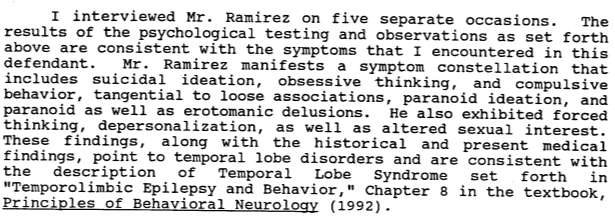
“Mr. Ramirez manifests a symptom constellation that includes suicidal ideation, obsessive thinking, and compulsive behavior, tangential to loose associations, paranoid ideation, and paranoid as well as erotomanic delusions. He also exhibited forced thinking, depersonalization, as well as altered sexual interest.
These findings, along with the historical and present medical findings, point to temporal lobe disorders and are consistent with … Temporal Lobe Syndrome set forth in “Temporolimbic Epilepsy and Behavior,” chapter 8 in the textbook Principles of Behavioral Neurology (1992).”– Declaration of Dr. George Woods, document 20-3
Below is an image taken from Woods’ declaration.
Mental Incompetence vs Insanity Defense
Mental competency is not a concept from psychiatry but a legal term. Nor does it mean an individual cannot take care of basic needs or are “insane.” Richard was not, for lack of a better word, “witless.” It’s about understanding, reasoning, and processing.
An “insanity” defense is not the same as “mental incompetency.” Insanity refers to a defendant admitting they committed a crime but claiming they didn’t understand it was wrong at the time. In contrast, mental incompetency refers to whether a person can currently understand the legal process and assist in their defense. It’s entirely possible for someone to be found competent to stand trial but argue insanity at the time of the crime.
Richard did not use an insanity defense in either his Los Angeles or San Francisco cases. He pled not guilty to all charges, and the competency proceedings initiated by his San Francisco attorneys were based solely on his present ability to participate in his defense – not claims of insanity.
Maybe some people just can’t accept the idea that Richard Ramirez was mentally incompetent. Maybe they prefer to see him as a criminal mastermind who manipulated every expert and attorney over decades. But that’s not what the evidence shows.
Richard read a lot and spoke fairly well. Perhaps this makes it difficult for some people to believe he was mentally incompetent from a legal standpoint. While reading and speaking proficiency can be signs of intellectual functioning, they do not necessarily reflect the ability to process and comprehend information.
None of the professionals who evaluated Richard believed he was malingering – that is, faking his symptoms. His test results consistently showed he was not pretending, and his behaviors and thought processes remained strikingly consistent across evaluations, from the first in 1976 to the last in 2004. (Exhibit 72, Declaration of Dr. Anne Evans, Document 16.7, p. 8).
Judge Soper
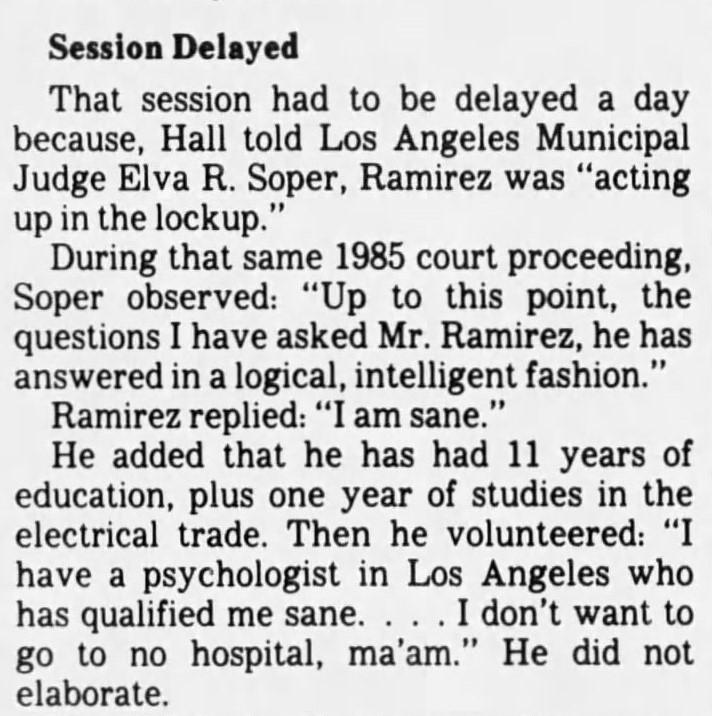
Shortly after his arrest in 1985, Richard appeared in Judge Elva Soper’s courtroom and the exchange that occurred was printed in The Los Angeles Times:
There are multiple issues with Judge Soper’s findings including:
- Someone answering “intelligently” doesn’t mean they understand the charges against them, can rationally participate in their defense, or are mentally competent to stand trial.
- The defendant stating, “I am sane,” and have had 11 years of education and a year of trade school, does not indicate their present level of functioning and comprehension.
- The defendant saying, “I don’t want to go to no hospital,” should have prompted Soper to investigate Richard’s mental status further.
Richard made that statement but did not elaborate, nor did Soper inquire any further about this statement and why he made it. While she may have been a legal expert, it’s fair to say she was not a mental health expert. As the judge, Soper was responsible for being the “gatekeeper, “ensuring that court proceedings were just and fair. She did neither of those things.
Many mentally ill incarcerated individuals have an unusual presentation of psychiatric symptoms, and those with cognitive impairments often manifest a “cloak of competence,” which is an attempt to mask deficits that define serious mental illness. Because of the stigma that has historically been associated with mental illness, it is not uncommon for individuals to attempt to conceal their symptoms.
Richard did not want to be seen as sick or “crazy.” He often publicly exhibited behaviors that covered what multiple individuals encountered “behind the scenes” when interacting with him. Such was the stigma of mental illness that this 25-year-old man did not want to be treated as though he had a mental disorder. He would rather have gone to jail than a mental health facility. Just ask yourself, ” What rational person would prefer incarceration over hospitalization?
So Many Experts
Just how many experts needed to evaluate Richard Ramirez and declare he suffered from mental and cognitive health issues that rendered him unable to rationally participate in his defense and was incompetent to stand trial before the so-called United States criminal justice system would accept these findings? Apparently, a multitude, because that’s what we have. Considering what we have learned from the statements of other experts who evaluated Richard, Dr. Woods’ findings should be no surprise.
The image below shows Dr. Woods’ competency evaluation.
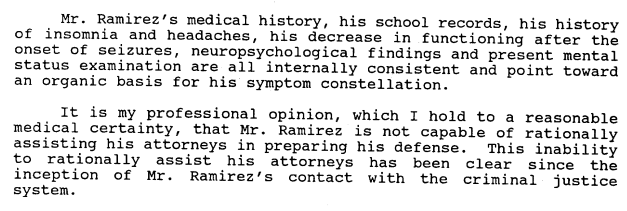
Why did so many professionals proclaim that Richard suffered from significant mental and cognitive impairments that affected his daily functioning and impacted his ability to stand trial? Typically, we only need one or two professionals to evaluate and diagnose a health issue for it to be considered a valid diagnosis. In Richard’s case eleven experts evaluated him over decades, reaching the same or very similar conclusions. And that doesn’t even include the professional opinions of the multiple attorneys who worked with him.
Every person who evaluated Richard was highly competent and qualified in their respective fields. None of them had any reason or motivation to skew their findings or to report inaccuracies. They reported what they observed and found based on facts and evidence stretching back to Richard’s childhood.
Declaration of Dr. George Woods, document 20-3
Ninth Circuit Court of Appeals
The United States Ninth Circuit Court of Appeals is the largest of the 13 federal appeals courts in the United States and has more power than a state or district court. The only United States court with more authority than a circuit court is the United States Supreme Court. The Ninth Circuit Court has a history of overturning decisions of lower courts, such as the California State Supreme Court and the California Central District Court, for reasons such as due process violations and incompetence of attorneys.
The goal was to get Richard’s 2008 Federal Petition for Writ of Habeas Corpus to the United States Ninth Circuit Court of Appeals. Richard’s case was filled with multiple due process violations, including representation by attorneys who had no qualifications or experience to defend a single capital murder charge, much less multiple capital murder charges.
We can only wonder what decision the Ninth Circuit Court would have handed down considering the blatant and numerous violations in Richard’s case. Would they have had the “balls” to go against popular opinion, the biased media, law enforcement, and the likes of the lead detectives on the “Night Stalker” case? Unfortunately, we will never know because Richard became very physically ill during the long, complicated process of getting his petition to its destination and passed away on June 7, 2013. Again, we are left with more questions than answers.
I’ll leave you with Richard’s final words at his Los Angeles sentencing. I think he summed things up pretty well.
“It is nothing you would understand, but I do have something
to say. In fact, I have a lot to say, but now is not time or the place. I don’t even know why I’m wasting my breath, but what the hell. As for what is said of my life, there have been lies in the past and there will be lies in the future. I don’t believe in the hypocritical moralistic dogma of this so-called civilized society and need not look beyond this room to see all of the liars, the haters, the killers, the crooks, the paranoid cowards, truly the trematodes of the earth, each one in his own legal profession.
You maggots make me sick. Hypocrites one and all. We are
all expendable for a cause, and no one knows that better than those who kill for policy, clandestinely or openly, as do the governments of the world which kill in the name of God and country and for whatever else they deem appropriate. I don’t need to hear all of society’s rationalizations. I’ve heard them all before and the fact remains that is what it is.
You don’t understand me. You are not expected to. You are
not capable of it. I am beyond your experience. I am beyond good and evil. Legions of the night, night breed, repeat not the errors of night prowler and show no mercy. I will be avenged. Lucifer dwells within us all.”
Statement of Richard Ramirez (included in the 2008 Federal Petition for Writ of Habeas Corpus, Document 14)
KayCee


 Expendable For A Cause.
Leave a reply to Trilly Cancel reply