
Note: Richard’s early years have been covered here, detailing his various head injuries, physical and mental problems, and his time in the custody of the Texas Youth Council, so I need not repeat that. Likewise, the influence of his infamous cousin, Miguel, and the associated trauma and violence. Please see the posts indicated for more information on those matters.
*Some images may appear small, a desktop is advised*
“No one from Richard’s trial defense team asked me to testify at Richard’s Los Angeles trial. Had I been asked, I would have willingly provided the information contained in this declaration to anyone from his legal team prior to the trial. Had I been asked, I would have testified to the information in this declaration at Richard’s murder trial in Los Angeles.”
Statement of Mercedes Ramirez, document 20-5
Following on from Part One, the information within this post can be found in documents 7-19, the declaration of Marylin Cornell, from her interviews with the Ramirez family, and from the family statements, documents 20-5 and 7-30, and also 20-8. All are exhibits to the 2008 Writ of Habeas Corpus.
Culture Clash
According to Cornell, life did not get any easier for the Ramirez family; for Julian Snr., Mercedes, and their growing brood of children, with their psychological, neurological and physical needs, it meant that trouble was never far from the door.
Cornell states that the Ramirezes had difficulty settling into their new environment, partly adhering to their Mexican roots and ways, whilst working and trying to accommodate a change in culture and language, and although Mercedes was born in Colorado, she spoke no English, her parents having relocated back to Mexico when she was a child.
Like many immigrant families, the Ramirezes had a deep mistrust of authority, which was deeply entrenched after an incident in the early 1950s when the border patrol mistakenly believed they were illegal immigrants and physically drove them back across the border, dumping them, their bags, and their small children by the side of the road in Juarez. Mercedes, so cowed by these government agencies, could not articulate that she was a citizen of the United States and that they had every right to be there.
It was two years before Julian Snr. could sort out his paperwork, enabling them to return.
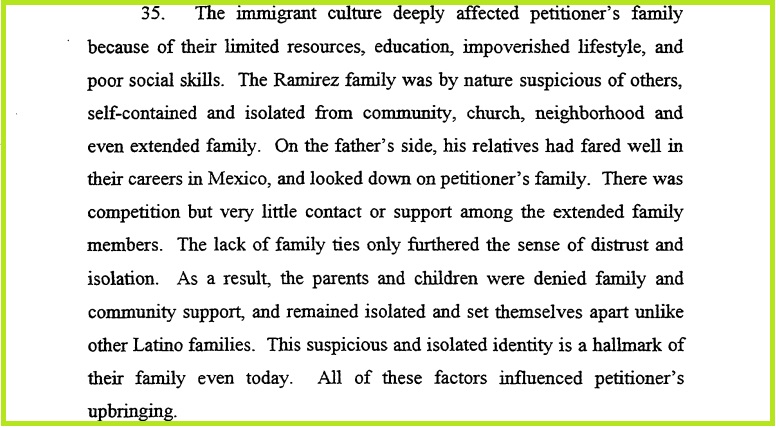
It seems that from her interactions with Richard’s family, Cornell believed they were somewhat isolated and kept themselves to themselves within a social context; she says that Julian Snr.’s family back in Mexico, who were faring well for themselves, looked down on their extended family in El Paso, and offered little or no support. At the time of the Ramirez family interviews, she believed that the family still carried that hallmark, which is unsurprising considering they bore the notoriety of the connection to Richard daily. Why would they trust anyone?
“In my contact with the family, I viewed the only photo album that exists from petitioner’s childhood. It documents only two family celebrations. The Ramirez family was not involved in social activities, after school activities, sports, or even church events. “We keep everything in the family,” according to Ignacio.”
Report of Marylin Cornell, document 7-19.
Mercedes had taken on more and more with each pregnancy and had to work long hours to help provide. She struggled to assimilate into her new culture and surroundings, often finding comfort and familiarity in what she knew: her family’s traditions and cultural background. Distrustful even of medical practices, Richard and his brother Ignacio were taken to see a traditional healer/shaman in Juarez to receive injections, although they were not sure what they contained.
“Petitioner’s family believed in superstitions and folk medicine. The family felt they could only go to Mexico for medical help. They relied on unproven medical cures in Juarez, Mexico, and received injections without knowing what they were. As a child, Petitioner, his father, and Ignacio travelled to Camargo for healing rituals with a curandero.”
Report of Marylin Cornell, document 7-19
Mercedes and Julian Snr. embodied the strict Latino culture that they had been raised in, which sat awkwardly on the rebellious sons, who spent their teenage years in and out of trouble.
Often away working, Julian Snr. came home to hear a litany of misdeeds attributed to his children.
Dynamics and Dysfunction
“After Miguel killed his wife, Josefina, Julian Snr. applied to the courts to adopt Miguel’s young children; he was turned down; the judge refused, stating that the Ramirez family had enough trouble raising their own sons”.
Report of Marylin Cornell, document 7-19.
That Julian Snr. was a strict disciplinarian, no one is denying. However, there is one thing I will address right now: the often-told story of him tying Richard to a cross in a cemetery as punishment. That never happened; it’s one more exaggeration in the story, which a Ramirez family member has confirmed. By choice, Richard took himself off to a cemetery (probably the the Evergreen as that was where he used to hang out with friends) to avoid his father and any discord at home.
And discord there was.
“Petitioner was also subjected to the abusive and neglectful treatment of his older brothers. Petitioner’s brother Julian Jr. abused Petitioner when he was a young child, and Petitioner’s sister Rosa tried to protect him from the brothers’ abuse. Petitioner’s sister sought to care for him and protect from his older brothers. After Rosa left home, she allowed Petitioner to stay at her home. Rosa knew that Petitioner was having difficulties at home as well as at school”.
(Ex. 32, M. Cornell Dec., ¶ 59; Ex. 67, J. Ramirez, Jr. Dec., ¶ 7; Ex. 70, Rosario Ramirez Dec., ¶ 2.) Writ of Habeas Corpus, page 496
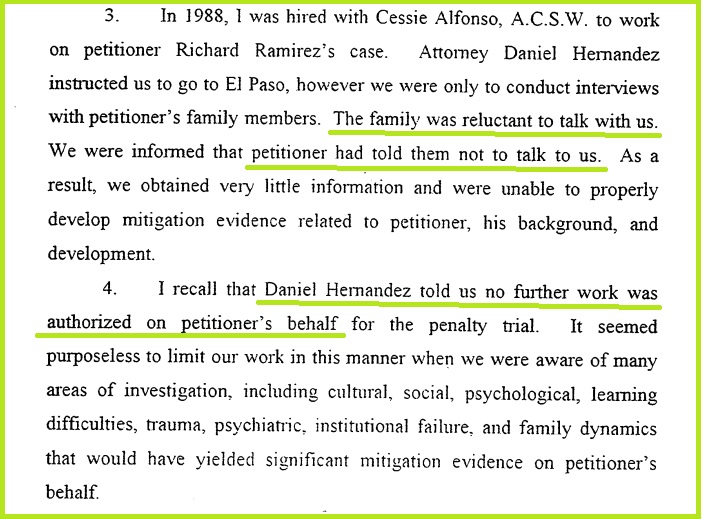
In 2004 and 2008, immediate members of the Ramirez family gave a series of statements to Richard’s post-conviction lawyers. The information within should have been collated for Richard’s trial in 1989 to be used in mitigation during the penalty phase. Still, as we’ve shown, Ramirez was given no mitigation in defence. This was partly his doing because he refused to let his family be investigated or involved at any stage of the proceedings. He became distraught when his father was called to testify in court. His lawyers, rather than overrule him and do it anyway (they were supposed to be saving his life at this stage), had made a half-hearted attempt in 1988 by sending two social workers to El Paso to talk to Richard’s family about his upbringing, culture and family dynamics, plus any psychological and learning difficulties experienced by him.
Unsurprisingly, Ramirez, prone to self-sabotage, primarily where his family was concerned, allegedly called ahead and forbade his family to talk to them.
Here is the statement of Katherine Bauer, one of the social workers sent by Daniel and Arturo Hernandez. You can sense her frustration.
Here, then, are the statements and recollections the Ramirez family, which can be read in full in documents 20-5 and 7-30, exhibits to the Writ of Habeas Corpus
Crime and Punishment
“Julian Sr. always tried to keep the family unit self-contained. On
Report of Marylin Cornell, document 7-19, page 24.
petitioner’s arrest, Julian Sr. got his gun and wanted to kill himself because of the shame to the family“.
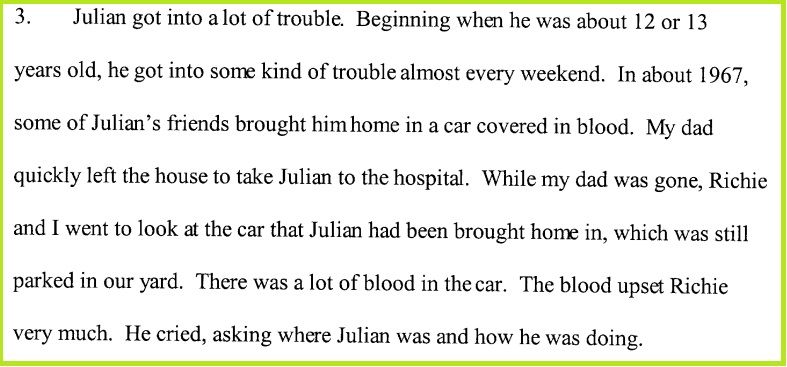
Julian Jnr.
“By the age of 16, I began to use drugs on a regular basis. I have been involved in drug usage for many years. As a result of my addiction, two of my children were removed from my care and placed in foster homes. Despite the loss of my children, I was unable to stop using drugs for a lengthy period of time. I have had numerous arrests since 1968, mostly for drug charges, theft-related offenses, and domestic violence. I have spent time in jail in California over the past 30 years. As a result of my lifestyle, I have been unable to find work except for menial labor. I did not have a place to live or a family to support me”.
Statement of Julian Ramirez, document 7-30
Julian goes on to say how he and Robert would beat and kick Richard as a child, the parents not being around to control or intervene. In her report, Cornell explains how Rosa would try to protect Richard from his older brothers.
Both Julian Jnr. and Robert were regular substance abusers; with these role models during his formative years, it is no surprise that Richard followed suit. Whether for self-medication or recreation, he was, by his early teens, using drugs daily.
Robert

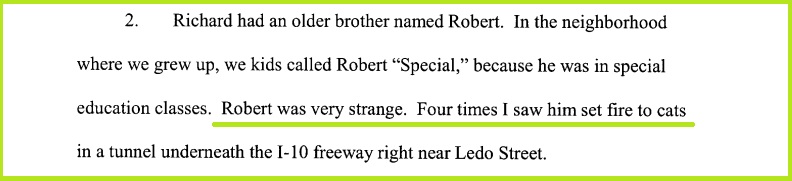
Note: Of the siblings, Robert goes into the most detail concerning violence in the home. However, Robert is also the one who tells a story about the supposed killing of a police dog by his brother Richard. Another member of the family has unequivocally denied this; other factors raising doubt on this accusation is that killing a police dog is a criminal offence and, as such, would appear in Richard’s records. We have found no such record. What we did find was a statement mentioning Robert’s penchant for setting fire to cats.
In his statement, dated 19th November 2008, Robert recalls his father, Julian Snr., working away and only returning home for a couple of nights every two or three weeks. On his return, Mercedes would recite the misdemeanours of her sons, who, except for Ignacio, would be punished.
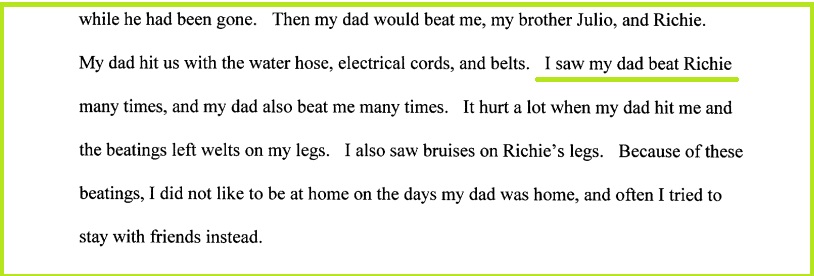
Robert remembered his father having a very short fuse and would take out his temper on himself; he notes an occasion when Julian Snr. had difficulty repairing a sink in the home and hit himself with a hammer, another where he failed to fix a car tyre and kicked the car off its jack, and also that he brandished a gun at his sons, and threatened to blow the head off of one of Robert’s friends.
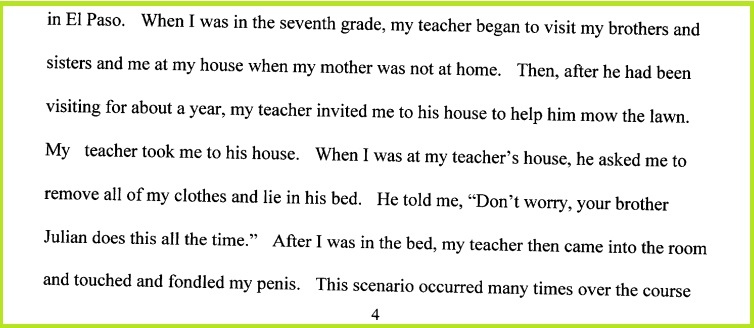
In a disturbing admission, Robert said that he and his brother Julian were sexually abused by a teacher in their school. In what sounds like a year-long grooming session, the man would come to the house when their parents were still at work; after that, he began taking Robert to his house, where the abuse took place.
Robert was to spend two years in Huntsville prison for drug offences and three years for stealing suitcases when he was employed by the railroad company. He was also involved in two shootings for which he spent another six months inside.

Ignacio
“We were home after school alone until 5 o’clock, and we did whatever we felt like doing. We had water fights in the house, even going as far as spraying each other with the garden hose indoors. One time we even flooded the living room. We also climbed up onto the roof to throw eggs, and whatever else we could find, at each other. Our parents never seemed to realize what was going on. We kids always did our best to hide our activities from our parents. When it got close to 5 o’clock, it was time to start cleaning up”.
Statement of Ignacio Ramirez, document 20-5
The medical trauma suffered by Ignacio has been explained in Part One; however, in his statement, Ignacio remembers how, because of it, he was the one who received most of the love and attention from his parents. “I believe that my brothers and sister sometimes acted out just to get attention from our parents”, he says.
His elder brothers, Julian Jnr. and Robert were frequently in trouble with the authorities; he states they were both arrested for drug offences and stole cars.
His father tried to discipline them in the only way he knew, but unsurprisingly, it had no effect. Julian Snr. was once forced to sell a piece of land he had saved up for to pay for legal representation for his two sons. This offsets Robert’s statement, for here we can see a man at the end of his tether, now manoeuvred into a position where he must sell his hard-earned land to foot the bill for the lawyers his sons needed because they could not stay out of trouble.
Ignacio, too, remembers the sexual abuse of his brothers:
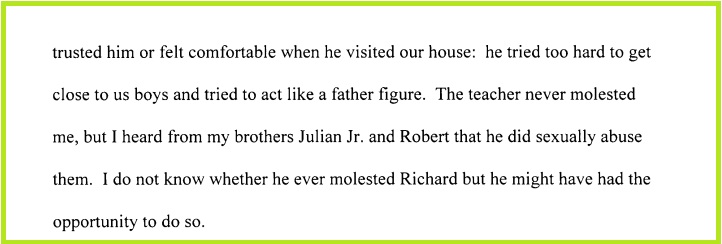
Richard never admitted that this teacher abused him, but then again, he never admitted anything. It is plausible that he may have been molested as well, although that cannot be substantiated.
Ignacio recalled his cousin, Miguel, and spoke of the atrocities he committed whilst in Vietnam:
“Miguel even claimed that he had in his possession photographs of dead bodies and of women who had been raped and murdered. He claimed he brought these photographs with him when he returned from Vietnam. I never saw the photographs myself; I never wanted to see them. I heard him describe these photographs frequently. Miguel constantly talked about the horrible things he had seen and done in war. On more than one occasion, I had heard Miguel say that he kept his gun in the fridge because he like the feel of cold steel when he killed someone”.
Statement of Ignacio Ramirez, document 20-5.
Ignacio tried to talk to his younger brother about the murder of Miguel’s wife, Josefina, but Richard clammed up and refused to talk about it. Richard was, by this time, keeping a lot of things inside.
Of the arguments between Richard and his father, he says:
“On more than one occasion, I witnessed loud arguments between Richard and our father: he accused Richard of stealing his tools and selling them for drugs, and he yelled that he needed the tools for work. The arguments never seemed to have any effect on Richard. I witnessed these arguments over and over, Richard never denied it and didn’t seem to care about what our father had to say”.
Statement of Ignacio Ramirez, document 20-5.
After moving to Los Angeles, Richard told Ignacio that their brother, Julian Jnr., was teaching him how to steal cars and get properly high.
“He [Julian] asked me why I never taught Richie how to really get high, and he then said that he had had to teach him himself. He also told me that Richard had developed a $500 a day cocaine habit and that Richard was shooting up coke on a regular basis”.
Statement of Ignacio Ramirez, document 20-5.
Despite all this, Richard’s parents, sick with worry, begged their youngest child to return to El Paso and give up the drugs, to no avail; Richard had no intention of returning.
The last time Ignacio saw Richard before his arrest he was a mess: skinny and unclean.
Rosa
“After Richie was arrested, I went to visit him in jail in California. As soon as I saw Richie he began to sob uncontrollably. I told Richie, “No ensenes el cobre”, which is something my Dad used to say. It means, literally, “Don’t show the copper”, as in, “Don’t show your true self or feelings”. Now, when I look back on that visit, I wish I had let Richie cry”.
Statement of Rosario Ramirez, document 20-5. Richard apparently took that to heart, and from it, perhaps, came his court room persona.
Rosa and Richard were close, with his mother out working long hours; Rosa cared for him. It was to her that he turned for comfort and protection when Julian and Robert were picking on him. Julian and Robert, ten and seven years older than Richard (respectively), took delight in hitting their little brother, calling him “mamma’s boy” and “chiple”, which means spoilt brat in Spanish. As he grew up, Richard also protected Rosa from the same treatment.
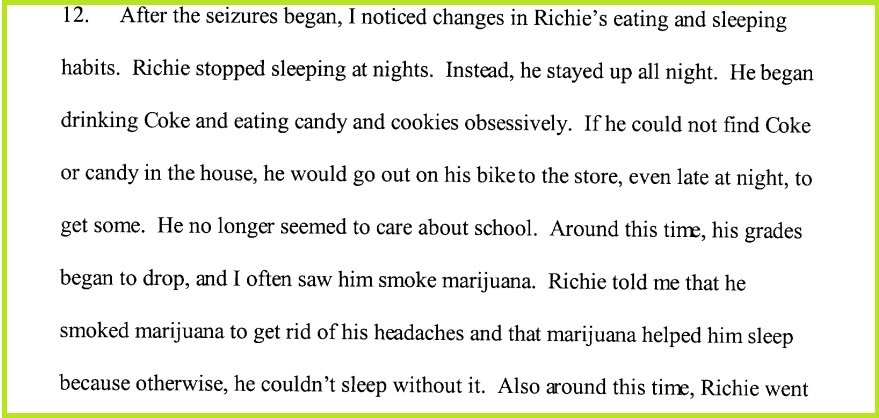
Rosa noticed the changes that came upon her brother after he began having seizures at around 12 to 13 years of age when he started to self-medicate with marijuana. (His early medical difficulties have already been covered in earlier posts, so please refer HERE for more information).
Regarding the discipline meted out by her father, Rosa says that to outsiders, it may have looked like abuse and that Julian Snr. had received the same treatment from his own father. That was the only way he knew. The punishments were frequent, and “at times, the beatings got out of hand” despite that, it had no effect on the Ramirez boys.
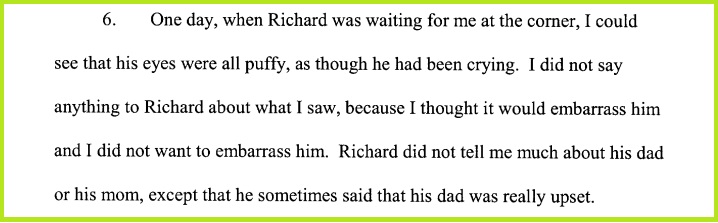
In what must have been a painful subject to discuss, Rosa talks of her first husband, Robert Sahs, whom she divorced for his unsavoury activity of going out into the neighbourhood at night, spying on women through their windows. Richard was often taken with his brother-in-law on these outings as a young teenager.
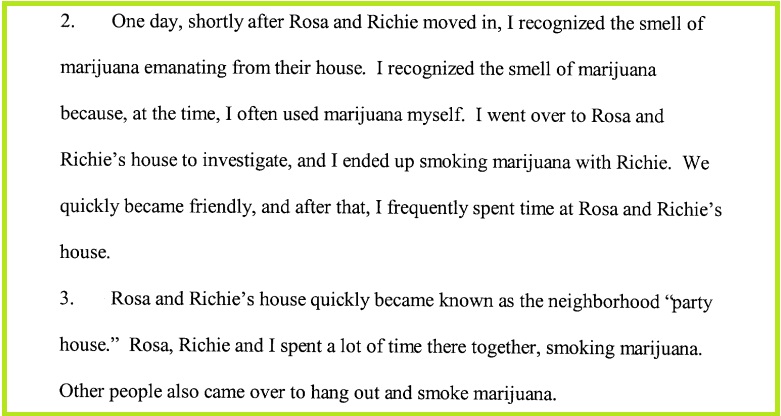
After the divorce, Rosa and Richard (who preferred living with her to his parents) moved into a house together on Corozal Drive in El Paso, where they smoked marijuana every day.
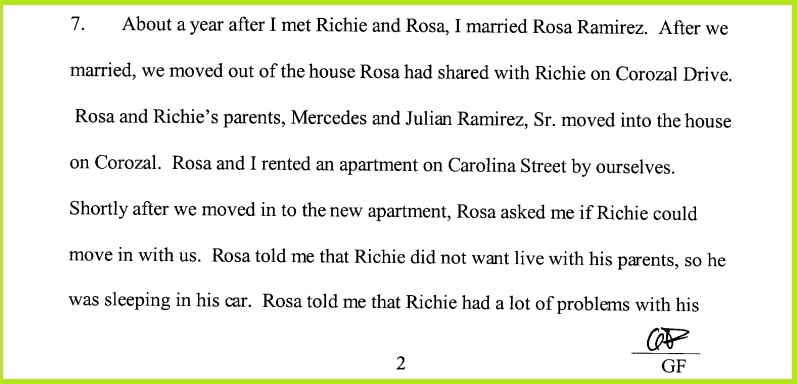
It was here that Rosa was to meet her second husband, Gilbert Flores, who lived next door; after marriage, Rosa and Gilbert moved out into their own apartment, and Mercedes, Julian Snr and Rosa’s daughter from her first marriage, Jennifer, moved into the house on Corozal. Richard stayed with Rosa and Gilbert frequently, eventually moving in with them. According to Gilbert’s statement, Richard wasn’t getting on with his parents and was sleeping in his car.

At nineteen, Richard left El Paso for good, spending his time rootless and unanchored between friends in San Francisco and Los Angeles.
After hearing reports about how badly he was doing, Rosa attempted three times to bring him back home to El Paso from California; she says how different he seemed during her visits. The last time she saw him before his arrest, he looked so bad she struggled to recognise him.
Finding lawyers for Richard’s defence fell to Rosa; she eventually hired Daniel and Arturo Hernandez. She did so on the advice of the family lawyer, Manuel Barraza, who must have known, as Rosa did not, that these two attorneys were unequal to the job.
The consequences caused a conflict of interest, ensuring Ramirez would never receive a fair trial. These events have been covered fully HERE, HERE and HERE.
To Conclude
Marylin Cornell found critical events and environmental factors permanently and adversely shaped the life of Richard Ramirez, as well as his emotional, cognitive, psychological, neurological and neuropsychological development and functioning.
“His development as an infant, child, and adolescent was severely and adversely affected by poverty, neglect, physical and emotional deprivation and abuse, exposure to violence; family dysfunction and instability; lack of parental supervision, guidance and protection, trauma, and a host of cognitive, emotional, environmental, psychological, neuropsychological, and psychiatric impairments”. (Declarations of Drs. Robert Schneider, Dietrich Blumer, Dale Watson, and Jane Wells, exhibits to the petition.)
Report of Marylin Cornell, document 7-19.
No one stepped in, and no one gave him the psychiatric help he needed. He fell through the cracks of society; the cumulative effects of exposure to violence, trauma, and physical and emotional abuse followed him all through his life.
“Petitioner was exposed to multiple traumas and suffered a significant history of physical and psychological trauma, beginning as a young child. He received no treatment or help of any kind for the lengthy pattern of traumatic experiences he had endured. Institutions responsible for Petitioner’s care . . . ignored his disturbed background and consistently failed to provide necessary treatment.”
Report of Marylin Cornell, document 7-19.
There are significant lessons to be learned from this.
~ Jay ~


 Expendable For A Cause.
Leave a comment