California Dreamin’

A Den of Thieves

We usually do not write about the charges against Richard Ramirez in San Francisco (SF) because the SF legal documents are unavailable. Most of what we know about the San Francisco charges against Richard comes from news articles available at the time, as well as small pieces of information contained within the 2008 Federal Petition for Writ of Habeas Corpus. Because we seek to be authentic and write about things that can be verified with reliable sources, and most of what is written about Richard outside of legal documents is based on speculation, outright lies, or the result of a “he said-she said” scenario, we are limited in writing about the San Francisco case. However, as there are many questions surrounding the SF case against Richard, we want to discuss the limited information that is available and where it came from.

The purpose of this post is to provide the reader with some of the information presented by the media regarding the San Fransico case against Richard. While the news articles give us some helpful information, we must take the newspaper writings with a “grain of salt” as law enforcement and the media were highly biased towards Richard and continue to be so to this day. This post is an introduction to the people Richard spent time with in San Franciso. The SF crimes will be discussed in a future post.

Richard Ramirez had several relationships that had a significant influence on his life. Exploring some of these relationships is essential to understanding the events leading up to his arrest in August 1985.


Richard grew up in El Paso, Texas, and per his mother’s statement to federal public defenders in 2008, he moved to California in 1979. He spent time in Los Angeles and San Francisco, vacillating between the two cities from 1979 to 1985. Richard’s key relationships in California were with Reyes Garcia, also known as “Arabe” or “Ray,” Antonio Reyes, Armando Rodriguez, Donna Myers, and Earl Gregg. Reyes Garcia (Arabe), Armando Rodriguez, and Antonio Reyes were all childhood friends of Richard’s from El Paso who moved to California in 1979-the early 1980s.

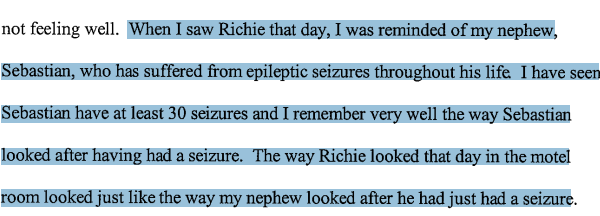
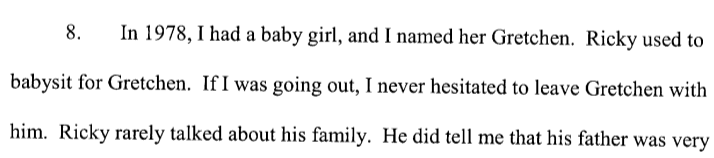
Cynthia Melendez, Reyes Garcia’s one-time girlfriend, was also a childhood friend of Richard’s. She gave a sworn statement to federal public defenders in 2008 describing her interactions with Richard and Reyes (Arabe) in 1979 and early 1980s. In 1978, Cynthia and Arabe had a daughter they named Gretchen. Cynthia stated they moved into a house together in early 1979 in “La Roca,” in El Paso. They both smoked and sold marijuana, not only in Texas but in other states such as California and Oklahoma. They also had LSD parties. Richard smoked marijuana and took LSD with them. Arabe and Cynthia had a separate building on their property that they cleaned up for Richard to move into in March 1979. Cynthia stated she never hesitated to leave her daughter with Richard, and sometimes he babysat for her.
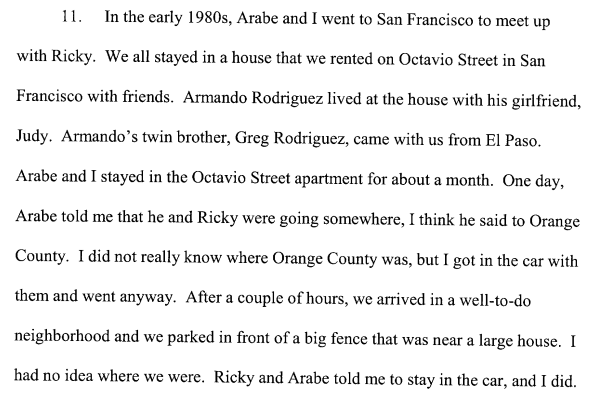
In June or July of 1979, Cynthia and Arabe moved in with her mother, and around this time, Richard moved to California. In the early 1980’s, she and Arabe went to San Franciso to meet up with Richard. Cynthia, Arabe, Richard, and another friend from El Paso, Armando Rodriguez, rented a house together in San Francisco for a brief time. Cynthia described an occasion when she, Arabe, and Richard drove from San Francisco to a nice neighborhood in Orange County, California. Richard and Arabe got out of the car and told her to wait in the vehicle. A while later, Richard and Arabe returned to the car and drove back to San Francisco. Shortly after returning to San Francisco, Cynthia saw Richard and Arabe with jewelry and guns stolen from the home in Orange County.
*from 2008 Federal Petition for Writ of Habeas Corpus supporting document 20-8

Shortly after Richard’s arrest, Arabe spoke to reporters from the San Francisco Examiner on September 1, 1985. His remarks were contradictory to the sworn statement given by Cynthia Melendez to Richard’s attorneys in 2008. Arabe told reporters that he only saw Richard at game arcades and 7-Eleven convenience stores while living in El Paso. He failed to mention he and Richard were schoolmates, had burglarized and partied together, and that Richard had lived on his property for several months in 1979. Perhaps Arabe suffered from selective amnesia and conveniently forgot to mention his long-time connection to Richard.

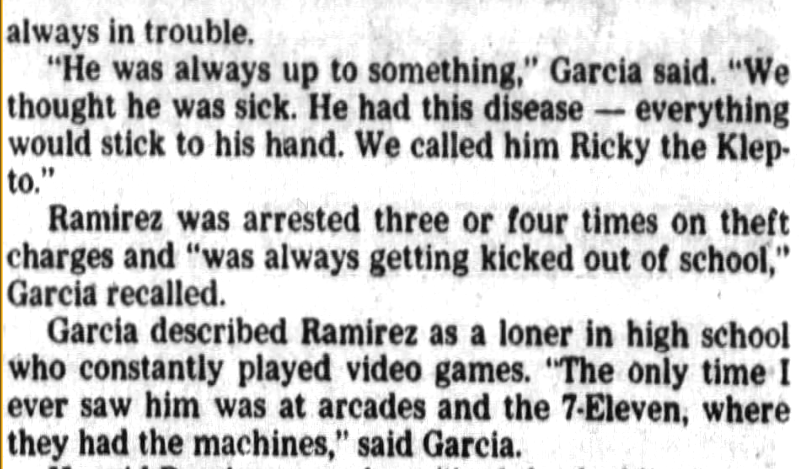
San Francisco Examiner, September 1, 1985, p.20

*from 2008 Federal Petition for Writ of Habeas Corpus supporting document 20-8

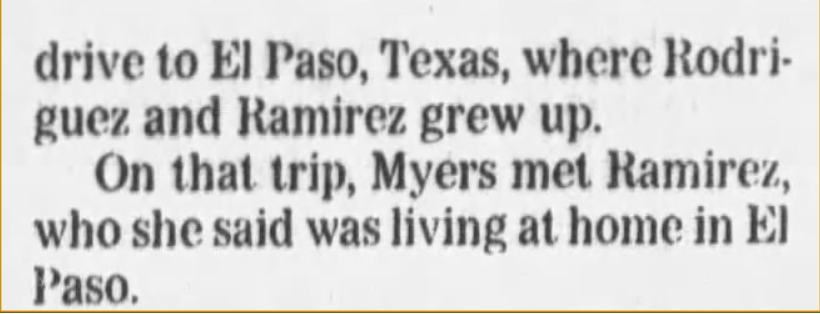
Donna Myers was an acquaintance of Richard’s who lived in San Pablo, California. Per the San Francisco Examiner, on September 4, 1985, Donna said she met Richard through Armando Rodriguez. In 1979, she and Armando made a trip to Armando’s hometown of El Paso, and it was at that time she met then-19-year-old Richard. Between 1979 and 1981, he stayed at her home in Richmond, California, a few times. She later moved to San Pablo, where Armando and Richard visited her frequently. Donna said Richard, whom she knew as Rick, was never violent, and she never saw him with any weapons. She described him as being “very nice and very polite.”
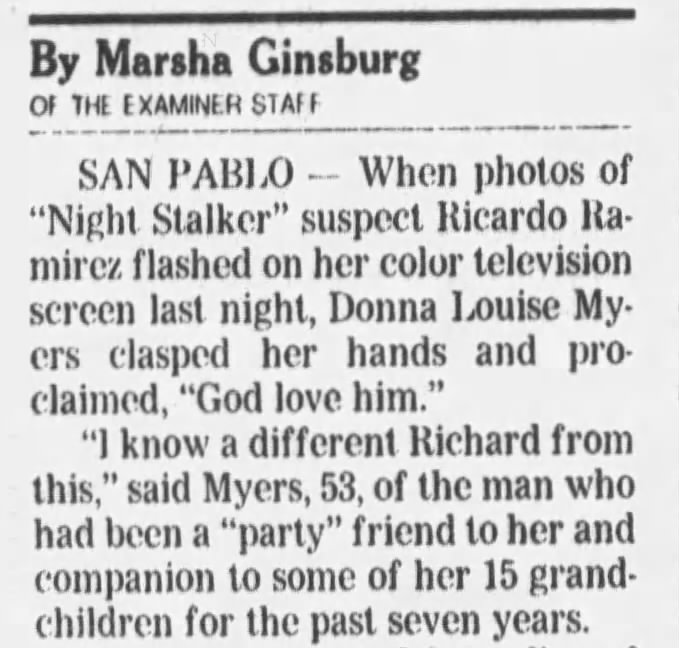
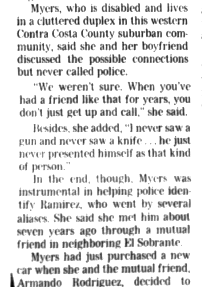
*San Francisco Examiner, September 4, 1985, p.10

Earl Gregg, another San Francisco acquaintance of Richard’s, was Donna Myers’s son-in-law. He was married to Donna’s daughter, Deleen. Earl reportedly also met Rick (Richard) through Armando Rodriguez. In the Lompoc Record from September 5, 1985, Earl claimed he lived with Richard in Richmond, California, in 1981 for four months. The suspicion about Richard being the Night Stalker was triggered by Gregg’s sister, Laurie Ochoa, who convinced Earl that their friend looked like the Khovananth police composite. Gregg did not initially agree. Although the teeth sounded similar, the composite did not resemble Richard – the chin was too long, the hair too curly, and the eyes large and bulging. Even though he believed the police composite of the Night Stalker suspect did not look like Rick, Earl stated, “There were just too many coincidences.” Seeds of doubt had been planted.
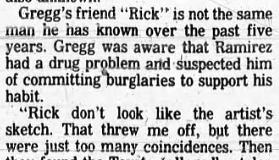
*Lompoc Record, September 5, 1985, p.1

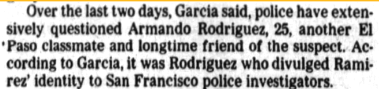
Armando Rodriguez and Richard Ramirez grew up together in El Paso. They were childhood friends and lived together briefly in California, hanging out and partying with a mutual friend, Donna Myers. Armando is the one who gave police Richard’s legal name, allowing police to put a name and face to the Night Stalker. It seems Armando did not readily sell his long-time friend down the river but only did so after succumbing to police brutality at the hands of San Francisco Police Detective (SFPD) Frank Falzon, an incident in which the retired investigator brags about in the Netflix documentary, Night Stalker: The Hunt for a Serial killer. “Not my best punch, but definitely not my worst,” he recalled.
San Francisco Examiner, September 1, 1985, p.20

Why do these relationships matter and why should we care?

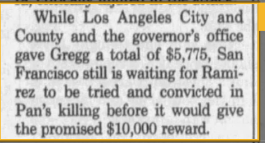
All of the individuals discussed above interacted with Richard regularly. They knew about his lifestyle and were either involved in the same activities as Richard, specifically burglarizing and drug use or were a willing recipient of stolen goods. Three individuals mentioned, Armando, Donna, and Earl were instrumental in Richard being identified and arrested as the Night Stalker. But why did they turn on Richard? What motive did they have for doing so?  By the time Richard was arrested, the monetary reward for the capture of the Night Stalker was over $70,000. Perhaps they were merely trying to cover their ass or collect the reward money.

Et tu Brute?

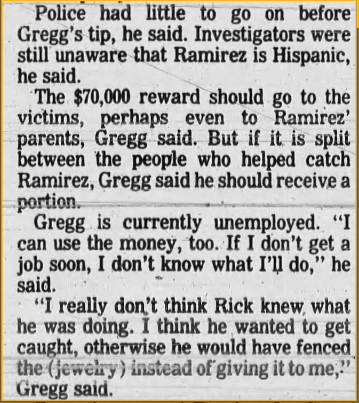
On August 26, 1985, Earl Gregg, at the insistence of his sister, Laurie, called the San Francisco Police Department (SFPD) and told them he thought his acquaintance, Rick, might be the so-called Night Stalker. The call was made on August 26, four days after San Francisco police announced the Night Stalker had arrived in their city. Even though the Greggs admitted the idea that their friend could be the Night Stalker was preposterous, they reported him anyway. After all, a large reward was being offered by both Los Angeles and San Francisco, and the Greggs were struggling financially. Earl did not have a last name for Rick, so he led the police to his mother-in-law, Donna Myers, who also knew Rick. Although Richard had visited Donna’s home numerous times, she only knew him as “Rick Mena.” However, she knew someone who did know “Rick’s” last name: Armando Rodriguez.
Lompoc Record, Sept. 5, 1985, p.5

Shortly after Donna disclosed this information to police, the nearly two days of “questioning” of Armando Rodriguez by SFPD and Detective Falzon began. After Rodriguez was taken in for questioning and told he would be charged with accessory to murder unless he gave up information, he admitted to seeing Ramirez on August 16 and receiving stolen goods. Deleen’s mother, Donna, with whom Richard was staying, alleged that she had received stolen jewelry from Richard on August 16, as well. She had given two of the stolen items to her daughter, Deleen. Earl Gregg also claimed he received stolen property from Richard approximately two weeks before Richard’s arrest.

The San Francisco Examiner, Feb 20, 1995, P. 5

Are we to believe that of those that Richard hung out with, he was the only one with a drug problem or who committed burglaries? I have a hard time believing these acquaintances did not commit burglaries and engage in drug use, just as Richard did. We know, per Cynthia’s Melendez’ sworn statement, that Arabe, in fact, did commit burglary and use drugs with Richard. If these SF associates weren’t involved in similar activities, why did they willingly accept stolen goods and pass them on to family members? Why did they willingly have Richard in their home?
There are at least three potential reasons why Richard’s so-called friends may have turned on him: Immunity from prosecution for possessing stolen property, accessory to murder, and reward money.

KayCee & VenningB

59 responses to “California Dreamin’”

  1. Excellent work, KayCee. Richard was undoubtedly unlucky in his choice of companions. I wonder how long it took Armando to crack after he was beaten and threatened with being an accomplice.

    Liked by 5 people

    1. I wish there was a recording of his interrogation with Falzon and that we could find it!

      Liked by 4 people

  2. I don’t know if this is an unpopular opinion, but I do feel bad for Armando. The methods used by the SFPD were illegal, and “evidence” or statements obtained in illegal ways can’t and shouldn’t be used in court. Suddenly, this didn’t seem to be a problem.

    Armando was beaten up, I don’t believe Falzon stuck to that half-assed punch and one-sentence threat. Armando gave him Richard’s last name, but he also began with, “Fuck you, I’m not helping you. He’s not the Night Stalker.” And that should have been taken into serious consideration too.

    There’s a difference between partaking in burglary and supporting a man who breaks into people’s homes to beat and kill them and whatnot. Even if Richard’s friends weren’t the best one could get out there, I doubt they’d be as stupid as to let a serial killer babysit their kids and let him roam around for months.

    Liked by 5 people

    1. Armando also attempted to give Richard an alibi, but Falzon wasn’t listening; it appears he was told he’d be charged as an accomplice, and so you’re probably on the right track. In his book he says Armando gave him credit for “turning his life around”, so it seems Frank Falzon isn’t above patting himself on the back, either.
      There was a lot of rivalry between SFPD and LASD over this case, both claiming the “glory”, SFPD referring to Salerno and Carrillo as “empty suits”.

      Liked by 3 people

    2. Yeah he was put in a position where he was going to be charged with accessory to murder…punched in the face. This was a childhood friend. I was even surprised that Falzon admitted Armando said Richard was in S.F. when the crimes occurred in L.A. and vice versa. In the Netflix documentary, it made it seem like Armando was a regular snitch but it wasn’t as simple. I wonder what Armando thought of Richard’s personality and whether his description matched those of his other friends. ‘Nice but a thief.’ I wonder if Richard’s friends were convinced to believe he really was the killer.

      Liked by 3 people

    3. I do have some sympathy for Armando. I don’t think he willingly told Falzon Richard was the nightstalker. Falzon makes it pretty clear in the book he wrote that Armando was threatened and beaten during the questioning. Police misconduct is a signficant contributing factor in false and coerced confessions. It appears that a lot of law enforcement misconduct happened in the so called nightstalker case.

      Liked by 3 people

  3. I’m wondering about Armando’s brother, Greg. Apparently the name “Greg Rodriguez” was written on the tag which was attached to the bag recovered from Greyhound…

    Liked by 2 people

    1. I wonder about that, too, and mentioned it in the post about the ballistics reports. It’s never been established why Richard had Greg’s bag, did they share the locker if ever Greg Rodriguez was in LA? Was he borrowing the bag? Or did he just take it?

      Liked by 2 people

    2. This is definitely something that needed more investigation. As far as I know, Greg Rodriguez lived and worked in San Francisco, so I don’t know why Richard had his bag or whether the brothers came down to Los Angeles to spend time with him. For all we know, they could have something to do with the crimes.

      Liked by 2 people

  4. have anyone you guys seen those YouTube videos where AI sounds like to Richard and he’s reading out his penpal letters but he also states that he has no friends so he was obviously betrayed! I hate that he trusted those idiots!!!

    Like

  5. Earl Gregg admitted committing robberies with Richard in a documentary. Someone posted an excerpt from that documentary on tumblr. Not surprising, but definitely new.

    Liked by 1 person

    1. Yes! I’ve mentioned it in the book. It seems like Richard was led by others a lot. Was that the same documentary where Richard was laying about in the street with his brother? And Donna Myers had breathing tubes in? These documentaries are so low quality.

      Liked by 1 person

      1. Breathing tubes? Didn’t she die in 1989? Yes, just looked it up, August 11th, 1989. If that info is correct. They all already passed away. Laurie Ochoa in 2009, Earl Gregg in 2019 and Deleen in 2021. None of them was older than 60. Did the breathing tubs come from Laurie Ochoa, who said in the 90s that she had only 1 year to live bc of her emphysema? I believe Deleen had breathing problems too. So, maybe Donna too?

        Liked by 2 people

  6. Murder made me famous, if i remember correctly. It was so bad that i was fast forwarding it all the time.

    Liked by 1 person

    1. They’re always unintentionally hilarious.

      Liked by 1 person

  7. I don’t believe Richard was inherently a bad person, but I do acknowledge that he was definitely involved in some sketchy behavior. There’s no way those people genuinely thought the jewelry and items Richard gave them weren’t stolen. He was drifting from place to place, likely living on the streets, and probably looked disheveled all the time. Anyone with even a couple of brain cells would question the origin of those items and would be wary of getting involved with possession of stolen property. While I don’t agree with many of the things his parents said and did, I do believe they were right about one thing: Richard surrounded himself with really questionable company, which I think played a significant role in his downfall. Many of those people would have sold him out for a mere crumb.I do feel bad for Armando as he probably suffered more abuse at the the hands of law enforcement than a simple “half-assed punch”. But all the others are just trash and sell-outs.

    Liked by 1 person

    1. I don’t believe he was a bad person. He was misguided with no positive role models in his life, which led to emulating the behaviors of his older brothers, who were delinquents, that encouraged and taught their baby brother how to steal and how to “really get high.” He definitely surrounded himself with shady characters. I think Richard was a bit naive when it came to the company he kept. He was surrounded by many thieves that were better at the job than he was and of course they all knew he was dealing in stolen goods because they were as well. How is that of all the individuals that congregated at the greyhound bus station, Richard was the only one engaged in delinquent behaviors? Are we really supposed to believe the rest of them were upstanding law abiding citizens? Those acquaintances saw him as a liability who wasn’t a very good thief, stole mostly items that were of law value, and could have brought attention onto the others with his sometimes reckless behaviors. So selling him out wasn’t a difficult decision for them. It took the heat off of the others. I am not blaming everything on his parents but they had a responsibility to get their son the medical treatment he needed. By failing to do so Richard was set up for a lifetime of physical and mental health issues that stemmed directly from his untreated seizure disorder. He was also set up to engage in delinquent behavior because of his parents failings. There were options to get him the help he needed. The legal system and the Texas Youth council all failed Richard and bear some responsibility for his lifetime struggles. The judge could have ordered him to attend counseling. TYC could have used the time he was there to provide counseling, help him with the drug addictions he had, help him finish his high school education, and help him learn a trade. But instead it appears that they did nothing to help him. They merely seemed to have housed him so that he couldn’t engage in delinquent behaviors. That could have been a turning point in his life. I think he wanted to do better but he didn’t know how to help himself. He didn’t know how to get off drugs, he didn’t have job skills and those that were in the position to turn his life around epically failed him. Because at the end of the day, he was a kid. A kid with medical and mental health issues who needed help and guidance from the adults in his life.

      Liked by 2 people

      1. I wholeheartedly agree with everything you’ve expressed. I believe that with the right support and resources, Richard had immense potential to lead a relatively normal and healthy life. However, I find it challenging to strike a balance between holding him accountable for his actions and attributing his circumstances to the adverse influences of his environment, such as his family background, poverty, and negative role models. It’s clear that he lacked positive figures to look up to for guidance and support throughout his life.

        His parents could have done significantly more to assist him with his mental health issues, especially considering the numerous head injuries he sustained. I understand that resources were likely limited due to their financial struggles, but it feels as though their efforts were half-hearted. The overall atmosphere and functionality of the family dynamic could have greatly improved with more mindful parenting and open communication.

        I often wonder why Julian Sr. resorted to physical punishment, given that he himself had suffered similar abuse as a child. Children don’t typically act out just for the sake of it; there are underlying reasons for their behavior. Open and calm communication with children can help parents mitigate the harm that their kids might bring to themselves and the family. Instead, they chose the easier path of resorting to violence, which only perpetuated a cycle of abuse.

        Sometimes, I feel like I’m constantly defending Richard, struggling to detach myself from that mindset to view things more objectively. On other occasions, I recognize that he had very few people to stand by him in life—Doreen being a notable exception—so I feel compelled to defend him after his death. Finding that balance is incredibly difficult for me. One thing I am sure of, however, is that he was dealt a horrible hand in life, shaped by the people around him, his environment, and the circumstances he faced.

        It’s tragic to think about how many opportunities adults had to intervene and help him find a different path. Despite Richard’s assertions, I doubt that burglarizing homes and living as a transient was truly his dream. More likely, he found himself trapped in a “hole,” struggling to climb out, but without any support.

        I am frustrated by how his so-called family and friends point fingers at him, treating him as if he were an anomaly in their community. Many of them grapple with drug addiction, have been involved in crime, and come from dysfunctional families that also struggle with mental health issues. Richard was not an outlier; he was a reflection of his community’s struggles.

        Sometimes, I need to distance myself from both Richard’s case and the surrounding circumstances, as it can be incredibly depressing and overwhelming to witness the destruction of a young life alongside the tragedies faced by the victims. There are moments when I forget that he is no longer alive and that there’s nothing I can do to ease his suffering. It’s a profoundly frustrating and saddening reality to grapple with.

        Liked by 2 people

      2. Rosie has done a podcast where she’s blaming Richard for everything bad she did. This includes the anger that led her to treat her own son badly and became a drug addict herself. Despite her grandfather beating her father, and her own mother being a violent alcoholic, she didn’t learn the lesson and just blames generational trauma and having a “molester” uncle. Blame, blame, blame. Never any learning or attempts to break the chain of abuse. And this son grew up to be an addict himself. The Ramirez cycle continues. But most ludicrous of all is the claim that Mercedes and Juliàn Snr were “helicopter parents” who never neglected their kids and made sure they were looked after. Funny how they all said the opposite for the legal documents. The way they still lie to protect them even though they’re dead is suspicious to me. Some trauma-bonding Stockholm syndrome shit there.

        Liked by 2 people

      3. It’s far easier for people to deflect blame onto others than to face their own accountability, and Richard’s family seems to be doing exactly that. While it’s true that environmental factors and the people around you play a significant role in shaping who you become, everyone ultimately has a choice about whether they will break the cycle of abuse or perpetuate it. It’s unsurprising that his family seems content to paint Richard as the primary problem rather than look inward; they strike me as the type who would prefer to complain about their struggles rather than put real energy or resources into changing their circumstances.
        The claim that Julian Sr. and Mercedes were “helicopter parents” is also intriguing. There’s likely much more to this family dynamic than we’re aware of. While I believe Richard genuinely cared for and loved his family, I sometimes wonder if he was also hiding something significant about them. It seems plausible that the family continues to portray Richard as the “black sheep” or “bad seed” to preserve a certain image of themselves—a narrative that conveniently absolves them of blame. I suspect the family trauma and abuse ran deeper than we might have previously understood as you said.
        One aspect that always stood out to me was Richard’s consistent complaints to his friends about being hungry. His brother Ignacio stated that their parents tried to ensure there was always food on the table and a roof over their heads, but if that’s true, why would Richard repeatedly be hungry? I thought Mercedes worked from morning to early afternoon, so it’s odd that he would lack food if she was home part of the day. Perhaps he was afraid or reluctant to go home to avoid conflict with his father, or maybe their finances were indeed stretched thin, though perhaps not to the extent that would justify him being constantly hungry.

        Liked by 2 people

      4. Also by the time Richard became delinquent, he had two brothers living out of state, Rosa was married and moved out, same with Nacho. So the parents are down to one child at home and surely can no longer claim they were struggling with 5 kids. Especially because he was the youngest by 5 years so again, they were all adults by the time he was misbehaving.
        It makes me curious about Robert Bryan’s declaration where he claimed Mercedes admitted Richard was the victim of sexual abuse. Who by? Then there were Richard’s claims of witnessing sexual abuse of others but also that he was touched sexually by women in his letters. It crossed my mind that he was so afraid of lawyers talking to family in case they revealed such things happened to him. There was also that Faye Snyder woman. I don’t know how valid her claims are but she suggested the same, that the brothers/family all made him show his dick and that contributed to him always getting it out for approval. That said, she also simultaneously seemed full of shit. With Richard’s youth, it’s so difficult to tell what’s bullshit and what’s not, because lots of people want to be relevant, want to have seen something crazy, want to be some kind of victim.

        Liked by 1 person

      5. Also regarding the helicopter parents thing. If they’re constantly hovering over Richard, how was he, aged 12 or 13, not taking his meds, not seeing the doctor, getting picked up by Miguel from school… Oh yes that’s right, Richard was “stubborn”, so it’s totally not their fault… So why didn’t helicopter Juliàn whack him into submission like his brothers? And yes. He was always hungry and by this time, the only child. It feels like they’d given up on parenting by that time. And what would Rosie know, living in Los Angeles?

        Liked by 2 people

      6. Yes… he was so well fed Tony Reye’s Mum took pity on him, sitting on the curb, head in his hands.
        She often fed him.

        Liked by 3 people

      7. Sorry, this is my third reply to the same thing… If the parents were so attentive to Richard et al, then why is there a narrative that Rosa was a mother figure to her brother, hence his devastation when she left home and his need to live with her and her husbands? So many questions…

        Liked by 2 people

      8. Rosie clearly is attention seeking. Her narrative that Richard abused her is about $. If she claimed someone else abused her, then no one would give her much thought. And she definitely wouldn’t be making $ off of her story. I think she’s a disgrace. I’ve met victims of abuse and haven’t seen any of them do what she does. Certainly everyone has different responses to trauma but victims typically don’t talk about their experiences on a public level. They seek healing through counseling, etc. They don’t bring a so called Christian pastor on a podcast, who also engages with them in demonizing an individual. I have two questions for Rosie. If Richie abused you and he’s to blame for every bad choice you made, then why do you honor him on Dia de Los Muertos? That’s a day that some people honor their loved ones who have passed away. They do it to keep the persons spirit alive. They make an altar to help the soul of their loved one find it’s way home. Why does she want to honor Richard’s memory and keep his soul alive if he abused her and caused her so much suffering? Has she ever addressed these questions?

        Liked by 1 person

      9. That pastor said “This isn’t about Richard”. But it is. It’s all about him, it always has been.

        Liked by 2 people

      10. Exactly. If it wasn’t about Richard then why are they doing a podcast about HIM? If it were about healing and helping others then why isn’t the podcast about those things? Rosie and her pastor friend are not credible.

        Liked by 1 person

      11. I’m sorry bringing the Christian pastor on is wild. I know that not every victim is the same. But I agree that they usually don’t go public with what happened for fear of being judged or plain just wanting to privacy. IF they are being dishonest what they are doing is wrong. Not only are they damaging the reputation and image of their uncle. They are also creating a sense of mistrust in other victims of abuse who may go public with their stories for support. I’m not talking about Richard’s victims just general victims of abuse. And what kind of victim would want to keep the spirit of their abuser alive. I agree it doesn’t make sense how you can go out in public and make claims that you were abused by him and yet still try to honor him. It’s confusing! It makes the claims of abuse sound less valid. I wonder what these people would be doing if Richard was never given the infamy of being one of America’s most notorious serial killers?

        Like

      12. I’m appalled that a Christian pastor would do such a thing, unless of course he’s one of those so-called pastors that is fame and fortune seeking. Often times victims don’t go public because it’s just too emotionally painful to do so and can cause more trauma. If she were working with a victims of abuse group, trying to help others, then I might find her more believable. But instead she goes on TV/podcasts telling her so called story in a way that only benefits her. In my experience, victims don’t want to keep the memory of their abuser alive and attempt to avoid reminders of the abuse/abuser. A common theme we see in psychiatry is that people who were abused try to avoid talking about the abuse. And when or if they do open up about it they need specialized trauma counseling to prevent causing further trauma. To me Rosie comes across as “revering/idolizing” Richard, not as some one who was abused and traumatized by him. Personally I think Rosie is a liar.

        Liked by 2 people

      13. The statement her Dad gave to Marylin Cornell show that the time that Ramirez was supposed to live with them has been somewhat ‘changed’ now. Not one of them can keep a story straight.

        Liked by 2 people

      14. Is she not aware that he was in reform school for months , possibly almost a year, during which she alleges some of the abuse occurred? I’m guessing she probably found out and changed her time frame to accommodate for that. Rather convenient.

        Liked by 2 people

      15. It’s why I am not interested. Once she started asking fangirls what to put in the book I was done with it.
        I realise that people may deal with trauma in different ways, but this is unreal. On a healing journey, so asks hybristophiles what they want to see.. Pictures.. they wanted pictures of him.
        Weird doesn’t quite cover it.

        Liked by 2 people

      16. I think she is now claiming he visited in summer. We weren’t sure when he came out of TYC were we? I remember reading that youths stay for five months, so maybe he was out by July. I know Richard wasn’t the most reliable narrator (he frequently confused dates, his age at the time of events etc) but there was an interview where he spoke of his mother throwing him out the moment he left “reform school” so he lived in cars and sold weed. Gilbert Flores corroborates this and said he apartment hopped with them until 1979. Nothing about moving to his brother’s in California. But apparently he simultaneously lived in Arizona with Robert for months in 1978 (whilst allegedly interfering with his ex-wife!) and also Los Angeles, where Carlo claims he was sexually inappropriate with Julian’s wife in the same year.

        Most of his friends and even his mother said it was 1979 when he went to California. He seems to have got around if all these brothers are remembering correctly in their drug-addled hazes.

        Like

      17. Are these people perpetually incapable of making money or name for themselves through their own hard work and efforts?

        Like

      18. That pastor is probably one of those with a helicopter pad..

        Liked by 1 person

      19. I don’t trust religious figures anyways so…

        Liked by 2 people

      20. Yeah, same. I see them as money grabbing, manipulating naive people and there are so many stories of paedophilia among religious leaders… I’m not a follower of any religion…

        Liked by 1 person

      21. From my perspective the concept of religion itself can be sometimes helpful in helping people find meaning, stability and value in life. But I detest religious institutions and figures. I 100% agree with you that a lot of them are manipulative and money hungry among other things. All religions constantly fight over which God or belief system is best. But forget that the point of religion is unity and not division. I myself am a Buddhist so I don’t believe in God or a higher power. I don’t even go to temples. I mostly believe that what you put out into the world will come right back to you and finding happiness in things beyond materialistic desires.

        Liked by 2 people

      22. I wouldn’t doubt that the whole Satanic Panic debacle in the 80’s was further exacerbated by religious figures and institutions trying to gain more power.

        Liked by 2 people

      23. They create paranoia and fear within people and feed off of it. Disgusting!

        Liked by 1 person

      24. I have a friend who was an administrator working with the therapy files of sexual abuse and family trauma victims. She says the same, that the behaviour of the nieces doesn’t quite align with what these victims say of their abusive relative. They feel revulsion towards their abuser whereas members of the Ramirez family, including former sisters-in-law always remark that he was cute/sweet and funny in between recalling what he allegedly did to them. Obviously different people handle trauma in different ways, but its strange how multiple ‘victims’ in one family should all act out of the norm when speaking about the abuser.

        Liked by 2 people

      25. I feel the same about it being overwhelming. To write the book, I had to switch my emotions off. After we left Los Angeles, I felt profoundly sad, because I can’t help Richard. I can’t be a positive person in his life. I can’t start a campaign for his release and I can’t write to him to keep him company. It’s sad.

        Liked by 2 people

      26. I’ve been closely following the Menendez brothers’ case, and it stirs a lot of emotions for me. On one hand, I feel a sense of happiness seeing that they have supporters who are actively working to shine a light on their story, drawing attention to the injustices they faced in their second trial. This support has helped more people view the case from a different perspective, potentially opening up a path to freedom for them. But on the other hand, it saddens me that Richard never had that kind of support. Even before his trial, he was already publicly branded as the Night Stalker, depriving him of the chance to fairly defend himself or prove his innocence. Except for Doreen, he had very few people truly in his corner who cared enough to fight for him.
        I do think that the book and this blog have given people a fresh perspective on Richard and his case and even changed their minds about his guilt or total guilt, which is incredibly encouraging. But it’s incredibly frustrating to see certain people clinging to the sensationalized narrative of him as the “Night Stalker,” resisting any effort to engage in thoughtful, nuanced discussion about his life and circumstances. I’m not sure if I’m expressing this clearly, but I can’t shake the feeling that there’s more I could—or should—be doing for him. Seeing the Menendez case gain momentum only deepens my wish to bring that same level of understanding and compassion to Richard’s story.

        Liked by 1 person

      27. Yeah, he never had his own movement. There was a Facebook group made during his life about why he should be freed but no one in it talked about the case. They just wrote sex fantasies about him.

        I hope we make an impact one day. I hope we’ve righted some of the wrongs.

        Liked by 1 person

      28. Why am I not surprised. 😒

        I genuinely believe that the work you guys have done has made a profound impact. It’s frustrating, though, to see that those sensationalized documentaries keep getting produced, while people who aim to bring a fresh perspective—like you guys—face bans on various platforms. If there were a way to share this information on a broader platform, I’m confident this new take on the case could reach a wider audience and potentially challenge or even change public perceptions about his guilt. The efforts of you,Kaycee,and Jay, deserve that level of visibility and respect at the very least.

        Like

      29. Richard’s own family sabotages everything, whether it’s for money, attention, or God. Whereas the Menedez brothers have family support.

        Liked by 2 people

      30. The dysfunction must run deep for them to constantly throw Richard under the bus. I seriously don’t understand how you can do that to your own brother or uncle.

        Liked by 3 people

      31. Yeah, I agree, it was draining, the whole thing. Draining and sad.

        Liked by 1 person

      32. In my view, Richard’s brother should feel a deep sense of shame for introducing their vulnerable younger brother to a group of criminals, fully aware of the detrimental path it would lead him down. While Richard ultimately had a choice in which direction to take his life, it’s clear that he didn’t feel he had any viable options. He was heavily influenced by his brothers, who he trusted, and unfortunately, he was naive about the consequences that came with associating with such a dangerous lifestyle. It’s equally concerning that Richard’s “friends” were no better. They seemed to exploit his trust and naivety for their gain, further entrenching him in a world of crime. I genuinely struggle to understand how individuals can take advantage of someone so defenseless. If I were in their position, I would be overwhelmed with guilt and grief for betraying someone’s trust in such a profound way. Perhaps I’m being too idealistic or naive about human nature, but I find it troubling to witness how poorly people can treat one another. The fact that some people can manipulate and take advantage of others without a second thought is deeply disheartening.

        Liked by 2 people

      33. Yeah it’s so ridiculous how the police claim that the others aren’t criminals either. Like Alejandro Espinoza, Cuba had apparently given up crime…sure…sure it’s only Richard doing this stuff.

        Liked by 1 person

      34. Cuba gave up crime… until they found him with stolen property. 🤣 It is so ridiculous.

        Liked by 1 person

      35. I never mentioned this in the book or on here for that matter: I think they tried to claim a necklace missing from Okazaki was the one Cuba had won off Richard. But he probably won it in 1984. This is only because at the top of the Cuba police statement, it mentions a necklace from that scene.

        Liked by 1 person

      36. Anything to find a link..

        Liked by 1 person

      37. They had to make that case a burglary just to make sure the Night Stalker would be gassed. For a 19th time …

        Liked by 1 person

      38. Appalling.
        Nearly as bad as branding him Yu’s lover without proof he ever knew her.

        Liked by 1 person

    2. Yes! I love how Solano, the actual fence, first claimed he didn’t know Richard was stealing. That’s a hilariously bad lie.
      Also I think because he had burglar cousins and brothers, finding friends with the same proclivities was just an extension of that.

      Liked by 1 person

  8. Why did Gregg’s say that some of the reward should go to Richard’s parents?

    Liked by 1 person

    1. I saw that quote and I don’t know why they said it, maybe out of guilt for turning in their son, maybe because they were poor?

      Like

Leave a reply to Vivi Cancel reply