
The unreliability of fingerprint forensics was previously discussed in Kaycee’s article on the Vincow Incident. Vincow’s was the only murder scene that supposedly linked Ramirez to a crime scene – or at least the outside of it – for the incriminating print was on a window screen. This was a latent print (invisible to the naked eye) and was not the only one on the screen – there were multiple, and those remain unidentified. When Ramirez had his fingerprints taken after his arrest, they were manually compared to the Vincow print (along with another handprint allegedly found at a burglary scene) by Deputy Sheriff Hannah Woods. In other words, Woods made the judgement with her eyes and not a computer. Despite Ramirez enduring two stints in county jail for car theft, somehow his prints had evaded law enforcement and he was never linked with Vincow until after his arrest, with the excuse being that the computer system was not advanced enough.
Much is also made of another latent partial print on an orange Toyota station wagon, thought to be connected to the attempted murder of Bill Carns, which was some of the weakest circumstantial evidence in the entire Night Stalker case. They have not sufficiently proved that the car was in Orange County and was spotted more than a mile from the crime scene.
Using information from the police, the newspapers reported that the latent partial print was run through a brand-new computer system, “Cal-ID”, which was apparently in the middle of a software update. Police insisted that the installation of Cal-ID be interrupted so they could enter the “Night Stalker’s prints” from this car.
From the Los Angeles Times, 5th September 1985.

Ramirez’s print being selected quickly out of 380,000 prints sounds very impressive. But other newspapers told different stories. The following is from News Pilot on 3rd September 1985.
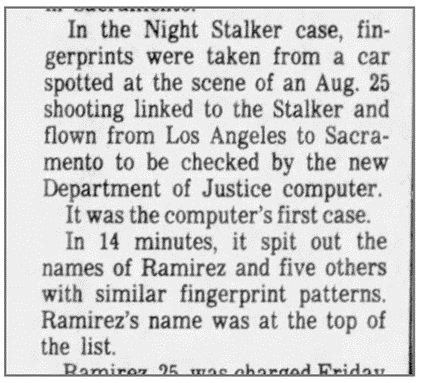
Five other suspects were flagged and the time it took has increased from three minutes to fourteen. Not such a “fluke” – but to narrow 380,000 down to five does still look impressive. However, the claim that they ‘fed his print into the system’ does not appear to be true…
Nothing Is Ever As It Seems
Philip Carlo’s biography – in spite of its fictionesque retelling of the Night Stalker story – often provides interesting nuggets of information, especially when it comes to poor evidence and the trial. He wrote (on page 124) that the above version was just the ‘official story,’ and the truth is police merely searched the database for the names Richard or Ricardo Ramirez.
Carlo was telling the truth – his claim was later confirmed on the Netflix documentary by Carrillo and Salerno themselves, who said eight Richard/Ricardo Ramirezes came up and of course ‘our’ Ricardo Muñoz Ramirez matched one of them. So, they were down to eight men, all with the same or similar names, whose fingerprints all looked alike – because, as mentioned in the Vincow article – fingerprints are not as unique as we are told. From these Ramirezes, just one of his prints was matched manually with the naked eye and not from a scientifically advanced computer database.
Carlo quotes Richard Ramirez as claiming this evidence was a “travesty of justice” and that “these fingerprints should not have been allowed in at all. They had only three discernible loops, and for a print to be admissible in court, it’s supposed to be seven loops.” One might argue, ‘of course Richard would say that – he doesn’t want to be sentenced to death’ – but what if he was telling the truth? This whole case was built around flaky evidence and police manipulation that simply was not adequately defended in court.
At the Los Angeles trial, Ramirez’s attorneys failed to explain to the jury the significance of unidentifiable prints on Jennie Vincow’s window screen and should have argued that they were not from Ramirez. Not only that, but the prosecution also failed to preserve the other prints, so they could never be matched to other potential suspects in future. The defence attorneys moved for sanctions on this in the pre-trial hearings but in the actual trial, they neglected to raise the issue. So, it was assumed only Ramirez’s prints had been left on the window screen.
Then of course, Ramirez was never tried in Orange County nor San Francisco, so the prints’ veracity remain untested. But the fact that names rather than fingerprints were inputted into the system surely invalidates another print connected with Ramirez – one at a burglary in San Francisco, that police linked (based on a hunch) to Peter Pan’s murder. (A post on this case will be written in the near future). This print was also on the external side of a window and not inside the burglary scene itself.
Attempts by the Habeas Corpus lawyers to obtain the fingerprint evidence so their own expert Ron Smith could examine them were obstructed by the government (it is unclear whether this was the California government or the US Federal Government). If the fingerprints still exist and the state’s evidence is valid and reliable, then why should they fear re-examination? Is it because they know it might not withstand scientific scrutiny and consequently cast reasonable doubt, thus resulting in an overturned conviction?
-Venning B-
29th August 2023


 Expendable For A Cause.
Leave a reply to ~ Jay ~ Cancel reply