
*Some images may be better viewed on a desktop because of the size*
“The trial court failed properly to inquire about and conduct a full
Writ of Habeas Corpus page 191
hearing as to Petitioner’s mental competency to actively participate in the proceedings. Petitioner was entitled to a full and fair determination of his mental competency in this multiple murder capital case”.
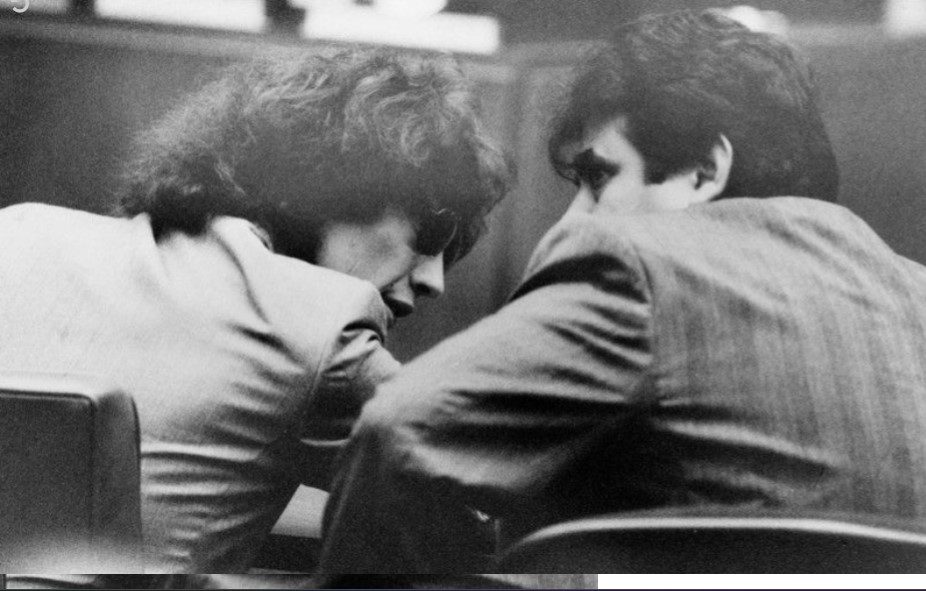
Penal Code § 1368
The Sixth Amendment to the United States Constitution protects the requirement that a defendant be mentally competent to stand trial.
Under California law, a defendant’s mental competency to stand trial is defined in Penal Code § 1368 PC. Under this section, if a judge believes that a defendant lacks the cognitive ability to understand the legal proceedings and assist in their defence, then the judge must state that belief in the court’s record. In such cases, a hearing may be ordered to assess if the defendant is incompetent.
This code section requires the judge presiding over a criminal case to do two things if they believe a defendant is mentally incompetent.
- State their doubts about the defendant’s mental competency in the official court record.
- Ask the defendant’s attorney for their opinion of the accused’s competence.
The presiding judge should order a competency hearing if the defence can show substantial evidence of incompetency. The purpose is to establish whether the accused is fit to stand trial.
Mental Competence in Law
A defendant is incompetent to stand trial when they suffer a mental disorder or developmental disability rendering them unable to:
- Understand the nature of the criminal proceedings, or
- Assist counsel in the conduct of a defence in a rational manner.
A development disability is a disability that:
- Begins before a person is 18 years old, and
- Continues, or is expected to continue, for an indefinite period. (Source: Shouse California Law Group)
In the case of Richard Ramirez, both of these situations applied. Forgive the “legalese” once more, but it is essential to understand the context of penal code 1368 when reading the post (I kept it concise).
When you Google the “Night Stalker” crimes, you’ll find a lot of info about the crimes, his childhood and a thousand edits. His mental health evaluations detailing the various psychological tests and corresponding results are missing. There is a reason for this, much of which has been covered in this post and again here and here. (I invite you to read them for an overview of the trial and to gain an understanding of what was done). However, there are records concerning this subject going back to the 1970s.
Doubts raised in Municipal Court
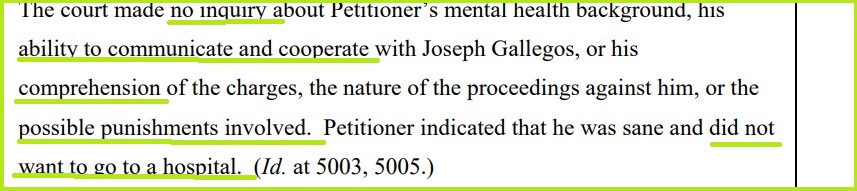
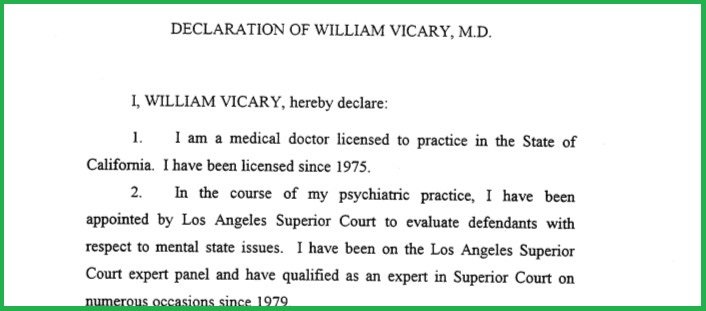
On October 24th 1985, before he was replaced by Daniel and Arturo Hernandez, Joseph Gallegos, briefly retained by Richard as his defence attorney, informed the court that he had grave concerns about his mental condition and moved to suspend criminal proceedings. In early September, just after the arrest of Ramirez, public defender Henry Hall (Richard’s first assigned counsel) had the same concerns over competency and had arranged for a psychiatrist, William Vicary M.D, to examine him at Los Angeles County Jail. Vicary was the first in a long line of psychiatrists who would come to examine him before and after his LA convictions.
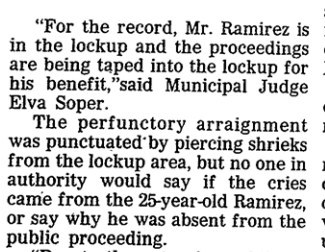
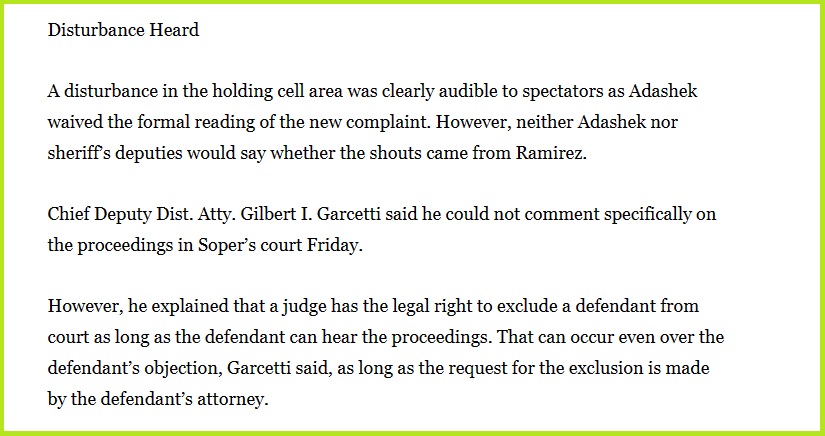
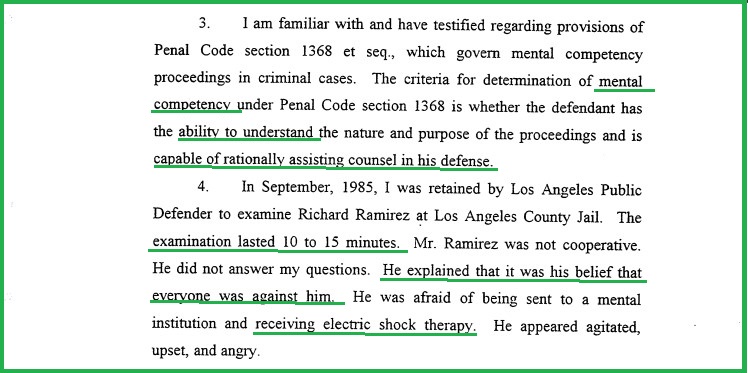
Before ruling on the competency motion tabled by Joseph Gallegos, the trial court asked Hall about the confidential psychiatric evaluation. Hall reported that Richard had been uncooperative, refusing to answer questions, expressing his fear that “everyone was out to get him”, and fears that he would be subjected to electric shock treatment.
Gallegos renewed his request that Richard should have a full and proper psychiatric examination per Penal Code § 1368. The court, however, found that he wasn’t mentally incompetent under § 1368 because he “remembered things”. Because he remembered things. What things? His name? His date of birth? What he had for breakfast? They made the decision even though, after spending such a short time with him, Vicary could determine that things were wrong with Richard Ramirez.
Richard did not want to be regarded as insane and commented, “I don’t want to go to no hospital, Ma’am”.
On observing him in court during October 1985, a Los Angeles psychiatrist revealed her thoughts to a newspaper; the article is from the UPI Archive and is dated 28th October 1985, four days after Joseph Gallegos raised his concerns over Richard’s mental state. That wasn’t public knowledge, for she says none of his lawyers attempted to highlight the issues. As we’ve seen, that wasn’t true; she doesn’t know as she wasn’t party to that information because she wasn’t attached to the case; she was watching from the gallery. Gallegos tried, as did Henry Hall; Arturo and Daniel Hernandez did not. The trial court wasn’t listening. If a court observer could see the problem, it is reasonable to assume that the trial court was aware but chose to ignore it. In the news article, Ramirez is called the Night Stalker, another example of media bias. This was in 1985; he wasn’t convicted until 1989.
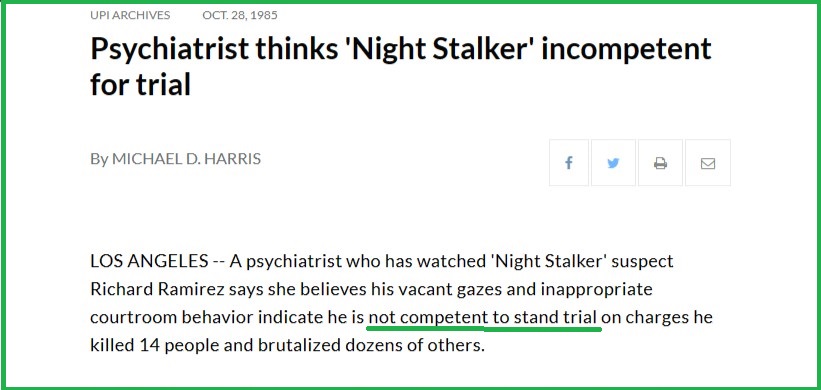
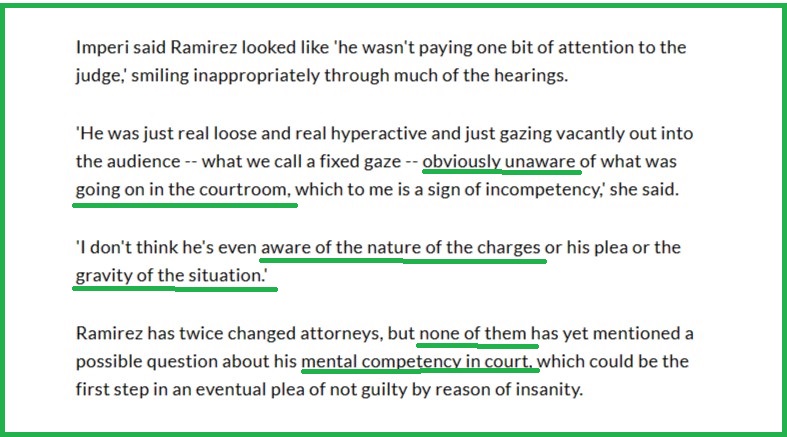
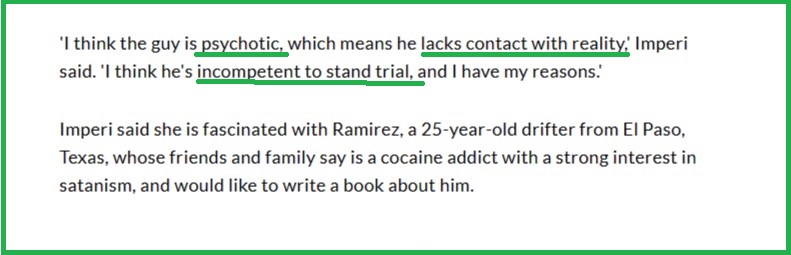
From the UPI Archive, the thoughts of Dr Lillian Imperi, a psychiatrist with over 30 years clinical experience. Swipe through the gallery above.
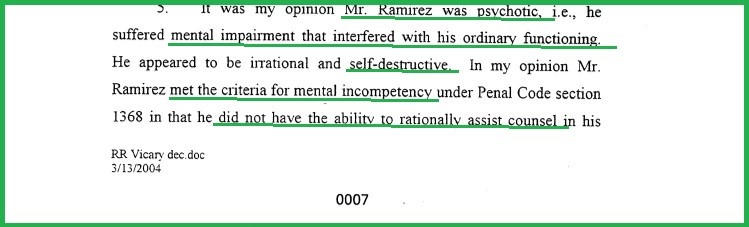
What Happened to the Reporter’s Transcript?
Subsequently, an in-camera hearing was held on April 14th, 1986. However, despite repeated, diligent efforts of state appellate counsel to obtain a complete record on appeal, the sealed reporter’s transcript of the hearing held that date was not made part of the record on appeal, and no settled statement summarising that hearing could be obtained.
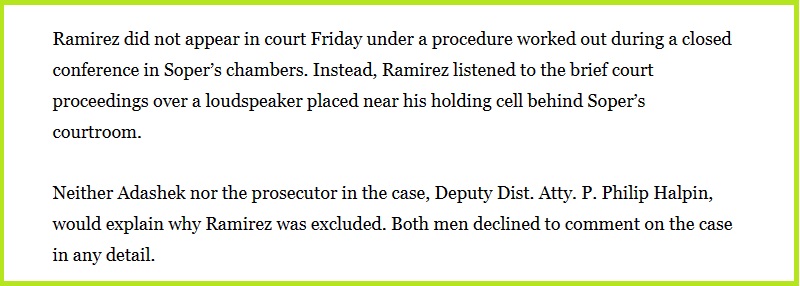
An” in camera” hearing means privately, in chambers, and out of the public eye. Richard’s appeal lawyers could not recover whatever was said within that room; the transcript was sealed. Richard was absent from this discussion.
His lawyers at this time were Daniel and Arturo Hernandez, who were both fully aware of the findings of Vicary and Dietrich Blumer, M.D, neuropsychiatrist (whose report will be discussed in a future post). The Hernandez’ did not follow up on the accounts of either.
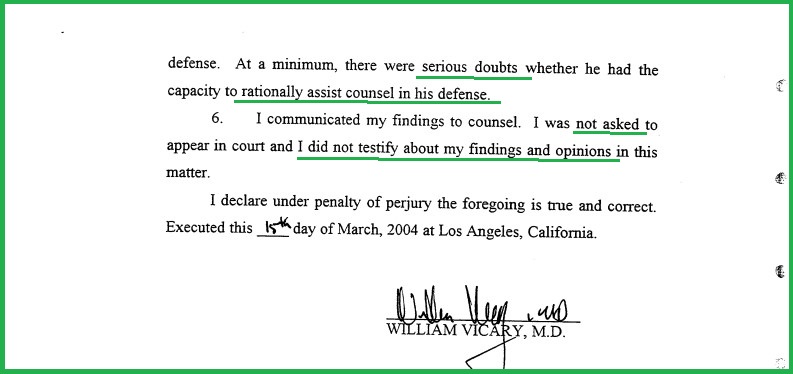
There was no determination of Richard’s mental competency in the Municipal Court.
The subject of Richard’s mental impairment has been brushed aside over many years, and it was only because his San Francisco attorneys arranged for him to be correctly assessed that it is possible to understand the depth of his condition. The public defenders in San Francisco did their work thoroughly; we can hardly say the same for LA.
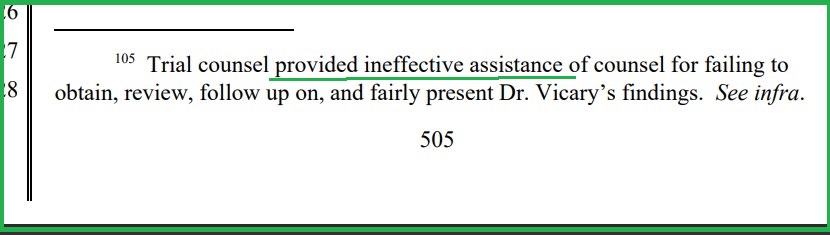
“Competent counsel could and should have investigated, developed, and presented evidence that Petitioner, from his childhood and continuing to the present day, suffered from long-standing and severe psychiatric, psychological, neurological, and cognitive impairments, including, but not limited to, long-standing temporal lobe epilepsy; mental incompetency in September 1985; thought disorder of psychotic proportion, resulting from his seizure disorder; psychotic disorder; disorganized speech, thought, and behaviour; hallucinations, delusions, paranoia; severe mood disorder; brain damage; severe impairments in memory tasks and higher cognitive functioning, of a kind typically associated with impairment of the frontal and temporal lobes; impairments in his ability to inhibit behaviour and responses and obsessive and compulsive behaviours; and the impact on his behaviour and personality of multiple disorders – all of which established that Petitioner was seriously mentally ill and incompetent to stand trial and waive his rights and which would have constituted effective defences, at guilt and penalty, to the crimes charged against him.”
Writ of Habeas Corpus page 512
Please note: psychosis is a severe mental disorder in which thoughts and emotions are so impaired that contact with external reality is lost. It is not psychopathy; Richard was never diagnosed with psychopathy.
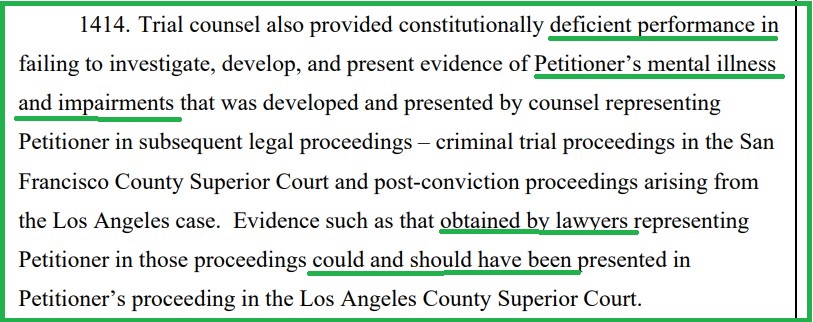
Because Petitioner was incompetent to stand trial, based upon this
Writ of Habeas Corpus page 174
social history and mental health evidence developed by lawyers at the SFPD, his criminal trial proceedings in the San Francisco County Superior Court were stayed indefinitely in 1995 and were never brought to trial. For the same reasons, he was incompetent to stand trial and waive rights in the Los Angeles proceedings.
If Richard was found incompetent in San Francisco, he would be similarly incapable in Los Angeles. Rather than come out and say this, for to do so could compromise the LA convictions, the trial in San Francisco was simply stayed instead.
The Poor Outsider
The public defender Henry Hall, and after him (briefly) retained counsel Joseph Gallegos, had tried to intervene, but Richard replaced them with underqualified attorneys. A decision that could have and should have been overruled by the court, especially when the accused was not competent to understand how badly he was being represented and what was required from his defence counsel.
From the beginning, it is painfully clear that Richard was let down by those who had a duty to defend him and protect his constitutional right to a fair trial. The odds were always stacked against him. The poor “outsider”, the “misfit”, had fallen through the cracks, and no one was picking up the pieces or seemingly helping him, as he could not help himself. The errors are many, from deficient lawyers to false evidence presented and a jury misled. One of the saddest realisations is the cover-up of his mental health during a conflict of interest that was out of his control and beyond his capability or understanding to correct. He was, after all, a person who believed that being checked out in a hospital equalled electric shock therapy.
As we have often said, the central theme here is a trial that was neither fair nor constitutionally correct; it is not about guilt or innocence but rather the lack of a solid and vigorous defence, which every accused person should have, no matter who it is. The issues surrounding the mental health of Richard Ramirez should have been drawn upon in both the guilt and penalty phases, and especially in mitigation. They were not.
“Nothing can make injustice just but mercy.” – Robert Frost.
~ Jay ~


 Expendable For A Cause.
Leave a reply to ~ Jay ~ Cancel reply