

So much of what we think we know about Richard Ramirez is based on myths and rumors. It’s like the “telephone” game played in the United States. Someone makes a statement, and that statement becomes so distorted that it doesn’t even remotely resemble what was said to begin with. The story gets changed and no longer has an element of truth in it. Is it so hard to believe that this is the case with Richard? Is it difficult to believe that most, if not everything, you have read and heard about him couldn’t possibly be true or may only represent a small part of his ever-changing story?
The few interviews he gave during his lifetime have been taken out of context, twisted, turned and made into something sinister. They have been made out to mean something that they didn’t. There are some that continue to perpetuate the rumors and untruths with absolutely no evidence to back up their claims or statements. And the story keeps growing and changing so much so that none of us know who Richard Ramirez really was.
Richard Ramirez wasn’t born a “bad seed.” He wasn’t a “bad kid”. Yes, he had some struggles. Had anyone of us walked in his shoes likely we would have experienced unfortunate events as well. For those that think he was evil incarnate from the moment he arrived on the planet, and for those who don’t, let’s look beyond the rumors and the myths and look at the evidence that exists.
In a previous post, we discussed how Richard was not a troublemaker as a child and how he did well in school, at least until the onset of the seizure disorder he developed at the age of 12-13. It was only after this that he began to misbehave and use drugs. And even then, those misbehaviors were relatively mild.
Richard’s first contact with the criminal justice system was in 1974, at the age of 14, for criminal mischief. He attempted to steal something, the record does not indicate what it was, but he was merely issued a warning. So, whatever it was didn’t warrant a proper arrest so we can conclude it must have been negligible. For the next two years there is nothing in Richard’s juvenile record indicating any criminal behavior.
In May of 1976, Richard was charged with committing theft that was “over $20 but less than $200” (no specifics were given as to what was stolen). He was released to his parents and the case was closed without any further investigation.
The following month, Richard was apprehended for burglary of a residence. Again, no specifics are given as to what was stolen. The case was dismissed by the county prosecutor because whoever filed the complaint couldn’t be located. In July of 1976, Richard was given a warning for disorderly conduct.
Two months later, in September, Richard was accused of burglarizing a residence but this case was also dropped due to lack of a statement from the person seeking prosecution.
The following month Richard was given a warning by the El Paso police for vandalizing U.S. postal property. December 16, 1976, Richard was accused of burglarizing a home. The individual that pressed charges waited 12 days before doing so and no specifics were given as to what, if anything, had been stolen from the property. It was this last incident that Richard ended up going to court for in March of 1977. Richard was never on probation or arrested for any of the aforementioned incidents. Not even the one that occurred in December 1976.
Philip Carlo’s Unverifiable Claims
In Philip Carlo’s book The Life and Crimes of Richard Ramirez, Carlo tells the story of Richard working for a hotel as a teenager. Carlo states Richard was in an elevator one day while at work when two teenage girls got on the elevator. Richard politely told one of them she was pretty. The young lady adid not appreciate what Richard said and she reported it to her parents who notified hotel management. Ramirez was reprimanded by the manager.
Somehow this story has morphed into Richard sexually assaulting these teens girls. However, Richard’s juvenile record does not list any such occurrence. Had Richard assaulted the teen girls he met in the hotel elevator, it would have been listed along with the other crimes he was accused in his criminal record. I would like to point out that in the hundreds of pages of documents submitted with the 2008 federal petition, there is absolutely nothing indicating Richard ever sexually assaulted anyone when he was a minor.
Contrary to popular opinion, Richard Ramirez was polite to girls and not violent towards them. The following comes from his school friend Ana “Patricia” Kassfy who wrote a character witness statement in 2004. It was used for both his 2006 direct appeal and his 2008 federal habeas corpus petition:
“Richard was a joker and when I was with him, we always laughed. Freshman year, he and I walked to school together practically every day. Richard stopped coming to school that year. In the ninth grade, I went home for lunch almost every school day.
Even when he was no longer attending school, Richard waited for me at the corner almost every school day and walked me back to school after lunch.
There were two ways to get to school. The shorter way was ten minutes faster, but you had to walk through three blocks of a really bad neighborhood. There was a lot of drug use … and the kids … frequently beat up other kids. On the days that Richard walked me back … we ran those three blocks in order not to be beaten up and harassed.”– Patricia Kassfy, exhibit 123, Document 20.8
Richard himself stated that anyone reading Carlos book should “take it with a grain of salt.” Carlo used creative license when writing it as his goal was to sell a book and Richard stated there were many untruths in it.
The El Paso Child Guidance Center
Richard was seen at the El Paso Child Guidance center three times in 1976. A psychological evaluation and personality testing were completed by Dr. Ursula Niziol who concluded Richard was depressed, withdrawn and had suicidal ideations. He did not have a personality disorder nor was he homicidal. The counselor who saw Richard at the guidance center determined he wanted help with getting back on track with school, finding employment and staying off drugs. She even stated Richard was a “black belt” in Karate and expressed an interest in teaching it.
The El Paso Child Guidance Center recommended individual counseling for Richard and family counseling for him and his parents. From the information that is available to us, it does not appear this happened. Clearly, Richard needed help at this point in his life because he was struggling with depression, suicidal thoughts, using drugs, getting in trouble for not going to school, and had several encounters with law enforcement.
No one is pointing the finger at anyone, but instead of getting counseling and help finding employment and with school, Richard fell through the cracks and was merely left to his own devices and thus, he ended up in court a few months later, followed by a stint in reform school with Texas Youth Council (TYC).
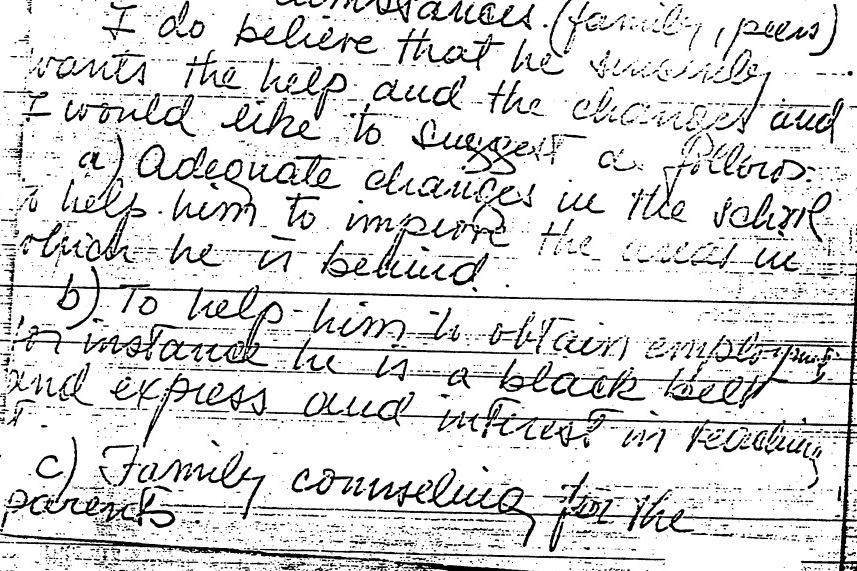
Below is a 1976 evaluation from a counsellor:
“I do believe that he seriously wants the help and the changes and would like to suggest as follows;
a) Adequste changes in the school to help him to improve the areas in which he is behind.
b) to help him to obtain employment – for instance he is a black belt and expresses an interest in teaching it.
c) Family counselling for the parents.
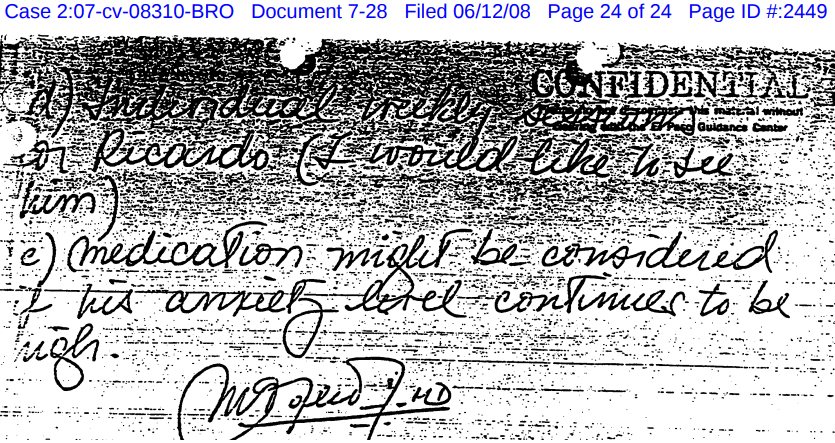
d) Individual counselling sessions for Ricardo. I would like to see him.
e) Medication might be considered if his anxiety continues to be high.”
Richard was also an active youth with hobbies. He was once a boy with a lot of potential:
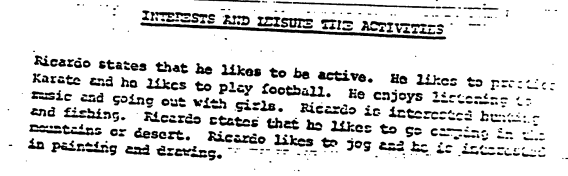
“Ricardo states that he likes to be active. He likes to practice Karate and he likes to play football. He enjoys listening to music and going out with girls. Ricardo is interested in hunting and fishing. Ricardo states that he likes to go camping in the mountains or desert. Ricardo likes to jog and he is interesting in painting and drawing.”
– Statement from the psychological evaluation completed by Dr. Niziol at the El Paso Guidance Center in 1976
Let me reiterate the findings of the psychological evaluation. The alleged big bad Night Stalker was not diagnosed with antisocial personality disorder in his youth as Philip Carlo implies (he does not directly state these diagnoses). This means he was not a budding sociopath or a psychopath. He was depressed and anxious, at times.
Alleged Cruelty
Furthermore, there is nothing in any of the psychological evaluations stating Richard was cruel to animals or a sexual deviant with predatory behaviors. We discovered claims to to the contrary that it wasn’t Richard, but his brother, Robert who was cruel to animals, setting cats on fire.
“Robert was very strange. Four times I saw him set fire to cats in a tunnel underneath the I-10 freeway near Ledo Street [where the Ramirez family lived]. Richard was different from the rest of the kids in our neighborhood. He was timid and the other neighborhood kids gave him a hard time.”
– David Palacios, Ramirez’s childhood friend, exhibit 126, document 20.5.
Texas Youth Council
In March 16, 1977, Richard appeared before a judge to answer for the burglary charge from December 1976. By this point the charge had been changed from burglary to criminal trespassing. No reason is given for the change in the charge.
Richard was found guilty because of an alleged eyewitness identification. Back in December of 1976, a police officer came to Richard’s home and told him of the accusation against him. The officer told Richard the person that was accusing him of burglary wanted to see him so that he/she could determine if Richard was the one who trespassed on their property. The officer basically told Richard if he had nothing to hide then he shouldn’t be concerned about letting this individual have a look at him. So Richard naively and willingly went with the police officer to the home of the accuser.
The police officer told Richard he needed to get out of the police car and stand beside it, so he did. It was then that the accuser looked out of a window to get a look at Richard. Based on this glimpse from the window, the accuser said Richard was indeed the person who trespassed on their property. That was used as evidence against him. Quite obviously this is not a legitimate way of identifying a perpetrator so why it was admissible in court, we don’t know.
The judge determined Richard should be sent to “reform” school for the criminal trespassing charge. So, on March 17, 1977, Richard was sent to the Texas Youth Council statewide reception center in Brownwood, Texas, to begin the process of placing him in the reform school system.
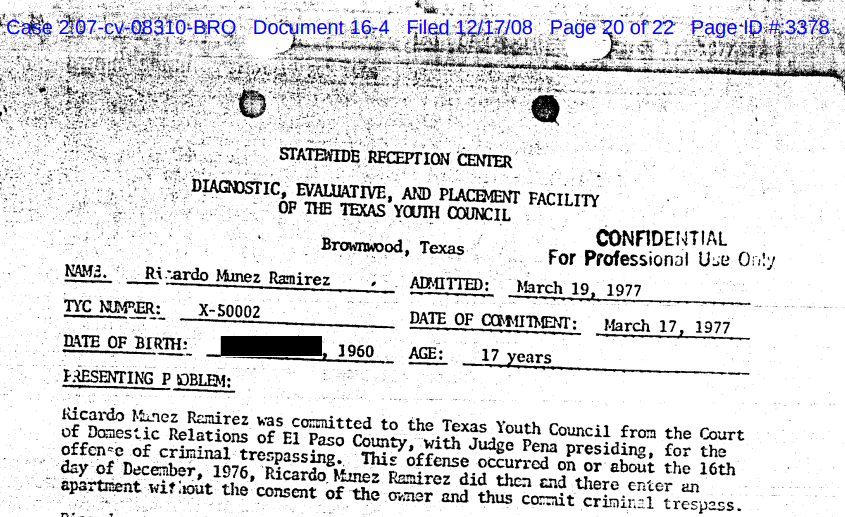
The Statewide Reception Center determined Richard was “suitable for community placement,” indicating he wasn’t violent, he wasn’t a sexual predator, and did not need to be separated from other juveniles in the reform school system. Staff stated he “responded to supervision very well” and that he enjoyed group activities with peers. Richard was placed at the “El Paso House,” a juvenile group home.
His estimated length of stay was approximately five months with the goal of family reunification after he was discharged. Reports indicating exactly how long Richard stayed in reform school have not been located but it may have been until his 18th birthday or close to that time, as an individual could not be kept in a youth reform system past the age of 18.
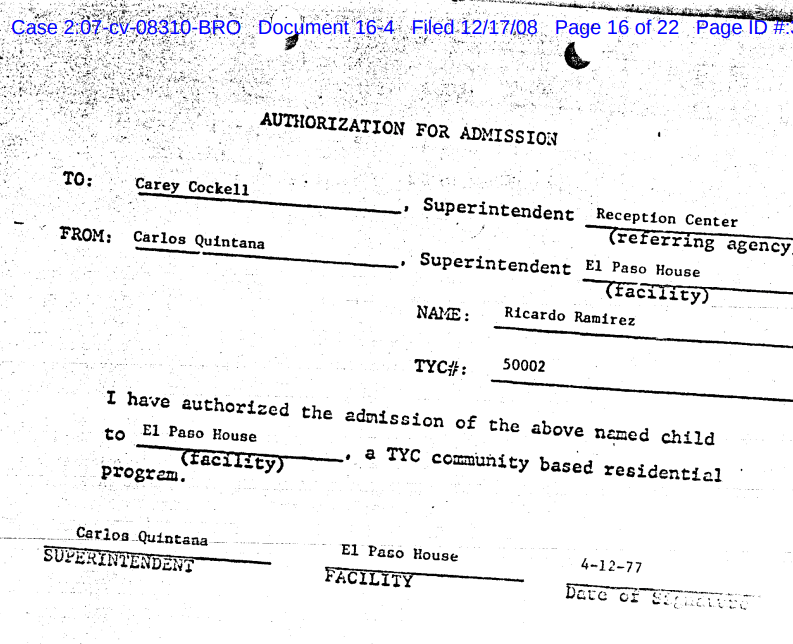
The purpose of reform schools that existed in the 1970’s in the United States was rehabilitation. We don’t know much about what happened during the time Richard spent at El Paso House. His records from the time he spent there may be unavailable because he was a juvenile or the records may be amongst the thousands of documents submitted along with his 2008 federal writ of habeas corpus petition but are sealed for some reason, so we don’t have access to them.
We can speculate on what may or may not have happened during his time with the Texas Youth Council based on his behavior after he was released. What should have happened while Richard was at TYC is he should have earned his general education diploma, received vocational training, and counseling and treatment for depression and drug abuse.
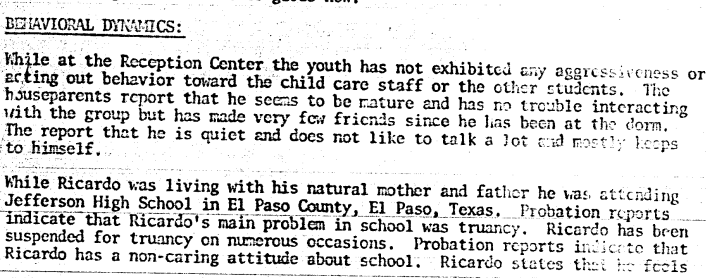
Richard’s death certificate indicates he was a high school graduate so likely he did get his general education diploma while at TYC. But it doesn’t appear he received any type of vocational training nor any treatment for depression or drug abuse.
So, what happened to the rehabilitation purpose the Texas Youth Council was supposed to serve for Richard? Did this reform school fulfill its purpose? Did it help Richard with gainful employment? Did it give him the skills to stay out of trouble and not use drugs? The answer would be no on all accounts. If the system ever failed anyone, it was Richard Ramirez.
So many opportunities existed to change the course of his life. While it’s true we can’t make anyone do something they don’t want to do, per the counselor’s statements Richard wanted help. It was known he suffered from depression and needed treatment. It was also known he suffered from a seizure disorder, yet no treatment or follow-up care was provided for that either.
We should be asking ourselves “why not?” Why didn’t he receive vocational training? Why didn’t he get counseling and medical treatment during the time he was at El Paso House? He was under the complete control of the reform school system. He had been court ordered there. He could have just as easily been ordered to receive counseling and treatment. During the time he was at the El Paso House he would not have had access to drugs or have been able to burglarize either. This was the perfect opportunity for rehabilitation. So why did the system not provide Richard with the tools and skills he needed to be rehabilitated? Why was he not provided with medical care and treatment when it was apparent he needed it?
Further reading:


 Expendable For A Cause.
Leave a reply to VenningB Cancel reply