
We’ve been sold a lie all these years. It’s been one vamped-up story after another to keep the ever-growing saga of Richard Ramirez alive. But the lies don’t add up. So many of the stories that have been spun don’t even make sense. Richard has been wrongly vilified for 37 years. The truth has been silenced and suppressed, with no one revealing the uncensored evidence of this convoluted story, until now.
Could any defendant possibly have had a more biased judge and jury than Richard Ramirez? Before you think I’m being too harsh or don’t know what I’m talking about, please continue to read as we delve deeper into this topic.
What is the Role of a Jury?
In criminal law, under the United States Constitution, a defendant has a right to a jury trial. The role of the jury is to hear and see the evidence, to follow the law, to deliberate after all the evidence has been presented, and to decide whether or not the accused is guilty of one or more of the charges.The key is impartiality and a presumption of innocence.
Where Do the Jurors Come From?
A jury is supposed to be made up of the accused “peers.” Generally, jurors are selected from those who have registered to vote. The court sends out notices to a certain number of voters in the local community requiring that they appear at the courthouse for possible selection as a juror. This creates a “jury pool”. In Richard’s case, the jurors were drawn from an area that was within 20 miles of the courthouse in downtown Los Angeles where his trial was held.
The jury is chosen from the jury pool through a process called a “voir dire.” The voir dire involves asking each person various questions to determine if they can be impartial when deliberating and deciding on the guilt or innocence of the accused. A jury is supposed to be made up of individuals who have not formulated an opinion about the defendant’s innocence or guilt. A jury trial consists of 12 jurors and several alternate jurors. The alternates attend the trial the same as the main jurors but have no input in deliberations or trial outcomes.
Change of Venue
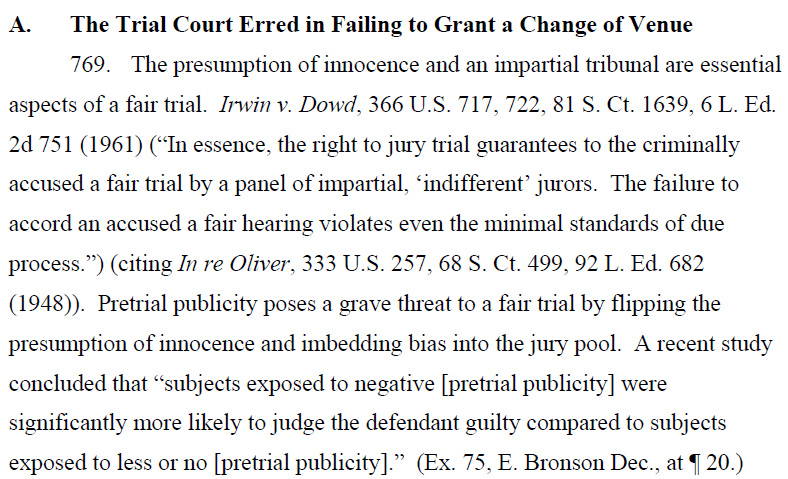
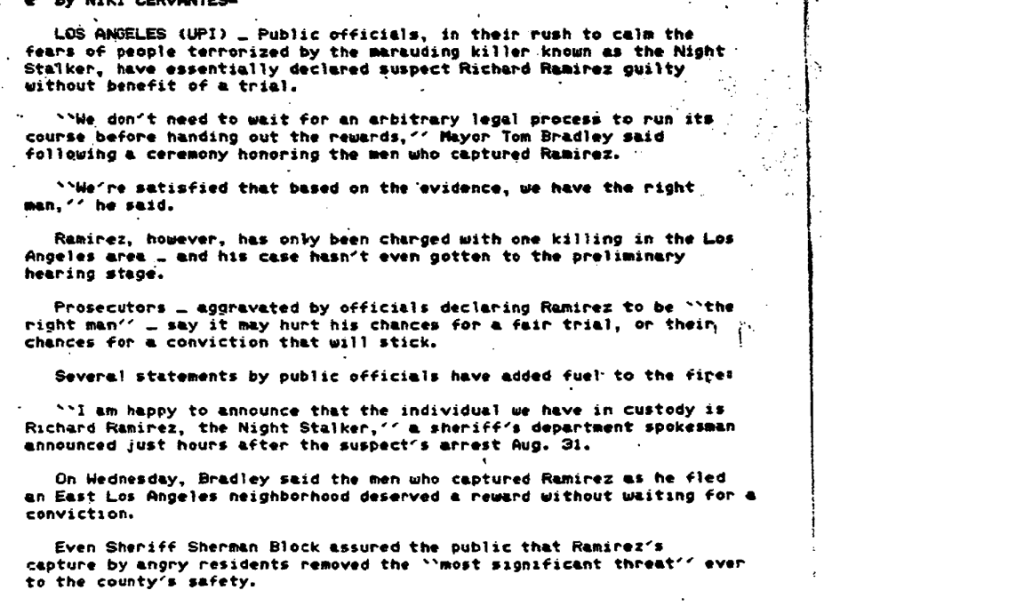
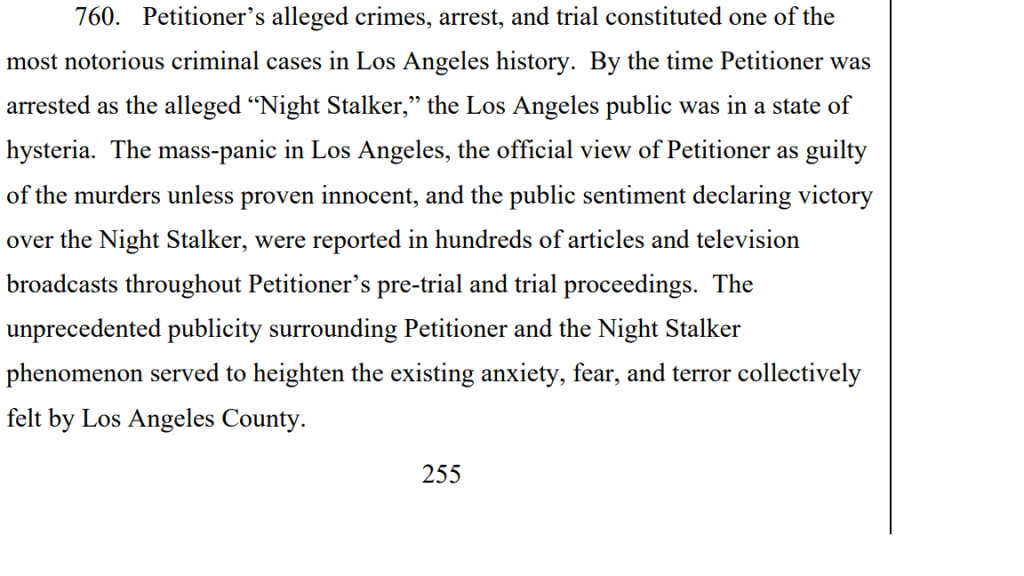
Richard’s case received an extraordinary amount of publicity. Even before Richard was arrested, the newspapers and television networks were filled with information about the Night Stalker. Los Angeles county was in a frenzied state. Gun sales were up. People were putting bars on their windows and buying guard dogs. A state of fear permeated the entire county. When Richard was arrested, many people expressed relief. Even the mayor of LA County made a statement on the day of his arrest, telling the public that they could rest easy because a dangerous criminal had been removed from the streets. He even said there was no need for a trial. Mere days after the arrest, Sheriff Block said that Richard’s arrest had removed the most significant threat the county had ever experienced. So much for innocent until proven guilty. More like innocent until accused.
Another example of the toxic publicity surrounding Richard’s arrest, this letter, appeared in the Los Angeles Times shortly after Richard was arrested.
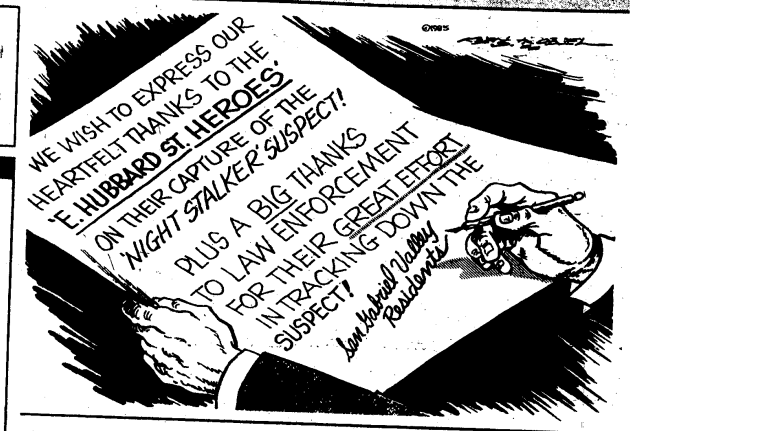
The thugs, for that, is what they were, that chased Richard down and beat him over the head the day of his arrest, were celebrated as heroes. If they had done what they did to Richard to another individual, they would’ve been charged with assault. Instead, they were given rewards and parties. This was the culture Richard’s jury was selected from.
The inept Hernandezes did make a motion to move the trial out of Los Angeles County, but they failed to properly authenticate supporting documents per trial protocol, and the motion was denied.
The Jury of Richard’s Peers
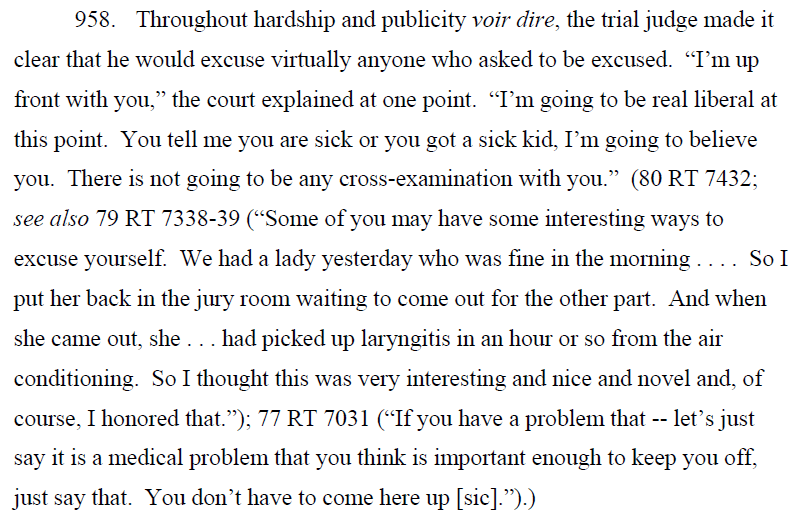
Several potential jurors were excused because they simply told Judge Tynan they could not serve because of an alleged “hardship.” However, this was after he led potential jurors in such a way that basically told them they could be excused for any reason, and he wouldn’t question them any further or require proof of hardship.
During voir dire, both the prosecuting and defense attorneys have what is called a “strike” available to use. Using a strike excludes the potential juror from serving. An attorney can use a strike for basically any reason to get a potential juror removed, but an attorney is not supposed to be allowed to remove a potential juror because of race. There are a limited number of strikes an attorney can use, and once they have used them all, they can no longer have a potential juror dismissed. During voir dire, the prosecution used strikes to remove several black and Hispanic jurors and to remove jurors that did not support the death penalty.

The Hernandezes had to use several strikes to remove potential jurors that believed the death penalty was an appropriate punishment for any murder conviction, regardless of mitigating factors. Despite this, several jurors remained that had strong beliefs in favor of the death penalty, such as Donald McGee and Chakalit Harris.
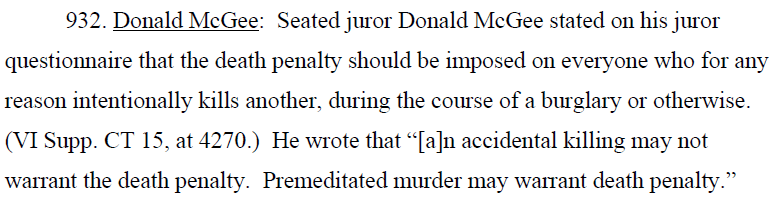
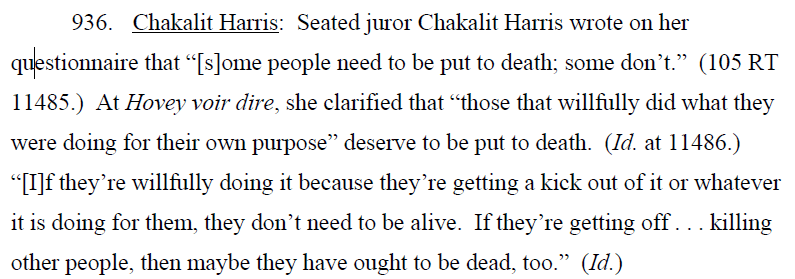
January 1989, 12 jurors and 13 alternate jurors were impaneled. And so began the trial of the Night Stalker. The following individuals would determine Richard’s fate: Lillian Aragon, Alfred Carillo, Lillian Casselli, Cynthia Haden, Chakalit Harris, Mary Helen Herrera (replaced Phyllis Singletary), Arthur Johnson, Donald McGee, Felipe Rodriguez, Martha Salcido, Verbe Sutton (replaced Robert Lee), and Shirley Zelaya. The jury would not be sequestered, meaning they would continue to be exposed to the onslaught of media coverage of Richard’s case and trial. And none of that publicity would favor Richard.
The burden of proof in a criminal trial is not on the accused. It is not their responsibility to prove they are innocent. It is the duty of the prosecuting attorney to prove the defendant committed the crimes they are accused of beyond a reasonable doubt. They have to prove that it is 100% likely the defendant committed the crime. It’s not to be a case of “I think they are 99% guilty.” Yet, in Richard’s trial, the burden of proof was placed on the defense. The jury expected Richard’s attorneys to prove he was innocent.
The jury that determined Richard’s fate ended up being a tainted jury of ” volunteers.” Basically, those that wanted to serve on Richard’s jury, for whatever reason, were the ones that ended up on the jury.
Removal of a Juror
The guilt phase deliberations began on July 26, 1989. On August 11, the jury foreman sent a note to Judge Tynan stating that Juror Robert Lee had fallen asleep briefly on 2 occasions during deliberations. The foreman stated he had not seen this juror sleeping before, and neither had any other jurors mentioned it. The foreman would further state that one of the alleged sleeping episodes was during their lunch break. On the basis of the information provided by the jury foreman, Juror Lee was removed from the jury without Tynan even so much as speaking to him about the alleged incidents or exploring alternative options.
Under the Fifth Amendment of the United States Constitution, a defendant has a right to have his case decided by the original jury that was sworn in. Very few reasons allow for the removal of a juror once they are sworn in, especially during a capital trial case. This is a right rooted in the “double jeopardy” clause of the Fifth Amendment. And “cat napping” on two occasions, one during a lunch break, certainly isn’t a legitimate reason. Far worse things have occurred in trials that did not result in the removal of a juror. Judge Tynan neglected to conduct a hearing to establish good cause to remove Robert Lee. Instead, he took the jury foreman’s statement at face value without so much as discussing it with Juror Lee. Judge Tynan not only interfered with the jury composition by removing Juror Lee, but he also allowed the jurors to exercise control over the composition of the jury, which was tantamount to jury tampering. Perhaps Juror Lee, 16 days into deliberations, did not agree with the findings of the other jurors. Could Robert Lee have been the one “hold out” that had the potential to cause a “hung jury?”
Murder of a Juror
On August 14, 1989, juror Phyllis Singletary failed to appear for jury duty. The following day, Judge Tynan informed the jurors that Singletary had been found in her apartment, beaten, and shot to death. Most of them had already learned of this via news broadcasts. On August 16, an alternate juror, Mary Helen Herrera, was selected to replace Singletary. She was so distraught and overcome with emotion that she could not even walk to the jury box and take her place as juror number 8, the seat Singletary had filled. All of the jurors were, rightly so, very upset and distraught over the murder of someone they had spent the past 7 months with and had come to know. Despite this, a mere 2 days after the murder, Tynan ordered the jury to resume deliberations. Richard’s attorneys did object to this and asked that the jury be polled on their ability to remain impartial. A request that Tynan denied. His solution was to ask the jury foreman, Felipe Rodriguez, if the jury could continue and resume deliberations. The following is the conversation Judge Tynan had with Rodriguez:
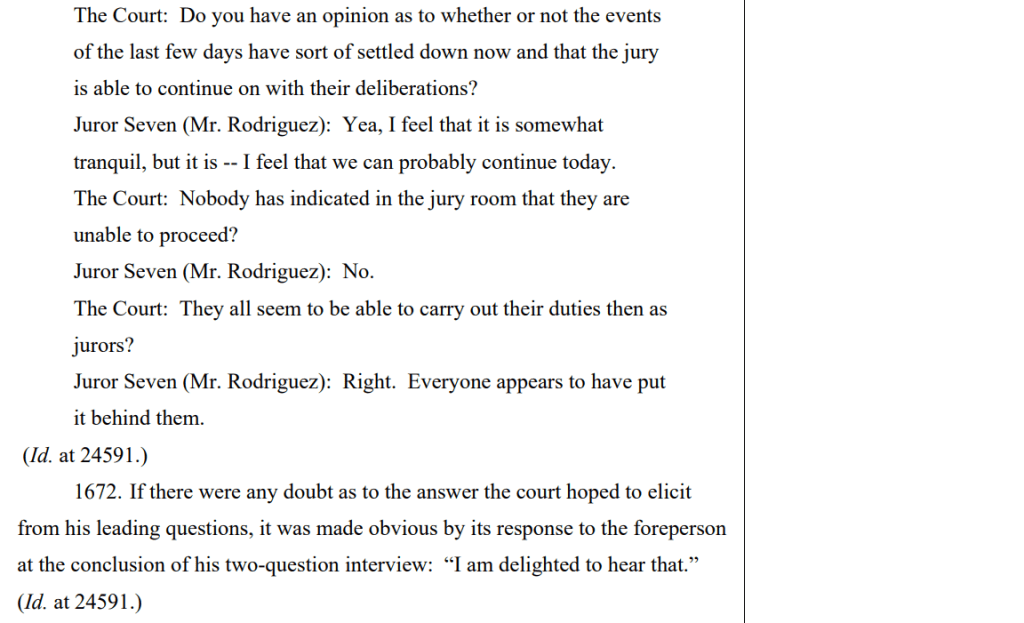
Two days after they found out a fellow juror had been murdered, the jury foreman told Tynan, “everyone appears to have put it behind them.” I find it difficult to believe that something as disturbing as the murder of a juror would be “put behind them” in 2 days. Here we also have the jury foreman testifying to the state of mind of the other jurors. How does one adequately testify to the emotional state of 11 other individuals?
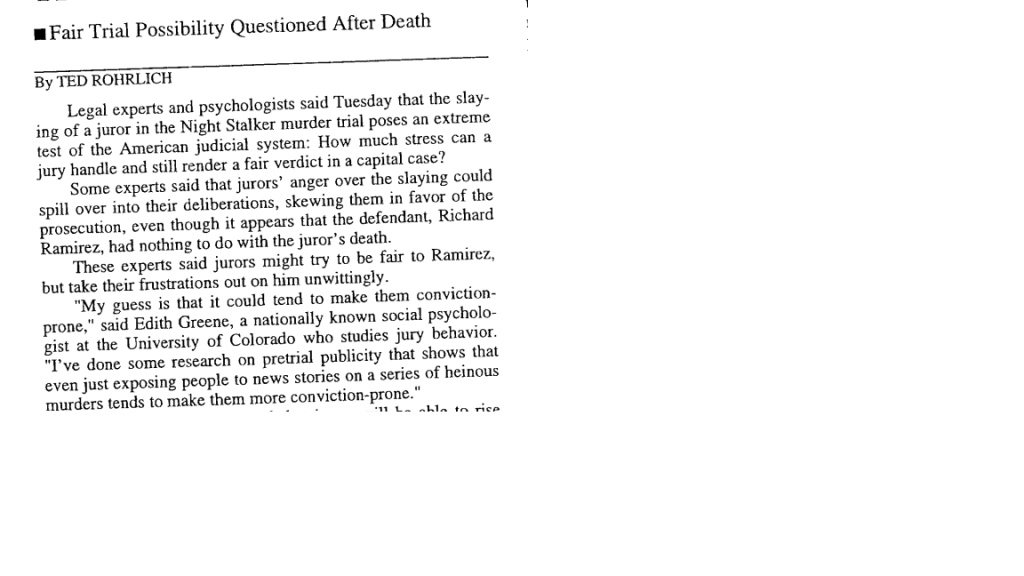
A juror was murdered during guilt phase deliberations in a similar manner as the victims were in a capital murder trial. How could the jurors possibly remain impartial when one of their own had been brutally murdered? Shouldn’t this have caused a mistrial? If grounds ever existed for a mistrial, surely this was it. The Hernandezes actually did make a motion to disqualify the jurors and moved for a mistrial. Of course, Judge Tynan, being the biased schmuck that he was, denied the motion. He wanted nothing to stop deliberations or the trial from moving forward. He did not seemingly care about fairness or justice. Otherwise, he would have done his duty as the trial judge and made sure the trial was conducted in a fair and impartial manner.
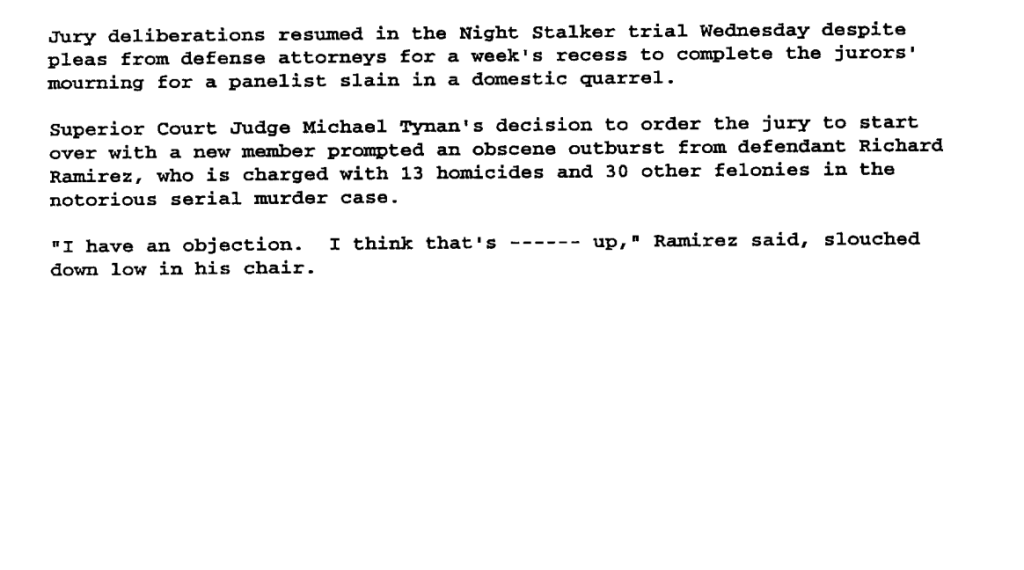
I must say, I agree with Richard’s objection to resume deliberations 2 days after the murder of Juror Singletary.
Convicted on Faulty Evidence
The evidence the jury used to determine Richard’s fate:
- Avia shoe prints at eight of the crime scenes-how do you convict someone based on a shoe the defendant was never even seen wearing? Richard was never seen wearing Avias, there’s no proof he ever owned a pair, and no Avias were ever found in his possession (and no, he didn’t throw them off the Golden Gate Bridge). Not only that, no one at any time during Richard’s trial ever measured his foot to see what size shoe he actually wore. So how do you convict someone based on a shoeprint when you don’t even know the defendant’s shoe size?
- Eye witness identification-every single person that identified Richard as their attacker changed their testimony from what they said in their initial police report. Not a single person gave a consistent statement regarding their attacker’s appearance. Not Maria, not Sakina, not Somkid, not Ginny, not Sophie, and not Carol.
- The “pattern”-there was no pattern, nothing that stands out as one person committing all of the “Night Stalker” crimes. Some victims were shot but not with the same type of weapon; some were stabbed, some were beaten, some were old, some young, some Caucasian, and some Asian. I’m no FBI profiler, but I can tell you that’s not how serial killers operate-they don’t change their modus operandi from one crime to the next.
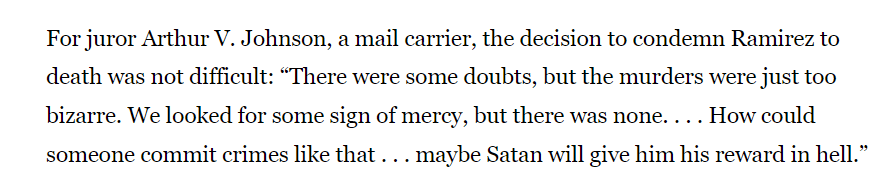
Because the defence was so bad, the jury had no exculpatory evidence to consider. The defence even failed to present mitigating circumstances to find reasons for Ramirez’s alleged criminal behaviour. From juror Arthur Johnson in the L.A. Times.
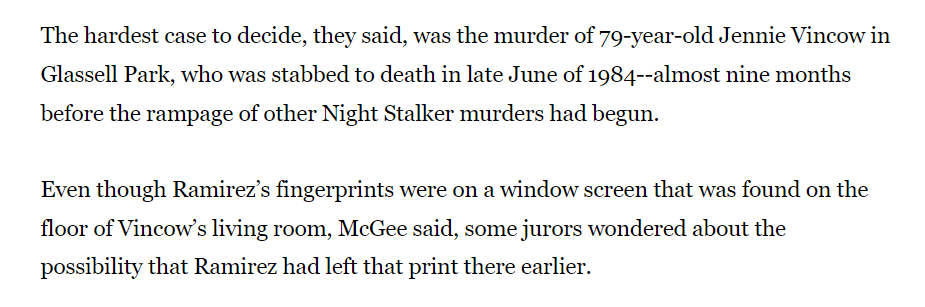
Ironically, the jurors had doubts about the one case where evidence was harder to explain away without a defence expert: the fingerprints at Vincow.
Convicted in the court of public opinion
Cynthia Haden was one of the jurors that convicted Richard and sentenced him to death. After his conviction, she appeared on the Geraldo Rivera show twice and said she believed he didn’t get a fair trial. She later became a private investigator because she said she wanted to help Richard with his appeal. So how does a juror vote for conviction and death but believe the trial wasn’t fair? Doesn’t the fact that you think the trial wasn’t fair mean you have a duty to vote against conviction? Isn’t a fair, impartial trial a part of due process? The answer is yes, it is.
Even alternate jurors, such as James Muldrow, Bonita Smith, and Fernando Sendejas, questioned some of the testimonies they heard in court. Unfortunately, as alternate jurors, there was nothing they could say or do to influence the legal proceedings.
Regardless of what you believe about Richard’s innocence or guilt, he was convicted by the media and law enforcement before he set foot in a courtroom. His trial was neither fair nor just. If you still think it was, then all I can say is perhaps your sense of justice is as warped as the judge and jury that sentenced him to death.
KayCee
 Expendable For A Cause.
Leave a comment