
The attack on William Doi and his wife, Lillie, occurred during the early hours Of May 14th, 1985.
Monterey Park police dispatcher Darlene Boese received a 911 call at approximately 5:00 a.m. The system showed the address to be 1586 Trumbower Street (according to official reports, however, it’s “avenue” not “street”) A male voice repeatedly said, “Help me.” An ambulance was dispatched, and the call terminated. A second 911 call from the same address was made a few minutes later. A male voice again asked for help. By that time, a fire company arrived on the scene.
Monterey Park firefighter Norman Case arrived at the Doi residence at approximately 5.04 am, where he found the front door open, the lights on, and Mrs Doi in her nightgown, near the hallway. She was incoherent, and in shock; her face swollen, a thumb cuff dangled from her left hand.
Her husband, William, was found sitting in a chair in the den, unconscious, and was taken by ambulance to Garfield Hospital.
Monterey Park Police Officer Michael Gorajewski was the first police officer to arrive. He observed that rooms in the house were ransacked, drawers open, and clothes thrown about.
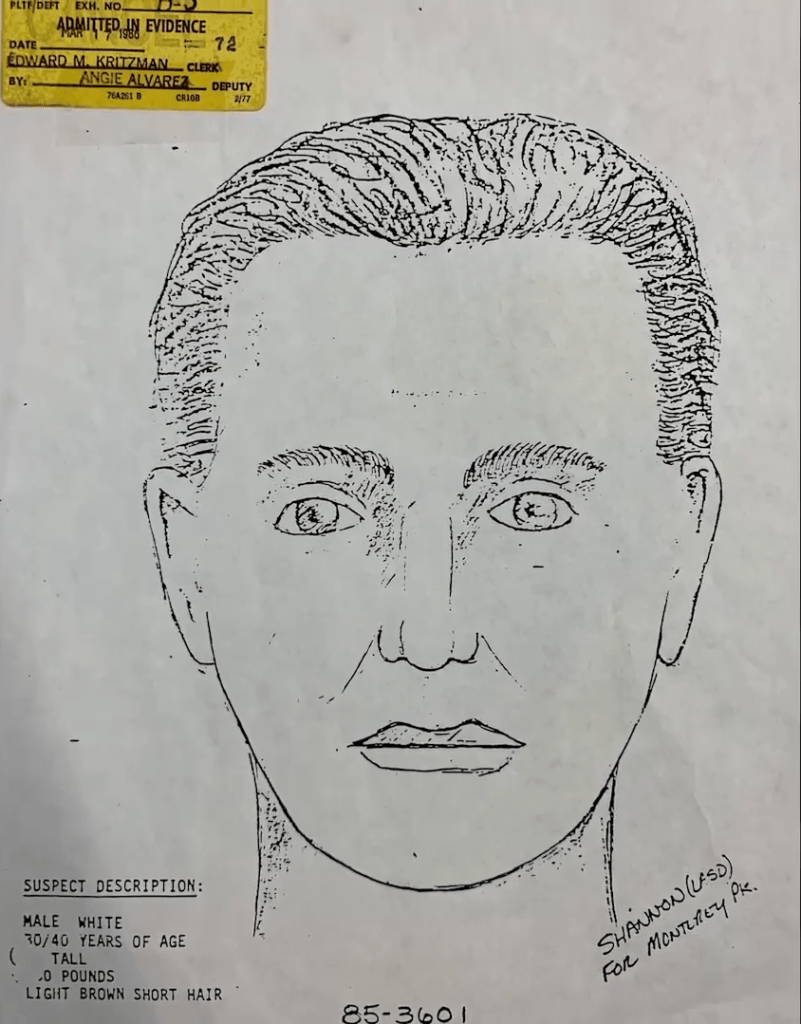
Mrs Doi was also taken to hospital, where her daughter, who had received a call at 5am, one assumes, from the police, was able to talk to her mother, who had suffered a stroke in 1982, and sustained speech impairment as a result. With her daughter’s help, Lillie Doi could put together a description of her attacker – she described a man with short, light brown hair, about 5ft 10, aged 30 -40 years old.
The Doi’s daughter, Linda, said she had visited her parents the day before, and they both appeared well, the house in order.
At Garfield Hospital, efforts to revive Mr Doi failed, and sadly, he died from a cardiac arrest, brought on by a gunshot wound to his head.
Richard Ramirez received the death penalty for the murder of William Doi, but no charges were brought against him for the attack on Lillie, one can assume, as she could not testify. Or was there another reason? Was it perhaps because her description and the composite she helped to create did not sound like Ramirez at all. In fact, she seems to have indicated to her neighbours that she didn’t believe it was him.
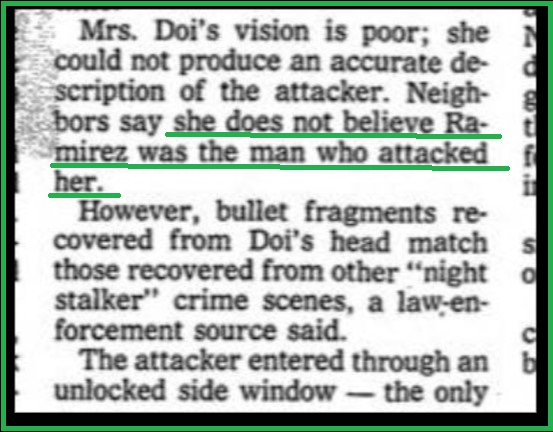
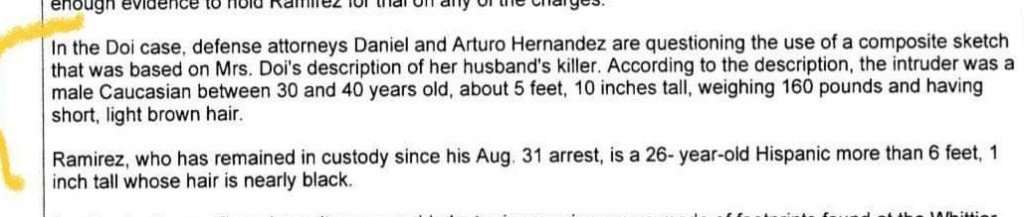
The following is from Access World News, March 21st, 1986 and can be found in petition supporting document 17-14:
“In the Doi case, defense attorneys, Daniel and Arturo Hernandez, are questioning the use of a composite sketch that was based on Mrs. Doi’s description of her husband’s killer. According to the description, the intruder was a male caucasian between 30 and 40 years old, about 5 feet 10 inches tall, weighing 160 pounds and having short, light brown hair. Ramirez, who has remained in custody since his Aug. 31 arrest, is a 26-year-old hispanic more than 6 feet 1 inch tall, whose hair is nearly black.”
So how did they tie this horrible crime to Ramirez?
Physical Evidence
At about 6.30 am, Monterey Park Police Sergeant, Paul Torres arrived at the Doi home. He found:
- Shoeprints in the dirt underneath the front bedroom window. Two different types, a jogging shoe and combat boots.
- A screen had been removed from the bathroom window.
- Master bathroom had been ransacked.
- A bloodstained pillowcase in the bathtub.
- Blood smeared on the tub and walls.
- Mr Doi’s bedroom ransacked, boxes found on the floor.
- A bloodstained pillow at the head of the bed.
- Bloodstains in the hallway.
- A small .22 calibre cartridge casing found on the hallway floor.
Forensic serologist Joseph Snyder collected evidence and drew a sketch of the scene, he made casts of two shoe prints by the front bedroom and bathroom. He did not make casts of the muddy shoe impressions observed in front of the house. On speaking with officers at the scene, Snyder determined that an investigating officer – probably Officer Jiron – had made the muddy impressions with his boots. Snyder did not check other shoes worn by the various personnel at the scene.
Identification of Recovered Property.
Linda Doi-Fick, the daughter of William and Lillie, made a list of missing items from her parents’ home. She attended a police property line-up on September 5th, 1985, and identified items belonging to her parents, including a watch that her father never removed. Other items taken from the Doi residence were never recovered.
Eye Witness Identification
This is where it starts to get a little bit more convoluted, for the eyewitness identification in this case, has a slight overlap with another incident. Some of the timings and dates are questionable, as are the sightings of the suspect.
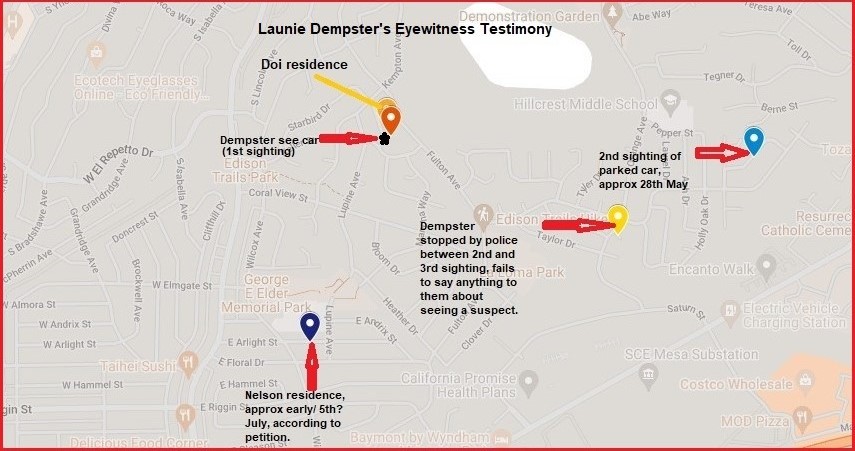
I made a little map, because sometimes visualising things can help them become clearer.
Launie Dempster
Ms Dempster gets a lot of air time in this post because this incident, like many others, relied on eyewitnesses to get a conviction.
Launie Dempster delivered newspapers around Monterey Park; her daily route was between 2am and 5am. She also worked as a security guard. At approximately 3.30am, while on her round in early May 1985, Dempster saw a man sitting in a car on Trumbower Street, opposite the house at 1594 Trumbower Street. She was driving, and it was still dark, but she said she saw a “young Mexican male” inside the car, which had a dark interior.
On returning an hour later, Dempster saw an ambulance in the driveway at 1586 Trumbower Street. The timing isn’t quite right here, as the call to 911 was made at 5am when she was finishing her route, but time passed can distort memories, making things harder to recall. She learned later that there had been a break-in at the address, and someone had died.
Two weeks later, at about 3:15 a.m., Dempster saw the same man in the neighbourhood, on San Patricio Drive, in the same car. She described the car as a brownish-green, older American model, like a Chevrolet, with black tyres and a dark interior. At a later date, when she was shown photos of cars matching her description, the cars didn’t match the car she saw.
This is Richard’s car; it’s in a bit of a state and doesn’t look like it’s been driven for a while. It has a flat tyre, and the tyres are rimmed white, not black. It also has a pale tone at the back. If she can see into a dark car, in the dark, and see a young “Mexican male”, you would imagine she could also see the light colouring at the rear of the car.
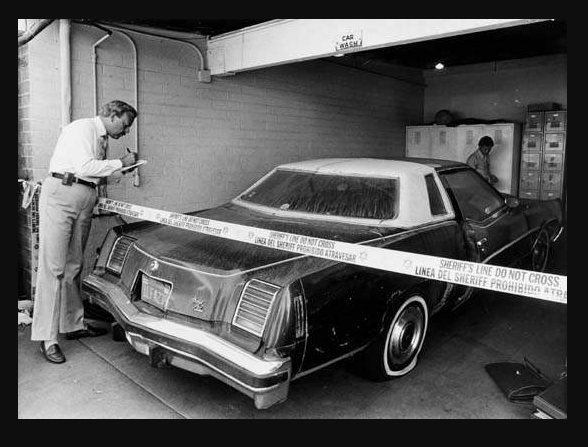
“His car had black tires, but she [Dempster] did not notice if it had hubcaps. She described the man as Mexican or Mexican-American based solely on his features.”
– Habeas Corpus pg. 60.
Ms Dempster says she saw the same man in the same car. Whose car? It wasn’t Richard’s by the sound of it. Can we surmise that “Richard” stole and returned the vehicle? Only to steal it again two weeks later? Then again, six weeks later? The same man, in the same car…
No firm date is given when this sighting took place, but two weeks later would make it around 28th May, which makes this very interesting. Even if the dates Dempster states she saw him are out by a couple of days on either side, it puts an entirely different slant on it, and it should have been challenged. THIS POST examines his movements around this time, so I won’t repeat it here.
Anyway, back to Dempster and her lurking Mexican. She goes on to say that the second time she saw the suspect sitting in the dark, in a dark car, with a dark interior, he “shouted a few words at her,” but as she had her radio on, she couldn’t hear what he was saying. How strange that this man, who was hiding in the shadows, and, as he was plotting nefarious deeds, didn’t want to draw attention to himself, decided to draw attention to himself by yelling out of the window to someone driving past him.
Third Strike
The third time Launie Dempster saw her Mexican male was approximately six weeks after the second sighting. Six weeks later makes this early July, during the first week.
According to the prosecution, it was 5th July 1985.

As ever, it’s a bit vague, as some sources state the 5th, which then changed to “early”, probably because on the 5th of July, during the early hours, an attack on Whitney Bennett occurred in Sierra Madre. He cannot be in two places at once, can he?
This time she says she saw him in a parked car on Arlight Street between 3 am and 4.30 am. He apparently walked from the back of his car to the driver’s side, and she didn’t notice anything about him, apart from he was wearing a black, short-sleeved T-shirt, a dark jacket, and dark pants.
How she could see through his jacket, to know he was wearing short sleeves, is a mystery.
Arlight Street is the residential location of another “Night Stalker” murder victim, Joyce Nelson. She was killed on July 7th, and the incident is the sad subject of another post, not this one. In court Dempster was to change her story to say that she had seen the suspect on the 7th.
Betwixt and In Between
Between her second and third sightings of the mysterious, dubiously parked “Mexican,” Launie Dempster was pulled over in a traffic stop by an undercover law enforcement officer assigned to the Night Stalker task force. She told the officer, William Reynolds, that she was delivering papers but does not seem to have said to him that she thought she had seen the suspect, although she later indicated that she did. Officer Reynolds did not recall that she gave any description of the man and made no notes of the conversation he had with her. Another paradox for how likely is it that an officer would ignore the information concerning the person they were trying to apprehend? He’d have been straight off to tell his superiors.
We are in the dark, like Launie’s suspect, and possibly like Ms Dempster, too, because she stated that she saw a composite of the suspect but told the police that that wasn’t the man she had seen.
“Dempster saw Petitioner’s [Ramirez] face on television after his arrest. She told her boss that the man on television was the same person she had seen on her route. She recalled that the man was 6 feet to 6’1″ tall, thin and lanky. In 1986, she had further contact with a police officer and told him about her observations. At this police officer’s insistence, Dempster contacted Sheriff Detective John Yarbrough [Night Stalker Task Force member]. Dempster gave Yarbrough a route list that was current for April 1986. The route had changed only slightly from Dempster’s route in 1985.”
– Habeas Corpus pg. 59
Ahh, now she’s had a good look at him on the TV. She made no mention of height before that.
It wasn’t until after the arrest of Ramirez, that Dempster, seeing him on TV and in the newspapers multiple times, told a colleague that this was the man she had seen on her route. Suddenly, she “recalled that the man was 6’ to 6’1” tall, thin and lanky”, after stating that she did not notice anything about him, on viewing him outside the car, other than his clothing. It is interesting to note that the papers she delivered every day, used the word “lanky” over and over, in describing him. How many times did she see his face in those papers?
Launie Dempster did not attend the live line-up on September 5th, 1985. She first identified Ramirez in court.
The Bias of a In-Court Identification.
The following is from Dr Kathy Pezdek a psychologist with an expertise in eyewitness identification.
“An in-court identification is not a fair and unbiased identification procedure because the eyewitnesses are not given a set of similar looking individuals from which to select the perpetrator. There is also the suggestion in court that the defendant must be guilty because he is there. All in-court identifications at the Preliminary Hearing and the Trial would have suffered from this bias. In addition, two witnesses identified Mr. Ramirez for the first time in Court. Launie Dempster first identified the defendant at the Preliminary Hearing having not attended the live lineup.“
– Declaration of Dr Kathy Pezdek document 16.7.
With a specific analysis of Dempster’s identification, she said:
“Launie Dempster testified that while she was delivering newspapers very early in the morning in the Monterey Park area, she saw the same man on three different occasions. She was shown a composite drawing by the police, but it did not depict the same person that she saw. She testified that she saw Mr. Ramirez’s picture on the television news the day before he was arrested. After he was arrested, she saw his picture in the newspaper paper and kept up with the news for about a month. At the trial and at the preliminary Hearing, she identified Mr. Ramirez in court. She did not attend the live lineup.”
– Declaration of Dr Kathy Pezdek document 16.7.
Under cross-examination, Dempster said, “The man she had seen did not resemble the composite drawing; his face was different, his hair was dark, longer, and not as curly.” Was this after she had seen him on TV? In the papers? Or at the defence table?
The Defence Fails Again
The defence did retain an expert witness regarding eyewitness identification; what they didn’t do was adequately prepare the expert, Dr Elizabeth Loftus, with the particulars about each individual incident. She was, therefore, unable to provide expert witness testimony regarding the background of each case, allowing her to identify important factors that would have been relevant. She failed to present the facts. Giving a general, non-specific testimony meant the jury was less likely to link the substance of what she was saying, making it seem unrelated to the case.
“One example is that many witnesses had seen Petitioner on television or in the newspaper before they identified him at the line-up or in court. Because the witnesses had previously seen Petitioner in the media, there was a high probability that the witnesses’ memories were suggestively influenced before they identified Petitioner at the line-up or in court, at the preliminary hearing or the trial. (See id., pp. 134-35). Although Dr. Loftus testified regarding the effect of “post event information” on the memory of the witnesses, trial counsel never explained to the jury what the term meant with respect to Petitioner’s case, and why it would call into question the reliability of the identifications in this case”.
Ex. 71, Declaration of Dr. Kathy Pezdek
Post-event information is as it sounds when an eyewitness is influenced by what they see and hear in the media before giving an identification, either in court or at a line-up. Basically, it means their testimony is, in all probability dubious, at best, meaningless or unsound, at worst.
.” . . I was not asked to render an opinion about the facts and circumstances of eyewitness identification. If I had been asked, I would have rendered an opinion based on the following:
- Procedures employed during preparation of composite drawings prepared by law enforcement, with the assistance of eyewitnesses.
- Inconsistencies in physical descriptions of the suspect given by eyewitnesses.
- Massive publicity following Petitioner’s arrest on August 31, 1985, including extensive television coverage of Petitioner’s face
- The impact of post-event information on eyewitness identification, including September 5th, 1985, pretrial live line-up and simultaneous property line-up, and multiple viewing of Petitioner in court, which had the potential to alter, supplement, or contaminate the witnesses’ recollection.
In my opinion, expert testimony pertaining to the above facts and circumstances was important for the jury to consider in assessing the credibility of eyewitness identification evidence”. (Declaration of Dr Elizabeth Loftus)
Trial counsel failed to competently challenge the testimony of Launie Dempster related to the Doi and Nelson incidents. There were unusual circumstances surrounding her identification since Ms Dempster delivered newspapers early in the morning when it was still dark. Photographs were taken to show the poor viewing conditions, and a simulated drive-by was photographed. How easy is it to identify someone seen quickly passing by in the dark? This should have been challenged vigorously.
She failed to report her possible sightings of a suspect but later identified Ramirez after seeing his face on television and in the papers she delivered daily. There was no adequate defence examination of her sightings, the opportunities to view his face, or the basis for identification, including the length of time to see the person’s face or the features. Trial counsel should have challenged her on why, if she was sure she had seen the suspect when the killings were happening, did she fail to report it?
There was no defence examination concerning the individual depicted in the composite drawing and lack of independent grounds for the in-court identification.
The defence should have questioned the accuracy of the date concerning the 5th of July sighting. How could Richard be parked up on Arlight Street in the early hours when he is accused of being in Sierra Madre, attacking Whitney Bennett simultaneously? More should have been made of that as it gives grounds for reasonable doubt. “Around the 5th of July” is simply not good enough. On the 5th? The 4th, perhaps? Independence Day, surely she would have remembered that? The viewing around the 28th of May is also questionable in what, according to the counsel for the prosecution, was a hectic week for the accused. This is important! Nothing further seems to have happened where that is concerned.
Her testimony, and thus her credibility, both flimsy and unreliable, should have been disregarded.
“The defense failed to challenge the physical evidence or impeach Dempster about her sightings and eyewitness identification.”
– Habeas Corpus, pg. 432.
Avias
Criminalist Gerald Burke, from the crime lab, examined the shoeprint findings; astonishingly, he had neither training nor qualifications to do so nor to give an opinion. He determined that the shoeprint impression could only be made by one pair of shoes in California: those infamous Avia Aerobic 445b’s. The problem here is that it simply wasn’t true. In THIS post, the shoeprint saga is thoroughly examined, so I will not repeat everything.
Richard’s defence counsel did make a half-hearted attempt to challenge the prosecution by bringing to attention the fact that no Avia sneakers had been found or ever seen on him (There is no evidence to suggest that he threw them off the Golden Gate Bridge, whatever you’ve heard, seen, or read)
They introduced no expert witness of their own.
Here are the findings of Forensic Specialist Lisa DiMeo, expert witness in countless federal and state trials; her field of expertise is shoeprint impressions, blood spatter patterns and tyre treads. Retained by the federal habeas counsel, she examined the shoeprint evidence for this writ.
“Doi:
Photographs and casts were taken of two partial shoe impressions at the scene. Concentric circles were noted on the impressions. However, the questioned impressions were too poor to make any meaningful comparison. It was not possible to include any Avia Aerobics, Basketball, Referee/Coach or All Court Sport model, which exhibited a similar design to the partial questioned impressions.”– Declaration of Forensic Specialist Lisa DiMeo
Not so unique then. Here is an image of the Doi shoe impression.
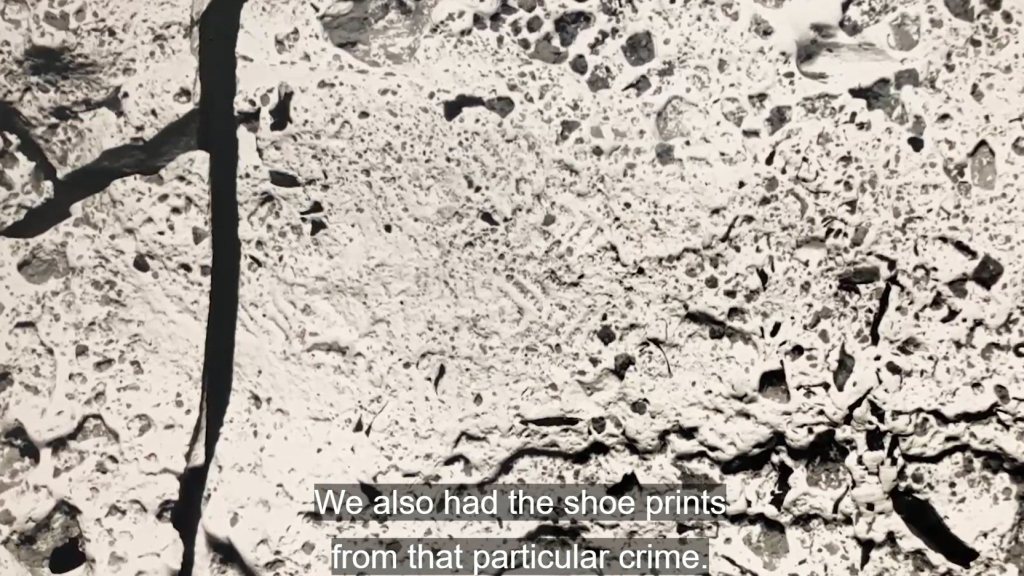
The government refused the request of the forensic specialist to have a deeper dive into the shoeprint evidence. Why? I will leave you to make up your own mind.
Who Had the Stolen Items?
Well, not Richard. None of the items stolen from the Doi residence were discovered in his possession. The Doi’s had been the target for an earlier burglary, no inventory of this property was taken.
The person who had the items was Felipe Solano, a fence and associate of Richard’s. This person of interest and his associates is discussed further in the highlighted post. This is too large a subject to fall within the scope of this post.
Felipe Solano first testified at the preliminary hearing and, at trial, was granted immunity from prosecution for receiving stolen property. The prosecution told the jury, in closing, that to prosecute Solano, for having the stolen property, they would have to release the accused.
This fence, was allowed to take part in the tainted lineup, to identify someone he clearly already knew, and to go into the next room, to identify property he was familiar with, because the police had got it from him in the first place!
Solano lied to the police, he told them that he had received the stolen goods from Richard alone, which was untrue, and it later transpired that he had deliberately deceived the court and law enforcement. He had to admit he had received property from others, namely Eva Castillo aka Rosa Solis, “Monje”, and “Cuba”. In short, he committed perjury to take the heat off his mates and to point his sticky finger at Richard Ramirez.
This self-server commented that he was only protecting “a lady” and friends. He would rather throw someone else under the bus and not care that the person concerned was now facing the death penalty.
When you’re so bad at your job the prosecution tells you how to do it…
“The prosecution contended that trial counsel Daniel Hernandez was incompetent because he failed to properly review prosecution discovery and conduct defence investigation”.
From the Writ of Habeas Corpus page 124
No investigation of these people was ever done, even though the tables in the identification room were laden with items sold to Solano by others, as well as Richard, who was, according to his unsavoury associates, a rubbish burglar.
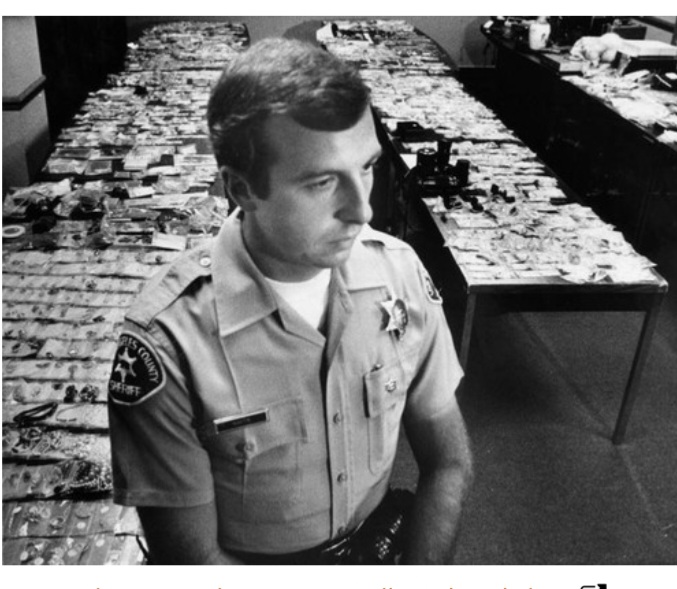
That Ramirez stole and participated in some shady stuff isn’t in doubt or up for debate; however, the lying testimony of Felipe Solano did not prove anything other than he perjured himself, and his specious testimony was worthless. He could not be believed.
The Ballistics and The Jennings
William Doi sadly died from cardiac arrest arising from a gunshot wound to his head. The autopsy report shows the shot was fired at close range, a bullet was recovered during procedure. A bullet casing was found at the crime scene.
Deputy Sheriff Edward Robinson determined that the weapon used was a .22 calibre Jennings Semi-automatic pistol, the gun was not recovered from Richard, there is no proof he ever owned or used the gun in question, other than the testimony of a convicted criminal, Jesse Perez, who testified that he bought the gun from Ramirez and received $13000 as his reward for doing so.
What Jesse Perez seems to have forgotten was that he had originally told the police that he had received the gun in question around six to nine months before the May attack on the Dois. When pressed on this during cross examination, Perez said he was “senile” and couldn’t remember.
The Jennings pistol was given to the police on 30th August 1985, three months after the incident. The chain of custody of the Jennings has been fully covered, again, I urge you to read the post, to avoid repetition here.
The prosecution, it must be stressed, used three examiners for the firearms and projectile testing, Officers Robinson, Hawkins and Christansen. It should come as no surprise that they only called Robinson to testify because, out of the three, his report was the only one that matched the outcome the prosecution wanted to see. The other two reports did not agree with the findings.
Did Richard’s attorneys jump in with their own firearms expert? Well, they thought about it, and then didn’t bother to give the expert witness the material he needed to do his job. Yes, as I have mentioned before, counsel for defence did not furnish the expert firearms examiner with the evidence, and so, they never presented a challenge to the ballistics report. A full breakdown of the ballistics reports can be found in this link.
“In 1986, I was hired by Daniel Hernandez to conduct examination of ballistics evidence in the Los Angeles case, People v. Richard Ramirez, A771272. However, my work was terminated because counsel failed to communicate with me after I requested to be provided with the physical evidence, or that counsel make arrangements for me to view the evidence at the Sheriff’s lab. As a result, I was unable to reach any conclusions or findings about the evidence.”
–Ex 35 Declaration of expert witness, Paul Dougherty.
They conceded, without even trying. Ray Clark gave his response: “You have to assume that the ballistics evidence is correct.”
Firearms expert, Paul Dougherty, who was properly retained by counsel for habeas corpus, discovered in his preliminary findings that far from being conclusive, that law enforcement work was inaccurate and inadequate. In reviewing the work performed in this case, he found that:
“Based on my review of the materials, it is not possible to rely on photographs of the ballistics evidence. There are problems with the quality and quantity of the photographs that make it impossible to say with certainty whether the findings testified to my Mr Robinson [the prosecution’s expert witness] are accurate. Also, there are internal conflicts in the written reports with regard to the testing conducted, such as the condition of the bullets.”
– Ex 35 Declaration of Paul Dougherty, dated 12th June 2004 from the Writ of Habeas Corpus
In Dougherty’s opinion, all ballistics evidence should be retested, as it was scientifically unsound.
In Conclusion
- No fingerprints found belonging to Richard
- Exact model or size of Avia shoeprint not determined, second print ignored.
- Wounds not unique
- No inventory of property stolen from earlier burglary was done
- Trail of stolen property not investigated or questioned
- Could have been more than one person
- Chain of custody of the Jennings unproven
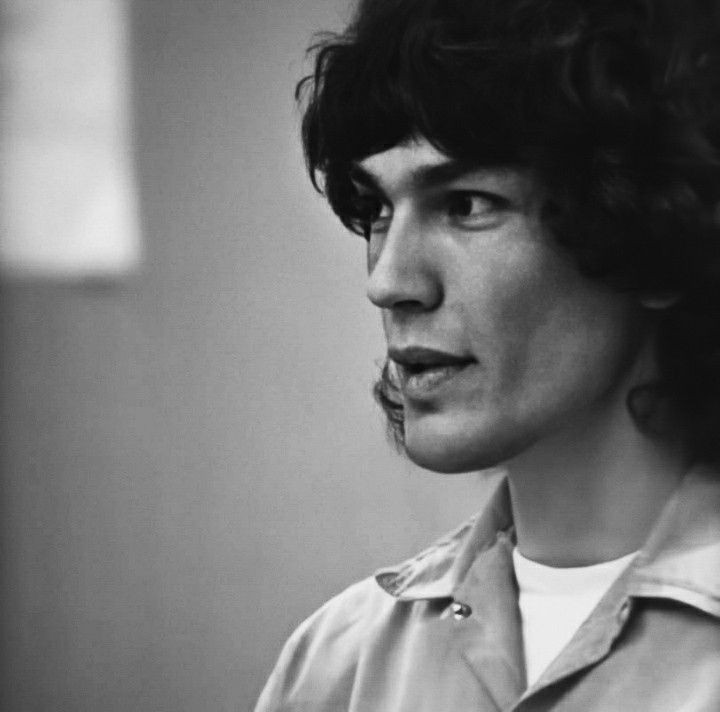
Richard Ramirez was found guilty and sentenced to death in the face of unreliable evidence, faulty ballistics testing, a debatable and unbelievable eyewitness testimony, the lies of a fence, and the word of a convicted criminal who received money for it.


 Expendable For A Cause.
Leave a reply to Vivi Cancel reply