
On the afternoon of June 28, 1984, between 1-2 p.m., Jack Vincow proceeded to his mother’s apartment in Glassell Park. He found Jennie Vincow lying on her bed with her throat slashed, covered with a blanket.
She had numerous stab wounds – one had severed her jugular vein. Jennie had aspirated blood. There were seven stab wounds in all and the coroner believed that four were lethal. It is often stated that Vincow was raped. There was no physical evidence of sexual assault. However, her girdle was pulled down and her dress partially lifted. (Richard Ramirez’s 2008 Federal Habeas Corpus, pg. 411).
The apartment had been broken into and ransacked. The window next to the front door was open, and the door was unlocked. The window screen had been placed inside the house.
Physical Evidence:
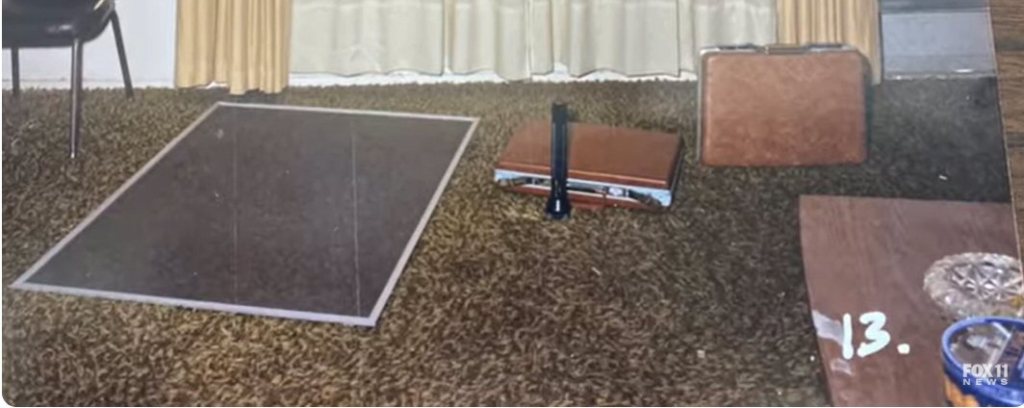
- Blood spatter in the living room, bath and bedroom and on a portable car top in the bedroom closet.
- Blood smudges in the bathroom sink and on a lamp table.
- Ransacked apartment, drawers open.
LAPD fingerprint technician Reynaldo Clara arrived at 5pm and lifted five latent fingerprints. Four were from the window screen and one was from the interior of the living room window. Two prints looked identifiable. Clara could not determine how long the prints had been on the screen.
Per the coroner’s report, it was estimated, based on liver temperature, that Vincow had been killed within 2-3 hours of when her body was discovered (at 2 p.m.). Jack Vincow told law enforcement he had last seen his mother alive the previous day between 1-2 p.m. This might suggest that Jennie was murdered in the morning and not during the previous night, making this case deviate from the Night Stalker’s modus operandi.
The Vincow murder was unlike any of the other crimes attributed to the Night Stalker. Jennie Vincow was an elderly woman that lived alone and was killed in the middle of the day. She lived in an apartment building surrounded by numerous other tenants. Despite the ransacking, nothing seemed to have been stolen from her apartment.
Jennie Vincow’s Sons:
Jennie Vincow had two sons, Manny and Jack. Jack was a pharmacist who lived above her in their apartment building. Manny, had been hospitalized multiple times for mental health disturbances and was rumored to have been both physically and emotionally abusive to his mother. He lived in a mental institution in Brooklyn, New York.
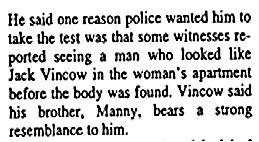
Jack Vincow testified that he initially thought his brother might have been responsible for their mother’s death. This was because Wanda Doss, the manager of the apartment block, thought she saw Jack inside Jennie’s apartment on the morning of the murder. Wanda Doss did not testify at trial. This information comes from Philip Carlo’s biography, pp. 258-259. Per Jack, his brother Manny bore a strong resemblance to him.
Jack Vincow engaged in some odd behaviors after the death of his mother. After discovering his mother had been brutally murdered in her apartment, Jack took the time to open the curtains and the windows in the living room and the kitchen before having the apartment manager call the police. (Habeas Corpus, pg. 43).
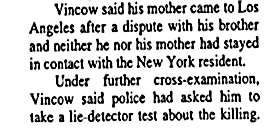
LAPD Detective Jesse Castillo thought Jack’s behavior was suspicious, prompting him to follow him in his vehicle on one occasion. He was asked to take a lie detector test, which he refused. Lie detector tests are not admissible so this is reasonable. Law enforcement tried to interview Jack several times, and he was uncooperative, leaving in the middle of one.
“He said one reason police wanted him to take the test was that some witnesses reported seeing a man who looked like Jack Vincow in the woman’s apartment before the body was found. Vincow said his brother, Manny, bears a strong resemblance to him.”
– Los Angeles Times (Southland Metro) March 4, 1986.
Fingerprint Evidence:
Ramirez’s alleged fingerprint was the only evidence that tied him to the Vincow murder. There were no links to the other Night Stalker cases apart from the home invasion aspect.
On Jennie Vincow’s window screen, four fingerprints were found. Only two had potential to be identified, according to techician Reynaldo Clara and Darnell Carter who examined them. There were other prints on the screen that were unidentifiable.
This was before AFIS (Automated Fingerprint Identification System) so they were unable to match it to a criminal record. When Richard Ramirez was captured, the Los Angeles Police Department and Los Angeles County Sheriff’s Department looked through cold cases to see if any matched the Night Stalker’s M.O. (the police simultaneously argued that he did not have an M.O.). Jennie Vincow’s murder case was raised and the LAPD gave the Vincow case to the LASD.
It was the LASD’s Deputy Sheriff Hannah Woods who examined the fingerprints, as well as Richard Ramirez’s belongings. Woods manually examined the prints and concluded that they belonged to Ramirez. Because Ramirez’s defence were incompetent and had no money, they failed to retain a fingerprint expert to examine the Vincow fingerprints and the prosecution’s evidence was left unchallenged. They lacked the funds because they were not sufficiently qualified to take the case and the judge refused to pay them.
Instead, they conceded the fingerprint evidence and argued that the jury should acquit Richard of the Vincow charge because his fingerprints were not found inside the apartment. This was an incredibly weak argument – but one the jury considered. Incredibly, juror Donald McGee actually stated that he would have voted for acquittal had Vincow been a standalone case. (Habeas Corpus document 20.8)
The Unidentifiable Prints:
During deliberations, the jury questioned the unidentifiable fingerprints and posed this question to the court:
“What is the legal definition of an unidentifiable fingerprint? Is it because there is not enough of a print to make an I.D. or because the print is not a part of the records the police have with which to make a comparison?”
– Federal Writ of Habeas Corpus, pg 414.
At this point, the defense should have explained the significance of unidentifiable fingerprints and argued that they had not come from Ramirez. If this wasn’t bad enough, the prosecution failed to preserve them.
Ramirez’s attorneys were supposed to object to the prosecution for losing evidence in their closing argument. Because they failed to do so, the prosecutor, Philip Halpin, shifted the burden of proof onto the defense. In other words, they had to prove the prints were not Ramirez’s – impossible when they no longer existed.
The California Government Refused a Review of Ramirez’s Fingerprint Evidence
In 2008, fingerprint examiner Ron Smith was retained by federal habeas attorneys to review the fingerprint evidence introduced against Richard at his Los Angeles trial; however, the state refused to release the fingerprint exhibits.
“Fingerprint examiner, Ron Smith, has been retained by federal habeas counsel to review the fingerprint evidence introduced against Petitioner at trial; however, he requires the release of the fingerprint exhibits to his care in order to do so. Petitioner has filed a request with the Superior Court to release the exhibits to Mr. Smith’s care; the government has opposed Petitioner’s request.“
– Habeas Corpus, pg. 413
What were they afraid of? What don’t they want us to know? If the state’s evidence is valid and reliable, then why do they not want anyone else to examine it? Is it because they know their evidence will not hold up to scientific scrutiny? Do they fear if a competent, independent fingerprint examiner looks at the evidence, it will quickly crumble, showing substantial reasonable doubt?
A young man’s life and liberty depended on the authenticity of this evidence. Yet, the Hernandez’s didn’t bother with contesting it, the state lost the unidentifiable prints and would not release the prints for independent analysis.
Fingerprints Case Study:
For as long as I can remember, I was taught no two fingerprints are alike, that they are distinct, like DNA. Well, that’s not quite accurate. Fingerprinting is not an exact science, and contrary to widespread belief, not every set of fingerprints is unique. The science of fingerprinting varies from one law enforcement agency to the next, and each agency determines its own protocols for examining fingerprint evidence. The science of fingerprint evidence is based on two key assumptions: That fingerprint reading is objective and that every person has completely unique fingerprints. Neither of these assumptions is 100 percent correct. To be considered scientifically valid, an instrument or testing procedure must be proven beyond a reasonable degree of scientific certainty to be accurate, valid, and replicable.
Unlike DNA testing, the fingerprint industry is not held to these standards. Since 1911, when prosecutors first introduced them as evidence, U.S. courts have consistently accepted fingerprints, and juries have considered them incontrovertible evidence. But unlike DNA evidence, fingerprinting was adopted before the United States Supreme Court decided attorneys and expert witnesses must prove that evidence is scientific and reliable. Matches become even more difficult when law enforcement finds only a partial fingerprint.While prosecutors rely heavily on fingerprint evidence in criminal cases, and juries often take fingerprint evidence as proof beyond a reasonable doubt of a defendant’s guilt, fingerprint evidence has been known to implicate the wrong person. And this is because matching fingerprints is not an exact science.
Fingerprint comparison is highly subjective, and even proficient forensic scientists can make mistakes when it comes to reading and comparing fingerprints. As such, it’s important for a jury to understand that not all fingerprint evidence is reliable, and a competent attorney should know how to cast doubt on fingerprint evidence so the jury realizes it’s not foolproof.
A prime example of fingerprint misidentification occurred after the train bombings in Madrid in 2004. Spanish authorities found fingerprints on a bag that held explosives. They sent the fingerprint evidence to international authorities for further comparison. Three FBI experts matched the prints to Brandon Mayfield, an Oregon lawyer. The FBI claimed the match was 100 percent accurate, and Mayfield was detained by federal authorities. Spanish authorities eventually found that Mayfield had not left the United States for several years and the fingerprints matched an Algerian national. So how is it that supposedly infallible fingerprint evidence can incriminate a man who hadn’t left the country in a terrorist attack halfway across the world?
Unfortunately, many people may receive wrongful convictions based on unreliable fingerprint evidence if they don’t have a defense attorney handling their case that knows how to successfully dispute fingerprint evidence.
Kaycee
Dec 22 2022
Further reading:


 Expendable For A Cause.
Leave a comment