
By Venning
Sierra Madre, Los Angeles County. 5th July 1985. 16-year-old Whitney Bennett arrived home via the back door. She made sure it was locked before changing for bed. The light was still on, and the curtains were left open when she fell asleep. Bennett’s bedroom was at the front of the house.
Sometime between 2:45 and 3:45, Bennett woke face down on her bed. The light had been turned out; the curtains were now partially pulled across. There was blood all over her sheets and pain in her head and hands. Her underwear had been removed. Bennett was able to make her way to the hallway – where her pained moans woke her father – before collapsing.
Bennett was extremely lucky to survive such a brutal attack. She required multiple operations to treat a fractured skull and eye socket, a partially detached retina and many lacerations to her head and face. She also suffered a fractured finger. She also had ligature marks on her neck and her hands were swollen, possibly from ligatures.
Evidence at the scene
- Window screen missing from the front of the house.
- Bedroom ransacked.
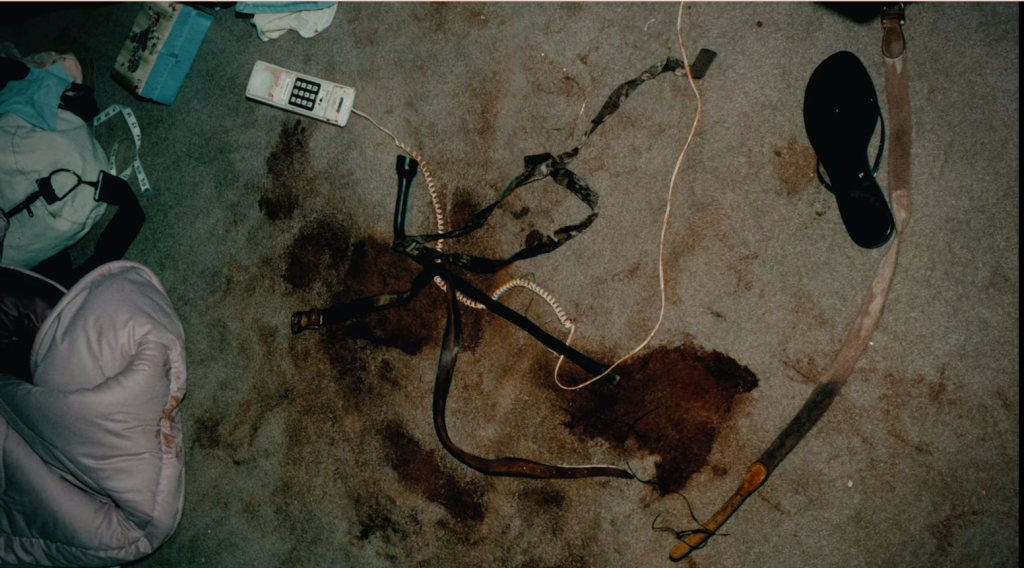
- A tyre iron on the floor, in a pool of blood.
- Blood on the curtains, carpet and bed and a sash.
- A gloved handprint on the windowsill.
- Blood on the windowsill.
- Severed telephone cord; phone placed on the windowsill.
- Two partial shoe prints on her comforter.
- A pubic hair.
- Jewellery box was moved and two rings missing.
Did Any Evidence Tie Ramirez to the Bennett Crime Scene?
The blood on the curtain sash contained antigens that were not from Whitney Bennett, nor were they from Ramirez. This blood was Type A. Ramirez was Type O – the same as Whitney Bennett. It could be that, as the attacker was slashing Bennett, the slippery blood caused the knife to slice through his gloves, cutting his fingers. This blood could have been spread to the curtain as the suspect escaped via the window.
The blood evidence does not seem to have been discussed at length at trial, and Philip Carlo’s book revealed that the defence’s ‘special master’ was unable to obtain the samples for this case from the prosecution. The 2008 Habeas Corpus petition does not mention this, but if it is true that the prosecutor withheld blood samples, this is a clear Brady violation and the defence should have filed a Brady motion – but failed to do so. Blood that did not match Richard Ramirez was found at the home of another Night Stalker victim, Mary Cannon. The samples were tested by the same criminalist, Giselle LaVigne, but no further tests seem to have been carried out to determine whether the blood at both crime scenes matched.
The pubic hair was similar to Ramirez’s but there was nothing unique about it; it was a common type and without the benefit of modern testing, is inconclusive. The prosecution argued that bloody glove prints on the windowsill matched some gloves found in Ramirez’s locker at the Greyhound Bus Depot, but fabric is incapable of yielding identifiable prints, and is not usually admissible. Ramirez’s defence failed to raise an objection due to incompetence. If Ramirez’s own gloves were used at Bennett, they would surely have been blood-stained and torn.
The blood alone could have eliminated Ramirez as the suspect and the charge might have been dropped. But because of the presence of the ubiquitous Avia shoe prints, the prosecution pressed ahead with it, despite no proof that Ramirez wore such footwear.
Those Bloody Avia Prints – Literally
There were two partial shoe prints found on Whitney Bennett’s bed: one was a herringbone pattern and the other was from an Avia sole, that aside from its missing heel, was near-perfect, with no smudging or marks of wear, such as nicks or dents.
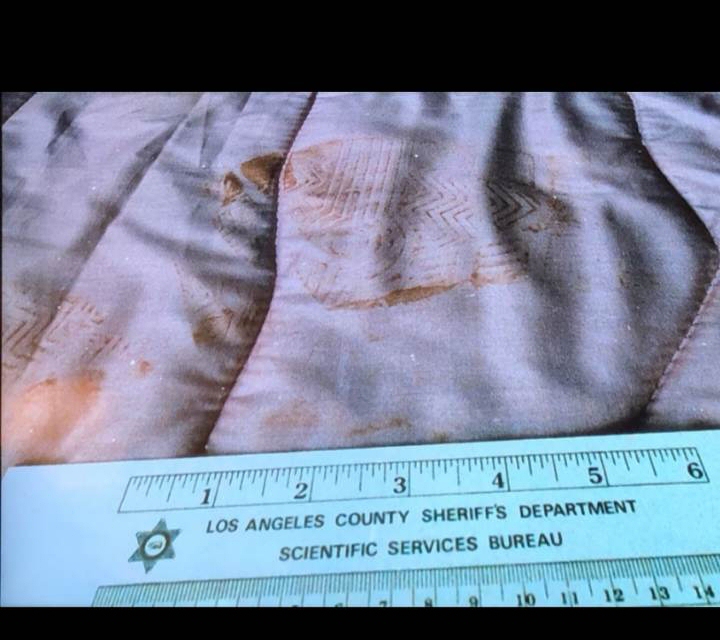
Because the herringbone pattern (chevrons or ‘zigzags’) is universal across brands, a second perpetrator in a different type of shoe cannot be ruled out. The defence failed to argue this and simply half-heartedly told the jury that Ramirez was not currently wearing Avias and had never been seen wearing them.
The prosecution argued that all shoeprints were made by a black Aerobics model 445B. The shoe forensics expert for the Habeas Corpus petition, Lisa DiMeo agreed that this print was made by an Avia but disagreed with prosecution expert witness, Gerald Burke, that it was a particular model. With Avias, the heel area must be visible to determine whether it is an Aerobics, Basketball or Coach/Referee type – and that was not present on the blanket.
This means at least thirteen different models of Avia could be in the frame. DiMeo could only conclusively eliminate Coach model 552R. While the distinctions between Avia shoe models may seem technical, they are crucial to understanding the evidentiary flaws in this case.
“Found at the scene was a partial shoeprint – ball area – in apparent blood on a fabric comforter. This was consistent with an Avia athletic right shoe that exhibited similar class characteristics to the Aerobics model. Only the Avia Referee /coach model 552R can be eliminated as the source of the print based upon the break between the dam element and flex joint. A second partial print on the comforter in apparent blood exhibited herringbone elements, but no further description could be determined.”
– Declaration of Lisa DiMeo, Document 7.19.
In her supplemental declaration, DiMeo was critical of Gerald Burke’s testing methods.
“The receiving medium is a plush fabric comforter. The comforter is a yielding surface, and caution should be used when comparing and interpreting a transferred impression. There is no evidence that Mr. Burke created test transfer impressions on a similar yielding surface before concluding that the impression was an Avia Aerobic size 11-12.
– Supplementary Declaration of Lisa DiMeo, Document 7.20.
Furthermore, DiMeo stated that Burke’s measuring techniques were not of the standard used by forensic examiners. Burke determined that the print on Whitney Bennett’s comforter was an Aerobics model in size 11½ because there were ten chevrons below the parallel lines (called a flex-join). Basketball models only had nine chevrons. However, he contradicted himself by admitting that sizes 12 and 13 also have ten chevrons – 13s have a partial eleventh chevron. This meant that a number of shoes could have caused the print pictured above.
Burke made this assessment without bothering to check sole sizes 5-9½ to see if his ‘ten chevrons on Aerobics’ models was truly correct. There are also many variations of the same sole design released in the early 1980s, but detectives insist Avias were brand new and therefore rare shoes.
“A qualified analyst would not state an absolute without collecting all the available data.”
– Supplementary Declaration of Lisa DiMeo, Document 7.19.
DiMeo’s opinion was that if a shoe’s print submitted as evidence and associated with a known shoe, jurors will be more likely to believe the analyst’s testimony that it is indeed that particular shoe. Had the jury known thousands of shoes may have created this print and they were not unique like the police claimed, the evidence might not have been so compelling.
This is why counterevidence from a professional shoe forensics expert was imperative, but Ramirez’s lawyers failed to retain experts, because they had no money. This was because they lacked the necessary qualifications to enable them to be funded by the court.
Curiously, the Avia prints were not initially discovered when the police first entered the crime scene. The blanket was bundled in the corner of the room and was later unfurled by Giselle LaVigne who called the detectives to look. This was the point when Sergeant Salerno began to believe Detective Carrillo’s serial killer theory. They are keen to emphasise that they remained outside Bennett’s bedroom when LaVigne found the Avia impression.
Why Was Ramirez Convicted of the Bennett Attack?
Another reason was that Whitney Bennett was a sympathetic survivor, who was just sixteen at the time of her attempted murder. She had been asked to testify at the trial, despite the fact she was unable to remember anything and did not see the attacker. While likely distressing for Bennett, her testimony added little evidentiary value, as she could not identify her attacker. Its inclusion may have risked inflaming juror emotion rather than aiding deliberation.
The prosecution attempted to link the Bennett Incident to Mary Cannon’s murder on the basis of its proximity, as well as Bell and Lang. All three were close to the same hills and canyons (3.5 miles by road, but just a mile as the crow flies). This is a fair argument – the modus operandi is also similar – but the forensic inconsistencies raise serious doubt that Richard Ramirez was the perpetrator in any of these cases, and the defence should have argued this.
These three attacks, and possibly the Nelson Incident – although that was much further away – might have been carried out by the same perpetrator. However, this does not mean all of the ‘Night Stalker’ attacks were connected, regardless of whether Avia prints were found – their models were inconclusive. This is why the Night Stalker cases should have been divided into categories and separate trials. However, the court denied the defence’s motion. A joinder between the crimes caused a lengthy trial, and combined with the constant false reiteration that Ramirez had owned Avias, it had a cumulative effect on the jury.
4th December 2022


 Expendable For A Cause.
Leave a reply to csmutny06cae8b36d Cancel reply