
Richard Ramirez, known as the “Night Stalker,” was convicted of multiple murders, including that of Mary Cannon on July 2, 1985, in Arcadia, Los Angeles County. However, key forensic evidence in Cannon’s case was overlooked or misrepresented – issues later raised in Ramirez’s 2008 federal habeas corpus petition. A habeas corpus petition is a legal mechanism that allows a prisoner to challenge the lawfulness of their imprisonment, especially after state appeals have been exhausted.
Mary Cannon was a two-time cancer survivor. She had been in a minor car accident the day before she was murdered. That evening, she had visited her neighbours, who had a spare key to her house. Despite staying up watching TV approximately 35 feet away from Cannon’s house, the neighbour did not hear anything strange. However, at 8:30 the next morning he noticed that the screen from her window was lying on the porch and her newspaper remained on the grass, soggy from her garden sprinkler.
Concerned, the neighbours phoned Cannon, then entered with their spare key. They were alarmed to find the lights on and the hallway in disarray, and they phoned the police. Officer Edward Winter arrived at 9:26am and found Mary Cannon dead on her bed, face down in a pool of blood. Later, Sergeant Frank Salerno of the Los Angeles County Sheriff’s Department arrived.
The autopsy revealed that Mary Cannon was killed by multiple stab wounds to the neck; one was fatal. She had also been strangled by either hands or the crook of an arm. Additionally, she suffered blunt force trauma to the face and head. The murder weapons appeared to be a ten-inch knife, her walking cane, and a glass lamp stand.
Physical Evidence:
- A paper tissue with a bloody shoeprint.
- Three more shoe prints in the carpet.
- Shattered glass from a broken lamp near her shoulder and in her hair.
- A bloody mitten.
- A snapped walking cane on the bed.
- A bloody ten-inch knife on the bed – this had come from her kitchen.
- Ransacked room, including a filing cabinet and raided jewellery box.
- Bedroom window screen missing from a smashed window.
- Human hairs – blonde/light brown.
- A rape kit was collected.
Irregularities with the Blood Evidence
Giselle LaVigne, a criminalist from the Los Angeles County Sheriff’s Department (LASD) discovered wet blood on some shattered glass in Cannon’s hair. This came from a glass lamp stand that was used as a bludgeoning instrument.
This blood was tested to determine PGM markers. Before DNA testing, forensic scientists used PGM testing to identify people based on enzymes in blood, semen, or saliva. PGM (phosphoglucomutase) subtypes vary slightly from person to person because of genetic differences. They are like unique markers in your DNA, and they can be used to tell people apart.
In a crime investigation, if blood is found at a crime scene, forensic scientists can test it to see which PGM subtypes are present. Here’s how it works:
- Scientists take a sample of the blood (or other fluid, like semen) from the crime scene.
- They use a technique called electrophoresis, where the sample is placed in a gel and an electric current is applied. Different PGM subtypes move at different speeds in the gel, creating distinct patterns (like bands) that can be seen under special conditions.
- The PGM subtype pattern in the crime scene blood is compared to the PGM subtypes in a suspect’s blood. If they match, the suspect could be the source of the blood. If they don’t match, the suspect can be ruled out.
LaVigne’s initial findings were that the blood on the shattered glass did not match Mary Cannon’s PGM subtype. But it also did not match Richard Ramirez’s subtype.
A second blood sample came from a mitten. The blood’s PGM markers were consistent with both Mary Cannon’s blood and Ramirez’s. However, LaVigne subjected it to additional electrophoretic tests which conclusively proved that the mitten blood did not come from Ramirez. It is possible that the differing blood results from the shattered glass and the mitten could mean there were two perpetrators. (Ramirez’s federal habeas corpus, pp. 138-139).
The Problems at Trial
LaVigne’s original analysis strongly suggested a third party at the crime scene. However, on the witness stand, she reversed her findings and doubted her own accuracy, claiming that the blood sample was degraded. She testified that neither Cannon nor Ramirez could be excluded from the blood samples.
But how did the sample become degraded? Was there a flaw in the way it was collected and subsequently stored? Electrophoretic testing can work on both wet and dry blood – indeed 90% of crime scene blood samples received by forensic scientists are dried or old. (Source).
Because LaVigne discredited herself, and Ramirez’s attorneys failed to bring their own forensic scientist to examine the samples, jurors were left confused over the blood samples. One juror, Martha Salcido, wrote a declaration for Ramirez’s appeals:
“I recall some confusion over something like blood stains.”
– Declaration of Martha Salcido, Document 20.8.
Ramirez’s appeal petition also states that some evidence was released to the defence but for some reason, it was not returned to the crime lab. This presumably relates to the blood samples. It is unclear whether this is the fault of the prosecution or the defence team. Ramirez’s attorneys lacked the money required for their own expert witnesses. They were relying on money from book and movie deals that never came. They asked for the court to fund them but the request was denied because they were not sufficiently qualified under California law. They had never defended a capital case and were out of their depth.
Hair Evidence
Los Angeles Sheriff’s Department criminalist, Melvin Kong, found some hairs in Mary Cannon’s home. He determined that they had not come from Ramirez because they were the wrong colour. Hair that did not match Ramirez was also found at the Bell and Lang, Nelson, Kneiding and Abowath crime scenes. In the newspaper cutting below, it is revealed that Melvin Kong testified that the hairs were blonde. Ramirez’s 2008 appeal says some hairs were medium brown. (Habeas Corpus pg. 138).
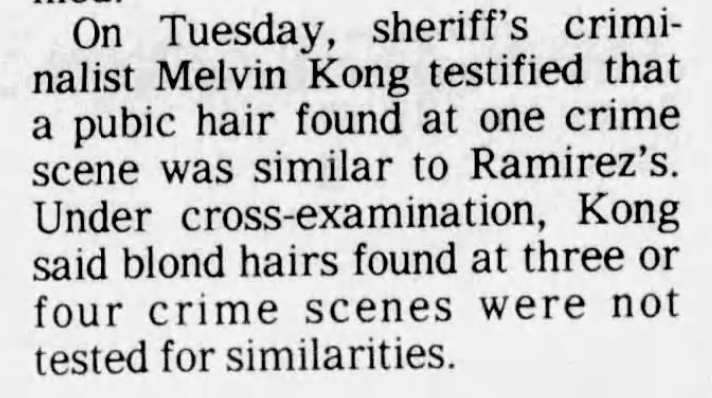
Hair testing was primitive in the 1980s and was subjective depending on the serologist’s opinion (it is now tested using mtDNA). Ramirez’s attorneys should have argued that it was not Ramirez hair but they failed to do so.
Shoeprint Evidence & Potential Perjury
One of the most compelling pieces of the prosecution’s evidence in the Night Stalker case was the Avia shoeprints found at multiple crime scenes. These were Zazzara, Doi, Bell and Lang, Cannon, Bennett, Nelson and Khovananth.
Shoe prints were found in several rooms of Mary Cannon’s house. Carpet pieces were extracted and sent to the Sheriff’s Department criminalist, Gerald Burke. Initially, Burke could not tell what type of shoe had left the prints. However, he changed his story on the witness stand.
Below is an image of is Burke’s report from Habeas Corpus supporting document 7.20. It says:
“[Shoeprint 1] was photographed … and enlarged to life scale … there is no definite pattern present to identify … as being made by a specific brand of shoe.
[Shoeprints 2 & 3] were not photographed due to lack of detail on carpet imprints.
[Shoeprint 4] … the pattern of the red stain shows certain characteristics that are present in … Avia Aerobic shoes. There is not, however, enough pattern detail to conclusively state that … was made by this type of shoe.”
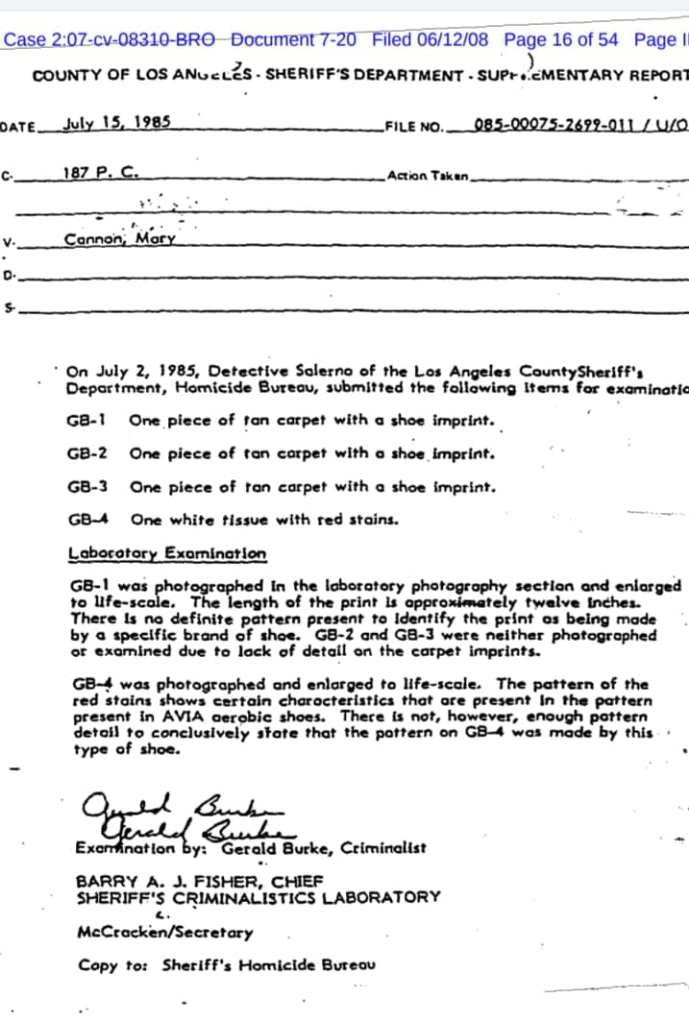
On the witness stand, however, Burke testified that he had found Avia Aerobics model prints on Mary Cannon’s carpet.
Ramirez’s attorneys did not retain a shoe forensics expert, so the prosecution’s shoe evidence – as well as Burke’s changing testimony – were left unchallenged.
In 2004, Ramirez’s appellate lawyers hired forensic expert Lisa DiMeo to reexamine the Avia shoe evidence. The following is from one of her declarations regarding the Cannon case.
“In the Cannon incident, Mr Burke testified that a partial shoe impression in the carpet was made by a right Avia Aerobic shoe. Burke admitted that by the time he got the sample, he was unable to observe any specific pattern. In a written report prepared by Mr Burke dated July 15, 1985 … he stated “There is no definite pattern present to identify the print as being made by a specific brand of shoe.” However, by the time of the trial, he had made an identification of one of the carpet impressions as a right Avia Aerobic.”
– Declaration of Lisa DiMeo, Document 7.20.
Not only did Burke lie about his findings, but DiMeo found his trial exhibit to be falsified with a printed overlay which tricked the jury into believing there was an obvious Avia shoe print.
“I personally examined the Cannon carpet sample and the court display Mr Burke used during his testimony. No impression was observed on the carpet sample; however, due to the length of time that has passed, I would not have expected an impression to remain in the carpet.
The display depicted a photograph of the impression at the scene. A transparent overlay of a right Avia Aerobic model shoe was hinge-taped over the impression. I lifted the transparency to observe the photographic enlargement beneath.
Other than an approximate length and right shoe orientation, no shoe pattern could be identified. It is only by use of the transparency taped over the photograph that there is any association between the scene impression and Avia Aerobic print.
To an untrained eye, there is an assumed correlation due to the design of the display. However, to the trained eye, this is incorrect and misleading.”– Declaration of Lisa DiMeo.

A partial bloody print of an alleged Avia was made on a small piece of tissue. It was impossible to tell which model it was because the heel is not present – the heel pattern of an Avia determines whether they come from Basketball, Aerobics or Coach/Referee models.
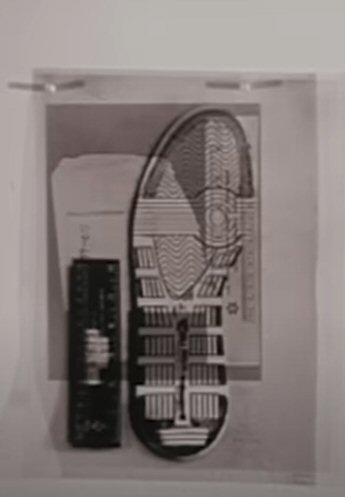
According to DiMeo, this means at least 13 types of Avia sneaker could be responsible for the partial print. It is a misconception that the Avia sole design was invented in 1985. The design had been in circulation since 1981. The prosecution’s argument that the sole was new and unique at the time of the Night Stalker murders has been conflated with the fact that the Aerobics model – the one thought to be observed at the crime scenes – was released in early 1985.
The shoeprints at the Cannon crime scene remain inconclusive and most importantly, the Avia shoes were never recovered and cannot be scientifically connected to Richard Ramirez.
Circumstantial Evidence: Stolen Property
The prosecution had more cards to play and presented evidence that Richard Ramirez had sold items stolen from Mary Cannon’s house to a fence called Felipe Solano. A friend of Cannon’s identified her jewellery at a property line-up on September 5, 1985.
On the surface, this looks compelling but is more complicated than it seems. In court, Felipe Solano’s testimony unravelled, when it was revealed he was protecting multiple criminals – one of these could have committed some of the Night Stalker crimes. There are so many questions that need answering in regard to Felipe Solano and this network of burglars.
According to Philip Carlo’s biography, a burglar associate of Ramirez, Sandra Hotchkiss, claimed that Solano was beaten up by police before being questioned about his connection to Ramirez. She tried to tell the District Attorney and claimed this beating was recorded on tape but the tape was never presented as evidence and the police denied everything.
Ultimately, the chain of custody of the stolen items was never established, none were recovered from Richard Ramirez and his fingerprints were not found on any of them. At the end of the article, there will be a link to articles explaining the network of burglars in the Night Stalker case.
Halpin Logic – Prosecution Conjecture
The defence attorneys were not the only ones at fault: some of Prosecutor Philip Halpin’s arguments were conjecture, for example urging the jury to find Ramirez guilty of the Cannon murder because the stab wounds matched those on Maxine Zazzara. Stabbings and beatings are the most common methods of murder and unless the weapon was unique, wounds look identical, making comparison meaningless. The Zazzara and Cannon crimes have nothing in common aside from alleged Avia shoeprints. At least the defence made an argument against this.
Halpin also urged conviction based on the Cannon scene’s proximity to the Bennett and Bell/Lang scenes. Was Richard Ramirez innocent of this crime? We can never truly know. However, serological test results suggest the possibility of reasonable doubt.
-VenningB-
11th Oct 2022
Further reading:


 Expendable For A Cause.
Leave a reply to The Shoe Prints: Avia, a Cinderella Story – Expendable For A Cause. Cancel reply