
*Some images are better viewed on a desktop due to size and for clarity*
“I need not look beyond this room to see all the liars, the haters, the killers, the crooks, the paranoid cowards. Truly the trematodes of the earth, each of one his own legal profession.”
Richard Ramirez, taken from transcripts during his court address prior to sentencing.
If you condemn someone to death, you’d better hope you’re in possession of all the facts. All of them, 100%, beyond any reasonable doubt. All evidence laid out, cast iron; irrefutable. You had better be sure.
But what if a jury is wilfully and deliberately misled? What if false testimony and unsound facts are presented? Expert witnesses who are not actually “experts” or fully trained in the intricacies of the subject in question? What if the defence counsel is woefully inadequate, unequal to the task, lacks experience, or sometimes not even present? Who defends the undefended?
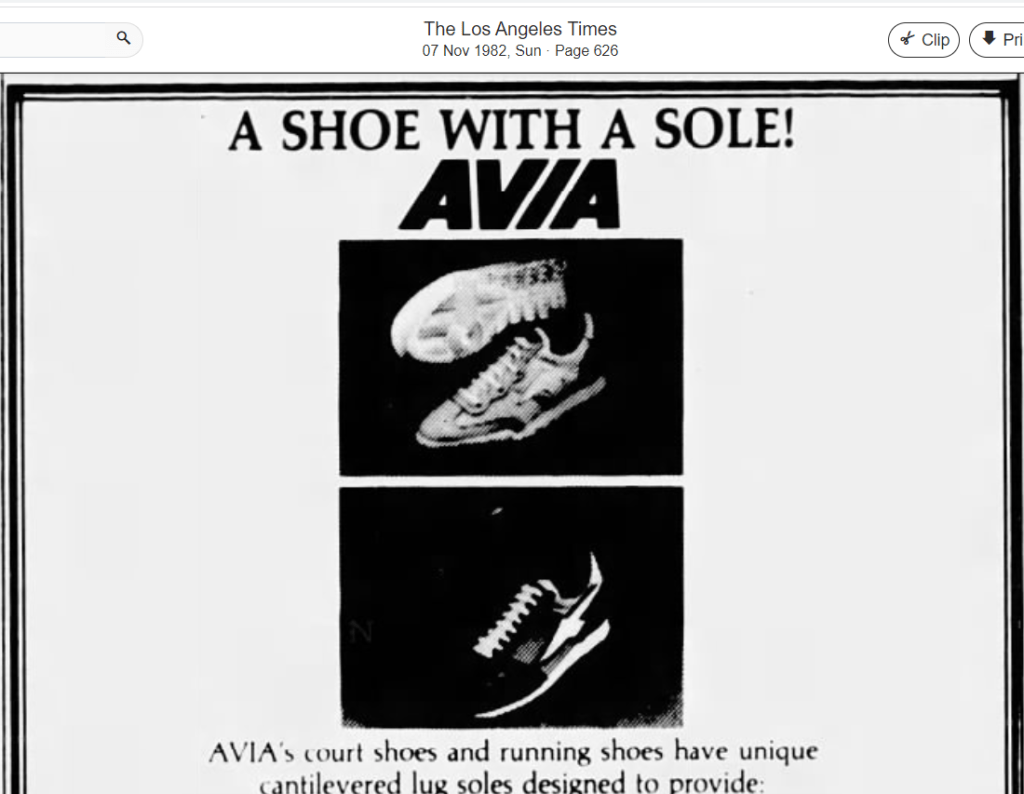
In this item, I want to discuss the most recounted pair of sneakers, the infamous black Avia Aerobic shoes, model 445b, size 11 1/2. Model 445 came in white, and white aerobic shoes didn’t fit the profile of the so-called Night Stalker. Interestingly, in the Netflix documentary Night Stalker: The Hunt for a Serial Killer, the detectives refer to the Avia model as a 440, which they inexplicably show instead. That is incorrect.
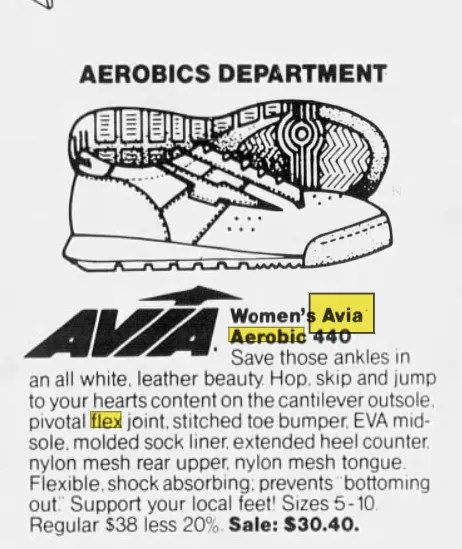
The “phantom sneakers” have followed this case all the way from 1985. Footprints, partial prints and impressions were found at eight of the crime scenes and it was these prints that law enforcement used, along with ballistics to link the crimes together. More information can be found in in this post and also in this one.
The jury and the world have been persuaded that only one pair of shoes could possibly have made those prints, one shoe, one perpetrator. This, on the contrary, is incorrect.
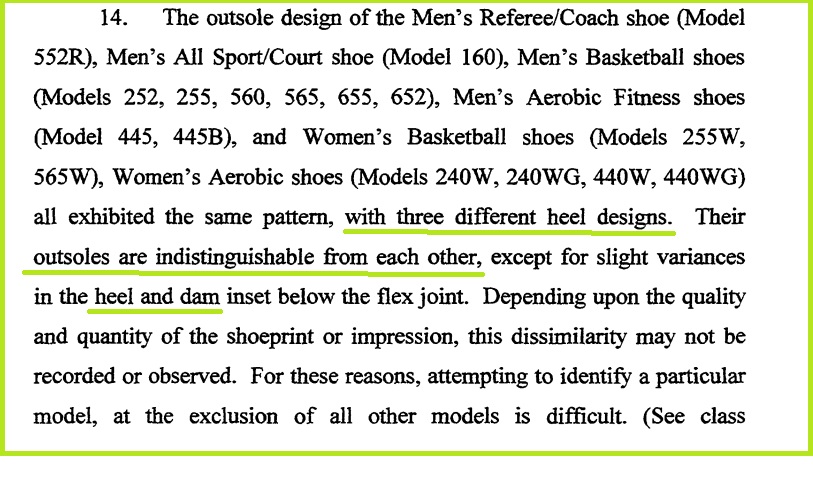
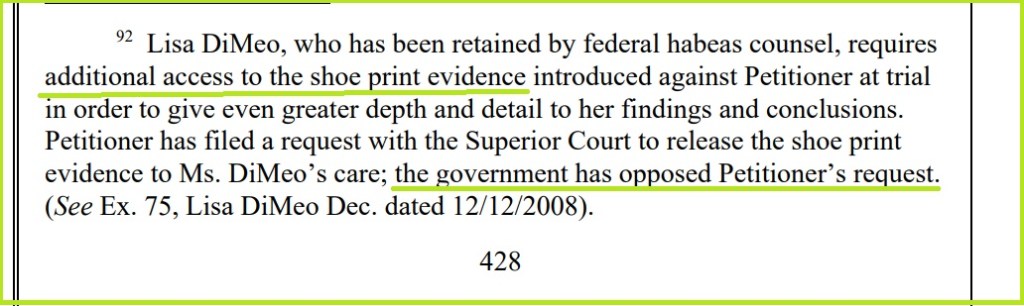
The information within this article comes from the Federal Petition of the Writ Of Habeas Corpus, filed by the Public Defenders Office in 2008, and the declaration of Forensic Specialist Lisa DiMeo (document 7-19). Both of these are available through the Plainsite.org for anyone looking.
Lisa DiMeo is a forensic specialist, trained in crime scene analysis and impression evidence, including latent prints, footwear, tire treads and bloodstain patterns. She has repeatedly provided expert testimony in both Federal and State jurisdictions.
Oh, Those Avias…
The narrative that Richard Ramirez left a trail of footprints at eight of the crime scenes has been universally accepted. It’s true that shoe prints and impressions were found, but as for the truth of it, well, that’s a little more hazy.

There is no proof whatsoever that Richard ever purchased, owned, borrowed, danced the Tango, or ever wore a pair of Avia sneakers. No evidence, and no one who knew him ever said so, apart from law enforcement and counsel for the prosecution.
We have also been led to believe that once Richard realised that they had his footprints, thanks to (the now late) Mayor, and later Senator Dianne Feinstein’s San Francisco press conference of 23rd August 1985, he, at 8pm that very night, strolled into the centre of the Golden Gate Bridge and threw those incriminating Avias into the bay and began wearing the Stadia brand instead. However, the Stadias had already appeared at the Abowath incident on 8th August, so we can discount that nugget of information, too.
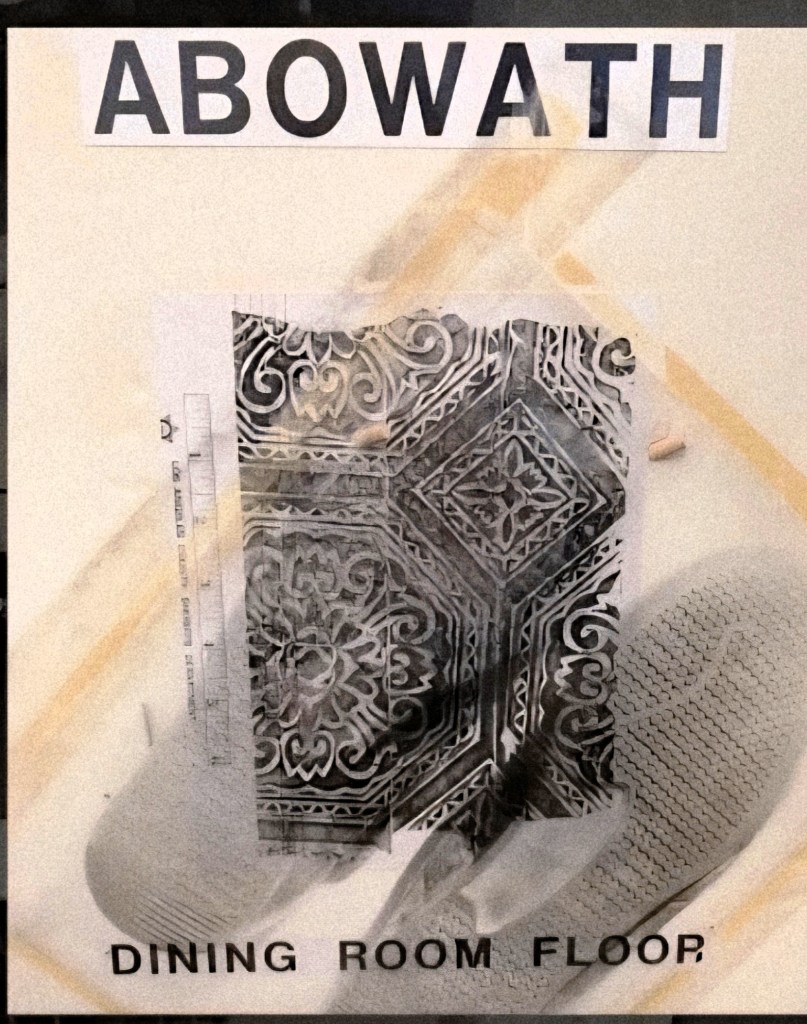
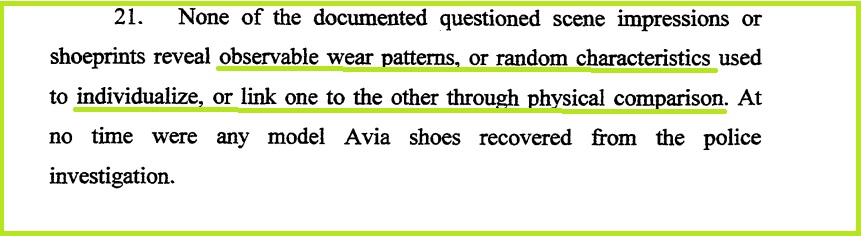
Once more, there is no proof, evidence, or witnesses that this ever happened. Indeed, Richard never said anything of the sort. It was all so convenient, perhaps to explain why they failed to discover the shoes in question. This erroneous rhetoric has been accepted as gospel, retold and recounted repeatedly, and, rather like a macabre Cinderella story; only one shoe is possible...but not the one pictured below.
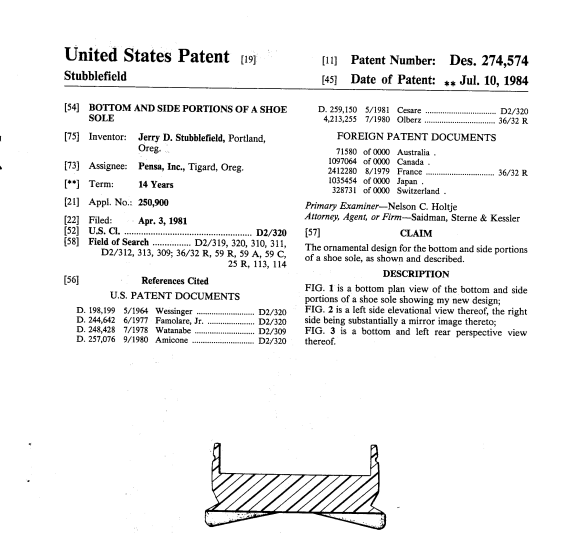
In Jerry Stubblefield’s design patent for the Aerobic sole, there were TWO heel designs in the Aerobics class.
The sole pictured here featured three graduating bars in the heel and was found in Avia models 252, 255, 225w, 552R, 560, 565w, and 565.
The heel design associated with the Night Stalker crimes had a slightly different heel design; the three bars were all of equal length; in other words, they didn’t graduate. Models with this heel included 160, 240w, 440w, 440wg, 445 and 445b. (There is no available patent picture for these models, probably because they were so similar).
Without those heel inclusions, it cannot be narrowed down, and as this sole patent was in use for the other models before 1985 (only the 445 and 445b were released that year), just how many different shoes do you imagine were already out there with that same sole pattern?

If The Shoe Fits..
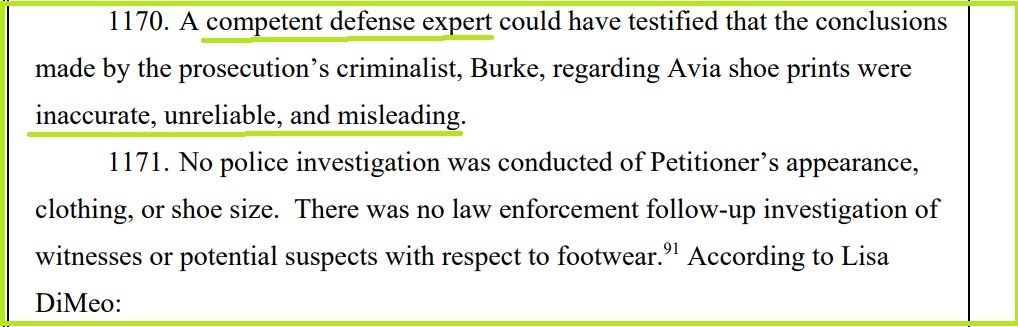
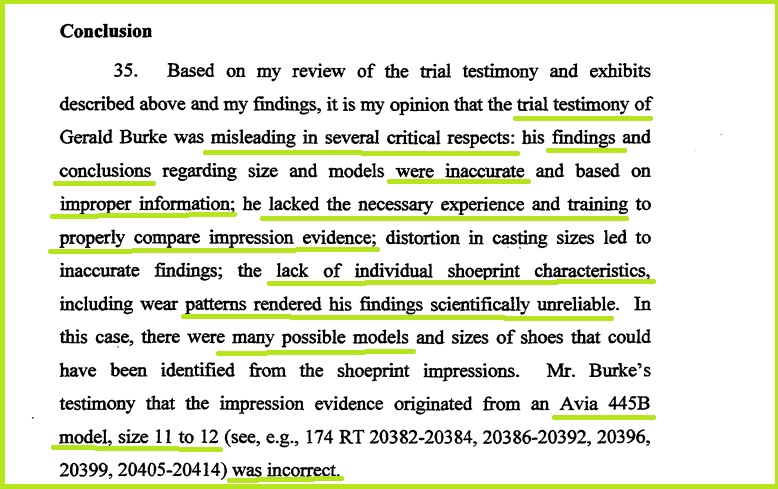
Gerald Burke, a Sheriff’s Crime Lab criminalist, examined the prints and impressions. He had no previous experience in either shoe print or impression evidence. Subsequently, he lacked the necessary training to compare evidence correctly.
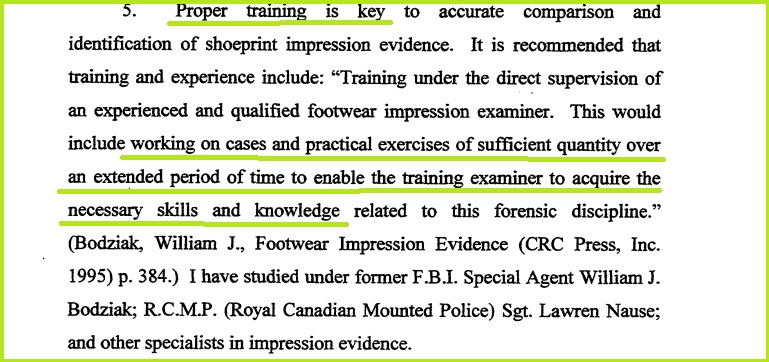
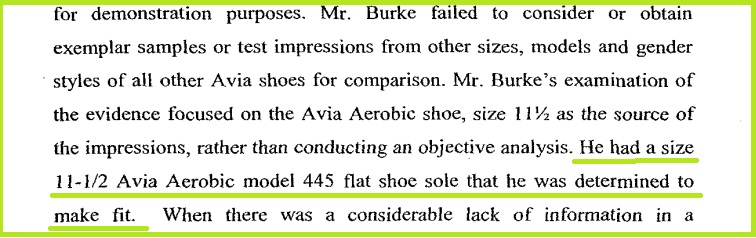
Retained as an expert witness for the prosecution, his testimony regarding shoe print evidence contributed to the misconception that only one pair of Avia shoes could have made the impressions. Burke, after comparing 97 brands, determined that the prints were made by an Avia shoe, size 11-12, and after a visit to Avia HQ, announced it was model 445b.
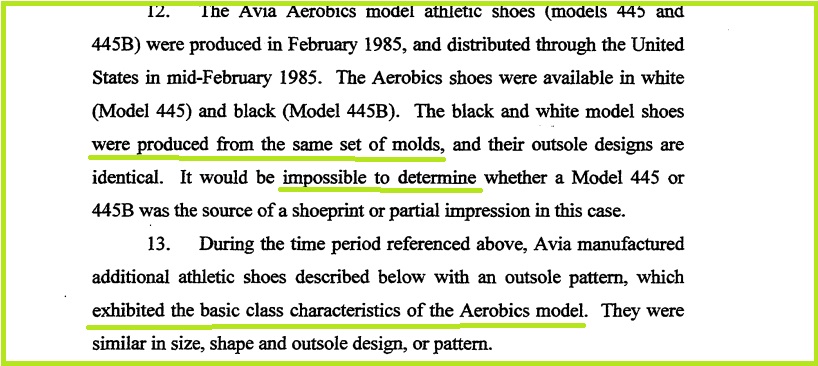
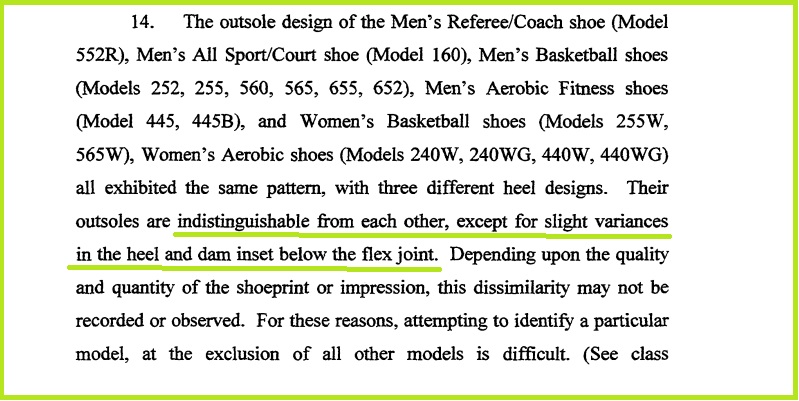
Furthermore, Avia Footwear data processing manager, Jeff Brewer, testified in court that in Southern California, from January to July 1985, twenty-four pairs of Avia shoes, model 445b, were sold. Of these, only one pair was size 11 1/2, and black. This information led the jury to believe that only one pair of shoes in Southern California could have made those impressions and prints. This was simply not true. In addition, Jerry Stubblefield, designer of the Avia aerobic shoe, misled the jury into believing that the soles of models 445 and 445b were different. Both Brewer and Stubblefield were themselves mislead by Carrillo telling them that the man he was hunting wore black sneakers, when he had no evidence of that.

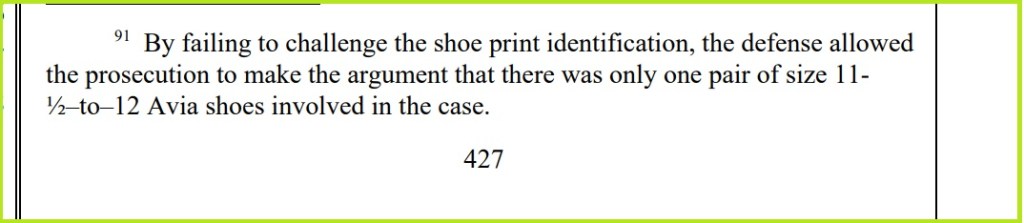
Here, as in the rest of the trial, Richard was severely let down by his defence counsel, who failed to challenge any of these points. How this trial was allowed to continue is mystifying. Everyone, no matter who they are, is entitled to a competent defence, especially during a trial where life is at stake. That is a fundamental right. The defence introduced no expert witness of their own.
The Incidents
I use the word “incident” instead of “crime”, as this is the wording used in the petition and other documents. It is not to downplay or distract from what happened in Los Angeles during 1985, nor do I wish to focus on the horror of it, as that is not the purpose of this piece. Here expert witness testimony will be applied to misconceptions and misleading information delivered during the trial.
Of the eight incidents detailed below, one is referred to as the “uncharged incident”, however it still featured as part of the trial.
Please refer to our LA CRIMES section for a full analysis of the individual incidents.
Vincent and Maxine Zazzara
“The two impressions that were cast in the Zazzara incident are sufficient to identify Avia Aerobics as the source based upon several design features, however the exact size cannot be determined. The inclusion of the various sizes increases the pool of possible sources by tens of thousands. Other shoeprint impressions, which appear to be Avia Aerobic shoes were photographed, but not cast. The partial patent print on the top of the yellow bucket depicts a herringbone pattern of unknown origin. The size or design of the shoe that made this impression is also unknown. A measuring scale placed in the photograph would have assisted in determining the size of the herringbone pattern. Any shoe exhibiting a similar herringbone pattern could have been the source of this partial print”.
Supplementary Declaration of Lisa DiMeo, document 7-20
William and Lillian Doi
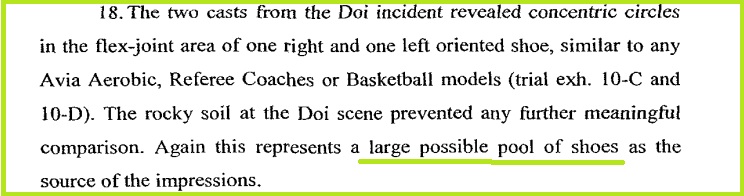
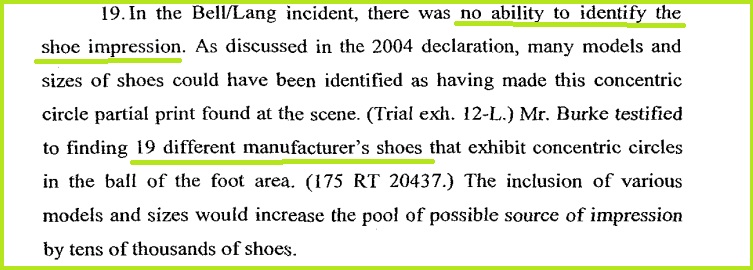
Mabel Bell and Florence Lang
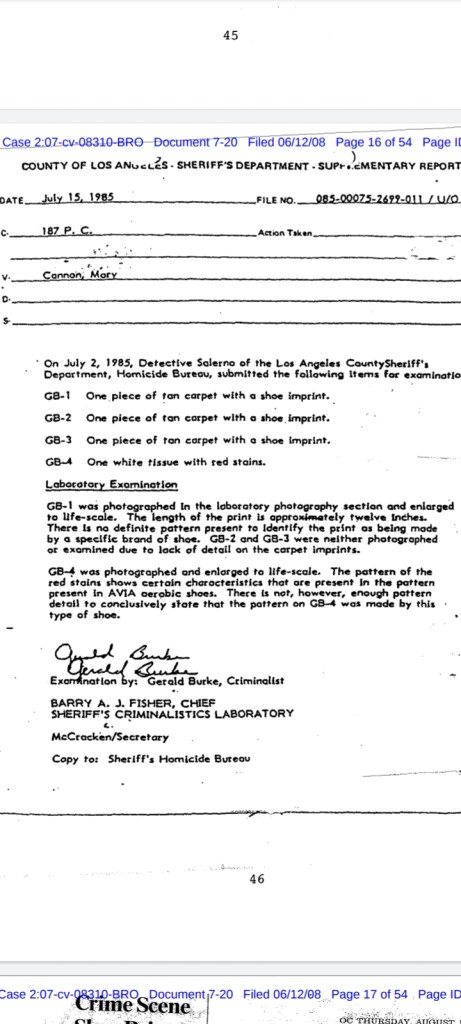
Mary Louise Cannon
“In the Cannon incident, Mr. Burke testified that a partial shoe impression in carpet was made by a right Avia Aerobic shoe. (175 RT 20406.) He did not go to the scene, but the section of carpet was brought to him at the laboratory. (175 RT 20405.) Burke admitted that by the time he got the carpet sample he was unable to observe any specific pattern. (175 RT 20407.) In a written report prepared by Mr. Burke, dated July 15, 1985, (see exh. 1, Burke’s one-page report attached to the supplemental declaration) regarding his examination of three carpet samples through GB-3), bearing impressions collected from the Cannon scene, he stated as to GB-l(tria1 exh. 19 D-I), “There is no definite pattern present to identify the print as being made by a specific brand of shoe. [Carpet samples] GB-2 and GB-3 were neither photographed nor examined due to lack of detail on the carpet imprints.” (See exh. I.) However, by the time of trial he had made an identification of one of the carpet impressions as a right Avia Aerobic shoe”. (175 RT 20407.)
Supplementary declaration of Lisa DiMeo, document 7-20
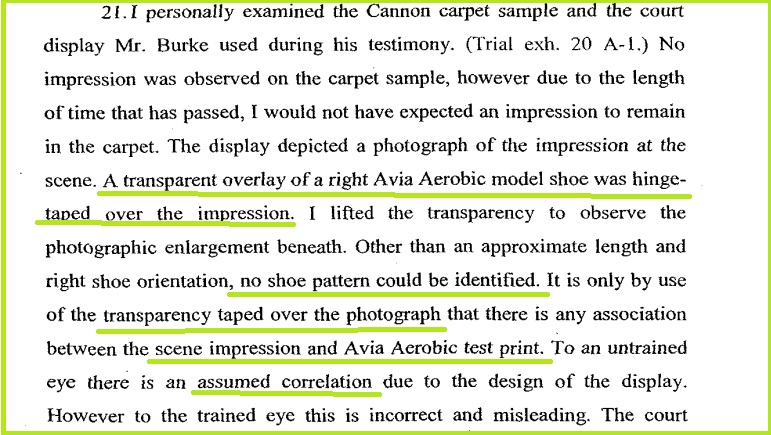
“The court display (trial exh. 20 A- I) also showed a photograph of a partial print on a white facial tissue. The print consisted of eight short parallel lines, none exceeding one inch in length, and two “V” shaped patterns. Gerald Burke testified that a left Avia Aerobic shoe was the source of the partial print on the tissue based upon his observation of the eight straight lines and chevron pattern. (175 RT 20408.) Based on my review of the evidence, the eight lines could be part of the pivotal flex-joint design, which is not exclusive to the Avia Aerobic model, and is in fact present on all men’s Coaches and Basketball models, as well as several women’s Avia shoe models”.
Lisa DiMeo, document 7-20
Whitney Bennett
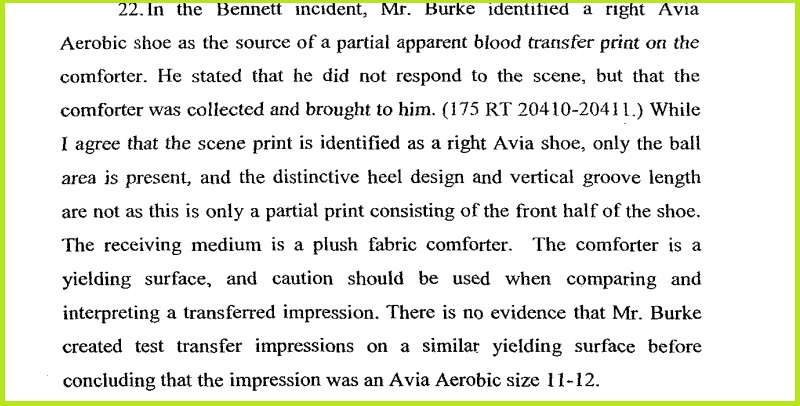
“ Mr. Burke’s explanation of how he determined the model of the shoe that left the print in the Bennett incident was based on “the lower chevron pattern, it comes up to meet the lower straight line in the ball area of the foot.” (1 75 RT 20412.) I disagree with Mr. Burke’s explanation. All men’s and women’s Avia Aerobic, Basketball and Referee Coaches shoe models share this same feature: the chevrons below the flex joint meet the lower straight line [of the flex-joint] in the ball area of the foot“.
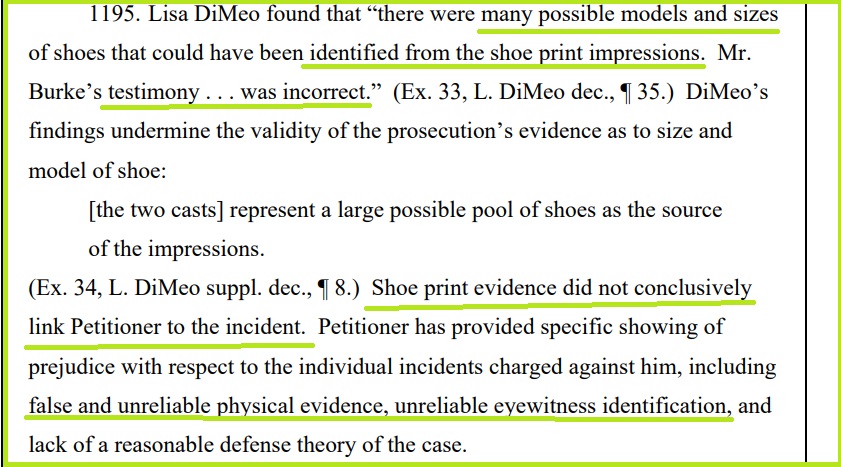
“Mr. Burke made an identification based on his assumption that only the Avia Aerobic model contains ten chevrons below the flex-joint without having examined all the other Avia model and size shoes produced. Mr. Burke should not have made an identification to the exclusion of all other possibilities without empirical observations and testing. A qualified analyst would not state an absolute without collecting all the available data. Again, Mr. Stubblefield never stated when asked about distinguishing design features that the shoe models were dependent upon a certain number of chevrons. Forensic experts frequently use qualifying terms to support an association between a questioned piece of evidence and a defendant, including coincide, consistent with, not dissimilar, could have originated from, could not be excluded as a possible source, or compatible with. The concern is with respect to an analyst’s testimony that there is an association between a questioned impression and a known shoe which will be improperly interpreted by jurors as a definite match. The inclusion of additional possible Avia shoe models would increase the pool of tens of thousands of shoes that could have left the impressions on the comforter”.
Lisa DiMeo, document 7-20
Note: There were two differing shoe prints found in the Bennet incident, more information on that can be found in this post.
Joyce Nelson

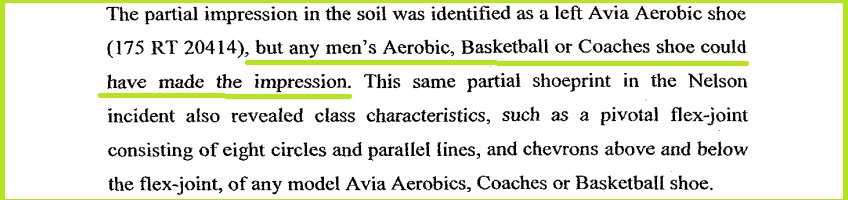
Chainarong and Somkid Khovananth
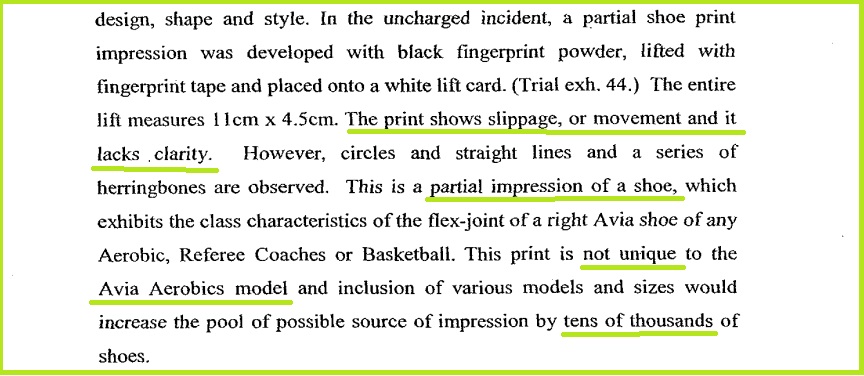
The “Uncharged” Incident – Clara Hadsall
See THIS POST for a breakdown of the Hadsall incident.
In Conclusion..
The finding of expert witness and forensic specialist Lisa DiMeo refutes the prosecution about the incidents detailed above. Her expert testimony cannot be disregarded and shows conclusively that misinformation was deliberately introduced and fed to the jury in the increasingly circus-like atmosphere both inside and outside the court. Gerald Burke had neither the experience nor training to compare footprints and impressions. The casting impressions were distorted, measurements incorrectly obtained, and the lack of individual print characteristics rendered the prosecution findings scientifically unreliable and unsafe.
Had Richard Ramirez had a competent defence counsel with an expert witness, such as Ms DiMeo, they could have challenged this flimsy evidence and presented to court evidence regarding the massive pool of possible shoes and testimony regarding shoe measurement. Competent counsel would have done so, but Arturo and Daniel Hernandez failed to provide a proper defence. By any reasonable account, it is clear that Richard was abysmally represented. Indeed, several jurors made statements indicating that a different outcome may have been possible had all the evidence and mitigating facts been presented.
But that didn’t happen.
And so..
I will go back to the beginning and ask, what if the person on the witness stand, swearing that the evidence they shall give is “the truth, the whole truth and nothing but the truth”, isn’t delivering the facts?
“The worst form of injustice is pretended justice.”
Plato
And there it is..

~ Jay ~


 Expendable For A Cause.
Leave a reply to Karen Hancock Cancel reply